E-Commerce   Knowledge Management Project Abdulaziz |  monoaziz
Prelude What is E-Commerce?  E-Commerce (Electronic commerce): Buying and selling of products or services over electronic systems such as the Internet and other computer networks.
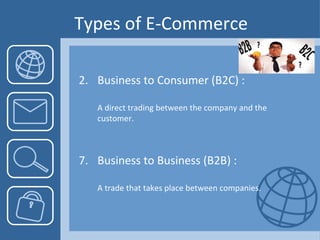
Types of E-Commerce Business to Consumer (B2C) : A direct trading between the company and the customer. Business to Business  ( B2B ) : A trade that takes place between companies.
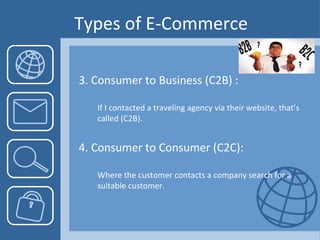
Types of E-Commerce 3. Consumer to Business (C2B) : If I contacted a traveling agency via their website, that’s called (C2B). 4. Consumer to Consumer (C2C):  Where the customer contacts a company search for a suitable customer.
Goals of E-Commerce To increase profit. Make it easier for customers to buy & sell products or services . 3.  Decreases the distance to reach customers in an easily way ( Globalization ).
Knowledge Management & E-Commerce Knowledge Management (KM) is an essential tool to deal with E- Commerce, improves it, as well as increases the productivity. Because the digital world is growing, it become important to business men to do their work with their computers in any where in the world. Any user is going to fully understand the  E-Commerce processes and techniques if he understood the KM.
Types of Knowledge 1. Explicit: - Easy to codify.  - Example:  The customer database. Transactions during the order process. 2. Tacit: - Difficult to codify. - Example:  Rules of purchasing a product or service.
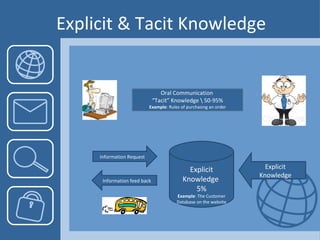
Explicit & Tacit Knowledge Oral Communication  “ Tacit” Knowledge \ 50-95% Example : Rules of purchasing an order Explicit Knowledge  5% Example : The Customer Database on the website Information Request Information feed back Explicit Knowledge
Increasing The Knowledge ! To increase the knowledge, we need: Global Literacy ( Listening Carefully). All those responsible for changing the system by editing or simple update, should listen carefully to all the suggestions and comments. Example: Listening to customers complaints, suggestions, and questions before and after purchasing a product online.
Increasing The Knowledge ! 2. Electronic Infrastructure. Means that the devices ( Hardware & Software ) are available, had a good quality, and to be maintained. Examples:  Computers, routers, and other hardware.  System and applications software. Support services, such as web site and hosting, electronic payment method, and certification services. Human capital, such as programmers & designers.
Increasing The Knowledge ! 3. Social Revitalization  ( New Life). Learning in a new and different way. The customer can now purchase in anything, in anytime &  anywhere. Instead of going out of your house, you can shop online without  leaving.  All the employees in our company whom they use E-Commerce has to be:  Job Secure ( They’re not afraid of getting fired soon). Educated, because Education is one of the essence of life. Financially Secure.
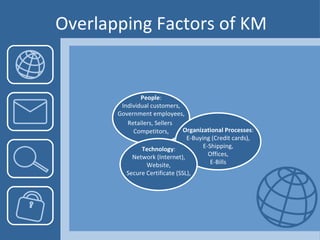
Overlapping Factors of KM People : Individual customers, Government employees, Retailers, Sellers   Competitors, Organizational Processes : E-Buying (Credit cards), E-Shipping, Offices, E-Bills Technology : Network (Internet), Website, Secure Certificate (SSL),
Technology’s Role in KM 1. Facilitates communication. Example:  By using the web to buy & sell stuff, without leaving the home. 2. Storing codified and explicated knowledge. Example:  Using MySQL to store information about products, customer,  shipping…etc.
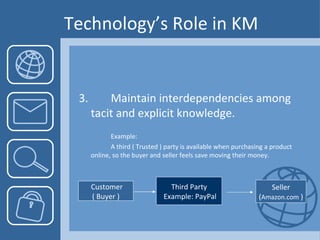
Technology’s Role in KM 3.  Maintain interdependencies among  tacit and explicit knowledge. Example:  A third ( Trusted ) party is available when purchasing a product  online, so the buyer and seller feels save moving their money.  Customer  ( Buyer ) Third Party Example: PayPal  Seller (  Amazon.com )
Leveraged Infrastructure Means improving and powering the infrastructure. Could be by:  Providing new and up to date technologies ( Designing new web-site, using new Hardware & Software… etc). Maintain the system on regular times. Keeping the risk low. Example:  Studying the visibility before starting a project.
Leveraging The Internet 1.  Cost Effectiveness. If the activity is a cost effective, It has a good value for the money paid for it. Example:  It’s NOT a cost effective to buy an expensive new computer when all you want to do is web browsing. 2. Distributed Connectivity. Our company has many branches all over the world. They’ll use the same technologies and facilities. Benefits:  Increase the outcome.  The company’s name will be well-known.
Leveraging The Internet 3. Strong Global Data Path. Our information will be available in any branch in the world. 4.  Open & Global Competitive Intelligence. Having a competitive is always welcome to rival with, gives the best of our work, and changing the prices.
Platform Independence Any user ( Buyer or Seller ) is able to  access the system in any platform. Examples: Windows, Mac, Linux, Sun. What’s required? He\She has to have: Internet  connection, Web browser,  Credit Card. What is the benefits? Higher number of customers. Allow liberty & eliminate monopolism .
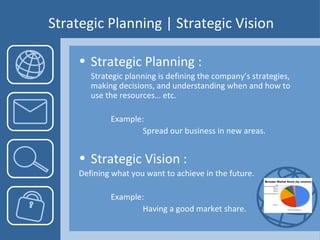
Strategic Planning | Strategic Vision Strategic Planning : Strategic planning is defining the company’s strategies, making decisions, and understanding when and how to use the resources… etc. Example:  Spread our business in new areas. Strategic Vision : Defining what you want to achieve in the future. Example: Having a good market share.
Strategic Planning | Strategic Vision What drives what ? Knowledge drives Strategy , Strategy drives KM. Knowledge    Strategy    KM Example: There is no Games Store in Al-Hassa  There should be a game store in Al-Hassa  Provide online shopping for Games in Al-Hassa
SWOT Analysis What is SWOT Analysis? It’s a method used to know your Strengths, Weaknesses,  Opportunities, and Threats. Our SWOT .. ? Strengths : We’re providing online shopping with less price  than actual shopping. Weaknesses : We’re new on the market.  Opportunities : Customers trust us. Threats : Big companies may have a conflict rivaling with us.
Porter’s Five Forces Threats of companies:   Other companies may watch our work, what are we doing and what new product are we going to display. They might give less prices than we do. 2.  Rivalry: Weather the other companies are new or old on the market, a rivalry must be there. Each company will rival with their unique advantage \ advantages.
Porter’s Five Forces 3. Bargaining power of buyers: If there’s alternative sellers, the buyer might choose what suites him. Example:  Buying new Watch. If the buyer understand the market well.  Example: A Computer Science student wants to buy  new computer. 4. Bargaining power of sellers: If the switching cost is high. If the product is so important. Example: A one in a kind medicine.
Porter’s Five Forces 5. Threats of products: If there’s an alternative products doing the same function. A company must be aware when pricing that product.
Codification | Personalization Codification:  Consistent with structured and semi-structured problems.  Example: Structured Problems:  The customer didn’t provide the necessary documents. Example: A copy of the customer’s ID card when purchasing. Semi-Structured Problems:  The system is down, and needs to be restarted or changed.  An already known virus in the system.
Codification | Personalization Personalization :  Consistent with unstructured problems.  Example: New virus in the system. A hacker is trying to access the customer’s database.
The Knowledge Organization The Knowledge of E-commerce can obtain  from customers, products, markets and financial Knowledge. E-commerce must using technology to facilitate knowledge sharing and innovation.
Why knowledge management in E-commerce? E-commerce gain benefits from the knowledge as people learn from it. By KM, E-commerce reacting instantly to new business opportunities. Ensuring successful partnering with suppliers and customers.
The Drivers Technology Drivers: Web technology must by provided  for successful E-commerce. Process Drivers: Depict easy ways to sale and  receive products to increase E- commerce. Financial Drivers:  Enough budget must be available.
Why KM is important in E-commerce ? To Maximize performance and impact companies ( E-commerce) bottom line. Generating a competitive advantage in  E-commerce.
4 Phases of the 10 Steps KM road map What we need? To gain a successful in E-commerce  we need a KM road map. Phase 1: Infrastructural  Evaluation Firstly we need to know what is already in place in  E-commerce ( e.g. components) to identify critical gaps in the existing infrastructure, so we can use new technology to eliminate gaps.
4 Phases of the 10 Steps KM road map Phase 2: Creating the KM blueprint for E-commerce company.  Blueprint provides a plan for building and improving our business in E-commerce.   Phase 3: Create a reward structure to motivate contribution that  enhance E-commerce business. Encourage use of employee support.
Why KM is important in E-commerce ? Phase 4: Accounts for both financial and competitive impact to measure returns of E-commerce. That help us to refine KM road  map.
E N D Any Questions … ?

E - C O M M E R C E

  • 1.
    E-Commerce Knowledge Management Project Abdulaziz | monoaziz
  • 2.
    Prelude What isE-Commerce? E-Commerce (Electronic commerce): Buying and selling of products or services over electronic systems such as the Internet and other computer networks.
  • 3.
    Types of E-CommerceBusiness to Consumer (B2C) : A direct trading between the company and the customer. Business to Business ( B2B ) : A trade that takes place between companies.
  • 4.
    Types of E-Commerce3. Consumer to Business (C2B) : If I contacted a traveling agency via their website, that’s called (C2B). 4. Consumer to Consumer (C2C): Where the customer contacts a company search for a suitable customer.
  • 5.
    Goals of E-CommerceTo increase profit. Make it easier for customers to buy & sell products or services . 3. Decreases the distance to reach customers in an easily way ( Globalization ).
  • 6.
    Knowledge Management &E-Commerce Knowledge Management (KM) is an essential tool to deal with E- Commerce, improves it, as well as increases the productivity. Because the digital world is growing, it become important to business men to do their work with their computers in any where in the world. Any user is going to fully understand the E-Commerce processes and techniques if he understood the KM.
  • 7.
    Types of Knowledge1. Explicit: - Easy to codify. - Example: The customer database. Transactions during the order process. 2. Tacit: - Difficult to codify. - Example: Rules of purchasing a product or service.
  • 8.
    Explicit & TacitKnowledge Oral Communication “ Tacit” Knowledge \ 50-95% Example : Rules of purchasing an order Explicit Knowledge 5% Example : The Customer Database on the website Information Request Information feed back Explicit Knowledge
  • 9.
    Increasing The Knowledge! To increase the knowledge, we need: Global Literacy ( Listening Carefully). All those responsible for changing the system by editing or simple update, should listen carefully to all the suggestions and comments. Example: Listening to customers complaints, suggestions, and questions before and after purchasing a product online.
  • 10.
    Increasing The Knowledge! 2. Electronic Infrastructure. Means that the devices ( Hardware & Software ) are available, had a good quality, and to be maintained. Examples: Computers, routers, and other hardware. System and applications software. Support services, such as web site and hosting, electronic payment method, and certification services. Human capital, such as programmers & designers.
  • 11.
    Increasing The Knowledge! 3. Social Revitalization ( New Life). Learning in a new and different way. The customer can now purchase in anything, in anytime & anywhere. Instead of going out of your house, you can shop online without leaving. All the employees in our company whom they use E-Commerce has to be: Job Secure ( They’re not afraid of getting fired soon). Educated, because Education is one of the essence of life. Financially Secure.
  • 12.
    Overlapping Factors ofKM People : Individual customers, Government employees, Retailers, Sellers Competitors, Organizational Processes : E-Buying (Credit cards), E-Shipping, Offices, E-Bills Technology : Network (Internet), Website, Secure Certificate (SSL),
  • 13.
    Technology’s Role inKM 1. Facilitates communication. Example: By using the web to buy & sell stuff, without leaving the home. 2. Storing codified and explicated knowledge. Example: Using MySQL to store information about products, customer, shipping…etc.
  • 14.
    Technology’s Role inKM 3. Maintain interdependencies among tacit and explicit knowledge. Example: A third ( Trusted ) party is available when purchasing a product online, so the buyer and seller feels save moving their money. Customer ( Buyer ) Third Party Example: PayPal Seller ( Amazon.com )
  • 15.
    Leveraged Infrastructure Meansimproving and powering the infrastructure. Could be by: Providing new and up to date technologies ( Designing new web-site, using new Hardware & Software… etc). Maintain the system on regular times. Keeping the risk low. Example: Studying the visibility before starting a project.
  • 16.
    Leveraging The Internet1. Cost Effectiveness. If the activity is a cost effective, It has a good value for the money paid for it. Example: It’s NOT a cost effective to buy an expensive new computer when all you want to do is web browsing. 2. Distributed Connectivity. Our company has many branches all over the world. They’ll use the same technologies and facilities. Benefits: Increase the outcome. The company’s name will be well-known.
  • 17.
    Leveraging The Internet3. Strong Global Data Path. Our information will be available in any branch in the world. 4. Open & Global Competitive Intelligence. Having a competitive is always welcome to rival with, gives the best of our work, and changing the prices.
  • 18.
    Platform Independence Anyuser ( Buyer or Seller ) is able to access the system in any platform. Examples: Windows, Mac, Linux, Sun. What’s required? He\She has to have: Internet connection, Web browser, Credit Card. What is the benefits? Higher number of customers. Allow liberty & eliminate monopolism .
  • 19.
    Strategic Planning |Strategic Vision Strategic Planning : Strategic planning is defining the company’s strategies, making decisions, and understanding when and how to use the resources… etc. Example: Spread our business in new areas. Strategic Vision : Defining what you want to achieve in the future. Example: Having a good market share.
  • 20.
    Strategic Planning |Strategic Vision What drives what ? Knowledge drives Strategy , Strategy drives KM. Knowledge  Strategy  KM Example: There is no Games Store in Al-Hassa There should be a game store in Al-Hassa Provide online shopping for Games in Al-Hassa
  • 21.
    SWOT Analysis Whatis SWOT Analysis? It’s a method used to know your Strengths, Weaknesses, Opportunities, and Threats. Our SWOT .. ? Strengths : We’re providing online shopping with less price than actual shopping. Weaknesses : We’re new on the market. Opportunities : Customers trust us. Threats : Big companies may have a conflict rivaling with us.
  • 22.
    Porter’s Five ForcesThreats of companies: Other companies may watch our work, what are we doing and what new product are we going to display. They might give less prices than we do. 2. Rivalry: Weather the other companies are new or old on the market, a rivalry must be there. Each company will rival with their unique advantage \ advantages.
  • 23.
    Porter’s Five Forces3. Bargaining power of buyers: If there’s alternative sellers, the buyer might choose what suites him. Example: Buying new Watch. If the buyer understand the market well. Example: A Computer Science student wants to buy new computer. 4. Bargaining power of sellers: If the switching cost is high. If the product is so important. Example: A one in a kind medicine.
  • 24.
    Porter’s Five Forces5. Threats of products: If there’s an alternative products doing the same function. A company must be aware when pricing that product.
  • 25.
    Codification | PersonalizationCodification: Consistent with structured and semi-structured problems. Example: Structured Problems: The customer didn’t provide the necessary documents. Example: A copy of the customer’s ID card when purchasing. Semi-Structured Problems: The system is down, and needs to be restarted or changed. An already known virus in the system.
  • 26.
    Codification | PersonalizationPersonalization : Consistent with unstructured problems. Example: New virus in the system. A hacker is trying to access the customer’s database.
  • 27.
    The Knowledge OrganizationThe Knowledge of E-commerce can obtain from customers, products, markets and financial Knowledge. E-commerce must using technology to facilitate knowledge sharing and innovation.
  • 28.
    Why knowledge managementin E-commerce? E-commerce gain benefits from the knowledge as people learn from it. By KM, E-commerce reacting instantly to new business opportunities. Ensuring successful partnering with suppliers and customers.
  • 29.
    The Drivers TechnologyDrivers: Web technology must by provided for successful E-commerce. Process Drivers: Depict easy ways to sale and receive products to increase E- commerce. Financial Drivers: Enough budget must be available.
  • 30.
    Why KM isimportant in E-commerce ? To Maximize performance and impact companies ( E-commerce) bottom line. Generating a competitive advantage in E-commerce.
  • 31.
    4 Phases ofthe 10 Steps KM road map What we need? To gain a successful in E-commerce we need a KM road map. Phase 1: Infrastructural Evaluation Firstly we need to know what is already in place in E-commerce ( e.g. components) to identify critical gaps in the existing infrastructure, so we can use new technology to eliminate gaps.
  • 32.
    4 Phases ofthe 10 Steps KM road map Phase 2: Creating the KM blueprint for E-commerce company. Blueprint provides a plan for building and improving our business in E-commerce. Phase 3: Create a reward structure to motivate contribution that enhance E-commerce business. Encourage use of employee support.
  • 33.
    Why KM isimportant in E-commerce ? Phase 4: Accounts for both financial and competitive impact to measure returns of E-commerce. That help us to refine KM road map.
  • 34.
    E N DAny Questions … ?