The Customer Value Proposition
Differentiation through the Eyes of Your Customer
Pamela Hudadoff
Dedicated to making expert marketing techniques more accessible
Applied Product Marketing LLC
Web: http://www.AppliedProductMarketing.com
Blog: http://MarketSense.AppliedProductMarketing.com
This eBook courtesy of AppliedProductMarketing.com Copyright © 2009 Applied Product Marketing LLC. All Rights Reserved.
A customer value proposition is a description of the
experiences a target user will realize upon purchase and use of a
product.
In my work in product marketing, I haven’t seen many marketing
organizations create or employ the customer value proposition.
Sometimes, I have seen something called a “value proposition”
used. However, those “value propositions” are usually a simple
list of benefit statements applied to a generic audience.
The customer value proposition is arguably the most important
tool in the product marketer’s toolset. It is the foundation for
understanding how the product will realistically be valued by the
target user. Unlike a benefits statement, a customer value
proposition is more balanced. It certainly includes the advantages
a target user would experience. But to these benefits it adds the
tension of disadvantages and parity experiences. The sum of all
of these experiences provides a much more accurate assessment
of the product in its marketplace.
In the absence of customer value propositions, companies are
walking blindly in the marketplace. Businesses underplay the fact
that their target users have other options. They ignore that fact
that their product has deficiencies some of which may significantly
hamper their efforts in the marketplace.
Lurking behind the lack of customer value proposition is the real
issue – most businesses lack a deep understanding of their target
user. They don’t know how that user works and behaves.
Businesses don’t perceive the challenges that user faces each day.
They haven’t learned how that target user will actually evaluate
and use their product. The result is that businesses lack the true
conviction of their product’s worth. This is seen in the way they
price their product, the way they message their product, and the
way they sell their product.
The customer value proposition is the keystone for effective
product marketing activities. It brings together customer
intelligence, competitive insight, and product valuation. It delivers
a concise, supportable statement of the product’s value. It
quantifies how that value is realized based on all of the target
user’s likely product experiences. The customer value proposition
provides a focused approach to understanding the target user in
the context of your product.
This eBook shows you how to create customer value propositions
for each of your target users. With these customer value
propositions in place, product marketers and managers will find it
much easier to direct product roadmaps, write compelling
messaging, build supportive sales tools, and excite the whole
company.
Please feel free to share this eBook with others who would benefit
from reading it by posting it on your blog, emailing it, or linking to
it.
The copyright holder is licensing this under the Creative Commons
License. Attribution 3.0.
http://creativecommons.org/licenses/by/3.0/
What is a customer value proposition?
This eBook courtesy of AppliedProductMarketing.com Copyright © 2009 Applied Product Marketing LLC. All Rights Reserved.
We live in a world of constantly changing products. New features
are added. Prices are changed. Competitive products are
enhanced. New alternatives are introduced. All of these events
affect the customer value proposition. For this reason, customer
value propositions are associated with a specific timeframe.
Customer value propositions can be created for newly available
products where none previously existed. They can be developed
as a strategic planning mechanism for products that are in the
formative stages. They can be updated for an upcoming product
release.
The timeframe in the customer value proposition identifies the
period of time in which the value proposition will be delivered.
This timeframe sets the context for the value proposition. It ties
the value experiences to a particular version of a product. It also
assumes the availability of the next best alternative for the
customer during that period.
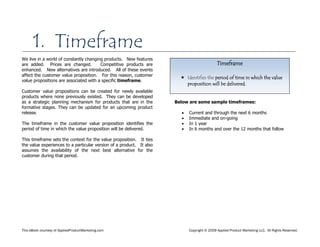
Below are some sample timeframes:
Current and through the next 6 months
Immediate and on-going
In 1 year
In 6 months and over the 12 months that follow
Timeframe
 Identifies the period of time in which the value
proposition will be delivered.
1. Timeframe
This eBook courtesy of AppliedProductMarketing.com Copyright © 2009 Applied Product Marketing LLC. All Rights Reserved.
A customer value proposition is specific to a key target user.
So, what exactly is a key target user?
First, a key target user is an intended user of the
product. These are the people for whom the product was
designed. These are the individuals who will be
experiencing the value proposition.
Second, the key target user is a predominant user for
the product. There may be other secondary and tertiary
users for the product. Those other users may be
significant enough to warrant their own customer value
proposition.
Third, the key target user does not refer to an individual.
It refers to a segment of individuals that share the
same characteristics.
Some products may have more than one key target user. In
those cases, a customer value proposition should be developed for
each key target user.
Before a customer value proposition can be created, the key
target user must be identified and profiled. Key target user
profiles help the entire organization understand who are the key
target users, where can they be found, what issues do they face,
and how would they use the product. These target user profiles
cannot be created in a vacuum. They must be determined
through interviews with and real observation of a sampling of
individuals that fit the key target user identification.
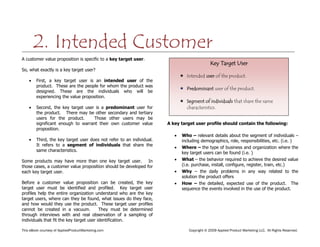
A key target user profile should contain the following:
Who – relevant details about the segment of individuals –
including demographics, role, responsibilities, etc. (i.e. )
Where – the type of business and organization where the
key target users can be found (i.e. )
What – the behavior required to achieve the desired value
(i.e. purchase, install, configure, register, train, etc.)
Why – the daily problems in any way related to the
solution the product offers
How – the detailed, expected use of the product. The
sequence the events involved in the use of the product.
2. Intended Customer
Key Target User
 Intended user of the product.
 Predominant user of the product.
 Segment of individuals that share the same
characteristics.
This eBook courtesy of AppliedProductMarketing.com Copyright © 2009 Applied Product Marketing LLC. All Rights Reserved.
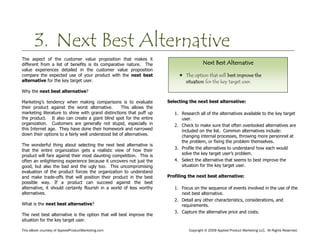
The aspect of the customer value proposition that makes it
different from a list of benefits is its comparative nature. The
value experiences detailed in the customer value proposition
compare the expected use of your product with the next best
alternative for the key target user.
Why the next best alternative?
Marketing’s tendency when making comparisons is to evaluate
their product against the worst alternative. This allows the
marketing literature to shine with grand distinctions that puff up
the product. It also can create a giant blind spot for the entire
organization. Customers are generally not stupid, especially in
this Internet age. They have done their homework and narrowed
down their options to a fairly well understood list of alternatives.
The wonderful thing about selecting the next best alternative is
that the entire organization gets a realistic view of how their
product will fare against their most daunting competition. This is
often an enlightening experience because it uncovers not just the
good, but also the bad and the ugly too. This uncompromising
evaluation of the product forces the organization to understand
and make trade-offs that will position their product in the best
possible way. If a product can succeed against the best
alternative, it should certainly flourish in a world of less worthy
alternatives.
What is the next best alternative?
The next best alternative is the option that will best improve the
situation for the key target user.
Selecting the next best alternative:
1. Research all of the alternatives available to the key target
user.
2. Check to make sure that often overlooked alternatives are
included on the list. Common alternatives include:
changing internal processes, throwing more personnel at
the problem, or fixing the problem themselves.
3. Profile the alternatives to understand how each would
solve the key target user’s problem.
4. Select the alternative that seems to best improve the
situation for the key target user.
Profiling the next best alternative:
1. Focus on the sequence of events involved in the use of the
next best alternative.
2. Detail any other characteristics, considerations, and
requirements.
3. Capture the alternative price and costs.
3. Next Best Alternative
Next Best Alternative
 The option that will best improve the
situation for the key target user.
This eBook courtesy of AppliedProductMarketing.com Copyright © 2009 Applied Product Marketing LLC. All Rights Reserved.
As I mentioned in the introduction, the customer value proposition
focuses on experiences. We first identified these experiences
when we profiled how our key target user would use the product.
That profile gave us a sequence of events that described how the
key target user uses the product. We also created a similar list of
events for the key target user’s use of the next best alternative.
In the value experiences section of the customer value
proposition, we build out the comparison between our product
and the next best alternative. We then cull the value experiences
into those that benefit the user, those that are equivalent and
those that are negative for the user.
Before we can separate these value experiences, we must expand
the information about the “how” events we’ve identified for the
key target user. We do this by adding the following details:
1. End result or consequences of the event for the key target
user.
2. Quantification of the impact of those consequences for the
key target user.
3. Differentiation of the value for our product and the next
best alternative.
For some of our product’s events, there may not be a comparable
event for the next best alternative (and vice versa). When this
occurs, we simply add our value experience to the appropriate
experience list based on the end result’s value (positive, neutral,
negative).
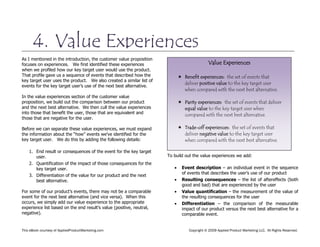
To build out the value experiences we add:
Event description – an individual event in the sequence
of events that describes the user’s use of our product
Resulting consequences – the list of aftereffects (both
good and bad) that are experienced by the user
Value quantification – the measurement of the value of
the resulting consequences for the user
Differentiation – the comparison of the measurable
impact of our product versus the next best alternative for a
comparable event.
4. Value Experiences
Value Experiences
 Benefit experiences: the set of events that
deliver positive value to the key target user
when compared with the next best alternative.
 Parity experiences: the set of events that deliver
equal value to the key target user when
compared with the next best alternative.
 Trade-off experiences: the set of events that
deliver negative value to the key target user
when compared with the next best alternative.
This eBook courtesy of AppliedProductMarketing.com Copyright © 2009 Applied Product Marketing LLC. All Rights Reserved.
One of the most difficult parts about detailing the user value
experiences is measuring the impact of the resulting
consequences. This is hard enough to do for your own product. It
can be close to impossible to do with the next best alternative.
Yet, without these quantifications, the value proposition lacks
persuasiveness and it likely to be quickly dismissed. Without
these measurements, it is much more difficult to truly differentiate
the benefit experiences from the parity and trade-off experiences.
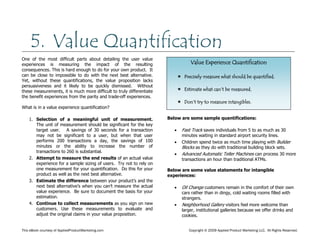
What is in a value experience quantification?
1. Selection of a meaningful unit of measurement.
The unit of measurement should be significant for the key
target user. A savings of 30 seconds for a transaction
may not be significant to a user, but when that user
performs 200 transactions a day, the savings of 100
minutes or the ability to increase the number of
transactions to 260 is substantial.
2. Attempt to measure the end results of an actual value
experience for a sample sizing of users. Try not to rely on
one measurement for your quantification. Do this for your
product as well as the next best alternative.
3. Estimate the difference between your product’s and the
next best alternative’s when you can’t measure the actual
value experience. Be sure to document the basis for your
estimation.
4. Continue to collect measurements as you sign on new
customers. Use these measurements to evaluate and
adjust the original claims in your value proposition.
Below are some sample quantifications:
Fast Track saves individuals from 5 to as much as 30
minutes waiting in standard airport security lines.
Children spend twice as much time playing with Builder
Blocks as they do with traditional building block sets.
Advanced Automatic Teller Machines can process 30 more
transactions an hour than traditional ATMs.
Below are some value statements for intangible
experiences:
Oil Change customers remain in the comfort of their own
cars rather than in dingy, cold waiting rooms filled with
strangers.
Neighborhood Gallery visitors feel more welcome than
larger, institutional galleries because we offer drinks and
cookies.
5. Value Quantification
Value Experience Quantification
 Precisely measure what should be quantified.
 Estimate what can’t be measured.
 Don’t try to measure intangibles.
This eBook courtesy of AppliedProductMarketing.com Copyright © 2009 Applied Product Marketing LLC. All Rights Reserved.
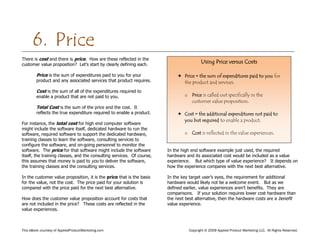
There is cost and there is price. How are these reflected in the
customer value proposition? Let’s start by clearly defining each.
Price is the sum of expenditures paid to you for your
product and any associated services that product requires.
Cost is the sum of all of the expenditures required to
enable a product that are not paid to you.
Total Cost is the sum of the price and the cost. It
reflects the true expenditure required to enable a product.
For instance, the total cost for high end computer software
might include the software itself, dedicated hardware to run the
software, required software to support the dedicated hardware,
training classes to learn the software, consulting services to
configure the software, and on-going personnel to monitor the
software. The price for that software might include the software
itself, the training classes, and the consulting services. Of course,
this assumes that money is paid to you to deliver the software,
the training classes and the consulting services.
In the customer value proposition, it is the price that is the basis
for the value, not the cost. The price paid for your solution is
compared with the price paid for the next best alternative.
How does the customer value proposition account for costs that
are not included in the price? These costs are reflected in the
value experiences.
In the high end software example just used, the required
hardware and its associated cost would be included as a value
experience. But which type of value experience? It depends on
how the experience compares with the next best alternative.
In the key target user’s eyes, the requirement for additional
hardware would likely not be a welcome event. But as we
defined earlier, value experiences aren’t benefits. They are
comparisons. If your solution requires lower cost hardware than
the next best alternative, then the hardware costs are a benefit
value experience.
6. Price
Using Price versus Costs
 Price = the sum of expenditures paid to you for
the product and services.
o Price is called out specifically in the
customer value proposition.
 Cost = the additional expenditures not paid to
you but required to enable a product.
o Cost is reflected in the value experiences.
This eBook courtesy of AppliedProductMarketing.com Copyright © 2009 Applied Product Marketing LLC. All Rights Reserved.
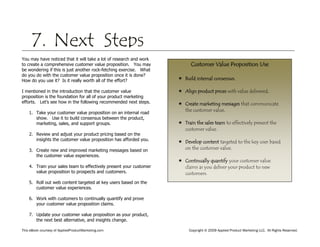
You may have noticed that it will take a lot of research and work
to create a comprehensive customer value proposition. You may
be wondering if this is just another rock-fetching exercise. What
do you do with the customer value proposition once it is done?
How do you use it? Is it really worth all of the effort?
I mentioned in the introduction that the customer value
proposition is the foundation for all of your product marketing
efforts. Let’s see how in the following recommended next steps.
1. Take your customer value proposition on an internal road
show. Use it to build consensus between the product,
marketing, sales, and support groups.
2. Review and adjust your product pricing based on the
insights the customer value proposition has afforded you.
3. Create new and improved marketing messages based on
the customer value experiences.
4. Train your sales team to effectively present your customer
value proposition to prospects and customers.
5. Roll out web content targeted at key users based on the
customer value experiences.
6. Work with customers to continually quantify and prove
your customer value proposition claims.
7. Update your customer value proposition as your product,
the next best alternative, and insights change.
7. Next Steps
Customer Value Proposition Use
 Build internal consensus.
 Align product prices with value delivered.
 Create marketing messages that communicate
the customer value.
 Train the sales team to effectively present the
customer value.
 Develop content targeted to the key user based
on the customer value.
 Continually quantify your customer value
claims as you deliver your product to new
customers.
This eBook courtesy of AppliedProductMarketing.com Copyright © 2009 Applied Product Marketing LLC. All Rights Reserved.
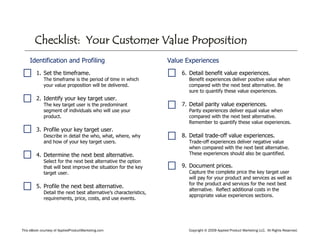
Identification and Profiling
1. Set the timeframe.
The timeframe is the period of time in which
your value proposition will be delivered.
2. Identify your key target user.
The key target user is the predominant
segment of individuals who will use your
product.
3. Profile your key target user.
Describe in detail the who, what, where, why
and how of your key target users.
4. Determine the next best alternative.
Select for the next best alternative the option
that will best improve the situation for the key
target user.
5. Profile the next best alternative.
Detail the next best alternative’s characteristics,
requirements, price, costs, and use events.
Value Experiences
6. Detail benefit value experiences.
Benefit experiences deliver positive value when
compared with the next best alternative. Be
sure to quantify these value experiences.
7. Detail parity value experiences.
Parity experiences deliver equal value when
compared with the next best alternative.
Remember to quantify these value experiences.
8. Detail trade-off value experiences.
Trade-off experiences deliver negative value
when compared with the next best alternative.
These experiences should also be quantified.
9. Document prices.
Capture the complete price the key target user
will pay for your product and services as well as
for the product and services for the next best
alternative. Reflect additional costs in the
appropriate value experiences sections.
Checklist: Your Customer Value Proposition
This eBook courtesy of AppliedProductMarketing.com Copyright © 2009 Applied Product Marketing LLC. All Rights Reserved.
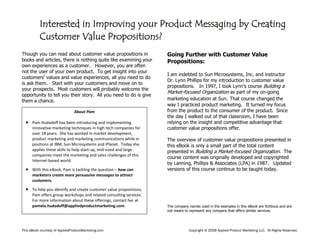
Though you can read about customer value propositions in
books and articles, there is nothing quite like examining your
own experiences as a customer. However, you are often
not the user of your own product. To get insight into your
customers’ values and value experiences, all you need to do
is ask them. Start with your customers and move on to
your prospects. Most customers will probably welcome the
opportunity to tell you their story. All you need to do is give
them a chance.
Going Further with Customer Value
Propositions:
I am indebted to Sun Microsystems, Inc. and instructor
Dr. Lynn Phillips for my introduction to customer value
propositions. In 1997, I took Lynn’s course Building a
Market-focused Organization as part of my on-going
marketing education at Sun. That course changed the
way I practiced product marketing. It turned my focus
from the product to the consumer of the product. Since
the day I walked out of that classroom, I have been
relying on the insight and competitive advantage that
customer value propositions offer.
The overview of customer value propositions presented in
this eBook is only a small part of the total content
presented in Building a Market-focused Organization. The
course content was originally developed and copyrighted
by Lanning, Phillips & Associates (LPA) in 1987. Updated
versions of this course continue to be taught today.
The company names used in the examples in this eBook are fictitious and are
not meant to represent any company that offers similar services.
About Pam
 Pam Hudadoff has been introducing and implementing
innovative marketing techniques in high tech companies for
over 18 years. She has worked in market development,
product marketing and marketing communications while in
positions at IBM, Sun Microsystems and iPlanet. Today she
applies these skills to help start-up, mid-sized and large
companies meet the marketing and sales challenges of this
Internet-based world.
 With this eBook, Pam is tackling the question – how can
marketers create more persuasive messages to attract
customers.
 To help you identify and create customer value propositions,
Pam offers group workshops and related consulting services.
For more information about these offerings, contact her at
pamela.hudadoff@appliedproductmarketing.com.
Interested in Improving your Product Messaging by Creating
Customer Value Propositions?

Customer Value Proposition

  • 1.
    The Customer ValueProposition Differentiation through the Eyes of Your Customer Pamela Hudadoff Dedicated to making expert marketing techniques more accessible Applied Product Marketing LLC Web: http://www.AppliedProductMarketing.com Blog: http://MarketSense.AppliedProductMarketing.com
  • 2.
    This eBook courtesyof AppliedProductMarketing.com Copyright © 2009 Applied Product Marketing LLC. All Rights Reserved. A customer value proposition is a description of the experiences a target user will realize upon purchase and use of a product. In my work in product marketing, I haven’t seen many marketing organizations create or employ the customer value proposition. Sometimes, I have seen something called a “value proposition” used. However, those “value propositions” are usually a simple list of benefit statements applied to a generic audience. The customer value proposition is arguably the most important tool in the product marketer’s toolset. It is the foundation for understanding how the product will realistically be valued by the target user. Unlike a benefits statement, a customer value proposition is more balanced. It certainly includes the advantages a target user would experience. But to these benefits it adds the tension of disadvantages and parity experiences. The sum of all of these experiences provides a much more accurate assessment of the product in its marketplace. In the absence of customer value propositions, companies are walking blindly in the marketplace. Businesses underplay the fact that their target users have other options. They ignore that fact that their product has deficiencies some of which may significantly hamper their efforts in the marketplace. Lurking behind the lack of customer value proposition is the real issue – most businesses lack a deep understanding of their target user. They don’t know how that user works and behaves. Businesses don’t perceive the challenges that user faces each day. They haven’t learned how that target user will actually evaluate and use their product. The result is that businesses lack the true conviction of their product’s worth. This is seen in the way they price their product, the way they message their product, and the way they sell their product. The customer value proposition is the keystone for effective product marketing activities. It brings together customer intelligence, competitive insight, and product valuation. It delivers a concise, supportable statement of the product’s value. It quantifies how that value is realized based on all of the target user’s likely product experiences. The customer value proposition provides a focused approach to understanding the target user in the context of your product. This eBook shows you how to create customer value propositions for each of your target users. With these customer value propositions in place, product marketers and managers will find it much easier to direct product roadmaps, write compelling messaging, build supportive sales tools, and excite the whole company. Please feel free to share this eBook with others who would benefit from reading it by posting it on your blog, emailing it, or linking to it. The copyright holder is licensing this under the Creative Commons License. Attribution 3.0. http://creativecommons.org/licenses/by/3.0/ What is a customer value proposition?
  • 3.
    This eBook courtesyof AppliedProductMarketing.com Copyright © 2009 Applied Product Marketing LLC. All Rights Reserved. We live in a world of constantly changing products. New features are added. Prices are changed. Competitive products are enhanced. New alternatives are introduced. All of these events affect the customer value proposition. For this reason, customer value propositions are associated with a specific timeframe. Customer value propositions can be created for newly available products where none previously existed. They can be developed as a strategic planning mechanism for products that are in the formative stages. They can be updated for an upcoming product release. The timeframe in the customer value proposition identifies the period of time in which the value proposition will be delivered. This timeframe sets the context for the value proposition. It ties the value experiences to a particular version of a product. It also assumes the availability of the next best alternative for the customer during that period. Below are some sample timeframes: Current and through the next 6 months Immediate and on-going In 1 year In 6 months and over the 12 months that follow Timeframe  Identifies the period of time in which the value proposition will be delivered. 1. Timeframe
  • 4.
    This eBook courtesyof AppliedProductMarketing.com Copyright © 2009 Applied Product Marketing LLC. All Rights Reserved. A customer value proposition is specific to a key target user. So, what exactly is a key target user? First, a key target user is an intended user of the product. These are the people for whom the product was designed. These are the individuals who will be experiencing the value proposition. Second, the key target user is a predominant user for the product. There may be other secondary and tertiary users for the product. Those other users may be significant enough to warrant their own customer value proposition. Third, the key target user does not refer to an individual. It refers to a segment of individuals that share the same characteristics. Some products may have more than one key target user. In those cases, a customer value proposition should be developed for each key target user. Before a customer value proposition can be created, the key target user must be identified and profiled. Key target user profiles help the entire organization understand who are the key target users, where can they be found, what issues do they face, and how would they use the product. These target user profiles cannot be created in a vacuum. They must be determined through interviews with and real observation of a sampling of individuals that fit the key target user identification. A key target user profile should contain the following: Who – relevant details about the segment of individuals – including demographics, role, responsibilities, etc. (i.e. ) Where – the type of business and organization where the key target users can be found (i.e. ) What – the behavior required to achieve the desired value (i.e. purchase, install, configure, register, train, etc.) Why – the daily problems in any way related to the solution the product offers How – the detailed, expected use of the product. The sequence the events involved in the use of the product. 2. Intended Customer Key Target User  Intended user of the product.  Predominant user of the product.  Segment of individuals that share the same characteristics.
  • 5.
    This eBook courtesyof AppliedProductMarketing.com Copyright © 2009 Applied Product Marketing LLC. All Rights Reserved. The aspect of the customer value proposition that makes it different from a list of benefits is its comparative nature. The value experiences detailed in the customer value proposition compare the expected use of your product with the next best alternative for the key target user. Why the next best alternative? Marketing’s tendency when making comparisons is to evaluate their product against the worst alternative. This allows the marketing literature to shine with grand distinctions that puff up the product. It also can create a giant blind spot for the entire organization. Customers are generally not stupid, especially in this Internet age. They have done their homework and narrowed down their options to a fairly well understood list of alternatives. The wonderful thing about selecting the next best alternative is that the entire organization gets a realistic view of how their product will fare against their most daunting competition. This is often an enlightening experience because it uncovers not just the good, but also the bad and the ugly too. This uncompromising evaluation of the product forces the organization to understand and make trade-offs that will position their product in the best possible way. If a product can succeed against the best alternative, it should certainly flourish in a world of less worthy alternatives. What is the next best alternative? The next best alternative is the option that will best improve the situation for the key target user. Selecting the next best alternative: 1. Research all of the alternatives available to the key target user. 2. Check to make sure that often overlooked alternatives are included on the list. Common alternatives include: changing internal processes, throwing more personnel at the problem, or fixing the problem themselves. 3. Profile the alternatives to understand how each would solve the key target user’s problem. 4. Select the alternative that seems to best improve the situation for the key target user. Profiling the next best alternative: 1. Focus on the sequence of events involved in the use of the next best alternative. 2. Detail any other characteristics, considerations, and requirements. 3. Capture the alternative price and costs. 3. Next Best Alternative Next Best Alternative  The option that will best improve the situation for the key target user.
  • 6.
    This eBook courtesyof AppliedProductMarketing.com Copyright © 2009 Applied Product Marketing LLC. All Rights Reserved. As I mentioned in the introduction, the customer value proposition focuses on experiences. We first identified these experiences when we profiled how our key target user would use the product. That profile gave us a sequence of events that described how the key target user uses the product. We also created a similar list of events for the key target user’s use of the next best alternative. In the value experiences section of the customer value proposition, we build out the comparison between our product and the next best alternative. We then cull the value experiences into those that benefit the user, those that are equivalent and those that are negative for the user. Before we can separate these value experiences, we must expand the information about the “how” events we’ve identified for the key target user. We do this by adding the following details: 1. End result or consequences of the event for the key target user. 2. Quantification of the impact of those consequences for the key target user. 3. Differentiation of the value for our product and the next best alternative. For some of our product’s events, there may not be a comparable event for the next best alternative (and vice versa). When this occurs, we simply add our value experience to the appropriate experience list based on the end result’s value (positive, neutral, negative). To build out the value experiences we add: Event description – an individual event in the sequence of events that describes the user’s use of our product Resulting consequences – the list of aftereffects (both good and bad) that are experienced by the user Value quantification – the measurement of the value of the resulting consequences for the user Differentiation – the comparison of the measurable impact of our product versus the next best alternative for a comparable event. 4. Value Experiences Value Experiences  Benefit experiences: the set of events that deliver positive value to the key target user when compared with the next best alternative.  Parity experiences: the set of events that deliver equal value to the key target user when compared with the next best alternative.  Trade-off experiences: the set of events that deliver negative value to the key target user when compared with the next best alternative.
  • 7.
    This eBook courtesyof AppliedProductMarketing.com Copyright © 2009 Applied Product Marketing LLC. All Rights Reserved. One of the most difficult parts about detailing the user value experiences is measuring the impact of the resulting consequences. This is hard enough to do for your own product. It can be close to impossible to do with the next best alternative. Yet, without these quantifications, the value proposition lacks persuasiveness and it likely to be quickly dismissed. Without these measurements, it is much more difficult to truly differentiate the benefit experiences from the parity and trade-off experiences. What is in a value experience quantification? 1. Selection of a meaningful unit of measurement. The unit of measurement should be significant for the key target user. A savings of 30 seconds for a transaction may not be significant to a user, but when that user performs 200 transactions a day, the savings of 100 minutes or the ability to increase the number of transactions to 260 is substantial. 2. Attempt to measure the end results of an actual value experience for a sample sizing of users. Try not to rely on one measurement for your quantification. Do this for your product as well as the next best alternative. 3. Estimate the difference between your product’s and the next best alternative’s when you can’t measure the actual value experience. Be sure to document the basis for your estimation. 4. Continue to collect measurements as you sign on new customers. Use these measurements to evaluate and adjust the original claims in your value proposition. Below are some sample quantifications: Fast Track saves individuals from 5 to as much as 30 minutes waiting in standard airport security lines. Children spend twice as much time playing with Builder Blocks as they do with traditional building block sets. Advanced Automatic Teller Machines can process 30 more transactions an hour than traditional ATMs. Below are some value statements for intangible experiences: Oil Change customers remain in the comfort of their own cars rather than in dingy, cold waiting rooms filled with strangers. Neighborhood Gallery visitors feel more welcome than larger, institutional galleries because we offer drinks and cookies. 5. Value Quantification Value Experience Quantification  Precisely measure what should be quantified.  Estimate what can’t be measured.  Don’t try to measure intangibles.
  • 8.
    This eBook courtesyof AppliedProductMarketing.com Copyright © 2009 Applied Product Marketing LLC. All Rights Reserved. There is cost and there is price. How are these reflected in the customer value proposition? Let’s start by clearly defining each. Price is the sum of expenditures paid to you for your product and any associated services that product requires. Cost is the sum of all of the expenditures required to enable a product that are not paid to you. Total Cost is the sum of the price and the cost. It reflects the true expenditure required to enable a product. For instance, the total cost for high end computer software might include the software itself, dedicated hardware to run the software, required software to support the dedicated hardware, training classes to learn the software, consulting services to configure the software, and on-going personnel to monitor the software. The price for that software might include the software itself, the training classes, and the consulting services. Of course, this assumes that money is paid to you to deliver the software, the training classes and the consulting services. In the customer value proposition, it is the price that is the basis for the value, not the cost. The price paid for your solution is compared with the price paid for the next best alternative. How does the customer value proposition account for costs that are not included in the price? These costs are reflected in the value experiences. In the high end software example just used, the required hardware and its associated cost would be included as a value experience. But which type of value experience? It depends on how the experience compares with the next best alternative. In the key target user’s eyes, the requirement for additional hardware would likely not be a welcome event. But as we defined earlier, value experiences aren’t benefits. They are comparisons. If your solution requires lower cost hardware than the next best alternative, then the hardware costs are a benefit value experience. 6. Price Using Price versus Costs  Price = the sum of expenditures paid to you for the product and services. o Price is called out specifically in the customer value proposition.  Cost = the additional expenditures not paid to you but required to enable a product. o Cost is reflected in the value experiences.
  • 9.
    This eBook courtesyof AppliedProductMarketing.com Copyright © 2009 Applied Product Marketing LLC. All Rights Reserved. You may have noticed that it will take a lot of research and work to create a comprehensive customer value proposition. You may be wondering if this is just another rock-fetching exercise. What do you do with the customer value proposition once it is done? How do you use it? Is it really worth all of the effort? I mentioned in the introduction that the customer value proposition is the foundation for all of your product marketing efforts. Let’s see how in the following recommended next steps. 1. Take your customer value proposition on an internal road show. Use it to build consensus between the product, marketing, sales, and support groups. 2. Review and adjust your product pricing based on the insights the customer value proposition has afforded you. 3. Create new and improved marketing messages based on the customer value experiences. 4. Train your sales team to effectively present your customer value proposition to prospects and customers. 5. Roll out web content targeted at key users based on the customer value experiences. 6. Work with customers to continually quantify and prove your customer value proposition claims. 7. Update your customer value proposition as your product, the next best alternative, and insights change. 7. Next Steps Customer Value Proposition Use  Build internal consensus.  Align product prices with value delivered.  Create marketing messages that communicate the customer value.  Train the sales team to effectively present the customer value.  Develop content targeted to the key user based on the customer value.  Continually quantify your customer value claims as you deliver your product to new customers.
  • 10.
    This eBook courtesyof AppliedProductMarketing.com Copyright © 2009 Applied Product Marketing LLC. All Rights Reserved. Identification and Profiling 1. Set the timeframe. The timeframe is the period of time in which your value proposition will be delivered. 2. Identify your key target user. The key target user is the predominant segment of individuals who will use your product. 3. Profile your key target user. Describe in detail the who, what, where, why and how of your key target users. 4. Determine the next best alternative. Select for the next best alternative the option that will best improve the situation for the key target user. 5. Profile the next best alternative. Detail the next best alternative’s characteristics, requirements, price, costs, and use events. Value Experiences 6. Detail benefit value experiences. Benefit experiences deliver positive value when compared with the next best alternative. Be sure to quantify these value experiences. 7. Detail parity value experiences. Parity experiences deliver equal value when compared with the next best alternative. Remember to quantify these value experiences. 8. Detail trade-off value experiences. Trade-off experiences deliver negative value when compared with the next best alternative. These experiences should also be quantified. 9. Document prices. Capture the complete price the key target user will pay for your product and services as well as for the product and services for the next best alternative. Reflect additional costs in the appropriate value experiences sections. Checklist: Your Customer Value Proposition
  • 11.
    This eBook courtesyof AppliedProductMarketing.com Copyright © 2009 Applied Product Marketing LLC. All Rights Reserved. Though you can read about customer value propositions in books and articles, there is nothing quite like examining your own experiences as a customer. However, you are often not the user of your own product. To get insight into your customers’ values and value experiences, all you need to do is ask them. Start with your customers and move on to your prospects. Most customers will probably welcome the opportunity to tell you their story. All you need to do is give them a chance. Going Further with Customer Value Propositions: I am indebted to Sun Microsystems, Inc. and instructor Dr. Lynn Phillips for my introduction to customer value propositions. In 1997, I took Lynn’s course Building a Market-focused Organization as part of my on-going marketing education at Sun. That course changed the way I practiced product marketing. It turned my focus from the product to the consumer of the product. Since the day I walked out of that classroom, I have been relying on the insight and competitive advantage that customer value propositions offer. The overview of customer value propositions presented in this eBook is only a small part of the total content presented in Building a Market-focused Organization. The course content was originally developed and copyrighted by Lanning, Phillips & Associates (LPA) in 1987. Updated versions of this course continue to be taught today. The company names used in the examples in this eBook are fictitious and are not meant to represent any company that offers similar services. About Pam  Pam Hudadoff has been introducing and implementing innovative marketing techniques in high tech companies for over 18 years. She has worked in market development, product marketing and marketing communications while in positions at IBM, Sun Microsystems and iPlanet. Today she applies these skills to help start-up, mid-sized and large companies meet the marketing and sales challenges of this Internet-based world.  With this eBook, Pam is tackling the question – how can marketers create more persuasive messages to attract customers.  To help you identify and create customer value propositions, Pam offers group workshops and related consulting services. For more information about these offerings, contact her at pamela.hudadoff@appliedproductmarketing.com. Interested in Improving your Product Messaging by Creating Customer Value Propositions?