PARASITISM AND ITS TYPES
COURSE TEACHER
Dr. PARTHASARATHY S
Asst. Professor (Plant Pathology)
STUDENT : GOWTHAM M
ID. NO. : 2017021020
COLLEGE OF AGRICULTURAL TECHNOLOGY
(Affiliated to Tamil Nadu Agricultural University, Coimbatore-3)
Kullapuram (Po), Via Vaigai Dam, Theni-625 562
PARASITISM
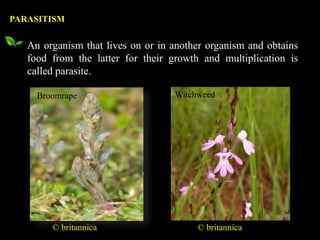
An organism that lives on or in another organism and obtains
food from the latter for their growth and multiplication is
called parasite.
Broomrape Witchweed
© britannica © britannica
The word parasite is derived from a latin word ‘parasitus’ which means
“one who eats at the table of the another”
TYPES OF PARASITISM
Ectoparasite
Endoparasite
Destructive parasite
Balanced parasite
Facultative parasite
Facultative saprophyte
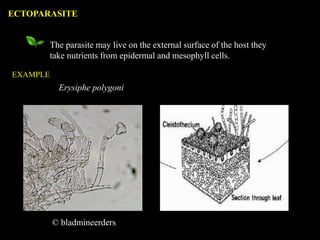
ECTOPARASITE
The parasite may live on the external surface of the host they
take nutrients from epidermal and mesophyll cells.
Erysiphe polygoni
© bladmineerders
EXAMPLE
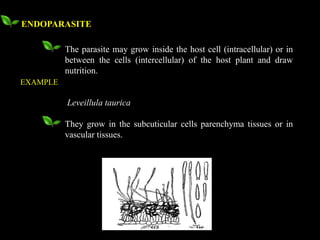
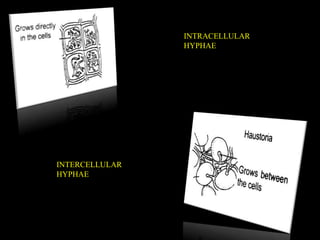
The parasite may grow inside the host cell (intracellular) or in
between the cells (intercellular) of the host plant and draw
nutrition.
Leveillula taurica
They grow in the subcuticular cells parenchyma tissues or in
vascular tissues.
ENDOPARASITE
EXAMPLE
INTRACELLULAR
HYPHAE
INTERCELLULAR
HYPHAE
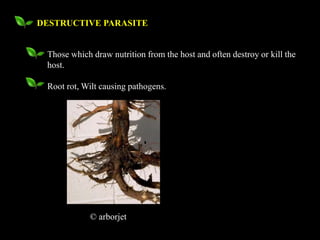
DESTRUCTIVE PARASITE
Those which draw nutrition from the host and often destroy or kill the
host.
Root rot, Wilt causing pathogens.
© arborjet
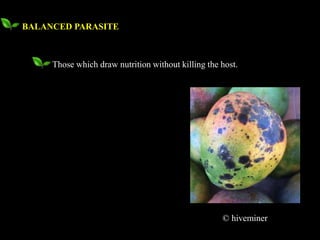
BALANCED PARASITE
Those which draw nutrition without killing the host.
© hiveminer
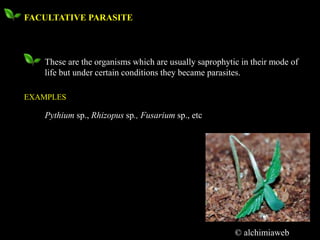
FACULTATIVE PARASITE
These are the organisms which are usually saprophytic in their mode of
life but under certain conditions they became parasites.
Pythium sp., Rhizopus sp., Fusarium sp., etc
© alchimiaweb
EXAMPLES
FACULTATIVE SAPROPHYTE
These are the organisms which are usually parasites in their mode
of life but under certain condition they become saprophytes.
Smut fungi, Phytophthora sp., Mucor sp. and Venturia sp.
© wikipedia
EXAMPLES
BROAD CATEGORIES OF PARASITISM
BY LUTTRELL (1974)
BIOTROPHS
HEMIBIOTROPHS
PERTHOTROPHS
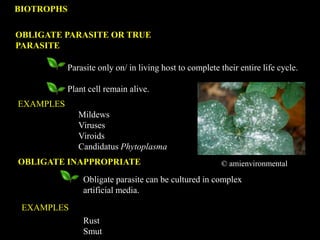
BIOTROPHS
OBLIGATE INAPPROPRIATE
OBLIGATE PARASITE OR TRUE
PARASITE
Parasite only on/ in living host to complete their entire life cycle.
Plant cell remain alive.
Obligate parasite can be cultured in complex
artificial media.
Mildews
Viruses
Viroids
Candidatus Phytoplasma
EXAMPLES
Rust
Smut
EXAMPLES
© amienvironmental
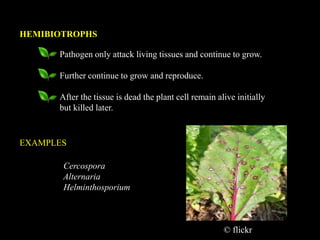
HEMIBIOTROPHS
Pathogen only attack living tissues and continue to grow.
Further continue to grow and reproduce.
After the tissue is dead the plant cell remain alive initially
but killed later.
Cercospora
Alternaria
Helminthosporium
EXAMPLES
© flickr
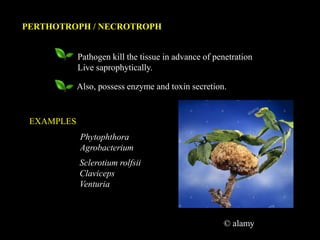
PERTHOTROPH / NECROTROPH
Pathogen kill the tissue in advance of penetration
Live saprophytically.
Also, possess enzyme and toxin secretion.
Phytophthora
Agrobacterium
Sclerotium rolfsii
Claviceps
Venturia
EXAMPLES
© alamy
REFERENCES
ALICE D, JEYALAKSHMI C AND SETHURAMA K, 2007. HANDBOOK
OF INTRODUCTORY TO PLANT PATHOLOGY.
A.E.PUBLICATIONS,COIMBATORE.
https://www.britannica.com/plant/parasitic-plant/media/1511885/114207

Parasitism and its types

  • 1.
    PARASITISM AND ITSTYPES COURSE TEACHER Dr. PARTHASARATHY S Asst. Professor (Plant Pathology) STUDENT : GOWTHAM M ID. NO. : 2017021020 COLLEGE OF AGRICULTURAL TECHNOLOGY (Affiliated to Tamil Nadu Agricultural University, Coimbatore-3) Kullapuram (Po), Via Vaigai Dam, Theni-625 562
  • 2.
    PARASITISM An organism thatlives on or in another organism and obtains food from the latter for their growth and multiplication is called parasite. Broomrape Witchweed © britannica © britannica
  • 3.
    The word parasiteis derived from a latin word ‘parasitus’ which means “one who eats at the table of the another” TYPES OF PARASITISM Ectoparasite Endoparasite Destructive parasite Balanced parasite Facultative parasite Facultative saprophyte
  • 4.
    ECTOPARASITE The parasite maylive on the external surface of the host they take nutrients from epidermal and mesophyll cells. Erysiphe polygoni © bladmineerders EXAMPLE
  • 5.
    The parasite maygrow inside the host cell (intracellular) or in between the cells (intercellular) of the host plant and draw nutrition. Leveillula taurica They grow in the subcuticular cells parenchyma tissues or in vascular tissues. ENDOPARASITE EXAMPLE
  • 6.
  • 7.
    DESTRUCTIVE PARASITE Those whichdraw nutrition from the host and often destroy or kill the host. Root rot, Wilt causing pathogens. © arborjet
  • 8.
    BALANCED PARASITE Those whichdraw nutrition without killing the host. © hiveminer
  • 9.
    FACULTATIVE PARASITE These arethe organisms which are usually saprophytic in their mode of life but under certain conditions they became parasites. Pythium sp., Rhizopus sp., Fusarium sp., etc © alchimiaweb EXAMPLES
  • 10.
    FACULTATIVE SAPROPHYTE These arethe organisms which are usually parasites in their mode of life but under certain condition they become saprophytes. Smut fungi, Phytophthora sp., Mucor sp. and Venturia sp. © wikipedia EXAMPLES
  • 11.
    BROAD CATEGORIES OFPARASITISM BY LUTTRELL (1974) BIOTROPHS HEMIBIOTROPHS PERTHOTROPHS
  • 12.
    BIOTROPHS OBLIGATE INAPPROPRIATE OBLIGATE PARASITEOR TRUE PARASITE Parasite only on/ in living host to complete their entire life cycle. Plant cell remain alive. Obligate parasite can be cultured in complex artificial media. Mildews Viruses Viroids Candidatus Phytoplasma EXAMPLES Rust Smut EXAMPLES © amienvironmental
  • 13.
    HEMIBIOTROPHS Pathogen only attackliving tissues and continue to grow. Further continue to grow and reproduce. After the tissue is dead the plant cell remain alive initially but killed later. Cercospora Alternaria Helminthosporium EXAMPLES © flickr
  • 14.
    PERTHOTROPH / NECROTROPH Pathogenkill the tissue in advance of penetration Live saprophytically. Also, possess enzyme and toxin secretion. Phytophthora Agrobacterium Sclerotium rolfsii Claviceps Venturia EXAMPLES © alamy
  • 15.
    REFERENCES ALICE D, JEYALAKSHMIC AND SETHURAMA K, 2007. HANDBOOK OF INTRODUCTORY TO PLANT PATHOLOGY. A.E.PUBLICATIONS,COIMBATORE. https://www.britannica.com/plant/parasitic-plant/media/1511885/114207