Agrobacterium mediated
Transformation
Dr. Varsha C Mohanan
Assistant Professor
Department of Biotechnology
St. Mary’s College Thrissur
Agrobacterium mediated Transformation, Dr. Varsha C Mohanan, St.Mary’s CollegeSt.Mary’s College
Agrobacterium - a natural genetic engineer
 Agrobacterium- Crown Gall
and root hair disease in plants,
characterised by tumor and hairy
root morphology.
Induces disease in dicot
angiosperms, some monocots
and gymnosperms
 Disease- Genetic transfer of
disease causing genes from the
Agrobacterium to the host plant.
Delivery of transferred (T)-DNA
from bacterial cells into host
plant cells through a bacterial
type IV secretion system (T4SS).
Courtesy: www.rhs.org.uk
Most well known
Agrobacterium sps
•Agrobacterium
tumefaciens
•Agrobacterium
rhizogenes
Agrobacterium mediated Transformation, Dr. Varsha C Mohanan,St.Mary’s CollegeSt.Mary’s College
Infects wounded parts of
the plant
Agrobacterium infection
Courtesy: B. Hohn, Encyclopedia of Genetics, 2001
Sciencephoto.com
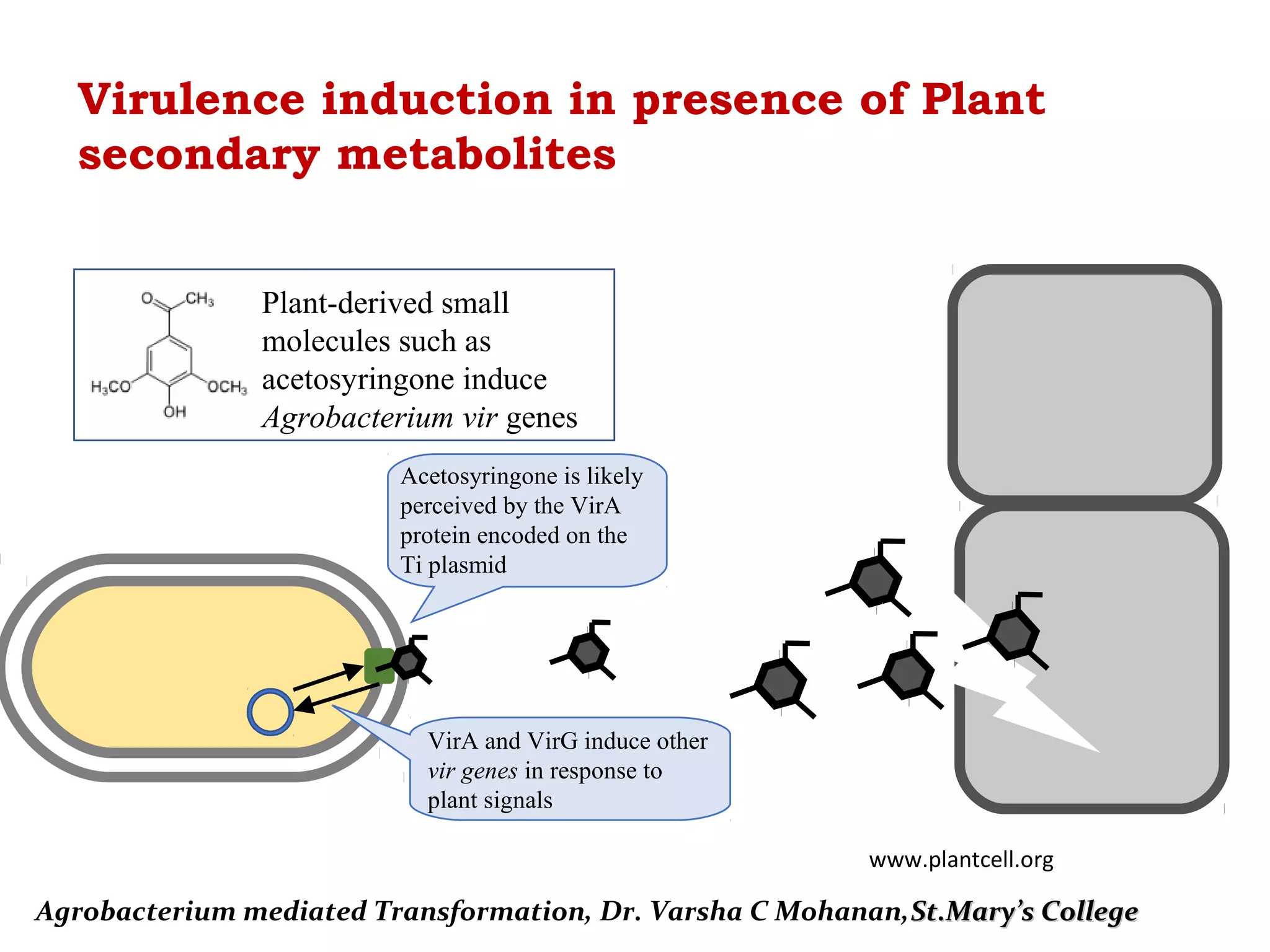
Ti-plasmid
DNA sequence regions in
Ti plasmid -Left border,
ORFs for Auxin, Cytokinin
and Opine synthesis, Right
border, Conjugal plasmid
transfer between bacteria,
Octopine catabolism,
mannityl opine catabolism,
Ori/inc regions and Vir
genes
 Chromosomal and Vir Genes
 T-DNA Transfer
 T-DNA Integration
Mechanism of gene transfer
Agrobacterium mediated Transformation, Dr. Varsha C Mohanan, St.Mary’s CollegeSt.Mary’s College
M. Ashraf et al. (eds.), Crop Production for Agricultural
Improvement, 2012
Tumor inducing genes
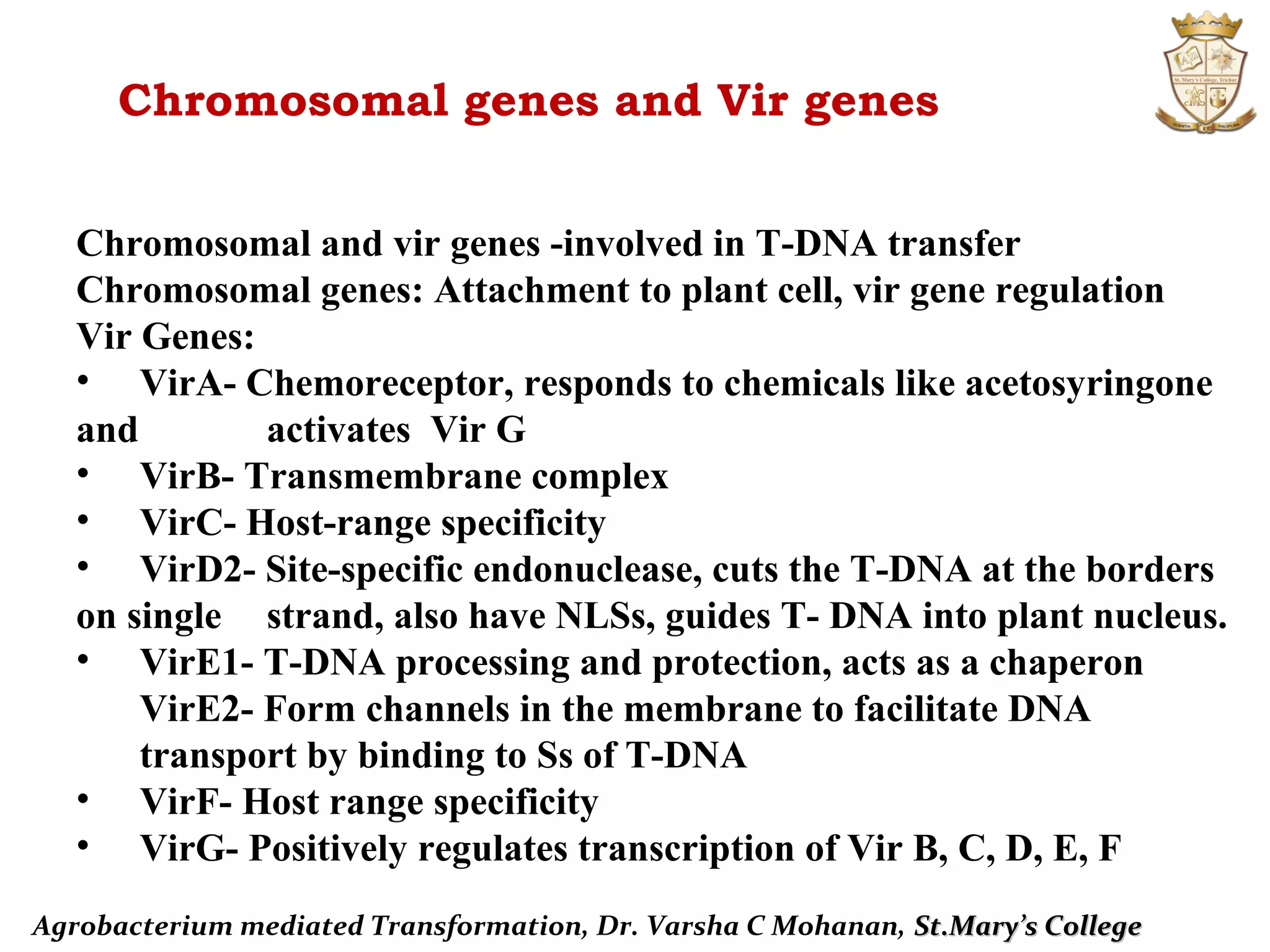
Acetosyringone is likely
perceived by the VirA
protein encoded on the
Ti plasmid
VirA and VirG induce other
vir genes in response to
plant signals
Plant-derived small
molecules such as
acetosyringone induce
Agrobacterium vir genes
Virulence induction in presence of Plant
secondary metabolites
www.plantcell.org
Agrobacterium mediated Transformation, Dr. Varsha C Mohanan,St.Mary’s CollegeSt.Mary’s College
Chromosomal genes and Vir genes
Chromosomal and vir genes -involved in T-DNA transfer
Chromosomal genes: Attachment to plant cell, vir gene regulation
Vir Genes:
• VirA- Chemoreceptor, responds to chemicals like acetosyringone
and activates Vir G
• VirB- Transmembrane complex
• VirC- Host-range specificity
• VirD2- Site-specific endonuclease, cuts the T-DNA at the borders
on single strand, also have NLSs, guides T- DNA into plant nucleus.
• VirE1- T-DNA processing and protection, acts as a chaperon
VirE2- Form channels in the membrane to facilitate DNA
transport by binding to Ss of T-DNA
• VirF- Host range specificity
• VirG- Positively regulates transcription of Vir B, C, D, E, F
Agrobacterium mediated Transformation, Dr. Varsha C Mohanan, St.Mary’s CollegeSt.Mary’s College
Agrobacterium tumefaciens – pathogen
and useful tool for genetic engineering
The features of Ti plasmid can be modified to use it for genetic
engineering
A modified Ti or Ri plasmid can be used. The plasmid is
'disarmed' by deletion of the tumor inducing genes; the only
essential parts of the T-DNA are its two small (25 base pair)
border repeats, at least one of which is needed for plant
transformation.
Binary Vectors system for Transformation
A transfer DNA (T-DNA) binary system is a pair of plasmids
consisting of a binary plasmid and a helper plasmid. The two
plasmids are used together (thusbinary) to produce genetically
modified plants.
Agrobacterium mediated Transformation, Dr. Varsha C Mohanan, St.Mary’s CollegeSt.Mary’s College
Lee L-Y & Gelvin S. B, 2008 Plant Physiology
•Binary Vector construction
•Remove the aux and cyt genes and disarm Ti Plasmid.
• Move it into a small vector plasmid
•Insert a selection marker for bacterial selection (eg.
Kanamycin resistance) and eukaryotic selection (eg.
Hygromycin resistance) within the T-DNA regions.
• Insert the gene of interest between the T- DNA borders
without disrupting the selection marker
•Retain Vir genes on different plasmid (Helper plasmid)
•Transconjugant generation
•Co-transform Agrobacterium with both plasmids
•Plant Transformation
•Infect plant with transformed bacteria
Agrobacterium mediated Transformation, Dr. Varsha C Mohanan, St.Mary’s CollegeSt.Mary’s College
Plant Transformation methods
•Callus transformation
• Leaf Disc Transformation
•Floral dip Transformation
•Root Transformation
Agrobacterium mediated Transformation, Dr. Varsha C Mohanan, St.Mary’s CollegeSt.Mary’s College
www.Biology Discussion.com
REFERENCES
•Hohn, B. (2001). Transfer of Genetic Information from Agrobacterium
tumefaciens to Plants. Encyclopedia of Genetics, 1984–
1986.doi:10.1006/rwgn.2001.1638
•Ashraf, M., Öztürk, M., Ahmad, M. S. A., & Aksoy, A. (Eds.). (2012). Crop
Production for Agricultural Improvement. doi:10.1007/978-94-007-4116-4
•Stachel, S.E., Messens, E., Van Montagu, M. and Zambryski, P. (1985).
Identification of the signal molecules produced by wounded plant cells
that activate T-DNA transfer in Agrobacterium tumefaciens. Nature. 318:
624-629
•Stachel, S.E., Nester, E.W. and Zambryski, P.C. (1986). A plant cell factor
induces Agrobacterium tumefaciens vir gene expression. Proc. Natl. Acad.
Sci. USA. 83: 379-383.
• Lee, L.-Y., & Gelvin, S. B. (2007). T-DNA Binary Vectors and Systems. Plant
physiology, 146(2), 325–332. doi:10.1104/pp.107.113001
•http://www.biologydiscussion.com/gene/gene-transfer/top-4-methods-
of-gene-transfer-with-diagrams/11898
Agrobacterium mediated Transformation, Dr. Varsha C Mohanan,St.Mary’s CollegeSt.Mary’s College

Biotechnology:Agrobacterium mediated Transformation

  • 1.
    Agrobacterium mediated Transformation Dr. VarshaC Mohanan Assistant Professor Department of Biotechnology St. Mary’s College Thrissur
  • 2.
    Agrobacterium mediated Transformation,Dr. Varsha C Mohanan, St.Mary’s CollegeSt.Mary’s College Agrobacterium - a natural genetic engineer  Agrobacterium- Crown Gall and root hair disease in plants, characterised by tumor and hairy root morphology. Induces disease in dicot angiosperms, some monocots and gymnosperms  Disease- Genetic transfer of disease causing genes from the Agrobacterium to the host plant. Delivery of transferred (T)-DNA from bacterial cells into host plant cells through a bacterial type IV secretion system (T4SS). Courtesy: www.rhs.org.uk Most well known Agrobacterium sps •Agrobacterium tumefaciens •Agrobacterium rhizogenes
  • 3.
    Agrobacterium mediated Transformation,Dr. Varsha C Mohanan,St.Mary’s CollegeSt.Mary’s College Infects wounded parts of the plant Agrobacterium infection Courtesy: B. Hohn, Encyclopedia of Genetics, 2001 Sciencephoto.com
  • 4.
    Ti-plasmid DNA sequence regionsin Ti plasmid -Left border, ORFs for Auxin, Cytokinin and Opine synthesis, Right border, Conjugal plasmid transfer between bacteria, Octopine catabolism, mannityl opine catabolism, Ori/inc regions and Vir genes  Chromosomal and Vir Genes  T-DNA Transfer  T-DNA Integration Mechanism of gene transfer Agrobacterium mediated Transformation, Dr. Varsha C Mohanan, St.Mary’s CollegeSt.Mary’s College M. Ashraf et al. (eds.), Crop Production for Agricultural Improvement, 2012 Tumor inducing genes
  • 5.
    Acetosyringone is likely perceivedby the VirA protein encoded on the Ti plasmid VirA and VirG induce other vir genes in response to plant signals Plant-derived small molecules such as acetosyringone induce Agrobacterium vir genes Virulence induction in presence of Plant secondary metabolites www.plantcell.org Agrobacterium mediated Transformation, Dr. Varsha C Mohanan,St.Mary’s CollegeSt.Mary’s College
  • 6.
    Chromosomal genes andVir genes Chromosomal and vir genes -involved in T-DNA transfer Chromosomal genes: Attachment to plant cell, vir gene regulation Vir Genes: • VirA- Chemoreceptor, responds to chemicals like acetosyringone and activates Vir G • VirB- Transmembrane complex • VirC- Host-range specificity • VirD2- Site-specific endonuclease, cuts the T-DNA at the borders on single strand, also have NLSs, guides T- DNA into plant nucleus. • VirE1- T-DNA processing and protection, acts as a chaperon VirE2- Form channels in the membrane to facilitate DNA transport by binding to Ss of T-DNA • VirF- Host range specificity • VirG- Positively regulates transcription of Vir B, C, D, E, F Agrobacterium mediated Transformation, Dr. Varsha C Mohanan, St.Mary’s CollegeSt.Mary’s College
  • 7.
    Agrobacterium mediated Transformation,Dr. Varsha C Mohanan, St.Mary’s CollegeSt.Mary’s College Agrobacterium tumefaciens – pathogen and useful tool for genetic engineering The features of Ti plasmid can be modified to use it for genetic engineering A modified Ti or Ri plasmid can be used. The plasmid is 'disarmed' by deletion of the tumor inducing genes; the only essential parts of the T-DNA are its two small (25 base pair) border repeats, at least one of which is needed for plant transformation.
  • 8.
    Binary Vectors systemfor Transformation A transfer DNA (T-DNA) binary system is a pair of plasmids consisting of a binary plasmid and a helper plasmid. The two plasmids are used together (thusbinary) to produce genetically modified plants. Agrobacterium mediated Transformation, Dr. Varsha C Mohanan, St.Mary’s CollegeSt.Mary’s College Lee L-Y & Gelvin S. B, 2008 Plant Physiology
  • 9.
    •Binary Vector construction •Removethe aux and cyt genes and disarm Ti Plasmid. • Move it into a small vector plasmid •Insert a selection marker for bacterial selection (eg. Kanamycin resistance) and eukaryotic selection (eg. Hygromycin resistance) within the T-DNA regions. • Insert the gene of interest between the T- DNA borders without disrupting the selection marker •Retain Vir genes on different plasmid (Helper plasmid) •Transconjugant generation •Co-transform Agrobacterium with both plasmids •Plant Transformation •Infect plant with transformed bacteria Agrobacterium mediated Transformation, Dr. Varsha C Mohanan, St.Mary’s CollegeSt.Mary’s College
  • 10.
    Plant Transformation methods •Callustransformation • Leaf Disc Transformation •Floral dip Transformation •Root Transformation Agrobacterium mediated Transformation, Dr. Varsha C Mohanan, St.Mary’s CollegeSt.Mary’s College www.Biology Discussion.com
  • 11.
    REFERENCES •Hohn, B. (2001).Transfer of Genetic Information from Agrobacterium tumefaciens to Plants. Encyclopedia of Genetics, 1984– 1986.doi:10.1006/rwgn.2001.1638 •Ashraf, M., Öztürk, M., Ahmad, M. S. A., & Aksoy, A. (Eds.). (2012). Crop Production for Agricultural Improvement. doi:10.1007/978-94-007-4116-4 •Stachel, S.E., Messens, E., Van Montagu, M. and Zambryski, P. (1985). Identification of the signal molecules produced by wounded plant cells that activate T-DNA transfer in Agrobacterium tumefaciens. Nature. 318: 624-629 •Stachel, S.E., Nester, E.W. and Zambryski, P.C. (1986). A plant cell factor induces Agrobacterium tumefaciens vir gene expression. Proc. Natl. Acad. Sci. USA. 83: 379-383. • Lee, L.-Y., & Gelvin, S. B. (2007). T-DNA Binary Vectors and Systems. Plant physiology, 146(2), 325–332. doi:10.1104/pp.107.113001 •http://www.biologydiscussion.com/gene/gene-transfer/top-4-methods- of-gene-transfer-with-diagrams/11898 Agrobacterium mediated Transformation, Dr. Varsha C Mohanan,St.Mary’s CollegeSt.Mary’s College