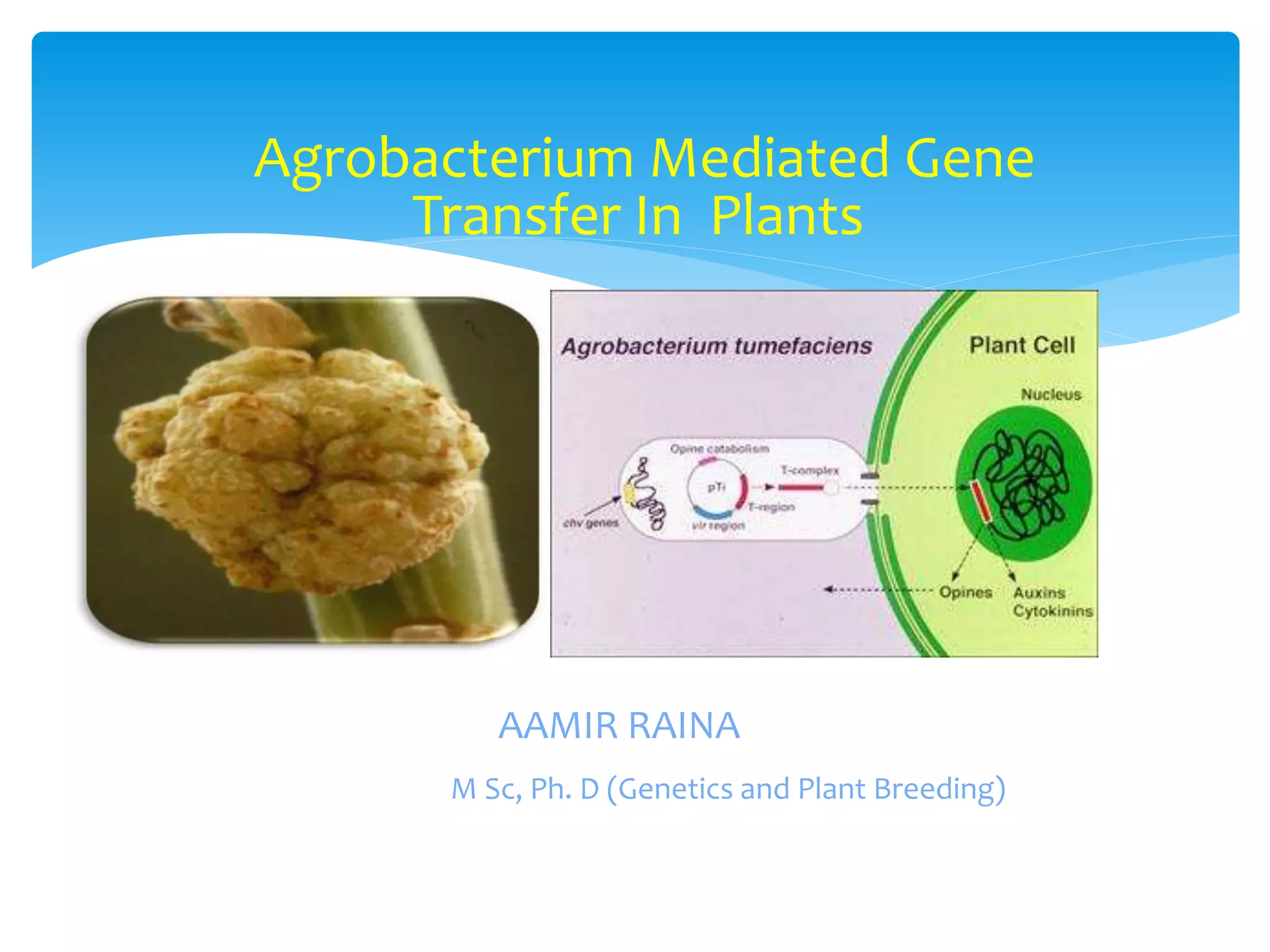
Agrobacterium Mediated Gene
Transfer In Plants
AAMIR RAINA
M Sc, Ph. D (Genetics and Plant Breeding)
Gene Transfer
 Recombinant DNA technology is based on the
insertion of a DNA fragment (Gene of interest) into
a suitable cloning vector and then its introduction
into a suitable host to propagate the recombinant
DNA.
Gene Carrier Vehicle
 If a gene is to be introduced into a host cell,a carrier
molecule that can transport the gene into the host
cell is required.
 Such a molecule is called a cloning vehicle or carrier
molecule or a vector.
Gene Carrier Vehicle
 Following are few gene carrier vehicles.
 Plasmids
 Bacteriophages
 Cosmids
 Viruses
 Virus vector for animal cells.
 Simian Virus
Making Transgenic Plants—Why?
1. Study gene function and regulation
2. Making new organismic tools for other fields of
research
3. Curing genetic diseases
4. Improving agriculture and related raw materials
5. New sources of bioengineered drugs.
 Must get DNA:
1. into the cells
2. integrated into the genome (unless using transient
expression assays)
3. expressed (everywhere or controlled)
 For (1) and (2), two main approaches for plants:
1. Agrobacterium - mediated gene transfer
2. Direct gene transfer
 For (3), use promoter that will direct expression when
and where wanted – may also require other
modifications such as removing or replacing introns.
Genetic Engineering of Plants
 Agrobacteria
 soil bacteria, gram-negative, related to Rhizobia
species:
 It invades many dicot plants when they are
injured at the soil level and causes
crown gall disease
Agrobacterium tumefaciens-Nature’s
smallest genetic engineer
 The ability to cause crown gall disease is
associated with the presence of Ti Plasmid
within bacterial cell
 A remarkable feature of Ti Plasmid is that after
infection part of molecule is integrated into
plant chromosomal DNA. This segment called T-
DNA is between 15 and 30 kb in size
 It is maintained in a stable form in plant cellc
and is passed onto daughter cells as an integral
part of chromosome
Agrobacterium tumefaciens-Nature’s
smallest genetic engineer
Crown galls
caused by A.
tumefaciens on
nightshade.
More about Galls:
http://waynesword.palomar.edu/pljuly99.htm
http://kaweahoaks.com/html/galls_ofthe_voaks.
html
 the species of choice for engineering dicot
plants; monocots are generally resistant
 some dicots more resistant than others (a
genetic basis for this)
 complex bacterium – genome has been
sequenced; 4 chromosomes; ~ 5500
genes
Agrobacterium tumefaciens
 Infection occurs at wound sites
 Involves recognition and chemotaxis of the
bacterium toward wounded cells
 galls are “real tumors”, can be removed and
will grow indefinitely without hormones
 genetic information must be transferred to
plant cells
Infection and tumorigenesis
1. Synthesize a unique amino acid, called “opine”
 octopine and nopaline - derived from arginine
 agropine - derived from glutamate
2. Opine depends on the strain of A. tumefaciens
3. Opines are catabolized by the bacteria, which
can use only the specific opine that it causes
the plant to produce.
4. Has obvious advantages for the bacteria, what
about the plant?
Tumor characteristics
 It was recognized early that virulent strains
could be cured of virulence, and that
cured strains could regain virulence when
exposed to virulent strains; suggested an
extra- chromosomal element.
 Large plasmids were found in A. tumefaciens
and their presence correlated with
virulence: called tumor-inducing or Ti
plasmids.
Elucidation of the TIP (tumor-inducing
principle)
1. An extrachromosomal double stranded
circular DNA molecule
2. Tumour inducing
3. Large (200-kb in size) and conjugative type
4. ~10% of plasmid transferred to plant cell
after infection
5. Transferred DNA (called T-DNA) integrates
semi-randomly into nuclear DNA
6. Ti plasmid also encodes:
 enzymes involved in opine metabolism
 proteins involved in mobilizing T-DNA (Vir genes)
Ti Plasmid
auxA auxB cyt ocsLB RB
LB, RB – left and right borders (direct repeat)
auxA + auxB – enzymes that produce auxin
cyt – enzyme that produces cytokinin
Ocs – octopine synthase, produces octopine
T-DNA
These genes have typical eukaryotic expression signals!
auxA auxB
Tryptophan indoleacetamide  indoleacetic acid
(auxin)
cyt
AMP + isopentenylpyrophosphate  isopentyl-AMP
(a cytokinin)
• Increased levels of these hormones stimulate cell
division.
• Explains uncontrolled growth of tumor.
1. On the Ti plasmid
2. Transfer the T-DNA to plant cell
3. Acetosyringone (AS) (a flavonoid) released by
wounded plant cells activates vir genes.
4. virA,B,C,D,E,F,G (7 complementation
groups, but some have multiple ORFs),
span about 30 kb of Ti plasmid.
Vir (virulent) genes
 virA - transports AS into bacterium, activates
virG post-translationally (by phosphoryl.)
 virG - promotes transcription of other vir genes
 virD2 - endonuclease/integrase that cuts T-
DNA at the borders but only on one strand;
attaches to the 5' end of the SS
 virE2 - binds SS of T-DNA & can form channels
in artificial membranes
 virE1 - chaperone for virE2
 virD2 & virE2 also have NLSs, gets T-DNA to
the nucleus of plant cell
 virB - operon of 11 proteins, gets T-DNA
through bacterial membranes
Vir gene functions (cont.)
From Covey & Grierson
Gauthier, A. et al. (2003) J. Biol. Chem. 278:25273-25276
Type IV Secretion Sys.
• many pathogens, also
used in conjugation
• promiscuous
• forms T-Pilus
• B7-B10 span OM & IM
• B7-B9 in OM interacts
w/B8 & B10 of IM to
form channel
• 3 ATPases
• D4 promotes specific
transport
• B2 can form filaments
VirE2 may get DNA-protein complex across host PM
Dumas et al., (2001), Proc. Natl. Acad. Sci. USA, 98:485
 T-DNA is excised from the TI Plasmid and
transferred to the nucleus of the plant cell.
 Here the T-DNA gets integrated into the plant
DNA .
 The T-DNA can be passed onto daughter cells as
an integral part of plant chromosome
Transfer of tumour inducing Principle
 Only small segment of Ti Plasmid is transferred
to the host plant cell and gets integrated with
the genome
 It contains genes for tumour formation(Tum)
and nopalina biosynthesis(NOS)
 Tum genes encode enzymes that catalyse the
synthesis of phytoharmones like IAA and the
Cytokinin, Isopentenyl adenosine that causes
tumourous growth of cells in crown galls
 The T-DNA is bordered by 25 bp repeats,
required for the excision and transfer of T-DNA
The T-DNA
 Recognition of susceptible wounded plant cell
- Plant exudates act as signals by inducing genes in the Vir
genes of the Ti Plasmid
- Acetosyringone (AS) ,alpha – hydroxy acetosyringone
- -Binding to wounded cells, controlled by two
chromosomal genes of agrobacterium-chv-A and chv-B
Tumour induction by Agrobacterium
 Excision, transfer and integration
- The border repeats of the T-DNA play an
important role
- Any DNA sequence located between the border
repeats is transferred to the post plant
- The T-DNA region is excised from the plasmid
by the enzymes encoded by the Vir region
 These enzymes specifically recognize the T-DNA
borders
 The T-DNA enters the plant cell and integrates
into the host genome , mediated by host
enzymes
Tumour induction by Agrobacterium
 The Ti plasmid has an innate ability to transmit
bacterial DNA into plant cell.
 This potential is exploited by the genetic engineers
to use this as a vector
 The gene of a donnor organism can be introduced
into the Ti Plasmid at the TDNA region
 This plassmid now becomes a recombinant plasmid
 By Agrobacterium infection , the donor genes can
be transferred and integrated into the genotype of
host
 This results in the production of a transgenic plant
Ti plasmid as a vector
 A mature plant regenerated from transformed cells will
contain the cloned gene in every cell and will pass on the
cloned gene onto its offsprings
 However regeneration of transformed plant can occure
only if the Ti plasmid has been disarmed so that
transformed cells donot display cancerious properties.
Ti plasmid as a vector
 Disarming is possible because cancer genes are not
needed for infection
 Infectivity is controlled by virulence region of Ti
plasmid.
 Infactonly parts ofTDNA are involved in infection are
two 25bp repeat sequance
Disarmed Ti plasmid
 Any DNA placed between these two repeat
sequences will be treated as T- DNA and transferred
to plant
 It is therefore possible to remove all the cancer genes
from normal T-DNA and replace them with an entirely
new set of genes with out disturbing the infection
process.
Disarmed Ti plasmid
 Removal of genes responsible of auxin cytokinin and
nopaline synthesis.
 Disarmed Ti plasmids
 Deletion of T-DNA REGION.
 PGV3850 is constructed from pTiC58
 It has pBR322 with AmpR
 Has Border repeats and NOS genes
Disarmed Ti plasmid
 Agrobacterium having this PGV 3850 can transfer the
modified T-DNA into plant cells.
 But the recipient cells will not produce tumour, but
could produce nopaline.
 This can be used as an efficient vector for introducing
foreign genes into plants.
Disarmed Ti plasmid
 The main problem is of course that a unique
restriction site is an impossibility with a plasmid
200Kb in size.
 Novel strategies have to be developed for inserting
new DNA into plasmid.
LIMITATIONS
Strategy:
1. Move T-DNA onto a separate, small plasmid.
2. Remove aux and cyt genes.
3. Insert selectable marker (kanamycin resistance) gene
in T-DNA.
4. Vir genes are retained on a separate plasmid.
5. Put foreign gene between T-DNA borders.
6. Co-transform Agrobacterium with both plasmids.
7. Infect plant with the transformed bacteria.
Binary vector system
 A foreign gene cloned into an appropriate plasmid
(pBR322) can be integrated with the disarmed Ti
plasmid by a homologous recombination
 A compound plasmid called cointegrate is formed.
Construction of Cointegrate
1. Leaf-disc transformation - after selection and
regeneration with tissue culture, get plants
with the introduced gene in every cell
2. Floral Dip – does not require tissue culture.
Reproductive tissue is transformed and the
resulting seeds are screened for drug-
resistant growth. (Clough and Bent (1998) Floral dip: a
simplified method for Agrobacterium-mediated transformation of
Arabidopsis thaliana. Plant Journal 16, 735–743)
2 Common Transformation Protocols
Making a transgenic
plant by leaf disc
transformation with
Agrobacterium.
S.J. Clough, A.F. Bent (1998) Floral dip: a simplified method for
Agrobacterium-mediated transformation of Arabidopsis thaliana.
Plant Journal 16, 735–743.
 Employing method, genes from entirely unrelated
plants can be transferred to other dicots transgenic
plants with the following attributes were developed.
 Resistance –
 To antibiotics
 Pesticides and insect pests
 Drought and herbicides
Uses
Thank You

Agrobacterium mediated gene transfer in plants

  • 1.
    Agrobacterium Mediated Gene TransferIn Plants AAMIR RAINA M Sc, Ph. D (Genetics and Plant Breeding)
  • 2.
    Gene Transfer  RecombinantDNA technology is based on the insertion of a DNA fragment (Gene of interest) into a suitable cloning vector and then its introduction into a suitable host to propagate the recombinant DNA.
  • 3.
    Gene Carrier Vehicle If a gene is to be introduced into a host cell,a carrier molecule that can transport the gene into the host cell is required.  Such a molecule is called a cloning vehicle or carrier molecule or a vector.
  • 4.
    Gene Carrier Vehicle Following are few gene carrier vehicles.  Plasmids  Bacteriophages  Cosmids  Viruses  Virus vector for animal cells.  Simian Virus
  • 5.
    Making Transgenic Plants—Why? 1.Study gene function and regulation 2. Making new organismic tools for other fields of research 3. Curing genetic diseases 4. Improving agriculture and related raw materials 5. New sources of bioengineered drugs.
  • 6.
     Must getDNA: 1. into the cells 2. integrated into the genome (unless using transient expression assays) 3. expressed (everywhere or controlled)  For (1) and (2), two main approaches for plants: 1. Agrobacterium - mediated gene transfer 2. Direct gene transfer  For (3), use promoter that will direct expression when and where wanted – may also require other modifications such as removing or replacing introns. Genetic Engineering of Plants
  • 7.
     Agrobacteria  soilbacteria, gram-negative, related to Rhizobia species:  It invades many dicot plants when they are injured at the soil level and causes crown gall disease Agrobacterium tumefaciens-Nature’s smallest genetic engineer
  • 8.
     The abilityto cause crown gall disease is associated with the presence of Ti Plasmid within bacterial cell  A remarkable feature of Ti Plasmid is that after infection part of molecule is integrated into plant chromosomal DNA. This segment called T- DNA is between 15 and 30 kb in size  It is maintained in a stable form in plant cellc and is passed onto daughter cells as an integral part of chromosome Agrobacterium tumefaciens-Nature’s smallest genetic engineer
  • 9.
    Crown galls caused byA. tumefaciens on nightshade. More about Galls: http://waynesword.palomar.edu/pljuly99.htm http://kaweahoaks.com/html/galls_ofthe_voaks. html
  • 10.
     the speciesof choice for engineering dicot plants; monocots are generally resistant  some dicots more resistant than others (a genetic basis for this)  complex bacterium – genome has been sequenced; 4 chromosomes; ~ 5500 genes Agrobacterium tumefaciens
  • 11.
  • 12.
     Infection occursat wound sites  Involves recognition and chemotaxis of the bacterium toward wounded cells  galls are “real tumors”, can be removed and will grow indefinitely without hormones  genetic information must be transferred to plant cells Infection and tumorigenesis
  • 13.
    1. Synthesize aunique amino acid, called “opine”  octopine and nopaline - derived from arginine  agropine - derived from glutamate 2. Opine depends on the strain of A. tumefaciens 3. Opines are catabolized by the bacteria, which can use only the specific opine that it causes the plant to produce. 4. Has obvious advantages for the bacteria, what about the plant? Tumor characteristics
  • 14.
     It wasrecognized early that virulent strains could be cured of virulence, and that cured strains could regain virulence when exposed to virulent strains; suggested an extra- chromosomal element.  Large plasmids were found in A. tumefaciens and their presence correlated with virulence: called tumor-inducing or Ti plasmids. Elucidation of the TIP (tumor-inducing principle)
  • 15.
    1. An extrachromosomaldouble stranded circular DNA molecule 2. Tumour inducing 3. Large (200-kb in size) and conjugative type 4. ~10% of plasmid transferred to plant cell after infection 5. Transferred DNA (called T-DNA) integrates semi-randomly into nuclear DNA 6. Ti plasmid also encodes:  enzymes involved in opine metabolism  proteins involved in mobilizing T-DNA (Vir genes) Ti Plasmid
  • 16.
    auxA auxB cytocsLB RB LB, RB – left and right borders (direct repeat) auxA + auxB – enzymes that produce auxin cyt – enzyme that produces cytokinin Ocs – octopine synthase, produces octopine T-DNA These genes have typical eukaryotic expression signals!
  • 17.
    auxA auxB Tryptophan indoleacetamide indoleacetic acid (auxin) cyt AMP + isopentenylpyrophosphate  isopentyl-AMP (a cytokinin) • Increased levels of these hormones stimulate cell division. • Explains uncontrolled growth of tumor.
  • 18.
    1. On theTi plasmid 2. Transfer the T-DNA to plant cell 3. Acetosyringone (AS) (a flavonoid) released by wounded plant cells activates vir genes. 4. virA,B,C,D,E,F,G (7 complementation groups, but some have multiple ORFs), span about 30 kb of Ti plasmid. Vir (virulent) genes
  • 19.
     virA -transports AS into bacterium, activates virG post-translationally (by phosphoryl.)  virG - promotes transcription of other vir genes  virD2 - endonuclease/integrase that cuts T- DNA at the borders but only on one strand; attaches to the 5' end of the SS  virE2 - binds SS of T-DNA & can form channels in artificial membranes  virE1 - chaperone for virE2  virD2 & virE2 also have NLSs, gets T-DNA to the nucleus of plant cell  virB - operon of 11 proteins, gets T-DNA through bacterial membranes Vir gene functions (cont.)
  • 20.
    From Covey &Grierson
  • 21.
    Gauthier, A. etal. (2003) J. Biol. Chem. 278:25273-25276 Type IV Secretion Sys. • many pathogens, also used in conjugation • promiscuous • forms T-Pilus • B7-B10 span OM & IM • B7-B9 in OM interacts w/B8 & B10 of IM to form channel • 3 ATPases • D4 promotes specific transport • B2 can form filaments
  • 22.
    VirE2 may getDNA-protein complex across host PM Dumas et al., (2001), Proc. Natl. Acad. Sci. USA, 98:485
  • 23.
     T-DNA isexcised from the TI Plasmid and transferred to the nucleus of the plant cell.  Here the T-DNA gets integrated into the plant DNA .  The T-DNA can be passed onto daughter cells as an integral part of plant chromosome Transfer of tumour inducing Principle
  • 24.
     Only smallsegment of Ti Plasmid is transferred to the host plant cell and gets integrated with the genome  It contains genes for tumour formation(Tum) and nopalina biosynthesis(NOS)  Tum genes encode enzymes that catalyse the synthesis of phytoharmones like IAA and the Cytokinin, Isopentenyl adenosine that causes tumourous growth of cells in crown galls  The T-DNA is bordered by 25 bp repeats, required for the excision and transfer of T-DNA The T-DNA
  • 25.
     Recognition ofsusceptible wounded plant cell - Plant exudates act as signals by inducing genes in the Vir genes of the Ti Plasmid - Acetosyringone (AS) ,alpha – hydroxy acetosyringone - -Binding to wounded cells, controlled by two chromosomal genes of agrobacterium-chv-A and chv-B Tumour induction by Agrobacterium
  • 26.
     Excision, transferand integration - The border repeats of the T-DNA play an important role - Any DNA sequence located between the border repeats is transferred to the post plant - The T-DNA region is excised from the plasmid by the enzymes encoded by the Vir region  These enzymes specifically recognize the T-DNA borders  The T-DNA enters the plant cell and integrates into the host genome , mediated by host enzymes Tumour induction by Agrobacterium
  • 27.
     The Tiplasmid has an innate ability to transmit bacterial DNA into plant cell.  This potential is exploited by the genetic engineers to use this as a vector  The gene of a donnor organism can be introduced into the Ti Plasmid at the TDNA region  This plassmid now becomes a recombinant plasmid  By Agrobacterium infection , the donor genes can be transferred and integrated into the genotype of host  This results in the production of a transgenic plant Ti plasmid as a vector
  • 28.
     A matureplant regenerated from transformed cells will contain the cloned gene in every cell and will pass on the cloned gene onto its offsprings  However regeneration of transformed plant can occure only if the Ti plasmid has been disarmed so that transformed cells donot display cancerious properties. Ti plasmid as a vector
  • 29.
     Disarming ispossible because cancer genes are not needed for infection  Infectivity is controlled by virulence region of Ti plasmid.  Infactonly parts ofTDNA are involved in infection are two 25bp repeat sequance Disarmed Ti plasmid
  • 30.
     Any DNAplaced between these two repeat sequences will be treated as T- DNA and transferred to plant  It is therefore possible to remove all the cancer genes from normal T-DNA and replace them with an entirely new set of genes with out disturbing the infection process. Disarmed Ti plasmid
  • 31.
     Removal ofgenes responsible of auxin cytokinin and nopaline synthesis.  Disarmed Ti plasmids  Deletion of T-DNA REGION.  PGV3850 is constructed from pTiC58  It has pBR322 with AmpR  Has Border repeats and NOS genes Disarmed Ti plasmid
  • 32.
     Agrobacterium havingthis PGV 3850 can transfer the modified T-DNA into plant cells.  But the recipient cells will not produce tumour, but could produce nopaline.  This can be used as an efficient vector for introducing foreign genes into plants. Disarmed Ti plasmid
  • 33.
     The mainproblem is of course that a unique restriction site is an impossibility with a plasmid 200Kb in size.  Novel strategies have to be developed for inserting new DNA into plasmid. LIMITATIONS
  • 34.
    Strategy: 1. Move T-DNAonto a separate, small plasmid. 2. Remove aux and cyt genes. 3. Insert selectable marker (kanamycin resistance) gene in T-DNA. 4. Vir genes are retained on a separate plasmid. 5. Put foreign gene between T-DNA borders. 6. Co-transform Agrobacterium with both plasmids. 7. Infect plant with the transformed bacteria. Binary vector system
  • 35.
  • 36.
     A foreigngene cloned into an appropriate plasmid (pBR322) can be integrated with the disarmed Ti plasmid by a homologous recombination  A compound plasmid called cointegrate is formed. Construction of Cointegrate
  • 37.
    1. Leaf-disc transformation- after selection and regeneration with tissue culture, get plants with the introduced gene in every cell 2. Floral Dip – does not require tissue culture. Reproductive tissue is transformed and the resulting seeds are screened for drug- resistant growth. (Clough and Bent (1998) Floral dip: a simplified method for Agrobacterium-mediated transformation of Arabidopsis thaliana. Plant Journal 16, 735–743) 2 Common Transformation Protocols
  • 38.
    Making a transgenic plantby leaf disc transformation with Agrobacterium. S.J. Clough, A.F. Bent (1998) Floral dip: a simplified method for Agrobacterium-mediated transformation of Arabidopsis thaliana. Plant Journal 16, 735–743.
  • 39.
     Employing method,genes from entirely unrelated plants can be transferred to other dicots transgenic plants with the following attributes were developed.  Resistance –  To antibiotics  Pesticides and insect pests  Drought and herbicides Uses
  • 40.