INTRODUCTION

   Transformation – the process of obtaining
    transgenic plants.

   Transgenic plant – a plant with a foreign gene
    (or genes) from another plant/animal that is
    incorporated into its chromosome
Agrobacterium rhizogenes

   A grobacterium rhizogenes is a Gram negative soil bacterium
    that produces hairy root disease in dicotyledonous
    plants.

   A .rhizogenes induces the formation of proliferate multi-
    branched adventitious roots at the site of infection; so
    called ‘hairy roots’.

   A.rhizogenes, the causative agent of hairy root
    syndrome, is a common soil organism capable of
    entering a plant through a wound and causing a
    proliferation of secondary roots.
Ri plasmids

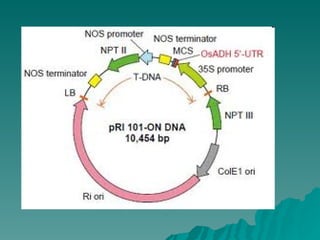
   Ri plasmids are large (200 to greater than 800 kb) and
    contain one or two regions of T-DNA and a vir (virulence)
    region, all of which are necessary for hairy root
    formation.

   The Ri-plasmids are grouped into two main classes
    according to the opines synthesized by hairy roots.

   First, agropine-type strains induce roots to synthesise
    agropine, mannopine and the related acids.
   Second, mannopine-type strains induce roots to
    produce mannopine and the corresponding
    acids.

   The agropine-type Ri-plasmids are very similar
    as a group and a quite distinct group from the
    mannopine-type plasmids.
The genes responsible for hairy root
                formation
   The T-DNA of the agropine-type Ri-plasmid
    consists of two separate T-DNA regions
    designed the TL-DNA and TR-DNA (15 - 20
    kb).These two fragments can be transferred
    independently during the infection process.

   The genes encoding auxin synthesis (tms1 and
    tms2) and agropine synthesis (ags) have been
    localised on the TR-DNA of the agropine type
    Ri-plasmid.

   The mannopine type Ri-plasmids contain only
    one T-DNA that shares considerable DNA
   rolA, rolB, and rolC play the most important role
    in hairy root induction.

   rolA is associated with internode shortening and
    leaf wrinkling; rolB is responsible for protruding
    stigmas and reduced length of stamens; rolC
    causes internode shortening and reduced apical
    dominance.

   Although the TR-DNA is not essential for hairy
    root formation it has been shown that the aux1
    gene harbored in this segment provides to the
    trasformed cells with an additional source of
    auxin.
M e c h a n is m o f
     A g r o b a c t e r iu m-p l a n t c e l l
                in t e r a c t io n
   One of the earliest stages in the interaction
    between A grobacterium and a plant is the
    attachment of the bacterium to the surface of the
    plant cell.

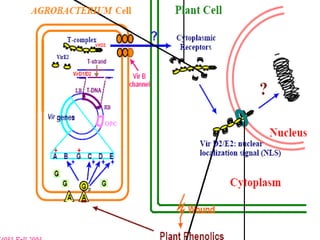
   A plant cell becomes susceptible to A grobacterium
    when it is wounded.The wounded cells release
    phenolic compounds, such as acetosyringone,
    that activate the vir-region of the bacterial
    plasmid.

   The A grobacterium plasmid carries three genetic
    components that are required for plant cell
   The A grobacterium plasmid carries three genetic
    components that are required for plant cell
    transformation.

    It has been shown that the A grobacterium plasmid
    carries three genetic components that are
    required for plant cell transformation.

    The first component, the T-DNA that is
    integrated into the plant cells, is a mobile DNA
    element.
The second one is the virulence area (vir), which
contains several vir genes.

These genes do not enter the plant cell but,
together with the chromosomal DNA (two loci),
cause the transfer of T-DNA. The third
component, the so-called border sequences (25
bp), resides in the Agrobacterium chromosome.

The mobility of T-DNA is largely determined by
these sequences, and they are the only cis
elements necessary for direct T-DNA processing.
ADVANTAGES
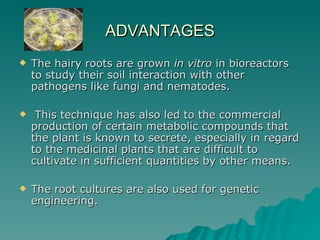
   The hairy roots are grown in vitro in bioreactors
    to study their soil interaction with other
    pathogens like fungi and nematodes.

    This technique has also led to the commercial
    production of certain metabolic compounds that
    the plant is known to secrete, especially in regard
    to the medicinal plants that are difficult to
    cultivate in sufficient quantities by other means.

   The root cultures are also used for genetic
    engineering.

Agrobacterium

  • 2.
    INTRODUCTION  Transformation – the process of obtaining transgenic plants.  Transgenic plant – a plant with a foreign gene (or genes) from another plant/animal that is incorporated into its chromosome
  • 3.
    Agrobacterium rhizogenes  A grobacterium rhizogenes is a Gram negative soil bacterium that produces hairy root disease in dicotyledonous plants.  A .rhizogenes induces the formation of proliferate multi- branched adventitious roots at the site of infection; so called ‘hairy roots’.  A.rhizogenes, the causative agent of hairy root syndrome, is a common soil organism capable of entering a plant through a wound and causing a proliferation of secondary roots.
  • 4.
    Ri plasmids  Ri plasmids are large (200 to greater than 800 kb) and contain one or two regions of T-DNA and a vir (virulence) region, all of which are necessary for hairy root formation.  The Ri-plasmids are grouped into two main classes according to the opines synthesized by hairy roots.  First, agropine-type strains induce roots to synthesise agropine, mannopine and the related acids.
  • 5.
    Second, mannopine-type strains induce roots to produce mannopine and the corresponding acids.  The agropine-type Ri-plasmids are very similar as a group and a quite distinct group from the mannopine-type plasmids.
  • 7.
    The genes responsiblefor hairy root formation  The T-DNA of the agropine-type Ri-plasmid consists of two separate T-DNA regions designed the TL-DNA and TR-DNA (15 - 20 kb).These two fragments can be transferred independently during the infection process.  The genes encoding auxin synthesis (tms1 and tms2) and agropine synthesis (ags) have been localised on the TR-DNA of the agropine type Ri-plasmid.  The mannopine type Ri-plasmids contain only one T-DNA that shares considerable DNA
  • 8.
    rolA, rolB, and rolC play the most important role in hairy root induction.  rolA is associated with internode shortening and leaf wrinkling; rolB is responsible for protruding stigmas and reduced length of stamens; rolC causes internode shortening and reduced apical dominance.  Although the TR-DNA is not essential for hairy root formation it has been shown that the aux1 gene harbored in this segment provides to the trasformed cells with an additional source of auxin.
  • 9.
    M e ch a n is m o f A g r o b a c t e r iu m-p l a n t c e l l in t e r a c t io n  One of the earliest stages in the interaction between A grobacterium and a plant is the attachment of the bacterium to the surface of the plant cell.  A plant cell becomes susceptible to A grobacterium when it is wounded.The wounded cells release phenolic compounds, such as acetosyringone, that activate the vir-region of the bacterial plasmid.  The A grobacterium plasmid carries three genetic components that are required for plant cell
  • 10.
    The A grobacterium plasmid carries three genetic components that are required for plant cell transformation. It has been shown that the A grobacterium plasmid carries three genetic components that are required for plant cell transformation. The first component, the T-DNA that is integrated into the plant cells, is a mobile DNA element.
  • 12.
    The second oneis the virulence area (vir), which contains several vir genes. These genes do not enter the plant cell but, together with the chromosomal DNA (two loci), cause the transfer of T-DNA. The third component, the so-called border sequences (25 bp), resides in the Agrobacterium chromosome. The mobility of T-DNA is largely determined by these sequences, and they are the only cis elements necessary for direct T-DNA processing.
  • 13.
    ADVANTAGES  The hairy roots are grown in vitro in bioreactors to study their soil interaction with other pathogens like fungi and nematodes.  This technique has also led to the commercial production of certain metabolic compounds that the plant is known to secrete, especially in regard to the medicinal plants that are difficult to cultivate in sufficient quantities by other means.  The root cultures are also used for genetic engineering.