PUBLIC REVENUE
Dr Julie P. Lazar
Assistant Professor
Department of Economics
St. Mary’s College, Thrissur
Public Revenue, Dr Julie P. Lazar, St Mary’s College, Thrissur
PUBLIC REVENUE
• Govt. needs to perform various functions to maximise social and
economic welfare and this requires large amount of resources.
These economic resources are called public revenue.
• This is also known as Public Income/ Public Receipts
• It is the income of the government from all sources
• It includes tax and non tax receipts, public borrowing and income
from public sector enterprises
Public Revenue, Dr Julie P. Lazar, St Mary’s College, Thrissur
TYPES OF PUBLIC REVENUE
• Tax Revenue- Main source of revenue of the state
• Non Tax Revenue
• Administrative Revenue
• Commercial Revenue- Also Called Price
• Gift and Grants
• Borrowing
• Printing of Currency
Public Revenue, Dr Julie P. Lazar, St Mary’s College, Thrissur
TAX
• Compulsory contribution made by people to government for no
direct benefit in return
• Taussig- The essence of a tax , as distinguished from other charges
by government is the absence of direct quid pro quo between tax
payer and public authority
• Seligman- A tax is a compulsory contribution from a person to
government to defray the expenses incurred in the common
interest of all without reference to special benefits conferred.
Public Revenue, Dr Julie P. Lazar, St Mary’s College, Thrissur
CHARACTERISTICS OF TAX
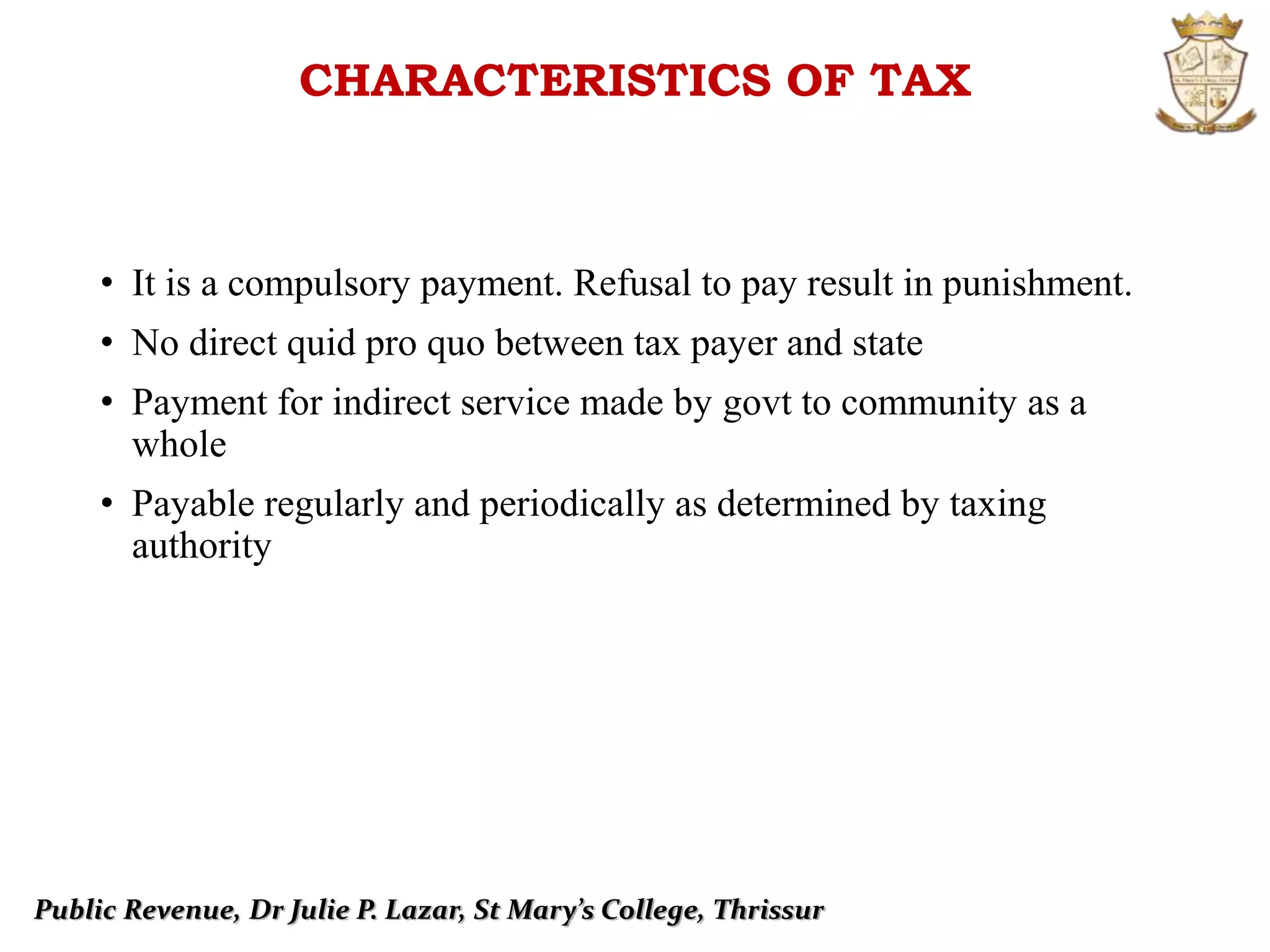
• It is a compulsory payment. Refusal to pay result in punishment.
• No direct quid pro quo between tax payer and state
• Payment for indirect service made by govt to community as a
whole
• Payable regularly and periodically as determined by taxing
authority
Public Revenue, Dr Julie P. Lazar, St Mary’s College, Thrissur
ADMINISTRATIVE REVENUE
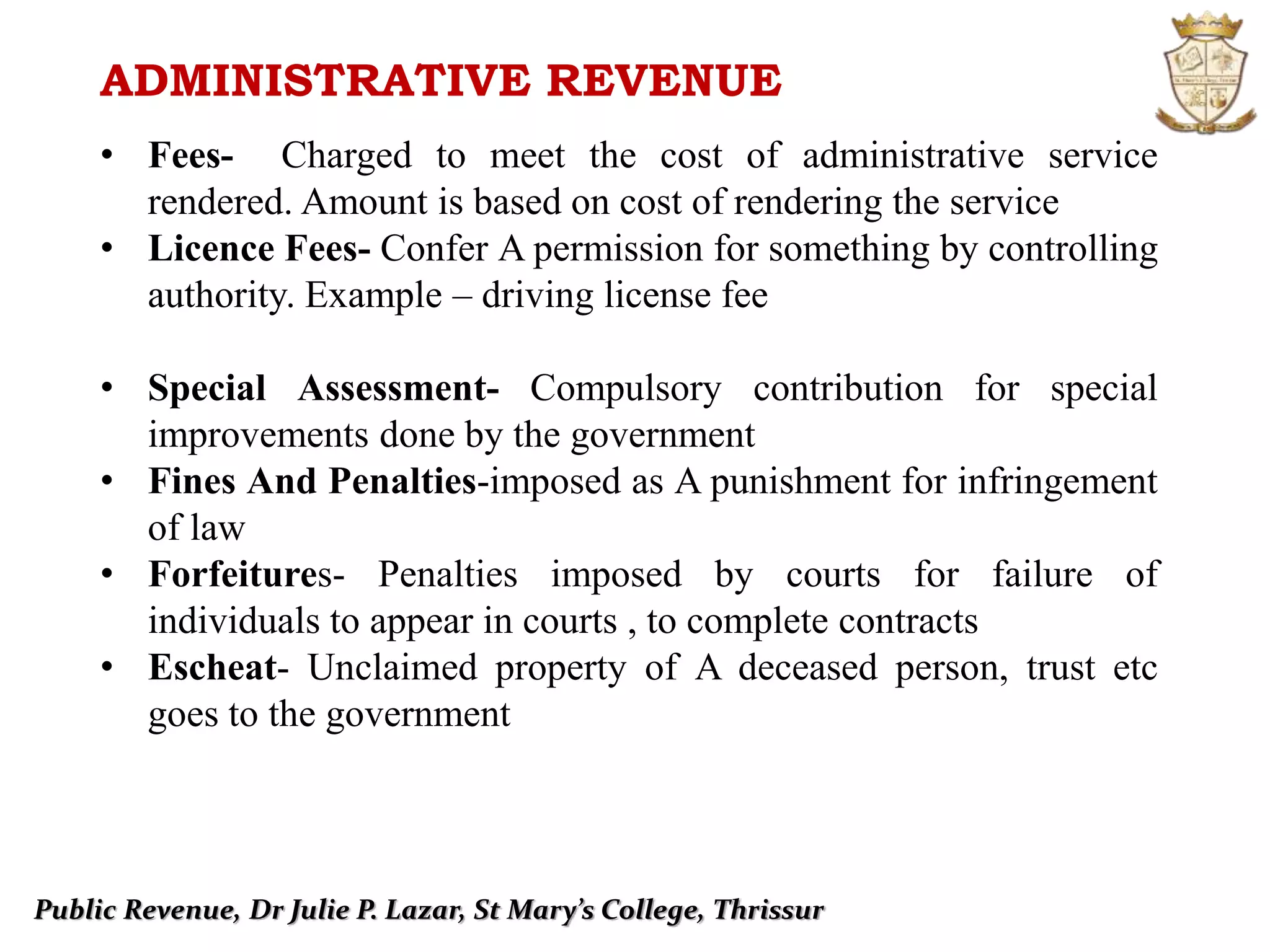
• Fees- Charged to meet the cost of administrative service
rendered. Amount is based on cost of rendering the service
• Licence Fees- Confer A permission for something by controlling
authority. Example – driving license fee
• Special Assessment- Compulsory contribution for special
improvements done by the government
• Fines And Penalties-imposed as A punishment for infringement
of law
• Forfeitures- Penalties imposed by courts for failure of
individuals to appear in courts , to complete contracts
• Escheat- Unclaimed property of A deceased person, trust etc
goes to the government
Public Revenue, Dr Julie P. Lazar, St Mary’s College, Thrissur
OTHER NON TAX REVENUE
• Gift and Grants-gifts are donations from individuals or charitable
organisations. Grants are also given by one country to other or
from one government to other. Also termed as foreign aid.
• Commercial Revenue-also called as price, income earned by sale
of goods and services of governement owned companies or
agencies
• Borrowing- borrowing from within the country and outside from
individuals , agencies and governments
• Printing of currency- done in extreme situations, leads to
hyperinflation
DIRECT AND INDIRECT TAXES
• DIRECT TAX
• Paid by the person on whom
it is imposed
• Impact and incidence falls on
one and the same person
• Tax shifting does not take
place
• Tax payer is tax bearer
• Eg- income tax, wealth tax
• INDIRECT TAX
• Paid by one person, burden
borne by other
• Impact and incidence falls on
different persons
• Tax Shifting take place
• Tax payer is not tax bearer
• Eg sale tax, excise duty
Public Revenue, Dr Julie P. Lazar, St Mary’s College, Thrissur
PROGRESSIVE TAXES
Tax base and tax rate are directly related, as tax base
increases tax rate also increases
TAX BASE (in Rs) TAX RATE (in %) AMOUNT OF TAX(in Rs)
100000 10 10000
200000 20 40000
300000 30 90000
400000 40 160000
Public Revenue, Dr Julie P. Lazar, St Mary’s College, Thrissur
PROPORTIONAL TAX
As tax base increases tax rate remains the same, but
amount of tax increases
TAX BASE (in Rs) TAX RATE (in %) AMOUNT OF TAX(in Rs)
100000 10 10000
200000 10 20000
300000 10 30000
400000 10 40000
Public Revenue, Dr Julie P. Lazar, St Mary’s College, Thrissur
REGRESSIVE TAX
As tax base increases tax rate decreases
TAX BASE (in Rs) TAX RATE (in %) AMOUNT OF TAX(in Rs)
100000 15 15000
200000 12 24000
300000 9 27000
400000 7 28000
Public Revenue, Dr Julie P. Lazar, St Mary’s College, Thrissur
Degressive tax
It’s a mix of Progressive and proportional tax. Initially tax rate
increases and then remains same
TAX BASE (in Rs) TAX RATE (in %) AMOUNT OF TAX(in Rs)
100000 10 10000
200000 20 40000
300000 30 90000
400000 30 120000
Public Revenue, Dr Julie P. Lazar, St Mary’s College, Thrissur
SPECIFIC AND AD VALOREM TAX
Specific Tax- Levied on weight of the commodity or some external
measures. - Specific duties are expressed as definite sum to be paid
for a definite measure or weight
Eg - Rupees per meter of cloth.
Ad valorem tax – Levied on basis of value of the commodity.
Expressed as percent of value of commodity
Eg - three percent of value of the commodity
Public Revenue, Dr Julie P. Lazar, St Mary’s College, Thrissur
SINGLE AND MULTIPLE TAX
• Single Tax- Levied on one item/ one head / one class of things /
one class of people
• Double Tax- Levied on same base twice by different tax
authorities or same base taxed twice by same body
• Multiple tax – There are different kinds of taxes- direct and
indirect, differing degrees and different bases so that each citizen
contributes to state revenue
Public Revenue, Dr Julie P. Lazar, St Mary’s College, Thrissur
CONCLUSION
The sources of public revenue are large, so is the expenditure of the
state. A judicious mix of different types of taxes brings sufficient
revenue to the government and makes the tax system diverse and
widespread. Hence the overall impact of taxation on common man
will be reduced.

Economics:Public Revenue

  • 1.
    PUBLIC REVENUE Dr JulieP. Lazar Assistant Professor Department of Economics St. Mary’s College, Thrissur
  • 2.
    Public Revenue, DrJulie P. Lazar, St Mary’s College, Thrissur PUBLIC REVENUE • Govt. needs to perform various functions to maximise social and economic welfare and this requires large amount of resources. These economic resources are called public revenue. • This is also known as Public Income/ Public Receipts • It is the income of the government from all sources • It includes tax and non tax receipts, public borrowing and income from public sector enterprises
  • 3.
    Public Revenue, DrJulie P. Lazar, St Mary’s College, Thrissur TYPES OF PUBLIC REVENUE • Tax Revenue- Main source of revenue of the state • Non Tax Revenue • Administrative Revenue • Commercial Revenue- Also Called Price • Gift and Grants • Borrowing • Printing of Currency
  • 4.
    Public Revenue, DrJulie P. Lazar, St Mary’s College, Thrissur TAX • Compulsory contribution made by people to government for no direct benefit in return • Taussig- The essence of a tax , as distinguished from other charges by government is the absence of direct quid pro quo between tax payer and public authority • Seligman- A tax is a compulsory contribution from a person to government to defray the expenses incurred in the common interest of all without reference to special benefits conferred.
  • 5.
    Public Revenue, DrJulie P. Lazar, St Mary’s College, Thrissur CHARACTERISTICS OF TAX • It is a compulsory payment. Refusal to pay result in punishment. • No direct quid pro quo between tax payer and state • Payment for indirect service made by govt to community as a whole • Payable regularly and periodically as determined by taxing authority
  • 6.
    Public Revenue, DrJulie P. Lazar, St Mary’s College, Thrissur ADMINISTRATIVE REVENUE • Fees- Charged to meet the cost of administrative service rendered. Amount is based on cost of rendering the service • Licence Fees- Confer A permission for something by controlling authority. Example – driving license fee • Special Assessment- Compulsory contribution for special improvements done by the government • Fines And Penalties-imposed as A punishment for infringement of law • Forfeitures- Penalties imposed by courts for failure of individuals to appear in courts , to complete contracts • Escheat- Unclaimed property of A deceased person, trust etc goes to the government
  • 7.
    Public Revenue, DrJulie P. Lazar, St Mary’s College, Thrissur OTHER NON TAX REVENUE • Gift and Grants-gifts are donations from individuals or charitable organisations. Grants are also given by one country to other or from one government to other. Also termed as foreign aid. • Commercial Revenue-also called as price, income earned by sale of goods and services of governement owned companies or agencies • Borrowing- borrowing from within the country and outside from individuals , agencies and governments • Printing of currency- done in extreme situations, leads to hyperinflation
  • 8.
    DIRECT AND INDIRECTTAXES • DIRECT TAX • Paid by the person on whom it is imposed • Impact and incidence falls on one and the same person • Tax shifting does not take place • Tax payer is tax bearer • Eg- income tax, wealth tax • INDIRECT TAX • Paid by one person, burden borne by other • Impact and incidence falls on different persons • Tax Shifting take place • Tax payer is not tax bearer • Eg sale tax, excise duty
  • 9.
    Public Revenue, DrJulie P. Lazar, St Mary’s College, Thrissur PROGRESSIVE TAXES Tax base and tax rate are directly related, as tax base increases tax rate also increases TAX BASE (in Rs) TAX RATE (in %) AMOUNT OF TAX(in Rs) 100000 10 10000 200000 20 40000 300000 30 90000 400000 40 160000
  • 10.
    Public Revenue, DrJulie P. Lazar, St Mary’s College, Thrissur PROPORTIONAL TAX As tax base increases tax rate remains the same, but amount of tax increases TAX BASE (in Rs) TAX RATE (in %) AMOUNT OF TAX(in Rs) 100000 10 10000 200000 10 20000 300000 10 30000 400000 10 40000
  • 11.
    Public Revenue, DrJulie P. Lazar, St Mary’s College, Thrissur REGRESSIVE TAX As tax base increases tax rate decreases TAX BASE (in Rs) TAX RATE (in %) AMOUNT OF TAX(in Rs) 100000 15 15000 200000 12 24000 300000 9 27000 400000 7 28000
  • 12.
    Public Revenue, DrJulie P. Lazar, St Mary’s College, Thrissur Degressive tax It’s a mix of Progressive and proportional tax. Initially tax rate increases and then remains same TAX BASE (in Rs) TAX RATE (in %) AMOUNT OF TAX(in Rs) 100000 10 10000 200000 20 40000 300000 30 90000 400000 30 120000
  • 13.
    Public Revenue, DrJulie P. Lazar, St Mary’s College, Thrissur SPECIFIC AND AD VALOREM TAX Specific Tax- Levied on weight of the commodity or some external measures. - Specific duties are expressed as definite sum to be paid for a definite measure or weight Eg - Rupees per meter of cloth. Ad valorem tax – Levied on basis of value of the commodity. Expressed as percent of value of commodity Eg - three percent of value of the commodity
  • 14.
    Public Revenue, DrJulie P. Lazar, St Mary’s College, Thrissur SINGLE AND MULTIPLE TAX • Single Tax- Levied on one item/ one head / one class of things / one class of people • Double Tax- Levied on same base twice by different tax authorities or same base taxed twice by same body • Multiple tax – There are different kinds of taxes- direct and indirect, differing degrees and different bases so that each citizen contributes to state revenue
  • 15.
    Public Revenue, DrJulie P. Lazar, St Mary’s College, Thrissur CONCLUSION The sources of public revenue are large, so is the expenditure of the state. A judicious mix of different types of taxes brings sufficient revenue to the government and makes the tax system diverse and widespread. Hence the overall impact of taxation on common man will be reduced.