PUBLIC DEBT
Dr Julie P. Lazar
Assistant Professor
Department of Economics
St. Mary’s College, Thrissur
Public Debt , Dr Julie P. Lazar, St Mary’s College, Thrissur
DEFINITIONS
Public debt refers to loan raised by a government within the country
or a form of promise outside the country.
Philip E. Taylor- the debt is in form of promose by treasury to pay
the holders of these promises a principal sum anain most instances
interest on that principal
Findlay Shirras- National debt is a debt which the state owes to its
subjects or nationals of other countries
Public Debt , Dr Julie P. Lazar, St Mary’s College, Thrissur
OBJECTIVES/ CAUSES
• To cover budgetary deficit
• Unpopularity of taxation
• To maintain economic stability
• To maintain economic development
• To meet unexpected contingencies
• To finance wars
• To finance public sector enterprises
• For welfare Programmes
• To create social overheads
• For better resource allocation
• Create essential non income yielding assets
Public Debt , Dr Julie P. Lazar, St Mary’s College, Thrissur
CLASSIFICATION OF PUBLIC DEBT
• Internal and External
• Productive and Unproductive
• Voluntary and Compulsory
• Redeemable and Irredeemable
• Short, Medium and Long Term
• Funded and Unfunded
• Marketable and Non Marketable
• Gross and Net
Public Debt , Dr Julie P. Lazar, St Mary’s College, Thrissur
Internal/ External Debt
• Internal Loans are raised from individuals, NBFIs, Commercial
banks and Central bank within the area controlled by public
authority.
Involves only transfer of funds from people to Government
with the country.
Productive capacity is not affected
• External Loans are raised from individuals or institutions outside
the area controlled by public authority.
Net payments go out of the country as interest payments.
Productive capacity is adversely affected since interest
payments are made
Public Debt , Dr Julie P. Lazar, St Mary’s College, Thrissur
Productive/Unproductive Debt
- Productive Debts are loans used for projects which yield income
to government. Eg construction of steel plants, power projects.
These debts are fully covered by assets.
- Unproductive Debts are loans used for projects which do not
yield income to government. Eg financing war, flood relief. They
are called dead weight debts as they do not create any assets
Voluntary/ Compulsory Debt
- In case of Voluntary Debts people contribute to Govenments loan
programme without any compulsion.
- Compulsory debt implies government use force or pressure for
making people subscribe government loans
-
• .
Public Debt , Dr Julie P. Lazar, St Mary’s College, Thrissur
Redeemable/ Irredeemable Debt
Redeemable debt are those for which the government is committed
to repay at an appointed date.
Loans for which no commitment is made are irredeemable debt.
Short/Medium/ Long Term loans
Short term loans is usually incurred for period from 3 months to
one year. Generally for covering temporary deficits in budgets.
Medium term loans are those which are obtained for more than a
year and less than 10 years. Eg- For war finance, meet expenditure
on education etc
Public Debt , Dr Julie P. Lazar, St Mary’s College, Thrissur
Long Term loans is repayable after long period, generally for a
period of 10 years and above. Generally for development finance
Funded/ Unfunded Debts
Funded debt is a long term debt usually for creation of permanent
asset. Provision is made for repayment of loan
Unfunded debt is a short term debt for meeting the current needs and
paid off within a year.
Marketable and Non Marketable Debts
In case of marketable loan, the securities are traded or negotiable in
the open market.
If the bonds are tradable in the stock market, it is non negotiable or
non marketable loan.
Public Debt , Dr Julie P. Lazar, St Mary’s College, Thrissur
Gross/ Net Debt
Gross Debt refers to total amount of debt outstanding at any
time.
Net debt refers to gross debt minus funds earmarked for
repayment.
Mrs Hicks Classification
Dead weight debts- this do not increase the productive
powers of the country
Passive debt – does not yield money income and does not
increase productive powers
Active debts- creation of assets which do not increase
productive power of the community
Public Debt , Dr Julie P. Lazar, St Mary’s College, Thrissur
REDEMPTION OF PUBLIC DEBT
Govt borrows with a promise to repay the Principal and interest.
Growing public debt means increasing burden and greater taxation
in future which has demoralising effect. If govt fails to meet the
previous obligations they will not be able to raise new loans in the
future. Redemption of Public Debt means repayment of debt
Public Debt , Dr Julie P. Lazar, St Mary’s College, Thrissur
Repudiation
• Government refuses to repay the debt.
• Government does not recognise its obligation to repay the
loan- the principal and interest
• Unilateral decision of the borrower.
Methods
• Partial Repudiation- govt. either repays the interest or part of
Principal only
• repudiation by means of inflation of currency
Cancellation
• The debt is not repaid . Agreed upon by lender and borrower
for non repayment.
• Bilateral decision
Public Debt , Dr Julie P. Lazar, St Mary’s College, Thrissur
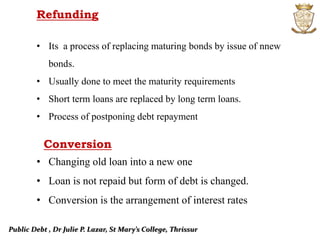
Refunding
• Its a process of replacing maturing bonds by issue of nnew
bonds.
• Usually done to meet the maturity requirements
• Short term loans are replaced by long term loans.
• Process of postponing debt repayment
Conversion
• Changing old loan into a new one
• Loan is not repaid but form of debt is changed.
• Conversion is the arrangement of interest rates
Public Debt , Dr Julie P. Lazar, St Mary’s College, Thrissur
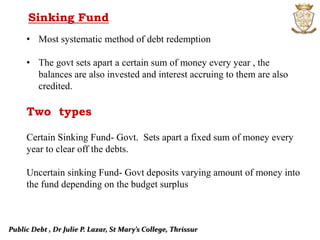
Sinking Fund
• Most systematic method of debt redemption
• The govt sets apart a certain sum of money every year , the
balances are also invested and interest accruing to them are also
credited.
Two types
Certain Sinking Fund- Govt. Sets apart a fixed sum of money every
year to clear off the debts.
Uncertain sinking Fund- Govt deposits varying amount of money into
the fund depending on the budget surplus
Public Debt , Dr Julie P. Lazar, St Mary’s College, Thrissur
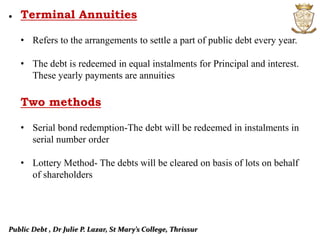
• Terminal Annuities
• Refers to the arrangements to settle a part of public debt every year.
• The debt is redeemed in equal instalments for Principal and interest.
These yearly payments are annuities
Two methods
• Serial bond redemption-The debt will be redeemed in instalments in
serial number order
• Lottery Method- The debts will be cleared on basis of lots on behalf
of shareholders
Public Debt , Dr Julie P. Lazar, St Mary’s College, Thrissur
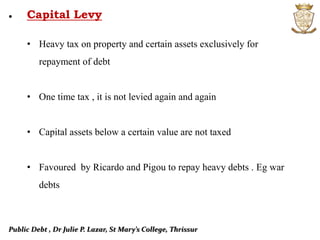
• Capital Levy
• Heavy tax on property and certain assets exclusively for
repayment of debt
• One time tax , it is not levied again and again
• Capital assets below a certain value are not taxed
• Favoured by Ricardo and Pigou to repay heavy debts . Eg war
debts
Public Debt , Dr Julie P. Lazar, St Mary’s College, Thrissur
• Redemption of External Debts
• Possible only through earning foreign exchange, done by creating
export surplus ( unrequired exports)
• If foreign funds are invested in those areas of export producing goods
loans may be easily repaid
• If loans are utilised for unproductive purpose, export surplus may
increase cost of home consumption and increase burden of public debt

Economics:Public Debt

  • 1.
    PUBLIC DEBT Dr JulieP. Lazar Assistant Professor Department of Economics St. Mary’s College, Thrissur
  • 2.
    Public Debt ,Dr Julie P. Lazar, St Mary’s College, Thrissur DEFINITIONS Public debt refers to loan raised by a government within the country or a form of promise outside the country. Philip E. Taylor- the debt is in form of promose by treasury to pay the holders of these promises a principal sum anain most instances interest on that principal Findlay Shirras- National debt is a debt which the state owes to its subjects or nationals of other countries
  • 3.
    Public Debt ,Dr Julie P. Lazar, St Mary’s College, Thrissur OBJECTIVES/ CAUSES • To cover budgetary deficit • Unpopularity of taxation • To maintain economic stability • To maintain economic development • To meet unexpected contingencies • To finance wars • To finance public sector enterprises • For welfare Programmes • To create social overheads • For better resource allocation • Create essential non income yielding assets
  • 4.
    Public Debt ,Dr Julie P. Lazar, St Mary’s College, Thrissur CLASSIFICATION OF PUBLIC DEBT • Internal and External • Productive and Unproductive • Voluntary and Compulsory • Redeemable and Irredeemable • Short, Medium and Long Term • Funded and Unfunded • Marketable and Non Marketable • Gross and Net
  • 5.
    Public Debt ,Dr Julie P. Lazar, St Mary’s College, Thrissur Internal/ External Debt • Internal Loans are raised from individuals, NBFIs, Commercial banks and Central bank within the area controlled by public authority. Involves only transfer of funds from people to Government with the country. Productive capacity is not affected • External Loans are raised from individuals or institutions outside the area controlled by public authority. Net payments go out of the country as interest payments. Productive capacity is adversely affected since interest payments are made
  • 6.
    Public Debt ,Dr Julie P. Lazar, St Mary’s College, Thrissur Productive/Unproductive Debt - Productive Debts are loans used for projects which yield income to government. Eg construction of steel plants, power projects. These debts are fully covered by assets. - Unproductive Debts are loans used for projects which do not yield income to government. Eg financing war, flood relief. They are called dead weight debts as they do not create any assets Voluntary/ Compulsory Debt - In case of Voluntary Debts people contribute to Govenments loan programme without any compulsion. - Compulsory debt implies government use force or pressure for making people subscribe government loans - • .
  • 7.
    Public Debt ,Dr Julie P. Lazar, St Mary’s College, Thrissur Redeemable/ Irredeemable Debt Redeemable debt are those for which the government is committed to repay at an appointed date. Loans for which no commitment is made are irredeemable debt. Short/Medium/ Long Term loans Short term loans is usually incurred for period from 3 months to one year. Generally for covering temporary deficits in budgets. Medium term loans are those which are obtained for more than a year and less than 10 years. Eg- For war finance, meet expenditure on education etc
  • 8.
    Public Debt ,Dr Julie P. Lazar, St Mary’s College, Thrissur Long Term loans is repayable after long period, generally for a period of 10 years and above. Generally for development finance Funded/ Unfunded Debts Funded debt is a long term debt usually for creation of permanent asset. Provision is made for repayment of loan Unfunded debt is a short term debt for meeting the current needs and paid off within a year. Marketable and Non Marketable Debts In case of marketable loan, the securities are traded or negotiable in the open market. If the bonds are tradable in the stock market, it is non negotiable or non marketable loan.
  • 9.
    Public Debt ,Dr Julie P. Lazar, St Mary’s College, Thrissur Gross/ Net Debt Gross Debt refers to total amount of debt outstanding at any time. Net debt refers to gross debt minus funds earmarked for repayment. Mrs Hicks Classification Dead weight debts- this do not increase the productive powers of the country Passive debt – does not yield money income and does not increase productive powers Active debts- creation of assets which do not increase productive power of the community
  • 10.
    Public Debt ,Dr Julie P. Lazar, St Mary’s College, Thrissur REDEMPTION OF PUBLIC DEBT Govt borrows with a promise to repay the Principal and interest. Growing public debt means increasing burden and greater taxation in future which has demoralising effect. If govt fails to meet the previous obligations they will not be able to raise new loans in the future. Redemption of Public Debt means repayment of debt
  • 11.
    Public Debt ,Dr Julie P. Lazar, St Mary’s College, Thrissur Repudiation • Government refuses to repay the debt. • Government does not recognise its obligation to repay the loan- the principal and interest • Unilateral decision of the borrower. Methods • Partial Repudiation- govt. either repays the interest or part of Principal only • repudiation by means of inflation of currency Cancellation • The debt is not repaid . Agreed upon by lender and borrower for non repayment. • Bilateral decision
  • 12.
    Public Debt ,Dr Julie P. Lazar, St Mary’s College, Thrissur Refunding • Its a process of replacing maturing bonds by issue of nnew bonds. • Usually done to meet the maturity requirements • Short term loans are replaced by long term loans. • Process of postponing debt repayment Conversion • Changing old loan into a new one • Loan is not repaid but form of debt is changed. • Conversion is the arrangement of interest rates
  • 13.
    Public Debt ,Dr Julie P. Lazar, St Mary’s College, Thrissur Sinking Fund • Most systematic method of debt redemption • The govt sets apart a certain sum of money every year , the balances are also invested and interest accruing to them are also credited. Two types Certain Sinking Fund- Govt. Sets apart a fixed sum of money every year to clear off the debts. Uncertain sinking Fund- Govt deposits varying amount of money into the fund depending on the budget surplus
  • 14.
    Public Debt ,Dr Julie P. Lazar, St Mary’s College, Thrissur • Terminal Annuities • Refers to the arrangements to settle a part of public debt every year. • The debt is redeemed in equal instalments for Principal and interest. These yearly payments are annuities Two methods • Serial bond redemption-The debt will be redeemed in instalments in serial number order • Lottery Method- The debts will be cleared on basis of lots on behalf of shareholders
  • 15.
    Public Debt ,Dr Julie P. Lazar, St Mary’s College, Thrissur • Capital Levy • Heavy tax on property and certain assets exclusively for repayment of debt • One time tax , it is not levied again and again • Capital assets below a certain value are not taxed • Favoured by Ricardo and Pigou to repay heavy debts . Eg war debts
  • 16.
    Public Debt ,Dr Julie P. Lazar, St Mary’s College, Thrissur • Redemption of External Debts • Possible only through earning foreign exchange, done by creating export surplus ( unrequired exports) • If foreign funds are invested in those areas of export producing goods loans may be easily repaid • If loans are utilised for unproductive purpose, export surplus may increase cost of home consumption and increase burden of public debt