Gene Transfer system in plants
Dr.S.Karthikumar
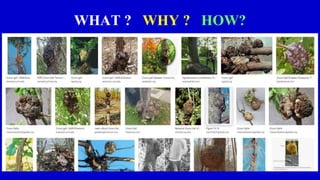
WHAT ? WHY ? HOW?
Genetic Engineering of Plants
• Must get DNA:
1. into the cells
2. integrated into the genome (unless using transient
expression assays)
3. expressed (everywhere or controlled)
• For (1) and (2), two main approaches for plants:
1. Agrobacterium - mediated gene transfer
2. Direct gene transfer
• For (3), use promoter that will direct expression when
and where wanted – may also require other
modifications such as removing or replacing introns.
Agrobacterium - mediated Gene Transfer
• Most common method of engineering dicots, but also
used for monocots
• Pioneered by J. Schell (Max-Planck Inst., Cologne)
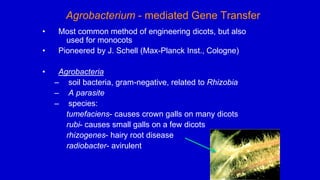
• Agrobacteria
– soil bacteria, gram-negative, related to Rhizobia
– A parasite
– species:
tumefaciens- causes crown galls on many dicots
rubi- causes small galls on a few dicots
rhizogenes- hairy root disease
radiobacter- avirulent
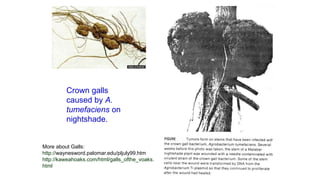
Crown galls
caused by A.
tumefaciens on
nightshade.
More about Galls:
http://waynesword.palomar.edu/pljuly99.htm
http://kaweahoaks.com/html/galls_ofthe_voaks.
html
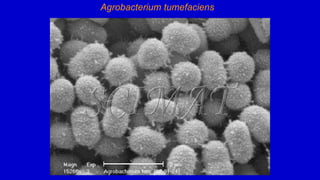
Agrobacterium tumefaciens
• the species of choice for engineering dicot plants; monocots
are generally resistant
• some dicots more resistant than others (a genetic basis for
this)
• complex bacterium – genome has been sequenced; 4
chromosomes; ~ 5500 genes
Agrobacterium tumefaciens
Infection and tumorigenesis
• Infection occurs at wound sites
• Involves recognition and chemotaxis of the bacterium toward
wounded cells
• galls are “real tumors”, can be removed and will grow
indefinitely without hormones
• genetic information must be transferred to plant cells
Tumor characteristics
1. Synthesize a unique amino acid, called “opine”
– octopine and nopaline - derived from
arginine
– agropine - derived from glutamate
2. Opine depends on the strain of A. tumefaciens
3. Opines are catabolized by the bacteria, which
can use only the specific opine that it causes
the plant to produce.
4. Has obvious advantages for the bacteria
Elucidation of the TIP (tumor-
inducing principle)
• It was recognized early that virulent strains could be cured of
virulence, and that cured strains could regain virulence
when exposed to virulent strains; suggested an extra-
chromosomal element.
• Large plasmids were found in A. tumefaciens and their
presence correlated with virulence: called tumor-inducing or
Ti plasmids.
Ti Plasmid
1. Large ( 200-kb), circular
2. Conjugative
3. ~10% of plasmid transferred to plant cell
after infection
4. 3-5% of chromosome – independent
replication
5. Transferred DNA (called T-DNA) integrates
semi-randomly into nuclear DNA
6. Ti plasmid also encodes:
– enzymes involved in opine metabolism
– proteins involved in mobilizing T-DNA (Vir
genes)
– Tumor induction
Opines
• Low molecular weight
• Diffuse from plant cells – Bacterial cells
• Promote the transfer of Ti-Plasmid
• C, N source for bacteria
• Genetic colonization
• Induce conjugation
Classification
• Based on opine they produce
• Oct-Ti I, Ti II,
• Nop-Ti
• Agro-Ti
• Agro-Ri
Classification
Ti-plasmid (T-I): Octopine
• Agropine : CHO derivative /
• Octopine : Arg + pyruate condensation
• Mannopine
Ti-plasmid (T-II): Octopine
• Only octopine
• Narrow host range
• Low homology
Nopaline-Ti plasmid
• Arg + alpha keto glutarate
• Agrocine – A,B
• Heterogenous group
Agropine Ti
• Agropine + mannopine
• Agrocine- C,D
• Rough tumor, adv.shoot proliferation
Structure
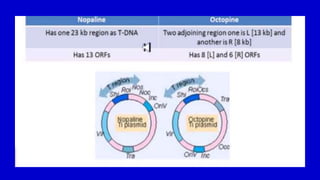
• Octopine : 23 kb
• Nop : 13Kb L, 8 Kb R
• Base region is not closely related
• Homologous regions
• 4 regions/ 9Kb
– Oncogenic region
– Opine metabolism
– Replication control region
– Conjugation control region
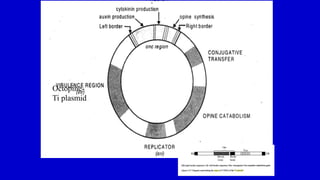
Octopine-
Ti plasmid
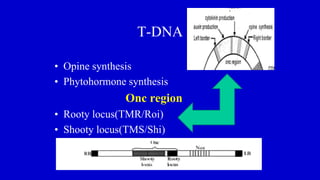
T-DNA
• Opine synthesis
• Phytohormone synthesis
Onc region
• Rooty locus(TMR/Roi)
• Shooty locus(TMS/Shi)
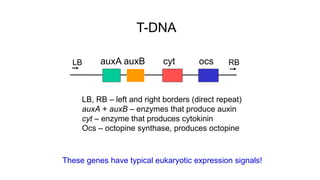
auxA auxB cyt ocs
LB RB
LB, RB – left and right borders (direct repeat)
auxA + auxB – enzymes that produce auxin
cyt – enzyme that produces cytokinin
Ocs – octopine synthase, produces octopine
T-DNA
These genes have typical eukaryotic expression signals!
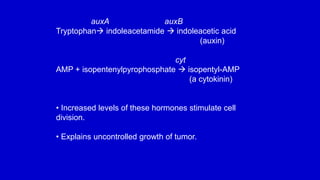
auxA auxB
Tryptophan indoleacetamide  indoleacetic acid
(auxin)
cyt
AMP + isopentenylpyrophosphate  isopentyl-AMP
(a cytokinin)
• Increased levels of these hormones stimulate cell
division.
• Explains uncontrolled growth of tumor.
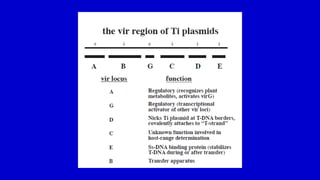
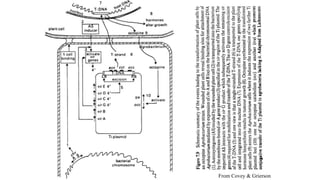
Vir (virulent) genes
1. On the Ti plasmid
2. Span : 40-Kb
3. 24 genes involved
4. 8-operons(Vir A-H)
5. Transfer the T-DNA to plant cell
6. Acetosyringone (AS) (a flavonoid) released by
wounded plant cells activates vir genes.
7. virA,B,C,D,E,F,G (7 complementation
groups, but some have multiple ORFs)
Vir (virulent) genes
• Accessing T-DNA from Ti-plasmid
• DNA transfer
• Targeting of T-DNA to plant nucleus
• T-DNA integration
Vir gene functions (cont.)
• virA - transports AS into bacterium, activates
virG post-translationally (by phosphoryl.)
• virG - promotes transcription of other vir genes
• virD2 - endonuclease/integrase that cuts T-
DNA at the borders but only on one strand;
attaches to the 5' end of the SS
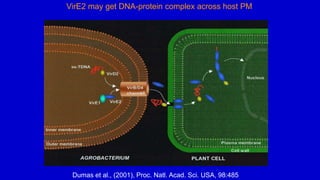
• virE2 - binds SS of T-DNA & can form channels
in artificial membranes
• virE1 - chaperone for virE2
• virD2 & virE2 also have NLSs, gets T-DNA to
the nucleus of plant cell
• virB - operon of 11 proteins, gets T-DNA
through bacterial membranes
Chromosomal Genes
• Chv A, Chv B, : Exopolysacchride binding
• Psc A : T-DNA transfer
• Chv E : Glucose/ Galactose Transporter
• Binds to sugar – induces Vir genes
https://www.indiabix.com/biotechnology/gene-
transfer-in-plants/011006
https://www.mcqbiology.com/2012/11/mcq-on-
biotechnology-gene-
transfer.html#.X736Ks0zZPY
From Covey & Grierson
VirE2 may get DNA-protein complex across host PM
Dumas et al., (2001), Proc. Natl. Acad. Sci. USA, 98:485
• Monocots don't produce AS in response to
wounding.
• Important: Put any DNA between the LB and RB
of T-DNA it will be transferred to plant cell!
Engineering plants with Agrobacterium:
Two problems had to be overcome:
(1) Ti plasmids large, difficult to manipulate
(2) couldn't regenerate plants from tumors
Ti plasmid derived vectors
Binary and Cointegrate Vectors
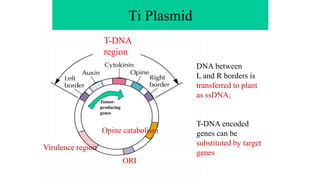
Ti Plasmid
Tumor-
producing
genes
Virulence region
Opine catabolism
ORI
T-DNA
region
DNA between
L and R borders is
transferred to plant
as ssDNA;
T-DNA encoded
genes can be
substituted by target
genes
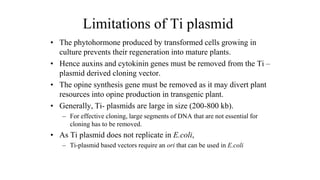
Limitations of Ti plasmid
• The phytohormone produced by transformed cells growing in
culture prevents their regeneration into mature plants.
• Hence auxins and cytokinin genes must be removed from the Ti –
plasmid derived cloning vector.
• The opine synthesis gene must be removed as it may divert plant
resources into opine production in transgenic plant.
• Generally, Ti- plasmids are large in size (200-800 kb).
– For effective cloning, large segments of DNA that are not essential for
cloning has to be removed.
• As Ti plasmid does not replicate in E.coli,
– Ti-plasmid based vectors require an ori that can be used in E.coli
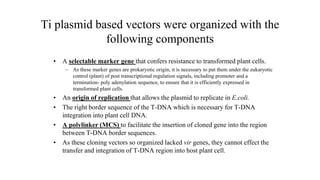
Ti plasmid based vectors were organized with the
following components
• A selectable marker gene that confers resistance to transformed plant cells.
– As these marker genes are prokaryotic origin, it is necessary to put them under the eukaryotic
control (plant) of post transcriptional regulation signals, including promoter and a
termination- poly adenylation sequence, to ensure that it is efficiently expressed in
transformed plant cells.
• An origin of replication that allows the plasmid to replicate in E.coli.
• The right border sequence of the T-DNA which is necessary for T-DNA
integration into plant cell DNA.
• A polylinker (MCS) to facilitate the insertion of cloned gene into the region
between T-DNA border sequences.
• As these cloning vectors so organized lacked vir genes, they cannot effect the
transfer and integration of T-DNA region into host plant cell.
So two Ti-plasmid derived vector systems were developed.
They include:
• Binary vector system
• Co-integrate vector system
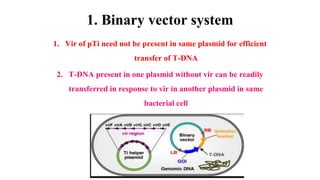
1. Binary vector system
1. Vir of pTi need not be present in same plasmid for efficient
transfer of T-DNA
2. T-DNA present in one plasmid without vir can be readily
transferred in response to vir in another plasmid in same
bacterial cell
• Binary vector has pair of plasmid
• First pair
– Disarmed T-DNA Sequence
– Has ori in both Agrobacterium and E.coli
– RB and LB sequences are present
– Eg: Bin 19 mini Ti
• Other plasmid
– Vir gene
– Lack entire T-DNA including border
– Eg: Helper Ti plasmid
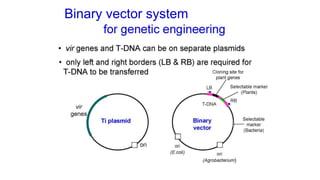
Binary vector system
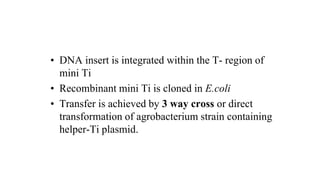
• DNA insert is integrated within the T- region of
mini Ti
• Recombinant mini Ti is cloned in E.coli
• Transfer is achieved by 3 way cross or direct
transformation of agrobacterium strain containing
helper-Ti plasmid.
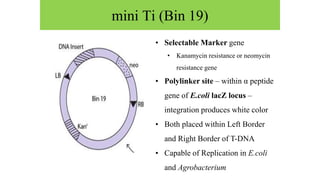
mini Ti (Bin 19)
• Selectable Marker gene
• Kanamycin resistance or neomycin
resistance gene
• Polylinker site – within α peptide
gene of E.coli lacZ locus –
integration produces white color
• Both placed within Left Border
and Right Border of T-DNA
• Capable of Replication in E.coli
and Agrobacterium
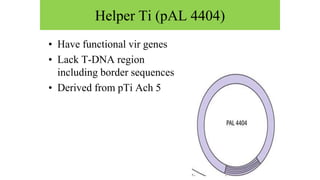
• Have functional vir genes
• Lack T-DNA region
including border sequences
• Derived from pTi Ach 5
Helper Ti (pAL 4404)
• Recombinant Ti (Bin 19) crossed with Agrobacterium cells
with pAL 4404 by conjugation or direct transfer
• vir genes in pAL 4404 help in transfer of T-DNA within
the insert
• Transformed cells are selected in Kanamyin medium
Binary vector system
Strategy:
1. Move T-DNA onto a separate, small plasmid.
2. Remove aux and cyt genes.
3. Insert selectable marker (kanamycin resistance) gene in T-DNA.
4. Vir genes are retained on a separate plasmid.
5. Put foreign gene between T-DNA borders.
6. Co-transform Agrobacterium with both plasmids.
7. Infect plant with the transformed bacteria.
Cointegrate vectors
Cointegrate vectors
• Deletion derivatives of Agrobacterium
• DNA to be introduced into plant transformation
vector is cloned to an intermediate vector
• The recombination within the bacterium is used to
clone the sequences
• Gene of Interest is initially cloned in E.coli
• pTi cant be used directly due to large size and non
availability of unique restriction sites
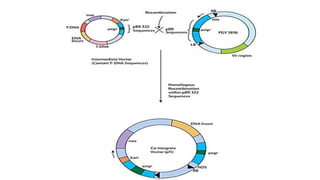
• Cointegrate vectors are produced by integrating modified E.coli
plasmid in to disarmed pTi
• The cointegration of two plasmid is achieved within
agrobacterium by homologous recombination
• E.coli plasmid pBR 322 and disarmed pTi must have some
sequence common to each other
• Common approach is to disarm pTi by replacing its oncogene
with sequence from E.coli plasmid to be used for cloning
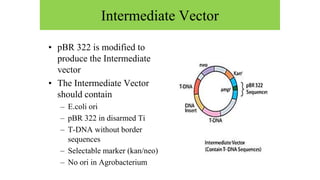
Intermediate Vector
• pBR 322 is modified to
produce the Intermediate
vector
• The Intermediate Vector
should contain
– E.coli ori
– pBR 322 in disarmed Ti
– T-DNA without border
sequences
– Selectable marker (kan/neo)
– No ori in Agrobacterium
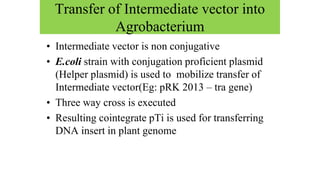
• Intermediate vector is non conjugative
• E.coli strain with conjugation proficient plasmid
(Helper plasmid) is used to mobilize transfer of
Intermediate vector(Eg: pRK 2013 – tra gene)
• Three way cross is executed
• Resulting cointegrate pTi is used for transferring
DNA insert in plant genome
Transfer of Intermediate vector into
Agrobacterium
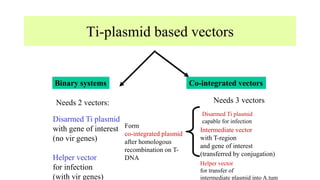
Ti-plasmid based vectors
Binary systems Co-integrated vectors
Needs 2 vectors: Needs 3 vectors
Disarmed Ti plasmid
with gene of interest
(no vir genes)
Helper vector
for infection
(with vir genes)
Disarmed Ti plasmid
capable for infection
Intermediate vector
with T-region
and gene of interest
(transferred by conjugation)
Form
co-integrated plasmid
after homologous
recombination on T-
DNA
Helper vector
for transfer of
intermediate plasmid into A.tum
Transformation
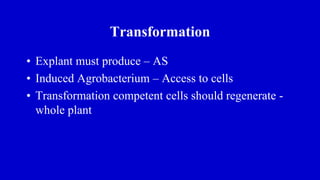
• Explant must produce – AS
• Induced Agrobacterium – Access to cells
• Transformation competent cells should regenerate -
whole plant
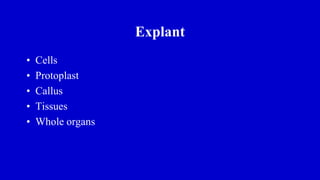
Explant
• Cells
• Protoplast
• Callus
• Tissues
• Whole organs
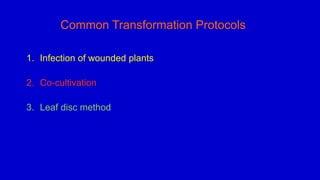
1. Infection of wounded plants
2. Co-cultivation
3. Leaf disc method
Common Transformation Protocols
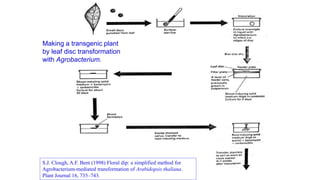
Making a transgenic plant
by leaf disc transformation
with Agrobacterium.
S.J. Clough, A.F. Bent (1998) Floral dip: a simplified method for
Agrobacterium-mediated transformation of Arabidopsis thaliana.
Plant Journal 16, 735–743.
Virus mediated Gene transfer
• High efficiency
• Amplification of Transferred gene by viral genome
replication
• Systemic infection
• Non – integrative
• Accumulate at high copy number
• Apart from pathogenicity – wild type
Viral Vectors –Classification
• Based on genetic material
–DNA
–RNA
Essential characteristics
• Broad host range
• Virulence
• Ease of mechanical transmission
• Easy manipulation
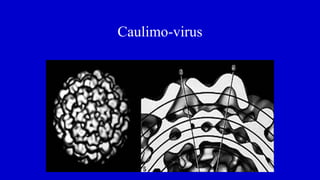
Caulimo-virus
Caulimo-virus
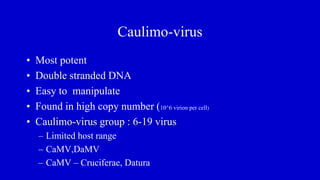
• Most potent
• Double stranded DNA
• Easy to manipulate
• Found in high copy number (10^6 virion per cell)
• Caulimo-virus group : 6-19 virus
– Limited host range
– CaMV,DaMV
– CaMV – Cruciferae, Datura
Caulimo-virus
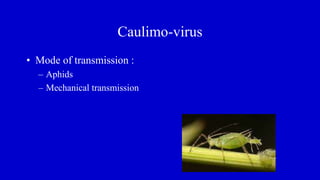
• Mode of transmission :
– Aphids
– Mechanical transmission
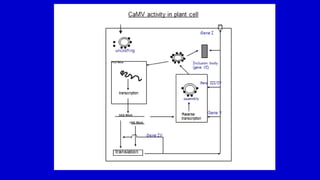
CaMV
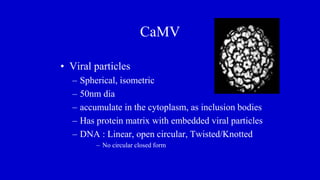
• Viral particles
– Spherical, isometric
– 50nm dia
– accumulate in the cytoplasm, as inclusion bodies
– Has protein matrix with embedded viral particles
– DNA : Linear, open circular, Twisted/Knotted
– No circular closed form
CaMV
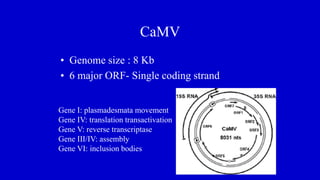
• Genome size : 8 Kb
• 6 major ORF- Single coding strand
Gene I: plasmadesmata movement
Gene IV: translation transactivation
Gene V: reverse transcriptase
Gene III/IV: assembly
Gene VI: inclusion bodies
• GOI : ORF-II, VII
• ORF-II : insect transmission factor
• ORF-VII : Unknown functions
Advantage & Disadvantages
• Naked DNA is infective
• Easy – transfer
……………………………………
• Genome tightly packed
• Deletion – affect virus infectivity
• Narrow host range
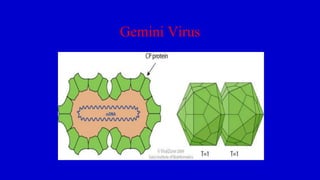
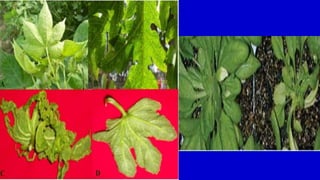
Gemini Virus
Gemini Virus
• Gemini viruses are insect-transmitted viruses
• These viruses cause extremely damaging diseases in a wide range of crops throughout
the world
– African cassava mosaic viruses
– Bean golden mosaic (BGM) viruses
– Beet curly top viruses
– Cotton leaf curl viruses
– Maize streak viruses
– Tomato yellow leaf curl viruses
• In nature, Gemini viruses are transmitted by phloem-feeding insects, including various
species of leafhoppers, a treehopper and whiteflies of the species Bemisia tabaci
• Gemini viruses are not transmitted through seeds, whereas many are graft-
transmissible and some are mechanically (sap) transmissible.
Characteristics
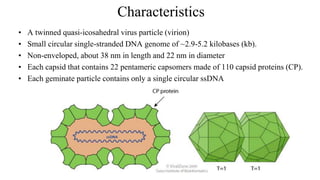
• A twinned quasi-icosahedral virus particle (virion)
• Small circular single-stranded DNA genome of ~2.9-5.2 kilobases (kb).
• Non-enveloped, about 38 nm in length and 22 nm in diameter
• Each capsid that contains 22 pentameric capsomers made of 110 capsid proteins (CP).
• Each geminate particle contains only a single circular ssDNA
GENOME
• Mono-, or bipartite, circular, single stranded DNA
• 2.5-3.0 kb (monopartite) or 4.8-5.6 kb (bipartite).
• The number of genome segments depends on the genera.
• 3' terminus has no poly(A) tract.
• The genome is replicated through double-stranded intermediates.
• The replication (Rep) protein initiates and terminates rolling
circle replication
• The host DNA polymerase being used for DNA replication
itself.
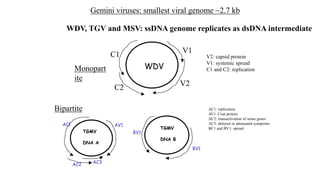
Gemini viruses: smallest viral genome ~2.7 kb
WDV, TGV and MSV: ssDNA genome replicates as dsDNA intermediate
V1
V2
C1
C2
WDV
AV1
TGMV
DNA A
AC1
AC2
AC3
TGMV
DNA B
BV1
BV1
Monopart
ite
Bipartite
V2: capsid protein
V1: systemic spread
C1 and C2: replication
AC1: replication
AV1: Coat protein
AC2: transactivation of sense genes
AC3: delayed or attenuated symptoms
BC1 and BV1: spread
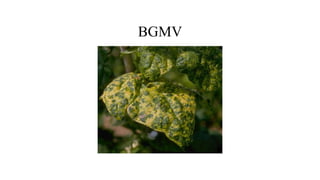
BGMV
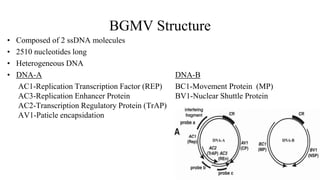
BGMV Structure
• Composed of 2 ssDNA molecules
• 2510 nucleotides long
• Heterogeneous DNA
• DNA-A DNA-B
AC1-Replication Transcription Factor (REP) BC1-Movement Protein (MP)
AC3-Replication Enhancer Protein BV1-Nuclear Shuttle Protein
AC2-Transcription Regulatory Protein (TrAP)
AV1-Paticle encapsidation
Gemini virus as plant viral vectors
• Primitive
• Permit the investigator to replace the coat protein with
reporter gene or gene of interest
• Gemini virus expression vectors are used to deliver, amplify
and express foreign genes in several different systems of
protoplast and cultured cells, leaf disc and plants
Wheat dwarf virus
• Introducing genes in cereals
• Capable of accommodating and replicating gene inserts
upto 3 kb in length
• Three bacterial gene inserted in WDV have been
successfully replicated and expressed
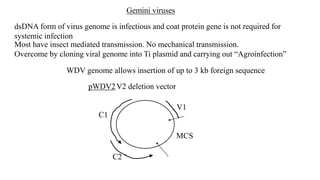
Gemini viruses
Most have insect mediated transmission. No mechanical transmission.
Overcome by cloning viral genome into Ti plasmid and carrying out “Agroinfection”
WDV genome allows insertion of up to 3 kb foreign sequence
pWDV2V2 deletion vector
MCS
C1
C2
V1
dsDNA form of virus genome is infectious and coat protein gene is not required for
systemic infection
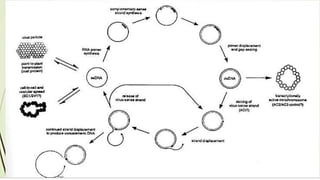
• Virus penetrates into the host cell.
• Uncoating, the viral ssDNA genome penetrates into the nucleus
• ssDNA is converted into dsDNA with the participation of cellular factors.
• Bidirectional double strand transription from the promoter produces viral mRNAs and
translation of viral proteins.
• Replication is initiated by cleavage of the strand occurs by rolling circle producing ssDNA
genomes.
• These newly synthesized ssDNA can either
a) be converted to dsDNA and serve as a template for transcription/replication
b) be encapsidated by capsid protein and form virions released by cell lysis
c) be transported outside the nucleus, to a neighboring cell through plasmodesmata (cell-cell
movement) with the help of viral movement protein
Uses as a cloning vector
• Replicate via double stranded intermediate
– In vivo manipulation is more convenient in bacterial plasmid
• Ability of bipartite genome organization
– Genome replication will not be affected
– Deletion or replacement of coat protein will not affect the replication of viral
genome
Problems
• Not readily transferred by mechanical means from plant to
plant
• Transmitted in nature by insects in persistent manner
• Small particle size
RNA virus
• Two basic type of single stranded RNA Virus
• Monopartite
– Undivided genome containing all genetic information
– Fairly large
– Tobacco Mosaic Virus
• Multipartite Virus
– Genome divided in to small RNA either in same particle or separate particles
– Bromo mosaic virus
– Contain four RNA divided between three separate particles
– RNA components are small
– Able to self replicate
TMV
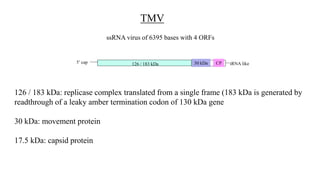
ssRNA virus of 6395 bases with 4 ORFs
126 / 183 kDa 30 kDa CP
126 / 183 kDa: replicase complex translated from a single frame (183 kDa is generated by
readthrough of a leaky amber termination codon of 130 kDa gene
30 kDa: movement protein
17.5 kDa: capsid protein
tRNA like
5’ cap
Figure 7. The replication cycle of Tobacco mosaic virus (TMV). TMV enters a wounded plant cell to begin the
replication cycle [1]. As the coat protein (CP) molecules are stripped away from the RNA [2], host ribosomes begin to
translate the two replicase-associated proteins. The replicase proteins (RP) are used to generate a negative-sense (-
sense) RNA template from the virus RNA [3]. This - sense RNA is, in turn, used to generate both full-length positive-
sense (+ sense) TMV RNA [4] and the + sense subgenomic RNAs (sgRNAs) [5] that are used to express the movement
protein (MP) and CP. The + sense TMV RNA is either encapsidated by the CP to form new TMV particles [6] or
wrapped with MP [7] to allow it to move to an adjacent cell for another round of replication (Drawing courtesy Vickie
Brewster: from K.-B. G. Scholthof 2000).
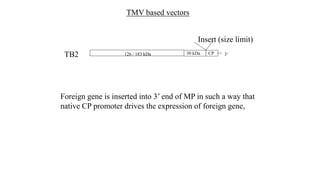
TMV based vectors
126 / 183 kDa 30 kDa CP 3’
Insert (size limit)
TB2
Foreign gene is inserted into 3’ end of MP in such a way that
native CP promoter drives the expression of foreign gene,
Satellite RNA
• Totally indisensible
• 270 bp to 1.5 Kb
• Share little homology to genomic RNA
• Template for replication
• Utilize the machinery for replication
• Capable for altering the pathogenicity of viral infection
• Ability to code for proteins
• Stability in the plant in the absence of other viral components
Use as a cloning vector
• Ease of use
• Highest level of gene expression
• Ability to infect and spread in differentiated tissue
• Replicate stably in protoplast and inoculated leaves
• Experiments can be carried out in protoplast or
differentiated tissues
Difficulties
• Limitation of insert size
• Induction of symptoms in host
Direct methods
• Particle bombardment (biolistics)
• Microprojectile gun method
• Electroporation
• Silicon carbide fibres
• Polyethylene glycol (PEG)/protoplast fusion
• Liposome mediated gene transfer
Chemical transfection - Ca3(PO4)2
• General principle is to form a precipitate of DNA that can be taken up by
endocytosis
• Mix DNA, in phosphate buffer with CaCl2 at precise pH and an insoluble
CaPO4 precipitate forms
• precision in pH is critical, alterations of as little as 0.01 pH units affect
efficiency
• leave on cells several hours to overnight
• wash ppt off and add fresh medium
• advantages
– very simple
– very inexpensive
– extensive literature
– works for most cell types
• disadvantages
– adherent cells only
– some touch and experience required to get good precipitates
– not particularly efficient in many cell types
– difficult to automate or perform as a high throughput method
Chemical transfection - DEAE dextran
• diethylaminoethyl (DEAE) modified dextran is a positively charged
polymer
– many other charged polymers have been used with varying degrees of
success and reproducibility
• PEI - polyethyleneimine
• poly-L-lysine
• DNA adheres to the polymer and remains soluble
• by some unknown means, the complex interacts with the cells and is
taken up by endocytosis
Polyethylene glycol (PEG) mediated
transformation method
• Plant protoplast can be transformed with
naked DNA by treatment with PEG in the
presence of divalent cations e. g., Calcium.
• PEG and divalent cations destabilize the
plasma membrane of the plant protoplast
and rendered it permeable to naked DNA.
• DNA enters the nucleus and integrates into
the host genome.
• advantages
– gentle, not very toxic to cells
– works for cells in suspension
• disadvantages
– doesn’t work well in many cell types
– unclear mechanism of action makes optimization troublesome
– moderately expensive
– low throughput
Lipofection - liposome mediated transfection
• produce liposomes and allow DNA to interact with them. Liposomes
can be produced by:
– sonication
– extrusion through a small pore membrane
– dilution into aqueous medium
• mix with cells and allow to interact
• for a long time it was assumed that liposomes mediate fusion with
cell membranes. However endocytosis is now known to be the
mechanism
• various formulations
– cationic lipids only, e.g. DOTAP
– mixture of cationic and neutral lipids, e.g. lipofectin
(DOTMA:DOPE)
– phospholipids
– cholesterol-related lipids
• all work to some degree
• advantages
– very simple to perform and optimize - anyone can do it.
– easy to automate, high throughput
– reliable and reproducible
– stable and transient assays work well
• disadvantages
– some formulations are unstable to oxygen
• DOTAP and other unsaturated lipids
– variable toxicity necessitates careful optimization for many types (e.g. Lipofectin)
Silicon carbide fibres-Whiskers
• Plant materials (Cells in suspension culture, embryos and embryo-derived
callus) is introduced into a buffer containing DNA and the silicon fibers
which is then vortexed.
• The fibers (0.3-0.6 μm in diameter and 10-100μm long) penetrate the cell
wall and plasma membrane, allowing the DNA to gain access to the inside
of the cells.
• Disadvantages and advantages
• The drawbacks of this technique relate to the availability of suitable plant
material and the inherent dangers of the fibers, which require careful
handing.
• Many cereals, produce embryonic callus that is hard and compact and not
easily transformed with this technique.
• Despite the some disadvantages, this method is recently used for
successful transformation of wheat, baerly, and maize without the need to
cell suspension.
Electroporation
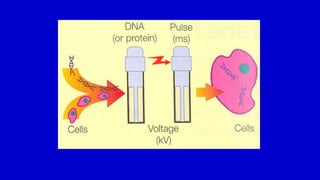
• Principle ., strong electrical pulse creates transient pores in
the cell membrane that allows exchange of molecules
• cells and DNA are placed into a cuvette between two
plates.
• High DC voltage (500+ V) applied as a pulse
• possible optimizations are voltage, pulse length, wave
form.
• Some experimentation with RF (radio frequency) pulses
suggests greater efficiency
• Advantages
• very efficient when it works
• quite effective at making stable transfectants (e.g.
ES cells)
• Disadvantages
• only works well for cells in suspension
• devices for transfecting adherent cells do not work
very well and are cumbersome to clean
• kills cells very effectively
• expensive equipment and cuvettes
• extensive optimization
• very sensitive to salt concentrations
Particle bombardment
• Less limitations than electroporation
• Can use on cells with walls
• Can transform organelles!
• Method:
• Precipitate DNA onto small tungsten or gold particles.
• Accelerate particles to high speeds and aim them at cells or tissues.
• Selective growth and regeneration of transgenic plants as described for Agro-
mediated transformation.
• Most powerful method for introducing nucleic acids into
plants, because the helium pressure can drive microcarriers
through cell walls
• Requires less DNA and fewer cells than other methods, and
can be used for either transient or stable transformation
Principle
• The gold or tungsten particles are coated with the DNA
that is used to be transform the plant tissue.
• The particles are propelled at high speed into the target
plant material where the DNA is released within then cell
and can integrate into the genome.
• Two types of plant tissues are used for particle
bombardment:
• a) Primary explants that are bombarded and then induced
to become embryogenic
• b) Proliferating embryonic cultures that are bombarded and
then allowed to proliferate further and subsequently
regenerate.
•
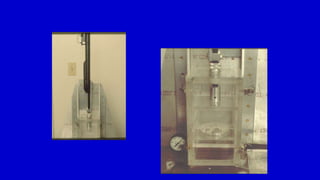
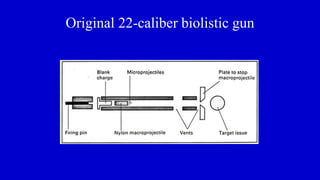
Original 22-caliber biolistic gun
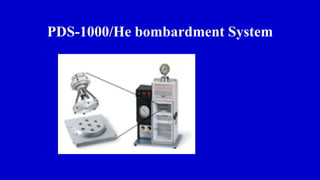
PDS-1000/He bombardment System
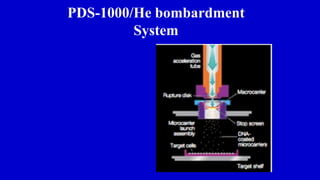
PDS-1000/He bombardment
System
• The sample to be transformed is placed in the bombardment
chamber, which is evacuated to subatmospheric pressure
• The instrument is fired; helium flows into the gas acceleration
tube and is held until the specific pressure of the rupture disk is
reached
• The disk bursts, and the ensuing helium shock wave drives the
macrocarrier disk -a short distance toward the stopping screen
• The stopping screen retains the macrocarrier, while the
microparticles pass through the screen into the bombardment
chamber and penetrate the target cells
• The launch velocity of microcarriers depends on a number of
adjustable parameters: the helium pressure (rupture disk
selection, 450–2,200 psi), the amount of vacuum, the distance
from the rupture disk to the macrocarrier, the distance from
the microcarrier launch assembly to the stopping screen, and
the distance between the stopping screen and target cells.
Adjusting these parameters allows you to produce a range of
velocities to optimally transform many different cell types.
• Advantages
• not very difficult
• Disadvantages
• equipment requirement
• not particularly efficient
• only a few % of target cells survive and take
up DNA
• tissues must survive partial vacuum
Microinjection
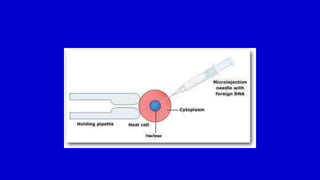
 Microinjection techniques for plant protoplasts utilize a
holding pipette for immobilizing the protoplast while an
injection pipette is utilized to inject the macromolecule.
 In order to manipulate the protoplasts without damage,
the protoplasts are cultured for from about 1 to 5 days
before the injection is performed to allow for partial
regeneration of the cell wall.
 It was found that injection through the partially
regenerated cell wall could still be accomplished and
particular compartments of the cell could be targeted.
 The methods are particularly useful for transformation of
plant protoplasts with exogenous genes.
Agrobacterium Infection.ppt

Agrobacterium Infection.ppt

  • 1.
    Gene Transfer systemin plants Dr.S.Karthikumar
  • 2.
    WHAT ? WHY? HOW?
  • 4.
    Genetic Engineering ofPlants • Must get DNA: 1. into the cells 2. integrated into the genome (unless using transient expression assays) 3. expressed (everywhere or controlled) • For (1) and (2), two main approaches for plants: 1. Agrobacterium - mediated gene transfer 2. Direct gene transfer • For (3), use promoter that will direct expression when and where wanted – may also require other modifications such as removing or replacing introns.
  • 5.
    Agrobacterium - mediatedGene Transfer • Most common method of engineering dicots, but also used for monocots • Pioneered by J. Schell (Max-Planck Inst., Cologne) • Agrobacteria – soil bacteria, gram-negative, related to Rhizobia – A parasite – species: tumefaciens- causes crown galls on many dicots rubi- causes small galls on a few dicots rhizogenes- hairy root disease radiobacter- avirulent
  • 6.
    Crown galls caused byA. tumefaciens on nightshade. More about Galls: http://waynesword.palomar.edu/pljuly99.htm http://kaweahoaks.com/html/galls_ofthe_voaks. html
  • 7.
    Agrobacterium tumefaciens • thespecies of choice for engineering dicot plants; monocots are generally resistant • some dicots more resistant than others (a genetic basis for this) • complex bacterium – genome has been sequenced; 4 chromosomes; ~ 5500 genes
  • 8.
  • 9.
    Infection and tumorigenesis •Infection occurs at wound sites • Involves recognition and chemotaxis of the bacterium toward wounded cells • galls are “real tumors”, can be removed and will grow indefinitely without hormones • genetic information must be transferred to plant cells
  • 10.
    Tumor characteristics 1. Synthesizea unique amino acid, called “opine” – octopine and nopaline - derived from arginine – agropine - derived from glutamate 2. Opine depends on the strain of A. tumefaciens 3. Opines are catabolized by the bacteria, which can use only the specific opine that it causes the plant to produce. 4. Has obvious advantages for the bacteria
  • 11.
    Elucidation of theTIP (tumor- inducing principle) • It was recognized early that virulent strains could be cured of virulence, and that cured strains could regain virulence when exposed to virulent strains; suggested an extra- chromosomal element. • Large plasmids were found in A. tumefaciens and their presence correlated with virulence: called tumor-inducing or Ti plasmids.
  • 12.
    Ti Plasmid 1. Large( 200-kb), circular 2. Conjugative 3. ~10% of plasmid transferred to plant cell after infection 4. 3-5% of chromosome – independent replication 5. Transferred DNA (called T-DNA) integrates semi-randomly into nuclear DNA 6. Ti plasmid also encodes: – enzymes involved in opine metabolism – proteins involved in mobilizing T-DNA (Vir genes) – Tumor induction
  • 13.
    Opines • Low molecularweight • Diffuse from plant cells – Bacterial cells • Promote the transfer of Ti-Plasmid • C, N source for bacteria • Genetic colonization • Induce conjugation
  • 14.
    Classification • Based onopine they produce • Oct-Ti I, Ti II, • Nop-Ti • Agro-Ti • Agro-Ri
  • 15.
    Classification Ti-plasmid (T-I): Octopine •Agropine : CHO derivative / • Octopine : Arg + pyruate condensation • Mannopine Ti-plasmid (T-II): Octopine • Only octopine • Narrow host range • Low homology
  • 16.
    Nopaline-Ti plasmid • Arg+ alpha keto glutarate • Agrocine – A,B • Heterogenous group Agropine Ti • Agropine + mannopine • Agrocine- C,D • Rough tumor, adv.shoot proliferation
  • 17.
    Structure • Octopine :23 kb • Nop : 13Kb L, 8 Kb R • Base region is not closely related • Homologous regions • 4 regions/ 9Kb – Oncogenic region – Opine metabolism – Replication control region – Conjugation control region
  • 19.
  • 20.
    T-DNA • Opine synthesis •Phytohormone synthesis Onc region • Rooty locus(TMR/Roi) • Shooty locus(TMS/Shi)
  • 21.
    auxA auxB cytocs LB RB LB, RB – left and right borders (direct repeat) auxA + auxB – enzymes that produce auxin cyt – enzyme that produces cytokinin Ocs – octopine synthase, produces octopine T-DNA These genes have typical eukaryotic expression signals!
  • 22.
    auxA auxB Tryptophan indoleacetamide indoleacetic acid (auxin) cyt AMP + isopentenylpyrophosphate  isopentyl-AMP (a cytokinin) • Increased levels of these hormones stimulate cell division. • Explains uncontrolled growth of tumor.
  • 23.
    Vir (virulent) genes 1.On the Ti plasmid 2. Span : 40-Kb 3. 24 genes involved 4. 8-operons(Vir A-H) 5. Transfer the T-DNA to plant cell 6. Acetosyringone (AS) (a flavonoid) released by wounded plant cells activates vir genes. 7. virA,B,C,D,E,F,G (7 complementation groups, but some have multiple ORFs)
  • 24.
    Vir (virulent) genes •Accessing T-DNA from Ti-plasmid • DNA transfer • Targeting of T-DNA to plant nucleus • T-DNA integration
  • 26.
    Vir gene functions(cont.) • virA - transports AS into bacterium, activates virG post-translationally (by phosphoryl.) • virG - promotes transcription of other vir genes • virD2 - endonuclease/integrase that cuts T- DNA at the borders but only on one strand; attaches to the 5' end of the SS • virE2 - binds SS of T-DNA & can form channels in artificial membranes • virE1 - chaperone for virE2 • virD2 & virE2 also have NLSs, gets T-DNA to the nucleus of plant cell • virB - operon of 11 proteins, gets T-DNA through bacterial membranes
  • 27.
    Chromosomal Genes • ChvA, Chv B, : Exopolysacchride binding • Psc A : T-DNA transfer • Chv E : Glucose/ Galactose Transporter • Binds to sugar – induces Vir genes https://www.indiabix.com/biotechnology/gene- transfer-in-plants/011006 https://www.mcqbiology.com/2012/11/mcq-on- biotechnology-gene- transfer.html#.X736Ks0zZPY
  • 28.
    From Covey &Grierson
  • 29.
    VirE2 may getDNA-protein complex across host PM Dumas et al., (2001), Proc. Natl. Acad. Sci. USA, 98:485
  • 30.
    • Monocots don'tproduce AS in response to wounding. • Important: Put any DNA between the LB and RB of T-DNA it will be transferred to plant cell! Engineering plants with Agrobacterium: Two problems had to be overcome: (1) Ti plasmids large, difficult to manipulate (2) couldn't regenerate plants from tumors
  • 31.
    Ti plasmid derivedvectors Binary and Cointegrate Vectors
  • 32.
    Ti Plasmid Tumor- producing genes Virulence region Opinecatabolism ORI T-DNA region DNA between L and R borders is transferred to plant as ssDNA; T-DNA encoded genes can be substituted by target genes
  • 33.
    Limitations of Tiplasmid • The phytohormone produced by transformed cells growing in culture prevents their regeneration into mature plants. • Hence auxins and cytokinin genes must be removed from the Ti – plasmid derived cloning vector. • The opine synthesis gene must be removed as it may divert plant resources into opine production in transgenic plant. • Generally, Ti- plasmids are large in size (200-800 kb). – For effective cloning, large segments of DNA that are not essential for cloning has to be removed. • As Ti plasmid does not replicate in E.coli, – Ti-plasmid based vectors require an ori that can be used in E.coli
  • 34.
    Ti plasmid basedvectors were organized with the following components • A selectable marker gene that confers resistance to transformed plant cells. – As these marker genes are prokaryotic origin, it is necessary to put them under the eukaryotic control (plant) of post transcriptional regulation signals, including promoter and a termination- poly adenylation sequence, to ensure that it is efficiently expressed in transformed plant cells. • An origin of replication that allows the plasmid to replicate in E.coli. • The right border sequence of the T-DNA which is necessary for T-DNA integration into plant cell DNA. • A polylinker (MCS) to facilitate the insertion of cloned gene into the region between T-DNA border sequences. • As these cloning vectors so organized lacked vir genes, they cannot effect the transfer and integration of T-DNA region into host plant cell.
  • 35.
    So two Ti-plasmidderived vector systems were developed. They include: • Binary vector system • Co-integrate vector system
  • 36.
    1. Binary vectorsystem 1. Vir of pTi need not be present in same plasmid for efficient transfer of T-DNA 2. T-DNA present in one plasmid without vir can be readily transferred in response to vir in another plasmid in same bacterial cell
  • 37.
    • Binary vectorhas pair of plasmid • First pair – Disarmed T-DNA Sequence – Has ori in both Agrobacterium and E.coli – RB and LB sequences are present – Eg: Bin 19 mini Ti • Other plasmid – Vir gene – Lack entire T-DNA including border – Eg: Helper Ti plasmid
  • 38.
  • 39.
    • DNA insertis integrated within the T- region of mini Ti • Recombinant mini Ti is cloned in E.coli • Transfer is achieved by 3 way cross or direct transformation of agrobacterium strain containing helper-Ti plasmid.
  • 40.
    mini Ti (Bin19) • Selectable Marker gene • Kanamycin resistance or neomycin resistance gene • Polylinker site – within α peptide gene of E.coli lacZ locus – integration produces white color • Both placed within Left Border and Right Border of T-DNA • Capable of Replication in E.coli and Agrobacterium
  • 41.
    • Have functionalvir genes • Lack T-DNA region including border sequences • Derived from pTi Ach 5 Helper Ti (pAL 4404)
  • 42.
    • Recombinant Ti(Bin 19) crossed with Agrobacterium cells with pAL 4404 by conjugation or direct transfer • vir genes in pAL 4404 help in transfer of T-DNA within the insert • Transformed cells are selected in Kanamyin medium
  • 43.
    Binary vector system Strategy: 1.Move T-DNA onto a separate, small plasmid. 2. Remove aux and cyt genes. 3. Insert selectable marker (kanamycin resistance) gene in T-DNA. 4. Vir genes are retained on a separate plasmid. 5. Put foreign gene between T-DNA borders. 6. Co-transform Agrobacterium with both plasmids. 7. Infect plant with the transformed bacteria.
  • 44.
  • 45.
    Cointegrate vectors • Deletionderivatives of Agrobacterium • DNA to be introduced into plant transformation vector is cloned to an intermediate vector • The recombination within the bacterium is used to clone the sequences
  • 46.
    • Gene ofInterest is initially cloned in E.coli • pTi cant be used directly due to large size and non availability of unique restriction sites
  • 47.
    • Cointegrate vectorsare produced by integrating modified E.coli plasmid in to disarmed pTi • The cointegration of two plasmid is achieved within agrobacterium by homologous recombination • E.coli plasmid pBR 322 and disarmed pTi must have some sequence common to each other • Common approach is to disarm pTi by replacing its oncogene with sequence from E.coli plasmid to be used for cloning
  • 49.
    Intermediate Vector • pBR322 is modified to produce the Intermediate vector • The Intermediate Vector should contain – E.coli ori – pBR 322 in disarmed Ti – T-DNA without border sequences – Selectable marker (kan/neo) – No ori in Agrobacterium
  • 50.
    • Intermediate vectoris non conjugative • E.coli strain with conjugation proficient plasmid (Helper plasmid) is used to mobilize transfer of Intermediate vector(Eg: pRK 2013 – tra gene) • Three way cross is executed • Resulting cointegrate pTi is used for transferring DNA insert in plant genome Transfer of Intermediate vector into Agrobacterium
  • 51.
    Ti-plasmid based vectors Binarysystems Co-integrated vectors Needs 2 vectors: Needs 3 vectors Disarmed Ti plasmid with gene of interest (no vir genes) Helper vector for infection (with vir genes) Disarmed Ti plasmid capable for infection Intermediate vector with T-region and gene of interest (transferred by conjugation) Form co-integrated plasmid after homologous recombination on T- DNA Helper vector for transfer of intermediate plasmid into A.tum
  • 52.
    Transformation • Explant mustproduce – AS • Induced Agrobacterium – Access to cells • Transformation competent cells should regenerate - whole plant
  • 53.
    Explant • Cells • Protoplast •Callus • Tissues • Whole organs
  • 54.
    1. Infection ofwounded plants 2. Co-cultivation 3. Leaf disc method Common Transformation Protocols
  • 55.
    Making a transgenicplant by leaf disc transformation with Agrobacterium. S.J. Clough, A.F. Bent (1998) Floral dip: a simplified method for Agrobacterium-mediated transformation of Arabidopsis thaliana. Plant Journal 16, 735–743.
  • 56.
    Virus mediated Genetransfer • High efficiency • Amplification of Transferred gene by viral genome replication • Systemic infection • Non – integrative • Accumulate at high copy number • Apart from pathogenicity – wild type
  • 57.
    Viral Vectors –Classification •Based on genetic material –DNA –RNA
  • 58.
    Essential characteristics • Broadhost range • Virulence • Ease of mechanical transmission • Easy manipulation
  • 59.
  • 60.
    Caulimo-virus • Most potent •Double stranded DNA • Easy to manipulate • Found in high copy number (10^6 virion per cell) • Caulimo-virus group : 6-19 virus – Limited host range – CaMV,DaMV – CaMV – Cruciferae, Datura
  • 61.
    Caulimo-virus • Mode oftransmission : – Aphids – Mechanical transmission
  • 62.
    CaMV • Viral particles –Spherical, isometric – 50nm dia – accumulate in the cytoplasm, as inclusion bodies – Has protein matrix with embedded viral particles – DNA : Linear, open circular, Twisted/Knotted – No circular closed form
  • 63.
    CaMV • Genome size: 8 Kb • 6 major ORF- Single coding strand Gene I: plasmadesmata movement Gene IV: translation transactivation Gene V: reverse transcriptase Gene III/IV: assembly Gene VI: inclusion bodies
  • 65.
    • GOI :ORF-II, VII • ORF-II : insect transmission factor • ORF-VII : Unknown functions
  • 66.
    Advantage & Disadvantages •Naked DNA is infective • Easy – transfer …………………………………… • Genome tightly packed • Deletion – affect virus infectivity • Narrow host range
  • 67.
  • 69.
    Gemini Virus • Geminiviruses are insect-transmitted viruses • These viruses cause extremely damaging diseases in a wide range of crops throughout the world – African cassava mosaic viruses – Bean golden mosaic (BGM) viruses – Beet curly top viruses – Cotton leaf curl viruses – Maize streak viruses – Tomato yellow leaf curl viruses • In nature, Gemini viruses are transmitted by phloem-feeding insects, including various species of leafhoppers, a treehopper and whiteflies of the species Bemisia tabaci • Gemini viruses are not transmitted through seeds, whereas many are graft- transmissible and some are mechanically (sap) transmissible.
  • 70.
    Characteristics • A twinnedquasi-icosahedral virus particle (virion) • Small circular single-stranded DNA genome of ~2.9-5.2 kilobases (kb). • Non-enveloped, about 38 nm in length and 22 nm in diameter • Each capsid that contains 22 pentameric capsomers made of 110 capsid proteins (CP). • Each geminate particle contains only a single circular ssDNA
  • 71.
    GENOME • Mono-, orbipartite, circular, single stranded DNA • 2.5-3.0 kb (monopartite) or 4.8-5.6 kb (bipartite). • The number of genome segments depends on the genera. • 3' terminus has no poly(A) tract. • The genome is replicated through double-stranded intermediates. • The replication (Rep) protein initiates and terminates rolling circle replication • The host DNA polymerase being used for DNA replication itself.
  • 72.
    Gemini viruses: smallestviral genome ~2.7 kb WDV, TGV and MSV: ssDNA genome replicates as dsDNA intermediate V1 V2 C1 C2 WDV AV1 TGMV DNA A AC1 AC2 AC3 TGMV DNA B BV1 BV1 Monopart ite Bipartite V2: capsid protein V1: systemic spread C1 and C2: replication AC1: replication AV1: Coat protein AC2: transactivation of sense genes AC3: delayed or attenuated symptoms BC1 and BV1: spread
  • 73.
  • 74.
    BGMV Structure • Composedof 2 ssDNA molecules • 2510 nucleotides long • Heterogeneous DNA • DNA-A DNA-B AC1-Replication Transcription Factor (REP) BC1-Movement Protein (MP) AC3-Replication Enhancer Protein BV1-Nuclear Shuttle Protein AC2-Transcription Regulatory Protein (TrAP) AV1-Paticle encapsidation
  • 75.
    Gemini virus asplant viral vectors • Primitive • Permit the investigator to replace the coat protein with reporter gene or gene of interest • Gemini virus expression vectors are used to deliver, amplify and express foreign genes in several different systems of protoplast and cultured cells, leaf disc and plants
  • 76.
    Wheat dwarf virus •Introducing genes in cereals • Capable of accommodating and replicating gene inserts upto 3 kb in length • Three bacterial gene inserted in WDV have been successfully replicated and expressed
  • 77.
    Gemini viruses Most haveinsect mediated transmission. No mechanical transmission. Overcome by cloning viral genome into Ti plasmid and carrying out “Agroinfection” WDV genome allows insertion of up to 3 kb foreign sequence pWDV2V2 deletion vector MCS C1 C2 V1 dsDNA form of virus genome is infectious and coat protein gene is not required for systemic infection
  • 78.
    • Virus penetratesinto the host cell. • Uncoating, the viral ssDNA genome penetrates into the nucleus • ssDNA is converted into dsDNA with the participation of cellular factors. • Bidirectional double strand transription from the promoter produces viral mRNAs and translation of viral proteins. • Replication is initiated by cleavage of the strand occurs by rolling circle producing ssDNA genomes. • These newly synthesized ssDNA can either a) be converted to dsDNA and serve as a template for transcription/replication b) be encapsidated by capsid protein and form virions released by cell lysis c) be transported outside the nucleus, to a neighboring cell through plasmodesmata (cell-cell movement) with the help of viral movement protein
  • 80.
    Uses as acloning vector • Replicate via double stranded intermediate – In vivo manipulation is more convenient in bacterial plasmid • Ability of bipartite genome organization – Genome replication will not be affected – Deletion or replacement of coat protein will not affect the replication of viral genome
  • 81.
    Problems • Not readilytransferred by mechanical means from plant to plant • Transmitted in nature by insects in persistent manner • Small particle size
  • 82.
    RNA virus • Twobasic type of single stranded RNA Virus • Monopartite – Undivided genome containing all genetic information – Fairly large – Tobacco Mosaic Virus • Multipartite Virus – Genome divided in to small RNA either in same particle or separate particles – Bromo mosaic virus – Contain four RNA divided between three separate particles – RNA components are small – Able to self replicate
  • 83.
    TMV ssRNA virus of6395 bases with 4 ORFs 126 / 183 kDa 30 kDa CP 126 / 183 kDa: replicase complex translated from a single frame (183 kDa is generated by readthrough of a leaky amber termination codon of 130 kDa gene 30 kDa: movement protein 17.5 kDa: capsid protein tRNA like 5’ cap
  • 84.
    Figure 7. Thereplication cycle of Tobacco mosaic virus (TMV). TMV enters a wounded plant cell to begin the replication cycle [1]. As the coat protein (CP) molecules are stripped away from the RNA [2], host ribosomes begin to translate the two replicase-associated proteins. The replicase proteins (RP) are used to generate a negative-sense (- sense) RNA template from the virus RNA [3]. This - sense RNA is, in turn, used to generate both full-length positive- sense (+ sense) TMV RNA [4] and the + sense subgenomic RNAs (sgRNAs) [5] that are used to express the movement protein (MP) and CP. The + sense TMV RNA is either encapsidated by the CP to form new TMV particles [6] or wrapped with MP [7] to allow it to move to an adjacent cell for another round of replication (Drawing courtesy Vickie Brewster: from K.-B. G. Scholthof 2000).
  • 85.
    TMV based vectors 126/ 183 kDa 30 kDa CP 3’ Insert (size limit) TB2 Foreign gene is inserted into 3’ end of MP in such a way that native CP promoter drives the expression of foreign gene,
  • 86.
    Satellite RNA • Totallyindisensible • 270 bp to 1.5 Kb • Share little homology to genomic RNA • Template for replication • Utilize the machinery for replication • Capable for altering the pathogenicity of viral infection • Ability to code for proteins • Stability in the plant in the absence of other viral components
  • 87.
    Use as acloning vector • Ease of use • Highest level of gene expression • Ability to infect and spread in differentiated tissue • Replicate stably in protoplast and inoculated leaves • Experiments can be carried out in protoplast or differentiated tissues
  • 88.
    Difficulties • Limitation ofinsert size • Induction of symptoms in host
  • 89.
    Direct methods • Particlebombardment (biolistics) • Microprojectile gun method • Electroporation • Silicon carbide fibres • Polyethylene glycol (PEG)/protoplast fusion • Liposome mediated gene transfer
  • 90.
    Chemical transfection -Ca3(PO4)2 • General principle is to form a precipitate of DNA that can be taken up by endocytosis • Mix DNA, in phosphate buffer with CaCl2 at precise pH and an insoluble CaPO4 precipitate forms • precision in pH is critical, alterations of as little as 0.01 pH units affect efficiency • leave on cells several hours to overnight • wash ppt off and add fresh medium
  • 91.
    • advantages – verysimple – very inexpensive – extensive literature – works for most cell types • disadvantages – adherent cells only – some touch and experience required to get good precipitates – not particularly efficient in many cell types – difficult to automate or perform as a high throughput method
  • 92.
    Chemical transfection -DEAE dextran • diethylaminoethyl (DEAE) modified dextran is a positively charged polymer – many other charged polymers have been used with varying degrees of success and reproducibility • PEI - polyethyleneimine • poly-L-lysine • DNA adheres to the polymer and remains soluble • by some unknown means, the complex interacts with the cells and is taken up by endocytosis
  • 93.
    Polyethylene glycol (PEG)mediated transformation method • Plant protoplast can be transformed with naked DNA by treatment with PEG in the presence of divalent cations e. g., Calcium. • PEG and divalent cations destabilize the plasma membrane of the plant protoplast and rendered it permeable to naked DNA. • DNA enters the nucleus and integrates into the host genome.
  • 94.
    • advantages – gentle,not very toxic to cells – works for cells in suspension • disadvantages – doesn’t work well in many cell types – unclear mechanism of action makes optimization troublesome – moderately expensive – low throughput
  • 95.
    Lipofection - liposomemediated transfection • produce liposomes and allow DNA to interact with them. Liposomes can be produced by: – sonication – extrusion through a small pore membrane – dilution into aqueous medium • mix with cells and allow to interact • for a long time it was assumed that liposomes mediate fusion with cell membranes. However endocytosis is now known to be the mechanism
  • 96.
    • various formulations –cationic lipids only, e.g. DOTAP – mixture of cationic and neutral lipids, e.g. lipofectin (DOTMA:DOPE) – phospholipids – cholesterol-related lipids • all work to some degree
  • 97.
    • advantages – verysimple to perform and optimize - anyone can do it. – easy to automate, high throughput – reliable and reproducible – stable and transient assays work well • disadvantages – some formulations are unstable to oxygen • DOTAP and other unsaturated lipids – variable toxicity necessitates careful optimization for many types (e.g. Lipofectin)
  • 98.
    Silicon carbide fibres-Whiskers •Plant materials (Cells in suspension culture, embryos and embryo-derived callus) is introduced into a buffer containing DNA and the silicon fibers which is then vortexed. • The fibers (0.3-0.6 μm in diameter and 10-100μm long) penetrate the cell wall and plasma membrane, allowing the DNA to gain access to the inside of the cells. • Disadvantages and advantages • The drawbacks of this technique relate to the availability of suitable plant material and the inherent dangers of the fibers, which require careful handing. • Many cereals, produce embryonic callus that is hard and compact and not easily transformed with this technique. • Despite the some disadvantages, this method is recently used for successful transformation of wheat, baerly, and maize without the need to cell suspension.
  • 99.
    Electroporation • Principle .,strong electrical pulse creates transient pores in the cell membrane that allows exchange of molecules • cells and DNA are placed into a cuvette between two plates. • High DC voltage (500+ V) applied as a pulse • possible optimizations are voltage, pulse length, wave form. • Some experimentation with RF (radio frequency) pulses suggests greater efficiency
  • 101.
    • Advantages • veryefficient when it works • quite effective at making stable transfectants (e.g. ES cells) • Disadvantages • only works well for cells in suspension • devices for transfecting adherent cells do not work very well and are cumbersome to clean • kills cells very effectively • expensive equipment and cuvettes • extensive optimization • very sensitive to salt concentrations
  • 102.
    Particle bombardment • Lesslimitations than electroporation • Can use on cells with walls • Can transform organelles! • Method: • Precipitate DNA onto small tungsten or gold particles. • Accelerate particles to high speeds and aim them at cells or tissues. • Selective growth and regeneration of transgenic plants as described for Agro- mediated transformation.
  • 103.
    • Most powerfulmethod for introducing nucleic acids into plants, because the helium pressure can drive microcarriers through cell walls • Requires less DNA and fewer cells than other methods, and can be used for either transient or stable transformation
  • 104.
    Principle • The goldor tungsten particles are coated with the DNA that is used to be transform the plant tissue. • The particles are propelled at high speed into the target plant material where the DNA is released within then cell and can integrate into the genome. • Two types of plant tissues are used for particle bombardment: • a) Primary explants that are bombarded and then induced to become embryogenic • b) Proliferating embryonic cultures that are bombarded and then allowed to proliferate further and subsequently regenerate. •
  • 106.
  • 107.
  • 108.
  • 109.
    • The sampleto be transformed is placed in the bombardment chamber, which is evacuated to subatmospheric pressure • The instrument is fired; helium flows into the gas acceleration tube and is held until the specific pressure of the rupture disk is reached • The disk bursts, and the ensuing helium shock wave drives the macrocarrier disk -a short distance toward the stopping screen • The stopping screen retains the macrocarrier, while the microparticles pass through the screen into the bombardment chamber and penetrate the target cells • The launch velocity of microcarriers depends on a number of adjustable parameters: the helium pressure (rupture disk selection, 450–2,200 psi), the amount of vacuum, the distance from the rupture disk to the macrocarrier, the distance from the microcarrier launch assembly to the stopping screen, and the distance between the stopping screen and target cells. Adjusting these parameters allows you to produce a range of velocities to optimally transform many different cell types.
  • 110.
    • Advantages • notvery difficult • Disadvantages • equipment requirement • not particularly efficient • only a few % of target cells survive and take up DNA • tissues must survive partial vacuum
  • 111.
    Microinjection  Microinjection techniquesfor plant protoplasts utilize a holding pipette for immobilizing the protoplast while an injection pipette is utilized to inject the macromolecule.  In order to manipulate the protoplasts without damage, the protoplasts are cultured for from about 1 to 5 days before the injection is performed to allow for partial regeneration of the cell wall.  It was found that injection through the partially regenerated cell wall could still be accomplished and particular compartments of the cell could be targeted.  The methods are particularly useful for transformation of plant protoplasts with exogenous genes.