This document discusses cryptography and various encryption techniques. It describes cryptography as the study of methods for sending secret messages. The basic terminology includes plaintext, ciphertext, encryption, and decryption. Several encryption methods are covered, including substitution ciphers, shift ciphers, affine ciphers, and digraph ciphers. Examples are provided to demonstrate how to encrypt and decrypt messages using these different cipher techniques. The document is authored by Sowmya K of St. Mary's College in Thrissur.
Cryptography :It is the study of methods of sending
messages in disguised form .
Plain text: The message we want to send.
Ciphertext: The message in disguised form.
Enciphering /encryption: The process of converting a plain
text to a ciphertext.
Deciphering /decryption: The process of converting a
ciphertext to a plaintext.
Cryptanalysis: It is the science of breaking secret messages.
Cryptography, Sowmya K, St.Mary’s College, Thrissur.
Terminology
3.
The plaintextand ciphertext are broken up into message
units.
A message unit might be a single letter,a pair of
letters(digraph),a triple of letters (trigraph) and so on.
Cryptography, Sowmya K, St.Mary’s College, Thrissur.
4.
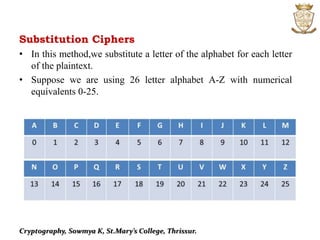
Substitution Ciphers
• Inthis method,we substitute a letter of the alphabet for each letter
of the plaintext.
• Suppose we are using 26 letter alphabet A-Z with numerical
equivalents 0-25.
Cryptography, Sowmya K, St.Mary’s College, Thrissur.
5.
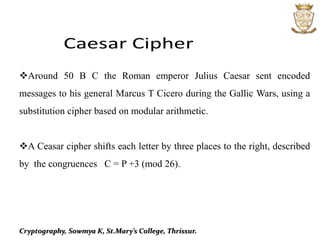
Around 50 BC the Roman emperor Julius Caesar sent encoded
messages to his general Marcus T Cicero during the Gallic Wars, using a
substitution cipher based on modular arithmetic.
A Ceasar cipher shifts each letter by three places to the right, described
by the congruences C = P +3 (mod 26).
Cryptography, Sowmya K, St.Mary’s College, Thrissur.
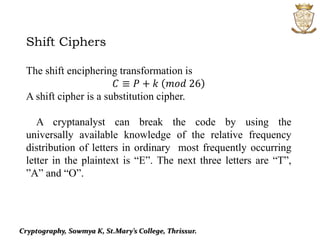
Shift Ciphers
The shiftenciphering transformation is
𝐶 ≡ 𝑃 + 𝑘 𝑚𝑜𝑑 26
A shift cipher is a substitution cipher.
A cryptanalyst can break the code by using the
universally available knowledge of the relative frequency
distribution of letters in ordinary most frequently occurring
letter in the plaintext is “E”. The next three letters are “T”,
”A” and “O”.
Cryptography, Sowmya K, St.Mary’s College, Thrissur.
10.
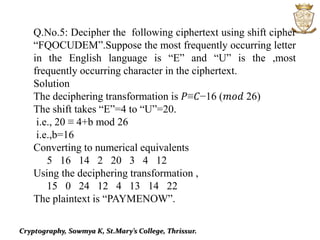
Q.No.5: Decipher thefollowing ciphertext using shift cipher
“FQOCUDEM”.Suppose the most frequently occurring letter
in the English language is “E” and “U” is the ,most
frequently occurring character in the ciphertext.
Solution
The deciphering transformation is 𝑃≡𝐶−16 (𝑚𝑜𝑑 26)
The shift takes “E”=4 to “U”=20.
i.e., 20 ≡ 4+b mod 26
i.e.,b=16
Converting to numerical equivalents
5 16 14 2 20 3 4 12
Using the deciphering transformation ,
15 0 24 12 4 13 14 22
The plaintext is “PAYMENOW”.
Cryptography, Sowmya K, St.Mary’s College, Thrissur.
11.
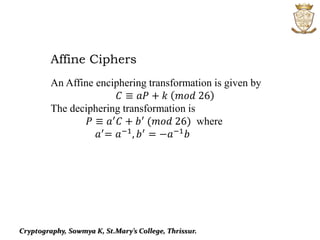
Affine Ciphers
An Affineenciphering transformation is given by
𝐶 ≡ 𝑎𝑃 + 𝑘 𝑚𝑜𝑑 26
The deciphering transformation is
𝑃 ≡ 𝑎′ 𝐶 + 𝑏′ (𝑚𝑜𝑑 26) where
𝑎′= 𝑎−1, 𝑏′ = −𝑎−1 𝑏
Cryptography, Sowmya K, St.Mary’s College, Thrissur.
12.
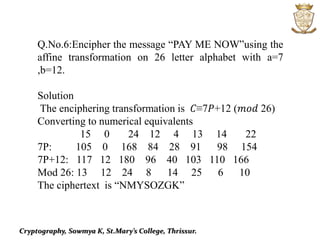
Q.No.6:Encipher the message“PAY ME NOW”using the
affine transformation on 26 letter alphabet with a=7
,b=12.
Solution
The enciphering transformation is 𝐶≡7𝑃+12 (𝑚𝑜𝑑 26)
Converting to numerical equivalents
15 0 24 12 4 13 14 22
7P: 105 0 168 84 28 91 98 154
7P+12: 117 12 180 96 40 103 110 166
Mod 26: 13 12 24 8 14 25 6 10
The ciphertext is “NMYSOZGK”
Cryptography, Sowmya K, St.Mary’s College, Thrissur.
13.
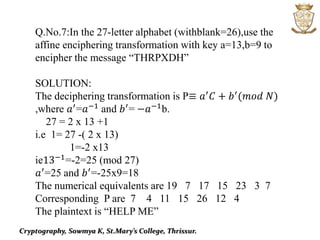
Q.No.7:In the 27-letteralphabet (withblank=26),use the
affine enciphering transformation with key a=13,b=9 to
encipher the message “THRPXDH”
SOLUTION:
The deciphering transformation is P≡ 𝑎′ 𝐶 + 𝑏′(𝑚𝑜𝑑 𝑁)
,where 𝑎′=𝑎−1 and 𝑏′= −𝑎−1b.
27 = 2 x 13 +1
i.e 1= 27 -( 2 x 13)
1=-2 x13
ie13−1=-2=25 (mod 27)
𝑎′=25 and 𝑏′=-25x9=18
The numerical equivalents are 19 7 17 15 23 3 7
Corresponding P are 7 4 11 15 26 12 4
The plaintext is “HELP ME”
Cryptography, Sowmya K, St.Mary’s College, Thrissur.
14.
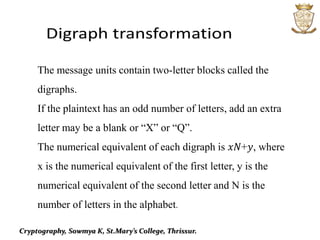
The message unitscontain two-letter blocks called the
digraphs.
If the plaintext has an odd number of letters, add an extra
letter may be a blank or “X” or “Q”.
The numerical equivalent of each digraph is 𝑥𝑁+𝑦, where
x is the numerical equivalent of the first letter, y is the
numerical equivalent of the second letter and N is the
number of letters in the alphabet.
Cryptography, Sowmya K, St.Mary’s College, Thrissur.
15.
Q.No.8:Suppose we areworking in a 26-letter alphabet
and using the digraph enciphering transformation 𝐶 ≡
159𝑃 + 580 𝑚𝑜𝑑 676. Encipher “NO” and decipher
“NV”.
Solution:
The numerical equivalent of “NO” is
xN + y = 26 x 13 + 14 = 352
𝐶 ≡ (159 𝑥 352) + 580 (𝑚𝑜𝑑 676)
≡ 440 (mod 676)
i.e. c = 440.
𝑐 = 𝑥′ 𝑁 + 𝑦′ 440 = 26 𝑥′ + 𝑦′
=26 x 16+24
i.e.,𝑥′ = 16 𝑦′=24.
The ciphertext is “QY”.
Cryptography, Sowmya K, St.Mary’s College, Thrissur.
16.
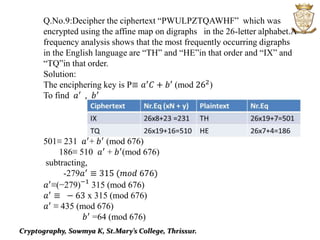
Q.No.9:Decipher the ciphertext“PWULPZTQAWHF” which was
encrypted using the affine map on digraphs in the 26-letter alphabet.A
frequency analysis shows that the most frequently occurring digraphs
in the English language are “TH” and “HE”in that order and “IX” and
“TQ”in that order.
Solution:
The enciphering key is P≡ 𝑎′
𝐶 + 𝑏′
(mod 262
)
To find 𝑎′
, 𝑏′
501≡ 231 𝑎′+ 𝑏′ (mod 676)
186≡ 510 𝑎′ + 𝑏′(mod 676)
subtracting,
-279𝑎′ ≡ 315 (𝑚𝑜𝑑 676)
𝑎′≡(−279)−1
315 (mod 676)
𝑎′ ≡ − 63 x 315 (mod 676)
𝑎′ ≡ 435 (mod 676)
𝑏′ =64 (mod 676)
Cryptography, Sowmya K, St.Mary’s College, Thrissur.
17.
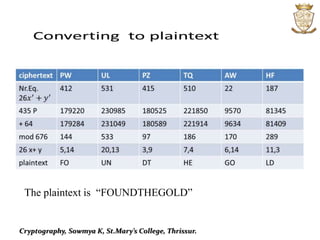
The plaintext is“FOUNDTHEGOLD”
Cryptography, Sowmya K, St.Mary’s College, Thrissur.
18.
REFERENCE
Neal Koblitz, ACourse in Number Theory and
Cryptography, Springer Verlag, New York,1987.
Cryptography, Sowmya K, St.Mary’s College, Thrissur.