ECG

BY:
Kira n R (1 RV1 0 EE0 2 6 )
Sunil Fe rna nd e s (1 RV1 0 EE5 2 )
Sura j K ( 1 RV1 0 EE0 5 3 )
Introduction




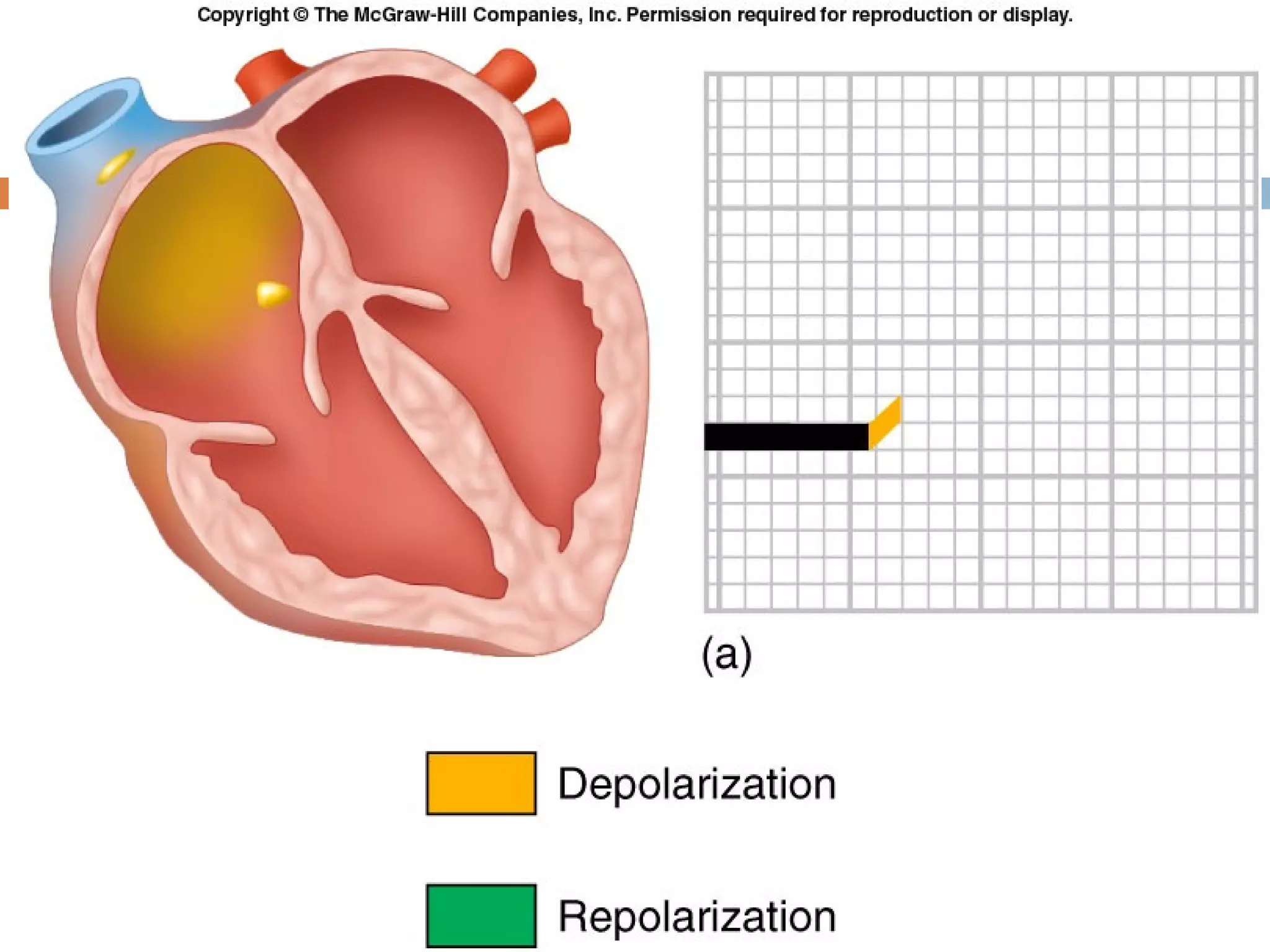
The electrocardiogram (ECG) is a time-varying signal
reflecting the ionic current flow which causes the cardiac
fibers to contract and subsequently relax. The surface
ECG is obtained by recording the potential difference
between two electrodes placed on the surface of the
skin. A single normal cycle of the ECG represents the
successive atrial depolarisation/repolarisation and
ventricular depolarisation/repolarisation which occurs
with every heart beat.
Simply put, the ECG (EKG) is a device that measures
and records the electrical activity of the heart from
electrodes placed on the skin in specific locations
Basic Working








The ECG is nothing but the recording of the hearts electrical activity.
The deviations in the normal electrical patterns indicate various
cardiac disorders. Cardiac cells, in the normal state are electrically
polarized. Their inner sides are negatively charged relative to their
outer sides.
These cardiac cells can lose their normal negativity in a process
called depolarization, which is the fundamental electrical activity of
the heart.
This depolarization is propagated from cell to cell, producing a wave
of depolarization that can be transmitted across the entire heart. This
wave of depolarization produces a flow of electric current and it can
be detected by keeping the electrodes on the surface of the body.
Once the depolarization is complete, the cardiac cells are able to
restore their normal polarity by a process called re-polarization.
•

•

•

The earlier method of ECG signal analysis was
based on time domain approach
But this is not always sufficient to study all the
features of ECG signals. So, the frequency
domain analysis is made use of
To accomplish this, FFT (Fast Fourier
Transform) technique is applied.
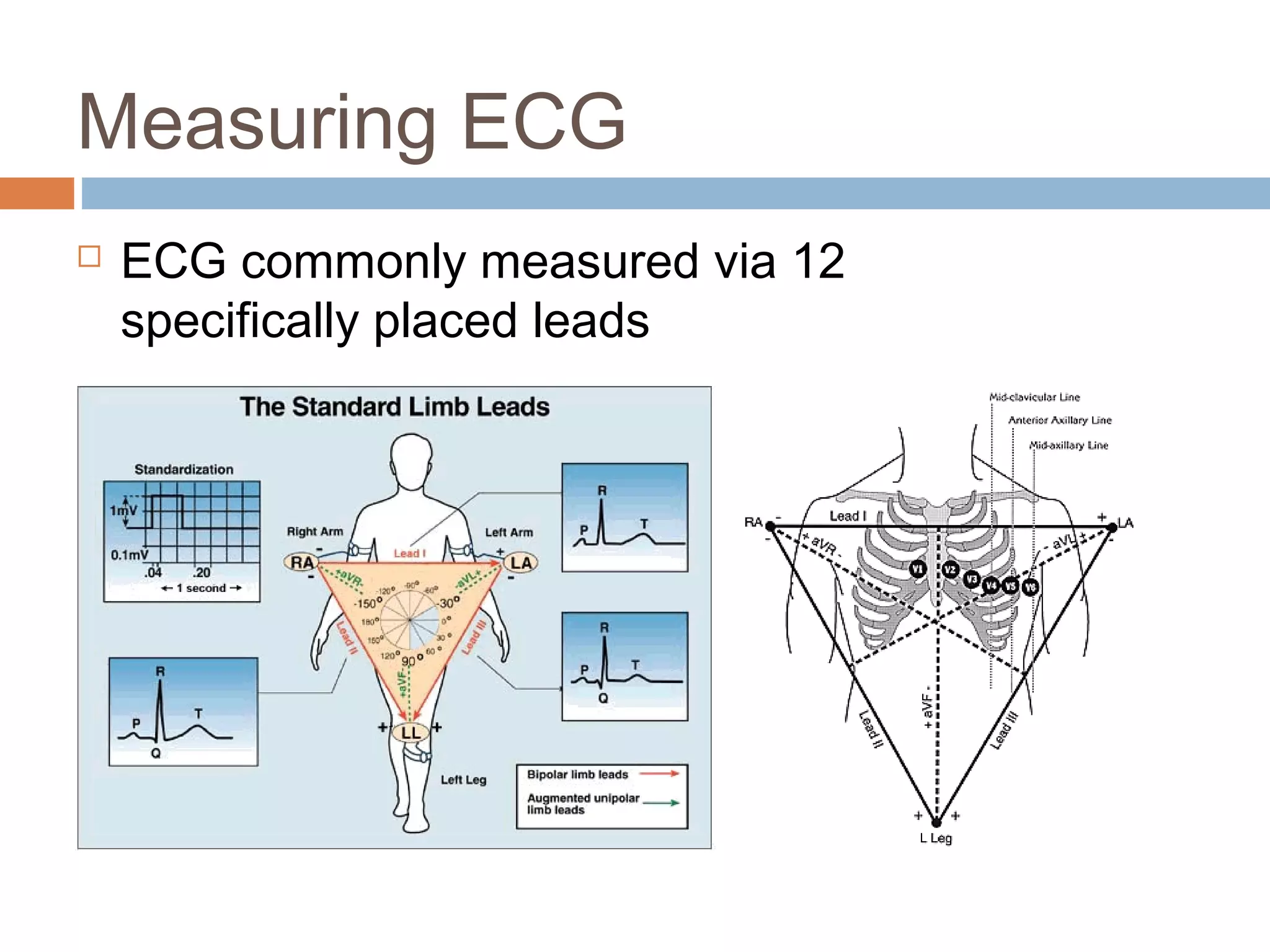
Measuring ECG


ECG commonly measured via 12
specifically placed leads
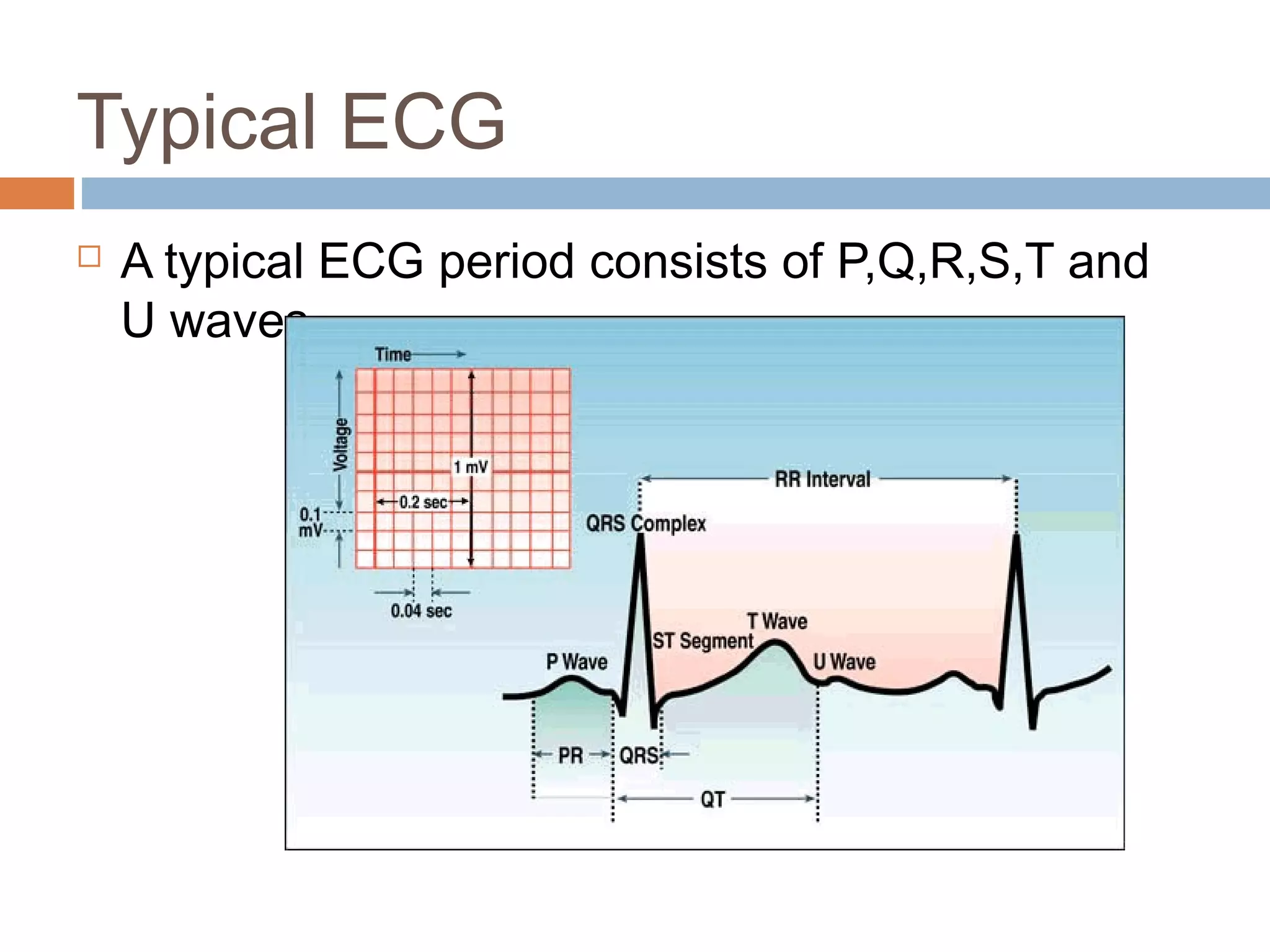
Typical ECG


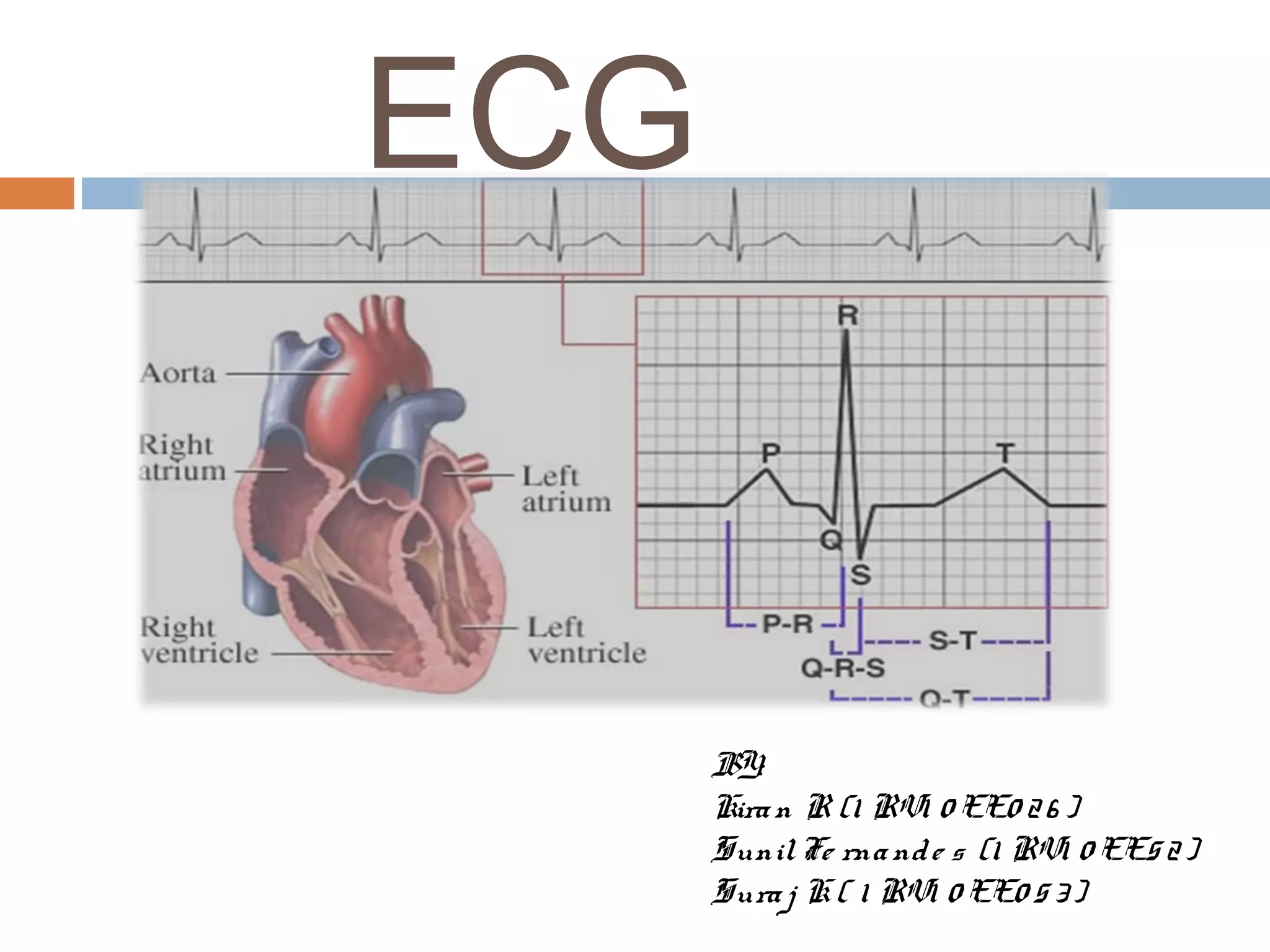
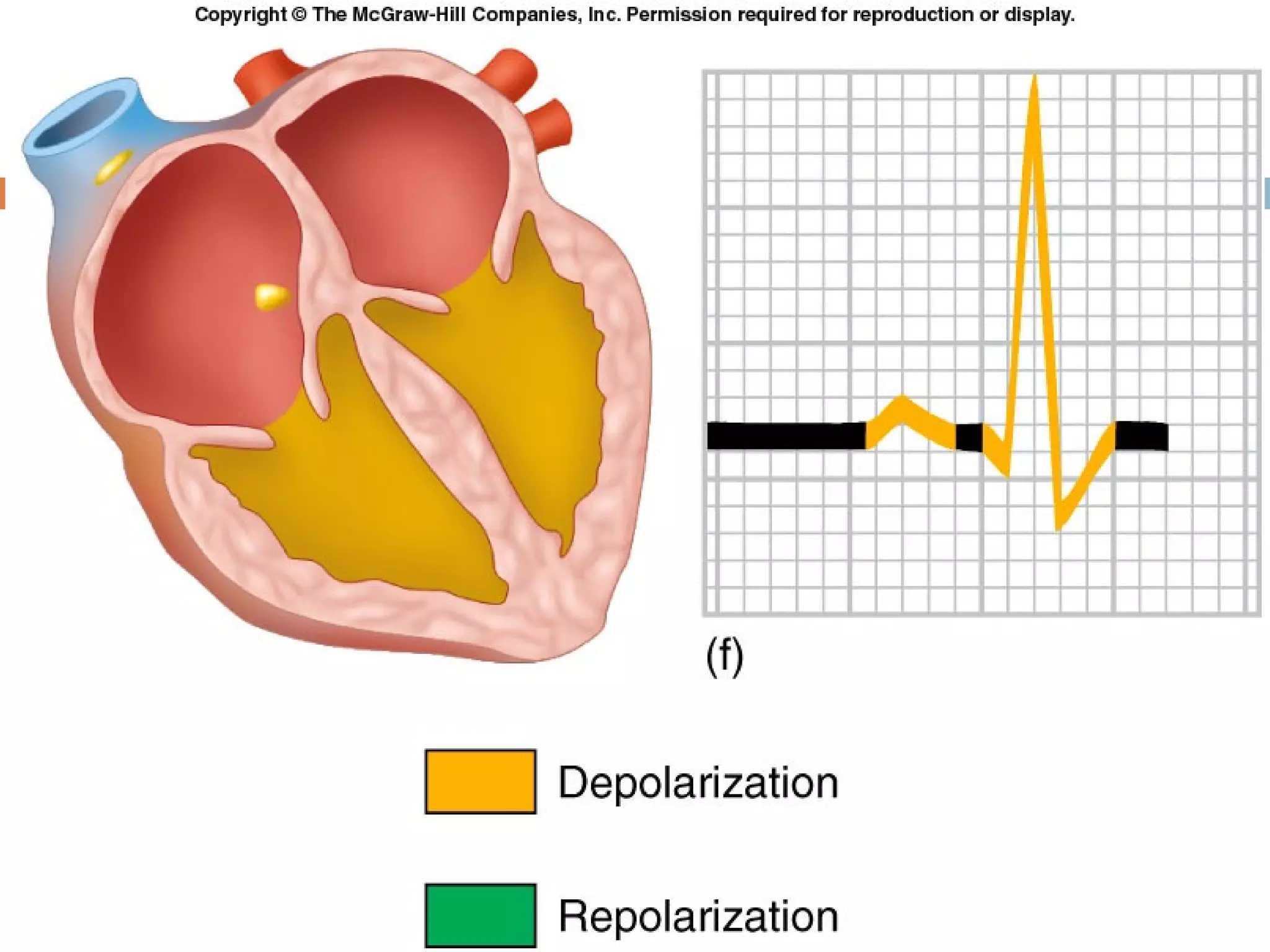
A typical ECG period consists of P,Q,R,S,T and
U waves
P,Q,R,S,T Theory
•ECG is composed of 5 waves - P, Q, R, S and T. This signal could
be measured by electrodes from human body in typical
engagement.
•Signals from these electrodes are brought to simple electrical
circuits with amplifiers and analogue – digital converters.
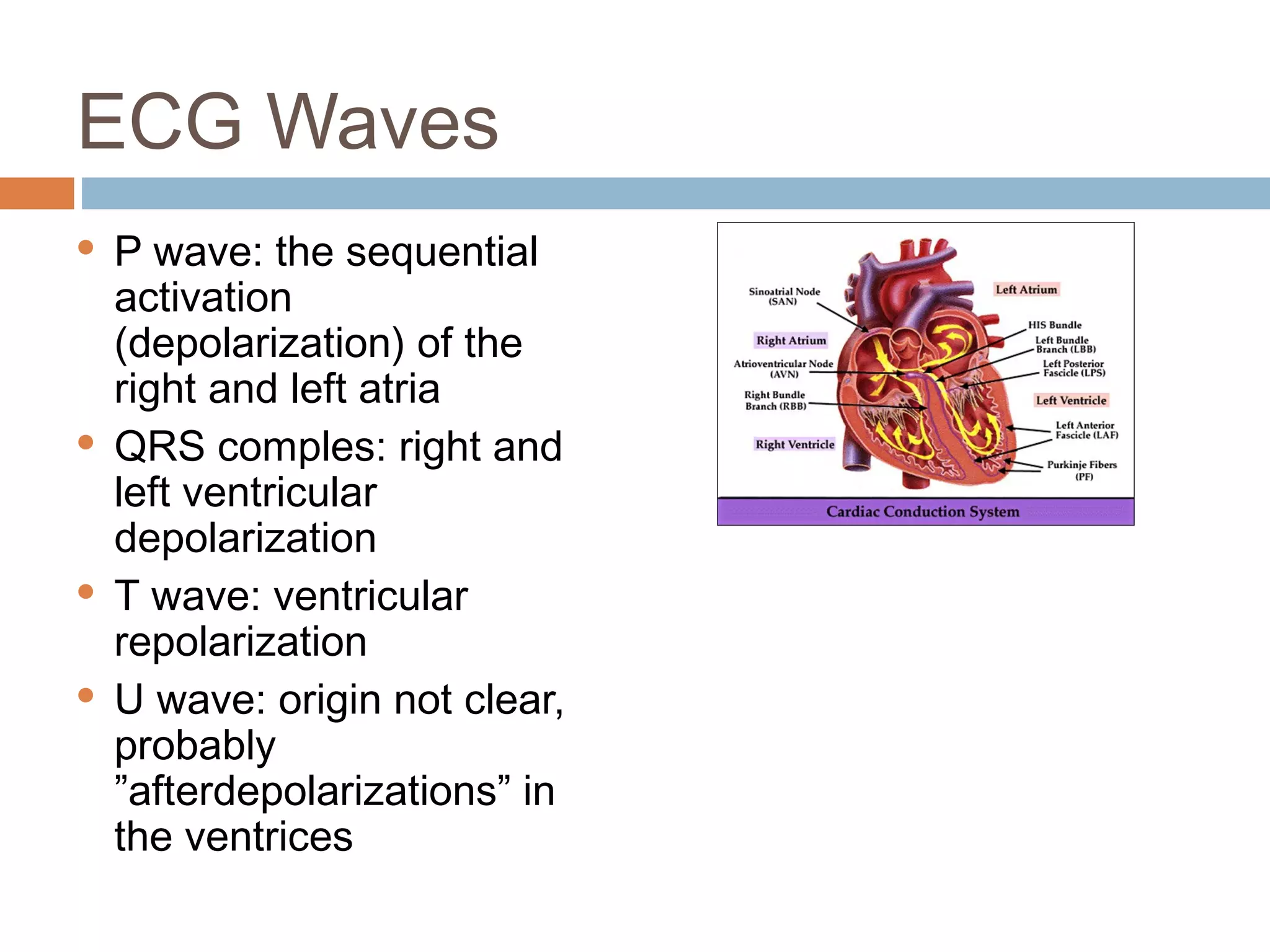
ECG Waves
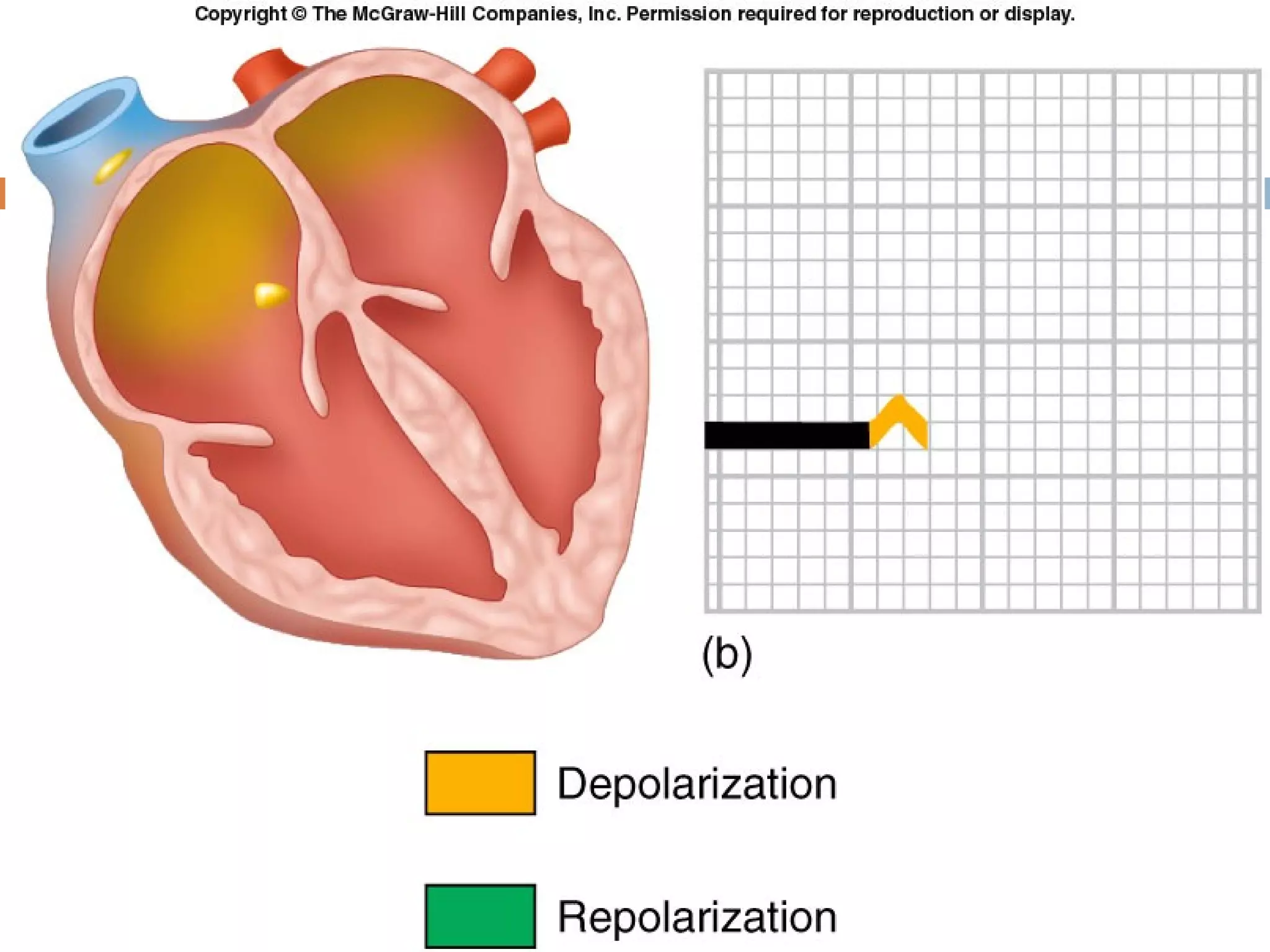
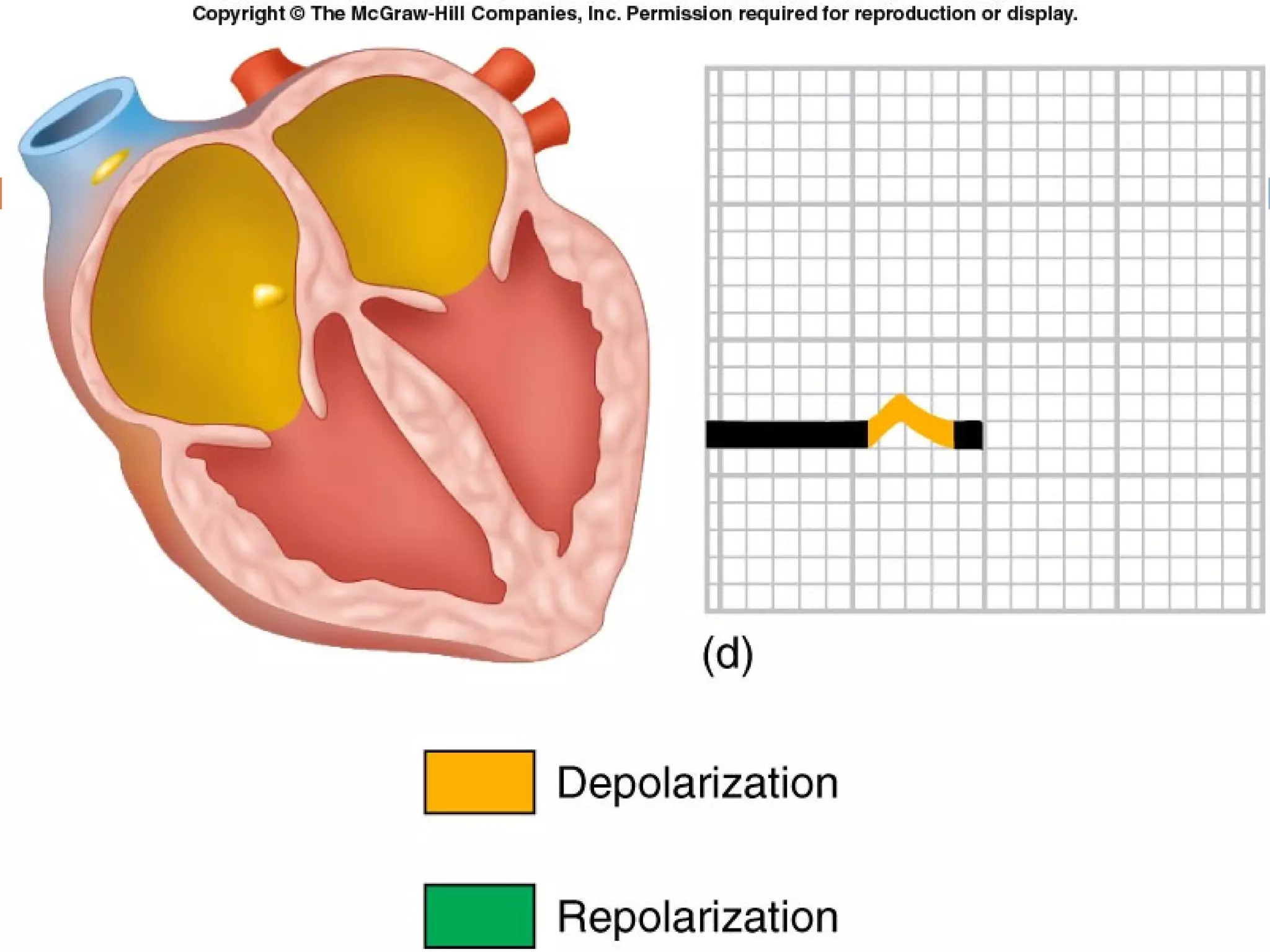
P wave: the sequential
activation
(depolarization) of the
right and left atria
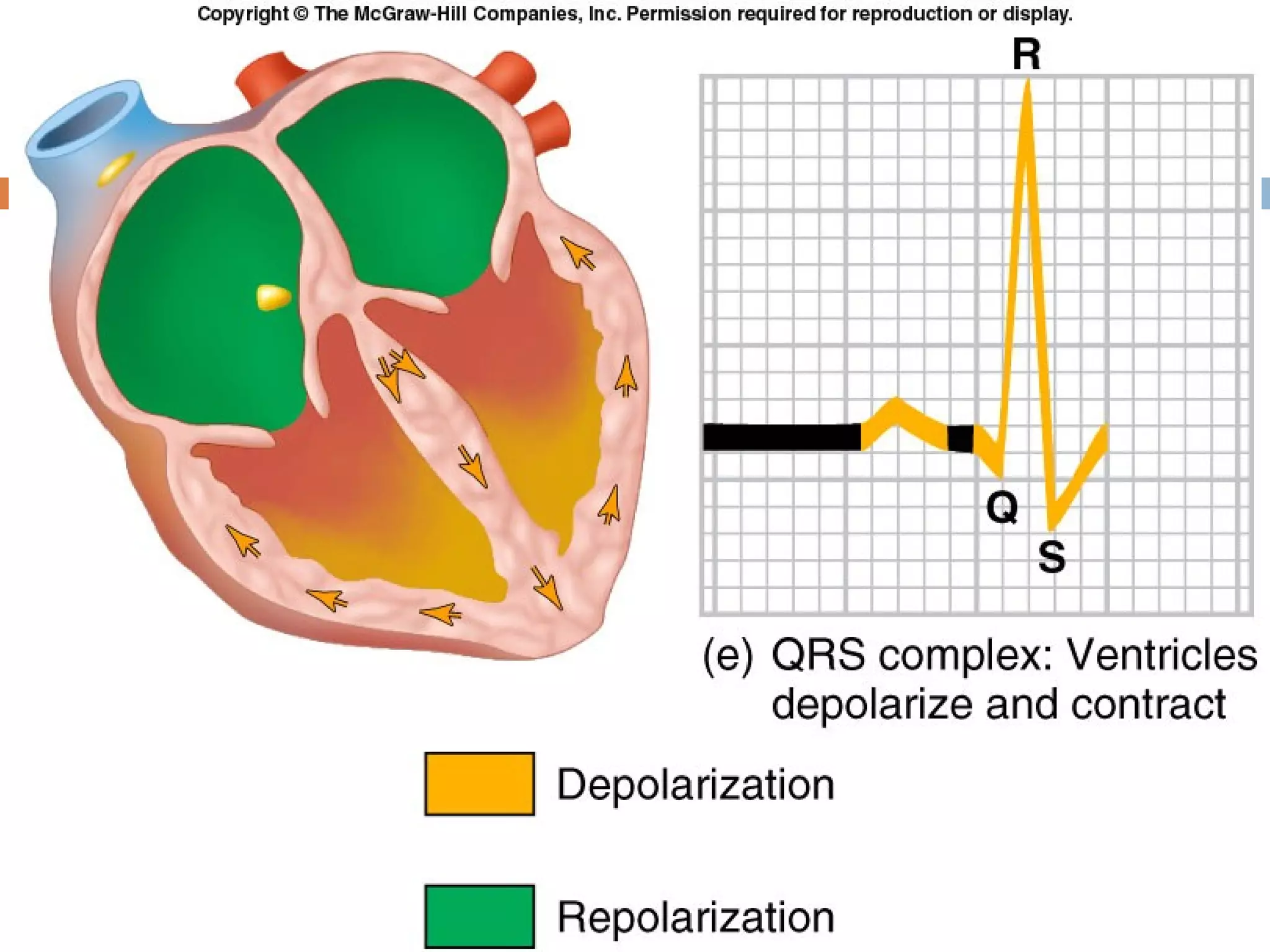
 QRS comples: right and
left ventricular
depolarization
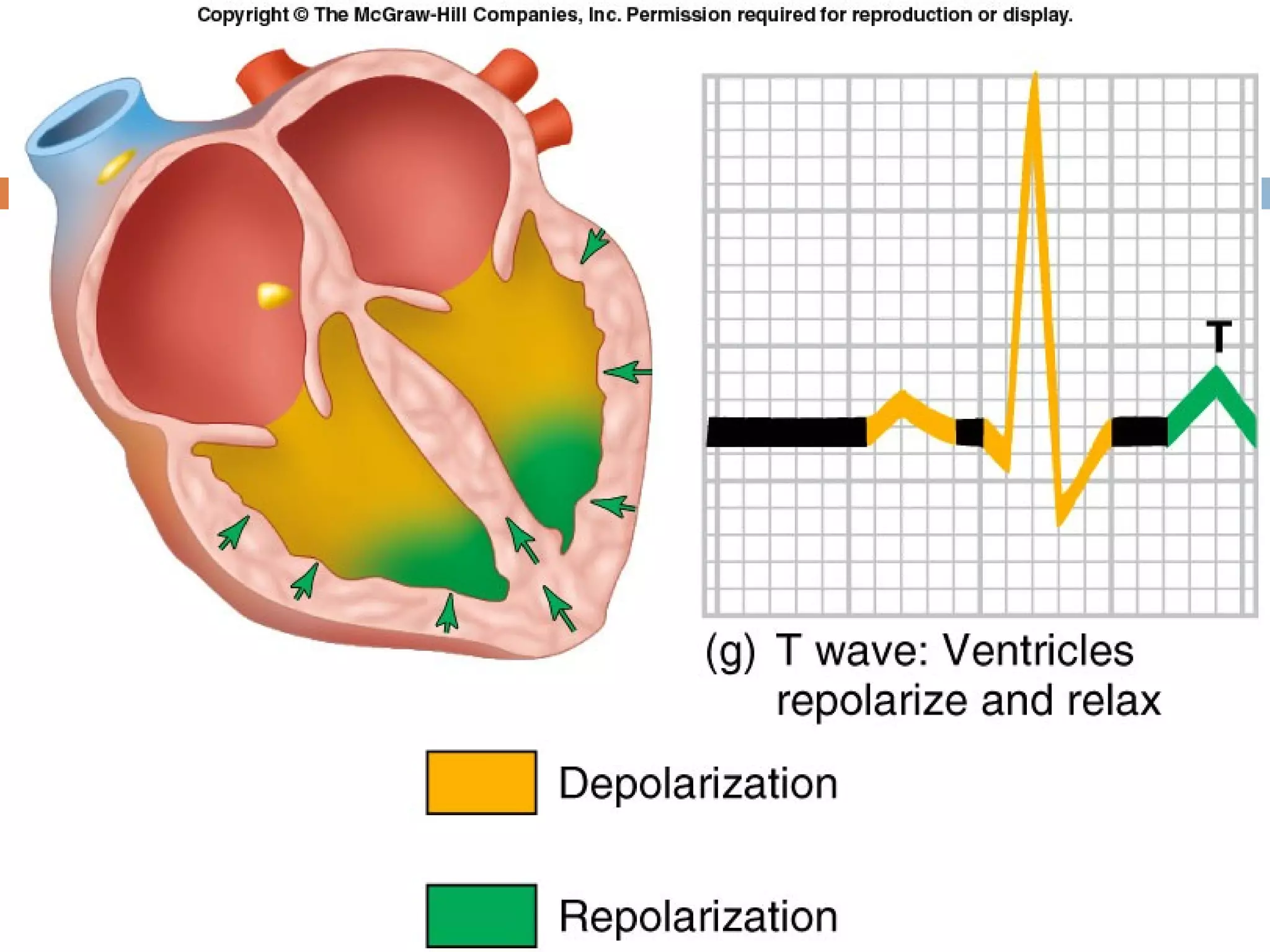
 T wave: ventricular
repolarization
 U wave: origin not clear,
probably
”afterdepolarizations” in
the ventrices

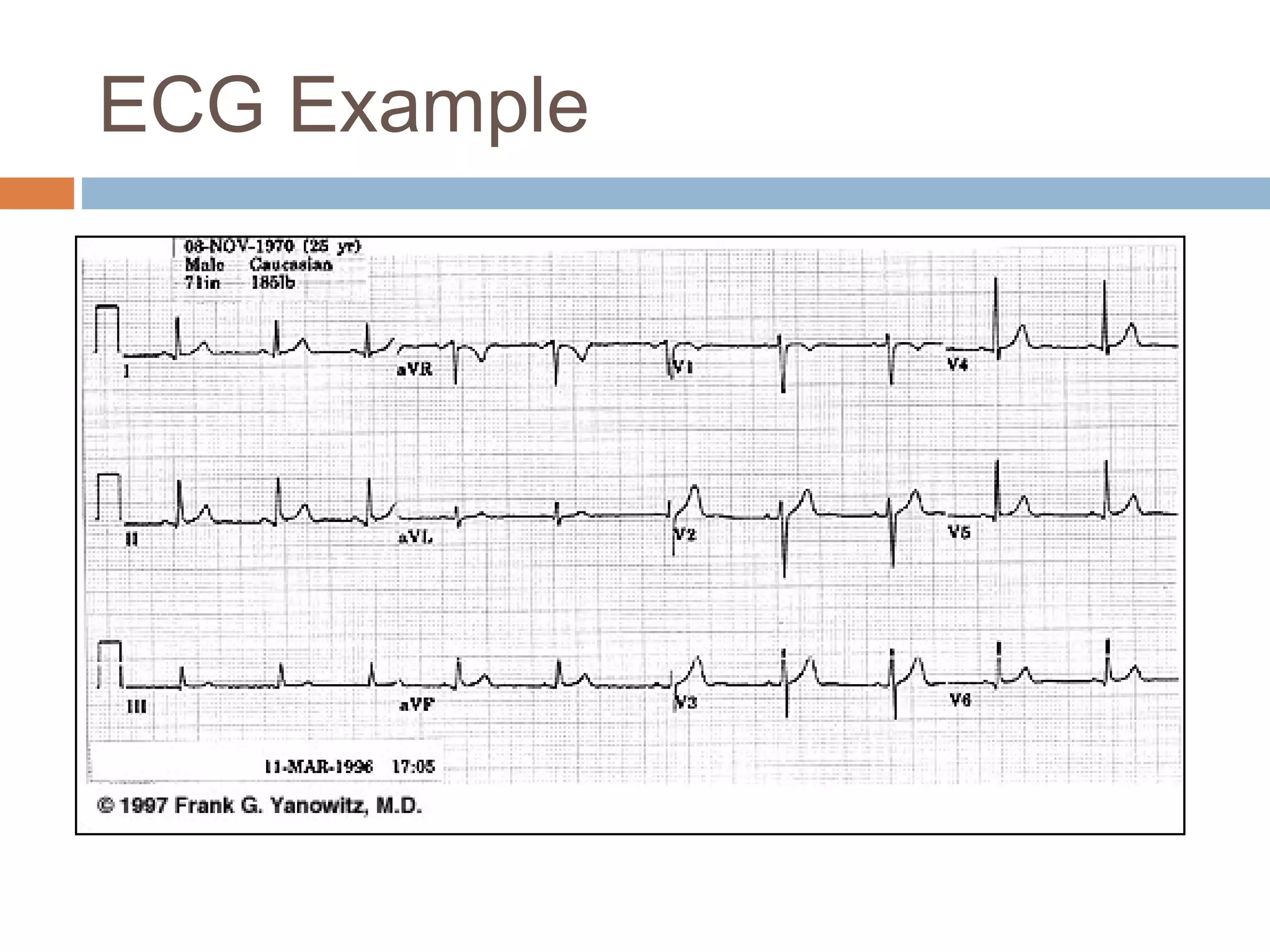
ECG Example
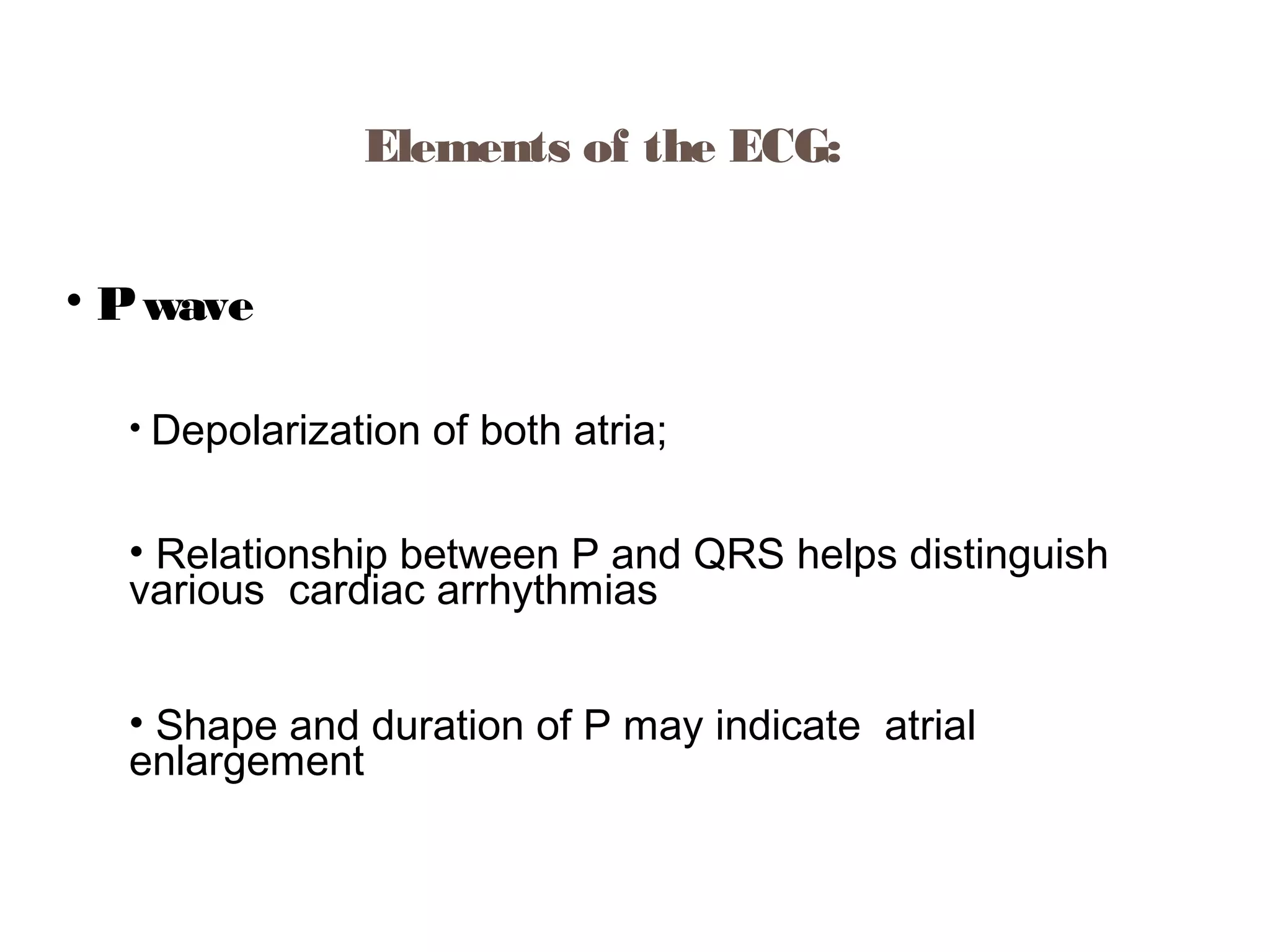
Elements of the ECG:
• P wave
• Depolarization

of both atria;

• Relationship between P and QRS helps distinguish
various cardiac arrhythmias
• Shape and duration of P may indicate atrial
enlargement
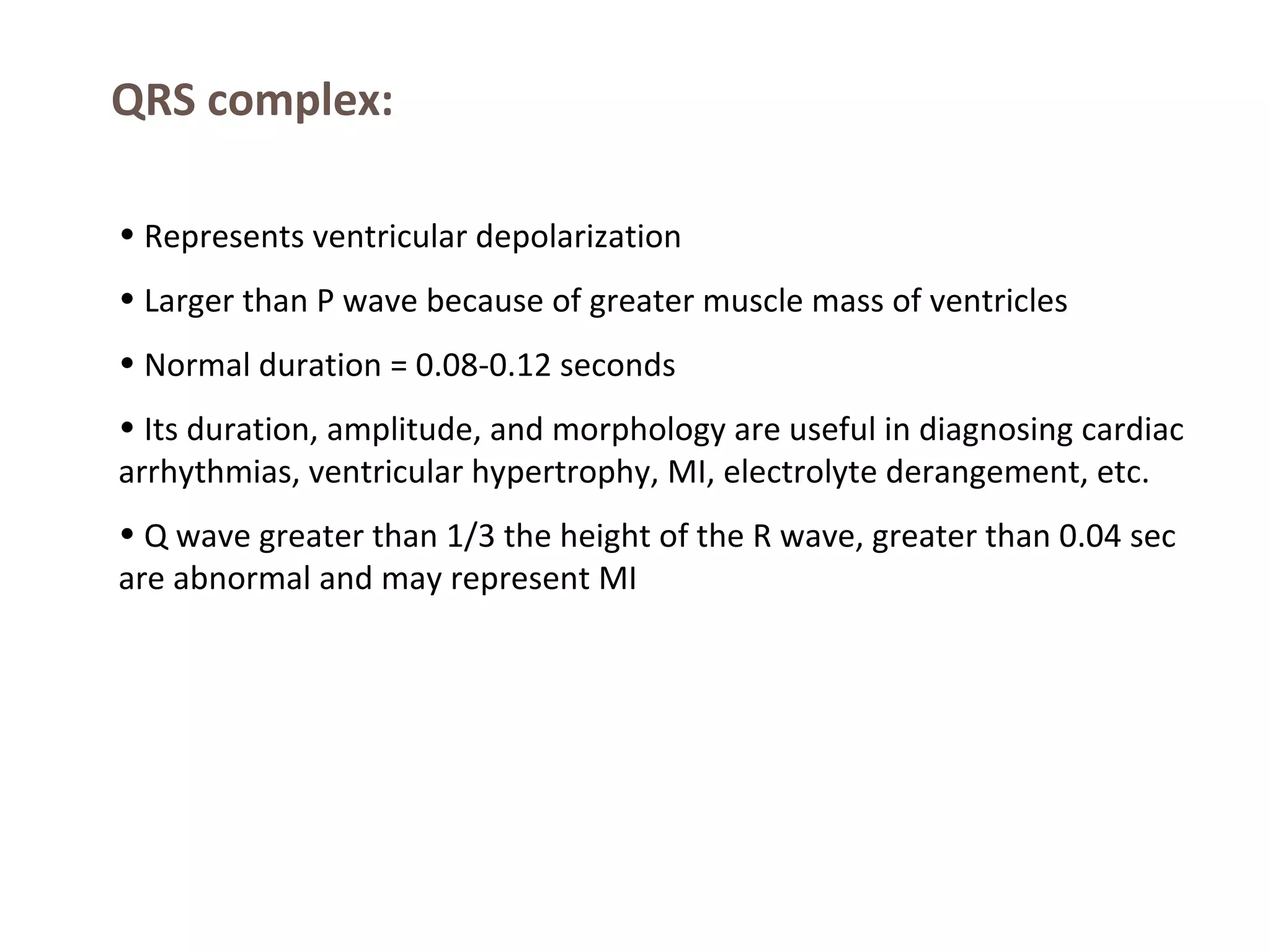
QRS complex:
• Represents ventricular depolarization
• Larger than P wave because of greater muscle mass of ventricles
• Normal duration = 0.08-0.12 seconds
• Its duration, amplitude, and morphology are useful in diagnosing cardiac
arrhythmias, ventricular hypertrophy, MI, electrolyte derangement, etc.
• Q wave greater than 1/3 the height of the R wave, greater than 0.04 sec
are abnormal and may represent MI
PR interval
• From onset of P wave to onset of QRS
• Normal duration = 0.12-2.0 sec (120-200 ms) (3-4
horizontal boxes)
• Represents atria to ventricular conduction time
(through His bundle)
• Prolonged PR interval may indicate a 1st degree
heart block
ST segment:
• Connects the QRS complex and T wave

• Duration of 0.08-0.12 sec (80-120 ms)

T wave:
• Represents repolarization or recovery of ventricles
• Interval from beginning of QRS to apex of T is referred to as the
absolute refractory period

QT Interval:
• Measured from beginning of QRS to the end of the T wave
• Normal QT is usually about 0.40 sec
• QT interval varies based on heart rate
Need for using DSP








A number of emerging medical applications not only
electrocardiography (ECG), but also digital stethoscope,
and pulse oximeters require DSP processing
performance at very low power.
The main problem of digitalized signal is interference
with other noisy signals like power supply network 50 Hz
frequency and breathing muscle artefacts.
These noisy elements have to be removed before the
signal is used for next data processing like heart rate
frequency detection.
Digital filters and signal processing should be designed
very effective for real-time applications in embedded
devices.
Steps Involved


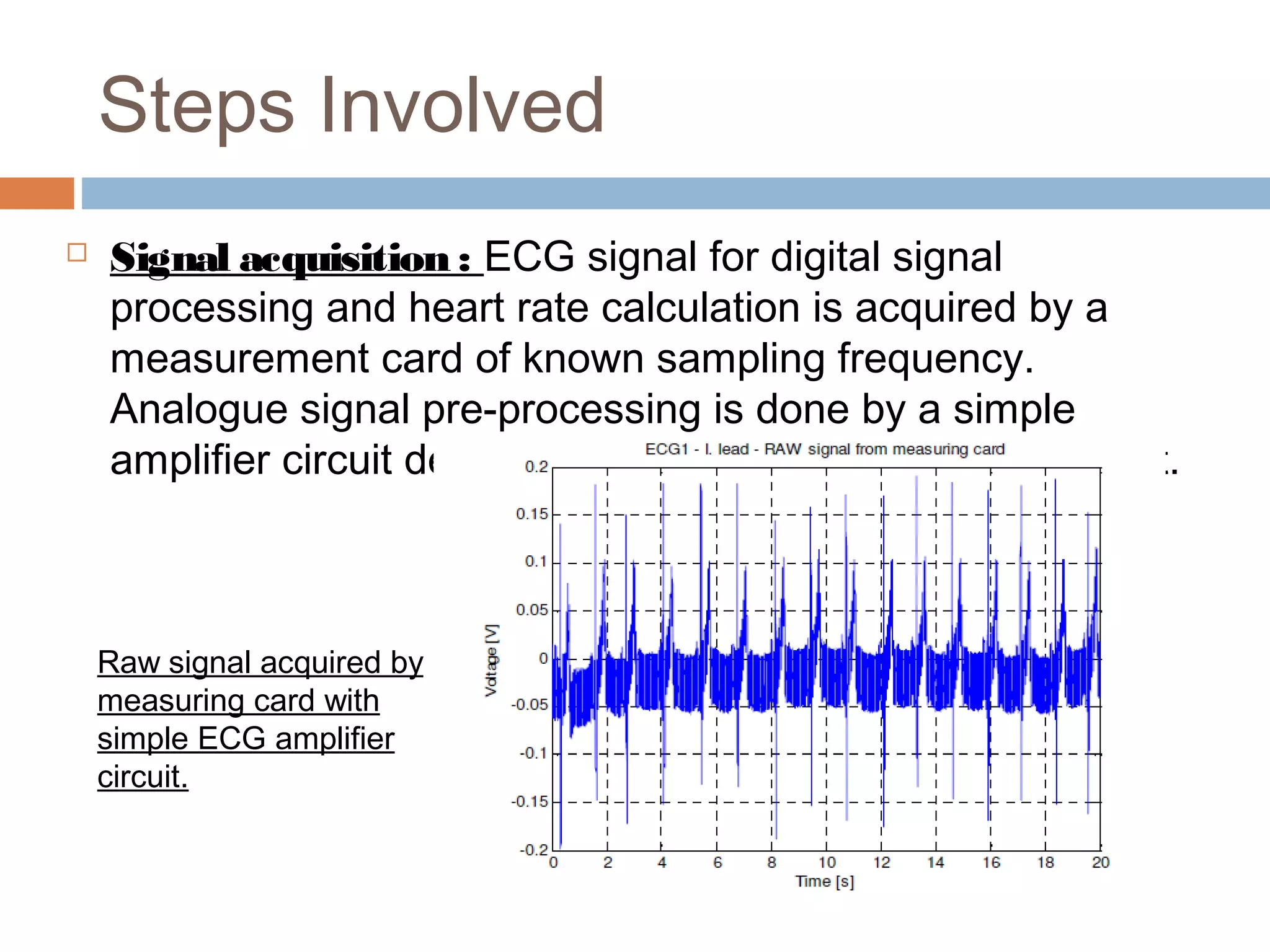
Signal acquisition : ECG signal for digital signal
processing and heart rate calculation is acquired by a
measurement card of known sampling frequency.
Analogue signal pre-processing is done by a simple
amplifier circuit designated for ECG signal measurement.

Raw signal acquired by
measuring card with
simple ECG amplifier
circuit.


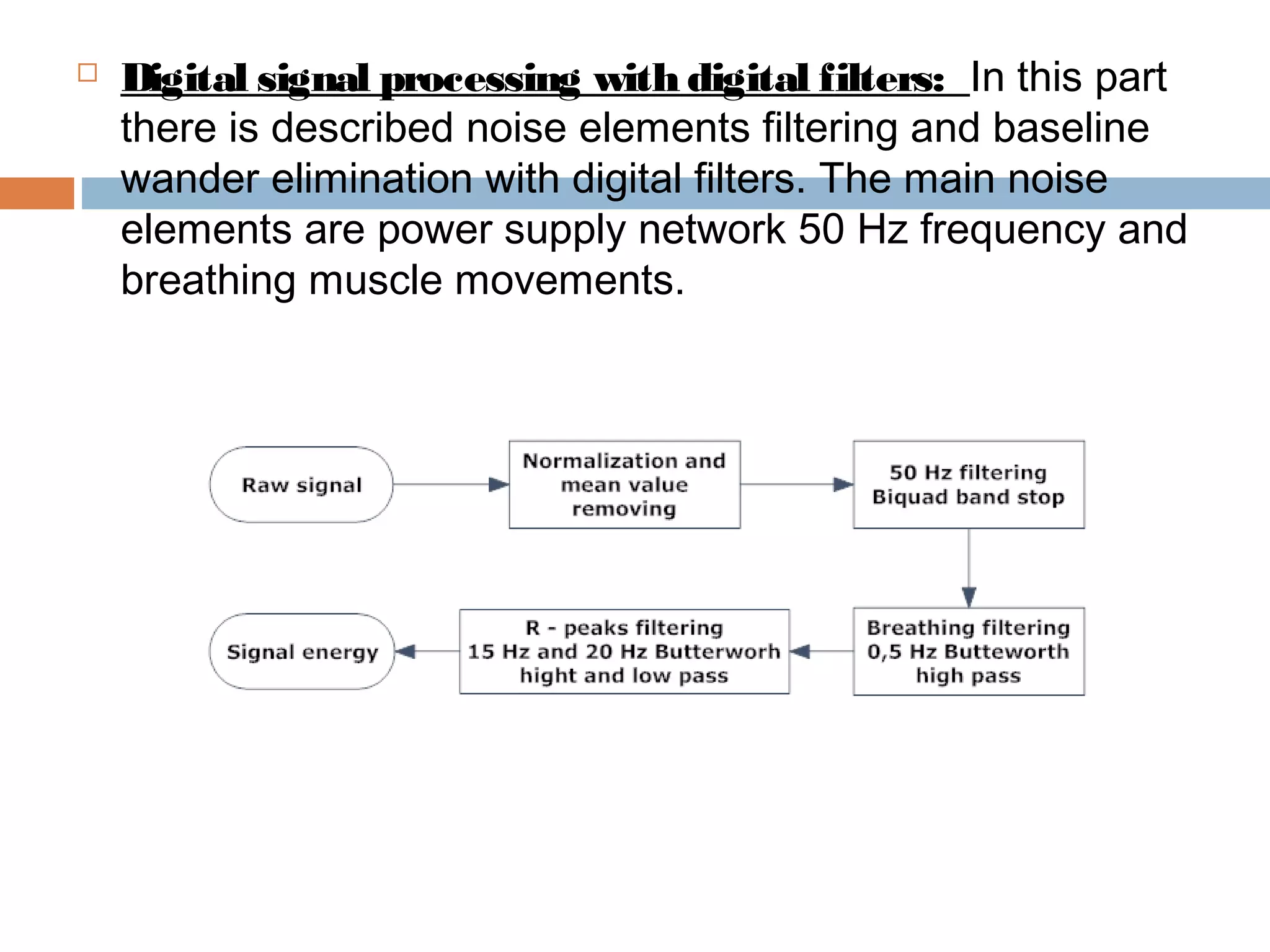
Digital signal processing with digital filters: In this part
there is described noise elements filtering and baseline
wander elimination with digital filters. The main noise
elements are power supply network 50 Hz frequency and
breathing muscle movements.
Filtered Waveforms

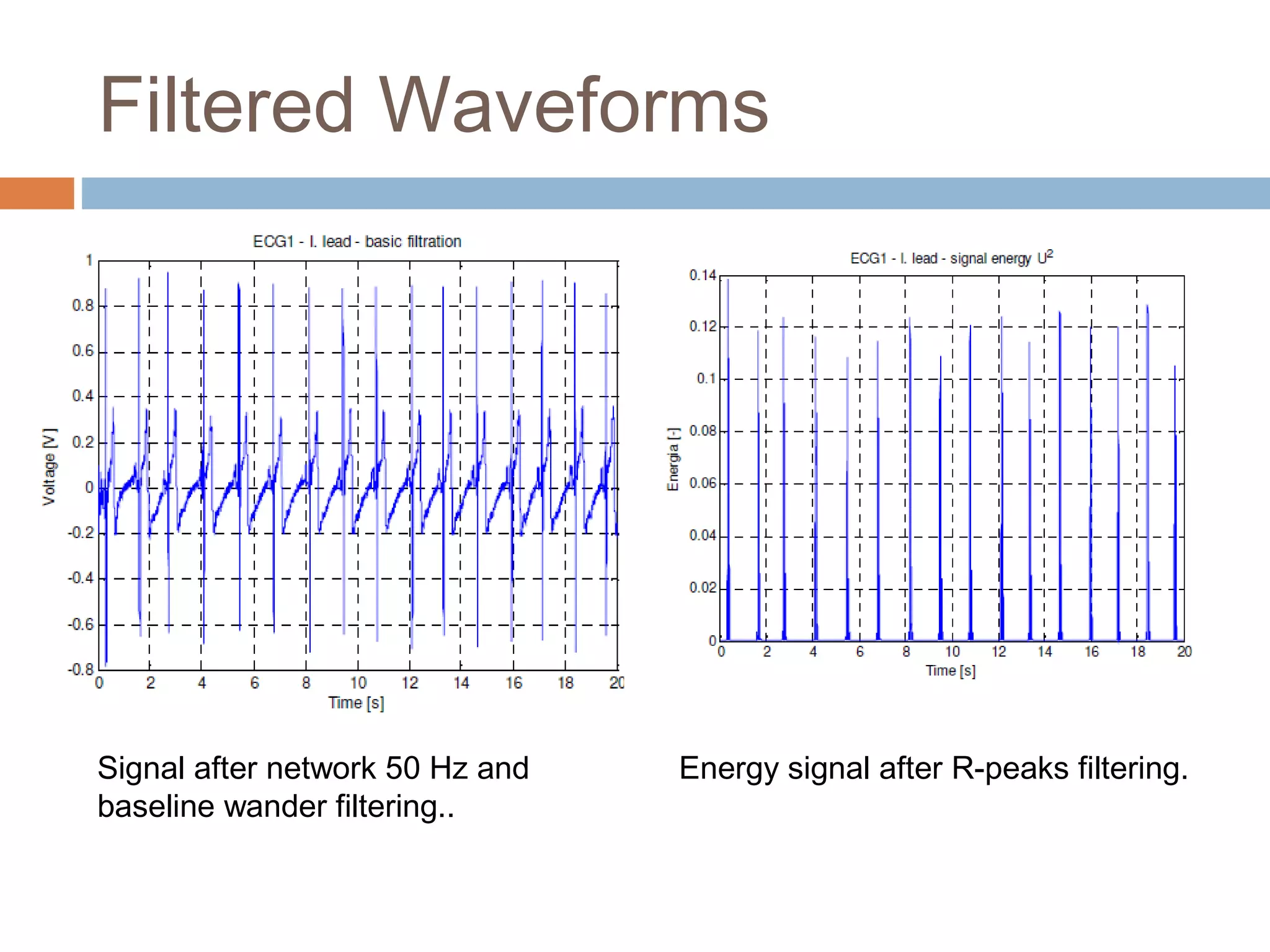
Signal after network 50 Hz and
baseline wander filtering..

Energy signal after R-peaks filtering.
Heart rate detection algorithms:
Two Types – 1 ) Sta tis tic a l Co m p uting





2 ) Diffe re ntia l Co m p uting
These algorithms compute heart rate
frequency from the signal energy.
A c o rre la tio n m e tho d can be used because the ECG
uto
signal is quasi-periodical. Matlab provides a very simple
way of using autocorrelation method in signal processing
which is very useful for this purpose.
The second algorithm aims at detecting heart rate as a
difference between R waves in ECG. These waves are
filtrated by band pass filters firstly and then the signal
energy is computed. The wave’s peaks are detected by
peak detector or s ig na l thre s ho ld ing .
[1] Autocorrelation of energy signal

Autocorrelation function of signal energy
[2] Thresholding of energy signal
Which method to adopt?




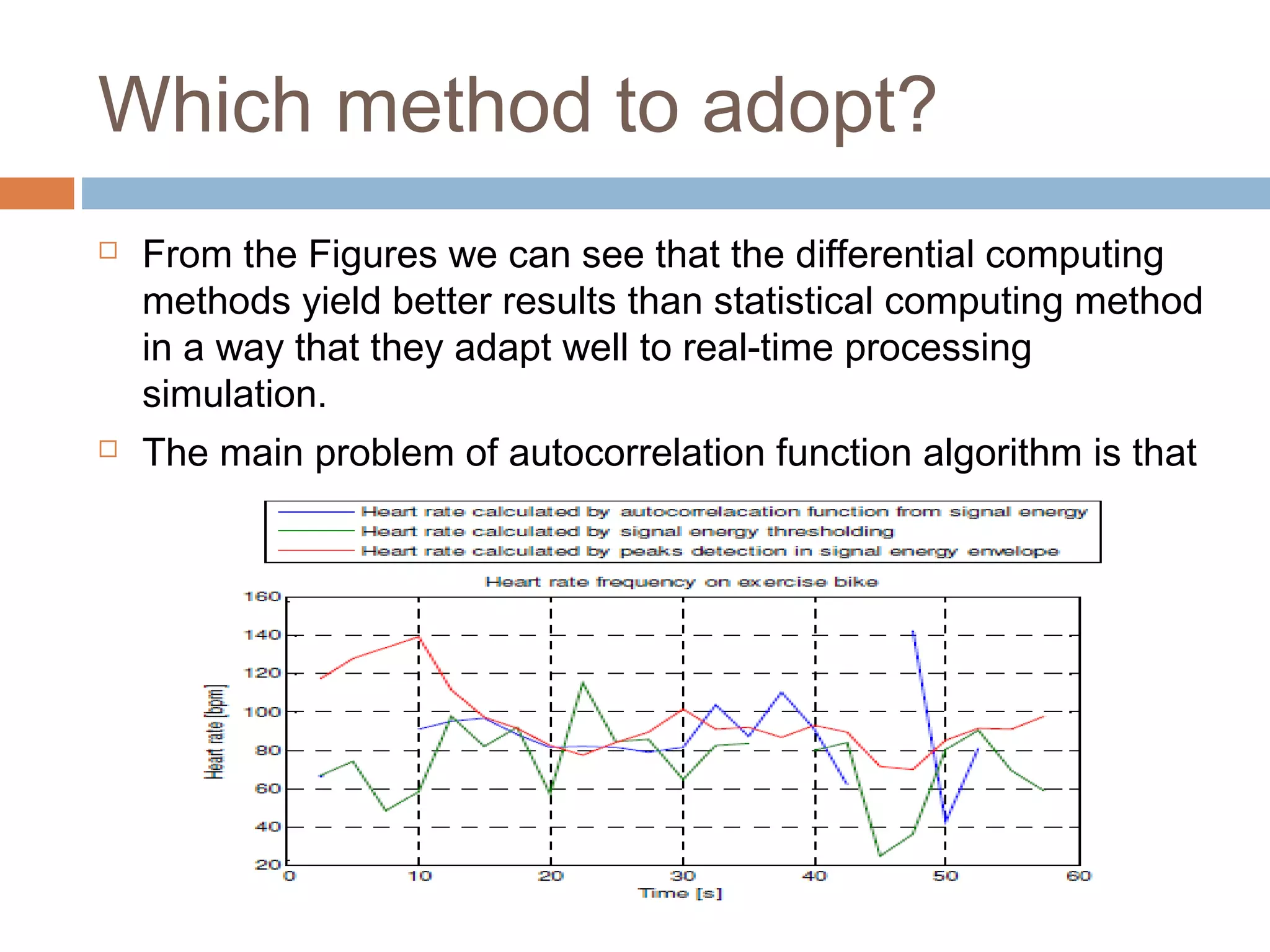
From the Figures we can see that the differential computing
methods yield better results than statistical computing method
in a way that they adapt well to real-time processing
simulation.
The main problem of autocorrelation function algorithm is that
the quality of signal is under par and fluctuates for fast signal
changes.
More about Digital Signal
Processors



Texas Instruments [TI] is a pioneer producer of DSPs.
The TMS320C5515 is the most widely used DSP in
Electro-Cardiograms owing to its good performance and
low power consumption.

The TM 320C5515 Digital signal processor (DS ) board
S
P
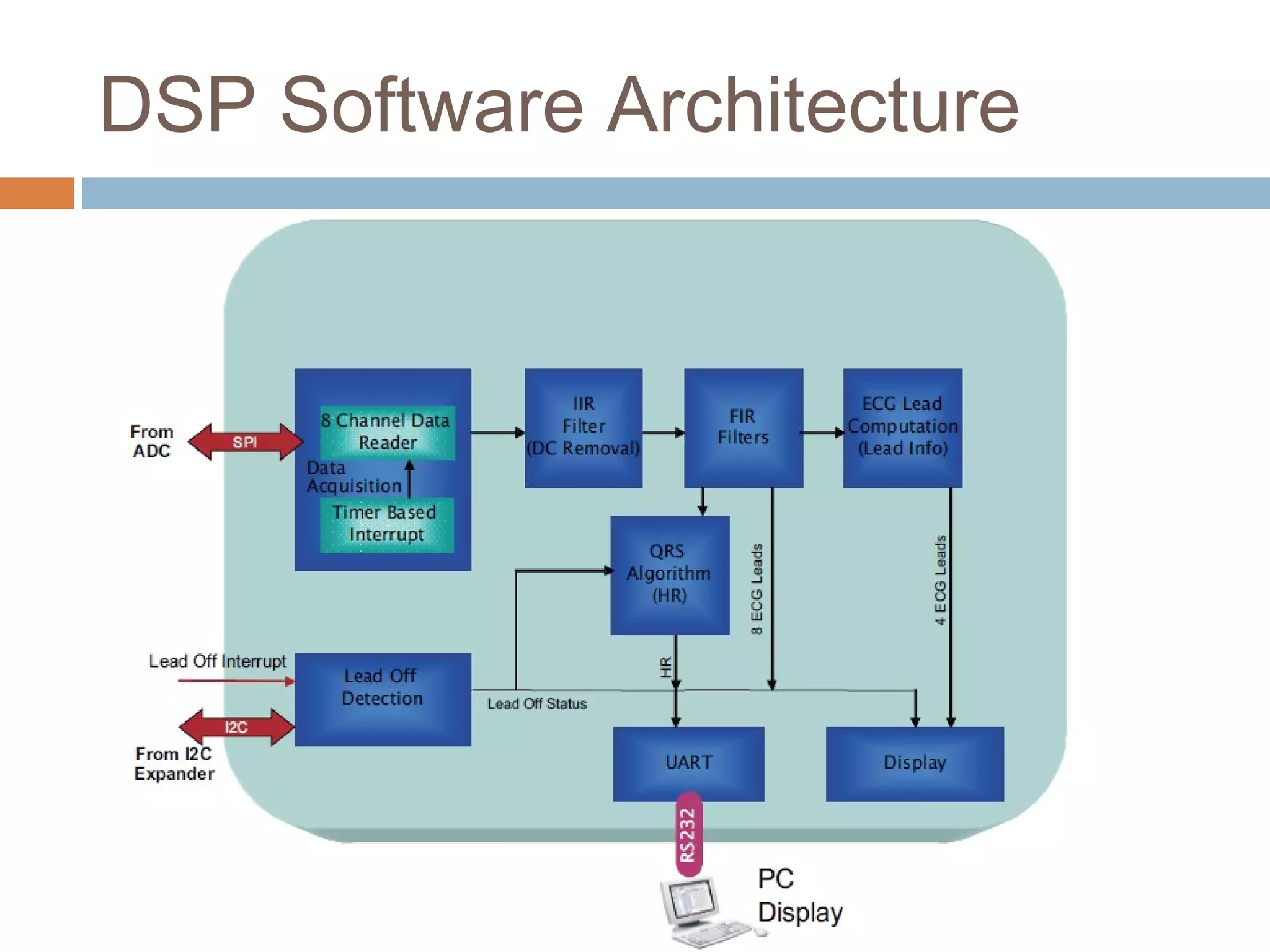
DSP Software Architecture
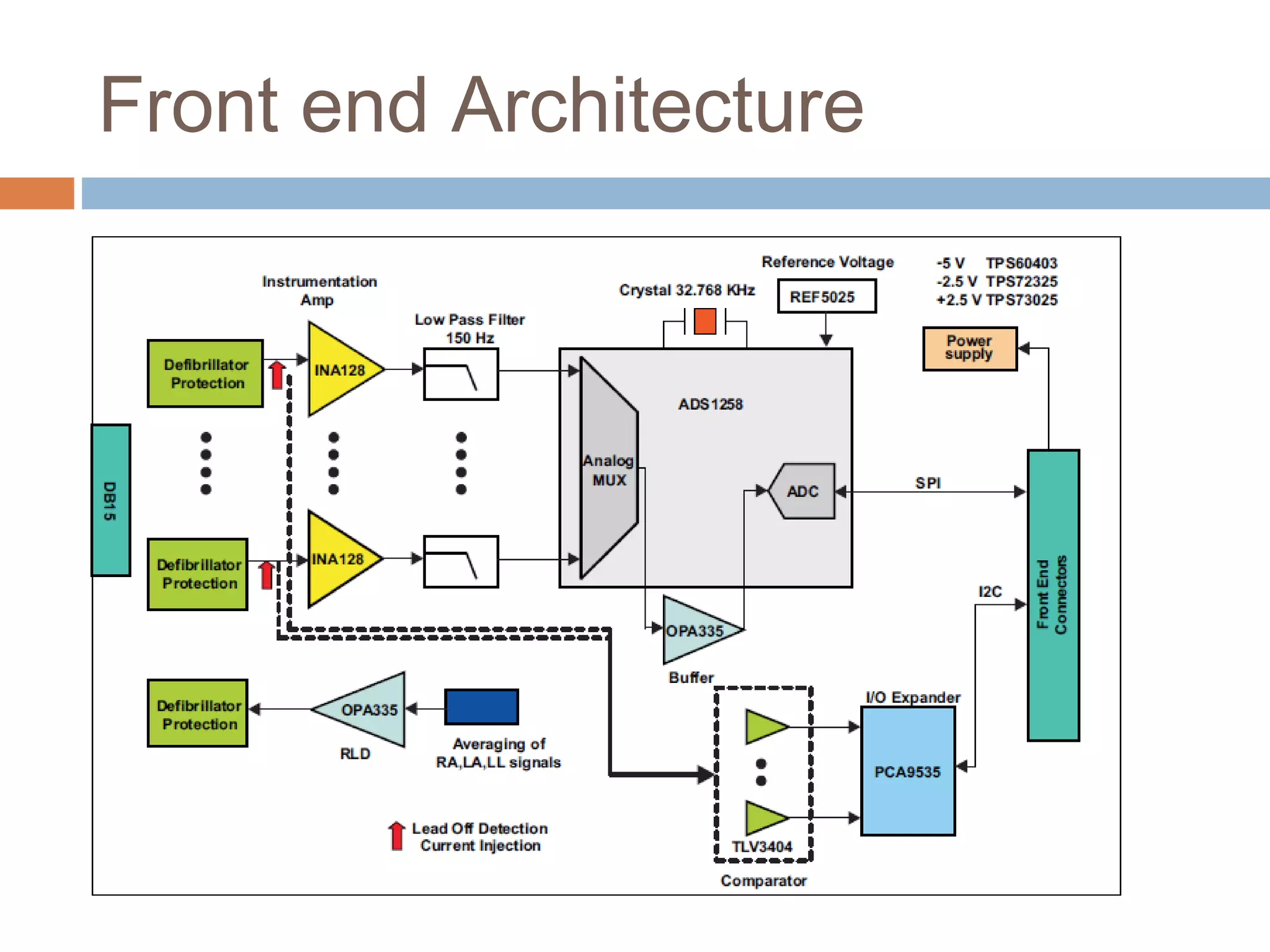
Front end Architecture
Diseases generally diagnosed using
ECG
•

Ischemic Heart Disease

•

AV node blocks Detected on ECG

•

Arrhythmias Detected on ECG

•

Fibrillation Detected on ECG
• www.ecglibrary.com/
• library.med.utah.edu/ecg/
• dsp.ti.com


ECG

  • 1.
    ECG BY: Kira n R(1 RV1 0 EE0 2 6 ) Sunil Fe rna nd e s (1 RV1 0 EE5 2 ) Sura j K ( 1 RV1 0 EE0 5 3 )
  • 2.
    Introduction   The electrocardiogram (ECG)is a time-varying signal reflecting the ionic current flow which causes the cardiac fibers to contract and subsequently relax. The surface ECG is obtained by recording the potential difference between two electrodes placed on the surface of the skin. A single normal cycle of the ECG represents the successive atrial depolarisation/repolarisation and ventricular depolarisation/repolarisation which occurs with every heart beat. Simply put, the ECG (EKG) is a device that measures and records the electrical activity of the heart from electrodes placed on the skin in specific locations
  • 3.
    Basic Working     The ECGis nothing but the recording of the hearts electrical activity. The deviations in the normal electrical patterns indicate various cardiac disorders. Cardiac cells, in the normal state are electrically polarized. Their inner sides are negatively charged relative to their outer sides. These cardiac cells can lose their normal negativity in a process called depolarization, which is the fundamental electrical activity of the heart. This depolarization is propagated from cell to cell, producing a wave of depolarization that can be transmitted across the entire heart. This wave of depolarization produces a flow of electric current and it can be detected by keeping the electrodes on the surface of the body. Once the depolarization is complete, the cardiac cells are able to restore their normal polarity by a process called re-polarization.
  • 4.
    • • • The earlier methodof ECG signal analysis was based on time domain approach But this is not always sufficient to study all the features of ECG signals. So, the frequency domain analysis is made use of To accomplish this, FFT (Fast Fourier Transform) technique is applied.
  • 5.
    Measuring ECG  ECG commonlymeasured via 12 specifically placed leads
  • 6.
    Typical ECG  A typicalECG period consists of P,Q,R,S,T and U waves
  • 7.
    P,Q,R,S,T Theory •ECG iscomposed of 5 waves - P, Q, R, S and T. This signal could be measured by electrodes from human body in typical engagement. •Signals from these electrodes are brought to simple electrical circuits with amplifiers and analogue – digital converters.
  • 8.
    ECG Waves P wave:the sequential activation (depolarization) of the right and left atria  QRS comples: right and left ventricular depolarization  T wave: ventricular repolarization  U wave: origin not clear, probably ”afterdepolarizations” in the ventrices 
  • 9.
  • 16.
    Elements of theECG: • P wave • Depolarization of both atria; • Relationship between P and QRS helps distinguish various cardiac arrhythmias • Shape and duration of P may indicate atrial enlargement
  • 17.
    QRS complex: • Representsventricular depolarization • Larger than P wave because of greater muscle mass of ventricles • Normal duration = 0.08-0.12 seconds • Its duration, amplitude, and morphology are useful in diagnosing cardiac arrhythmias, ventricular hypertrophy, MI, electrolyte derangement, etc. • Q wave greater than 1/3 the height of the R wave, greater than 0.04 sec are abnormal and may represent MI
  • 18.
    PR interval • Fromonset of P wave to onset of QRS • Normal duration = 0.12-2.0 sec (120-200 ms) (3-4 horizontal boxes) • Represents atria to ventricular conduction time (through His bundle) • Prolonged PR interval may indicate a 1st degree heart block
  • 19.
    ST segment: • Connectsthe QRS complex and T wave • Duration of 0.08-0.12 sec (80-120 ms) T wave: • Represents repolarization or recovery of ventricles • Interval from beginning of QRS to apex of T is referred to as the absolute refractory period QT Interval: • Measured from beginning of QRS to the end of the T wave • Normal QT is usually about 0.40 sec • QT interval varies based on heart rate
  • 20.
    Need for usingDSP     A number of emerging medical applications not only electrocardiography (ECG), but also digital stethoscope, and pulse oximeters require DSP processing performance at very low power. The main problem of digitalized signal is interference with other noisy signals like power supply network 50 Hz frequency and breathing muscle artefacts. These noisy elements have to be removed before the signal is used for next data processing like heart rate frequency detection. Digital filters and signal processing should be designed very effective for real-time applications in embedded devices.
  • 21.
    Steps Involved  Signal acquisition: ECG signal for digital signal processing and heart rate calculation is acquired by a measurement card of known sampling frequency. Analogue signal pre-processing is done by a simple amplifier circuit designated for ECG signal measurement. Raw signal acquired by measuring card with simple ECG amplifier circuit.
  • 22.
     Digital signal processingwith digital filters: In this part there is described noise elements filtering and baseline wander elimination with digital filters. The main noise elements are power supply network 50 Hz frequency and breathing muscle movements.
  • 23.
    Filtered Waveforms Signal afternetwork 50 Hz and baseline wander filtering.. Energy signal after R-peaks filtering.
  • 24.
    Heart rate detectionalgorithms: Two Types – 1 ) Sta tis tic a l Co m p uting   2 ) Diffe re ntia l Co m p uting These algorithms compute heart rate frequency from the signal energy. A c o rre la tio n m e tho d can be used because the ECG uto signal is quasi-periodical. Matlab provides a very simple way of using autocorrelation method in signal processing which is very useful for this purpose. The second algorithm aims at detecting heart rate as a difference between R waves in ECG. These waves are filtrated by band pass filters firstly and then the signal energy is computed. The wave’s peaks are detected by peak detector or s ig na l thre s ho ld ing .
  • 25.
    [1] Autocorrelation ofenergy signal Autocorrelation function of signal energy
  • 26.
    [2] Thresholding ofenergy signal
  • 27.
    Which method toadopt?   From the Figures we can see that the differential computing methods yield better results than statistical computing method in a way that they adapt well to real-time processing simulation. The main problem of autocorrelation function algorithm is that the quality of signal is under par and fluctuates for fast signal changes.
  • 28.
    More about DigitalSignal Processors   Texas Instruments [TI] is a pioneer producer of DSPs. The TMS320C5515 is the most widely used DSP in Electro-Cardiograms owing to its good performance and low power consumption. The TM 320C5515 Digital signal processor (DS ) board S P
  • 29.
  • 30.
  • 31.
    Diseases generally diagnosedusing ECG • Ischemic Heart Disease • AV node blocks Detected on ECG • Arrhythmias Detected on ECG • Fibrillation Detected on ECG
  • 32.
  • 33.

Editor's Notes

  • #23 Baseline wander, or extragenoeous low-frequency high-bandwidth components, can be caused by: Perspiration (effects electrode impedance) Respiration Body movements Can cause problems to analysis, especially when exmining the low-frequency ST-T segment Two main approaches used are linear filtering and polynomial fitting