Signal Types and Their
Classifications
By Ilkin Gambarov
What is a
Biomedical Signal?
• Biomedical signals are those signals
(phenomenon that conveys
information) which are used
primarily for extracting information
on a biological system under
investigation. The process of
extracting information could be as
simple as feeling the pulse of a
person on the wrist or as complex as
analyzing the structure of internal
soft tissues by an ultrasound
scanner. Biomedical signals originate
from a variety of sources such as:
Biomechanic
al Signals:
• These signals originate from some mechanical function
of the biological system. They include all types of motion
and displacement signals, pressure and flow signals etc.
The movement of the chest wall in accordance with the
respiratory activity is an example of this type of signal.
Bioelectric
Signals:
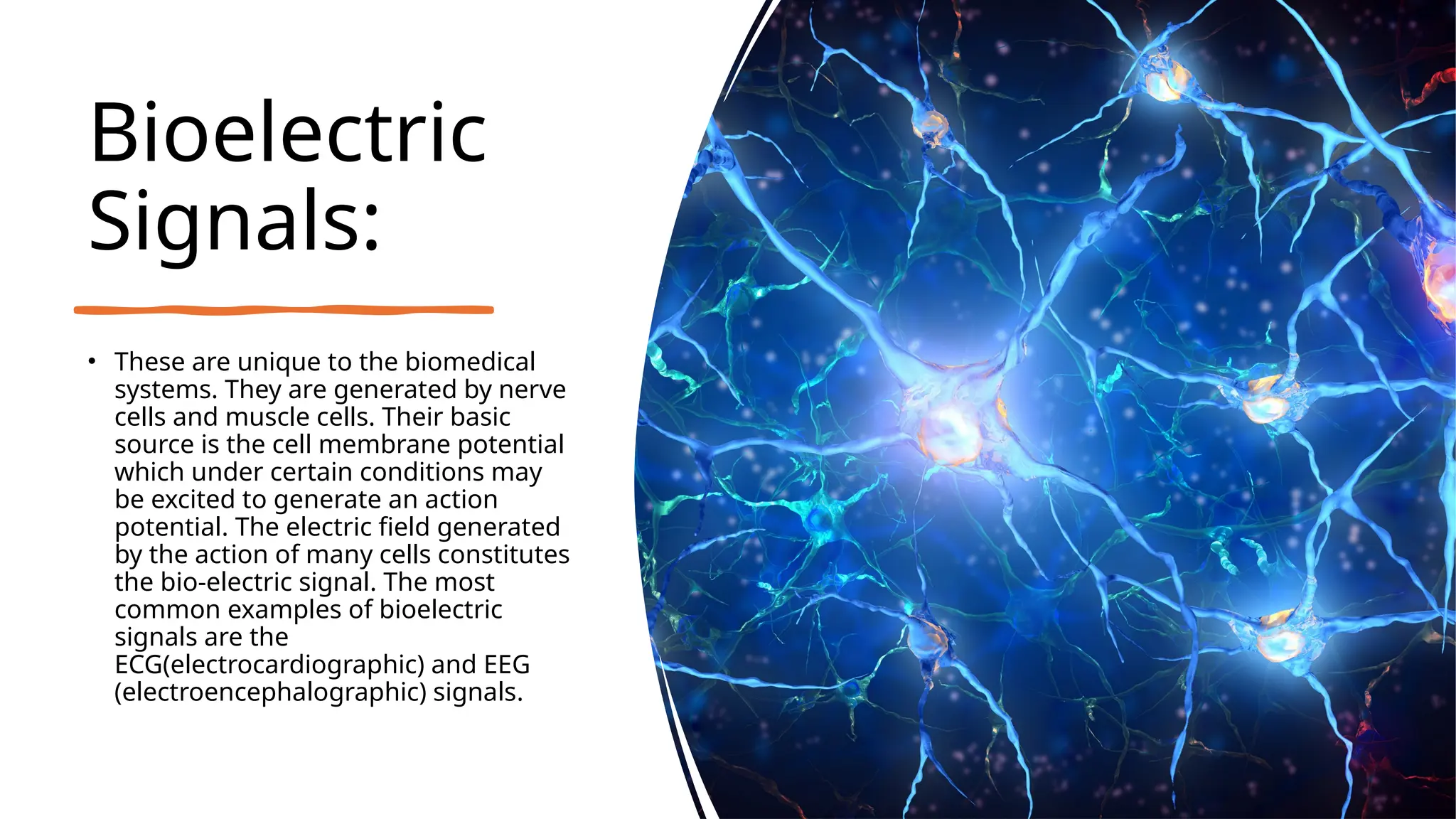
• These are unique to the biomedical
systems. They are generated by nerve
cells and muscle cells. Their basic
source is the cell membrane potential
which under certain conditions may
be excited to generate an action
potential. The electric field generated
by the action of many cells constitutes
the bio-electric signal. The most
common examples of bioelectric
signals are the
ECG(electrocardiographic) and EEG
(electroencephalographic) signals.
Biochemical
Signals:
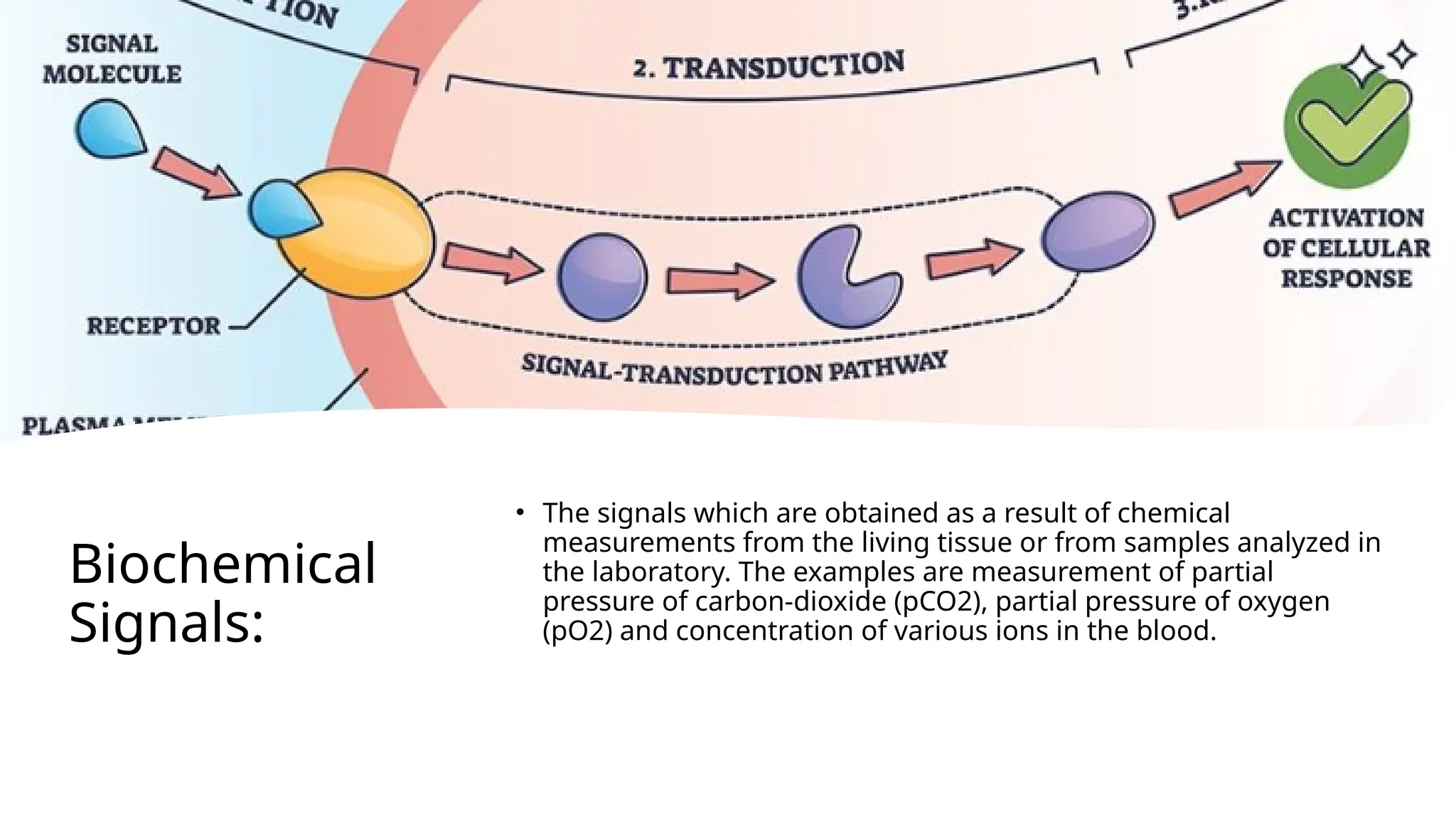
• The signals which are obtained as a result of chemical
measurements from the living tissue or from samples analyzed in
the laboratory. The examples are measurement of partial
pressure of carbon-dioxide (pCO2), partial pressure of oxygen
(pO2) and concentration of various ions in the blood.
Bio-optical
Signals:
• These signals are generated as result of
optical functions of the biological systems,
occurring either naturally or induced by the
measurement process. For example, blood
oxygenation may be estimated by measuring
the transmitted/back scattered light from a
tissue at different wavelengths.
Other Biosignals:
• Bio-impedance Signals: The impedance of the tissue is a source of important information
concerning its composition, blood distribution and blood volume etc. The measurement of
galvanic skin resistance is a typical example of this type of signal. The bio-impedance signal
is also obtained by injecting sinusoidal current in the tissue and measuring the voltage
drop generated by the tissue impedance. The measurement of respiration rate based on
bioimpedance technique is an example of this type of signals.
• Biomagnetic Signals: Extremely weak magnetic fields are produced by various organs such
as the brain, heart and lungs. The measurement of these signals provides information
which is not available in other types of bio-signals such bio-electric signals. A typical
example is that of magneto-encephalograph signal from the brain.
• Bioacoustic Signals: The measurement of acoustic signals created by many biomedical
phenomena provides information about the underlying phenomena. The examples of such
signals are: flow of blood in the heart, through the heart’s valves and flow of air through the
upper and lower airways and in the lungs which generate typical acoustic signal.
• Biothermal Signals, Bioradioactive Signals, and etc
Metal-plate electrodes:
Floating electrodes:
Flexible electro
Floating electrodes:
Thank You For Your
Atttention

Signal Types and Their Classifications.pptx

  • 1.
    Signal Types andTheir Classifications By Ilkin Gambarov
  • 2.
    What is a BiomedicalSignal? • Biomedical signals are those signals (phenomenon that conveys information) which are used primarily for extracting information on a biological system under investigation. The process of extracting information could be as simple as feeling the pulse of a person on the wrist or as complex as analyzing the structure of internal soft tissues by an ultrasound scanner. Biomedical signals originate from a variety of sources such as:
  • 3.
    Biomechanic al Signals: • Thesesignals originate from some mechanical function of the biological system. They include all types of motion and displacement signals, pressure and flow signals etc. The movement of the chest wall in accordance with the respiratory activity is an example of this type of signal.
  • 4.
    Bioelectric Signals: • These areunique to the biomedical systems. They are generated by nerve cells and muscle cells. Their basic source is the cell membrane potential which under certain conditions may be excited to generate an action potential. The electric field generated by the action of many cells constitutes the bio-electric signal. The most common examples of bioelectric signals are the ECG(electrocardiographic) and EEG (electroencephalographic) signals.
  • 5.
    Biochemical Signals: • The signalswhich are obtained as a result of chemical measurements from the living tissue or from samples analyzed in the laboratory. The examples are measurement of partial pressure of carbon-dioxide (pCO2), partial pressure of oxygen (pO2) and concentration of various ions in the blood.
  • 6.
    Bio-optical Signals: • These signalsare generated as result of optical functions of the biological systems, occurring either naturally or induced by the measurement process. For example, blood oxygenation may be estimated by measuring the transmitted/back scattered light from a tissue at different wavelengths.
  • 7.
    Other Biosignals: • Bio-impedanceSignals: The impedance of the tissue is a source of important information concerning its composition, blood distribution and blood volume etc. The measurement of galvanic skin resistance is a typical example of this type of signal. The bio-impedance signal is also obtained by injecting sinusoidal current in the tissue and measuring the voltage drop generated by the tissue impedance. The measurement of respiration rate based on bioimpedance technique is an example of this type of signals. • Biomagnetic Signals: Extremely weak magnetic fields are produced by various organs such as the brain, heart and lungs. The measurement of these signals provides information which is not available in other types of bio-signals such bio-electric signals. A typical example is that of magneto-encephalograph signal from the brain. • Bioacoustic Signals: The measurement of acoustic signals created by many biomedical phenomena provides information about the underlying phenomena. The examples of such signals are: flow of blood in the heart, through the heart’s valves and flow of air through the upper and lower airways and in the lungs which generate typical acoustic signal. • Biothermal Signals, Bioradioactive Signals, and etc
  • 9.
  • 10.
    Thank You ForYour Atttention