Biomedical Image Processing
Biomedical Signal Origin and Dynamics
Nilesh Bhaskarrao Bahadure
Ph.D., M.E., B.E.
Sanjay Ghodawat University
Atigre, Kolhapur, Maharashtra
nbahadure@gmail.com
https://www.sites.google.com/site/nileshbbahadure/home
February 11, 2021
Nilesh Bhaskarrao Bahadure Ph.D., M.E., B.E. (Sanjay Ghodawat University)
Biomedical Image Processing February 11, 2021 1 / 21
Overview
1 Introduction
2 General measurement and diagnostic system
3 Biomedical Signal Analysis - Computer Aided Diagnosis
4 Concurrent, coupled and correlated processes - illustration with case studies
5 Questions
6 Thank You
Nilesh Bhaskarrao Bahadure Ph.D., M.E., B.E. (Sanjay Ghodawat University)
Biomedical Image Processing February 11, 2021 2 / 21
Introduction
Introduction to Biological Signals
Physiological processes are complex phenomena, including nervous or hormonal
stimulation and control. Most physiological processes are accompanied by or
manifest themselves as signals that reflect their nature and activities. Such signals
could be of many types, including biochemical in the form of hormones and
neurotransmitters, electrical in the form of potential or current, and physical in
the form of pressure or temperature. Diseases or defects in a biological system
cause alterations in its normal physiological processes, leading to pathological
processes that affect the performance, health, and general wellbeing of the
system. A pathological process is typically associated with signals that are
different in some aspects from the corresponding normal signals. If one possesses
a good understanding of a system of interest, it becomes possible to observe the
corresponding signals and assess the state of the system. The task is not difficult
when the signal is simple and appears at the outer surface of the body.
Nilesh Bhaskarrao Bahadure Ph.D., M.E., B.E. (Sanjay Ghodawat University)
Biomedical Image Processing February 11, 2021 3 / 21
Introduction
Biomedical Signal Processing
Biomedical signals are recordings of physiological activities of organisms, ranging
from gene and protein sequences, to neural and cardiac rhythms, to tissue and
organ images. Electrocardiogram (ECG), electroencephalogram (EEG),
electromyogram (EMG), Electroneurogram (ENG) and various sensory evoked
potentials are a few examples of such bioelectric signals. Such signals convey
information about the structure and functioning of associated underlying
biological source. However, the required information is in the most cases hidden in
the signal structure and may not be immediately perceived. Before the signal can
be given a meaningful interpretation, some operations must be applied on the
available recordings to decode or extract the significant information.
Nilesh Bhaskarrao Bahadure Ph.D., M.E., B.E. (Sanjay Ghodawat University)
Biomedical Image Processing February 11, 2021 4 / 21
Introduction
Biomedical Signal Processing
The decoding procedure is sometimes straightforward and only needs visual
inspection of the signal on a computer screen or a paper printout. However, the
complexity of a signal is often quite substantial, and, therefore, advanced
biomedical signal processing procedures are needed for extracting clinically
significant information hidden in the signal. For instance, when the visual
processing mechanism of the brain is of interest, the eye is stimulated with a flash
and the activity of the brain is monitored by means of surface electrodes located
on the scalp. The information related to the visual activity of the brain is
accompanied with the signal which is mainly due to other activities of the brain.
Hence, in order to separate the desired physiological process from interfering
processes and to enhance the relevant information, noise reduction procedure
must be applied on the signal.
Nilesh Bhaskarrao Bahadure Ph.D., M.E., B.E. (Sanjay Ghodawat University)
Biomedical Image Processing February 11, 2021 5 / 21
Introduction
Biomedical Signal Processing
In addition to suppressing the noise, biomedical signal processing is often used to
extract hidden features which are not explicitly available from the signal through
visual inspection. For instance, small variations in heart rate cannot be captured
by the human eye have been found to offer useful clinical information when
measured using a proper signal processing technique.
Nilesh Bhaskarrao Bahadure Ph.D., M.E., B.E. (Sanjay Ghodawat University)
Biomedical Image Processing February 11, 2021 6 / 21
Introduction
Biomedical Signal Processing
In many situations, we may wish to transmit the signal from point of acquisition
to a remote location for monitoring or processing. This may be the case, for
example, when information recorded by means of wearable devices is required in
the hospital or physician’s office. In these cases, the main objective of processing
is to match the signal with the requirement of the transmission channel.
Nilesh Bhaskarrao Bahadure Ph.D., M.E., B.E. (Sanjay Ghodawat University)
Biomedical Image Processing February 11, 2021 7 / 21
General measurement and diagnostic system
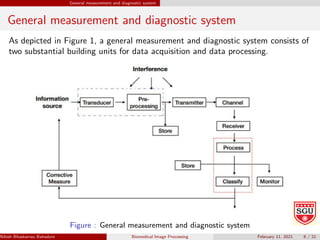
As depicted in Figure 1, a general measurement and diagnostic system consists of
two substantial building units for data acquisition and data processing.
Figure : General measurement and diagnostic system
Nilesh Bhaskarrao Bahadure Ph.D., M.E., B.E. (Sanjay Ghodawat University)
Biomedical Image Processing February 11, 2021 8 / 21
General measurement and diagnostic system
In diagnostic context, the processing has to classify the signal into one of many
given classes which may be the normal and various pathological classes. In a
therapeutic context, after classification, an algorithm may be taken to directly
modify the behavior of a certain physiological process. For instance, the algorithm
of cardiac pacemaker, initially estimates the mean of the heart rate and compares
it with a fixed or adaptively changing threshold. Then, based on this corrective
measure it may change the patterns of cardiac activity by sending appropriate
stimulating pulses. Signal processing unit (shown in red dashed line) typically
consists of the following blocks:
Nilesh Bhaskarrao Bahadure Ph.D., M.E., B.E. (Sanjay Ghodawat University)
Biomedical Image Processing February 11, 2021 9 / 21
General measurement and diagnostic system
1 Segmentation
2 Signal Estimation or Enhancement
3 Feature extraction
4 Classification and prediction
Nilesh Bhaskarrao Bahadure Ph.D., M.E., B.E. (Sanjay Ghodawat University)
Biomedical Image Processing February 11, 2021 10 / 21
Biomedical Signal Analysis - Computer Aided Diagnosis
Computer Aided Diagnosis
1 Cancer and other life threatening diseases is a major public health problem
with high morbidity and mortality worldwide
2 Early detection and diagnosis are crucial for improving the survival rate.
Screening examination plays an essential role in the diagnosis of diseases,
which produces a large number of images and requires physicians to interpret.
However, human interpretation has many limitations, including short-term
memory, inaccuracy, distraction, and fatigue.
3 To solve these limitations, computer-aided diagnosis (CAD) has been applied
in the biomedical imaging field.
Nilesh Bhaskarrao Bahadure Ph.D., M.E., B.E. (Sanjay Ghodawat University)
Biomedical Image Processing February 11, 2021 11 / 21
Biomedical Signal Analysis - Computer Aided Diagnosis
Computer Aided Diagnosis
Computer-aided detection (CADe), also called computer-aided diagnosis (CADx),
are systems that assist doctors in the interpretation of medical images. Imaging
techniques in X-ray, MRI, and ultrasound diagnostics yield a great deal of
information that the radiologist or other medical professional has to analyze and
evaluate comprehensively in a short time. CAD systems process digital images for
typical appearances and to highlight conspicuous sections, such as possible
diseases, in order to offer input to support a decision taken by the professional.
CAD also has potential future applications in digital pathology with the advent of
whole-slide imaging and machine learning algorithms.
Nilesh Bhaskarrao Bahadure Ph.D., M.E., B.E. (Sanjay Ghodawat University)
Biomedical Image Processing February 11, 2021 12 / 21
Biomedical Signal Analysis - Computer Aided Diagnosis
Computer Aided Diagnosis
The CAD was further developed in the early 1980s, and the expert system applied
in the field of medicine was the most noticeable one. The CAD processing
includes medical information collection, quantitative and statistical analysis of
medical information, and diagnosis. Popular models included Bayes theorem,
maximum likelihood model, and sequential model. In the middle 1980s,
researchers focused on the development and evaluation of CAD systems. Artificial
neural network (ANN) has developed rapidly since the 1990s. ANN is a
mathematical processing method that imitates the working principle of human
brain neurons. ANN can play an assistant role in diagnosis due to it has the ability
of self-learning, memory, and forecasting the development of events. Compared to
the traditional methods (such as probability and statistics method, mathematical
model), ANN offered better performance in classification and diagnosis. It can be
said that ANN is one of the most advanced artificial intelligence technologies.
Nilesh Bhaskarrao Bahadure Ph.D., M.E., B.E. (Sanjay Ghodawat University)
Biomedical Image Processing February 11, 2021 13 / 21
Biomedical Signal Analysis - Computer Aided Diagnosis
Computer Aided Diagnosis
Computer-aided diagnosis or computer-aided detection refers to the combination
of computer technology with medical image processing technology and other
possible physiological and biochemical techniques to assist doctors for clinical
decision-making and improve the accuracy of diagnosis. The computer-aided
detection focus on the localization task, while the computer-aided diagnosis
focuses on characterization task, such as the distinction between benign and
malignant tumors, and classification among different tumor types. The computer
only needs to annotate the abnormal signs and then carries out conventional
image processing without further diagnosis. In other words, computer-aided
diagnosis is the extension and ultimate goal of computer-aided detection.
Correspondingly, computer-aided detection is the basis and necessary stage of
computer-aided diagnosis. Previous studies proved that CAD plays a significant
role in improving the sensitivity, specificity, and accuracy of diagnosis.
Nilesh Bhaskarrao Bahadure Ph.D., M.E., B.E. (Sanjay Ghodawat University)
Biomedical Image Processing February 11, 2021 14 / 21
Concurrent, coupled and correlated processes - illustration with case studies
Concurrent, coupled and correlated processes
Biomedical signal processing aims at extracting significant information from
physiological signals, which includes:
1 heart rate
2 blood pressure
3 oxygen saturation levels
4 blood glucose
5 nerve conduction
6 brain activity
These signals can then be analyzed in order to provide information to physicians
about what is going on in the body and allows them to make a diagnosis if any
sort of abnormality is detected. This ultimately allows one to determine the state
of a patient’s health through non-invasive measures.
Nilesh Bhaskarrao Bahadure Ph.D., M.E., B.E. (Sanjay Ghodawat University)
Biomedical Image Processing February 11, 2021 15 / 21
Concurrent, coupled and correlated processes - illustration with case studies
Concurrent, coupled and correlated processes
As technology is improving, engineers are discovering new ways to provide
information to clinicians upon which they can make decisions. One of these
improvements is through real-time monitoring, which can lead to the better
management of chronic diseases, earlier diagnosis of disease, and earlier detection
of both heart attacks and strokes. Biomedical signal processing is most useful in
the critical care setting due to patient data needing to be analyzed in real-time.
By doing complex analyses of the body’s signals and having real-time monitoring,
we can discover early indicators for how conditions manifest.
Nilesh Bhaskarrao Bahadure Ph.D., M.E., B.E. (Sanjay Ghodawat University)
Biomedical Image Processing February 11, 2021 16 / 21
Concurrent, coupled and correlated processes - illustration with case studies
Concurrent, coupled and correlated processes
Examples of Biomedical Signals and Signal Processing Electrical Biosignals:
The electrical signals produced by the body that are extremely useful in
diagnostics includes:
Electroencephalogram (EEG) - Monitoring method to record electrical activity
of the brain. It is most often used to diagnose epilepsy but can be used to
diagnose other conditions such as: sleep disorders, tumors, stroke, coma,
encephalopathies, brain death, etc.
Nilesh Bhaskarrao Bahadure Ph.D., M.E., B.E. (Sanjay Ghodawat University)
Biomedical Image Processing February 11, 2021 17 / 21
Concurrent, coupled and correlated processes - illustration with case studies
Concurrent, coupled and correlated processes
Electrocardiogram (ECG) - Monitoring method to record electrical activity of
the heart. Indications for performing ECG includes: suspected myocardial
infarction, suspected pulmonary embolism, seizures, fainting, cardiac murmur, etc.
Electromyogram (EMG) - Monitoring method to record electrical activity of the
muscle. EMG is used as a diagnostic tool for identifying neuromuscular diseases
(Parkinson’s, multiple sclerosis, Huntington’s, etc) or as a research tool. All three
signals listed above require filtering of background noise (power source, other
biosignals, etc.) and often require conversion from continuous time (CT) to
discrete time (DT) for analysis.
Nilesh Bhaskarrao Bahadure Ph.D., M.E., B.E. (Sanjay Ghodawat University)
Biomedical Image Processing February 11, 2021 18 / 21
Concurrent, coupled and correlated processes - illustration with case studies
Concurrent, coupled and correlated processes
Biosensors: A biosensor is defined as a piece of hardware that can interact with
either a biological or physiological system to acquire a signal for diagnostic or
therapeutic purposes. They are analytical devices that convert a biological
response into an electric signal. Biosensor technology incorporates a wide range of
devices, which includes:
1 Stethoscope
2 Thermometer
3 Blood Pressure Cuff
4 Blood Glucose Device
5 Pregnancy Test
6 Pulse Oximetry
Nilesh Bhaskarrao Bahadure Ph.D., M.E., B.E. (Sanjay Ghodawat University)
Biomedical Image Processing February 11, 2021 19 / 21
Questions
Questions
1 What is biomedical signals? explain in details.
2 Draw and explain General measurement and diagnostic system
3 Write short notes on
1 Segmentation
2 Signal Estimation or Enhancement
4 What is CAD? Explain in details the Computer Aided Diagnosis system.
5 Explain Concurrent, coupled and correlated processes for Biomedical signals
6 What is EEG, ECG, ENG signals, differentiate between them
7 Explain biosensors in details
8 Write short notes on electrical bio-signals
Nilesh Bhaskarrao Bahadure Ph.D., M.E., B.E. (Sanjay Ghodawat University)
Biomedical Image Processing February 11, 2021 20 / 21
Thank You
Thank you
Please send your feedback at nilesh.bahadure@sanjayghodawatuniversity.ac.in
This is Nilesh B. Bahadure from SGU Kolhapur
Thanks for joining
Goodbye, Have a nice day.
For download and more information Click Here
Nilesh Bhaskarrao Bahadure Ph.D., M.E., B.E. (Sanjay Ghodawat University)
Biomedical Image Processing February 11, 2021 21 / 21

Biomedical Signal Origin and Dynamics

  • 1.
    Biomedical Image Processing BiomedicalSignal Origin and Dynamics Nilesh Bhaskarrao Bahadure Ph.D., M.E., B.E. Sanjay Ghodawat University Atigre, Kolhapur, Maharashtra nbahadure@gmail.com https://www.sites.google.com/site/nileshbbahadure/home February 11, 2021 Nilesh Bhaskarrao Bahadure Ph.D., M.E., B.E. (Sanjay Ghodawat University) Biomedical Image Processing February 11, 2021 1 / 21
  • 2.
    Overview 1 Introduction 2 Generalmeasurement and diagnostic system 3 Biomedical Signal Analysis - Computer Aided Diagnosis 4 Concurrent, coupled and correlated processes - illustration with case studies 5 Questions 6 Thank You Nilesh Bhaskarrao Bahadure Ph.D., M.E., B.E. (Sanjay Ghodawat University) Biomedical Image Processing February 11, 2021 2 / 21
  • 3.
    Introduction Introduction to BiologicalSignals Physiological processes are complex phenomena, including nervous or hormonal stimulation and control. Most physiological processes are accompanied by or manifest themselves as signals that reflect their nature and activities. Such signals could be of many types, including biochemical in the form of hormones and neurotransmitters, electrical in the form of potential or current, and physical in the form of pressure or temperature. Diseases or defects in a biological system cause alterations in its normal physiological processes, leading to pathological processes that affect the performance, health, and general wellbeing of the system. A pathological process is typically associated with signals that are different in some aspects from the corresponding normal signals. If one possesses a good understanding of a system of interest, it becomes possible to observe the corresponding signals and assess the state of the system. The task is not difficult when the signal is simple and appears at the outer surface of the body. Nilesh Bhaskarrao Bahadure Ph.D., M.E., B.E. (Sanjay Ghodawat University) Biomedical Image Processing February 11, 2021 3 / 21
  • 4.
    Introduction Biomedical Signal Processing Biomedicalsignals are recordings of physiological activities of organisms, ranging from gene and protein sequences, to neural and cardiac rhythms, to tissue and organ images. Electrocardiogram (ECG), electroencephalogram (EEG), electromyogram (EMG), Electroneurogram (ENG) and various sensory evoked potentials are a few examples of such bioelectric signals. Such signals convey information about the structure and functioning of associated underlying biological source. However, the required information is in the most cases hidden in the signal structure and may not be immediately perceived. Before the signal can be given a meaningful interpretation, some operations must be applied on the available recordings to decode or extract the significant information. Nilesh Bhaskarrao Bahadure Ph.D., M.E., B.E. (Sanjay Ghodawat University) Biomedical Image Processing February 11, 2021 4 / 21
  • 5.
    Introduction Biomedical Signal Processing Thedecoding procedure is sometimes straightforward and only needs visual inspection of the signal on a computer screen or a paper printout. However, the complexity of a signal is often quite substantial, and, therefore, advanced biomedical signal processing procedures are needed for extracting clinically significant information hidden in the signal. For instance, when the visual processing mechanism of the brain is of interest, the eye is stimulated with a flash and the activity of the brain is monitored by means of surface electrodes located on the scalp. The information related to the visual activity of the brain is accompanied with the signal which is mainly due to other activities of the brain. Hence, in order to separate the desired physiological process from interfering processes and to enhance the relevant information, noise reduction procedure must be applied on the signal. Nilesh Bhaskarrao Bahadure Ph.D., M.E., B.E. (Sanjay Ghodawat University) Biomedical Image Processing February 11, 2021 5 / 21
  • 6.
    Introduction Biomedical Signal Processing Inaddition to suppressing the noise, biomedical signal processing is often used to extract hidden features which are not explicitly available from the signal through visual inspection. For instance, small variations in heart rate cannot be captured by the human eye have been found to offer useful clinical information when measured using a proper signal processing technique. Nilesh Bhaskarrao Bahadure Ph.D., M.E., B.E. (Sanjay Ghodawat University) Biomedical Image Processing February 11, 2021 6 / 21
  • 7.
    Introduction Biomedical Signal Processing Inmany situations, we may wish to transmit the signal from point of acquisition to a remote location for monitoring or processing. This may be the case, for example, when information recorded by means of wearable devices is required in the hospital or physician’s office. In these cases, the main objective of processing is to match the signal with the requirement of the transmission channel. Nilesh Bhaskarrao Bahadure Ph.D., M.E., B.E. (Sanjay Ghodawat University) Biomedical Image Processing February 11, 2021 7 / 21
  • 8.
    General measurement anddiagnostic system General measurement and diagnostic system As depicted in Figure 1, a general measurement and diagnostic system consists of two substantial building units for data acquisition and data processing. Figure : General measurement and diagnostic system Nilesh Bhaskarrao Bahadure Ph.D., M.E., B.E. (Sanjay Ghodawat University) Biomedical Image Processing February 11, 2021 8 / 21
  • 9.
    General measurement anddiagnostic system General measurement and diagnostic system In diagnostic context, the processing has to classify the signal into one of many given classes which may be the normal and various pathological classes. In a therapeutic context, after classification, an algorithm may be taken to directly modify the behavior of a certain physiological process. For instance, the algorithm of cardiac pacemaker, initially estimates the mean of the heart rate and compares it with a fixed or adaptively changing threshold. Then, based on this corrective measure it may change the patterns of cardiac activity by sending appropriate stimulating pulses. Signal processing unit (shown in red dashed line) typically consists of the following blocks: Nilesh Bhaskarrao Bahadure Ph.D., M.E., B.E. (Sanjay Ghodawat University) Biomedical Image Processing February 11, 2021 9 / 21
  • 10.
    General measurement anddiagnostic system General measurement and diagnostic system 1 Segmentation 2 Signal Estimation or Enhancement 3 Feature extraction 4 Classification and prediction Nilesh Bhaskarrao Bahadure Ph.D., M.E., B.E. (Sanjay Ghodawat University) Biomedical Image Processing February 11, 2021 10 / 21
  • 11.
    Biomedical Signal Analysis- Computer Aided Diagnosis Computer Aided Diagnosis 1 Cancer and other life threatening diseases is a major public health problem with high morbidity and mortality worldwide 2 Early detection and diagnosis are crucial for improving the survival rate. Screening examination plays an essential role in the diagnosis of diseases, which produces a large number of images and requires physicians to interpret. However, human interpretation has many limitations, including short-term memory, inaccuracy, distraction, and fatigue. 3 To solve these limitations, computer-aided diagnosis (CAD) has been applied in the biomedical imaging field. Nilesh Bhaskarrao Bahadure Ph.D., M.E., B.E. (Sanjay Ghodawat University) Biomedical Image Processing February 11, 2021 11 / 21
  • 12.
    Biomedical Signal Analysis- Computer Aided Diagnosis Computer Aided Diagnosis Computer-aided detection (CADe), also called computer-aided diagnosis (CADx), are systems that assist doctors in the interpretation of medical images. Imaging techniques in X-ray, MRI, and ultrasound diagnostics yield a great deal of information that the radiologist or other medical professional has to analyze and evaluate comprehensively in a short time. CAD systems process digital images for typical appearances and to highlight conspicuous sections, such as possible diseases, in order to offer input to support a decision taken by the professional. CAD also has potential future applications in digital pathology with the advent of whole-slide imaging and machine learning algorithms. Nilesh Bhaskarrao Bahadure Ph.D., M.E., B.E. (Sanjay Ghodawat University) Biomedical Image Processing February 11, 2021 12 / 21
  • 13.
    Biomedical Signal Analysis- Computer Aided Diagnosis Computer Aided Diagnosis The CAD was further developed in the early 1980s, and the expert system applied in the field of medicine was the most noticeable one. The CAD processing includes medical information collection, quantitative and statistical analysis of medical information, and diagnosis. Popular models included Bayes theorem, maximum likelihood model, and sequential model. In the middle 1980s, researchers focused on the development and evaluation of CAD systems. Artificial neural network (ANN) has developed rapidly since the 1990s. ANN is a mathematical processing method that imitates the working principle of human brain neurons. ANN can play an assistant role in diagnosis due to it has the ability of self-learning, memory, and forecasting the development of events. Compared to the traditional methods (such as probability and statistics method, mathematical model), ANN offered better performance in classification and diagnosis. It can be said that ANN is one of the most advanced artificial intelligence technologies. Nilesh Bhaskarrao Bahadure Ph.D., M.E., B.E. (Sanjay Ghodawat University) Biomedical Image Processing February 11, 2021 13 / 21
  • 14.
    Biomedical Signal Analysis- Computer Aided Diagnosis Computer Aided Diagnosis Computer-aided diagnosis or computer-aided detection refers to the combination of computer technology with medical image processing technology and other possible physiological and biochemical techniques to assist doctors for clinical decision-making and improve the accuracy of diagnosis. The computer-aided detection focus on the localization task, while the computer-aided diagnosis focuses on characterization task, such as the distinction between benign and malignant tumors, and classification among different tumor types. The computer only needs to annotate the abnormal signs and then carries out conventional image processing without further diagnosis. In other words, computer-aided diagnosis is the extension and ultimate goal of computer-aided detection. Correspondingly, computer-aided detection is the basis and necessary stage of computer-aided diagnosis. Previous studies proved that CAD plays a significant role in improving the sensitivity, specificity, and accuracy of diagnosis. Nilesh Bhaskarrao Bahadure Ph.D., M.E., B.E. (Sanjay Ghodawat University) Biomedical Image Processing February 11, 2021 14 / 21
  • 15.
    Concurrent, coupled andcorrelated processes - illustration with case studies Concurrent, coupled and correlated processes Biomedical signal processing aims at extracting significant information from physiological signals, which includes: 1 heart rate 2 blood pressure 3 oxygen saturation levels 4 blood glucose 5 nerve conduction 6 brain activity These signals can then be analyzed in order to provide information to physicians about what is going on in the body and allows them to make a diagnosis if any sort of abnormality is detected. This ultimately allows one to determine the state of a patient’s health through non-invasive measures. Nilesh Bhaskarrao Bahadure Ph.D., M.E., B.E. (Sanjay Ghodawat University) Biomedical Image Processing February 11, 2021 15 / 21
  • 16.
    Concurrent, coupled andcorrelated processes - illustration with case studies Concurrent, coupled and correlated processes As technology is improving, engineers are discovering new ways to provide information to clinicians upon which they can make decisions. One of these improvements is through real-time monitoring, which can lead to the better management of chronic diseases, earlier diagnosis of disease, and earlier detection of both heart attacks and strokes. Biomedical signal processing is most useful in the critical care setting due to patient data needing to be analyzed in real-time. By doing complex analyses of the body’s signals and having real-time monitoring, we can discover early indicators for how conditions manifest. Nilesh Bhaskarrao Bahadure Ph.D., M.E., B.E. (Sanjay Ghodawat University) Biomedical Image Processing February 11, 2021 16 / 21
  • 17.
    Concurrent, coupled andcorrelated processes - illustration with case studies Concurrent, coupled and correlated processes Examples of Biomedical Signals and Signal Processing Electrical Biosignals: The electrical signals produced by the body that are extremely useful in diagnostics includes: Electroencephalogram (EEG) - Monitoring method to record electrical activity of the brain. It is most often used to diagnose epilepsy but can be used to diagnose other conditions such as: sleep disorders, tumors, stroke, coma, encephalopathies, brain death, etc. Nilesh Bhaskarrao Bahadure Ph.D., M.E., B.E. (Sanjay Ghodawat University) Biomedical Image Processing February 11, 2021 17 / 21
  • 18.
    Concurrent, coupled andcorrelated processes - illustration with case studies Concurrent, coupled and correlated processes Electrocardiogram (ECG) - Monitoring method to record electrical activity of the heart. Indications for performing ECG includes: suspected myocardial infarction, suspected pulmonary embolism, seizures, fainting, cardiac murmur, etc. Electromyogram (EMG) - Monitoring method to record electrical activity of the muscle. EMG is used as a diagnostic tool for identifying neuromuscular diseases (Parkinson’s, multiple sclerosis, Huntington’s, etc) or as a research tool. All three signals listed above require filtering of background noise (power source, other biosignals, etc.) and often require conversion from continuous time (CT) to discrete time (DT) for analysis. Nilesh Bhaskarrao Bahadure Ph.D., M.E., B.E. (Sanjay Ghodawat University) Biomedical Image Processing February 11, 2021 18 / 21
  • 19.
    Concurrent, coupled andcorrelated processes - illustration with case studies Concurrent, coupled and correlated processes Biosensors: A biosensor is defined as a piece of hardware that can interact with either a biological or physiological system to acquire a signal for diagnostic or therapeutic purposes. They are analytical devices that convert a biological response into an electric signal. Biosensor technology incorporates a wide range of devices, which includes: 1 Stethoscope 2 Thermometer 3 Blood Pressure Cuff 4 Blood Glucose Device 5 Pregnancy Test 6 Pulse Oximetry Nilesh Bhaskarrao Bahadure Ph.D., M.E., B.E. (Sanjay Ghodawat University) Biomedical Image Processing February 11, 2021 19 / 21
  • 20.
    Questions Questions 1 What isbiomedical signals? explain in details. 2 Draw and explain General measurement and diagnostic system 3 Write short notes on 1 Segmentation 2 Signal Estimation or Enhancement 4 What is CAD? Explain in details the Computer Aided Diagnosis system. 5 Explain Concurrent, coupled and correlated processes for Biomedical signals 6 What is EEG, ECG, ENG signals, differentiate between them 7 Explain biosensors in details 8 Write short notes on electrical bio-signals Nilesh Bhaskarrao Bahadure Ph.D., M.E., B.E. (Sanjay Ghodawat University) Biomedical Image Processing February 11, 2021 20 / 21
  • 21.
    Thank You Thank you Pleasesend your feedback at nilesh.bahadure@sanjayghodawatuniversity.ac.in This is Nilesh B. Bahadure from SGU Kolhapur Thanks for joining Goodbye, Have a nice day. For download and more information Click Here Nilesh Bhaskarrao Bahadure Ph.D., M.E., B.E. (Sanjay Ghodawat University) Biomedical Image Processing February 11, 2021 21 / 21