Presented By:
PAWAN KUMAR
M.Tech(Bio & Nano technology)
Roll No. 12091005
pawankamiya@yahoo.in
Father of the Biosensor
Professor Leland C Clark Jnr 1918–2005
The first and the most widely used
commercial biosensor: the blood glucose
biosensor -developed by Leland C. Clark
in 1962
Agenda
• Introduction
• Need for Biosensor
• Need of Biosensor
• Components
• Bioreceptor
• Types
• Applications
• Future of biosensor
• Market of biosensor
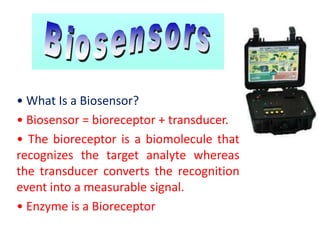
• What Is a Biosensor?
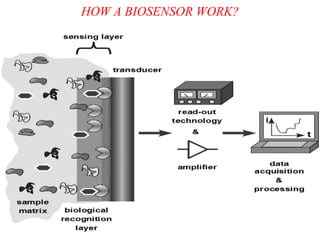
• Biosensor = bioreceptor + transducer.
• The bioreceptor is a biomolecule that
recognizes the target analyte whereas
the transducer converts the recognition
event into a measurable signal.
• Enzyme is a Bioreceptor
Need for Biosensor
• Diagnostic Market
• The current climate of prevention the need for detection at
increasingly lower limits is increasing in many diverse areas
• Clinical Testing
• clinical testing is one of the biggest diagnostic markets
• clinical testing products market in excess of 4000 million US$
in the 1990s
• Other Markets
• The medical arena (Technical Insights Inc.) with
veterinary and agricultural applications
Need of Biosensor
Specificity
• With biosensors, it is possible to measure specific analytes with
great accuracy.
Speed
• analyte tracers or catalytic products can be directly and
instantaneously measured
Simplicity
• receptor and transducer are integrated into one single sensor&
the measurement of target analytes without using reagents is
possible
Continuous monitoring capability
• Biosensors regenerate and reuse the immobilized biological
recognition element
Biosensor consists :
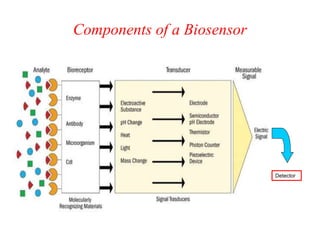
Components of a Biosensor
Detector
1ST Component: Biological Element
• The component used to bind the target molecule.
• Must be highly specific, stable under storage
conditions, and immobilized.
Microorganism
Tissue
Cell
Organelle
Nucleic Acid
Enzyme
Enzyme Component
Receptor
Antibody
Enzymes
• Enzymes act as catalysts for biochemical reactions
occurring in the cell
Antibody
• Antibodies constitute about 20% of the total plasma
protein and are collectively called immunoglobulin
Receptor Protein
• Receptor proteins having specific affinity for
hormones, antibodies, enzymes
Bioreceptor Molecules
Presence of receptor
• Receptors at Membrane
Biological receptors are protein molecules most of them are bound to the
cell membrane
• Hormone Receptors
Many hormones released into the blood do not penetrate the cell
membrane but react with specific receptors at the cell surface
• Smell Receptor
taste and olfactory receptors are typical examples of this biospecific
recognition process
• Light Receptor
2ND Component: Physiochemical Transducer
• Acts as an interface, measuring the physical change that
occurs with the reaction at the bioreceptor then transforming
that energy into measurable electrical output.
Type of transducer
• Electrochemical transducer
• Optical transducer
• Thermometric transducer
• Piezoelectric transducer
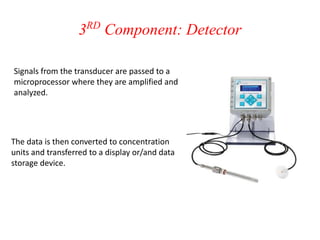
3RD Component: Detector
Signals from the transducer are passed to a
microprocessor where they are amplified and
analyzed.
The data is then converted to concentration
units and transferred to a display or/and data
storage device.
HOW A BIOSENSOR WORK?
Types of biosensor
Receptor based :
Biocatalytic-enzyme, cells, tissuses
Biocomplexing-Ag/Ab-immunosensor
Receptor/antagonist
Based on mode/transducers :
Electrochemical :
Amperometry
Potentiometry
Conductometry
Capacitive measurement
Optical :
Colorimetric-(NP, QDs)
Fluorimetric
Luminometric(chemo/bio)
RI (SPR, interferometer, resonant
mirror) fibre-optic
Piezoelectric :
QCM
Cantilever
Ultrasonic
Acoustic emission
Electrochemical Biosensor
• chemical reactions between immobilized biomolecule and
target analyte produce or consume ions or electrons, which
affects measurable electrical properties of the solution, such
an electric current or potential
Electrochemical Biosensor types:
• Potentiometric
: measure E
• Amperometric
: apply E, measure I
• Conductimetric
: measure the change in conductance
• Capacitive measurement
: measure change of capacitance at
electrode surface
Optical Biosensor
• The optical fibers allow detection of
analytes on the basis of absorption,
fluorescence or light scattering. optical
biosensors have the advantages of to in
vivo applications and allowing multiple
analytes to be detected by using different
monitoring wavelengths.
Fluorescence-based optical Biosensor
Optical Biosensor
Piezo-electric Biosensor
• Piezo-electric devices use gold to
detect the specific angle at which
electron waves are emitted when the
substance is exposed to laser light or
crystals, such as quartz, which vibrate
under the influence of an electric
field.
• The change in frequency is
proportional to the mass of absorbed
material.
Glucose Biosensor
• Fluorescent glucose
biosensors are devices that measure
the concentration of glucose
in diabetic patients by means of
sensitive protein that relays the
concentration by means of
fluorescence.
• It helps to keep the Glucose level in
control.
• It saves time also.
Applications of Biosensor
• Biosensor can be used for many analytical
problems, ranging from detection of industrial
toxins and food contamination to monitoring the
density of microbes in an industry and medical
diagnostics.
• Biosensor for medical diagnostics.
• Biosensor for agriculture and food industry.
• Biosensor for environment monitoring.
• Toxicology tests using biosensor.
• Biosensor for general industry.
• Biosensor for military and defense industry.
Design Variables
• Immobilization Methods
• (1) adsorption
• (2) entrapment
• (3) covalent coupling
• (4) cross-linking
• Change in Conformation
• Change in Microenvironment
• Non-Uniform Distribution
• Reaction and Diffusion
Future Prospects
• Data Processing and Pattern
• Recognition
• • Micro Instrument
• • Molecular Electronics
• • Multi-Disciplinary Nature
CONCLUSION
• Biosensors consist of bio-recognition systems, typically
• enzymes or binding proteins, such as antibodies,
• immobilized onto the surface of physico-chemical
• transducers
• Disadvantages
• •
• They cannot be steam sterilized
• •
• They react with the product
• And are oversensitive
Numbers of papers published in important fi elds of biosensor research between 2005
and 2010.
• Keywords
• “ Biosensor ” 11 345 549
• “ Biosensor ” and “ glucose ” 1 974 96
• “ Biosensor ” and “ glucose oxidase ” 1 331 37
• “ Biosensor ” and “ laccase ” 109 7
• “ Biosensor ” and “ cellobiose dehydrogenase ” 11 0
• “ Biosensor ” and “ DNA ” 2 166 156
• “ Biosensor ” and “ disposable ” 287 6
• “ Biosensor ” and “ amperometric ” 1 931 86
• “ Biosensor ” and “ electrochemistry ” 1 715 63
• “ Biosensor ” and “ reagentless ” 177 3
• “ Biosensor ” and “ direct electron transfer ” 570 25
• “ Biosensor ” and “ mediated electron transfer ” 53 2
• “ Biosensor ” and self - assembled monolayer ” 389 12
• “ Biosensor ” and “ conducting polymer ” 220 20
• “ Biosensor ” and “ osmium ” 40 0
• “ Biosensor ” and “ PQQ ” 26 6
• “ Biosensor ” and “ NADH ” 190 5
• “ Biosensor ” and “ biofuel cell ” 73 8
• “ Biosensor ” and “ microsensor ” 45 2
• “ Biosensor ” and “ microelectrode ” 185 16
• “ Biosensor ” and “ microarray ” 257 26
• “ Biosensor ” and “ biochip ” 155 12
• “ Biosensor ” and “ protein chip ” 304 14
• “ Biosensor ” and “ microfabrication ” 57 3
• “ Biosensor ” and “ microfl uidics ” 184 15
• “ Biosensor ” and “ scanning electrochemical microscope ” 51
• “ Biosensor ” and “ nano ” 476 29
• “ Biosensor ” and “ nanobiosensor ” 33 4
• “ Biosensor ” and “ nanomaterial ” 56 16
Biosensor
Biosensor

Biosensor

  • 1.
    Presented By: PAWAN KUMAR M.Tech(Bio& Nano technology) Roll No. 12091005 pawankamiya@yahoo.in
  • 2.
    Father of theBiosensor Professor Leland C Clark Jnr 1918–2005 The first and the most widely used commercial biosensor: the blood glucose biosensor -developed by Leland C. Clark in 1962
  • 3.
    Agenda • Introduction • Needfor Biosensor • Need of Biosensor • Components • Bioreceptor • Types • Applications • Future of biosensor • Market of biosensor
  • 4.
    • What Isa Biosensor? • Biosensor = bioreceptor + transducer. • The bioreceptor is a biomolecule that recognizes the target analyte whereas the transducer converts the recognition event into a measurable signal. • Enzyme is a Bioreceptor
  • 5.
    Need for Biosensor •Diagnostic Market • The current climate of prevention the need for detection at increasingly lower limits is increasing in many diverse areas • Clinical Testing • clinical testing is one of the biggest diagnostic markets • clinical testing products market in excess of 4000 million US$ in the 1990s • Other Markets • The medical arena (Technical Insights Inc.) with veterinary and agricultural applications
  • 6.
    Need of Biosensor Specificity •With biosensors, it is possible to measure specific analytes with great accuracy. Speed • analyte tracers or catalytic products can be directly and instantaneously measured Simplicity • receptor and transducer are integrated into one single sensor& the measurement of target analytes without using reagents is possible Continuous monitoring capability • Biosensors regenerate and reuse the immobilized biological recognition element
  • 7.
  • 8.
    Components of aBiosensor Detector
  • 9.
    1ST Component: BiologicalElement • The component used to bind the target molecule. • Must be highly specific, stable under storage conditions, and immobilized. Microorganism Tissue Cell Organelle Nucleic Acid Enzyme Enzyme Component Receptor Antibody
  • 10.
    Enzymes • Enzymes actas catalysts for biochemical reactions occurring in the cell Antibody • Antibodies constitute about 20% of the total plasma protein and are collectively called immunoglobulin Receptor Protein • Receptor proteins having specific affinity for hormones, antibodies, enzymes Bioreceptor Molecules
  • 11.
    Presence of receptor •Receptors at Membrane Biological receptors are protein molecules most of them are bound to the cell membrane • Hormone Receptors Many hormones released into the blood do not penetrate the cell membrane but react with specific receptors at the cell surface • Smell Receptor taste and olfactory receptors are typical examples of this biospecific recognition process • Light Receptor
  • 12.
    2ND Component: PhysiochemicalTransducer • Acts as an interface, measuring the physical change that occurs with the reaction at the bioreceptor then transforming that energy into measurable electrical output.
  • 13.
    Type of transducer •Electrochemical transducer • Optical transducer • Thermometric transducer • Piezoelectric transducer
  • 14.
    3RD Component: Detector Signalsfrom the transducer are passed to a microprocessor where they are amplified and analyzed. The data is then converted to concentration units and transferred to a display or/and data storage device.
  • 15.
  • 16.
  • 17.
    Types of biosensor Receptorbased : Biocatalytic-enzyme, cells, tissuses Biocomplexing-Ag/Ab-immunosensor Receptor/antagonist Based on mode/transducers : Electrochemical : Amperometry Potentiometry Conductometry Capacitive measurement Optical : Colorimetric-(NP, QDs) Fluorimetric Luminometric(chemo/bio) RI (SPR, interferometer, resonant mirror) fibre-optic Piezoelectric : QCM Cantilever Ultrasonic Acoustic emission
  • 18.
    Electrochemical Biosensor • chemicalreactions between immobilized biomolecule and target analyte produce or consume ions or electrons, which affects measurable electrical properties of the solution, such an electric current or potential
  • 19.
    Electrochemical Biosensor types: •Potentiometric : measure E • Amperometric : apply E, measure I • Conductimetric : measure the change in conductance • Capacitive measurement : measure change of capacitance at electrode surface
  • 20.
    Optical Biosensor • Theoptical fibers allow detection of analytes on the basis of absorption, fluorescence or light scattering. optical biosensors have the advantages of to in vivo applications and allowing multiple analytes to be detected by using different monitoring wavelengths. Fluorescence-based optical Biosensor
  • 21.
  • 22.
    Piezo-electric Biosensor • Piezo-electricdevices use gold to detect the specific angle at which electron waves are emitted when the substance is exposed to laser light or crystals, such as quartz, which vibrate under the influence of an electric field. • The change in frequency is proportional to the mass of absorbed material.
  • 23.
    Glucose Biosensor • Fluorescentglucose biosensors are devices that measure the concentration of glucose in diabetic patients by means of sensitive protein that relays the concentration by means of fluorescence. • It helps to keep the Glucose level in control. • It saves time also.
  • 24.
    Applications of Biosensor •Biosensor can be used for many analytical problems, ranging from detection of industrial toxins and food contamination to monitoring the density of microbes in an industry and medical diagnostics. • Biosensor for medical diagnostics. • Biosensor for agriculture and food industry. • Biosensor for environment monitoring. • Toxicology tests using biosensor. • Biosensor for general industry. • Biosensor for military and defense industry.
  • 25.
    Design Variables • ImmobilizationMethods • (1) adsorption • (2) entrapment • (3) covalent coupling • (4) cross-linking • Change in Conformation • Change in Microenvironment • Non-Uniform Distribution • Reaction and Diffusion
  • 26.
    Future Prospects • DataProcessing and Pattern • Recognition • • Micro Instrument • • Molecular Electronics • • Multi-Disciplinary Nature
  • 27.
    CONCLUSION • Biosensors consistof bio-recognition systems, typically • enzymes or binding proteins, such as antibodies, • immobilized onto the surface of physico-chemical • transducers • Disadvantages • • • They cannot be steam sterilized • • • They react with the product • And are oversensitive
  • 29.
    Numbers of paperspublished in important fi elds of biosensor research between 2005 and 2010. • Keywords • “ Biosensor ” 11 345 549 • “ Biosensor ” and “ glucose ” 1 974 96 • “ Biosensor ” and “ glucose oxidase ” 1 331 37 • “ Biosensor ” and “ laccase ” 109 7 • “ Biosensor ” and “ cellobiose dehydrogenase ” 11 0 • “ Biosensor ” and “ DNA ” 2 166 156 • “ Biosensor ” and “ disposable ” 287 6 • “ Biosensor ” and “ amperometric ” 1 931 86 • “ Biosensor ” and “ electrochemistry ” 1 715 63 • “ Biosensor ” and “ reagentless ” 177 3 • “ Biosensor ” and “ direct electron transfer ” 570 25 • “ Biosensor ” and “ mediated electron transfer ” 53 2 • “ Biosensor ” and self - assembled monolayer ” 389 12 • “ Biosensor ” and “ conducting polymer ” 220 20 • “ Biosensor ” and “ osmium ” 40 0 • “ Biosensor ” and “ PQQ ” 26 6 • “ Biosensor ” and “ NADH ” 190 5 • “ Biosensor ” and “ biofuel cell ” 73 8 • “ Biosensor ” and “ microsensor ” 45 2 • “ Biosensor ” and “ microelectrode ” 185 16 • “ Biosensor ” and “ microarray ” 257 26 • “ Biosensor ” and “ biochip ” 155 12 • “ Biosensor ” and “ protein chip ” 304 14 • “ Biosensor ” and “ microfabrication ” 57 3 • “ Biosensor ” and “ microfl uidics ” 184 15 • “ Biosensor ” and “ scanning electrochemical microscope ” 51 • “ Biosensor ” and “ nano ” 476 29 • “ Biosensor ” and “ nanobiosensor ” 33 4 • “ Biosensor ” and “ nanomaterial ” 56 16