DEFINITION
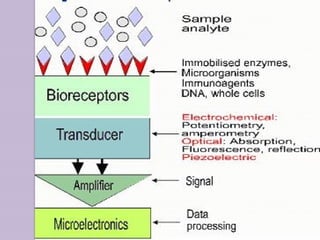
A biosensoris an analytical device
consisting of an immobilised layer of
biological material in the intimate
contact with transducer which
analyses the biological signal and
converts into an electrical signal .
An analyte is a compound whose
concentration is to be determined by
biosensor ; it may be pathogen ,
pesticide , heavy metal s and any other
components like glucose etc.
3.
COMPONENTS OF BIOSENSOR
A biological material can be
enzyme, antibody , organelle ,
hormones , nucleic acid or whole
cells
An transducer (sensor ) can be
anything , a single carbon
electrode , an ion sensitive
electrode , a photocell or a
thermistor .
6.
HISTORY
In 1987, for the first time YELLOW
SPRINGS INSTRUMENTS Co. , USA
developed a biosensor for
measuring glucose in blood
plasma .
The person who first developed
the biosensor is LELEND C. CLARK.
7.
PRINCIPLE
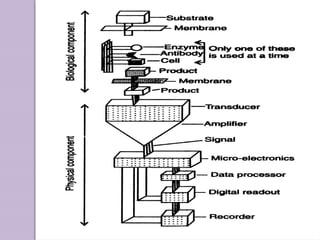
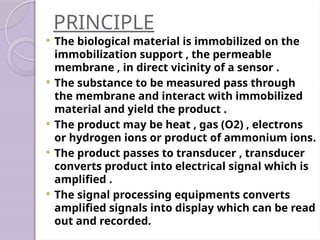
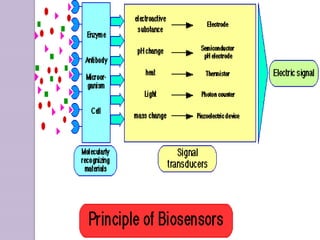
The biologicalmaterial is immobilized on the
immobilization support , the permeable
membrane , in direct vicinity of a sensor .
The substance to be measured pass through
the membrane and interact with immobilized
material and yield the product .
The product may be heat , gas (O2) , electrons
or hydrogen ions or product of ammonium ions.
The product passes to transducer , transducer
converts product into electrical signal which is
amplified .
The signal processing equipments converts
amplified signals into display which can be read
out and recorded.
9.
IDEAL CHARACTERSTICS OF
BIOSENSOR
It should be highly specific for analyte.
Device should be tiny and biocompatible .
Device should be cheap , small and easy
to use .
Assay should be rapid , accurate and
repeatable .
Should require small sample volume.
It should be durable i.e capable of
repeated use.
The reaction should be independent of
stirring , pH , temperature etc.
1. ELECTRO-CHEMICAL BIOSENSOR
It consist of electronic device either field
effect transmitors or light emitting
diode .
Light emitting diode measures charge
accumulation on their surface and
photoresponse is generated in silica base
chip as an alternating current .
Field effect transmitors measures a
biochemical reaction at the surface and
induce it into current .
The field effect transmitors can be
modified to ion sensitive , enzyme
12.
ELECTRO-CHEMICAL BIOSENSOR
Mostcommonly used for detection of
detection of hybrid DNA , DNA binding
drugs , glucose concentration etc.
The underlying principle of this type of
biosensor is that many biochemical
reactions produce or consume ions or
electrons which in turn cause change
in the electrical properties of solution
which can be sensed out and used as
measuring parameter.
13.
2. AMPEROMETRIC BIOSENSOR
Amperometric biosensor are those
which measure the reaction of anylate
with enzyme and generate electrons
directly or through a mediator .
These biosensors contain either
enzyme electrode or without
mediator , or chemically modified
electrodes.
Some enzyme electrode biosensor are
oxygen or peroxide based biosensor .
15.
Mediated biosensor :
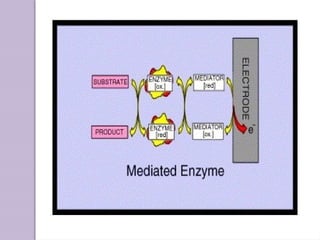
In this biosensor , redox reaction
catalysed by an enzymes is directly
coupled to an electrode where enzyme
is presented with the oxidizable
substrate .
The electrons are transferred from the
substrate to electrode via enzyme and
redox mediator.
In this biosensor the oxidase replaces
the oxygen requirement of the
enzymes.
17.
Enzyme electrode
Itis new type of biosensor which is used for the
assay of substances such as urea , amino acid ,
glucose , alcohol , lactic acid .
It consist of a electrochemical sensor in contact
with a thin permeable enzyme membrane
capable of reacting with given substrates.
The enzyme produce the product o2, H+
, NH4 ,
CO2 or other small molecules .
These are detected by specific sensor. The
magnitude of response determines the
concentration of substrates.
Important example of enzyme electrode is
glucose electrode
18.
GLUCOSE ELECTRODE
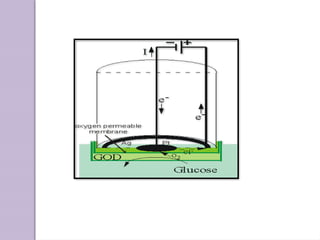
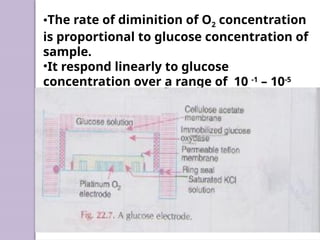
Itcan be built up by immobilizing glucose oxydase
in polyacrylamide gel around a platinum oxygen
electrode separated by teflon membrane . KCL
solution is placed around the Pt-O2 electrode .
From upper surface glucose oxydase is intimately
covered by cellulose acetate membrane.
When glucose and O2 pass through membrane into
enzyme layer as result of oxidation- reduction
reactions , converted into gluconic acid and H2O2.
As a result the conc. Of O2 decreases in the gel
around the electrode.
H2O2 brings about change in current .electrode
records the rate of reaction .
19.
•The rate ofdiminition of O2 concentration
is proportional to glucose concentration of
sample.
•It respond linearly to glucose
concentration over a range of 10 -1
– 10-5
mol dm-3
with a response time of 1 minute.
20.
3. POTENTIOMETRIC BIOSENSOR
In these biosensors , change in ionic
concentration are determined by use of
ion selective electrodes . Mainly these
reactions involve the release or
absorption of hydrogen ions .
The potential difference between the
potentiometric electrode and refrence
electrode can be measured . It is
proportional to concenteration of
substrate.
21.
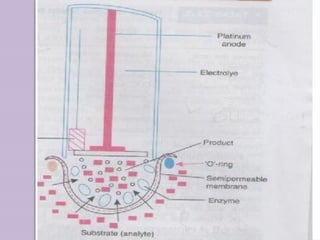
4. Thermistor containingbiosensor
It is used to record even small temperature
changes (between 0.01 -0.0010
C ) during
biochemical reaction.
These also known as calorimetric biosensor .
By immobilizing enzymes like cholesterol
oxidase , glucose oxidase,
invertase ,tyrosinase etc. thermistors have
been developed.
These are used for study of antigen antibody
with very high sensitivity in case of
thermometric ELISA and use for estimation
of serum cholesterol
23.
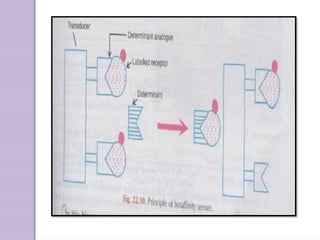
5.BIOAFFINITY SENSOR
Itmeasures the concentration of
determinants .
Determinants are substances based on
equilibrium binding
These type of biosensor shows high
degree of selectivity .
These are of diverse nature because of
use of radiolabelled , enzyme labelled or
fluorescence labelled substance .
24.
PRINCIPLE
In thisbiosensor , receptor is radiolabelled and
allowed to bind with determinant analogue
immobilized onto the surface of a transducer .
When concenteration of determinant are
increased , the labelled receptor forms an
intimately bound complex with determinant.
The radiolabelled analogue resulting in
increased concentration of labelled receptor .
This is measured by reduction in signal of the
labelled receptor .
E.g biosensors are the use of lectin receptors for
saccharide estimation , hormone receptor for
hormone , drug receptor for drug , antibodies
receptor for antigen and nucliec acid for
inherrited diseases and fingerprinting .
26.
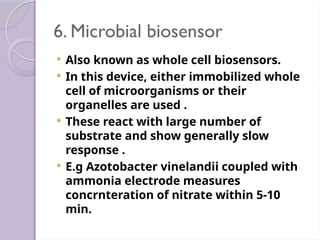
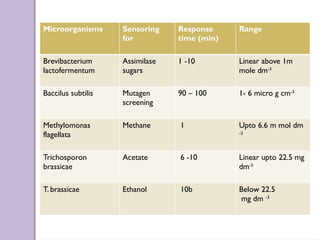
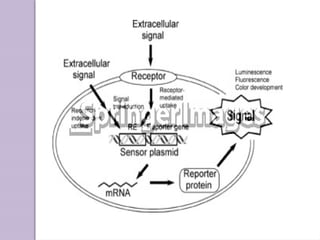
6. Microbial biosensor
Also known as whole cell biosensors.
In this device, either immobilized whole
cell of microorganisms or their
organelles are used .
These react with large number of
substrate and show generally slow
response .
E.g Azotobacter vinelandii coupled with
ammonia electrode measures
concrnteration of nitrate within 5-10
min.
7. OPTO-ELECTRONIC BIOSENSOR
In this biosensors either enzymes or
antibodies are immobilized on a surface of a
membrane .
The output transduced signal that is measured
is light signal for this type of biosensor .
For measiring colour , biosensor with enzymes
and dye is immobilized to a membrane .
When a substrate is catalysed to yield
product , change in pH of medium occur . This
result in changes in dye membrane complex .
These changes in colour are measured by
using a light emitting diode and photodiode .
30.
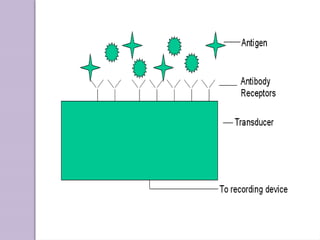
8. IMMUNOBIOSENSOR
Immunobiosensoror immunochemical
biosensor work on principle of
immunological specificity coupled with
measurement based on amperometric or
potentiometric biosensor .
This sensing system may involve the
fluorescent labelled antibody.
1. Uses inMedicine and Health
In 1979 , the first glucose analyser using
biomolecules for detection of blood
glucose was commercialized .
A device a mini pump filled with insulin
has been constructed to deliver insulin to
diabetics based on glucose levels of
blood.
Mutagenicity of Mitomycin can be
detected by using biosensor
Similarly, any other abnormal toxic
substance produced in body due to
infections can also be detected.
35.
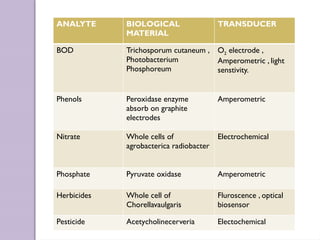
ANALYTE BIOLOGICAL
MATERIAL
TRANSDUCER
BOD Trichosporumcutaneum ,
Photobacterium
Phosphoreum
O2 electrode ,
Amperometric , light
senstivity.
Phenols Peroxidase enzyme
absorb on graphite
electrodes
Amperometric
Nitrate Whole cells of
agrobacterica radiobacter
Electrochemical
Phosphate Pyruvate oxidase Amperometric
Herbicides Whole cell of
Chorellavaulgaris
Fluroscence , optical
biosensor
Pesticide Acetycholinecerveria Electochemical
36.
2.Use in Pollutioncontrol
Monitoring biosensors are successful in
monitoring of pesticides in water .
Biosensor coupled with oxygen electrode and
immobilized Trichosporon cutaneum is used for
measuring BOD.
The whole cell biosensor developed by
immobilizing salmonella typhimurium and
bacillus subtilis in conjugation with oxygen
electrode can be used to measure mutagenicity
and carcinogenecity of several compunds.
37.
BOD BIOSENSOR
BODbiosensor provides rapid , online
determination of BOD
BOD biosensor can be either of the biofilm or
respirometer type.
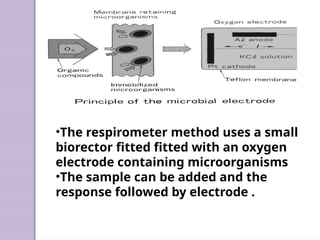
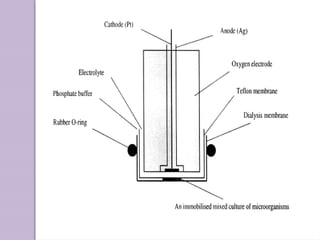
In biofilm biosensor a microbial film is sandwiched
between a porous membrane and the oxygen
permeable membrane of oxygen electrode .
A change in oxygen levels in microbial culture will
be proportional to metabolizable content of
material to be measured.
Biofilm may be consist of any miocroorganism like
Photobacterium phosphoreum , Alicaligenes
faecalis, Agrobacterium radiobacter , Chlorella
vulgaris
38.
•The respirometer methoduses a small
biorector fitted fitted with an oxygen
electrode containing microorganisms
•The sample can be added and the
response followed by electrode .
40.
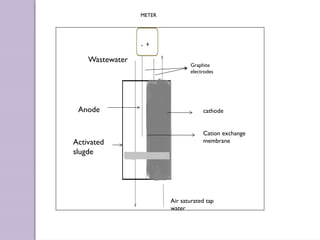
•Another BOD sensorwhich is based on
microbial fuel cell.
•In this system the anode and cathode are
seprated by a cation exchange and
electrodes are graphite felt . The chambers
have volume of 20 ml and are seeded with
activated sludge.
•The wastewater was run through the
anode and cathode has air saturated water
and steady state was reached after 60 min
which was proportional to wastewater`s
strength.
3. Uses inindustry
Biosensor can be designed to measure the
fermentation products to improve the feedback
control , to carry out rapid sampling and rejection
of below standared raw materials to improve the
efficiency of workers.
Isaokarube and other coworkers developed an ion
sensitive field effect transistor (ISFET) which is
very sensitive to change the ion concenteration
Using ISFET , it is possible to measure the odour ,
freshness and taste of foods . In determining fish
freshness either ATPase , aminoxidase or
putrescine oxidase is used . ATPase detects the
presence of ATP in fresh muscle . As ATP is not
present in staled foods , therefore signals do not
occur .
43.
•Biosensor have beendeveloped
which measure cholesterol levels
in butter . The enzyme cholesterol
oxidase , when immobilized on
the electrodes , reacts with
cholesterol of food.
44.
4. Biosensor inMilitary
The darker side of biosensor
application is to provide support
to military with such a biosensor
that can detect toxic gases
including chemical warfare
agents . Such biosensor have
advantage over the traditional
methods of sensing of chemicals
45.
REFERENCES
Text bookof Biotechnology by R.C
Dubey
Environmental Biotechnology by Allan
Scgrag
Biosensor by Raj Mohan Joshi
Editor's Notes
#4 Examples of suitable adsorbents are ion-exchange matrices porous carbon, clays, hydrous metal oxides, glasses and polymeric aromatic resins




![ONFH[AVN HIP] -TRIPLE REGIME -A NOVAL SURGICAL CONCEPT .pptx](https://cdn.slidesharecdn.com/ss_thumbnails/onfhavnhip2026koaconcalicutdrgokuldevdrmashraf-260210064517-213ec005-thumbnail.jpg?width=640&height=640&fit=bounds)


