Introduction
 Detection of anti-hepatitis C virus (anti-HCV)

antibodies
 May yield a high frequency of false-positive results in
people at low risk
 According to World Health Organization estimations,
 Anti-HCVantibody can not distinguish between a

current or past infection because people will retain
anti-HCV antibodies for life once they are exposed
to HCV. In addition, testing anti-HCV antibody
might provide false negative results because it ta kes
45– -68 days to develop ant i-HCV antibody post HCV
infection .
 On the other hand, detection of HCV RNA can distinguish

betweena current or past infection. However, d etection of
HCV RNA could
prov ide false positive results due to contamination.
 It is also expensive and labor-intensive for routine use.
Electrochemical immunosensor
Based on the highly specific molecular
recognition of antigen by its antibodies, have ahigh
interest in clinical diagnostics and will be expected
 to provide fast and highly sensitive detection of HCV
core antigencore antigen based on our knowledge
 The advantages of excellent sensiti vity, rapid response
 and cost-effectiveness of the nanostructured metaloxides
 make them the preferable choices to fabricate biosensor
We report on the construction of a label-free electrochemical
immunosensor for detecting the core antigen of the
hepatitis C virus (HCV core antigen). A glassy carbon
electrode (GCE) was modified with a nanocomposite made
from gold nanoparticles, zirconia nanoparticles and
chitosan, and prepared by in situ reduction.
The zirconia nanoparticles were first dispersed in chitosan
solution, and then AuNPs were prepared in situ on the
ZrO2-chitosan composite. In parallel, a nanocomposite was
synthesized from AuNPs, silica nanoparticles and chitosan,
and conjugated to a secondary antibody.
The properties of the resulting nanocomposites were
investigated by UV-visible photometry and
transmission electron microscopy, and the stepwise
assembly process was characterized by means of cyclic
voltammetry and electrochemical impedance
spectroscopy.
 The advantages of excellent sensiti vity, rapid response
 and cost-effectiveness of the nanostructured metal







oxides
make them the preferable choices to fabricate biosensor
We developed a novel and reliable procedure to construct
in one-step procedure using a chitsosan as reducing agent.
Anti-HCV was immobilized on this nanocomposite to
fabricate the immunosensor. The secondary antib ody
was immobilized on AuNPs/SiO2-Chit s nanocomposite,
which enhanced signal response of the HCV
immunosensor An sandwich type of immunosensor was
developed which displays high sensitivity to the HCV core
antigen in the concentration range between 2 and
512 ng mL−1, with a detection limit of 0.17 ng mL−1 (at
S/N = 3). This immunosensor provides an alternative
approach towards the diagnosis of HCV.
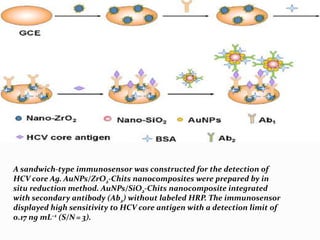
A sandwich-type immunosensor was constructed for the detection of
HCV core Ag. AuNPs/ZrO2-Chits nanocomposites were prepared by in
situ reduction method. AuNPs/SiO2-Chits nanocomposite integrated
with secondary antibody (Ab2) without labeled HRP. The immunosensor
displayed high sensitivity to HCV core antigen with a detection limit of
0.17 ng mL−1 (S/N = 3).
Electrochemical immunosensor

Electrochemical immunosensor

  • 2.
    Introduction  Detection ofanti-hepatitis C virus (anti-HCV) antibodies  May yield a high frequency of false-positive results in people at low risk  According to World Health Organization estimations,
  • 3.
     Anti-HCVantibody cannot distinguish between a current or past infection because people will retain anti-HCV antibodies for life once they are exposed to HCV. In addition, testing anti-HCV antibody might provide false negative results because it ta kes 45– -68 days to develop ant i-HCV antibody post HCV infection .
  • 4.
     On theother hand, detection of HCV RNA can distinguish betweena current or past infection. However, d etection of HCV RNA could prov ide false positive results due to contamination.  It is also expensive and labor-intensive for routine use.
  • 5.
    Electrochemical immunosensor Based onthe highly specific molecular recognition of antigen by its antibodies, have ahigh interest in clinical diagnostics and will be expected  to provide fast and highly sensitive detection of HCV core antigencore antigen based on our knowledge  The advantages of excellent sensiti vity, rapid response  and cost-effectiveness of the nanostructured metaloxides  make them the preferable choices to fabricate biosensor
  • 6.
    We report onthe construction of a label-free electrochemical immunosensor for detecting the core antigen of the hepatitis C virus (HCV core antigen). A glassy carbon electrode (GCE) was modified with a nanocomposite made from gold nanoparticles, zirconia nanoparticles and chitosan, and prepared by in situ reduction. The zirconia nanoparticles were first dispersed in chitosan solution, and then AuNPs were prepared in situ on the ZrO2-chitosan composite. In parallel, a nanocomposite was synthesized from AuNPs, silica nanoparticles and chitosan, and conjugated to a secondary antibody.
  • 7.
    The properties ofthe resulting nanocomposites were investigated by UV-visible photometry and transmission electron microscopy, and the stepwise assembly process was characterized by means of cyclic voltammetry and electrochemical impedance spectroscopy.
  • 8.
     The advantagesof excellent sensiti vity, rapid response  and cost-effectiveness of the nanostructured metal       oxides make them the preferable choices to fabricate biosensor We developed a novel and reliable procedure to construct in one-step procedure using a chitsosan as reducing agent. Anti-HCV was immobilized on this nanocomposite to fabricate the immunosensor. The secondary antib ody was immobilized on AuNPs/SiO2-Chit s nanocomposite, which enhanced signal response of the HCV immunosensor An sandwich type of immunosensor was developed which displays high sensitivity to the HCV core antigen in the concentration range between 2 and 512 ng mL−1, with a detection limit of 0.17 ng mL−1 (at S/N = 3). This immunosensor provides an alternative approach towards the diagnosis of HCV.
  • 9.
    A sandwich-type immunosensorwas constructed for the detection of HCV core Ag. AuNPs/ZrO2-Chits nanocomposites were prepared by in situ reduction method. AuNPs/SiO2-Chits nanocomposite integrated with secondary antibody (Ab2) without labeled HRP. The immunosensor displayed high sensitivity to HCV core antigen with a detection limit of 0.17 ng mL−1 (S/N = 3).