BIOSAFETY LEVELS
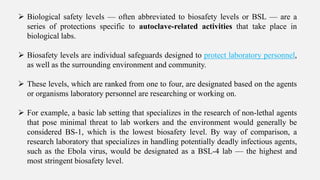
 Biological safety levels — often abbreviated to biosafety levels or BSL — are a
series of protections specific to autoclave-related activities that take place in
biological labs.
 Biosafety levels are individual safeguards designed to protect laboratory personnel,
as well as the surrounding environment and community.
 These levels, which are ranked from one to four, are designated based on the agents
or organisms laboratory personnel are researching or working on.
 For example, a basic lab setting that specializes in the research of non-lethal agents
that pose minimal threat to lab workers and the environment would generally be
considered BS-1, which is the lowest biosafety level. By way of comparison, a
research laboratory that specializes in handling potentially deadly infectious agents,
such as the Ebola virus, would be designated as a BSL-4 lab — the highest and
most stringent biosafety level.
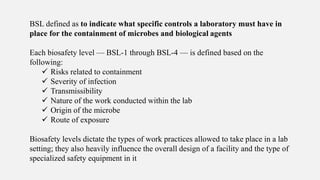
BSL defined as to indicate what specific controls a laboratory must have in
place for the containment of microbes and biological agents
Each biosafety level — BSL-1 through BSL-4 — is defined based on the
following:
 Risks related to containment
 Severity of infection
 Transmissibility
 Nature of the work conducted within the lab
 Origin of the microbe
 Route of exposure
Biosafety levels dictate the types of work practices allowed to take place in a lab
setting; they also heavily influence the overall design of a facility and the type of
specialized safety equipment in it
BIOSAFETY LEVEL 1 (BSL-1)
 The lowest of the four biosafety levels, biosafety level 1 (BSL-1)
applies to laboratory settings in which personnel work with low-risk
microbes that pose little to no threat of infection in healthy adults
 for example, a BSL-1 laboratory might work with a nonpathogenic
strain of E.coli. BSL-1 labs typically conduct research on benches do
not use special contaminant equipment, and do not need to be isolated
from surrounding facilities.
 BSL-1 labs also require immediate decontamination after spills.
Infectious materials should also be decontaminated prior to
disposal, generally through the use of an autoclave
Safety protocols for biosafety level 1 labs — which require only
standard microbial practices — include:
 Mechanical pipetting (no mouth pipetting allowed)
 Safe sharps handling
 Avoidance of splashes or aerosols
 Daily decontamination of all work surfaces when work is
complete
 Regular handwashing
 Prohibition of food, drink, and smoking materials
 The use of personal protective equipment (PPE), such as
goggles, gloves, and a lab coat or gown
 Biohazard signs
BIOSAFETY LEVEL 2 (BSL-2)
 Biosafety level 2 (BSL-2) covers all laboratories that work with agents
associated with human diseases that is, pathogenic or infectious organisms,
that pose a moderate health hazard
 examples of agents found in a BSL-2 lab include equine encephalitis viruses,
HIV, and staphylococcus aureus (staph infections
 BSL-2 labs are required to maintain the same standard microbial practices as
BSL-1 labs, as well as enhanced measures due to the potential risk
 Personnel working in biosafety level 2 laboratories are expected to take even
greater care to prevent injuries, such as cuts and other breakage to the skin,
as well as ingestion and mucous membrane exposures
BSL-2 labs are subject to the following safety controls:
 The use of PPE, including lab coats, gloves, eye protection, and — in some
cases — face shields
 All procedures that could cause infection from aerosols or splashes must be
performed within a biological safety cabinet.
 Decontamination of infectious materials prior to disposal, generally through
the use of an autoclave
 Self-closing, lockable doors
 Access to a sink and eyewash station
 Biohazard warning signs
Access to a biosafety level 2 lab is far more restrictive than to a biosafety level 1
lab. Outside personnel, or those with an increased risk of contamination, are often
restricted from entering the area while work is underway
BIOSAFETY LEVEL 3 (BSL-3)
a biosafety level 3 (BSL-3) laboratory typically conducts research into or
work on microbes that are either indigenous or exotic and can cause serious
or potentially lethal disease through inhalation.
Common examples of microbes found in BSL-3 labs include yellow fever,
West Nile virus, and the bacteria that causes tuberculosis.
Microbes found within biosafety level 3 settings are so serious that work is
often strictly controlled and registered through the appropriate government
agencies
Laboratory personnel are also under medical surveillance and may require
immunizations for the microbes they work with.
Common safety controls within a BSL-3 lab include:
 The use of PPE, including goggles and gloves; respirators may also be
required
 The use of solid-front wraparound gowns, scrub suits, and/or coveralls is
often required
 Access to a hands-free sink and eyewash station available near the exit
 Sustained directional airflow to draw air into the laboratory from clean
areas toward potentially contaminated areas (exhaust air cannot be
recirculated)
 Self-closing set of locking doors with access away from general building
corridors
Access to a BSL-3 laboratory is restricted and controlled at all times.
BIOSAFETY LEVEL 4 (BSL-4)
 Biosafety level 4 (BSL-4) labs are rare; however, a small number
exist in the U.S. and around the world.
 As the highest level of biological safety, BSL-4 labs work with highly
dangerous and exotic microbes, such as the Ebola and Marburg
viruses (zoonotic virus).
 Infections caused by these types of microbes are often fatal and come
without treatment or vaccines.
biosafety level 4 laboratories must follow these safety protocols:
 Personnel must change clothing before entering the facility and
shower upon exiting
 All materials must be decontaminated before leaving the facility
 Personnel must wear the PPE from lower BSL levels, as well as a
full-body, air-supplied, positive pressure suit
 Access to a Class III biological safety cabinet
BSL-4 labs are extremely isolated, often located in an isolated and
restricted zone of a building or in a separate building entirely. BSL-4
labs also feature a dedicated supply of exhaust air, as well as vacuum
lines and decontamination systems.
Biosafety Levels .pptx

Biosafety Levels .pptx

  • 1.
  • 2.
     Biological safetylevels — often abbreviated to biosafety levels or BSL — are a series of protections specific to autoclave-related activities that take place in biological labs.  Biosafety levels are individual safeguards designed to protect laboratory personnel, as well as the surrounding environment and community.  These levels, which are ranked from one to four, are designated based on the agents or organisms laboratory personnel are researching or working on.  For example, a basic lab setting that specializes in the research of non-lethal agents that pose minimal threat to lab workers and the environment would generally be considered BS-1, which is the lowest biosafety level. By way of comparison, a research laboratory that specializes in handling potentially deadly infectious agents, such as the Ebola virus, would be designated as a BSL-4 lab — the highest and most stringent biosafety level.
  • 3.
    BSL defined asto indicate what specific controls a laboratory must have in place for the containment of microbes and biological agents Each biosafety level — BSL-1 through BSL-4 — is defined based on the following:  Risks related to containment  Severity of infection  Transmissibility  Nature of the work conducted within the lab  Origin of the microbe  Route of exposure Biosafety levels dictate the types of work practices allowed to take place in a lab setting; they also heavily influence the overall design of a facility and the type of specialized safety equipment in it
  • 4.
  • 5.
     The lowestof the four biosafety levels, biosafety level 1 (BSL-1) applies to laboratory settings in which personnel work with low-risk microbes that pose little to no threat of infection in healthy adults  for example, a BSL-1 laboratory might work with a nonpathogenic strain of E.coli. BSL-1 labs typically conduct research on benches do not use special contaminant equipment, and do not need to be isolated from surrounding facilities.  BSL-1 labs also require immediate decontamination after spills. Infectious materials should also be decontaminated prior to disposal, generally through the use of an autoclave
  • 6.
    Safety protocols forbiosafety level 1 labs — which require only standard microbial practices — include:  Mechanical pipetting (no mouth pipetting allowed)  Safe sharps handling  Avoidance of splashes or aerosols  Daily decontamination of all work surfaces when work is complete  Regular handwashing  Prohibition of food, drink, and smoking materials  The use of personal protective equipment (PPE), such as goggles, gloves, and a lab coat or gown  Biohazard signs
  • 7.
  • 8.
     Biosafety level2 (BSL-2) covers all laboratories that work with agents associated with human diseases that is, pathogenic or infectious organisms, that pose a moderate health hazard  examples of agents found in a BSL-2 lab include equine encephalitis viruses, HIV, and staphylococcus aureus (staph infections  BSL-2 labs are required to maintain the same standard microbial practices as BSL-1 labs, as well as enhanced measures due to the potential risk  Personnel working in biosafety level 2 laboratories are expected to take even greater care to prevent injuries, such as cuts and other breakage to the skin, as well as ingestion and mucous membrane exposures
  • 9.
    BSL-2 labs aresubject to the following safety controls:  The use of PPE, including lab coats, gloves, eye protection, and — in some cases — face shields  All procedures that could cause infection from aerosols or splashes must be performed within a biological safety cabinet.  Decontamination of infectious materials prior to disposal, generally through the use of an autoclave  Self-closing, lockable doors  Access to a sink and eyewash station  Biohazard warning signs Access to a biosafety level 2 lab is far more restrictive than to a biosafety level 1 lab. Outside personnel, or those with an increased risk of contamination, are often restricted from entering the area while work is underway
  • 10.
  • 11.
    a biosafety level3 (BSL-3) laboratory typically conducts research into or work on microbes that are either indigenous or exotic and can cause serious or potentially lethal disease through inhalation. Common examples of microbes found in BSL-3 labs include yellow fever, West Nile virus, and the bacteria that causes tuberculosis. Microbes found within biosafety level 3 settings are so serious that work is often strictly controlled and registered through the appropriate government agencies Laboratory personnel are also under medical surveillance and may require immunizations for the microbes they work with.
  • 12.
    Common safety controlswithin a BSL-3 lab include:  The use of PPE, including goggles and gloves; respirators may also be required  The use of solid-front wraparound gowns, scrub suits, and/or coveralls is often required  Access to a hands-free sink and eyewash station available near the exit  Sustained directional airflow to draw air into the laboratory from clean areas toward potentially contaminated areas (exhaust air cannot be recirculated)  Self-closing set of locking doors with access away from general building corridors Access to a BSL-3 laboratory is restricted and controlled at all times.
  • 13.
  • 14.
     Biosafety level4 (BSL-4) labs are rare; however, a small number exist in the U.S. and around the world.  As the highest level of biological safety, BSL-4 labs work with highly dangerous and exotic microbes, such as the Ebola and Marburg viruses (zoonotic virus).  Infections caused by these types of microbes are often fatal and come without treatment or vaccines.
  • 15.
    biosafety level 4laboratories must follow these safety protocols:  Personnel must change clothing before entering the facility and shower upon exiting  All materials must be decontaminated before leaving the facility  Personnel must wear the PPE from lower BSL levels, as well as a full-body, air-supplied, positive pressure suit  Access to a Class III biological safety cabinet BSL-4 labs are extremely isolated, often located in an isolated and restricted zone of a building or in a separate building entirely. BSL-4 labs also feature a dedicated supply of exhaust air, as well as vacuum lines and decontamination systems.