Biosafety in Microbiological and
Biomedical Laboratories
S. Wongratanacheewin, Ph.D.
Melioidosis Research Center, Faculty of
Medicine, KKU.
E-mail: sura_wng@kku.ac.th
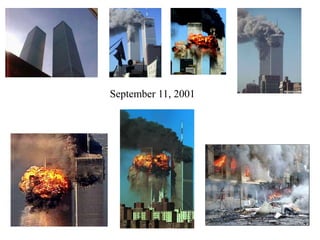
September 11, 2001
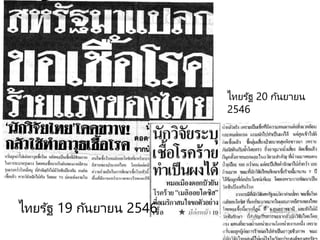
āš„ā¸—ā¸ĸā¸Ŗā¸ąā¸ 19 ā¸ā¸ąā¸™ā¸ĸ⏞ā¸ĸ⏙ 2546
āš„ā¸—ā¸ĸā¸Ŗā¸ąā¸ 20 ā¸ā¸ąā¸™ā¸ĸ⏞ā¸ĸ⏙
2546
Biosafety
īŽ Personal protection
īŽ Work place practices
īŽ Administrative
īŽ Engineering
All play an equal role in protecting workers
from occupational exposures in
laboratories
Biosafety
īŽ Personal protection
īŽ PPE, respirotors, gloves, booties, eye and ear
protections
īŽ Work place practices
īŽ Entry and exit practices, decontamination,
emergency procedure, handle sharp.
Biosafety
īŽ Administrative
īŽ Training
īŽ Risk management
īŽ Immunization
īŽ Security, supervision
īŽ Engineering
īŽ System, Hepa filter, Accessible
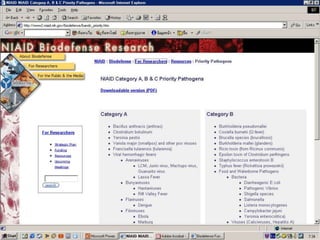
CDC Bioterrorism Agents
īŽ Category A
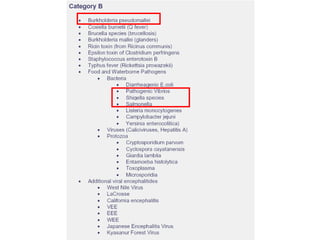
īŽ Category B
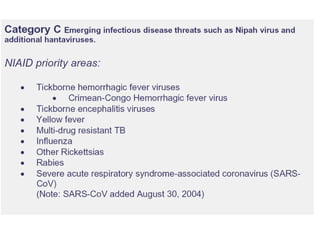
īŽ Category C
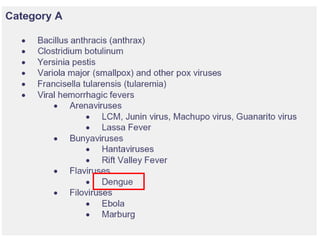
Category A Diseases/Agents
īŽ can be easily disseminated or
transmitted from person to person;
īŽ result in high mortality rates and have
the potential for major public health
impact;
īŽ might cause public panic and social
disruption; and
īŽ require special action for public health
preparedness.
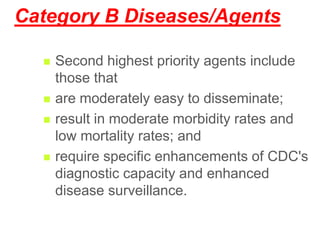
Category B Diseases/Agents
īŽ Second highest priority agents include
those that
īŽ are moderately easy to disseminate;
īŽ result in moderate morbidity rates and
low mortality rates; and
īŽ require specific enhancements of CDC's
diagnostic capacity and enhanced
disease surveillance.
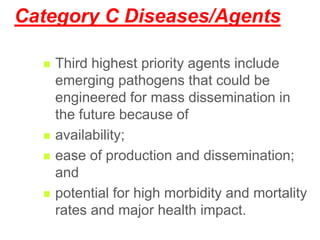
Category C Diseases/Agents
īŽ Third highest priority agents include
emerging pathogens that could be
engineered for mass dissemination in
the future because of
īŽ availability;
īŽ ease of production and dissemination;
and
īŽ potential for high morbidity and mortality
rates and major health impact.
Containment
īŽ Primary containment, the protection of
personnel and the immediate laboratory
environment from exposure to infectious
agents, is provided by both good
microbiological technique and the use of
appropriate safety equipment.
īŽ Secondary containment, the protection of
the environment external to the laboratory
from exposure to infectious materials,
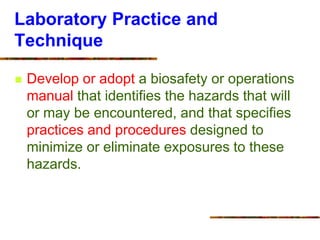
Laboratory Practice and
Technique
īŽ Develop or adopt a biosafety or operations
manual that identifies the hazards that will
or may be encountered, and that specifies
practices and procedures designed to
minimize or eliminate exposures to these
hazards.
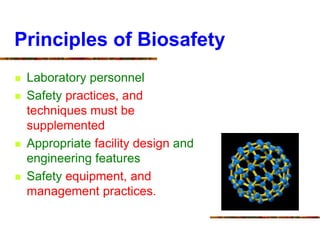
Principles of Biosafety
īŽ Laboratory personnel
īŽ Safety practices, and
techniques must be
supplemented
īŽ Appropriate facility design and
engineering features
īŽ Safety equipment, and
management practices.
Safety Equipment (Primary Barriers)
īŽ Biological safety cabinets (BSCs)
īŽ Enclosed containers,
īŽ Engineering controls designed to remove
or minimize exposures to hazardous
biological materials.
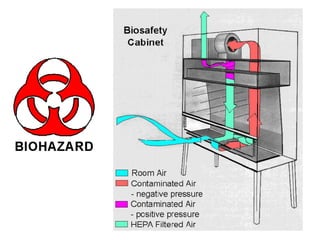
The biological safety cabinet (BSC)
īŽ Device used to provide containment of infectious
splashes or aerosols.
īŽ Three types of biological safety cabinets (Class
I, II, III) used in microbiological laboratories.
īŽ Open-fronted Class I and Class II biological
safety cabinets are primary barriers which offer
significant levels of protection to laboratory
personnel.
īŽ Safety centrifuge cup, an enclosed container
designed to prevent aerosols.
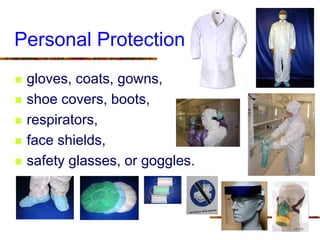
Personal Protection
īŽ gloves, coats, gowns,
īŽ shoe covers, boots,
īŽ respirators,
īŽ face shields,
īŽ safety glasses, or goggles.
Facility Design and Construction
(Secondary Barriers)
īŽ Depend on the risk of transmission of specific
agents.
īŽ Separation of the laboratory work area from
public access, availability of a decontamination
facility (e.g., autoclave), and handwashing
facilities.
īŽ If an infectious aerosol is present, higher levels
of primary containment and multiple secondary
barriers may become necessary to prevent
infectious agents from escaping into the
environment.
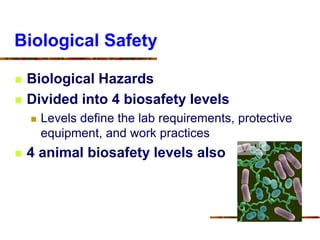
Biological Safety
īŽ Biological Hazards
īŽ Divided into 4 biosafety levels
īŽ Levels define the lab requirements, protective
equipment, and work practices
īŽ 4 animal biosafety levels also
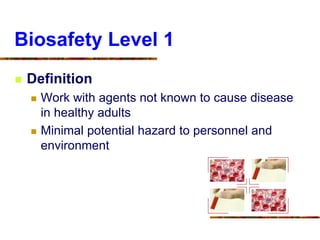
Biosafety Level 1
īŽ Definition
īŽ Work with agents not known to cause disease
in healthy adults
īŽ Minimal potential hazard to personnel and
environment
Biosafety Level 1
īŽ Requirements
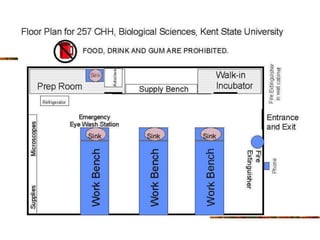
īŽ Wash hands before leaving lab
īŽ No eating, drinking, etc. in lab
īŽ Follow safe sharps procedures
īŽ Decontaminate waste and work surfaces
Biosafety Level 1
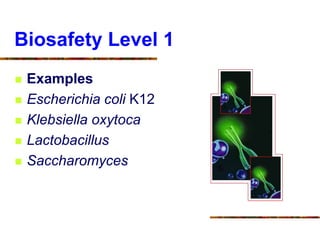
īŽ Examples
īŽ Escherichia coli K12
īŽ Klebsiella oxytoca
īŽ Lactobacillus
īŽ Saccharomyces
Biosafety Level 2
īŽ Definition
īŽ Work with agents of moderate potential
hazard to personnel and the environment.
Agents associated with human disease
which is rarely serious and for which
preventative or therapeutic interventions
are often available.
Biosafety Level 2
īŽ Requirements
īŽ All requirements for BSL1 plus:
īŽ Training to handle organisms
īŽ Personal protective equipment (PPE)- lab
coats, eyewear, and gloves
īŽ Minimize aerosol generation
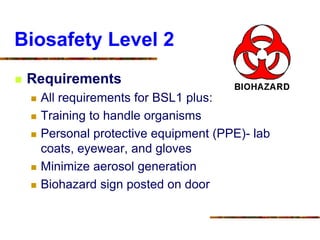
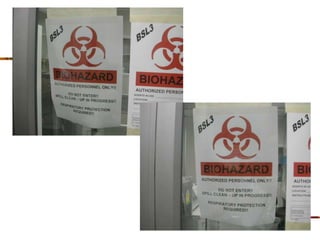
īŽ Biohazard sign posted on door
Biosafety Level 2
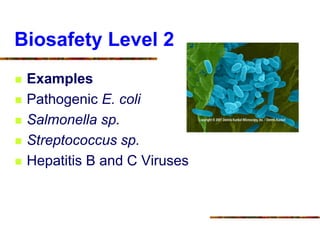
īŽ Examples
īŽ Pathogenic E. coli
īŽ Salmonella sp.
īŽ Streptococcus sp.
īŽ Hepatitis B and C Viruses
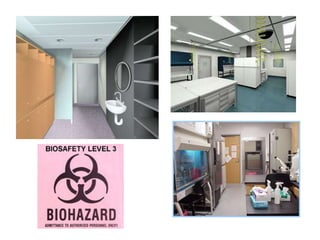
Biosafety Level 3
īŽ Definition
īŽ Agents associated with serious or lethal
disease for which preventative or
therapeutic intervention may be available.
High individual risk, low community risk.
Often risk is by inhalation route.
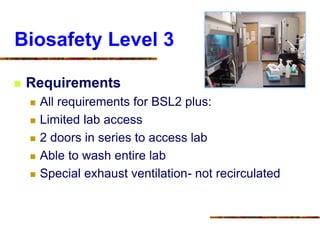
Biosafety Level 3
īŽ Requirements
īŽ All requirements for BSL2 plus:
īŽ Limited lab access
īŽ 2 doors in series to access lab
īŽ Able to wash entire lab
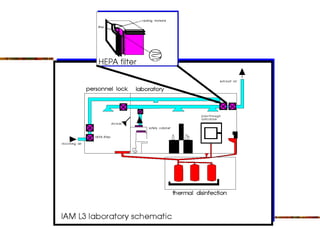
īŽ Special exhaust ventilation- not recirculated
Biosafety Level 3
īŽ Requirements
īŽ All requirements for BSL2 plus:
īŽ High level of training
īŽ Personnel receive vaccinations if available
īŽ Work in biosafety cabinets
Biosafety Level 3
īŽ Examples
īŽ HIV
īŽ Mycobacterium tuberculosis
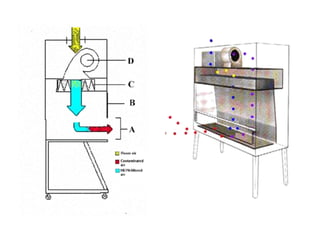
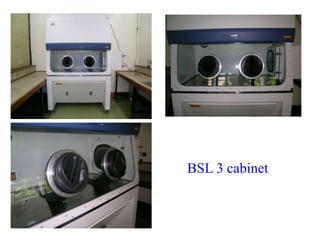
BSL 3 cabinet
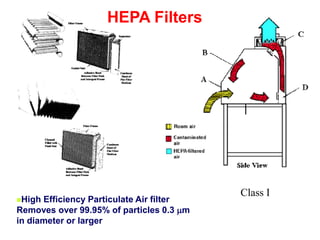
Class I
īŽHigh Efficiency Particulate Air filter
Removes over 99.95% of particles 0.3 mm
in diameter or larger
HEPA Filters
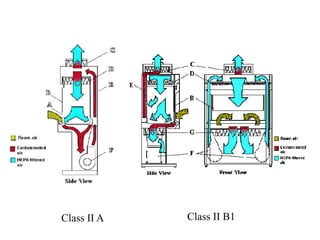
Class II A Class II B1
Connection to building exhaust system required.
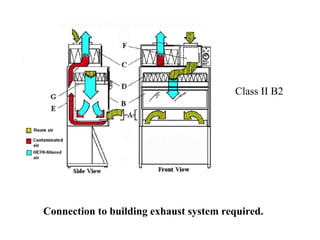
Class II B2
Connection to building exhaust system required.
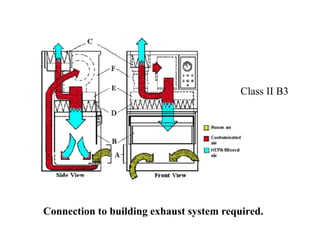
Class II B3
Biosafety Level 4
īŽ Definition
īŽ Agents likely to cause serious or lethal
disease for which preventative or
therapeutic intervention is usually NOT
available. Dangerous or exotic agents.
Biosafety Level 4
īŽ Requirements
īŽ All requirements for BSL3 plus:
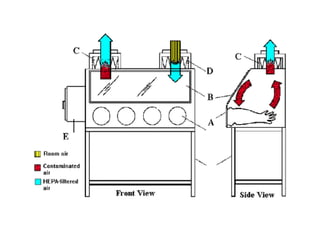
īŽ Class III biosafety cabinet or positive pressure
suits
īŽ Shower/change rooms - clothing autoclaved
before laundering
īŽ Air locks
Biosafety Level 4
īŽ Examples
īŽ No Bacteria or Fungi
īŽ Ebola Virus
īŽ Monkey B Virus
īŽ Marburg Virus
Safe Work Practices
īŽ Wash hands after work; before leaving lab;
when removing gloves
īŽ No eating, drinking, applying cosmetics,
handling contact lenses in lab
īŽ Maintain labs in clean, orderly fashion
īŽ Limit access to lab when work with
organisms is in progress
īŽ Use good microbiological techniques
īŽ No mouth pipetting
īŽ When possible use plastic instead of glass
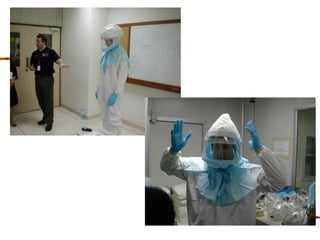
Personal Protective Equipment
īŽ Contaminated personal protective
equipment (PPE) should remain in the
work area- do not wear in any "clean"
areas
īŽ PPE that is contaminated must be
discarded as infectious waste or
disinfected prior to routine laundering
Use of Equipment
īŽ Minimize airflow disturbances (moving in/out
of cabinet, people walking by, opening
doors, blocking grilles with equipment)
īŽ Wipe down surfaces with alcohol before and
after work. Let run 10 minutes to clean it
īŽ Minimize use of flames in cabinet
īŽ Try not to use chemicals in cabinets- only
use in Class I or II hoods that are ducted-
contact DOHS
īŽ Do not store excess equipment in cabinet
Centrifuge Safety
īŽ Aerosol generation from broken tubes,
opening tubes, decanting supernatant,
resuspending materials
īŽ Balance load
īŽ Use sealed tubes, safety buckets or
rotors when possible
īŽ When possible fill & open centrifuge
tubes or buckets in BSC
Centrifuge Accidents
īŽ If a tube breaks-
īŽ Turn off centrifuge
īŽ Leave the lab
īŽ Call Officers
īŽ If you find a tube broke when you open the
centrifuge-
īŽ Close the lid
īŽ Leave the lab
īŽ Call Officers
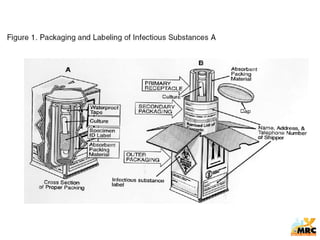
Shipping/ Transporting
īŽ Who regulate transportation of
biologicals????
īŽ Includes infectious materials,
diagnostic specimens, dry ice
īŽ Program being developed- to include
mandatory training
Disinfection
īŽ All equipment, environmental, and working
surfaces must be cleaned and
decontaminated after work with infectious
materials
īŽ Broken glass or sharps shall be cleaned up
using mechanical means- NOT by hand
īŽ Different levels of cleaning-
decontamination, sanitization, disinfection,
sterilization
Decontamination
īŽ Use appropriate disinfectant for agents
in use
īŽ Follow instructions, paying attention to
dilution, shelf life, and contact time to
assure effective kill
īŽ Care must be used to ensure mixing of
incompatible materials does not occur
Infectious Waste
īŽ What is infectious waste
īŽ Procedures for disposal
īŽ Solid waste
īŽ Liquid waste
īŽ Sharps
īŽ Autoclaving waste
īŽ Containers and pick-ups
īŽ Mixed waste
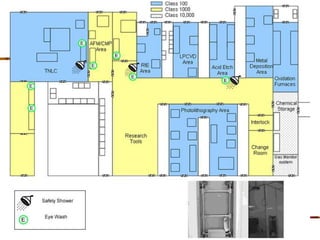
Emergencies
īŽ Safety equipment
īŽ in labs
īŽ Showers
īŽ Eye washes
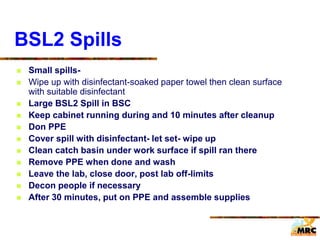
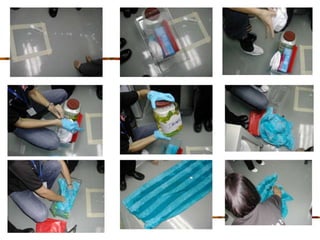
BSL2 Spills
īŽ Small spills-
īŽ Wipe up with disinfectant-soaked paper towel then clean surface
with suitable disinfectant
īŽ Large BSL2 Spill in BSC
īŽ Keep cabinet running during and 10 minutes after cleanup
īŽ Don PPE
īŽ Cover spill with disinfectant- let set- wipe up
īŽ Clean catch basin under work surface if spill ran there
īŽ Remove PPE when done and wash
īŽ Leave the lab, close door, post lab off-limits
īŽ Decon people if necessary
īŽ After 30 minutes, put on PPE and assemble supplies
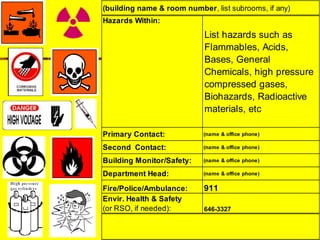
(building name & room number, list subrooms, if any)
Hazards Within:
List hazards such as
Flammables, Acids,
Bases, General
Chemicals, high pressure
compressed gases,
Biohazards, Radioactive
materials, etc
Primary Contact: (name & office phone)
Second Contact: (name & office phone)
Building Monitor/Safety: (name & office phone)
Department Head: (name & office phone)
Fire/Police/Ambulance: 911
Envir. Health & Safety
(or RSO, if needed): 646-3327
Acknowledgements
īŽ T2 (Thailand Tropical Diseases
Research Program).
īŽ TRF (Thailand Research Fund).
īŽ NSTDA
īŽ ONSITE, Emory University
īŽ Faculty of Science, MU
īŽ The Virology Association of
Thailand
īŽ Faculty of Medicine, KKU.

1573549i.ppt

  • 1.
    Biosafety in Microbiologicaland Biomedical Laboratories S. Wongratanacheewin, Ph.D. Melioidosis Research Center, Faculty of Medicine, KKU. E-mail: sura_wng@kku.ac.th
  • 2.
  • 3.
    āš„ā¸—ā¸ĸā¸Ŗā¸ąā¸ 19 ā¸ā¸ąā¸™ā¸ĸ⏞ā¸ĸ⏙2546 āš„ā¸—ā¸ĸā¸Ŗā¸ąā¸ 20 ā¸ā¸ąā¸™ā¸ĸ⏞ā¸ĸ⏙ 2546
  • 4.
    Biosafety īŽ Personal protection īŽWork place practices īŽ Administrative īŽ Engineering All play an equal role in protecting workers from occupational exposures in laboratories
  • 5.
    Biosafety īŽ Personal protection īŽPPE, respirotors, gloves, booties, eye and ear protections īŽ Work place practices īŽ Entry and exit practices, decontamination, emergency procedure, handle sharp.
  • 6.
    Biosafety īŽ Administrative īŽ Training īŽRisk management īŽ Immunization īŽ Security, supervision īŽ Engineering īŽ System, Hepa filter, Accessible
  • 7.
    CDC Bioterrorism Agents īŽCategory A īŽ Category B īŽ Category C
  • 8.
    Category A Diseases/Agents īŽcan be easily disseminated or transmitted from person to person; īŽ result in high mortality rates and have the potential for major public health impact; īŽ might cause public panic and social disruption; and īŽ require special action for public health preparedness.
  • 9.
    Category B Diseases/Agents īŽSecond highest priority agents include those that īŽ are moderately easy to disseminate; īŽ result in moderate morbidity rates and low mortality rates; and īŽ require specific enhancements of CDC's diagnostic capacity and enhanced disease surveillance.
  • 10.
    Category C Diseases/Agents īŽThird highest priority agents include emerging pathogens that could be engineered for mass dissemination in the future because of īŽ availability; īŽ ease of production and dissemination; and īŽ potential for high morbidity and mortality rates and major health impact.
  • 15.
    Containment īŽ Primary containment,the protection of personnel and the immediate laboratory environment from exposure to infectious agents, is provided by both good microbiological technique and the use of appropriate safety equipment. īŽ Secondary containment, the protection of the environment external to the laboratory from exposure to infectious materials,
  • 16.
    Laboratory Practice and Technique īŽDevelop or adopt a biosafety or operations manual that identifies the hazards that will or may be encountered, and that specifies practices and procedures designed to minimize or eliminate exposures to these hazards.
  • 17.
    Principles of Biosafety īŽLaboratory personnel īŽ Safety practices, and techniques must be supplemented īŽ Appropriate facility design and engineering features īŽ Safety equipment, and management practices.
  • 18.
    Safety Equipment (PrimaryBarriers) īŽ Biological safety cabinets (BSCs) īŽ Enclosed containers, īŽ Engineering controls designed to remove or minimize exposures to hazardous biological materials.
  • 19.
    The biological safetycabinet (BSC) īŽ Device used to provide containment of infectious splashes or aerosols. īŽ Three types of biological safety cabinets (Class I, II, III) used in microbiological laboratories. īŽ Open-fronted Class I and Class II biological safety cabinets are primary barriers which offer significant levels of protection to laboratory personnel. īŽ Safety centrifuge cup, an enclosed container designed to prevent aerosols.
  • 23.
    Personal Protection īŽ gloves,coats, gowns, īŽ shoe covers, boots, īŽ respirators, īŽ face shields, īŽ safety glasses, or goggles.
  • 24.
    Facility Design andConstruction (Secondary Barriers) īŽ Depend on the risk of transmission of specific agents. īŽ Separation of the laboratory work area from public access, availability of a decontamination facility (e.g., autoclave), and handwashing facilities. īŽ If an infectious aerosol is present, higher levels of primary containment and multiple secondary barriers may become necessary to prevent infectious agents from escaping into the environment.
  • 27.
    Biological Safety īŽ BiologicalHazards īŽ Divided into 4 biosafety levels īŽ Levels define the lab requirements, protective equipment, and work practices īŽ 4 animal biosafety levels also
  • 28.
    Biosafety Level 1 īŽDefinition īŽ Work with agents not known to cause disease in healthy adults īŽ Minimal potential hazard to personnel and environment
  • 29.
    Biosafety Level 1 īŽRequirements īŽ Wash hands before leaving lab īŽ No eating, drinking, etc. in lab īŽ Follow safe sharps procedures īŽ Decontaminate waste and work surfaces
  • 30.
    Biosafety Level 1 īŽExamples īŽ Escherichia coli K12 īŽ Klebsiella oxytoca īŽ Lactobacillus īŽ Saccharomyces
  • 32.
    Biosafety Level 2 īŽDefinition īŽ Work with agents of moderate potential hazard to personnel and the environment. Agents associated with human disease which is rarely serious and for which preventative or therapeutic interventions are often available.
  • 33.
    Biosafety Level 2 īŽRequirements īŽ All requirements for BSL1 plus: īŽ Training to handle organisms īŽ Personal protective equipment (PPE)- lab coats, eyewear, and gloves īŽ Minimize aerosol generation īŽ Biohazard sign posted on door
  • 34.
    Biosafety Level 2 īŽExamples īŽ Pathogenic E. coli īŽ Salmonella sp. īŽ Streptococcus sp. īŽ Hepatitis B and C Viruses
  • 35.
    Biosafety Level 3 īŽDefinition īŽ Agents associated with serious or lethal disease for which preventative or therapeutic intervention may be available. High individual risk, low community risk. Often risk is by inhalation route.
  • 36.
    Biosafety Level 3 īŽRequirements īŽ All requirements for BSL2 plus: īŽ Limited lab access īŽ 2 doors in series to access lab īŽ Able to wash entire lab īŽ Special exhaust ventilation- not recirculated
  • 39.
    Biosafety Level 3 īŽRequirements īŽ All requirements for BSL2 plus: īŽ High level of training īŽ Personnel receive vaccinations if available īŽ Work in biosafety cabinets
  • 40.
    Biosafety Level 3 īŽExamples īŽ HIV īŽ Mycobacterium tuberculosis
  • 41.
  • 42.
    Class I īŽHigh EfficiencyParticulate Air filter Removes over 99.95% of particles 0.3 mm in diameter or larger HEPA Filters
  • 43.
    Class II AClass II B1
  • 44.
    Connection to buildingexhaust system required. Class II B2
  • 45.
    Connection to buildingexhaust system required. Class II B3
  • 47.
    Biosafety Level 4 īŽDefinition īŽ Agents likely to cause serious or lethal disease for which preventative or therapeutic intervention is usually NOT available. Dangerous or exotic agents.
  • 48.
    Biosafety Level 4 īŽRequirements īŽ All requirements for BSL3 plus: īŽ Class III biosafety cabinet or positive pressure suits īŽ Shower/change rooms - clothing autoclaved before laundering īŽ Air locks
  • 49.
    Biosafety Level 4 īŽExamples īŽ No Bacteria or Fungi īŽ Ebola Virus īŽ Monkey B Virus īŽ Marburg Virus
  • 50.
    Safe Work Practices īŽWash hands after work; before leaving lab; when removing gloves īŽ No eating, drinking, applying cosmetics, handling contact lenses in lab īŽ Maintain labs in clean, orderly fashion īŽ Limit access to lab when work with organisms is in progress īŽ Use good microbiological techniques īŽ No mouth pipetting īŽ When possible use plastic instead of glass
  • 51.
    Personal Protective Equipment īŽContaminated personal protective equipment (PPE) should remain in the work area- do not wear in any "clean" areas īŽ PPE that is contaminated must be discarded as infectious waste or disinfected prior to routine laundering
  • 52.
    Use of Equipment īŽMinimize airflow disturbances (moving in/out of cabinet, people walking by, opening doors, blocking grilles with equipment) īŽ Wipe down surfaces with alcohol before and after work. Let run 10 minutes to clean it īŽ Minimize use of flames in cabinet īŽ Try not to use chemicals in cabinets- only use in Class I or II hoods that are ducted- contact DOHS īŽ Do not store excess equipment in cabinet
  • 53.
    Centrifuge Safety īŽ Aerosolgeneration from broken tubes, opening tubes, decanting supernatant, resuspending materials īŽ Balance load īŽ Use sealed tubes, safety buckets or rotors when possible īŽ When possible fill & open centrifuge tubes or buckets in BSC
  • 54.
    Centrifuge Accidents īŽ Ifa tube breaks- īŽ Turn off centrifuge īŽ Leave the lab īŽ Call Officers īŽ If you find a tube broke when you open the centrifuge- īŽ Close the lid īŽ Leave the lab īŽ Call Officers
  • 55.
    Shipping/ Transporting īŽ Whoregulate transportation of biologicals???? īŽ Includes infectious materials, diagnostic specimens, dry ice īŽ Program being developed- to include mandatory training
  • 57.
    Disinfection īŽ All equipment,environmental, and working surfaces must be cleaned and decontaminated after work with infectious materials īŽ Broken glass or sharps shall be cleaned up using mechanical means- NOT by hand īŽ Different levels of cleaning- decontamination, sanitization, disinfection, sterilization
  • 58.
    Decontamination īŽ Use appropriatedisinfectant for agents in use īŽ Follow instructions, paying attention to dilution, shelf life, and contact time to assure effective kill īŽ Care must be used to ensure mixing of incompatible materials does not occur
  • 59.
    Infectious Waste īŽ Whatis infectious waste īŽ Procedures for disposal īŽ Solid waste īŽ Liquid waste īŽ Sharps īŽ Autoclaving waste īŽ Containers and pick-ups īŽ Mixed waste
  • 60.
    Emergencies īŽ Safety equipment īŽin labs īŽ Showers īŽ Eye washes
  • 61.
    BSL2 Spills īŽ Smallspills- īŽ Wipe up with disinfectant-soaked paper towel then clean surface with suitable disinfectant īŽ Large BSL2 Spill in BSC īŽ Keep cabinet running during and 10 minutes after cleanup īŽ Don PPE īŽ Cover spill with disinfectant- let set- wipe up īŽ Clean catch basin under work surface if spill ran there īŽ Remove PPE when done and wash īŽ Leave the lab, close door, post lab off-limits īŽ Decon people if necessary īŽ After 30 minutes, put on PPE and assemble supplies
  • 62.
    (building name &room number, list subrooms, if any) Hazards Within: List hazards such as Flammables, Acids, Bases, General Chemicals, high pressure compressed gases, Biohazards, Radioactive materials, etc Primary Contact: (name & office phone) Second Contact: (name & office phone) Building Monitor/Safety: (name & office phone) Department Head: (name & office phone) Fire/Police/Ambulance: 911 Envir. Health & Safety (or RSO, if needed): 646-3327
  • 70.
    Acknowledgements īŽ T2 (ThailandTropical Diseases Research Program). īŽ TRF (Thailand Research Fund). īŽ NSTDA īŽ ONSITE, Emory University īŽ Faculty of Science, MU īŽ The Virology Association of Thailand īŽ Faculty of Medicine, KKU.