
BIOMECHANICS
OBAJE GODWIN SUNDAY
+2348068638121,
obaje199@gmail.com
FUNAI, Nigeria
5/4/2018 1
Why are modern mammals faster than
dinosaurs?
BIOMECHANICS
• Biomechanics - Its simply mechanics applied to living
systems - principally the human body or animals
systems. It refers to study of Engg. and physics
concerns with forces.
• Your lips are doing most of the work. … Whistling is
mostly forcing air from your lungs through your trachea
out of your mouth.
• The hip is a ball and socket style synovial joint, much
more so than the gleno-humeral joint of the shoulder
girdle in that the encompassing socket of the
acetabular rim fixed.
5/4/2018 2
Why are modern mammals faster than
dinosaurs?
Biomechanics Cont’D
• 2 main components one needs to learn biomechanics.
• Understanding of human anatomy is useful at least
with regards to learning about human biomechanics.
• For instance, opens up airway passages and relieves
stress put on body when in proper posture compared
to improper posture, such as a slumped back, rounded
shoulders.
• The physiologic activities involving human body
fluids.
5/4/2018 3
Why are modern mammals faster than
dinosaurs?
FIELD OF STUDY
• In india, biomechanics is a separate elective course
offered as part of mechanical or biomedical
engineering.
• if you are planning on getting a degree in biomechanics
with the hope of serving your community in a health
centered orientation then it is wise especially at
postgraduate levels.
• Some of the trends in the field are fluid-structure
interaction (FSI), growth, stimulation and remodeling,
optimization.
5/4/2018 4
Why are modern mammals faster than
dinosaurs?
Field Cont’D
• If you are interested in the circulatory system of human
body, you can touch on the fluid mechanics on
biological view e.g microfluidic devices.
5/4/2018 5
Why are modern mammals faster than
dinosaurs?
BOOKS
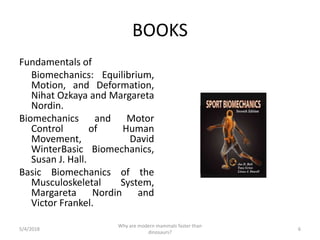
Fundamentals of
Biomechanics: Equilibrium,
Motion, and Deformation,
Nihat Ozkaya and Margareta
Nordin.
Biomechanics and Motor
Control of Human
Movement, David
WinterBasic Biomechanics,
Susan J. Hall.
Basic Biomechanics of the
Musculoskeletal System,
Margareta Nordin and
Victor Frankel.
5/4/2018 6
Why are modern mammals faster than
dinosaurs?
Biomechanics of Hip Joint
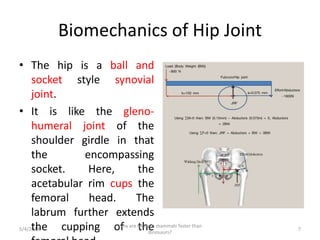
• The hip is a ball and
socket style synovial
joint.
• It is like the gleno-
humeral joint of the
shoulder girdle in that
the encompassing
socket. Here, the
acetabular rim cups the
femoral head. The
labrum further extends
the cupping of the5/4/2018 7
Why are modern mammals faster than
dinosaurs?
Hip Joint Cont’D
• This translates to an increase in structural stability. This
is largely due to the difference in forces experienced
between the two joints, and their requirements on the
"locomotion-stabilization continuum“.
• A joint located in the lower body like the hip will have
an increased need to be structurally stable. This is
because of the constant stresses of gait combined with
disproportionately larger forces exhibited during
locomotion.
• Motion occurred or occurring in one of the three
planes…sagittal plane, transverse and coronal
5/4/2018 8
Why are modern mammals faster than
dinosaurs?
Hip joint Cont’D
• Sagittal plane motions are called flexion (femoral shaft
moving anterior/superior forms) and extension
(femoral shaft moving anterior/superior) and operate
around an axis running horizontally medial-lateral
• The coronal (frontal) plane motions of abduction (leg
away from midline) and adduction (leg towards
midline) operate around an axis that runs front-back,
anterior-posterior.
• The transverse plane motions of internal (anterior
femur moving medially and posterior) and external
(anterior femur moving laterally and posterior) operate
around a vertical, superior-inferior axis.5/4/2018 9
Why are modern mammals faster than
dinosaurs?
Hip joint Cont’D
• To understands fully hip biomechanics……. the
biomechanics of the lower body in entity.
• Pronation
Is motions that contribute to eccentric, isometric, and
concentric contractions as controlled collapse of the
body to gravity.
• At the foot, is inversion of the forefoot, eversion of the
rear foot (calcaneus/heel), dorsiflexion of the talo-
crural (ankle) tibial internal rotation in space which
amounts to internal rotation at the talo-crural joint.
5/4/2018 10
Why are modern mammals faster than
dinosaurs?
Hip joint Cont’D
• At the knee the tibia is still internally rotating in space
as the knee is flexing; however, this motion can be
possibly overtaken by the motion at the femoral
condyles, which can amount to a net tibial external
rotation when looking at joint motion from a purely
arthrokinematic standpoint.
• Importantly, at the hip joint, we see a combination of
flexion, adduction, and internal rotation.
5/4/2018 11
Why are modern mammals faster than
dinosaurs?
Hip joint Cont’D
Supination motions also: concentric, eccentric and
isometric contractions of muscles) to gravity.
• At the foot eversion of the forefoot, inversion of the
rear foot, extension of the talo-crural joint (plantar
"flexion") , external rotation of the tibia and rotation of
the tibia on the talus at the talo-crural joint.
• The knee extends to a locked position, leading to
extension of the hip, along with abduction and external
rotation of the femur in relation to the pelvis. The knee
could be potentially in a position of internal rotation if
the amount of hip external rotation surpasses the
amount of tibia external rotation.5/4/2018 12
Why are modern mammals faster than
dinosaurs?
Hip joint Cont’D
• Gaits, supination and pronation cause the hip to
experience force traveling in the vector of the femoral
shaft. Thus, lateral hip stabilization is paramount.
• The structural stability of hip is by arthroanatomy of
the hip.
• Hip muscles which include but are not limited to
gluteus medius, gluteus minimus, gluteus maximus,
tensor fascia latae (TFL), addutors brevis, longus, and
magnus and pectineus.
5/4/2018 13
Why are modern mammals faster than
dinosaurs?
Hip joint Cont’D
• Gracilis, psoas major, iliacus, rectus femoris, sartorius,
semitendinosus, semimembranosus, biceps femoris
and piriformis.
• Gemellus inferior, gemellus superior, quadratus
femoris, obturator internus and obturator externus.
5/4/2018 14
Why are modern mammals faster than
dinosaurs?
Hip Joint Centre (HJC)
• Clinical gait analysis incorporating three-dimensional
motion analysis plays a key role in planning surgical
treatments in people with gait disability.
• The position of the Hip Joint Centre (HJC) within the
pelvis is thus critical to ensure accurate data
interpretation.
• The location of the hip joint centres (HJC) is an
important part of biomechanics modelling and has
repercussion in accuracy and subsequent
interpretation of gait data.
5/4/2018 15
Why are modern mammals faster than
dinosaurs?
Iliotibial tract and Biomechanics
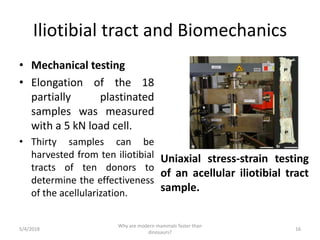
• Mechanical testing
• Elongation of the 18
partially plastinated
samples was measured
with a 5 kN load cell.
• Thirty samples can be
harvested from ten iliotibial
tracts of ten donors to
determine the effectiveness
of the acellularization.
5/4/2018
Why are modern mammals faster than
dinosaurs?
16
Uniaxial stress-strain testing
of an acellular iliotibial tract
sample.
Iliotibial Tract Cont’D
• Acellular scaffolds are increasingly used for the surgical
repair of tendon injury and ligament tears.
• Eighteen human iliotibial tract samples from nine body
donors using sodium dodecyl sulphate (SDS)
• Acellular scaffolds are increasingly applied in soft tissue
reconstruction or in the surgical treatment of
musculoskeletal system injury
5/4/2018
Why are modern mammals faster than
dinosaurs?
17
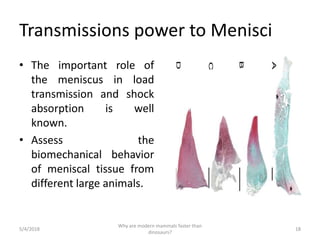
Transmissions power to Menisci
• The important role of
the meniscus in load
transmission and shock
absorption is well
known.
• Assess the
biomechanical behavior
of meniscal tissue from
different large animals.
5/4/2018
Why are modern mammals faster than
dinosaurs?
18
REFERENCE
• Burnfield J. M. & Perry J. (2010). Gait analysis: normal
and pathological function.
• Wren T. A., Gorton G. E. 3rd, Ounpuu S. & Tucker C. A.
(2011). Efficacy of clinical gait analysis: A systematic
review. Gait Posture 34, 149–153.
• Barber FA, Aziz-Jacobo J (2009) Biomechanical testing
of commercially available soft-tissue augmentation
materials. Arthroscopy 25 (11): 1233–1239.
• Branch JP (2011) A tendon graft weave using an
acellular dermal matrix for repair of the Achilles
tendon and other foot and ankle tendons. J Foot Ankle
Surg 50 (2): 257–265.
5/4/2018
Why are modern mammals faster than
dinosaurs?
19
THANKS
5/4/2018
Why are modern mammals faster than
dinosaurs?
20

Biomechanics 1

  • 1.
    BIOMECHANICS OBAJE GODWIN SUNDAY +2348068638121, obaje199@gmail.com FUNAI,Nigeria 5/4/2018 1 Why are modern mammals faster than dinosaurs?
  • 2.
    BIOMECHANICS • Biomechanics -Its simply mechanics applied to living systems - principally the human body or animals systems. It refers to study of Engg. and physics concerns with forces. • Your lips are doing most of the work. … Whistling is mostly forcing air from your lungs through your trachea out of your mouth. • The hip is a ball and socket style synovial joint, much more so than the gleno-humeral joint of the shoulder girdle in that the encompassing socket of the acetabular rim fixed. 5/4/2018 2 Why are modern mammals faster than dinosaurs?
  • 3.
    Biomechanics Cont’D • 2main components one needs to learn biomechanics. • Understanding of human anatomy is useful at least with regards to learning about human biomechanics. • For instance, opens up airway passages and relieves stress put on body when in proper posture compared to improper posture, such as a slumped back, rounded shoulders. • The physiologic activities involving human body fluids. 5/4/2018 3 Why are modern mammals faster than dinosaurs?
  • 4.
    FIELD OF STUDY •In india, biomechanics is a separate elective course offered as part of mechanical or biomedical engineering. • if you are planning on getting a degree in biomechanics with the hope of serving your community in a health centered orientation then it is wise especially at postgraduate levels. • Some of the trends in the field are fluid-structure interaction (FSI), growth, stimulation and remodeling, optimization. 5/4/2018 4 Why are modern mammals faster than dinosaurs?
  • 5.
    Field Cont’D • Ifyou are interested in the circulatory system of human body, you can touch on the fluid mechanics on biological view e.g microfluidic devices. 5/4/2018 5 Why are modern mammals faster than dinosaurs?
  • 6.
    BOOKS Fundamentals of Biomechanics: Equilibrium, Motion,and Deformation, Nihat Ozkaya and Margareta Nordin. Biomechanics and Motor Control of Human Movement, David WinterBasic Biomechanics, Susan J. Hall. Basic Biomechanics of the Musculoskeletal System, Margareta Nordin and Victor Frankel. 5/4/2018 6 Why are modern mammals faster than dinosaurs?
  • 7.
    Biomechanics of HipJoint • The hip is a ball and socket style synovial joint. • It is like the gleno- humeral joint of the shoulder girdle in that the encompassing socket. Here, the acetabular rim cups the femoral head. The labrum further extends the cupping of the5/4/2018 7 Why are modern mammals faster than dinosaurs?
  • 8.
    Hip Joint Cont’D •This translates to an increase in structural stability. This is largely due to the difference in forces experienced between the two joints, and their requirements on the "locomotion-stabilization continuum“. • A joint located in the lower body like the hip will have an increased need to be structurally stable. This is because of the constant stresses of gait combined with disproportionately larger forces exhibited during locomotion. • Motion occurred or occurring in one of the three planes…sagittal plane, transverse and coronal 5/4/2018 8 Why are modern mammals faster than dinosaurs?
  • 9.
    Hip joint Cont’D •Sagittal plane motions are called flexion (femoral shaft moving anterior/superior forms) and extension (femoral shaft moving anterior/superior) and operate around an axis running horizontally medial-lateral • The coronal (frontal) plane motions of abduction (leg away from midline) and adduction (leg towards midline) operate around an axis that runs front-back, anterior-posterior. • The transverse plane motions of internal (anterior femur moving medially and posterior) and external (anterior femur moving laterally and posterior) operate around a vertical, superior-inferior axis.5/4/2018 9 Why are modern mammals faster than dinosaurs?
  • 10.
    Hip joint Cont’D •To understands fully hip biomechanics……. the biomechanics of the lower body in entity. • Pronation Is motions that contribute to eccentric, isometric, and concentric contractions as controlled collapse of the body to gravity. • At the foot, is inversion of the forefoot, eversion of the rear foot (calcaneus/heel), dorsiflexion of the talo- crural (ankle) tibial internal rotation in space which amounts to internal rotation at the talo-crural joint. 5/4/2018 10 Why are modern mammals faster than dinosaurs?
  • 11.
    Hip joint Cont’D •At the knee the tibia is still internally rotating in space as the knee is flexing; however, this motion can be possibly overtaken by the motion at the femoral condyles, which can amount to a net tibial external rotation when looking at joint motion from a purely arthrokinematic standpoint. • Importantly, at the hip joint, we see a combination of flexion, adduction, and internal rotation. 5/4/2018 11 Why are modern mammals faster than dinosaurs?
  • 12.
    Hip joint Cont’D Supinationmotions also: concentric, eccentric and isometric contractions of muscles) to gravity. • At the foot eversion of the forefoot, inversion of the rear foot, extension of the talo-crural joint (plantar "flexion") , external rotation of the tibia and rotation of the tibia on the talus at the talo-crural joint. • The knee extends to a locked position, leading to extension of the hip, along with abduction and external rotation of the femur in relation to the pelvis. The knee could be potentially in a position of internal rotation if the amount of hip external rotation surpasses the amount of tibia external rotation.5/4/2018 12 Why are modern mammals faster than dinosaurs?
  • 13.
    Hip joint Cont’D •Gaits, supination and pronation cause the hip to experience force traveling in the vector of the femoral shaft. Thus, lateral hip stabilization is paramount. • The structural stability of hip is by arthroanatomy of the hip. • Hip muscles which include but are not limited to gluteus medius, gluteus minimus, gluteus maximus, tensor fascia latae (TFL), addutors brevis, longus, and magnus and pectineus. 5/4/2018 13 Why are modern mammals faster than dinosaurs?
  • 14.
    Hip joint Cont’D •Gracilis, psoas major, iliacus, rectus femoris, sartorius, semitendinosus, semimembranosus, biceps femoris and piriformis. • Gemellus inferior, gemellus superior, quadratus femoris, obturator internus and obturator externus. 5/4/2018 14 Why are modern mammals faster than dinosaurs?
  • 15.
    Hip Joint Centre(HJC) • Clinical gait analysis incorporating three-dimensional motion analysis plays a key role in planning surgical treatments in people with gait disability. • The position of the Hip Joint Centre (HJC) within the pelvis is thus critical to ensure accurate data interpretation. • The location of the hip joint centres (HJC) is an important part of biomechanics modelling and has repercussion in accuracy and subsequent interpretation of gait data. 5/4/2018 15 Why are modern mammals faster than dinosaurs?
  • 16.
    Iliotibial tract andBiomechanics • Mechanical testing • Elongation of the 18 partially plastinated samples was measured with a 5 kN load cell. • Thirty samples can be harvested from ten iliotibial tracts of ten donors to determine the effectiveness of the acellularization. 5/4/2018 Why are modern mammals faster than dinosaurs? 16 Uniaxial stress-strain testing of an acellular iliotibial tract sample.
  • 17.
    Iliotibial Tract Cont’D •Acellular scaffolds are increasingly used for the surgical repair of tendon injury and ligament tears. • Eighteen human iliotibial tract samples from nine body donors using sodium dodecyl sulphate (SDS) • Acellular scaffolds are increasingly applied in soft tissue reconstruction or in the surgical treatment of musculoskeletal system injury 5/4/2018 Why are modern mammals faster than dinosaurs? 17
  • 18.
    Transmissions power toMenisci • The important role of the meniscus in load transmission and shock absorption is well known. • Assess the biomechanical behavior of meniscal tissue from different large animals. 5/4/2018 Why are modern mammals faster than dinosaurs? 18
  • 19.
    REFERENCE • Burnfield J.M. & Perry J. (2010). Gait analysis: normal and pathological function. • Wren T. A., Gorton G. E. 3rd, Ounpuu S. & Tucker C. A. (2011). Efficacy of clinical gait analysis: A systematic review. Gait Posture 34, 149–153. • Barber FA, Aziz-Jacobo J (2009) Biomechanical testing of commercially available soft-tissue augmentation materials. Arthroscopy 25 (11): 1233–1239. • Branch JP (2011) A tendon graft weave using an acellular dermal matrix for repair of the Achilles tendon and other foot and ankle tendons. J Foot Ankle Surg 50 (2): 257–265. 5/4/2018 Why are modern mammals faster than dinosaurs? 19
  • 20.
    THANKS 5/4/2018 Why are modernmammals faster than dinosaurs? 20