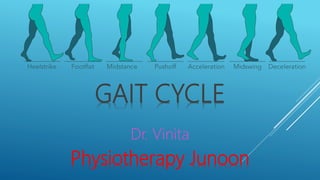
GAIT CYCLE
Dr. Vinita
Physiotherapy Junoon
1. INITIAL CONTACT
2. OPPOSITE TOE OFF
3. HEEL RISE
4. OPPOSITE INITIAL CONTACT
5. TOE OFF
6. FEET ADJACENT
7. TIBIA VERTICAL
(1. INITIAL CONTACT).
SUBDIVISION
1. LOADING RESPONSE
2. MID-STANCE
3. TERMINAL STANCE
4. PRE-SWING.
 The swing phase lasts from toe off to the next initial contact. It is
subdivided
 into:
 1. Initial swing
 2. Mid-swing
 3. Terminal swing.
THIS DEFINITION OF A ‘STRIDE’, CONSISTING OF ONE
‘STEP’ BY EACH FOOT, BREAKS
DOWN IN SOME PATHOLOGICAL GAITS, IN WHICH ONE
FOOT MAKES A SERIES OF ‘HOPPING’
MOVEMENTS WHILE THE OTHER IS IN THE AIR (WALL ET
AL., 1987).
The walking base(also known as the ‘stride width’ or
‘base of support’) is the
side-to-side distance between the line of the two feet,
usually measured at the
midpoint of the back of the heel but sometimes below
the center of the ankle joint.
 The toe out (or, less commonly, toe in) is the angle in degrees between
the
 direction of progression and a reference line on the sole of the foot.
The
 reference line varies from one study to another; it may be defined
anatomically
 but is commonly the midline of the foot, as judged by eye.
Muscle activity during the gait cycle
The movement pattern that we observe in the lower limbs during walking results
from the interaction between external forces (joint reaction and ground reaction)
and internal forces (produced by muscles and other soft tissue). Knowledge of
the ground reaction force is especially helpful to therapists who must understand
how muscle activity and timing contributes to stability and propulsion.
Muscle activity is typically studied using electromyography (EMG). EMG records
differ between individuals, and differ for a single individual according to variables
such as velocity. The following summary draws on the findings of reliable
investigators.
Loading Response (0 to 12 percent of gait cycle)
This is a period of extensive muscle activity. The ankle dorsiflexors act eccentrically to prevent slapping
of the foot on the ground. The quadriceps act eccentrically to control knee flexion. Hip flexion is
controlled by isometric action of the hamstrings (primarily biceps femoris) and gluteus maximus
(primarily its lower portion).
In the frontal plane, activity in the hip abductors, tensor fascia lata, and upper portions of the gluteus
maximus control drop of the contralateral pelvis, which is relative hip adduction. While activity in the
the anterior gluteals (gluteus medius and minimus) might appear eccentric, these muscles
simultaneously move the hip joint into internal rotation. In a closed chain, this hip rotation causes the
pelvis to rotate forward on the opposite side. Thus, gluteus medius activity may be nearly isometric.
Also contributing to both internal rotation and extension of the hip joint are the muscles of the
adductor group.
The erector spinae are also active during loading response. Their activity during this period has been
characterized classically as a mechanism to stabilize the trunk during weight transfer, and to prevent
its forward flexion during the rapid slowing of forward movement which occurs at initial contact.
Recent theory (Gracovetsky 1988) attributes to the paraspinal muscles a more active role in producing
important trunk and pelvic rotation.
Midstance (12 to 31 percent of gait cycle)
As the body moves over the stance limb, activity in the foot's
intrinsic muscles (which are primarily subtalar supinators)
activate to convert the foot into an increasingly rigid
structure. This supination force is augmented by activity in
the ankle plantar flexors, which act eccentrically to control
closed chain ankle dorsiflexion in the form of tibial
advancement over the stable foot.
The quadriceps act concentrically to initiate knee extension,
and the hip abductors continue their activity, becoming
isometric as they halt contralateral pelvic drop.
Why Gait Analysis is Important
 There are many reasons why gait analysis is important in both clinical and research environments.
• Injury Prevention: Identify asymmetries in an un-symptomatic patient, which might not be detected until
the patient presents with an injury.
• Post Treatment Confirmation: Feel confident that your treatments are making a positive change in your
patient’s gait with pre/post treatment or surgery assessments.
•Sports Performance: By understanding how an athlete is moving, it can
help optimize their performance and build customized training plans to
further improve athletic performance.
•Evaluating effects of different conditions: Researchers can evaluate the
effects of different types of footwear, terrains, floors and many other
conditions effect the way a person walks. By studying the effects of
different conditions, footwear, workplace environments and countless
other types of research we can see improvements in the function of
human gait.

GAIT CYCLE

  • 1.
  • 3.
    1. INITIAL CONTACT 2.OPPOSITE TOE OFF 3. HEEL RISE 4. OPPOSITE INITIAL CONTACT 5. TOE OFF 6. FEET ADJACENT 7. TIBIA VERTICAL (1. INITIAL CONTACT).
  • 5.
    SUBDIVISION 1. LOADING RESPONSE 2.MID-STANCE 3. TERMINAL STANCE 4. PRE-SWING.
  • 6.
     The swingphase lasts from toe off to the next initial contact. It is subdivided  into:  1. Initial swing  2. Mid-swing  3. Terminal swing.
  • 7.
    THIS DEFINITION OFA ‘STRIDE’, CONSISTING OF ONE ‘STEP’ BY EACH FOOT, BREAKS DOWN IN SOME PATHOLOGICAL GAITS, IN WHICH ONE FOOT MAKES A SERIES OF ‘HOPPING’ MOVEMENTS WHILE THE OTHER IS IN THE AIR (WALL ET AL., 1987).
  • 8.
    The walking base(alsoknown as the ‘stride width’ or ‘base of support’) is the side-to-side distance between the line of the two feet, usually measured at the midpoint of the back of the heel but sometimes below the center of the ankle joint.
  • 12.
     The toeout (or, less commonly, toe in) is the angle in degrees between the  direction of progression and a reference line on the sole of the foot. The  reference line varies from one study to another; it may be defined anatomically  but is commonly the midline of the foot, as judged by eye.
  • 26.
    Muscle activity duringthe gait cycle The movement pattern that we observe in the lower limbs during walking results from the interaction between external forces (joint reaction and ground reaction) and internal forces (produced by muscles and other soft tissue). Knowledge of the ground reaction force is especially helpful to therapists who must understand how muscle activity and timing contributes to stability and propulsion. Muscle activity is typically studied using electromyography (EMG). EMG records differ between individuals, and differ for a single individual according to variables such as velocity. The following summary draws on the findings of reliable investigators.
  • 27.
    Loading Response (0to 12 percent of gait cycle) This is a period of extensive muscle activity. The ankle dorsiflexors act eccentrically to prevent slapping of the foot on the ground. The quadriceps act eccentrically to control knee flexion. Hip flexion is controlled by isometric action of the hamstrings (primarily biceps femoris) and gluteus maximus (primarily its lower portion). In the frontal plane, activity in the hip abductors, tensor fascia lata, and upper portions of the gluteus maximus control drop of the contralateral pelvis, which is relative hip adduction. While activity in the the anterior gluteals (gluteus medius and minimus) might appear eccentric, these muscles simultaneously move the hip joint into internal rotation. In a closed chain, this hip rotation causes the pelvis to rotate forward on the opposite side. Thus, gluteus medius activity may be nearly isometric. Also contributing to both internal rotation and extension of the hip joint are the muscles of the adductor group. The erector spinae are also active during loading response. Their activity during this period has been characterized classically as a mechanism to stabilize the trunk during weight transfer, and to prevent its forward flexion during the rapid slowing of forward movement which occurs at initial contact. Recent theory (Gracovetsky 1988) attributes to the paraspinal muscles a more active role in producing important trunk and pelvic rotation.
  • 28.
    Midstance (12 to31 percent of gait cycle) As the body moves over the stance limb, activity in the foot's intrinsic muscles (which are primarily subtalar supinators) activate to convert the foot into an increasingly rigid structure. This supination force is augmented by activity in the ankle plantar flexors, which act eccentrically to control closed chain ankle dorsiflexion in the form of tibial advancement over the stable foot. The quadriceps act concentrically to initiate knee extension, and the hip abductors continue their activity, becoming isometric as they halt contralateral pelvic drop.
  • 30.
    Why Gait Analysisis Important  There are many reasons why gait analysis is important in both clinical and research environments. • Injury Prevention: Identify asymmetries in an un-symptomatic patient, which might not be detected until the patient presents with an injury. • Post Treatment Confirmation: Feel confident that your treatments are making a positive change in your patient’s gait with pre/post treatment or surgery assessments.
  • 31.
    •Sports Performance: Byunderstanding how an athlete is moving, it can help optimize their performance and build customized training plans to further improve athletic performance. •Evaluating effects of different conditions: Researchers can evaluate the effects of different types of footwear, terrains, floors and many other conditions effect the way a person walks. By studying the effects of different conditions, footwear, workplace environments and countless other types of research we can see improvements in the function of human gait.