
PLASTINATION
OBAJE Godwin Sunday
+2348068638121,
obaje199@gmail.com
INTRODUCTION
Decay is a vital process in nature but an impediment to
morphological studies, teaching, and research.
This is particularly true for biological specimens that
shrink considerably when exposed to normal atmospheric
conditions.
Therefore their preservation is necessary.
PLASTINATION
The study of gross specimens is an integral part in
learning oral pathology and medical educations.
Unfortunately their storage and handling using traditional
formalin is posed with great difficulties.
Plastination study forms gross specimens using resin
polymers.
DEFINITION OF PLASTINATION
Plastination is the method of long term preservation of the
biological tissues with completely visible surface and high
durability.
It was developed by Dr. Gunther von Hagens in 1978 at
the Heidelberg University in Germany.
DEFINITION CONT’D
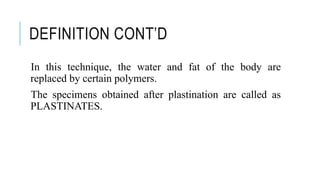
In this technique, the water and fat of the body are
replaced by certain polymers.
The specimens obtained after plastination are called as
PLASTINATES.
DEFINITION OF PLASTINATION
CONT’D
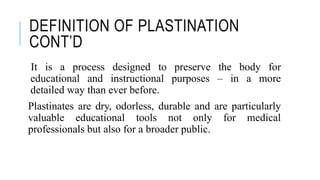
It is a process designed to preserve the body for
educational and instructional purposes – in a more
detailed way than ever before.
Plastinates are dry, odorless, durable and are particularly
valuable educational tools not only for medical
professionals but also for a broader public.
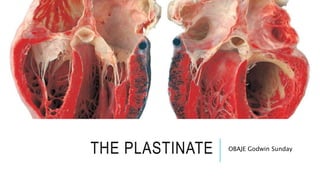
THE PLASTINATE OBAJE Godwin Sunday
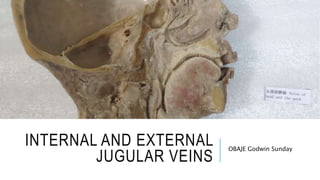
INTERNAL AND EXTERNAL
JUGULAR VEINS
OBAJE Godwin Sunday
REQUIREMENTS
Primarily, it’s required:
A lab equipped with fire extinguishers, explosive proof
lighting system and a freezer motor.
The room should have multiple extraction points
Equipped for possible spillages.
Other materials into 2 groups:
A. Chemicals and B. Equipments
INDONESIAN
RESEARCHERS IN THE
MARKET FOR
PLASTINATES
OBAJE Godwin Sunday
A. CHEMICALS ARE:
Formalin (≤ 10%), Acetone or methyl alcohol, Silicone or
epoxy polymer, Biodur S3 or S6 (hardener), Water.
B. Equipment needed:
Containers depending on size of specimen, Deep freezer,
motor system to create vaccum and pressure gauge.
BEFORE UNDERGOING THE
PROCEDURE TO FORM PLASTINATES.
Hollow organs need to be flushed, cleaned and then fixed
in a dilated position. This is because, dilation of hollow
organs will increase the flexibility of the organs due to the
thinner wall.
Intestinal specimens may be opened to remove ingest,
sutured closed and then dilated. Appropriate sized
cannulas and intravascular injection of colored silicone,
gelatin, latex and epoxy may be used to highlight vessels
PROCEDURE OF PLASTINATION
Four steps of plastination:
Fixation
Dehydration
Forced impregnation in a vacuum
Hardening or Curing
FIXATION
1-4 Days
Under fixation, the body is embalmed, usually in a
formaldehyde solution in order to prevent the
decomposition of the body.
Usually 10 % formaldehyde solution may be used as a
fixative, lower percentage formalin solutions may produce
less bleaching of the specimen.
FIXATION CONT’D
Minimal fixation with low percentage of formalin and
short time duration (1-2 days) will yield a specimen which
is more flexible and more natural looking.
DEHYDRATION
4-5 weeks
Equipment: Deep freezer with containers
Dehydration removes the specimen fluid at -25°C.
In this step, tissue fluid is replaced with an organic
solvent i.e acetone.
DEHYDRATION CONT’D
First, the specimens are washed in running tap water for
two days with the aim of neutralizing the
formalin/preservative fumes during dissection.
Tissue water and lipids were removed by subjecting the
specimens to at least three changes of acetone bath at one-
week interval in every change.
DEHYDRATION CONT’D
The specimens were turned/agitated at least once a day so
as to ensure maximum action of the acetone on the
specimens.
Acetone turns yellow when fats are removed.
Degreasing would be considered complete when the
acetone bath remains clear.
DEHYDRATION CONT’D
Acetone is used in most cases because, acetone also
serves as the intermediary solvent during the next step of
forced impregnation and it can be recycled.
Acetone also helps in removal of fat at room temperature
of 20° to 25°C.
An acetone amount of 10 times the specimen weight is
best for good results.
FORCED IMPREGNATION IN
VACCUM
Equipments:
Deep freezer (explosion proof or motor and compressor
removed and placed in a different room); Vacuum
chamber,
Vacuum pump with pressure gauge (Vacuum is complete
when the pressure is around 5 mm Hg)
FORCED IMPREGNATION IN
VACCUM CONT’D
This is the central step, where the intermediary solvent
(acetone) is replaced with a curable polymer such as
silicone, epoxy resin, polyester resin, etc under applied
vaccum.
The dehydrated specimen is placed in a bath containing
liquid polymer. After some days of immersion, vacuum is
applied to it.
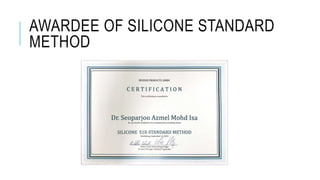
AWARDEE OF SILICONE STANDARD
METHOD
FORCED IMPREGNATION IN
VACCUM CONT’D
Vacuum is increased gradually to boil the intermediary
solvent (acetone), which has a lower boiling point (+56 °
C) out of the specimen.
Impregnation is monitored by watching the formation of
bubble on the surface of the mixture. Absence of bubbles
indicates completion of the procedure.
FORCED IMPREGNATION IN
VACCUM CONT’D
Structure of hydroxyl- terminated polydimethyl siloxane.
[Si - O] represents a basic silicone molecule.
HARDENING OR CURING
4-5 weeks
Equipment: plastic box, stretch foil, membrane
(aquarium) pump.
Finally, the polymer inside the specimen has to be cured
(hardened). This is achieved by exposing the impregnated
specimen to a hardener which can be liquid (S3) or
gaseous (S6) in nature .
HARDENING OR CURING CONT’D
S6 is a liquid that vaporizes at room temperature and
causes fast curing.
The impregnated specimen and a bowl filled with curing
agent is placed in a tightly closed chamber for several
weeks.
DISADVANTAGES OF PLASTINATION
Costly procedure
Time consuming
Requires skilled technical support to carry out the
procedures and in handling the equipment.
Prepared specimen requires handling with care.
Chemicals used, such as acetone are highly inflammable
and should be used in places equipped with fire
extinguishing measures.
IN CONCLUSION
Plastination, is superior to those preserved in formalin,
both in terms of user acceptance and ease of maintenance.
Although it appears time consuming, plastination is
recommended to any oral pathology department for
maintenance of student museum, for preservation of rare
specimens, or for postgraduate use.
THANKS FOR LISTENING
OBAJE Godwin Sunday,
Department of Anatomy,
Faculty of Basic Medical
Sciences, Alex Ekwueme
Federal University Ndufu
Alike

Plastination by OBAJE Godwin Sunday

  • 1.
  • 2.
    INTRODUCTION Decay is avital process in nature but an impediment to morphological studies, teaching, and research. This is particularly true for biological specimens that shrink considerably when exposed to normal atmospheric conditions. Therefore their preservation is necessary.
  • 3.
    PLASTINATION The study ofgross specimens is an integral part in learning oral pathology and medical educations. Unfortunately their storage and handling using traditional formalin is posed with great difficulties. Plastination study forms gross specimens using resin polymers.
  • 4.
    DEFINITION OF PLASTINATION Plastinationis the method of long term preservation of the biological tissues with completely visible surface and high durability. It was developed by Dr. Gunther von Hagens in 1978 at the Heidelberg University in Germany.
  • 5.
    DEFINITION CONT’D In thistechnique, the water and fat of the body are replaced by certain polymers. The specimens obtained after plastination are called as PLASTINATES.
  • 6.
    DEFINITION OF PLASTINATION CONT’D Itis a process designed to preserve the body for educational and instructional purposes – in a more detailed way than ever before. Plastinates are dry, odorless, durable and are particularly valuable educational tools not only for medical professionals but also for a broader public.
  • 7.
    THE PLASTINATE OBAJEGodwin Sunday
  • 8.
    INTERNAL AND EXTERNAL JUGULARVEINS OBAJE Godwin Sunday
  • 9.
    REQUIREMENTS Primarily, it’s required: Alab equipped with fire extinguishers, explosive proof lighting system and a freezer motor. The room should have multiple extraction points Equipped for possible spillages. Other materials into 2 groups: A. Chemicals and B. Equipments
  • 10.
    INDONESIAN RESEARCHERS IN THE MARKETFOR PLASTINATES OBAJE Godwin Sunday
  • 11.
    A. CHEMICALS ARE: Formalin(≤ 10%), Acetone or methyl alcohol, Silicone or epoxy polymer, Biodur S3 or S6 (hardener), Water. B. Equipment needed: Containers depending on size of specimen, Deep freezer, motor system to create vaccum and pressure gauge.
  • 12.
    BEFORE UNDERGOING THE PROCEDURETO FORM PLASTINATES. Hollow organs need to be flushed, cleaned and then fixed in a dilated position. This is because, dilation of hollow organs will increase the flexibility of the organs due to the thinner wall. Intestinal specimens may be opened to remove ingest, sutured closed and then dilated. Appropriate sized cannulas and intravascular injection of colored silicone, gelatin, latex and epoxy may be used to highlight vessels
  • 13.
    PROCEDURE OF PLASTINATION Foursteps of plastination: Fixation Dehydration Forced impregnation in a vacuum Hardening or Curing
  • 14.
    FIXATION 1-4 Days Under fixation,the body is embalmed, usually in a formaldehyde solution in order to prevent the decomposition of the body. Usually 10 % formaldehyde solution may be used as a fixative, lower percentage formalin solutions may produce less bleaching of the specimen.
  • 15.
    FIXATION CONT’D Minimal fixationwith low percentage of formalin and short time duration (1-2 days) will yield a specimen which is more flexible and more natural looking.
  • 16.
    DEHYDRATION 4-5 weeks Equipment: Deepfreezer with containers Dehydration removes the specimen fluid at -25°C. In this step, tissue fluid is replaced with an organic solvent i.e acetone.
  • 17.
    DEHYDRATION CONT’D First, thespecimens are washed in running tap water for two days with the aim of neutralizing the formalin/preservative fumes during dissection. Tissue water and lipids were removed by subjecting the specimens to at least three changes of acetone bath at one- week interval in every change.
  • 18.
    DEHYDRATION CONT’D The specimenswere turned/agitated at least once a day so as to ensure maximum action of the acetone on the specimens. Acetone turns yellow when fats are removed. Degreasing would be considered complete when the acetone bath remains clear.
  • 19.
    DEHYDRATION CONT’D Acetone isused in most cases because, acetone also serves as the intermediary solvent during the next step of forced impregnation and it can be recycled. Acetone also helps in removal of fat at room temperature of 20° to 25°C. An acetone amount of 10 times the specimen weight is best for good results.
  • 20.
    FORCED IMPREGNATION IN VACCUM Equipments: Deepfreezer (explosion proof or motor and compressor removed and placed in a different room); Vacuum chamber, Vacuum pump with pressure gauge (Vacuum is complete when the pressure is around 5 mm Hg)
  • 21.
    FORCED IMPREGNATION IN VACCUMCONT’D This is the central step, where the intermediary solvent (acetone) is replaced with a curable polymer such as silicone, epoxy resin, polyester resin, etc under applied vaccum. The dehydrated specimen is placed in a bath containing liquid polymer. After some days of immersion, vacuum is applied to it.
  • 22.
    AWARDEE OF SILICONESTANDARD METHOD
  • 23.
    FORCED IMPREGNATION IN VACCUMCONT’D Vacuum is increased gradually to boil the intermediary solvent (acetone), which has a lower boiling point (+56 ° C) out of the specimen. Impregnation is monitored by watching the formation of bubble on the surface of the mixture. Absence of bubbles indicates completion of the procedure.
  • 24.
    FORCED IMPREGNATION IN VACCUMCONT’D Structure of hydroxyl- terminated polydimethyl siloxane. [Si - O] represents a basic silicone molecule.
  • 25.
    HARDENING OR CURING 4-5weeks Equipment: plastic box, stretch foil, membrane (aquarium) pump. Finally, the polymer inside the specimen has to be cured (hardened). This is achieved by exposing the impregnated specimen to a hardener which can be liquid (S3) or gaseous (S6) in nature .
  • 26.
    HARDENING OR CURINGCONT’D S6 is a liquid that vaporizes at room temperature and causes fast curing. The impregnated specimen and a bowl filled with curing agent is placed in a tightly closed chamber for several weeks.
  • 27.
    DISADVANTAGES OF PLASTINATION Costlyprocedure Time consuming Requires skilled technical support to carry out the procedures and in handling the equipment. Prepared specimen requires handling with care. Chemicals used, such as acetone are highly inflammable and should be used in places equipped with fire extinguishing measures.
  • 28.
    IN CONCLUSION Plastination, issuperior to those preserved in formalin, both in terms of user acceptance and ease of maintenance. Although it appears time consuming, plastination is recommended to any oral pathology department for maintenance of student museum, for preservation of rare specimens, or for postgraduate use.
  • 29.
    THANKS FOR LISTENING OBAJEGodwin Sunday, Department of Anatomy, Faculty of Basic Medical Sciences, Alex Ekwueme Federal University Ndufu Alike