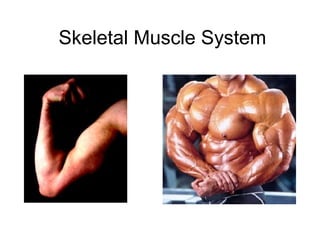
Skeletal Muscle System
Learning Outcomes
•   Characteristic of Muscle Tissue
•   Function of Skeletal Muscles
•   Types of Muscle Fibres
•   Muscle Name
•   Modes of Muscle Contraction
•   Benefits of Strength Training
•   Ways to train your Muscles
•   Types of Stretching
•   How to stretch your muscles
Characteristics of Muscle
               Tissue
•   Excitability
•   Contractility
•   Extensibility
•   Elasticity
Excitability
• A process where muscle tissues in our
  body send signals to the brain and the
  brain tells the body to move out
• All this happen within a fraction of a
  second
Contractility & Extensibility
• Our muscle work by contraction
• After muscle contracts, it must extend to
  release energy which it had stored
• Hence, muscles work in pair
Elasticity
• If muscles were not
  elastic, we would
  have been longer
  and taller with
  each extension.
• Elastic to a certain
  limit
• Beyond which it
  will break
Function of Skeletal Muscles
• Produce Movement
• Maintain posture
• Maintain body temperature
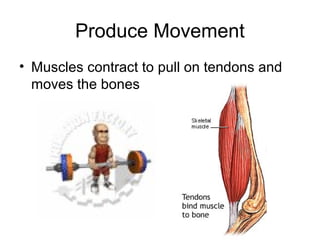
Produce Movement
• Muscles contract to pull on tendons and
  moves the bones
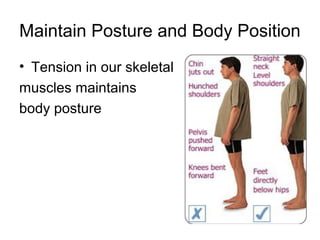
Maintain Posture and Body Position
• Tension in our skeletal
muscles maintains
body posture
Maintain body temperature
• Muscle contraction require energy
• Heat release by working muscles keep our
  body temperature in the range for normal
  functioning
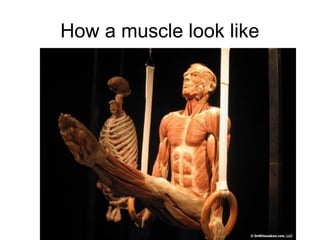
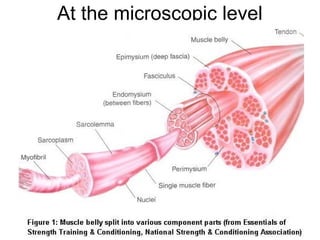
How a muscle look like
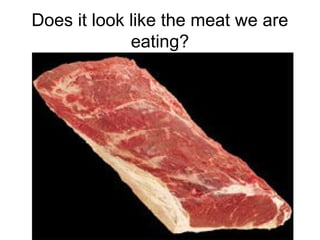
Does it look like the meat we are
             eating?
At the microscopic level
Watch the video on
muscle composition n contraction
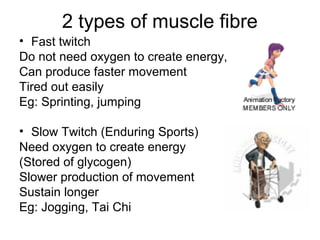
2 types of muscle fibre
• Fast twitch
Do not need oxygen to create energy,
Can produce faster movement
Tired out easily
Eg: Sprinting, jumping

• Slow Twitch (Enduring Sports)
Need oxygen to create energy
(Stored of glycogen)
Slower production of movement
Sustain longer
Eg: Jogging, Tai Chi
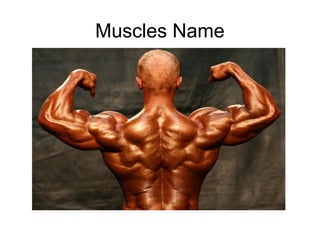
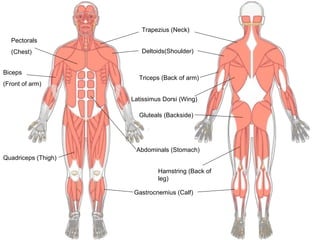
Muscles Name
Trapezius (Neck)
  Pectorals
  (Chest)               Deltoids(Shoulder)


Biceps
                       Triceps (Back of arm)
(Front of arm)

                     Latissimus Dorsi (Wing)

                       Gluteals (Backside)


                      Abdominals (Stomach)
Quadriceps (Thigh)

                              Hamstring (Back of
                              leg)

                      Gastrocnemius (Calf)
Modes of muscle contraction
• Concentric
• Eccentric
• Isometric
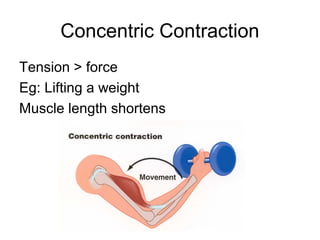
Concentric Contraction
Tension > force
Eg: Lifting a weight
Muscle length shortens
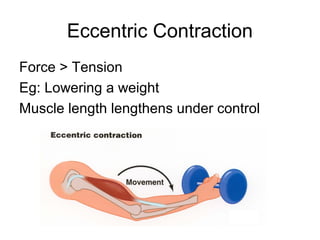
Eccentric Contraction
Force > Tension
Eg: Lowering a weight
Muscle length lengthens under control
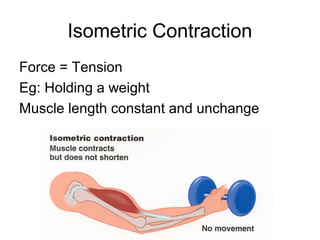
Isometric Contraction
Force = Tension
Eg: Holding a weight
Muscle length constant and unchange
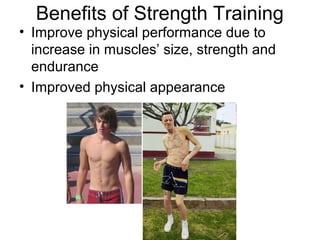
Benefits of Strength Training
• Improve physical performance due to
  increase in muscles’ size, strength and
  endurance
• Improved physical appearance
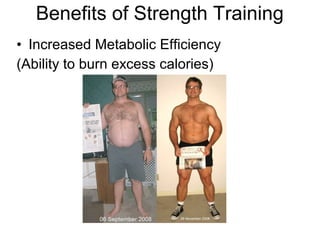
Benefits of Strength Training
• Increased Metabolic Efficiency
(Ability to burn excess calories)
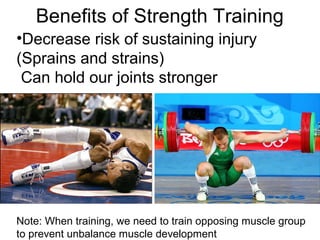
Benefits of Strength Training
•Decrease risk of sustaining injury
(Sprains and strains)
 Can hold our joints stronger


Note: When training, we need to train opposing muscle group
to prevent unbalance muscle development
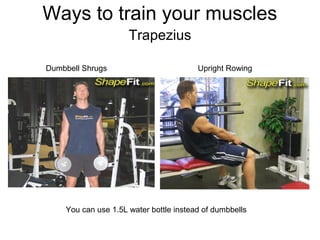
Ways to train your muscles
                     Trapezius

Dumbbell Shrugs                         Upright Rowing


    You can use 1.5L water bottle instead of dumbbells
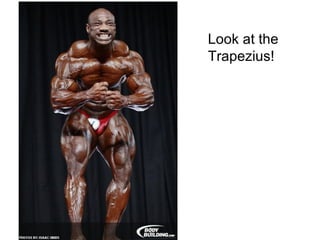
Look at the
Trapezius!
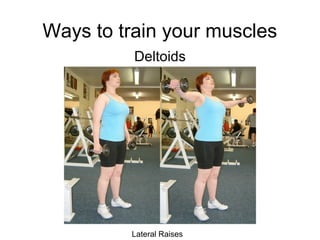
Ways to train your muscles
          Deltoids


         Lateral Raises
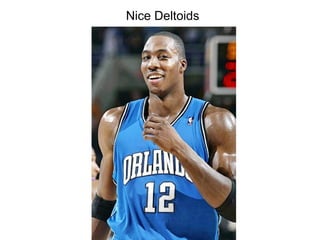
Nice Deltoids
Ways to train your muscles
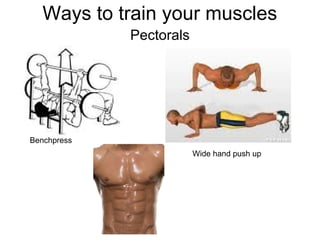
             Pectorals


Benchpress
                         Wide hand push up
Ways to train your muscles
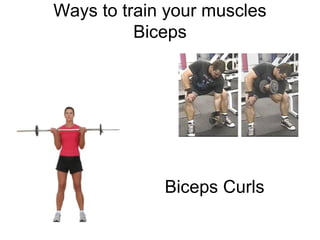
          Biceps


             Biceps Curls
Ways to train your muscles
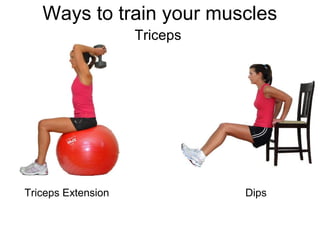
                    Triceps


Triceps Extension             Dips
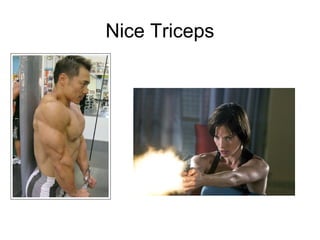
Nice Triceps
Ways to train your muscles
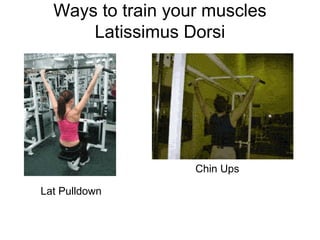
      Latissimus Dorsi


                   Chin Ups

Lat Pulldown
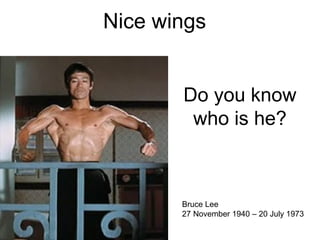
Nice wings


       Do you know
        who is he?


       Bruce Lee
       27 November 1940 – 20 July 1973
Ways to train your muscles
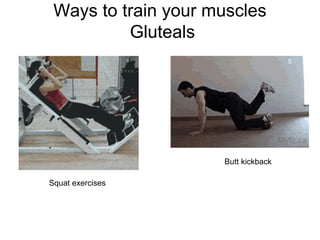
          Gluteals


                     Butt kickback

Squat exercises
Ways to train your muscles
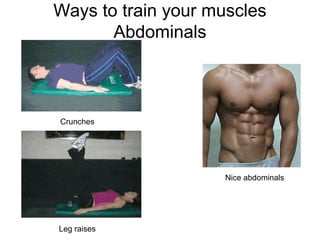
       Abdominals


Crunches


                    Nice abdominals


Leg raises
Ways to train your muscles
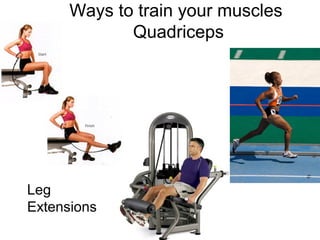
             Quadriceps


Leg
Extensions
Ways to train your muscles
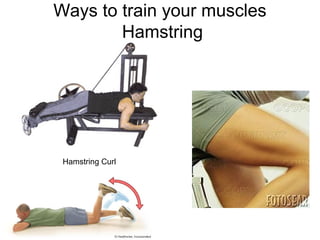
        Hamstring


 Hamstring Curl
Ways to train your muscles
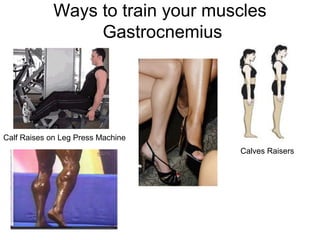
                  Gastrocnemius


Calf Raises on Leg Press Machine
                                   Calves Raisers
Why is stretching important?
• Increases flexibility and lessen risk of
  injuries
• Reduces stiffness after exercise
• ‘Shiok’ feeling
Types of stretching
•   Static
•   Passive
•   Dynamics
•   Ballistics
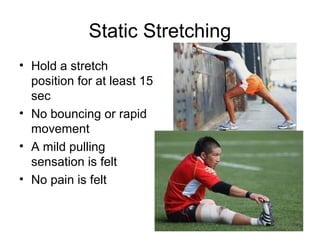
Static Stretching
• Hold a stretch
  position for at least 15
  sec
• No bouncing or rapid
  movement
• A mild pulling
  sensation is felt
• No pain is felt
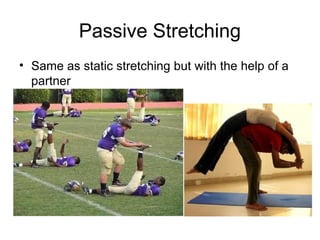
Passive Stretching
• Same as static stretching but with the help of a
  partner
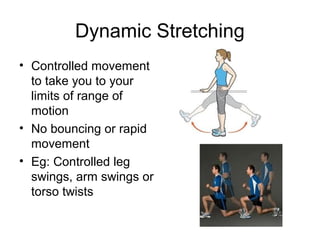
Dynamic Stretching
• Controlled movement
  to take you to your
  limits of range of
  motion
• No bouncing or rapid
  movement
• Eg: Controlled leg
  swings, arm swings or
  torso twists
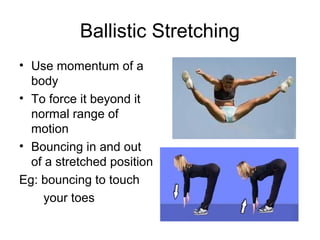
Ballistic Stretching
• Use momentum of a
  body
• To force it beyond it
  normal range of
  motion
• Bouncing in and out
  of a stretched position
Eg: bouncing to touch
     your toes
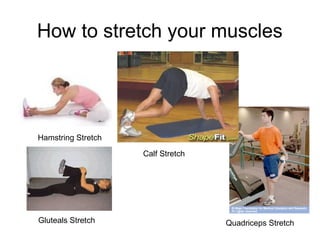
How to stretch your muscles


Hamstring Stretch

                    Calf Stretch


Gluteals Stretch                   Quadriceps Stretch
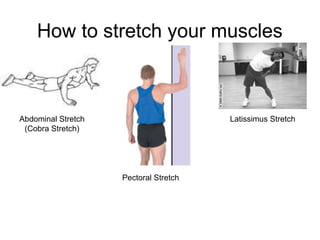
How to stretch your muscles


Abdominal Stretch                      Latissimus Stretch
 (Cobra Stretch)


                    Pectoral Stretch
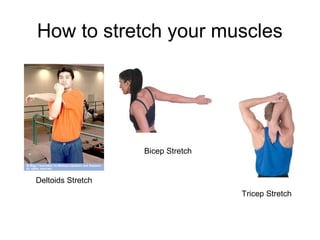
How to stretch your muscles


                   Bicep Stretch


Deltoids Stretch
                                   Tricep Stretch
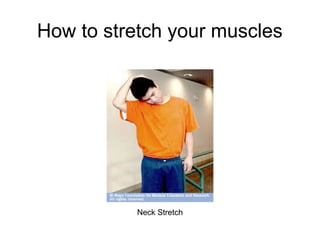
How to stretch your muscles


           Neck Stretch
Important
Always seek advice from your medical
doctor before you begin on any form of
         strenuous exercise

Muscular system

  • 1.
  • 2.
    Learning Outcomes • Characteristic of Muscle Tissue • Function of Skeletal Muscles • Types of Muscle Fibres • Muscle Name • Modes of Muscle Contraction • Benefits of Strength Training • Ways to train your Muscles • Types of Stretching • How to stretch your muscles
  • 3.
    Characteristics of Muscle Tissue • Excitability • Contractility • Extensibility • Elasticity
  • 4.
    Excitability • A processwhere muscle tissues in our body send signals to the brain and the brain tells the body to move out • All this happen within a fraction of a second
  • 5.
    Contractility & Extensibility •Our muscle work by contraction • After muscle contracts, it must extend to release energy which it had stored • Hence, muscles work in pair
  • 6.
    Elasticity • If muscleswere not elastic, we would have been longer and taller with each extension. • Elastic to a certain limit • Beyond which it will break
  • 7.
    Function of SkeletalMuscles • Produce Movement • Maintain posture • Maintain body temperature
  • 8.
    Produce Movement • Musclescontract to pull on tendons and moves the bones
  • 9.
    Maintain Posture andBody Position • Tension in our skeletal muscles maintains body posture
  • 10.
    Maintain body temperature •Muscle contraction require energy • Heat release by working muscles keep our body temperature in the range for normal functioning
  • 11.
    How a musclelook like
  • 12.
    Does it looklike the meat we are eating?
  • 13.
  • 14.
    Watch the videoon muscle composition n contraction
  • 15.
    2 types ofmuscle fibre • Fast twitch Do not need oxygen to create energy, Can produce faster movement Tired out easily Eg: Sprinting, jumping • Slow Twitch (Enduring Sports) Need oxygen to create energy (Stored of glycogen) Slower production of movement Sustain longer Eg: Jogging, Tai Chi
  • 16.
  • 17.
    Trapezius (Neck) Pectorals (Chest) Deltoids(Shoulder) Biceps Triceps (Back of arm) (Front of arm) Latissimus Dorsi (Wing) Gluteals (Backside) Abdominals (Stomach) Quadriceps (Thigh) Hamstring (Back of leg) Gastrocnemius (Calf)
  • 18.
    Modes of musclecontraction • Concentric • Eccentric • Isometric
  • 19.
    Concentric Contraction Tension >force Eg: Lifting a weight Muscle length shortens
  • 20.
    Eccentric Contraction Force >Tension Eg: Lowering a weight Muscle length lengthens under control
  • 21.
    Isometric Contraction Force =Tension Eg: Holding a weight Muscle length constant and unchange
  • 22.
    Benefits of StrengthTraining • Improve physical performance due to increase in muscles’ size, strength and endurance • Improved physical appearance
  • 23.
    Benefits of StrengthTraining • Increased Metabolic Efficiency (Ability to burn excess calories)
  • 24.
    Benefits of StrengthTraining •Decrease risk of sustaining injury (Sprains and strains) Can hold our joints stronger Note: When training, we need to train opposing muscle group to prevent unbalance muscle development
  • 25.
    Ways to trainyour muscles Trapezius Dumbbell Shrugs Upright Rowing You can use 1.5L water bottle instead of dumbbells
  • 26.
  • 27.
    Ways to trainyour muscles Deltoids Lateral Raises
  • 28.
  • 29.
    Ways to trainyour muscles Pectorals Benchpress Wide hand push up
  • 30.
    Ways to trainyour muscles Biceps Biceps Curls
  • 31.
    Ways to trainyour muscles Triceps Triceps Extension Dips
  • 32.
  • 33.
    Ways to trainyour muscles Latissimus Dorsi Chin Ups Lat Pulldown
  • 34.
    Nice wings Do you know who is he? Bruce Lee 27 November 1940 – 20 July 1973
  • 35.
    Ways to trainyour muscles Gluteals Butt kickback Squat exercises
  • 36.
    Ways to trainyour muscles Abdominals Crunches Nice abdominals Leg raises
  • 37.
    Ways to trainyour muscles Quadriceps Leg Extensions
  • 38.
    Ways to trainyour muscles Hamstring Hamstring Curl
  • 39.
    Ways to trainyour muscles Gastrocnemius Calf Raises on Leg Press Machine Calves Raisers
  • 40.
    Why is stretchingimportant? • Increases flexibility and lessen risk of injuries • Reduces stiffness after exercise • ‘Shiok’ feeling
  • 41.
    Types of stretching • Static • Passive • Dynamics • Ballistics
  • 42.
    Static Stretching • Holda stretch position for at least 15 sec • No bouncing or rapid movement • A mild pulling sensation is felt • No pain is felt
  • 43.
    Passive Stretching • Sameas static stretching but with the help of a partner
  • 44.
    Dynamic Stretching • Controlledmovement to take you to your limits of range of motion • No bouncing or rapid movement • Eg: Controlled leg swings, arm swings or torso twists
  • 45.
    Ballistic Stretching • Usemomentum of a body • To force it beyond it normal range of motion • Bouncing in and out of a stretched position Eg: bouncing to touch your toes
  • 46.
    How to stretchyour muscles Hamstring Stretch Calf Stretch Gluteals Stretch Quadriceps Stretch
  • 47.
    How to stretchyour muscles Abdominal Stretch Latissimus Stretch (Cobra Stretch) Pectoral Stretch
  • 48.
    How to stretchyour muscles Bicep Stretch Deltoids Stretch Tricep Stretch
  • 49.
    How to stretchyour muscles Neck Stretch
  • 50.
    Important Always seek advicefrom your medical doctor before you begin on any form of strenuous exercise