HUMAN VARIATION
OBAJE GODWIN SUNDAY
ANATOMY, ALEX EKWUEME FEDERAL UNIVERSITY
NDUFU ALIKE, EBONYI STATE
+2348068638121, OBAJE199@GMAIL.COM
ACCLIMATION
 To altitude, cold, heat, and UV radiation
The way that a person or organism adapts to
a new environment.
1/1/2020SG OBAJE
2
ACCLIMATIZATION
 To altitude, cold, heat and UV radiation
A form of phenotypic plasticity that enables
an individual organism to accommodate to a
complex of environmental factors.
1/1/2020SG OBAJE
3
ADAPTATION
 To altitude, cold, heat, and UV radiation
A structure, function, or behavior of an
organism that helps it survive and
reproduce.
1/1/2020SG OBAJE
4
ALBINISM
A characteristic of many mammals, including
humans, in which a genetic mutation results
in the inability to produce melanin pigment,
thus resulting in individuals with very light
skin and hair color.
1/1/2020SG OBAJE
5
PHYSICAL VARIATION IN HUMAN
POPULATIONS
Noticeable physical variations are: body
build, facial features, skin colour, and height
1/1/2020SG OBAJE
6
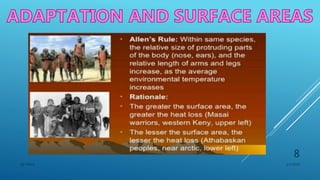
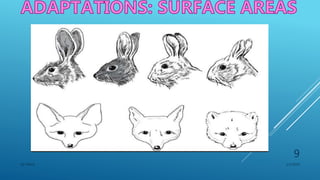
ALLEN'S RULE
The idea that, within a warm-blooded
species that is spread over a large
geographic area, populations in colder
climates tend to have shorter limbs, hence
having a lower surface-area-to-volume ratio.
1/1/2020SG OBAJE
7
1/1/2020SG OBAJE
8
1/1/2020SG OBAJE
9
BERGMANN'S RULE
The idea that, within a warm-blooded
species that is spread over a large
geographic area, populations in colder
climates tend to have larger body size.
1/1/2020SG OBAJE
10
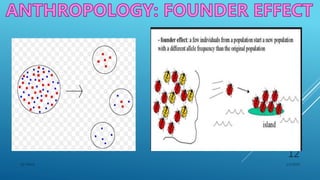
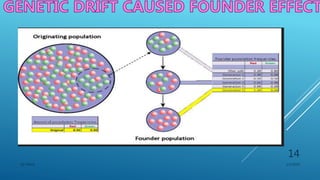
FOUNDER EFFECT
A change in allele frequencies in a newly
established population, relative to an
ancestral population, due to the chance o
which individuals were part of the founding
ancestors of the new population.
1/1/2020SG OBAJE
11
1/1/2020SG OBAJE
12
GENETIC DRIFT
Changes in allele frequencies seen in natural
populations from generation to generation
in circumstances for which selective,
mutational, and gene flow effects are
otherwise accounted.
1/1/2020SG OBAJE
13
1/1/2020SG OBAJE
14
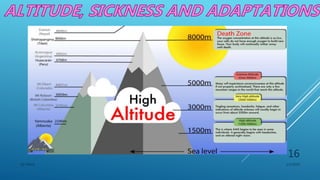
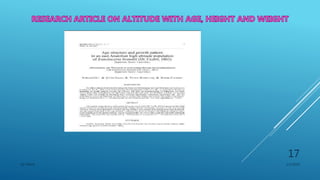
HIGH ALTITUDE AND GROWTH
Altitude has an effect on the growth of
height and weight during late childhood and
a more dramatic effect on adolescent
growth.
1/1/2020SG OBAJE
15
1/1/2020SG OBAJE
16
1/1/2020SG OBAJE
17
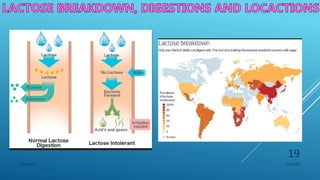
LACTOSE TOLERANCE
A mutation in the human genome allowed
many adults to digest lactose and drink milk.
1/1/2020SG OBAJE
18
1/1/2020SG OBAJE
19
LEWIS HUNTING PHENOMENON
A process of alternating vasoconstriction
(narrowing of the blood vessels resulting
from contraction of the muscular wall of the
vessels) and vasodilation (widening of blood
vessels) in extremities exposed to cold.
1/1/2020SG OBAJE
20
HYPOXIA
Low oxygen pressure/saturation levels at
high altitude
Lower air pressure at high altitude makes it
feel like there is a lower percentage of
oxygen; normal saturation at sea level is
about 98%.
A condition of low oxygen availability.
1/1/2020SG OBAJE
21
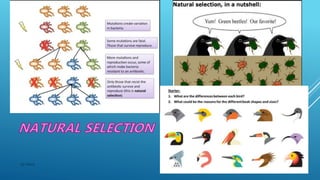
NATURAL SELECTION
The process by which adaptive traits
predominate in biological populations due
to a differential reproductive rate; natural
selection forms the basis for evolutionary
change.
1/1/2020SG OBAJE
22
1/1/2020SG OBAJE
23
CULTURAL ADAPTATION
The process and time it takes a person to
integrate into a new culture and feel
comfortable within it.
1/1/2020SG OBAJE
24
Heat and cold, dairying and
milk digestion
NEGATIVE IMPACTS OF AGRICULTURE
Land conversion, habitat loss, wasteful water
consumption, soil erosion, and degradation.
1/1/2020SG OBAJE
25
SMALLPOX
An acute contagious viral disease, with fever
and pustules usually leaving permanent
scars. It was effectively eradicated through
vaccination by 1979.
1/1/2020SG OBAJE
26
SYPHILIS
Disease caused by intimate contact that is
caused by the Treponema spirochete; the
disease is present in venereal (sexually
transmitted) and non-venereal forms.
1/1/2020SG OBAJE
27
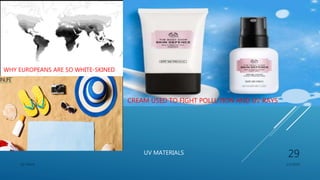
UV RADIATION AND SKIN COLOR
Variations in human skin color are adaptive
traits that correlate closely with geography and
the sun's ultraviolet (UV) radiation.
Melanin, the skin's brown pigment, is a natural
sunscreen that protects tropical peoples from
the many harmful effects of ultraviolet (UV)
rays.
1/1/2020SG OBAJE
28
1/1/2020SG OBAJE
29
WHY EUROPEANS ARE SO WHITE-SKINED
CREAM USED TO FIGHT POLLUTION AND UV RAYS
UV MATERIALS
VITAMIN D, CALCIUM & UV RADIATION
Vitamin D is a hormone that controls
calcium levels in the blood. It is needed to
develop and maintain healthy bones,
muscles and teeth and is also important for
general health.
Vitamin D is made through a series of
biochemical processes that start when the
skin is exposed to the sun's UV rays.
1/1/2020SG OBAJE
30
GENETIC DRIFT CONTINUED ……..
Refer to various random processes that
affect gene frequencies in small but isolated
populations.
Its also called Wright effect
Founder principle occurs here, where a small
group recently derived from a larger
population migrates to a relatively isolated
location.
1/1/2020SG OBAJE
31
SKIN COLOUR
Wide range of skin colour among people of
the world
Skin colour of a person depends on:
1. Amount of melanin pigment (dark)
2. Amount of blood that flows to skin surface
3. Gloger’s Rule
1/1/2020SG OBAJE
32
Warm climate have more melanin, and more darker people

Human variation in anthropology

  • 1.
    HUMAN VARIATION OBAJE GODWINSUNDAY ANATOMY, ALEX EKWUEME FEDERAL UNIVERSITY NDUFU ALIKE, EBONYI STATE +2348068638121, OBAJE199@GMAIL.COM
  • 2.
    ACCLIMATION  To altitude,cold, heat, and UV radiation The way that a person or organism adapts to a new environment. 1/1/2020SG OBAJE 2
  • 3.
    ACCLIMATIZATION  To altitude,cold, heat and UV radiation A form of phenotypic plasticity that enables an individual organism to accommodate to a complex of environmental factors. 1/1/2020SG OBAJE 3
  • 4.
    ADAPTATION  To altitude,cold, heat, and UV radiation A structure, function, or behavior of an organism that helps it survive and reproduce. 1/1/2020SG OBAJE 4
  • 5.
    ALBINISM A characteristic ofmany mammals, including humans, in which a genetic mutation results in the inability to produce melanin pigment, thus resulting in individuals with very light skin and hair color. 1/1/2020SG OBAJE 5
  • 6.
    PHYSICAL VARIATION INHUMAN POPULATIONS Noticeable physical variations are: body build, facial features, skin colour, and height 1/1/2020SG OBAJE 6
  • 7.
    ALLEN'S RULE The ideathat, within a warm-blooded species that is spread over a large geographic area, populations in colder climates tend to have shorter limbs, hence having a lower surface-area-to-volume ratio. 1/1/2020SG OBAJE 7
  • 8.
  • 9.
  • 10.
    BERGMANN'S RULE The ideathat, within a warm-blooded species that is spread over a large geographic area, populations in colder climates tend to have larger body size. 1/1/2020SG OBAJE 10
  • 11.
    FOUNDER EFFECT A changein allele frequencies in a newly established population, relative to an ancestral population, due to the chance o which individuals were part of the founding ancestors of the new population. 1/1/2020SG OBAJE 11
  • 12.
  • 13.
    GENETIC DRIFT Changes inallele frequencies seen in natural populations from generation to generation in circumstances for which selective, mutational, and gene flow effects are otherwise accounted. 1/1/2020SG OBAJE 13
  • 14.
  • 15.
    HIGH ALTITUDE ANDGROWTH Altitude has an effect on the growth of height and weight during late childhood and a more dramatic effect on adolescent growth. 1/1/2020SG OBAJE 15
  • 16.
  • 17.
  • 18.
    LACTOSE TOLERANCE A mutationin the human genome allowed many adults to digest lactose and drink milk. 1/1/2020SG OBAJE 18
  • 19.
  • 20.
    LEWIS HUNTING PHENOMENON Aprocess of alternating vasoconstriction (narrowing of the blood vessels resulting from contraction of the muscular wall of the vessels) and vasodilation (widening of blood vessels) in extremities exposed to cold. 1/1/2020SG OBAJE 20
  • 21.
    HYPOXIA Low oxygen pressure/saturationlevels at high altitude Lower air pressure at high altitude makes it feel like there is a lower percentage of oxygen; normal saturation at sea level is about 98%. A condition of low oxygen availability. 1/1/2020SG OBAJE 21
  • 22.
    NATURAL SELECTION The processby which adaptive traits predominate in biological populations due to a differential reproductive rate; natural selection forms the basis for evolutionary change. 1/1/2020SG OBAJE 22
  • 23.
  • 24.
    CULTURAL ADAPTATION The processand time it takes a person to integrate into a new culture and feel comfortable within it. 1/1/2020SG OBAJE 24 Heat and cold, dairying and milk digestion
  • 25.
    NEGATIVE IMPACTS OFAGRICULTURE Land conversion, habitat loss, wasteful water consumption, soil erosion, and degradation. 1/1/2020SG OBAJE 25
  • 26.
    SMALLPOX An acute contagiousviral disease, with fever and pustules usually leaving permanent scars. It was effectively eradicated through vaccination by 1979. 1/1/2020SG OBAJE 26
  • 27.
    SYPHILIS Disease caused byintimate contact that is caused by the Treponema spirochete; the disease is present in venereal (sexually transmitted) and non-venereal forms. 1/1/2020SG OBAJE 27
  • 28.
    UV RADIATION ANDSKIN COLOR Variations in human skin color are adaptive traits that correlate closely with geography and the sun's ultraviolet (UV) radiation. Melanin, the skin's brown pigment, is a natural sunscreen that protects tropical peoples from the many harmful effects of ultraviolet (UV) rays. 1/1/2020SG OBAJE 28
  • 29.
    1/1/2020SG OBAJE 29 WHY EUROPEANSARE SO WHITE-SKINED CREAM USED TO FIGHT POLLUTION AND UV RAYS UV MATERIALS
  • 30.
    VITAMIN D, CALCIUM& UV RADIATION Vitamin D is a hormone that controls calcium levels in the blood. It is needed to develop and maintain healthy bones, muscles and teeth and is also important for general health. Vitamin D is made through a series of biochemical processes that start when the skin is exposed to the sun's UV rays. 1/1/2020SG OBAJE 30
  • 31.
    GENETIC DRIFT CONTINUED…….. Refer to various random processes that affect gene frequencies in small but isolated populations. Its also called Wright effect Founder principle occurs here, where a small group recently derived from a larger population migrates to a relatively isolated location. 1/1/2020SG OBAJE 31
  • 32.
    SKIN COLOUR Wide rangeof skin colour among people of the world Skin colour of a person depends on: 1. Amount of melanin pigment (dark) 2. Amount of blood that flows to skin surface 3. Gloger’s Rule 1/1/2020SG OBAJE 32 Warm climate have more melanin, and more darker people