Permaforest Trust Individual ProjectA biomass-biochar stoveBy James Jenkinson
IntroductionVISION STATEMENT To design an affordable, clean-burning, durable, safe and sustainable 'carbon negative' stove technology for the over-developed and under-developed worlds. WHY?Increasing need for improving the affordability, efficiency, durability, safety and sustainability of cookstovesInterrelated environmental stresses connected to the design and usage requirements of stoves that affect human and environmental health and sustainability. Stresses include climate change, biodiversity conservation, human respiratory health and e-waste - just to name a handful.Purpose of study is to design a cutting edge stove that addresses these stresses
Main stakeholdersMullubimby Community Garden (biochar pod, kitchen pod)Project 540Stovers/The stoving communityNeighboursMiscpermiesByron Shire CouncilGreen movementEntrepeneursFarmersResearchers eg. CSIRO WollongbarPoliticiansForestry workersWoodburn mill(biomass pelletisation)
Research overviewBiochar overviewBiomass productionBiomass harvestingBiomass pelletisationLocal interviewsCommunity and bioregionalGlocal (Global/Local)Stove design and building
Biochar overviewBiochar is "the carbon-rich product obtained when biomass, such as wood, manure or leaves, is heated in a closed container with little or no available air"  (Lehmann, J. & Joseph, S. (Eds.), 'Biochar for Environmental Management: Science and Technology', U.K., Earthscan, 2009, p.1).Biocharis a 2,000 year-old practice that converts agricultural waste into a soil enhancer that can hold carbon, boost food security and discourage deforestation. The process creates a fine-grained, highly porous charcoal that helps soils retain nutrients and water (International Biochar Initiative)Main reason for biochar technology (Lehmann & Joseph,p.5), is to mitigate climate change, produce energy, improve soil and manage waste.
Biomass overview 1Biomass is organic matter, which includes forest and mill residues, agricultural crops and wastes, wood and wood wastes, animal wastes, livestock operation residues, aquatic plants, and municipal and industrial wastes.
The biomass industry is receiving increasing attention from the public as scientists, policy makers, and growers search for clean, renewable energy alternatives.
Compared with other renewable resources, biomass is very flexible; it can be used as a fuel for direct combustion, gasified, used in combined heat and power technologies, or biochemical conversions.Biomass overview 2Human Impacts• 1.6 million people die from wood smoke related diseases each year. • Smoke from wood fire is one of the WHO’s top 10 threats to human health.• Depleted wood resource causes political instability. Environmental Impacts• 14% of global warming attributable to black carbon. • Deforestation from wood collection.• Increased atmospheric CO2. Wood Consumption• Half of all wood harvested in the world is used for fuel.• 75% of wood harvested in developing countries is burned for fuel.
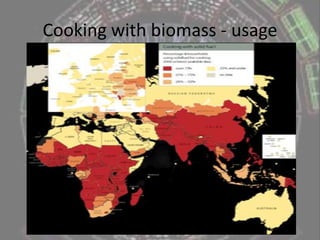
Cooking with biomass - usage
Biomass productionIn this bioregion the following have potential:BambooCamphor laurelLantanaMacadamia shellsPlantations, farms, roadside, nurseries, bush regenSustainably managed plantation timber wasteAgricultural waste
Biomass harvestingForage harvesting v individual stem harvestingRelates to accessibility and cost of equipment Differences between overdeveloped/underdeveloped worldsHarvesting equipmentSugar caneForestryAgriculture
Biomass pelletisationBiomass pelletization is the process of reducing the bulk volume of the material, by mechanical means for easy handling, transportation and storage of material. In addition to the practical advantage of increased convenience, putting biomass in pellet form also decreases the moisture content, increases the density and maintains a high heating value.Used in emergency humanitarian response eg. HaitiSold alongside stoves eg. World Stove, StovetecLocally, pellets available at Alstonville (produced at a mill in Woodburn)
Local interviews 1Main research questions were as follows:What qualities do you look for in a stove?What type of stove do you normally use for cooking?What other methods of cooking have you tried?What are your preferred methods of cooking?Have you heard of biomass stoves?Would you be interested in using one for a short trial of one month?Any other comments or thoughts about this research?
Local interviews 2Efficient and economical and ecological stoves were desiredGas or electric cooking appliances were most popularBaking or grilling were popular cooking types other than stove cookingBaking or grilling were most popular cooking methodsMost candidates had not heard of biomass stovesMost candidates were interested in participating in a biomass stove trialAdditional comments were varied including the desire to cook by adobe oven, willing to compromise on stove technology, desire to cook with dung and an opinion that the local community has a low usage of white goods and appliances suggesting that this area would be a good test bed for my stove
Community and BioregionalStoves can be manufactured on a community level which creates employmentBiochar produced by stoves can be used for soil amendment and water conservation in local food production systemsAppropriate microfinance structures have the potential to offer carbon credit exchange to local people creating biochar and using it in food production systemsPotential for further research in this region due to high cultural, economic and bio- diversity
Glocal (Global/Local)International Biochar InitiativeBioenergy ListsAprovecho Research CenterBodger’s HovelBiomass Energy FoundationGlobal Partnership Plant ConservationBiochar.orgEPRIDA
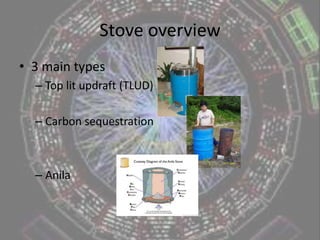
Stove overview3 main typesTop lit updraft (TLUD)Carbon sequestrationAnila
Stove design and building - principlesAffordable['Help make people self-reliant', 'Bring food production back to the cities', PDM]Clean-burning eg.smokeless, no VOCs etc['Produce no waste', PPP]Durable['Apply self-regulation and accept feedback', PPP]Safe[ 'People care', 'Help make people self-reliant', 'Bring food production back to the cities', PDM]Sustainable‘carbon negative’(biochar productive and 'clean-burning') ['Catch and store energy', 'Obtain a yield', 'Produce no waste', PPP]
Stove design  and building - Prototypes
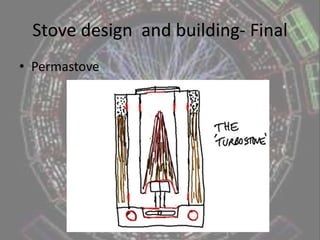
Stove design  and building- FinalPermastove
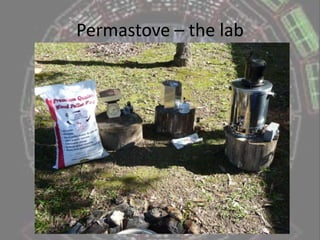
Permastove – the lab
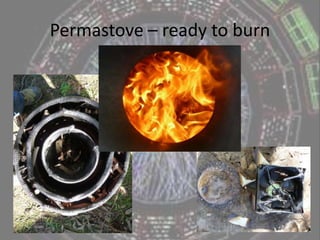
Permastove – ready to burn
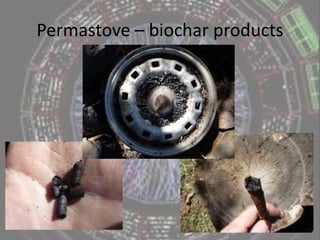
Permastove – biochar products
What’s the next step?Go to stove campAprovecho Research Centre, U.S.A.Modify and test the designObtain funding for further researchConduct research trial at community and bioregional scalesContact relevant international development organisations and entities for participation in a stove program

Biochar Stove

  • 1.
    Permaforest Trust IndividualProjectA biomass-biochar stoveBy James Jenkinson
  • 2.
    IntroductionVISION STATEMENT To designan affordable, clean-burning, durable, safe and sustainable 'carbon negative' stove technology for the over-developed and under-developed worlds. WHY?Increasing need for improving the affordability, efficiency, durability, safety and sustainability of cookstovesInterrelated environmental stresses connected to the design and usage requirements of stoves that affect human and environmental health and sustainability. Stresses include climate change, biodiversity conservation, human respiratory health and e-waste - just to name a handful.Purpose of study is to design a cutting edge stove that addresses these stresses
  • 3.
    Main stakeholdersMullubimby CommunityGarden (biochar pod, kitchen pod)Project 540Stovers/The stoving communityNeighboursMiscpermiesByron Shire CouncilGreen movementEntrepeneursFarmersResearchers eg. CSIRO WollongbarPoliticiansForestry workersWoodburn mill(biomass pelletisation)
  • 4.
    Research overviewBiochar overviewBiomassproductionBiomass harvestingBiomass pelletisationLocal interviewsCommunity and bioregionalGlocal (Global/Local)Stove design and building
  • 5.
    Biochar overviewBiochar is"the carbon-rich product obtained when biomass, such as wood, manure or leaves, is heated in a closed container with little or no available air" (Lehmann, J. & Joseph, S. (Eds.), 'Biochar for Environmental Management: Science and Technology', U.K., Earthscan, 2009, p.1).Biocharis a 2,000 year-old practice that converts agricultural waste into a soil enhancer that can hold carbon, boost food security and discourage deforestation. The process creates a fine-grained, highly porous charcoal that helps soils retain nutrients and water (International Biochar Initiative)Main reason for biochar technology (Lehmann & Joseph,p.5), is to mitigate climate change, produce energy, improve soil and manage waste.
  • 6.
    Biomass overview 1Biomassis organic matter, which includes forest and mill residues, agricultural crops and wastes, wood and wood wastes, animal wastes, livestock operation residues, aquatic plants, and municipal and industrial wastes.
  • 7.
    The biomass industryis receiving increasing attention from the public as scientists, policy makers, and growers search for clean, renewable energy alternatives.
  • 8.
    Compared with otherrenewable resources, biomass is very flexible; it can be used as a fuel for direct combustion, gasified, used in combined heat and power technologies, or biochemical conversions.Biomass overview 2Human Impacts• 1.6 million people die from wood smoke related diseases each year. • Smoke from wood fire is one of the WHO’s top 10 threats to human health.• Depleted wood resource causes political instability. Environmental Impacts• 14% of global warming attributable to black carbon. • Deforestation from wood collection.• Increased atmospheric CO2. Wood Consumption• Half of all wood harvested in the world is used for fuel.• 75% of wood harvested in developing countries is burned for fuel.
  • 9.
  • 10.
    Biomass productionIn thisbioregion the following have potential:BambooCamphor laurelLantanaMacadamia shellsPlantations, farms, roadside, nurseries, bush regenSustainably managed plantation timber wasteAgricultural waste
  • 11.
    Biomass harvestingForage harvestingv individual stem harvestingRelates to accessibility and cost of equipment Differences between overdeveloped/underdeveloped worldsHarvesting equipmentSugar caneForestryAgriculture
  • 12.
    Biomass pelletisationBiomass pelletizationis the process of reducing the bulk volume of the material, by mechanical means for easy handling, transportation and storage of material. In addition to the practical advantage of increased convenience, putting biomass in pellet form also decreases the moisture content, increases the density and maintains a high heating value.Used in emergency humanitarian response eg. HaitiSold alongside stoves eg. World Stove, StovetecLocally, pellets available at Alstonville (produced at a mill in Woodburn)
  • 13.
    Local interviews 1Mainresearch questions were as follows:What qualities do you look for in a stove?What type of stove do you normally use for cooking?What other methods of cooking have you tried?What are your preferred methods of cooking?Have you heard of biomass stoves?Would you be interested in using one for a short trial of one month?Any other comments or thoughts about this research?
  • 14.
    Local interviews 2Efficientand economical and ecological stoves were desiredGas or electric cooking appliances were most popularBaking or grilling were popular cooking types other than stove cookingBaking or grilling were most popular cooking methodsMost candidates had not heard of biomass stovesMost candidates were interested in participating in a biomass stove trialAdditional comments were varied including the desire to cook by adobe oven, willing to compromise on stove technology, desire to cook with dung and an opinion that the local community has a low usage of white goods and appliances suggesting that this area would be a good test bed for my stove
  • 15.
    Community and BioregionalStovescan be manufactured on a community level which creates employmentBiochar produced by stoves can be used for soil amendment and water conservation in local food production systemsAppropriate microfinance structures have the potential to offer carbon credit exchange to local people creating biochar and using it in food production systemsPotential for further research in this region due to high cultural, economic and bio- diversity
  • 16.
    Glocal (Global/Local)International BiocharInitiativeBioenergy ListsAprovecho Research CenterBodger’s HovelBiomass Energy FoundationGlobal Partnership Plant ConservationBiochar.orgEPRIDA
  • 17.
    Stove overview3 maintypesTop lit updraft (TLUD)Carbon sequestrationAnila
  • 18.
    Stove design andbuilding - principlesAffordable['Help make people self-reliant', 'Bring food production back to the cities', PDM]Clean-burning eg.smokeless, no VOCs etc['Produce no waste', PPP]Durable['Apply self-regulation and accept feedback', PPP]Safe[ 'People care', 'Help make people self-reliant', 'Bring food production back to the cities', PDM]Sustainable‘carbon negative’(biochar productive and 'clean-burning') ['Catch and store energy', 'Obtain a yield', 'Produce no waste', PPP]
  • 19.
    Stove design and building - Prototypes
  • 20.
    Stove design and building- FinalPermastove
  • 21.
  • 22.
  • 23.
  • 24.
    What’s the nextstep?Go to stove campAprovecho Research Centre, U.S.A.Modify and test the designObtain funding for further researchConduct research trial at community and bioregional scalesContact relevant international development organisations and entities for participation in a stove program

Editor's Notes

  • #9 That’s about 1/3 of world population using biomass as a fuel source
  • #12 Concentration/diffusion principle
  • #15 Microfinance especially relevant in underdeveloped world where majority of biomass is consumed and economic opportunities are low