
FLUIDIZED-BED
COMBUSTOR
By
Akash Raj D
2020248026
M.Tech. Polymer science and engineering
INTRODUCTION
Fluidized-bed technology was initiated in the 1920s as a process for
refining petroleum and for the production of chemical feedstock from
coal. This technology has been applied for the following since the
1940s:
i. Calcination of Alumina
ii. Cracking of Hydrocarbon
iii. Roasting of Ore
iv. Incineration of Waste
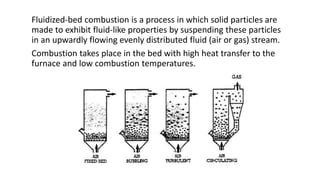
Fluidized-bed combustion is a process in which solid particles are
made to exhibit fluid-like properties by suspending these particles
in an upwardly flowing evenly distributed fluid (air or gas) stream.
Combustion takes place in the bed with high heat transfer to the
furnace and low combustion temperatures.
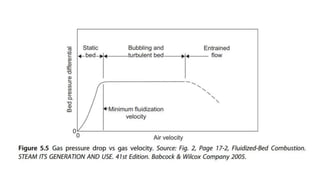
The velocity of the fluid at which the fixed bed transforms into the
fluidizing bed is called the minimum fluidization velocity, and it
depends on the following factors:
i. Particle diameter
ii. Particle density
iii. Particle shape
iv. Density of fluid
v. Viscosity of fluid
vi. Void fraction, etc
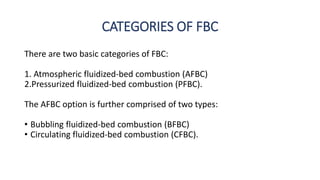
CATEGORIES OF FBC
There are two basic categories of FBC:
1. Atmospheric fluidized-bed combustion (AFBC)
2.Pressurized fluidized-bed combustion (PFBC).
The AFBC option is further comprised of two types:
• Bubbling fluidized-bed combustion (BFBC)
• Circulating fluidized-bed combustion (CFBC).
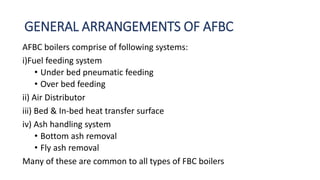
GENERAL ARRANGEMENTS OF AFBC
AFBC boilers comprise of following systems:
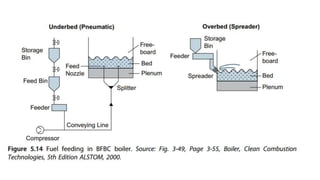
i)Fuel feeding system
• Under bed pneumatic feeding
• Over bed feeding
ii) Air Distributor
iii) Bed & In-bed heat transfer surface
iv) Ash handling system
• Bottom ash removal
• Fly ash removal
Many of these are common to all types of FBC boilers
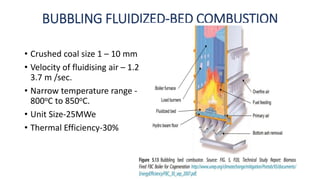
BUBBLING FLUIDIZED-BED COMBUSTION
(BFBC)
• Crushed coal size 1 – 10 mm
• Velocity of fluidising air – 1.2 to
3.7 m /sec.
• Narrow temperature range -
800oC to 850oC.
• Unit Size-25MWe
• Thermal Efficiency-30%
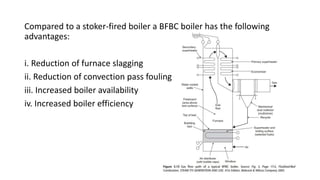
Compared to a stoker-fired boiler a BFBC boiler has the following
advantages:
i. Reduction of furnace slagging
ii. Reduction of convection pass fouling
iii. Increased boiler availability
iv. Increased boiler efficiency
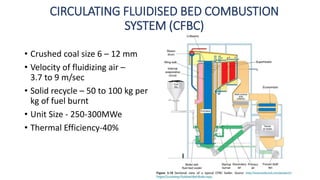
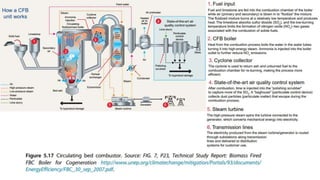
CIRCULATING FLUIDISED BED COMBUSTION
SYSTEM (CFBC)
• Crushed coal size 6 – 12 mm
• Velocity of fluidizing air –
3.7 to 9 m/sec
• Solid recycle – 50 to 100 kg per
kg of fuel burnt
• Unit Size - 250-300MWe
• Thermal Efficiency-40%
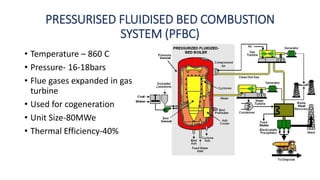
PRESSURISED FLUIDISED BED COMBUSTION
SYSTEM (PFBC)
• Temperature – 860 C
• Pressure- 16-18bars
• Flue gases expanded in gas
turbine
• Used for cogeneration
• Unit Size-80MWe
• Thermal Efficiency-40%
RETROFITTING OF FBC SYSTEMS TO
CONVENTIONAL BOILERS
• Retrofitting fluidized bed coal fired combustion systems to
conventional boilers has been carried out successfully both in India
and abroad.
• The important aspects to be considered in retrofit projects are:
a) Water/steam circulation design
b) Furnace bottom-grate clearance
c) Type of particulate control device
d) Fan capacity
e) Availability of space.
ADVANTAGES OF FBC BOILERS
1. High Efficiency
2. Reduction in Boiler Size
3. Fuel Flexibility
4. Ability to Burn Low Grade Fuel
5. Ability to Burn Fines
6. Pollution Control
7. Easier Ash Removal – No Clinker Formation
8. No Slagging in the Furnace-No Soot Blowing
9. Provisions of Automatic Coal and Ash Handling System
10.High Efficiency of Power Generation
DISADVANTAGES OF FBC BOILERS
1. Over-size particles result in improper fluidization and impair the combustion
process.
2. Undersized particlesmay escape the free-board (firing) zone, resulting in burning
of fine carbon particles around the cyclone, consequently there will be excursion
of flue gas temperature beyond the furnace zone.
3. Fluidizing nozzles sometimes get plugged, inhibiting proper fluidization of the
fuel bed.
4. Gradual and undetected wear of boiler parts.
CONCLUSIONS
• Decreasing electricity prices and improving environmental
protection
• Clean energy
• More flexible than conventional plants
• Reduced emissions and Improved combustion
• Research and development is required in order to improve the FBC
technology.
REFERENCES
• Koornneef, Joris & Junginger, Martin & Faaij, A.P.C.. (2007). Development of fluidized bed combustion—An
overview of trends, performance and cost. Progress in Energy and Combustion Science. 33. 19-55.
10.1016/j.pecs.2006.07.001.
• W., Muskała & Krzywanski, Jaroslaw & Sekret, Robert & Nowak, Wojciec. (2008). Model research of coal
combustion in circulating fluidized bed boilers. Chemical And Process Engineering. 29. 473-492.
• Leckner, Bo. (2003). Fluidized bed combustion research and development in Sweden: A historical survey.
Thermal Science - THERM SCI. 7. 3-16. 10.2298/TSCI0302003L.
THANK YOU

Fluidized bed combustor

  • 1.
  • 2.
    INTRODUCTION Fluidized-bed technology wasinitiated in the 1920s as a process for refining petroleum and for the production of chemical feedstock from coal. This technology has been applied for the following since the 1940s: i. Calcination of Alumina ii. Cracking of Hydrocarbon iii. Roasting of Ore iv. Incineration of Waste
  • 3.
    Fluidized-bed combustion isa process in which solid particles are made to exhibit fluid-like properties by suspending these particles in an upwardly flowing evenly distributed fluid (air or gas) stream. Combustion takes place in the bed with high heat transfer to the furnace and low combustion temperatures.
  • 4.
    The velocity ofthe fluid at which the fixed bed transforms into the fluidizing bed is called the minimum fluidization velocity, and it depends on the following factors: i. Particle diameter ii. Particle density iii. Particle shape iv. Density of fluid v. Viscosity of fluid vi. Void fraction, etc
  • 7.
    CATEGORIES OF FBC Thereare two basic categories of FBC: 1. Atmospheric fluidized-bed combustion (AFBC) 2.Pressurized fluidized-bed combustion (PFBC). The AFBC option is further comprised of two types: • Bubbling fluidized-bed combustion (BFBC) • Circulating fluidized-bed combustion (CFBC).
  • 8.
    GENERAL ARRANGEMENTS OFAFBC AFBC boilers comprise of following systems: i)Fuel feeding system • Under bed pneumatic feeding • Over bed feeding ii) Air Distributor iii) Bed & In-bed heat transfer surface iv) Ash handling system • Bottom ash removal • Fly ash removal Many of these are common to all types of FBC boilers
  • 10.
    BUBBLING FLUIDIZED-BED COMBUSTION (BFBC) •Crushed coal size 1 – 10 mm • Velocity of fluidising air – 1.2 to 3.7 m /sec. • Narrow temperature range - 800oC to 850oC. • Unit Size-25MWe • Thermal Efficiency-30%
  • 11.
    Compared to astoker-fired boiler a BFBC boiler has the following advantages: i. Reduction of furnace slagging ii. Reduction of convection pass fouling iii. Increased boiler availability iv. Increased boiler efficiency
  • 12.
    CIRCULATING FLUIDISED BEDCOMBUSTION SYSTEM (CFBC) • Crushed coal size 6 – 12 mm • Velocity of fluidizing air – 3.7 to 9 m/sec • Solid recycle – 50 to 100 kg per kg of fuel burnt • Unit Size - 250-300MWe • Thermal Efficiency-40%
  • 14.
    PRESSURISED FLUIDISED BEDCOMBUSTION SYSTEM (PFBC) • Temperature – 860 C • Pressure- 16-18bars • Flue gases expanded in gas turbine • Used for cogeneration • Unit Size-80MWe • Thermal Efficiency-40%
  • 15.
    RETROFITTING OF FBCSYSTEMS TO CONVENTIONAL BOILERS • Retrofitting fluidized bed coal fired combustion systems to conventional boilers has been carried out successfully both in India and abroad. • The important aspects to be considered in retrofit projects are: a) Water/steam circulation design b) Furnace bottom-grate clearance c) Type of particulate control device d) Fan capacity e) Availability of space.
  • 16.
    ADVANTAGES OF FBCBOILERS 1. High Efficiency 2. Reduction in Boiler Size 3. Fuel Flexibility 4. Ability to Burn Low Grade Fuel 5. Ability to Burn Fines 6. Pollution Control 7. Easier Ash Removal – No Clinker Formation 8. No Slagging in the Furnace-No Soot Blowing 9. Provisions of Automatic Coal and Ash Handling System 10.High Efficiency of Power Generation
  • 17.
    DISADVANTAGES OF FBCBOILERS 1. Over-size particles result in improper fluidization and impair the combustion process. 2. Undersized particlesmay escape the free-board (firing) zone, resulting in burning of fine carbon particles around the cyclone, consequently there will be excursion of flue gas temperature beyond the furnace zone. 3. Fluidizing nozzles sometimes get plugged, inhibiting proper fluidization of the fuel bed. 4. Gradual and undetected wear of boiler parts.
  • 18.
    CONCLUSIONS • Decreasing electricityprices and improving environmental protection • Clean energy • More flexible than conventional plants • Reduced emissions and Improved combustion • Research and development is required in order to improve the FBC technology.
  • 19.
    REFERENCES • Koornneef, Joris& Junginger, Martin & Faaij, A.P.C.. (2007). Development of fluidized bed combustion—An overview of trends, performance and cost. Progress in Energy and Combustion Science. 33. 19-55. 10.1016/j.pecs.2006.07.001. • W., Muskała & Krzywanski, Jaroslaw & Sekret, Robert & Nowak, Wojciec. (2008). Model research of coal combustion in circulating fluidized bed boilers. Chemical And Process Engineering. 29. 473-492. • Leckner, Bo. (2003). Fluidized bed combustion research and development in Sweden: A historical survey. Thermal Science - THERM SCI. 7. 3-16. 10.2298/TSCI0302003L.
  • 20.