Eukaryotic Replication of DNA
Semiconservativereplication,
By- Sanju Sah
St. Xavier’s College, Maitighar
Department of Microbiology
1
• Native DNA is a double helix made of complementary antiparallel
chains
• DNA can undergo reversible strand separation-denaturation and
renaturation
• DNA is made up of a limited number of monomeric building block
• Polymerization of nucleotides forms nucleic acid-monomers
added one at a time
• Formation of phosphodiester bonds-joins monomers
• Poly nucleotide has a specific start point and fixed terminus- 5’
end to 3’end.
• Molecular template guide the synthesis of macromolecules
• The primary synthetic product is often modified
• DNA replicates before cell divides. Replication is exact and rapid.
2
3
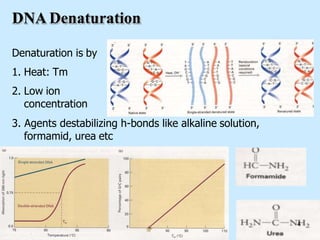
DNA Denaturation
Denaturation is by
1. Heat: Tm
2. Low ion
concentration
3. Agents destabilizing h-bonds like alkaline solution,
formamid, urea etc
4
Template strand
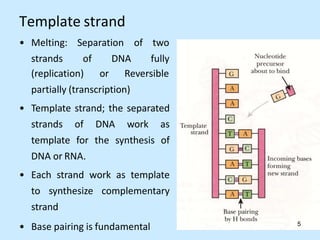
• Melting: Separation of
strands of DNA
two
fully
(replication) or Reversible
partially (transcription)
• Template strand; the separated
strands of DNA work as
template for the synthesis of
DNA or RNA.
• Each strand work as template
to synthesize complementary
strand
• Base pairing is fundamental 5
DNA replication begins at an origin
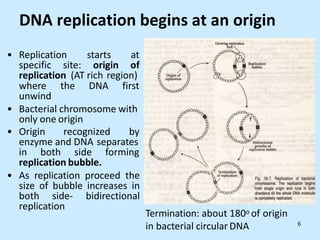
• Replication starts at
specific site: origin of
replication (AT rich region)
where the DNA first
unwind
• Bacterial chromosome with
only one origin
• Origin recognized by
enzyme and DNA separates
in both side forming
replication bubble.
• As replication proceed the
size of bubble increases in
both side- bidirectional
replication
Termination: about 180o of origin
in bacterial circular DNA 6
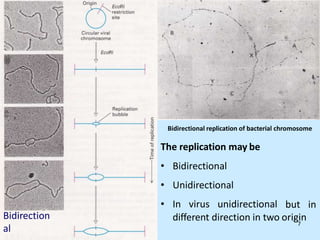
Bidirectional replication of bacterial chromosome
Bidirection
al
The replication may be
• Bidirectional
• Unidirectional
• In virus unidirectional but in
different direction in two origin
7
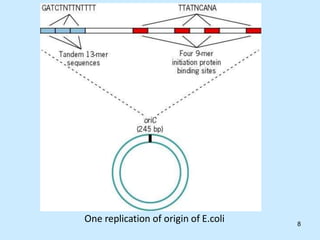
One replication of origin of E.coli 8
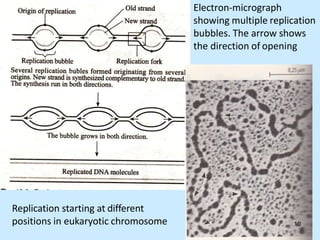
Multiple origins in Eukaryotic chromosome
• E.coli with 4.6 Mbp where as Human with about 6 billion bp in
46 chromosomes.
• E.coli replicate in about 30 min. with same rate it takes 500 hr
to replicate human genome.
• In reality it replicates fast within few hours.
• Replication begins at several origins with several replication
bubbles
• Replicon and replication fork
– About 20 -50 replicons initiate simultaneously
– Euchromatin: replicate early in S-phase, heterochromatin
replicate late in S-phase
– Eukaryote 50bp/s take 30 days to open 105 kb chromosome DNA
with one origin 9
Replication starting at different
positions in eukaryotic chromosome
Electron-micrograph
showing multiple replication
bubbles. The arrow shows
the direction of opening
10
Mechanism
• Similar procedure found in prokaryotic
and eukaryotic cell.
• Replication is governed by complex
formed by proteins in DNA-Replisome
 Multiple replicons in eukaryotes:
Mammalian DNA with 50,000 to
100,000 replicons of 40 to 200 kb. Yeast
DNA has 400 replicons
 Replication requires: Template, DNA
and
polymerase, dNTPs, enzymes
proteins
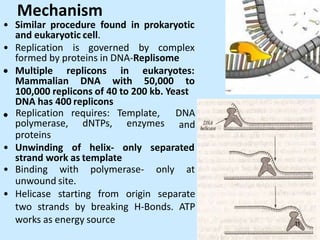
• Unwinding of helix- only separated
strand work as template
• Binding with polymerase- only at
unwound site.
• Helicase starting from origin separate
two strands by breaking H-Bonds. ATP
works as energy source 11
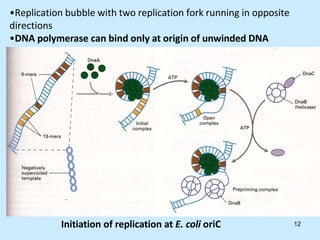
Initiation of replication at E. coli oriC
•Replication bubble with two replication fork running in opposite
directions
•DNA polymerase can bind only at origin of unwinded DNA
12
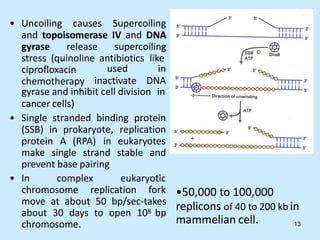
• Uncoiling causes Supercoiling
and topoisomerase IV and DNA
gyrase release supercoiling
stress (quinoline antibiotics like
ciprofloxacin
chemotherapy
used in
inactivate DNA
gyrase and inhibit cell division in
cancer cells)
• Single stranded binding protein
(SSB) in prokaryote, replication
protein A (RPA) in eukaryotes
make single strand stable and
prevent base pairing
• In complex eukaryotic
chromosome replication fork
move at about 50 bp/sec-takes
about 30 days to open 108 bp
chromosome.
•50,000 to 100,000
replicons of 40 to 200 kb in
mammelian cell. 13
Replication fork
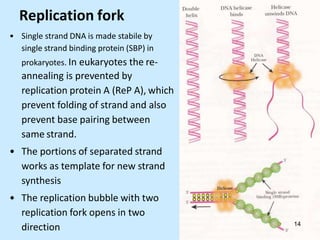
• Single strand DNA is made stabile by
single strand binding protein (SBP) in
prokaryotes. In eukaryotes the re-
annealing is prevented by
replication protein A (ReP A), which
prevent folding of strand and also
prevent base pairing between
same strand.
• The portions of separated strand
works as template for new strand
synthesis
• The replication bubble with two
replication fork opens in two
direction 14
DNA polymerase
• In the 1959, Arthur Kornberg and Severo Ochoa shared Nobel
Prize for the discovery of DNA - and RNA Polymerase
respectively in 1950s
• E.coli with 5 DNA polymerases three important are
polymerase I, II, III.
• Pol I for DNA repair during synthesis, Pol II for repair during
damage and Pol III for chain elongation during synthesis.
• Pol III with three units: α-subunit active site with nucleotide
addition, ε-subunit for 3‘ to 5‘ exonuclease activity, the
function of θ-subunit is not known.
15
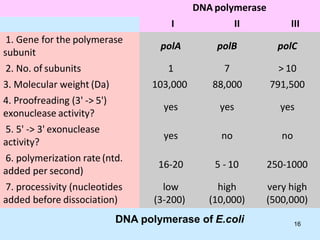
DNA polymerase
I II III
1. Gene for the polymerase
subunit
polA polB polC
2. No. of subunits 1 7 > 10
3. Molecular weight (Da) 103,000 88,000 791,500
4. Proofreading (3' -> 5')
exonuclease activity?
yes yes yes
5. 5' -> 3' exonuclease
activity?
yes no no
6. polymerization rate (ntd.
added per second)
16-20 5 - 10 250-1000
7. processivity (nucleotides
added before dissociation)
low
(3-200)
high
(10,000)
very high
(500,000)
DNA polymerase of E.coli 16
Eukaryotic Polymerase
• About 15 polymerases
• Pol α: Implicated in repairing DNA, in base excision repair and
gap-filling synthesis, DNA primer synthesis.
• Pol γ: Replicates and repairs mitochondrial DNA and has
proofreading 3'->5' exonuclease activity.
• Pol δ: Highly processive and has proofreading 3'->5'
exonuclease activity. Thought to be the main polymerase
involved in lagging strand synthesis, though there is still
debate about its role
17
• DNA polymerase α: 4 subunits, Primase activity,
polymerization activity for lagging strand synthesis
• DNA polymerase ε: DNA repair
• DNA polymerase δ: 2 subunits, leading strand synthesis
18
Eukaryotic Polymerase
Synthesis of DNA
Requirements
• DNA polymerase
• Substrate: template DNA and nucleotides triphosphate
• Protein and enzymes: helicase, SSB, topoisomerase, Mg 2+
Properties of DNA polymerase
• Join two nucleotides during elongation
• Elongates strand in 5’ to 3’ direction, needs free 3’ OH end. Add
nucleotide on free 3’ OH.
• Add nucleotides complementary to template strand
19
Synthesis of new strand
• The separated strand works as template
• DNA polymerase add nucleotide to only on free 3’OH of pre-
existing polynucleotide DNA or RNA
• Primosome (PriA, DnaG protein) form, a small oligonucleotide
Primer synthesized by primase (Dna G)
• Primer (about 11 to 12 bases) is synthesized at 3’ end of
template
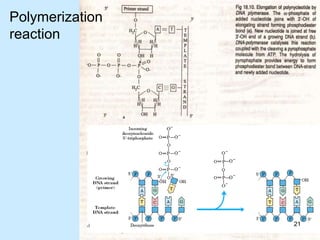
• Polymerase activity is in 5’ to 3’ direction, nucleotide is added
at 3’ OH end (first on primer)
• Phosphodiester bond between 3’ OH of polynucleotide and P of
5’ end of newly added nucleotide
• After several polymerase activity the primosome dissociates
• Replisome: complex controlling replication consists of proteins
bound to open DNA single strand 20
Polymerization
reaction
21
sangerseq.exe
22
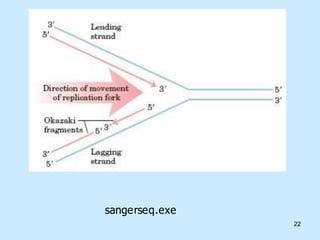
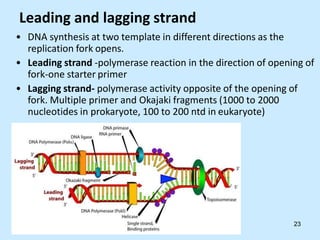
Leading and lagging strand
• DNA synthesis at two template in different directions as the
replication fork opens.
• Leading strand -polymerase reaction in the direction of opening of
fork-one starter primer
• Lagging strand- polymerase activity opposite of the opening of
fork. Multiple primer and Okajaki fragments (1000 to 2000
nucleotides in prokaryote, 100 to 200 ntd in eukaryote)
23
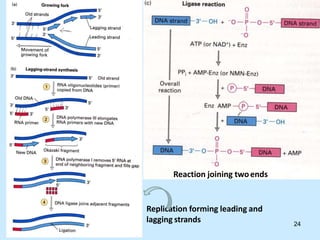
Replication forming leading and
lagging strands
Reaction joining twoends
24
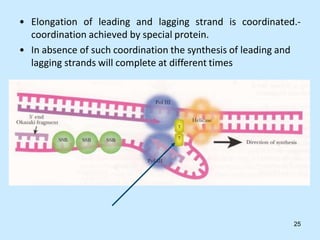
• Elongation of leading and lagging strand is coordinated.-
coordination achieved by special protein.
• In absence of such coordination the synthesis of leading and
lagging strands will complete at different times
25
26
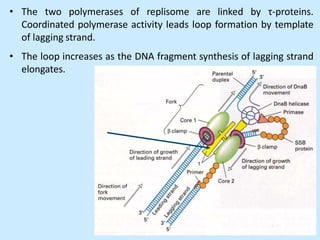
• The two polymerases of replisome are linked by τ-proteins.
Coordinated polymerase activity leads loop formation by template
of lagging strand.
• The loop increases as the DNA fragment synthesis of lagging strand
elongates.
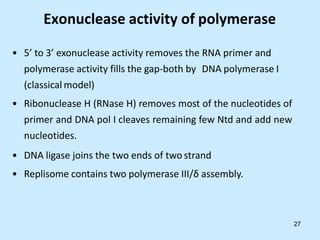
Exonuclease activity of polymerase
• 5’ to 3’ exonuclease activity removes the RNA primer and
polymerase activity fills the gap-both by DNA polymerase I
(classical model)
• Ribonuclease H (RNase H) removes most of the nucleotides of
primer and DNA pol I cleaves remaining few Ntd and add new
nucleotides.
• DNA ligase joins the two ends of two strand
• Replisome contains two polymerase III/δ assembly.
27
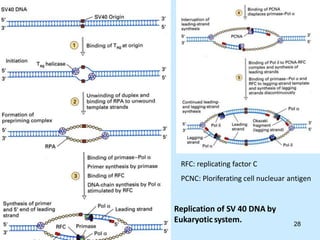
Replication of SV 40 DNA by
Eukaryotic system.
RFC: replicating factor C
PCNC: Ploriferating cell nucleuar antigen
28
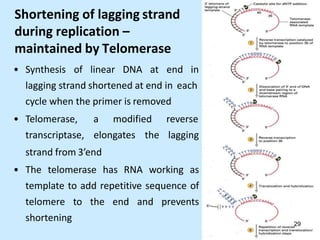
Shortening of lagging strand
during replication –
maintained by Telomerase
• Synthesis of linear DNA at end in
lagging strand shortened at end in each
cycle when the primer is removed
• Telomerase, a modified
transcriptase, elongates the
reverse
lagging
strand from 3’end
• The telomerase has RNA working as
template to add repetitive sequence of
telomere to the end and prevents
shortening 29
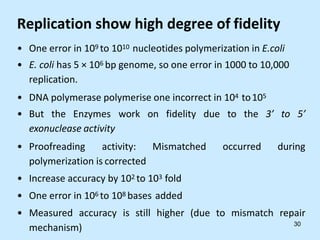
Replication show high degree of fidelity
• One error in 109 to 1010 nucleotides polymerization in E.coli
• E. coli has 5 × 10⁶ bp genome, so one error in 1000 to 10,000
replication.
• DNA polymerase polymerise one incorrect in 104 to105
• But the Enzymes work on fidelity due to the 3’ to 5’
exonuclease activity
• Proofreading activity: Mismatched occurred during
polymerization is corrected
• Increase accuracy by 102 to 103 fold
• One error in 106 to 108 bases added
• Measured accuracy is still higher (due to mismatch repair
mechanism) 30
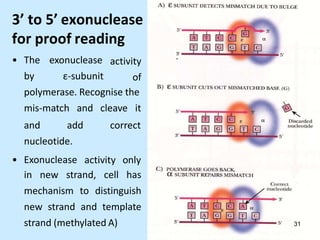
3’ to 5’ exonuclease
for proof reading
• The exonuclease
by ε-subunit
activity
of
polymerase. Recognise the
mis-match and cleave it
correct
and add
nucleotide.
• Exonuclease activity only
in new strand, cell has
mechanism to distinguish
new strand and template
strand (methylated A) 31
References
• Bhattarai, T: Plant Physiology
• Lodish et al : Molecular cell biology
• Turner et al: Instant notes Molecular biology
• Lehninger: Principles of Biochemistry
• Albrets et al: Molecular biology of cell
32
• Thank you…
33

Eukaryotic replication

  • 1.
    Eukaryotic Replication ofDNA Semiconservativereplication, By- Sanju Sah St. Xavier’s College, Maitighar Department of Microbiology 1
  • 2.
    • Native DNAis a double helix made of complementary antiparallel chains • DNA can undergo reversible strand separation-denaturation and renaturation • DNA is made up of a limited number of monomeric building block • Polymerization of nucleotides forms nucleic acid-monomers added one at a time • Formation of phosphodiester bonds-joins monomers • Poly nucleotide has a specific start point and fixed terminus- 5’ end to 3’end. • Molecular template guide the synthesis of macromolecules • The primary synthetic product is often modified • DNA replicates before cell divides. Replication is exact and rapid. 2
  • 3.
  • 4.
    DNA Denaturation Denaturation isby 1. Heat: Tm 2. Low ion concentration 3. Agents destabilizing h-bonds like alkaline solution, formamid, urea etc 4
  • 5.
    Template strand • Melting:Separation of strands of DNA two fully (replication) or Reversible partially (transcription) • Template strand; the separated strands of DNA work as template for the synthesis of DNA or RNA. • Each strand work as template to synthesize complementary strand • Base pairing is fundamental 5
  • 6.
    DNA replication beginsat an origin • Replication starts at specific site: origin of replication (AT rich region) where the DNA first unwind • Bacterial chromosome with only one origin • Origin recognized by enzyme and DNA separates in both side forming replication bubble. • As replication proceed the size of bubble increases in both side- bidirectional replication Termination: about 180o of origin in bacterial circular DNA 6
  • 7.
    Bidirectional replication ofbacterial chromosome Bidirection al The replication may be • Bidirectional • Unidirectional • In virus unidirectional but in different direction in two origin 7
  • 8.
    One replication oforigin of E.coli 8
  • 9.
    Multiple origins inEukaryotic chromosome • E.coli with 4.6 Mbp where as Human with about 6 billion bp in 46 chromosomes. • E.coli replicate in about 30 min. with same rate it takes 500 hr to replicate human genome. • In reality it replicates fast within few hours. • Replication begins at several origins with several replication bubbles • Replicon and replication fork – About 20 -50 replicons initiate simultaneously – Euchromatin: replicate early in S-phase, heterochromatin replicate late in S-phase – Eukaryote 50bp/s take 30 days to open 105 kb chromosome DNA with one origin 9
  • 10.
    Replication starting atdifferent positions in eukaryotic chromosome Electron-micrograph showing multiple replication bubbles. The arrow shows the direction of opening 10
  • 11.
    Mechanism • Similar procedurefound in prokaryotic and eukaryotic cell. • Replication is governed by complex formed by proteins in DNA-Replisome  Multiple replicons in eukaryotes: Mammalian DNA with 50,000 to 100,000 replicons of 40 to 200 kb. Yeast DNA has 400 replicons  Replication requires: Template, DNA and polymerase, dNTPs, enzymes proteins • Unwinding of helix- only separated strand work as template • Binding with polymerase- only at unwound site. • Helicase starting from origin separate two strands by breaking H-Bonds. ATP works as energy source 11
  • 12.
    Initiation of replicationat E. coli oriC •Replication bubble with two replication fork running in opposite directions •DNA polymerase can bind only at origin of unwinded DNA 12
  • 13.
    • Uncoiling causesSupercoiling and topoisomerase IV and DNA gyrase release supercoiling stress (quinoline antibiotics like ciprofloxacin chemotherapy used in inactivate DNA gyrase and inhibit cell division in cancer cells) • Single stranded binding protein (SSB) in prokaryote, replication protein A (RPA) in eukaryotes make single strand stable and prevent base pairing • In complex eukaryotic chromosome replication fork move at about 50 bp/sec-takes about 30 days to open 108 bp chromosome. •50,000 to 100,000 replicons of 40 to 200 kb in mammelian cell. 13
  • 14.
    Replication fork • Singlestrand DNA is made stabile by single strand binding protein (SBP) in prokaryotes. In eukaryotes the re- annealing is prevented by replication protein A (ReP A), which prevent folding of strand and also prevent base pairing between same strand. • The portions of separated strand works as template for new strand synthesis • The replication bubble with two replication fork opens in two direction 14
  • 15.
    DNA polymerase • Inthe 1959, Arthur Kornberg and Severo Ochoa shared Nobel Prize for the discovery of DNA - and RNA Polymerase respectively in 1950s • E.coli with 5 DNA polymerases three important are polymerase I, II, III. • Pol I for DNA repair during synthesis, Pol II for repair during damage and Pol III for chain elongation during synthesis. • Pol III with three units: α-subunit active site with nucleotide addition, ε-subunit for 3‘ to 5‘ exonuclease activity, the function of θ-subunit is not known. 15
  • 16.
    DNA polymerase I IIIII 1. Gene for the polymerase subunit polA polB polC 2. No. of subunits 1 7 > 10 3. Molecular weight (Da) 103,000 88,000 791,500 4. Proofreading (3' -> 5') exonuclease activity? yes yes yes 5. 5' -> 3' exonuclease activity? yes no no 6. polymerization rate (ntd. added per second) 16-20 5 - 10 250-1000 7. processivity (nucleotides added before dissociation) low (3-200) high (10,000) very high (500,000) DNA polymerase of E.coli 16
  • 17.
    Eukaryotic Polymerase • About15 polymerases • Pol α: Implicated in repairing DNA, in base excision repair and gap-filling synthesis, DNA primer synthesis. • Pol γ: Replicates and repairs mitochondrial DNA and has proofreading 3'->5' exonuclease activity. • Pol δ: Highly processive and has proofreading 3'->5' exonuclease activity. Thought to be the main polymerase involved in lagging strand synthesis, though there is still debate about its role 17
  • 18.
    • DNA polymeraseα: 4 subunits, Primase activity, polymerization activity for lagging strand synthesis • DNA polymerase ε: DNA repair • DNA polymerase δ: 2 subunits, leading strand synthesis 18 Eukaryotic Polymerase
  • 19.
    Synthesis of DNA Requirements •DNA polymerase • Substrate: template DNA and nucleotides triphosphate • Protein and enzymes: helicase, SSB, topoisomerase, Mg 2+ Properties of DNA polymerase • Join two nucleotides during elongation • Elongates strand in 5’ to 3’ direction, needs free 3’ OH end. Add nucleotide on free 3’ OH. • Add nucleotides complementary to template strand 19
  • 20.
    Synthesis of newstrand • The separated strand works as template • DNA polymerase add nucleotide to only on free 3’OH of pre- existing polynucleotide DNA or RNA • Primosome (PriA, DnaG protein) form, a small oligonucleotide Primer synthesized by primase (Dna G) • Primer (about 11 to 12 bases) is synthesized at 3’ end of template • Polymerase activity is in 5’ to 3’ direction, nucleotide is added at 3’ OH end (first on primer) • Phosphodiester bond between 3’ OH of polynucleotide and P of 5’ end of newly added nucleotide • After several polymerase activity the primosome dissociates • Replisome: complex controlling replication consists of proteins bound to open DNA single strand 20
  • 21.
  • 22.
  • 23.
    Leading and laggingstrand • DNA synthesis at two template in different directions as the replication fork opens. • Leading strand -polymerase reaction in the direction of opening of fork-one starter primer • Lagging strand- polymerase activity opposite of the opening of fork. Multiple primer and Okajaki fragments (1000 to 2000 nucleotides in prokaryote, 100 to 200 ntd in eukaryote) 23
  • 24.
    Replication forming leadingand lagging strands Reaction joining twoends 24
  • 25.
    • Elongation ofleading and lagging strand is coordinated.- coordination achieved by special protein. • In absence of such coordination the synthesis of leading and lagging strands will complete at different times 25
  • 26.
    26 • The twopolymerases of replisome are linked by τ-proteins. Coordinated polymerase activity leads loop formation by template of lagging strand. • The loop increases as the DNA fragment synthesis of lagging strand elongates.
  • 27.
    Exonuclease activity ofpolymerase • 5’ to 3’ exonuclease activity removes the RNA primer and polymerase activity fills the gap-both by DNA polymerase I (classical model) • Ribonuclease H (RNase H) removes most of the nucleotides of primer and DNA pol I cleaves remaining few Ntd and add new nucleotides. • DNA ligase joins the two ends of two strand • Replisome contains two polymerase III/δ assembly. 27
  • 28.
    Replication of SV40 DNA by Eukaryotic system. RFC: replicating factor C PCNC: Ploriferating cell nucleuar antigen 28
  • 29.
    Shortening of laggingstrand during replication – maintained by Telomerase • Synthesis of linear DNA at end in lagging strand shortened at end in each cycle when the primer is removed • Telomerase, a modified transcriptase, elongates the reverse lagging strand from 3’end • The telomerase has RNA working as template to add repetitive sequence of telomere to the end and prevents shortening 29
  • 30.
    Replication show highdegree of fidelity • One error in 109 to 1010 nucleotides polymerization in E.coli • E. coli has 5 × 10⁶ bp genome, so one error in 1000 to 10,000 replication. • DNA polymerase polymerise one incorrect in 104 to105 • But the Enzymes work on fidelity due to the 3’ to 5’ exonuclease activity • Proofreading activity: Mismatched occurred during polymerization is corrected • Increase accuracy by 102 to 103 fold • One error in 106 to 108 bases added • Measured accuracy is still higher (due to mismatch repair mechanism) 30
  • 31.
    3’ to 5’exonuclease for proof reading • The exonuclease by ε-subunit activity of polymerase. Recognise the mis-match and cleave it correct and add nucleotide. • Exonuclease activity only in new strand, cell has mechanism to distinguish new strand and template strand (methylated A) 31
  • 32.
    References • Bhattarai, T:Plant Physiology • Lodish et al : Molecular cell biology • Turner et al: Instant notes Molecular biology • Lehninger: Principles of Biochemistry • Albrets et al: Molecular biology of cell 32
  • 33.