What is biology, what is life, history of biology,
branches of biology, the scientific method
What is biology?
 It is the scientific study of living things.
 When is a thing a living thing?
 How does one perform a scientific study?
What are the characteristics of an
object so that it can be considered
alive?
a. Cellular organization
b. Reproduction
c. Metabolism
d. Homeostasis
e. Heredity
f. Response to stimuli
g. Growth and development
h. Adaptation through evolution
a. Cellular organization
 Living things are made up of cells.
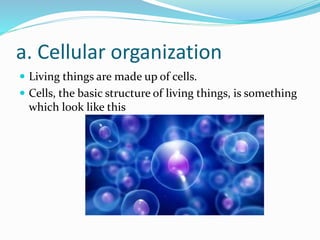
 Cells, the basic structure of living things, is something
which look like this
a. Cellular organization
 It is the smallest unit of life, it has a plasma membrane
which separates its internal environment from the
external environment
 The interior, or space inside the cell contains the
cytoplasm and DNA (deoxyribonucleic acid).
a. Cellular organization
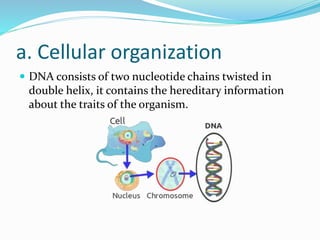
 DNA consists of two nucleotide chains twisted in
double helix, it contains the hereditary information
about the traits of the organism.
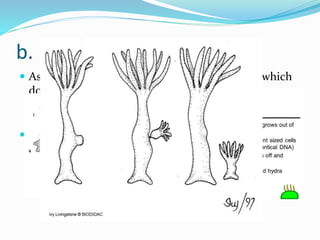
b. Reproduction
 Reproduction is the biological process by which new
individual organisms, “offspring” , are produced from
their “parents”.
 Living things are produced by another living organism.
 There are two types of reproduction, a. sexual and b.
asexual reproduction
b. Reproduction
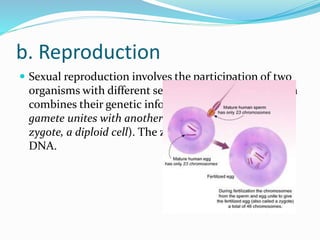
 Sexual reproduction involves the participation of two
organisms with different sexes in a sexual union which
combines their genetic information. ( A male haploid
gamete unites with another female gamete form a
zygote, a diploid cell). The zygote contains the new
DNA.
b. Reproduction
 Asexual reproduction is a type of reproduction which
does not require the participation of another
organism. The organism is an offspring only of one
parent.
 Common among uni-cellular organisms, but is also
found among multi-cellular organisms.
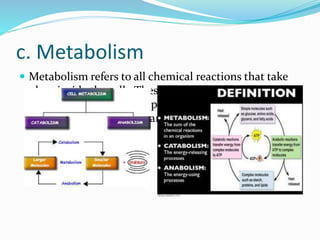
c. Metabolism
 Metabolism refers to all chemical reactions that take
place inside the cell. These chemical reactions are
behind the formation of proteins, digestion of
substances, cell division and energy transformation.
d. Homeostasis
 Living things are capable of maintaining a stable
internal environment.
 Examples of homeostasis among human beings:
 Body temperature . Too cold, we shake. Too warm, we
perspire)
 Glucose concentration. Too much glucose, body
releases insulin. Too few, body releases cortisol and
glucagon to increase glucose concentration)
 Calcium balance. Too few, body releases PTH
instructing our bones to release calcium.
d. Homeostasis
 Too much calcium in blood, the thyroid glands
releases calcitonin and fixes calcium into the bones.
 Fluid volume. Too much, we urinate. Too few,
antidiuretic hormones signals the kidney to retain
fluid and decrease urine output.
e. Heredity
 Heredity is the capability of living things to pass
genetic information to an offspring either through
sexual or asexual reproduction.
f. Response to stimuli
 Living things can sense change in its external
environment and react to that change. What happens
to a living thing when it is unable to react to many
changes in the environment?
 The organisms capacity for homeostasis is an example
of an involuntary response to stimulus.
f. Response to stimuli
 CIPA, congenital insensitivity to pain with anhidrosis
(the body does not sweat). A congenital disorder
which makes a person unable to feel any physical pain.
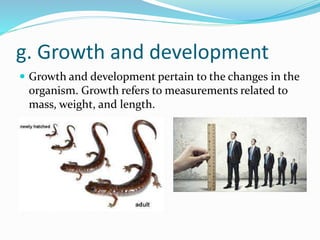
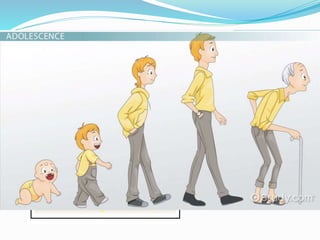
g. Growth and development
 Growth and development pertain to the changes in the
organism. Growth refers to measurements related to
mass, weight, and length.
g. Growth and development
 Development refers to the stages of transformation of
an organism from a lone cell with less complex
structure, to a multi-cellular organism with
differentiated tissues and organs, with complex
structure and functions.
h. Adaptation through evolution
 Adaptation is a process by which an animal or plant
species becomes fitted to its environment.
 The development in the structure and functioning of
cells through time that improves it fitness to survive.
 Adaptation through evolution (natural selection)
means those traits which do not give an organism a
survival advantage eventually disappear over a time
period.
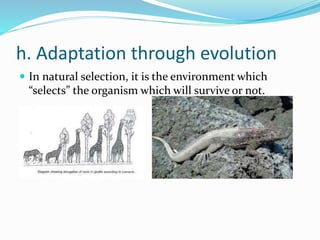
h. Adaptation through evolution
 In natural selection, it is the environment which
“selects” the organism which will survive or not.
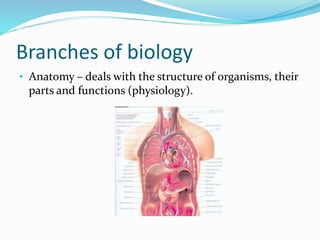
Branches of biology
• Anatomy – deals with the structure of organisms, their
parts and functions (physiology).
Branches of biology
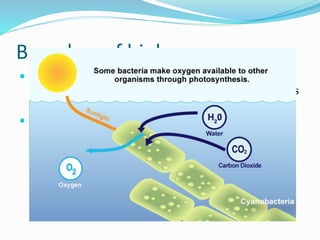
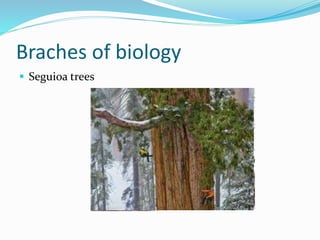
 Botany – the study of plants. Plants range from fungi
or bacteria with plant-like characteristics to giant trees
like the seguioa trees.
 Cyanobacteria – bacteria capable of photosynthesis.
Braches of biology
 Seguioa trees
Branches of biology
 Biochemistry – concerned with the chemical and
physicochemical processes that take place within a
living organisms
 Biophysics – the application of physical laws to
biological organisms. Examples of physical laws:
gravity, electricity, pressure-volume-density, sound
waves, light waves, etc.
 Biotechnology – the genetic re-engineering or
manipulation of biological process to produce
antibiotics, hormones, vaccines, GMOs, etc.
Branches of biology
 Cell biology- the study of cell structure and function.
 Ecology – the study of relations of organisms among
themselves and in relation to their environment.
 Evolution – the study of how various species of
organisms developed and diversified from its earlier
forms to its present form.
 Genes – the study of genes, genetic variation, and
heredity among living organisms.
Branches of biology
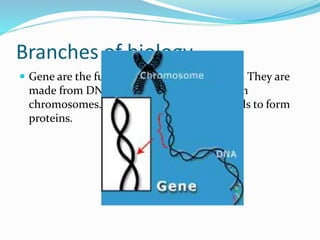
 Gene are the fundamental units of heredity. They are
made from DNA molecules and are found in
chromosomes. They give instructions to cells to form
proteins.
Branches of biology
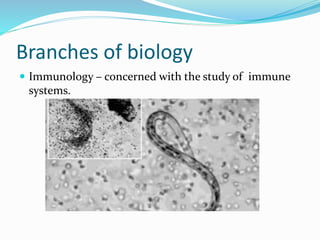
 Immunology – concerned with the study of immune
systems.
Branches of biology
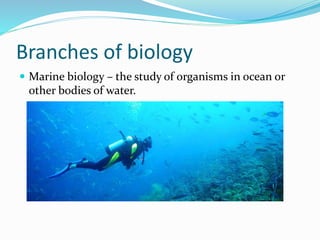
 Marine biology – the study of organisms in ocean or
other bodies of water.
Branches of biology
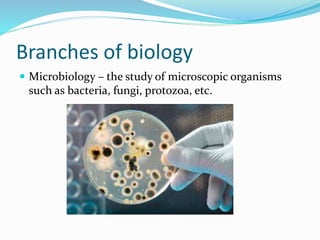
 Microbiology – the study of microscopic organisms
such as bacteria, fungi, protozoa, etc.
Branches of biology
 Molecular biology – studies the structure and function
of proteins and nucleic acids.
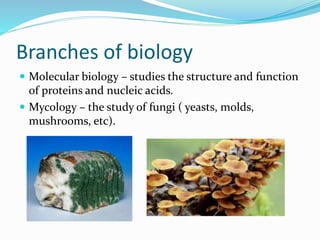
 Mycology – the study of fungi ( yeasts, molds,
mushrooms, etc).
Branches of biology
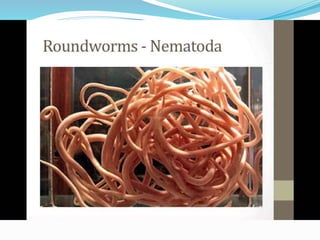
 Parasitology – the study of parasitic organisms,
(intestinal parasites: helminths and protozoans)
Branches of biology
 Photobiology – studies the interaction of light and
living organisms (photosynthesis, circadian rhythms,
bioluminescence, effects of UV light,
photomorphogenesis)
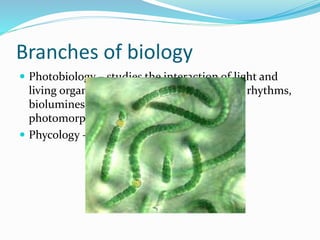
 Phycology – the study of algae
Branches of biology
 Phycology also sometimes referred to as algology.
 Physiology – the study of the normal functions of
living organisms and their parts. (Plant physiology,
animal physiology)
 Radiobiology – the study of the effects of ionizing
radiation on living things.
 Structural biology – a branch of microbiology,
biochemistry, and biophysics dealing with the
molecular structure of biological macromolecules
(protein).
Branches of biology
 Mathematical (theoretical) biology – an
interdisciplinary approach to biology that uses the
tools of mathematics.
 Virology – studies viruses ( infectious agent that
replicates only inside the living cells of organisms). A
virus is somewhere between living and nonliving
organism.
 Zoology – the study of the behavior, structure,
physiology, classification, and distribution of animals.

Biology 101

  • 1.
    What is biology,what is life, history of biology, branches of biology, the scientific method
  • 2.
    What is biology? It is the scientific study of living things.  When is a thing a living thing?  How does one perform a scientific study?
  • 3.
    What are thecharacteristics of an object so that it can be considered alive? a. Cellular organization b. Reproduction c. Metabolism d. Homeostasis e. Heredity f. Response to stimuli g. Growth and development h. Adaptation through evolution
  • 4.
    a. Cellular organization Living things are made up of cells.  Cells, the basic structure of living things, is something which look like this
  • 5.
    a. Cellular organization It is the smallest unit of life, it has a plasma membrane which separates its internal environment from the external environment  The interior, or space inside the cell contains the cytoplasm and DNA (deoxyribonucleic acid).
  • 6.
    a. Cellular organization DNA consists of two nucleotide chains twisted in double helix, it contains the hereditary information about the traits of the organism.
  • 7.
    b. Reproduction  Reproductionis the biological process by which new individual organisms, “offspring” , are produced from their “parents”.  Living things are produced by another living organism.  There are two types of reproduction, a. sexual and b. asexual reproduction
  • 8.
    b. Reproduction  Sexualreproduction involves the participation of two organisms with different sexes in a sexual union which combines their genetic information. ( A male haploid gamete unites with another female gamete form a zygote, a diploid cell). The zygote contains the new DNA.
  • 9.
    b. Reproduction  Asexualreproduction is a type of reproduction which does not require the participation of another organism. The organism is an offspring only of one parent.  Common among uni-cellular organisms, but is also found among multi-cellular organisms.
  • 10.
    c. Metabolism  Metabolismrefers to all chemical reactions that take place inside the cell. These chemical reactions are behind the formation of proteins, digestion of substances, cell division and energy transformation.
  • 11.
    d. Homeostasis  Livingthings are capable of maintaining a stable internal environment.  Examples of homeostasis among human beings:  Body temperature . Too cold, we shake. Too warm, we perspire)  Glucose concentration. Too much glucose, body releases insulin. Too few, body releases cortisol and glucagon to increase glucose concentration)  Calcium balance. Too few, body releases PTH instructing our bones to release calcium.
  • 12.
    d. Homeostasis  Toomuch calcium in blood, the thyroid glands releases calcitonin and fixes calcium into the bones.  Fluid volume. Too much, we urinate. Too few, antidiuretic hormones signals the kidney to retain fluid and decrease urine output.
  • 13.
    e. Heredity  Heredityis the capability of living things to pass genetic information to an offspring either through sexual or asexual reproduction.
  • 14.
    f. Response tostimuli  Living things can sense change in its external environment and react to that change. What happens to a living thing when it is unable to react to many changes in the environment?  The organisms capacity for homeostasis is an example of an involuntary response to stimulus.
  • 15.
    f. Response tostimuli  CIPA, congenital insensitivity to pain with anhidrosis (the body does not sweat). A congenital disorder which makes a person unable to feel any physical pain.
  • 16.
    g. Growth anddevelopment  Growth and development pertain to the changes in the organism. Growth refers to measurements related to mass, weight, and length.
  • 17.
    g. Growth anddevelopment  Development refers to the stages of transformation of an organism from a lone cell with less complex structure, to a multi-cellular organism with differentiated tissues and organs, with complex structure and functions.
  • 18.
    h. Adaptation throughevolution  Adaptation is a process by which an animal or plant species becomes fitted to its environment.  The development in the structure and functioning of cells through time that improves it fitness to survive.  Adaptation through evolution (natural selection) means those traits which do not give an organism a survival advantage eventually disappear over a time period.
  • 19.
    h. Adaptation throughevolution  In natural selection, it is the environment which “selects” the organism which will survive or not.
  • 20.
    Branches of biology •Anatomy – deals with the structure of organisms, their parts and functions (physiology).
  • 21.
    Branches of biology Botany – the study of plants. Plants range from fungi or bacteria with plant-like characteristics to giant trees like the seguioa trees.  Cyanobacteria – bacteria capable of photosynthesis.
  • 22.
  • 23.
    Branches of biology Biochemistry – concerned with the chemical and physicochemical processes that take place within a living organisms  Biophysics – the application of physical laws to biological organisms. Examples of physical laws: gravity, electricity, pressure-volume-density, sound waves, light waves, etc.  Biotechnology – the genetic re-engineering or manipulation of biological process to produce antibiotics, hormones, vaccines, GMOs, etc.
  • 24.
    Branches of biology Cell biology- the study of cell structure and function.  Ecology – the study of relations of organisms among themselves and in relation to their environment.  Evolution – the study of how various species of organisms developed and diversified from its earlier forms to its present form.  Genes – the study of genes, genetic variation, and heredity among living organisms.
  • 25.
    Branches of biology Gene are the fundamental units of heredity. They are made from DNA molecules and are found in chromosomes. They give instructions to cells to form proteins.
  • 26.
    Branches of biology Immunology – concerned with the study of immune systems.
  • 27.
    Branches of biology Marine biology – the study of organisms in ocean or other bodies of water.
  • 28.
    Branches of biology Microbiology – the study of microscopic organisms such as bacteria, fungi, protozoa, etc.
  • 29.
    Branches of biology Molecular biology – studies the structure and function of proteins and nucleic acids.  Mycology – the study of fungi ( yeasts, molds, mushrooms, etc).
  • 30.
    Branches of biology Parasitology – the study of parasitic organisms, (intestinal parasites: helminths and protozoans)
  • 31.
    Branches of biology Photobiology – studies the interaction of light and living organisms (photosynthesis, circadian rhythms, bioluminescence, effects of UV light, photomorphogenesis)  Phycology – the study of algae
  • 32.
    Branches of biology Phycology also sometimes referred to as algology.  Physiology – the study of the normal functions of living organisms and their parts. (Plant physiology, animal physiology)  Radiobiology – the study of the effects of ionizing radiation on living things.  Structural biology – a branch of microbiology, biochemistry, and biophysics dealing with the molecular structure of biological macromolecules (protein).
  • 33.
    Branches of biology Mathematical (theoretical) biology – an interdisciplinary approach to biology that uses the tools of mathematics.  Virology – studies viruses ( infectious agent that replicates only inside the living cells of organisms). A virus is somewhere between living and nonliving organism.  Zoology – the study of the behavior, structure, physiology, classification, and distribution of animals.