Dr. Abdul Matin, PhD, PDPhil, PGCHE
Associate Professor
Department of Medical Laboratory Sciences
Majmaah University, Kingdom of Saudia Arabia
Email: a.shafiqurhman@mu.edu.sa
Mobile: 0538569781
Biology (Bio-102)
Lecture-1
October 10, 2016
Campbell, N. A. and Reece, J. B.
2005
Biology
(6th edition)
Pearson Education. Inc. USA.
• Biology literally means "the study of life".
• Biology is such a broad field, covering the minute
workings of chemical machines inside our cells, to
broad scale concepts of ecosystems and global
climate change.
• Biologists study intimate details of the different
human organs, systems, composition of our
genes, and even the functioning of our
reproductive system.
• Biochemistry - the study of the chemical reactions
required for life to exist and function, usually a
focus on the cellular level
• Bioengineering - the study of biology through the
means of engineering with an emphasis on applied
knowledge and especially related to biotechnology.
• Bioinformatics - the use of information technology
for the study, collection, and storage of genomic
and other biological data
Branches of Biology
 These are the main branches of biology:
• Aerobiology - is a branch of biology that studies
organic particles, such as bacteria, fungal spores,
very small insects, pollen grains and viruses, which
are passively transported by the air (Spieksma,
1991).
• Anatomy - the study of form, in plants, animals, and
other organisms, or specifically in humans
• Astrobiology- the study of evolution, distribution, and
future of life in the universe. Also known as
exobiology, and bioastronomy.
• Biomathematics or Mathematical Biology - the
quantitative or mathematical study of biological
processes, with an emphasis on modeling.
• Biomechanics - often considered a branch of
medicine, the study of the mechanics of living
beings, with an emphasis on applied use through
artificial limbs, etc.
• Biomedical research - the study of the human body
in health and disease
• Biophysics - the study of biological processes
through physics, by applying the theories and
methods traditionally used in the physical sciences
• Biotechnology - a new and sometimes controversial
branch of biology that studies the manipulation of
living matter, including genetic modification.
• Botany - the study of plants
• Cell biology - the study of the cell as a complete
unit, and the molecular and chemical interactions
that occur within a living cell.
• Conservation Biology - the study of the
preservation, protection, or restoration of the natural
environment, natural ecosystems, vegetation, and
wildlife
• Cryobiology - the study of the effects of lower than
normally preferred temperatures on living beings.
•Developmental biology - the study of the processes
through which an organism forms, from zygote to full
structure.
•Ecology - the study of the interactions of living
organisms with one another and with the non-living
elements of their environment.
•Embryology - the study of the development of embryo
(from fecundation to birth). See also topobiology.
•Entomology - the study of insects
•Environmental Biology - the study of the natural
world, as a whole or in a particular area, especially as
affected by human activity
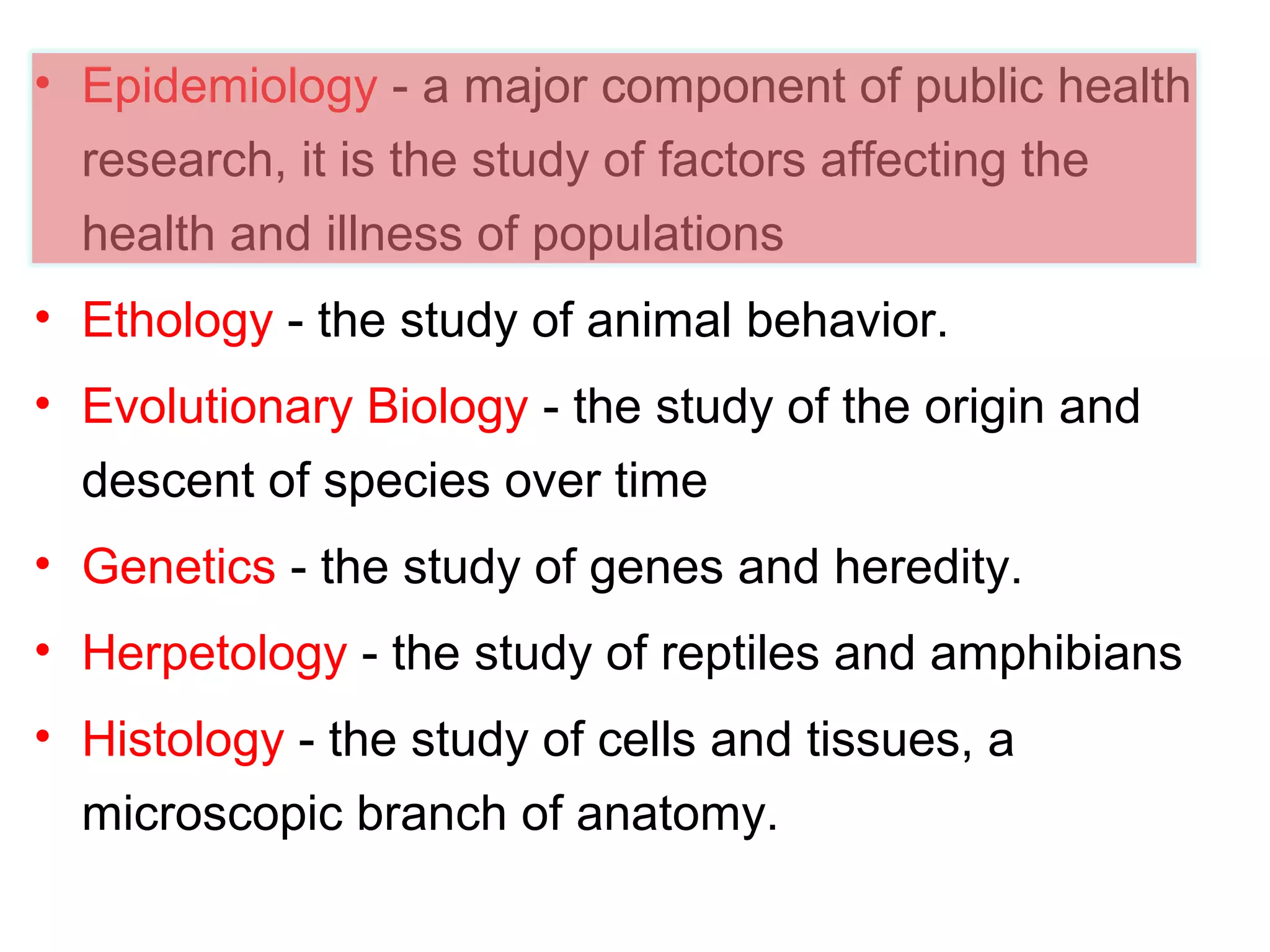
• Epidemiology - a major component of public health
research, it is the study of factors affecting the
health and illness of populations
• Ethology - the study of animal behavior.
• Evolutionary Biology - the study of the origin and
descent of species over time
• Genetics - the study of genes and heredity.
• Herpetology - the study of reptiles and amphibians
• Histology - the study of cells and tissues, a
microscopic branch of anatomy.
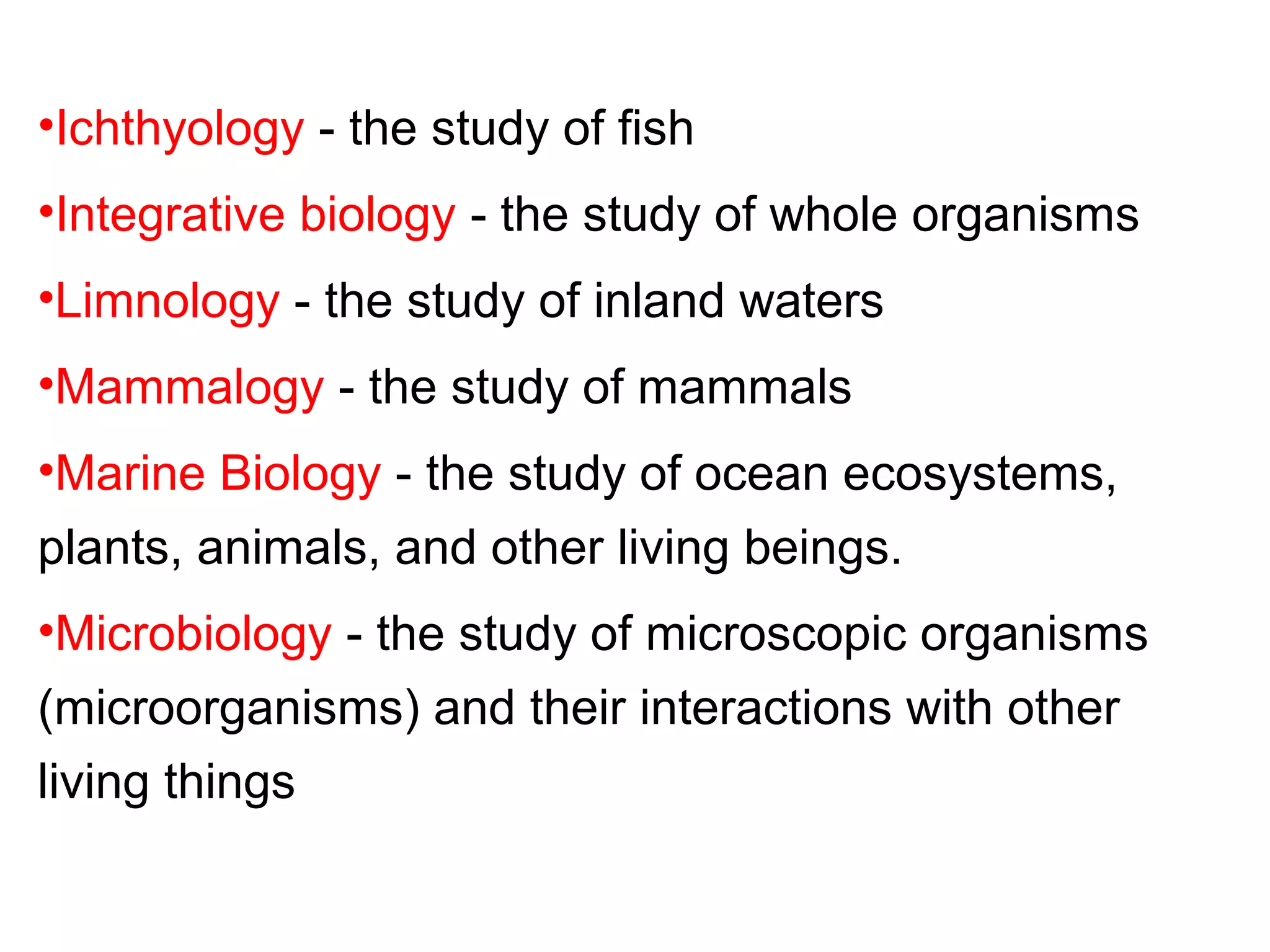
•Ichthyology - the study of fish
•Integrative biology - the study of whole organisms
•Limnology - the study of inland waters
•Mammalogy - the study of mammals
•Marine Biology - the study of ocean ecosystems,
plants, animals, and other living beings.
•Microbiology - the study of microscopic organisms
(microorganisms) and their interactions with other
living things
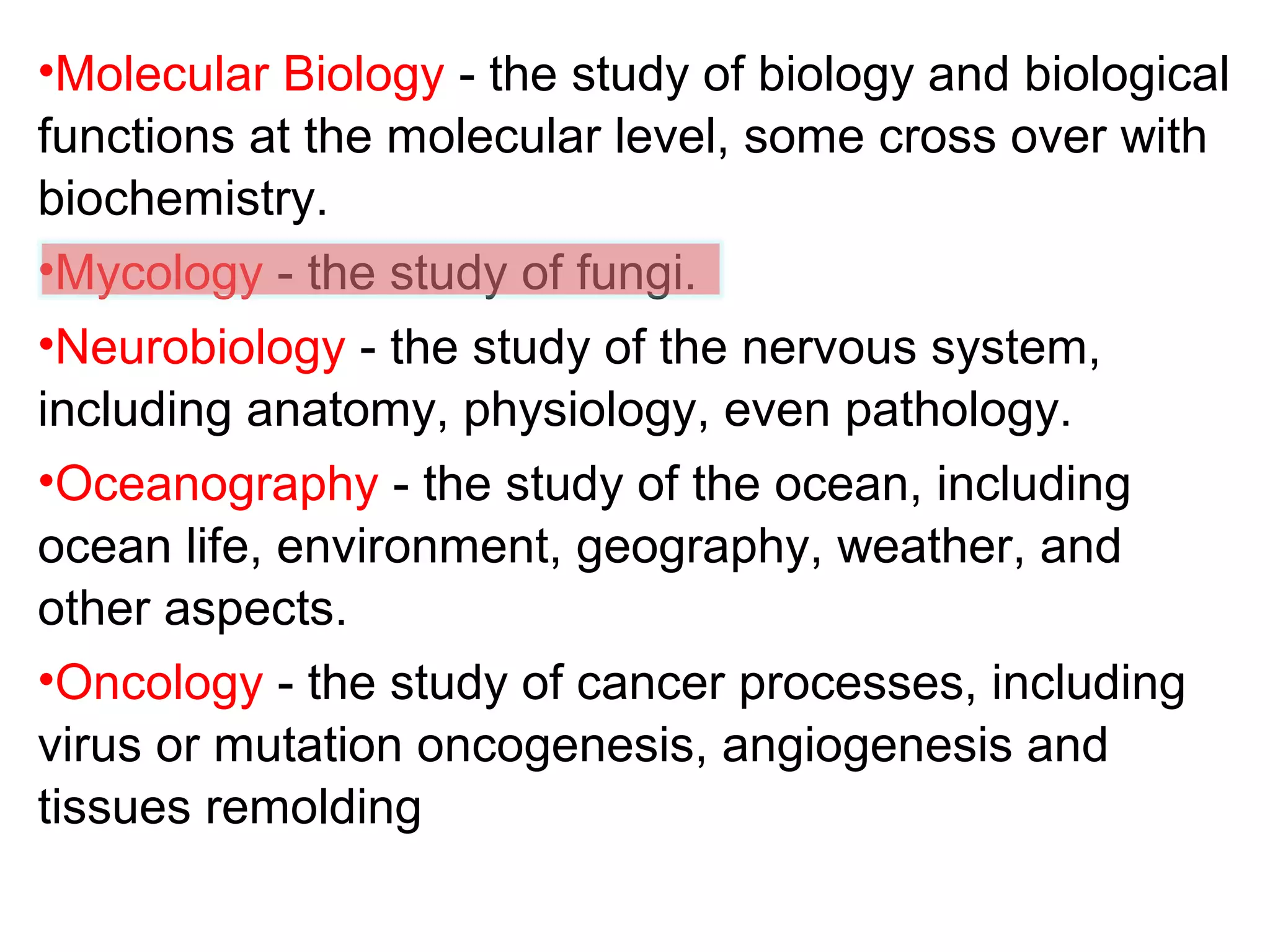
•Molecular Biology - the study of biology and biological
functions at the molecular level, some cross over with
biochemistry.
•Mycology - the study of fungi.
•Neurobiology - the study of the nervous system,
including anatomy, physiology, even pathology.
•Oceanography - the study of the ocean, including
ocean life, environment, geography, weather, and
other aspects.
•Oncology - the study of cancer processes, including
virus or mutation oncogenesis, angiogenesis and
tissues remolding
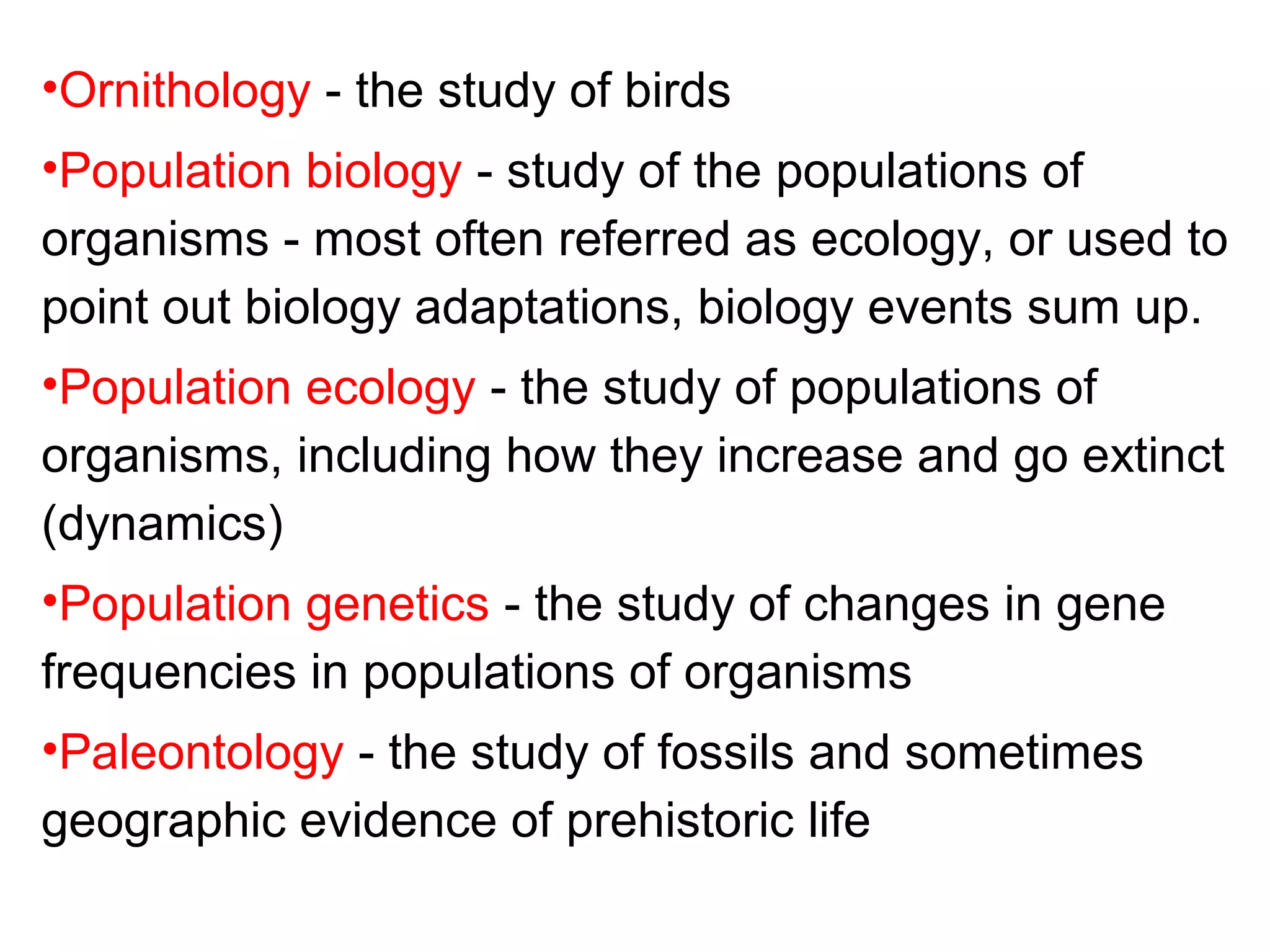
•Ornithology - the study of birds
•Population biology - study of the populations of
organisms - most often referred as ecology, or used to
point out biology adaptations, biology events sum up.
•Population ecology - the study of populations of
organisms, including how they increase and go extinct
(dynamics)
•Population genetics - the study of changes in gene
frequencies in populations of organisms
•Paleontology - the study of fossils and sometimes
geographic evidence of prehistoric life
• Pathobiology or pathology - the study of diseases,
and the causes, processes, nature, and
development of disease
• Parasitology - the study of parasites and
parasitism
• Pharmacology - the study and practical
application of preparation, use, and effects of
drugs and synthetic medicines.
• Physiology - the study of the functioning of living
organisms and the organs and parts of living
organisms
• Phytopathology - the study of plant diseases (also
called Plant Pathology)
• Psychobiology - study of the biological bases of
psychology
• Sociobiology - study of the biological bases of
sociology
• Structural biology - a branch of molecular biology,
biochemistry, and biophysics concerned with the
molecular structure of biological macromolecules
• Virology - the study of viruses and some other
virus-like agents
• Zoology - the study of animals, including
classification, physiology, development, and
behavior.
What is Life?
• Growth and development
• Metabolism
• Homeostasis
• Movement
• Response to stimuli
• Reproduction
• Evolution and adaptation
Characteristics of living things
•Living things have a variety of common
characteristics:
•Organization: Living things exhibit a high level of
organization, with multicellular organisms being
subdivided into cells, and cells into organelles, and
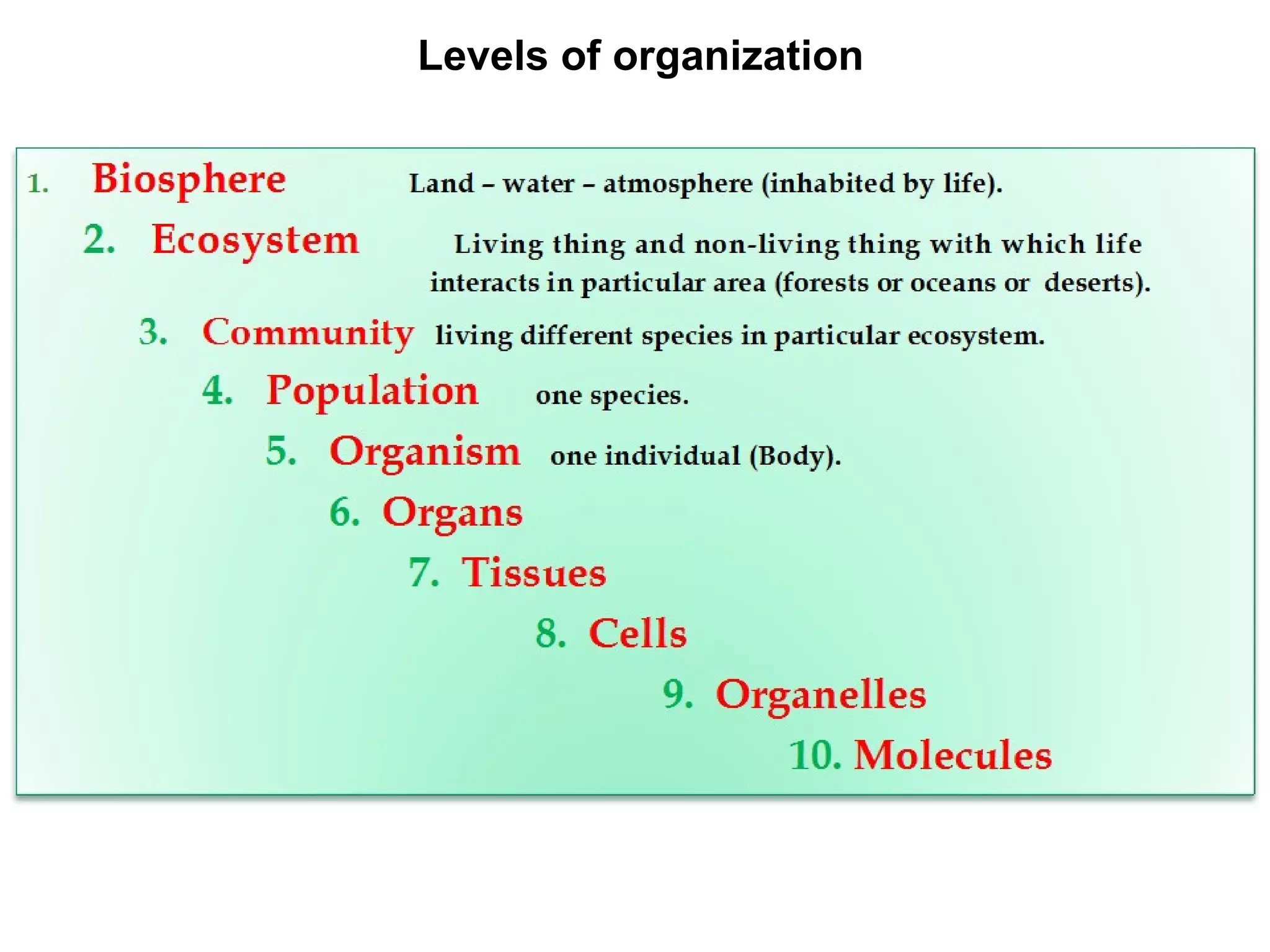
organelles into molecules, etc.
•Homeostasis: Homeostasis is the maintenance of a
constant (yet also dynamic) internal environment in
terms of temperature, pH, water concentrations, etc.
•Much of our own metabolic energy goes toward
keeping within our own homeostatic limits.
• If you run a high fever for long enough, the
increased temperature will damage certain
organs and impair your proper functioning.
• Swallowing of common household chemicals,
many of which are outside the pH (acid/base)
levels we can tolerate, will likewise negatively
impact the human body's homeostatic regime.
• Muscular activity generates heat as a waste
product. This heat is removed from our bodies by
sweating. Some of this heat is used by warm-
blooded animals, mammals and birds, to maintain
their internal temperatures.
• Adaptation: Living things are suited to their mode of
existence.
• Reproduction and heredity: Since all cells come from
existing cells, they must have some way of reproducing,
whether that involves asexual (no recombination of genetic
material) or sexual (recombination of genetic material).
• Most living things use the chemical DNA (deoxyribonucleic
acid) as the physical carrier of inheritance and the genetic
information.
• Some organisms, such as retroviruses (of which HIV is a
member), use RNA (ribonucleic acid) as the carrier.
• The variation that Darwin and Wallace recognized as the
wellspring of evolution and adaptation, is greatly increased
by sexual reproduction.
•Growth and development:
•Even single-celled organisms grow.
•When first formed by cell division, they are small, and must
grow and develop into mature cells.
•Multicellular organisms pass through a more complicated
process of differentiation and organogenesis (because they
have so many more cells to develop).
•Energy acquisition and release: One view of life is that it is a
struggle to acquire energy (from sunlight, inorganic chemicals,
or another organism), and release it in the process of forming
ATP (adenosine triphosphate).
• Detection and response to stimuli (both internal and external)
• Interactions: Living things interact with their environment as
well as each other.
• Organisms obtain raw materials and energy from the
environment or another organism.
• The various types of symbioses (organismal interactions with
each other) are examples of this.
Levels of organization
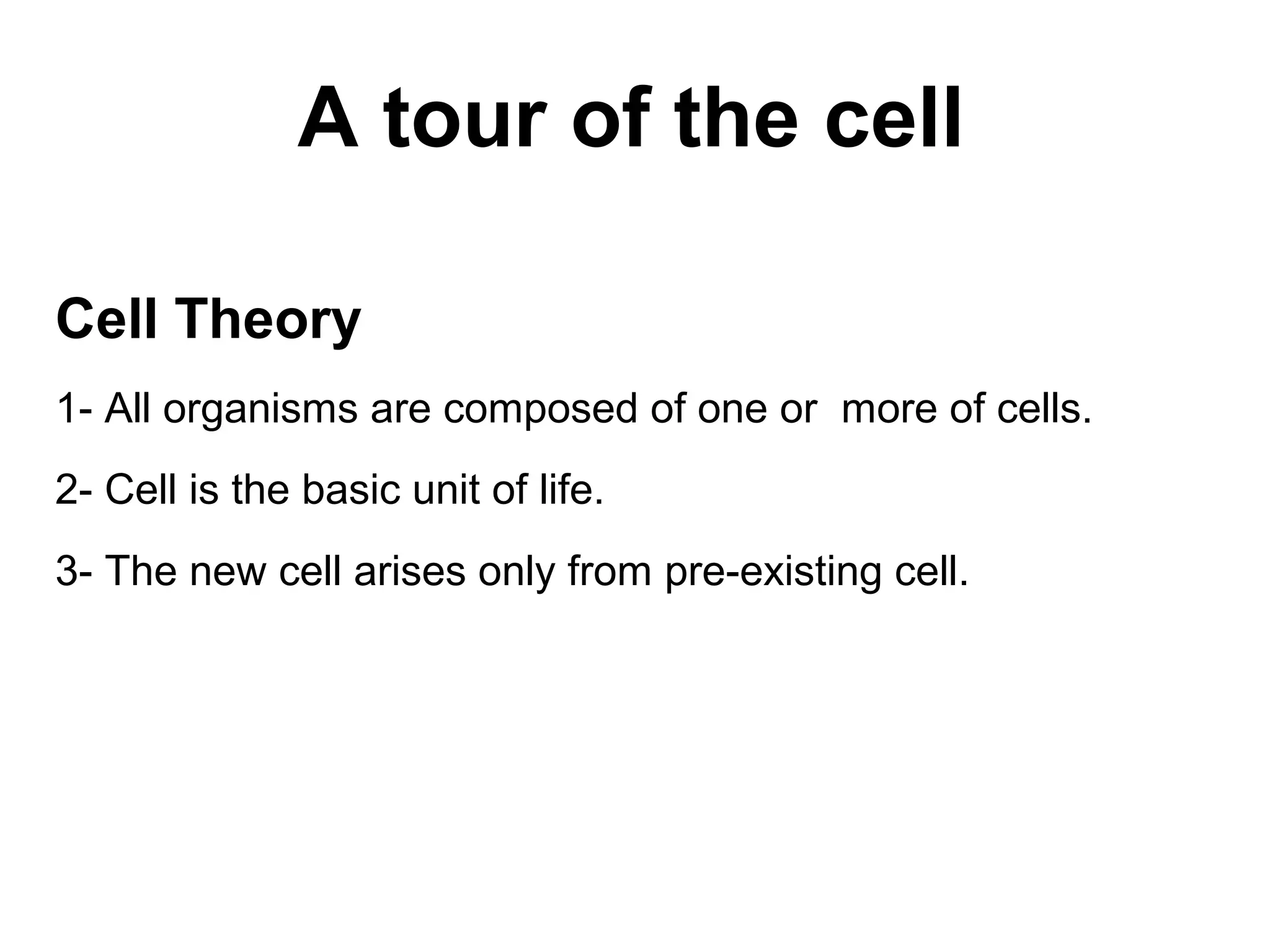
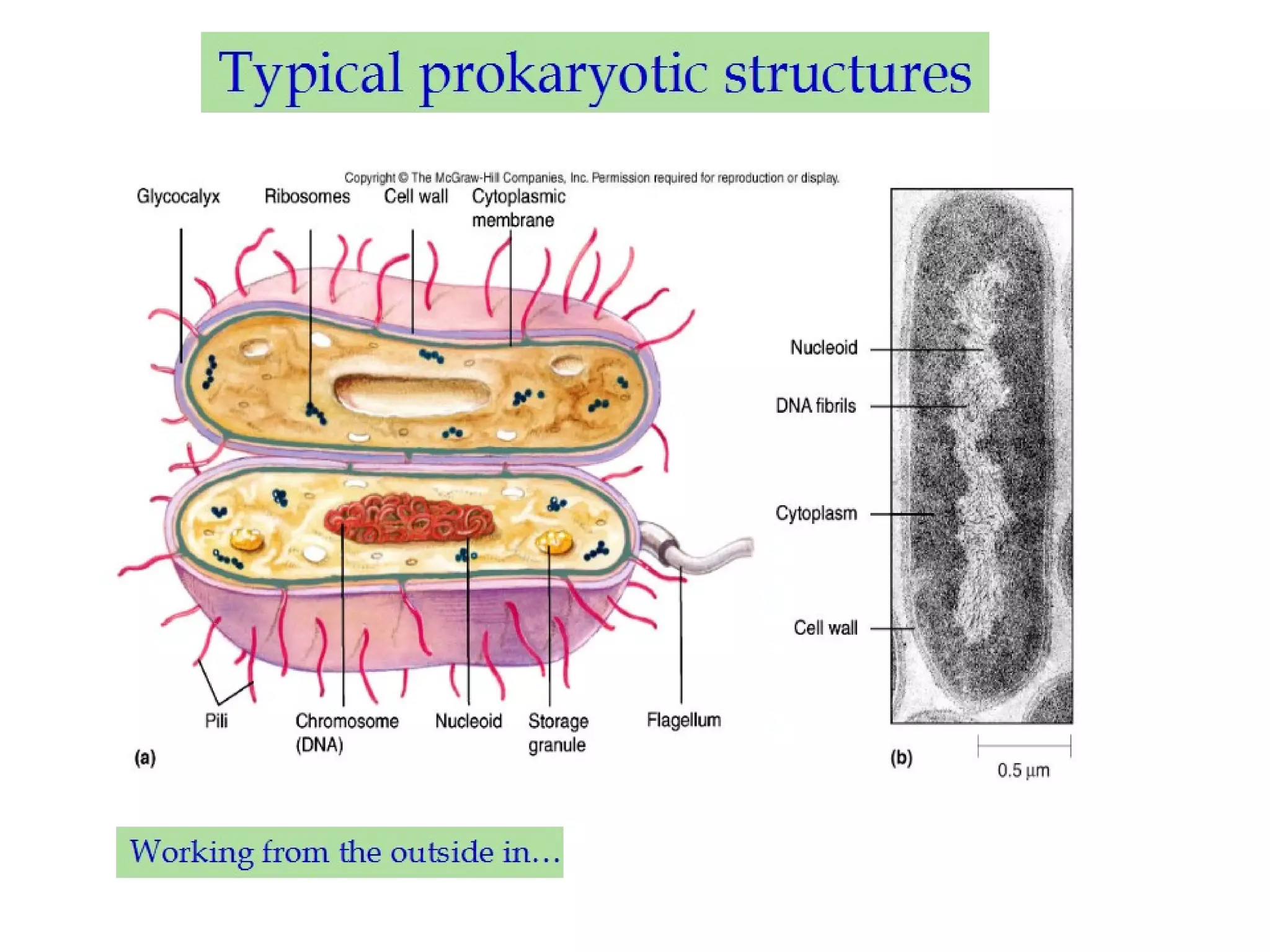
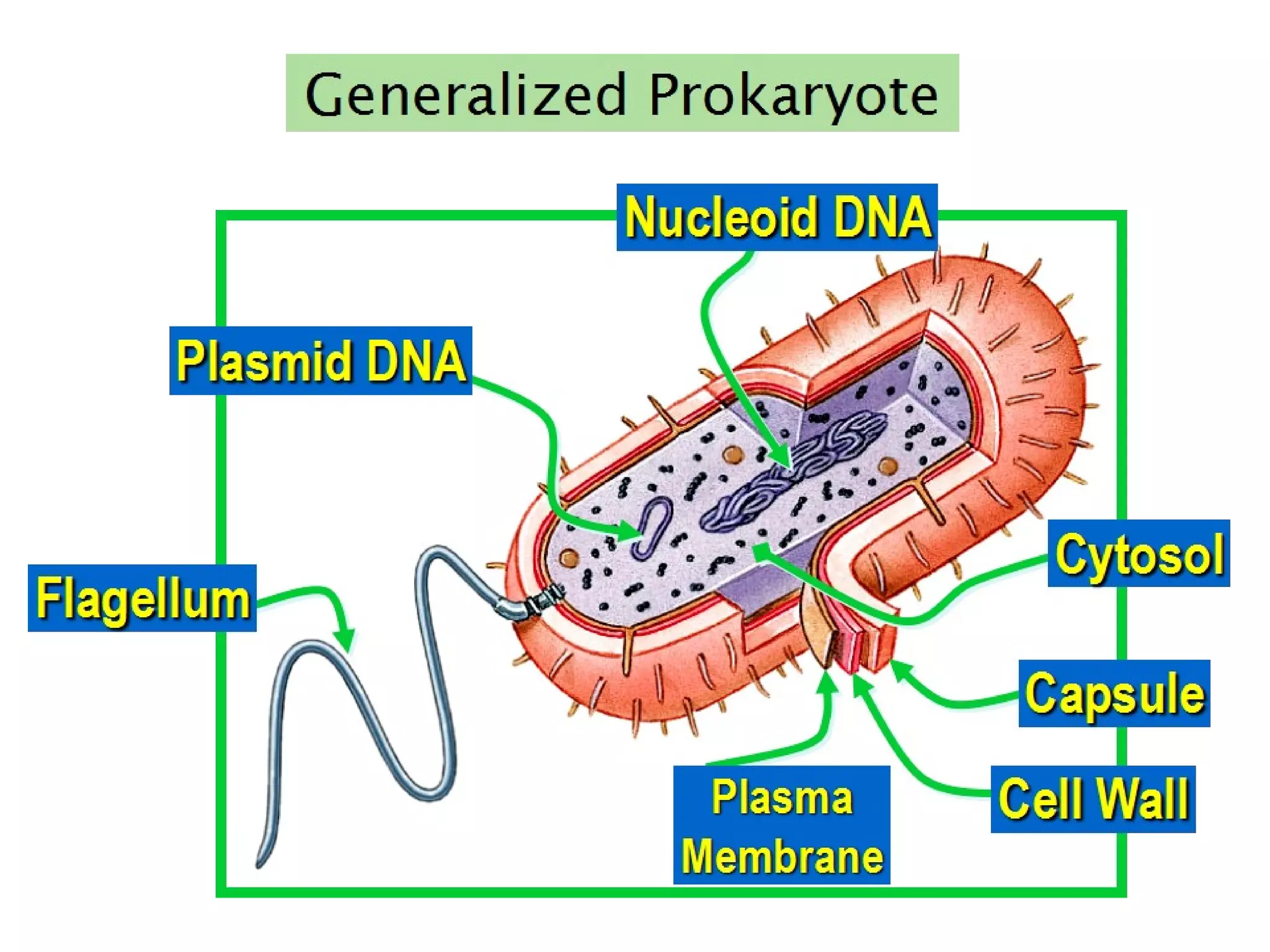
A tour of the cell
Cell Theory
1- All organisms are composed of one or more of cells.
2- Cell is the basic unit of life.
3- The new cell arises only from pre-existing cell.
Lecture 1 bio
Lecture 1 bio
Lecture 1 bio
Lecture 1 bio
Lecture 1 bio
Lecture 1 bio
Lecture 1 bio
Lecture 1 bio

Lecture 1 bio

  • 1.
    Dr. Abdul Matin,PhD, PDPhil, PGCHE Associate Professor Department of Medical Laboratory Sciences Majmaah University, Kingdom of Saudia Arabia Email: a.shafiqurhman@mu.edu.sa Mobile: 0538569781 Biology (Bio-102) Lecture-1 October 10, 2016
  • 2.
    Campbell, N. A.and Reece, J. B. 2005 Biology (6th edition) Pearson Education. Inc. USA.
  • 3.
    • Biology literallymeans "the study of life". • Biology is such a broad field, covering the minute workings of chemical machines inside our cells, to broad scale concepts of ecosystems and global climate change. • Biologists study intimate details of the different human organs, systems, composition of our genes, and even the functioning of our reproductive system.
  • 4.
    • Biochemistry -the study of the chemical reactions required for life to exist and function, usually a focus on the cellular level • Bioengineering - the study of biology through the means of engineering with an emphasis on applied knowledge and especially related to biotechnology. • Bioinformatics - the use of information technology for the study, collection, and storage of genomic and other biological data
  • 5.
    Branches of Biology These are the main branches of biology: • Aerobiology - is a branch of biology that studies organic particles, such as bacteria, fungal spores, very small insects, pollen grains and viruses, which are passively transported by the air (Spieksma, 1991). • Anatomy - the study of form, in plants, animals, and other organisms, or specifically in humans • Astrobiology- the study of evolution, distribution, and future of life in the universe. Also known as exobiology, and bioastronomy.
  • 6.
    • Biomathematics orMathematical Biology - the quantitative or mathematical study of biological processes, with an emphasis on modeling. • Biomechanics - often considered a branch of medicine, the study of the mechanics of living beings, with an emphasis on applied use through artificial limbs, etc. • Biomedical research - the study of the human body in health and disease • Biophysics - the study of biological processes through physics, by applying the theories and methods traditionally used in the physical sciences
  • 7.
    • Biotechnology -a new and sometimes controversial branch of biology that studies the manipulation of living matter, including genetic modification. • Botany - the study of plants • Cell biology - the study of the cell as a complete unit, and the molecular and chemical interactions that occur within a living cell. • Conservation Biology - the study of the preservation, protection, or restoration of the natural environment, natural ecosystems, vegetation, and wildlife • Cryobiology - the study of the effects of lower than normally preferred temperatures on living beings.
  • 8.
    •Developmental biology -the study of the processes through which an organism forms, from zygote to full structure. •Ecology - the study of the interactions of living organisms with one another and with the non-living elements of their environment. •Embryology - the study of the development of embryo (from fecundation to birth). See also topobiology. •Entomology - the study of insects •Environmental Biology - the study of the natural world, as a whole or in a particular area, especially as affected by human activity
  • 9.
    • Epidemiology -a major component of public health research, it is the study of factors affecting the health and illness of populations • Ethology - the study of animal behavior. • Evolutionary Biology - the study of the origin and descent of species over time • Genetics - the study of genes and heredity. • Herpetology - the study of reptiles and amphibians • Histology - the study of cells and tissues, a microscopic branch of anatomy.
  • 10.
    •Ichthyology - thestudy of fish •Integrative biology - the study of whole organisms •Limnology - the study of inland waters •Mammalogy - the study of mammals •Marine Biology - the study of ocean ecosystems, plants, animals, and other living beings. •Microbiology - the study of microscopic organisms (microorganisms) and their interactions with other living things
  • 11.
    •Molecular Biology -the study of biology and biological functions at the molecular level, some cross over with biochemistry. •Mycology - the study of fungi. •Neurobiology - the study of the nervous system, including anatomy, physiology, even pathology. •Oceanography - the study of the ocean, including ocean life, environment, geography, weather, and other aspects. •Oncology - the study of cancer processes, including virus or mutation oncogenesis, angiogenesis and tissues remolding
  • 12.
    •Ornithology - thestudy of birds •Population biology - study of the populations of organisms - most often referred as ecology, or used to point out biology adaptations, biology events sum up. •Population ecology - the study of populations of organisms, including how they increase and go extinct (dynamics) •Population genetics - the study of changes in gene frequencies in populations of organisms •Paleontology - the study of fossils and sometimes geographic evidence of prehistoric life
  • 13.
    • Pathobiology orpathology - the study of diseases, and the causes, processes, nature, and development of disease • Parasitology - the study of parasites and parasitism • Pharmacology - the study and practical application of preparation, use, and effects of drugs and synthetic medicines. • Physiology - the study of the functioning of living organisms and the organs and parts of living organisms • Phytopathology - the study of plant diseases (also called Plant Pathology)
  • 14.
    • Psychobiology -study of the biological bases of psychology • Sociobiology - study of the biological bases of sociology • Structural biology - a branch of molecular biology, biochemistry, and biophysics concerned with the molecular structure of biological macromolecules • Virology - the study of viruses and some other virus-like agents • Zoology - the study of animals, including classification, physiology, development, and behavior.
  • 15.
    What is Life? •Growth and development • Metabolism • Homeostasis • Movement • Response to stimuli • Reproduction • Evolution and adaptation
  • 16.
    Characteristics of livingthings •Living things have a variety of common characteristics: •Organization: Living things exhibit a high level of organization, with multicellular organisms being subdivided into cells, and cells into organelles, and organelles into molecules, etc. •Homeostasis: Homeostasis is the maintenance of a constant (yet also dynamic) internal environment in terms of temperature, pH, water concentrations, etc. •Much of our own metabolic energy goes toward keeping within our own homeostatic limits.
  • 17.
    • If yourun a high fever for long enough, the increased temperature will damage certain organs and impair your proper functioning. • Swallowing of common household chemicals, many of which are outside the pH (acid/base) levels we can tolerate, will likewise negatively impact the human body's homeostatic regime. • Muscular activity generates heat as a waste product. This heat is removed from our bodies by sweating. Some of this heat is used by warm- blooded animals, mammals and birds, to maintain their internal temperatures.
  • 18.
    • Adaptation: Livingthings are suited to their mode of existence. • Reproduction and heredity: Since all cells come from existing cells, they must have some way of reproducing, whether that involves asexual (no recombination of genetic material) or sexual (recombination of genetic material). • Most living things use the chemical DNA (deoxyribonucleic acid) as the physical carrier of inheritance and the genetic information. • Some organisms, such as retroviruses (of which HIV is a member), use RNA (ribonucleic acid) as the carrier. • The variation that Darwin and Wallace recognized as the wellspring of evolution and adaptation, is greatly increased by sexual reproduction.
  • 19.
    •Growth and development: •Evensingle-celled organisms grow. •When first formed by cell division, they are small, and must grow and develop into mature cells. •Multicellular organisms pass through a more complicated process of differentiation and organogenesis (because they have so many more cells to develop). •Energy acquisition and release: One view of life is that it is a struggle to acquire energy (from sunlight, inorganic chemicals, or another organism), and release it in the process of forming ATP (adenosine triphosphate).
  • 20.
    • Detection andresponse to stimuli (both internal and external) • Interactions: Living things interact with their environment as well as each other. • Organisms obtain raw materials and energy from the environment or another organism. • The various types of symbioses (organismal interactions with each other) are examples of this.
  • 21.
  • 22.
    A tour ofthe cell Cell Theory 1- All organisms are composed of one or more of cells. 2- Cell is the basic unit of life. 3- The new cell arises only from pre-existing cell.