BiologyThe Dynamics of Life
Biology“The Study of Life”
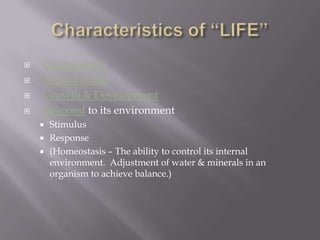
Characteristics of “LIFE”OrganizationReproduction  Growth & Development Respond to its environmentStimulusResponse(Homeostasis – The ability to control its internal environment.  Adjustment of water & minerals in an organism to achieve balance.)
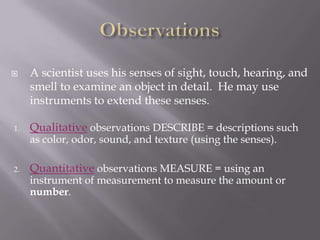
ObservationsA scientist uses his senses of sight, touch, hearing, and smell to examine an object in detail.  He may use instruments to extend these senses.Qualitative observations DESCRIBE = descriptions such as color, odor, sound, and texture (using the senses).Quantitative observations MEASURE = using an instrument of measurement to measure the amount or number.
ObservationsA scientist improves his skills of observation and his communication skills by practice.Observe the following and describe as much as you can.Accident #1Accident #2Accident #3
The Scientific MethodOVERVIEWIdentify a PROBLEM to solve.Make a HYPOTHESIS.TEST the hypothesis and COLLECTDATA.  (a controlled experiment)PUBLISH the results.Draw a CONCLUSION and [perhaps] develop a THEORY.
1. OBSERVATION leads to identifying a problemto solve.“Observing the world around you is the foundation of scientific investigation.”
2. Making a HYPOTHESIS. an EXPLANATION for a question or problem that can be formally TESTED.Not a RANDOM GUESS.
3. Collecting DATA. (numbers) Test the hypothesis in a controlled EXPERIMENT can be used to obtain data to test a  HYPOTHESIS.
4. PUBLISH results allows other scientists to repeat the experiment and VERIFY the results.
4. Forming a THEORY. A THEORY is a hypothesis that is supported by a LARGE body of scientific evidence. (not an unproven idea or hunch)
 Also 6. Developing new HYPOTHESES. 7. Revising the THEORY.
The Scientific MethodREVIEWIdentify a PROBLEM to solve.Make a HYPOTHESIS.TEST the hypothesis and COLLECTDATA.  (a controlled experiment)PUBLISH the results.Draw a CONCLUSION and [perhaps] develop a THEORY.
Parts of a Controlled ExperimentControl – the STANDARD against which the results of the experiment are COMPARED.INDEPENDENT Variable (I.V.) – the condition that is tested because it affects the outcome of the experiment.DEPENDENT Variable (D.V.) – the condition in an experiment that results from the changes made to the independent variable.CONSTANTS – the conditions that remainthesame in all of the experimental groups.
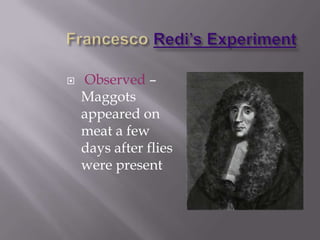
Francesco Redi’s ExperimentObserved – Maggots appeared on meat a few days after flies were present
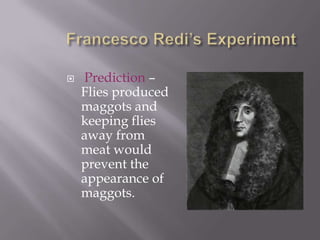
Francesco Redi’s ExperimentPrediction – Flies produced maggots and keeping flies away from meat would prevent the appearance of maggots.
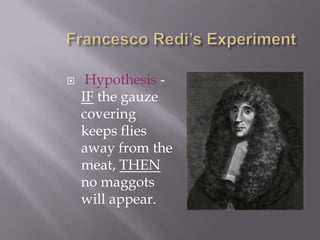
Francesco Redi’s ExperimentHypothesis -    IF the gauze covering keeps flies away from the meat, THEN no maggots will appear.
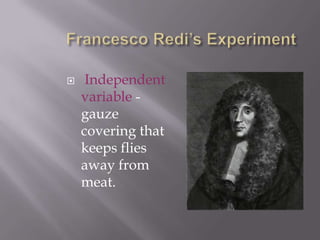
Francesco Redi’s ExperimentIndependent variable -    gauze covering that keeps flies away from meat.
Francesco Redi’s ExperimentDependent variable -    whether maggots appear on the meat.
Francesco Redi’s ExperimentControlled variables -    Jars, type of meat, location, temperature, time.
Francesco Redi’s ExperimentData -    showed that maggots appeared on the meat without gauze – but not on covered jars.
Francesco Redi’s ExperimentConclusion -    Maggots formed only when flies came into contact with the meat.  Not spontaneous generation.

Biology ppt

  • 1.
  • 2.
  • 3.
    Characteristics of “LIFE”OrganizationReproduction Growth & Development Respond to its environmentStimulusResponse(Homeostasis – The ability to control its internal environment. Adjustment of water & minerals in an organism to achieve balance.)
  • 4.
    ObservationsA scientist useshis senses of sight, touch, hearing, and smell to examine an object in detail. He may use instruments to extend these senses.Qualitative observations DESCRIBE = descriptions such as color, odor, sound, and texture (using the senses).Quantitative observations MEASURE = using an instrument of measurement to measure the amount or number.
  • 5.
    ObservationsA scientist improveshis skills of observation and his communication skills by practice.Observe the following and describe as much as you can.Accident #1Accident #2Accident #3
  • 6.
    The Scientific MethodOVERVIEWIdentifya PROBLEM to solve.Make a HYPOTHESIS.TEST the hypothesis and COLLECTDATA. (a controlled experiment)PUBLISH the results.Draw a CONCLUSION and [perhaps] develop a THEORY.
  • 7.
    1. OBSERVATION leadsto identifying a problemto solve.“Observing the world around you is the foundation of scientific investigation.”
  • 8.
    2. Making aHYPOTHESIS. an EXPLANATION for a question or problem that can be formally TESTED.Not a RANDOM GUESS.
  • 9.
    3. Collecting DATA.(numbers) Test the hypothesis in a controlled EXPERIMENT can be used to obtain data to test a HYPOTHESIS.
  • 10.
    4. PUBLISH resultsallows other scientists to repeat the experiment and VERIFY the results.
  • 11.
    4. Forming aTHEORY. A THEORY is a hypothesis that is supported by a LARGE body of scientific evidence. (not an unproven idea or hunch)
  • 12.
    Also 6.Developing new HYPOTHESES. 7. Revising the THEORY.
  • 13.
    The Scientific MethodREVIEWIdentifya PROBLEM to solve.Make a HYPOTHESIS.TEST the hypothesis and COLLECTDATA. (a controlled experiment)PUBLISH the results.Draw a CONCLUSION and [perhaps] develop a THEORY.
  • 14.
    Parts of aControlled ExperimentControl – the STANDARD against which the results of the experiment are COMPARED.INDEPENDENT Variable (I.V.) – the condition that is tested because it affects the outcome of the experiment.DEPENDENT Variable (D.V.) – the condition in an experiment that results from the changes made to the independent variable.CONSTANTS – the conditions that remainthesame in all of the experimental groups.
  • 15.
    Francesco Redi’s ExperimentObserved– Maggots appeared on meat a few days after flies were present
  • 16.
    Francesco Redi’s ExperimentPrediction– Flies produced maggots and keeping flies away from meat would prevent the appearance of maggots.
  • 17.
    Francesco Redi’s ExperimentHypothesis- IF the gauze covering keeps flies away from the meat, THEN no maggots will appear.
  • 18.
    Francesco Redi’s ExperimentIndependentvariable - gauze covering that keeps flies away from meat.
  • 19.
    Francesco Redi’s ExperimentDependentvariable - whether maggots appear on the meat.
  • 20.
    Francesco Redi’s ExperimentControlledvariables - Jars, type of meat, location, temperature, time.
  • 21.
    Francesco Redi’s ExperimentData- showed that maggots appeared on the meat without gauze – but not on covered jars.
  • 22.
    Francesco Redi’s ExperimentConclusion- Maggots formed only when flies came into contact with the meat. Not spontaneous generation.