Biochemical Reactions 4 kinds used for making/breaking macromolecules neutralization (acid-base)  redox (oxidation-reduction)  hydrolysis condensation
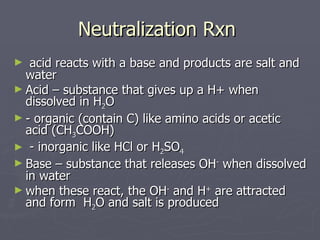
Neutralization Rxn  acid reacts with a base and products are salt and water Acid – substance that gives up a H+ when dissolved in H 2 O - organic (contain C) like amino acids or acetic acid (CH 3 COOH) - inorganic like HCl or H 2 SO 4 Base – substance that releases OH -  when dissolved in water when these react, the OH -  and H +  are attracted and form  H 2 O and salt is produced
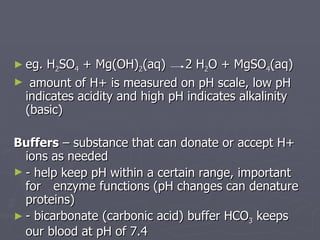
eg. H 2 SO 4  + Mg(OH) 2 (aq)    2 H 2 O + MgSO 4 (aq) amount of H+ is measured on pH scale, low pH indicates acidity and high pH indicates alkalinity (basic) Buffers  – substance that can donate or accept H+ ions as needed  - help keep pH within a certain range, important for    enzyme functions (pH changes can denature proteins) - bicarbonate (carbonic acid) buffer HCO 3  keeps our blood at pH of 7.4
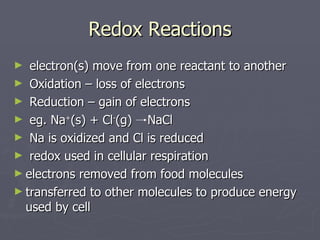
Redox Reactions electron(s) move from one reactant to another Oxidation – loss of electrons Reduction – gain of electrons eg. Na + (s) + Cl ­ (g)  NaCl Na is oxidized and Cl is reduced redox used in cellular respiration electrons removed from food molecules transferred to other molecules to produce energy used by cell
Hydrolysis & Condensation Rxns Condensation – 2 molecules bond together, H 2 O released eg. carbohydrate synthesis – condensation (eg. sucrose made from glucose and fructose) Hydrolysis - H 2 O added to molecule to break it in two eg. carbohydrate hydrolysis – reverse of  above
Examples: Polypeptides – condensation forms peptide bond between 2 a.a., hydrolysis breaks it Fats – formed when condensation reaction forms ester linkages between 3 fatty acids and glycerol molecule, releasing 3 H 2 O molecules, broken down by hydrolysis
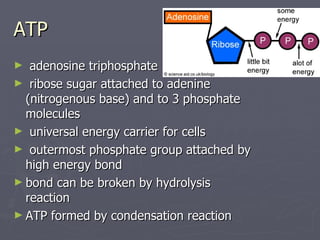
ATP adenosine triphosphate ribose sugar attached to adenine (nitrogenous base) and to 3 phosphate molecules universal energy carrier for cells outermost phosphate group attached by high energy bond bond can be broken by hydrolysis reaction ATP formed by condensation reaction

Biochemical reactions

  • 1.
    Biochemical Reactions 4kinds used for making/breaking macromolecules neutralization (acid-base) redox (oxidation-reduction) hydrolysis condensation
  • 2.
    Neutralization Rxn acid reacts with a base and products are salt and water Acid – substance that gives up a H+ when dissolved in H 2 O - organic (contain C) like amino acids or acetic acid (CH 3 COOH) - inorganic like HCl or H 2 SO 4 Base – substance that releases OH - when dissolved in water when these react, the OH - and H + are attracted and form H 2 O and salt is produced
  • 3.
    eg. H 2SO 4 + Mg(OH) 2 (aq) 2 H 2 O + MgSO 4 (aq) amount of H+ is measured on pH scale, low pH indicates acidity and high pH indicates alkalinity (basic) Buffers – substance that can donate or accept H+ ions as needed - help keep pH within a certain range, important for enzyme functions (pH changes can denature proteins) - bicarbonate (carbonic acid) buffer HCO 3 keeps our blood at pH of 7.4
  • 4.
    Redox Reactions electron(s)move from one reactant to another Oxidation – loss of electrons Reduction – gain of electrons eg. Na + (s) + Cl ­ (g) NaCl Na is oxidized and Cl is reduced redox used in cellular respiration electrons removed from food molecules transferred to other molecules to produce energy used by cell
  • 5.
    Hydrolysis & CondensationRxns Condensation – 2 molecules bond together, H 2 O released eg. carbohydrate synthesis – condensation (eg. sucrose made from glucose and fructose) Hydrolysis - H 2 O added to molecule to break it in two eg. carbohydrate hydrolysis – reverse of above
  • 6.
    Examples: Polypeptides –condensation forms peptide bond between 2 a.a., hydrolysis breaks it Fats – formed when condensation reaction forms ester linkages between 3 fatty acids and glycerol molecule, releasing 3 H 2 O molecules, broken down by hydrolysis
  • 7.
    ATP adenosine triphosphateribose sugar attached to adenine (nitrogenous base) and to 3 phosphate molecules universal energy carrier for cells outermost phosphate group attached by high energy bond bond can be broken by hydrolysis reaction ATP formed by condensation reaction