4/1/2013


              Sharq Elneil College
     School of Medical Laboratory Sciences
         Department of Microbiology
         Medical Bacteriology course


Biochemical reaction of Gram
     negative bacteria

        U.Mahadi Hassan Mahmoud
             Bsc, Msc, MIBMS Microbiology


             INDOLE TEST
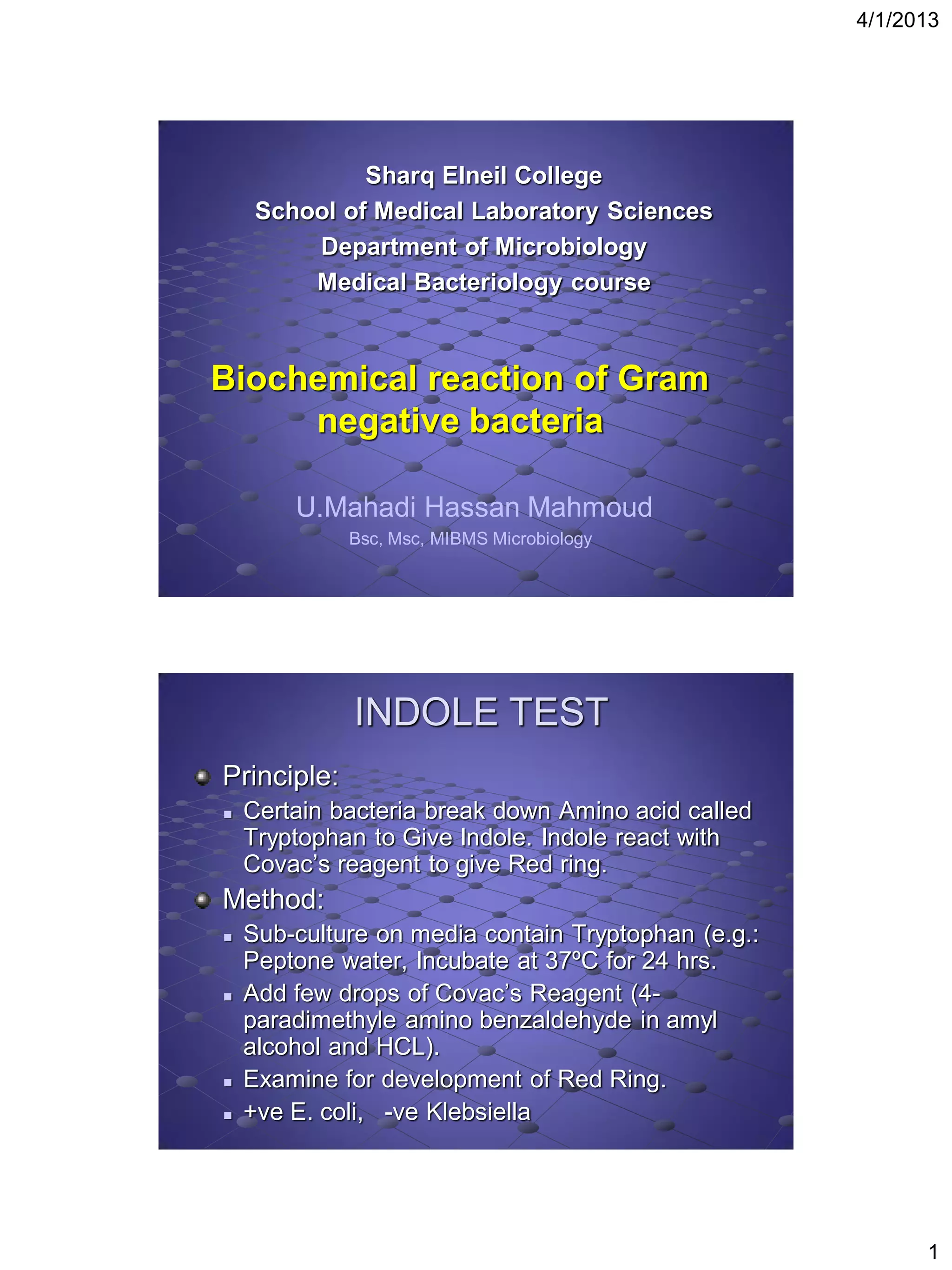
Principle:
   Certain bacteria break down Amino acid called
    Tryptophan to Give Indole. Indole react with
    Covac’s reagent to give Red ring.
Method:
   Sub-culture on media contain Tryptophan (e.g.:
    Peptone water, Incubate at 37ºC for 24 hrs.
   Add few drops of Covac’s Reagent (4-
    paradimethyle amino benzaldehyde in amyl
    alcohol and HCL).
   Examine for development of Red Ring.
   +ve E. coli, -ve Klebsiella


                                                           1
4/1/2013


           Methyl Red (MR)
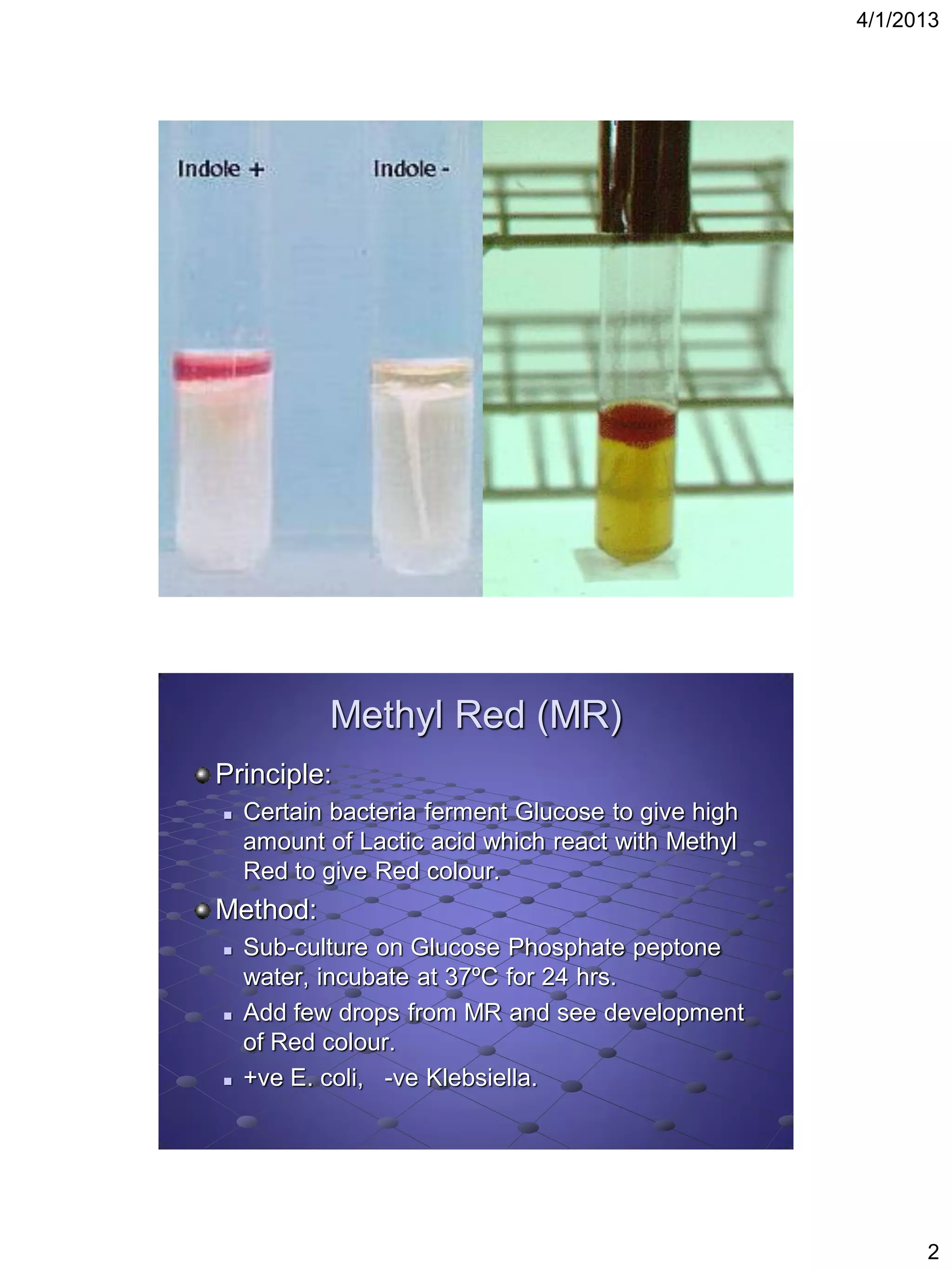
Principle:
   Certain bacteria ferment Glucose to give high
    amount of Lactic acid which react with Methyl
    Red to give Red colour.
Method:
   Sub-culture on Glucose Phosphate peptone
    water, incubate at 37ºC for 24 hrs.
   Add few drops from MR and see development
    of Red colour.
   +ve E. coli, -ve Klebsiella.


                                                          2
4/1/2013


      Vogous Proskaur (V.P)
Principle:
    Some organism Breakdown Glucose to give
     Acetyl Methyl carbinol which oxidized by air to
     give Diacetyl methyl carbinol react with -
     naphthol in Alkaline pH (KOH) to give red
     colour.
Method:
    Subculture in Glucose Phosphate peptone
     water incubate at 37ºC for 24 hrs.
    Add 1 ml of 40% KOH and 3 ml - naphthol
     and examined for red colour with 2-5 min.
    Listeria Monocytogenes V.P +ve and MR +ve.


        Citrate Utilization test
Media content:
    Koser’s citrate: (Broth media contain
     ammonium citrate and bromothymol blue)
    Simon Citrate (Koser’s citrate + agar)
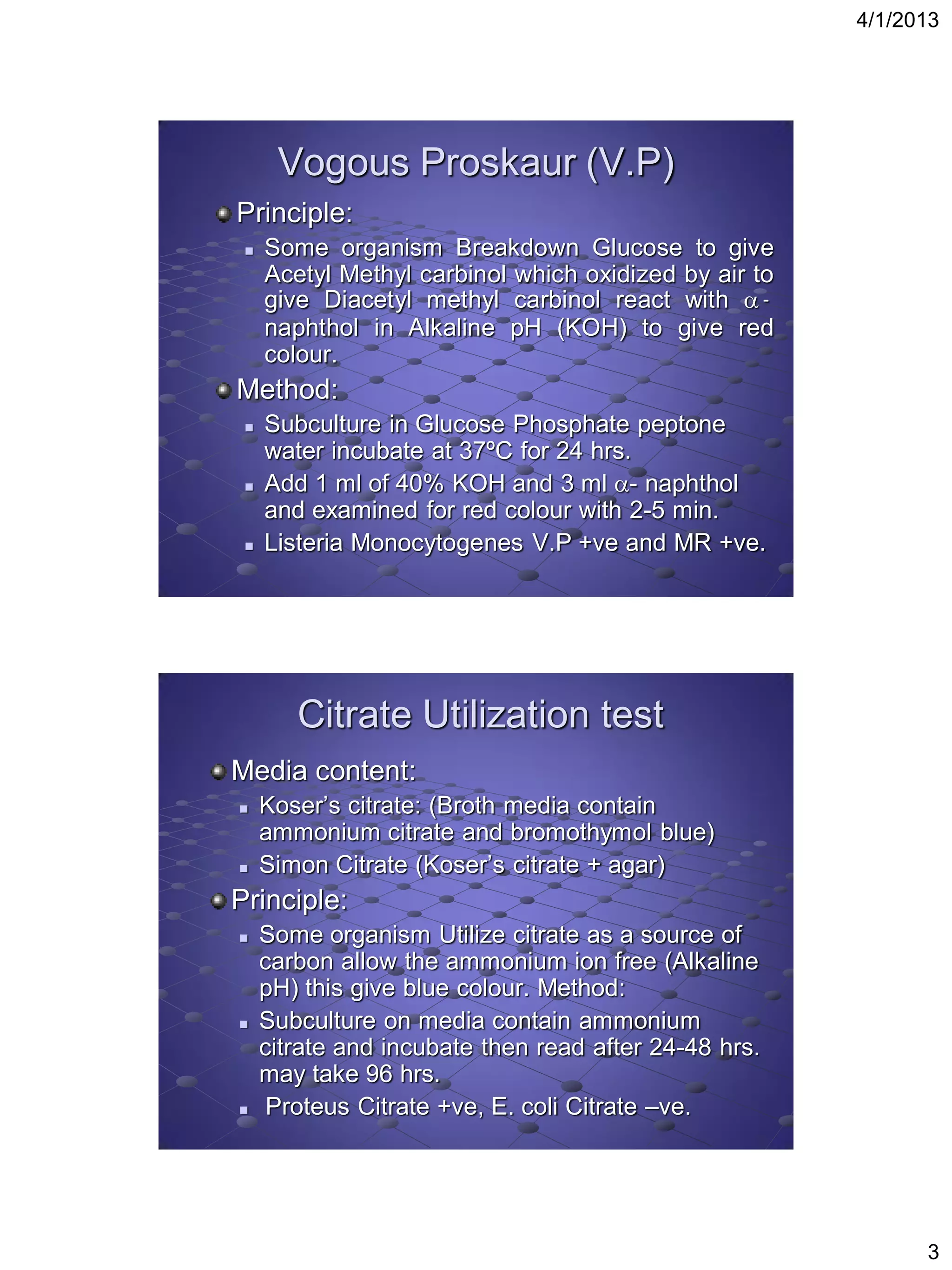
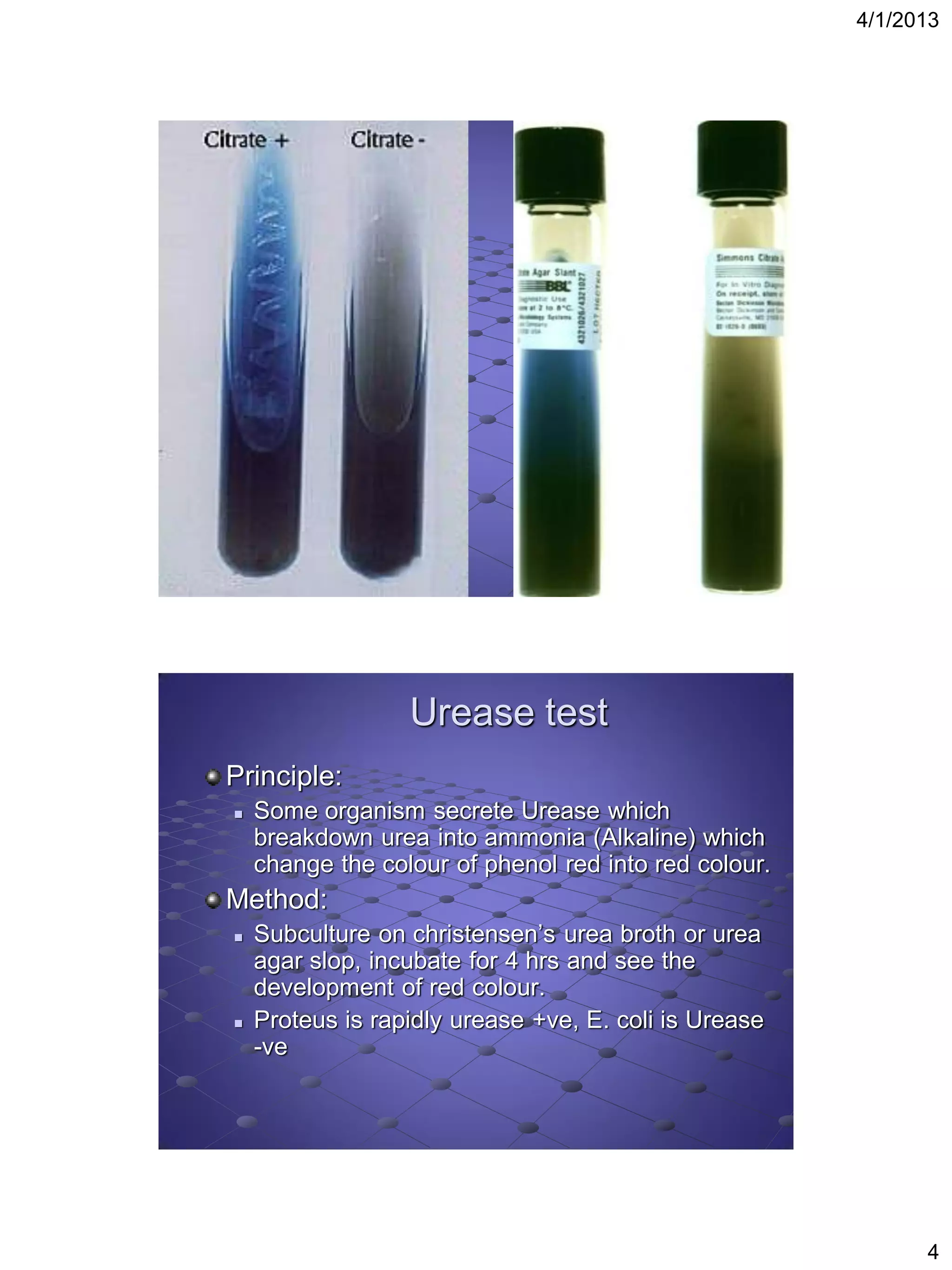
Principle:
    Some organism Utilize citrate as a source of
     carbon allow the ammonium ion free (Alkaline
     pH) this give blue colour. Method:
    Subculture on media contain ammonium
     citrate and incubate then read after 24-48 hrs.
     may take 96 hrs.
     Proteus Citrate +ve, E. coli Citrate –ve.


                                                             3
4/1/2013


                  Urease test
Principle:
   Some organism secrete Urease which
    breakdown urea into ammonia (Alkaline) which
    change the colour of phenol red into red colour.
Method:
   Subculture on christensen’s urea broth or urea
    agar slop, incubate for 4 hrs and see the
    development of red colour.
   Proteus is rapidly urease +ve, E. coli is Urease
    -ve


                                                             4
4/1/2013


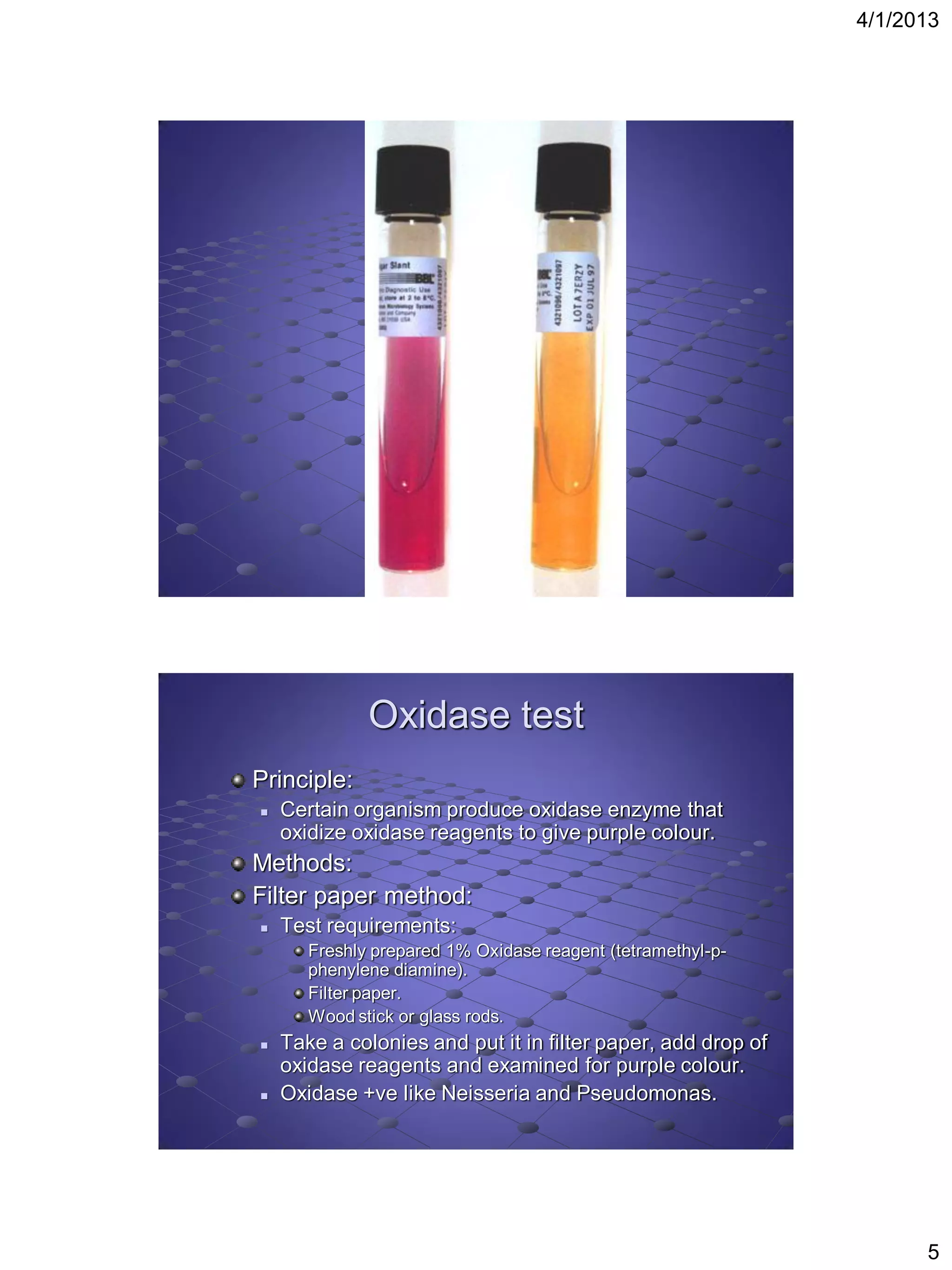
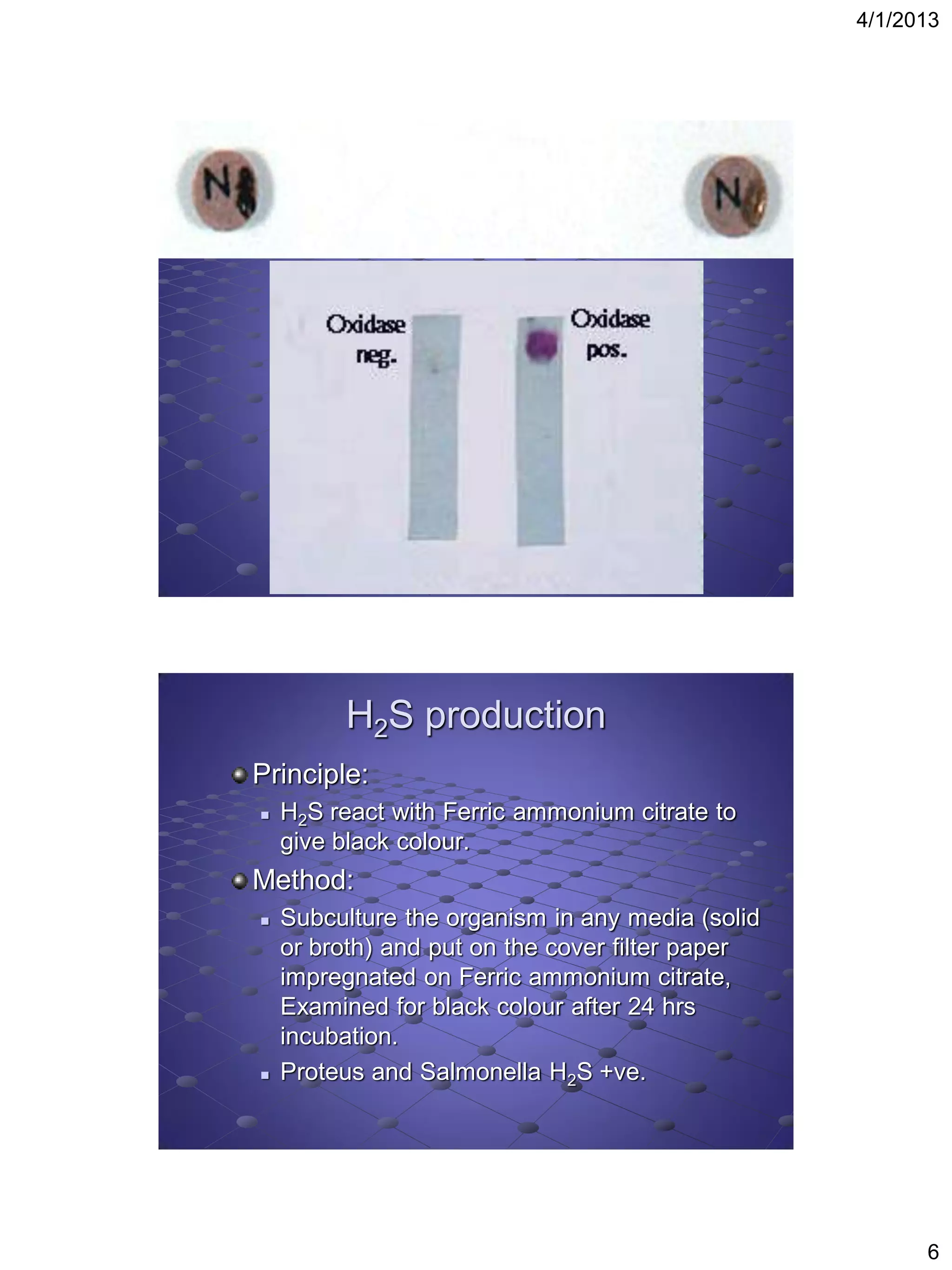
              Oxidase test
Principle:
   Certain organism produce oxidase enzyme that
    oxidize oxidase reagents to give purple colour.
Methods:
Filter paper method:
   Test requirements:
       Freshly prepared 1% Oxidase reagent (tetramethyl-p-
       phenylene diamine).
       Filter paper.
       Wood stick or glass rods.
   Take a colonies and put it in filter paper, add drop of
    oxidase reagents and examined for purple colour.
   Oxidase +ve like Neisseria and Pseudomonas.


                                                                    5
4/1/2013


         H2S production
Principle:
   H2S react with Ferric ammonium citrate to
    give black colour.
Method:
   Subculture the organism in any media (solid
    or broth) and put on the cover filter paper
    impregnated on Ferric ammonium citrate,
    Examined for black colour after 24 hrs
    incubation.
   Proteus and Salmonella H2S +ve.


                                                        6
4/1/2013


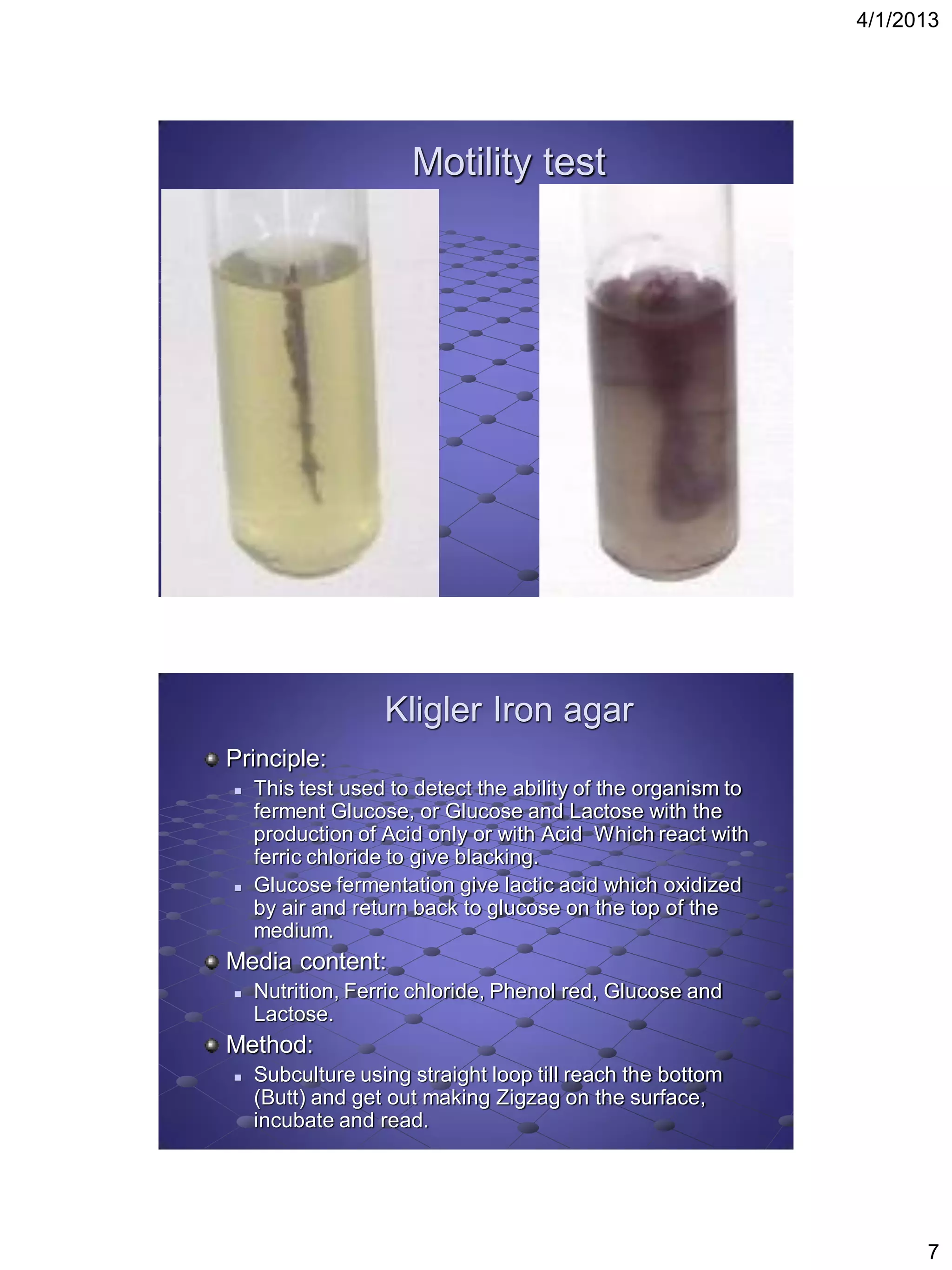
                     Motility test


                  Kligler Iron agar
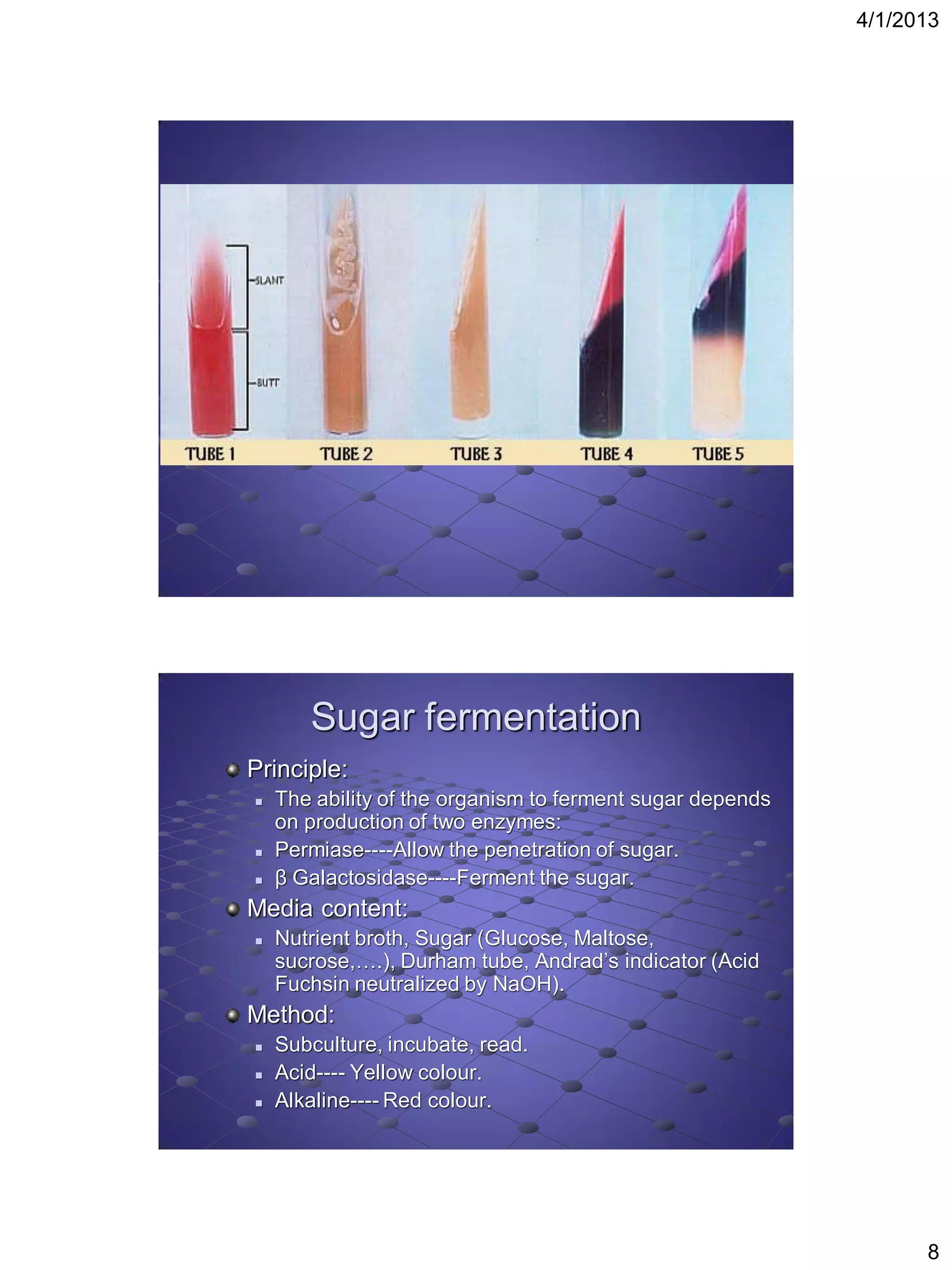
Principle:
   This test used to detect the ability of the organism to
    ferment Glucose, or Glucose and Lactose with the
    production of Acid only or with Acid Which react with
    ferric chloride to give blacking.
   Glucose fermentation give lactic acid which oxidized
    by air and return back to glucose on the top of the
    medium.
Media content:
   Nutrition, Ferric chloride, Phenol red, Glucose and
    Lactose.
Method:
   Subculture using straight loop till reach the bottom
    (Butt) and get out making Zigzag on the surface,
    incubate and read.


                                                                    7
4/1/2013


       Sugar fermentation
Principle:
   The ability of the organism to ferment sugar depends
    on production of two enzymes:
   Permiase----Allow the penetration of sugar.
   β Galactosidase----Ferment the sugar.
Media content:
   Nutrient broth, Sugar (Glucose, Maltose,
    sucrose,….), Durham tube, Andrad’s indicator (Acid
    Fuchsin neutralized by NaOH).
Method:
   Subculture, incubate, read.
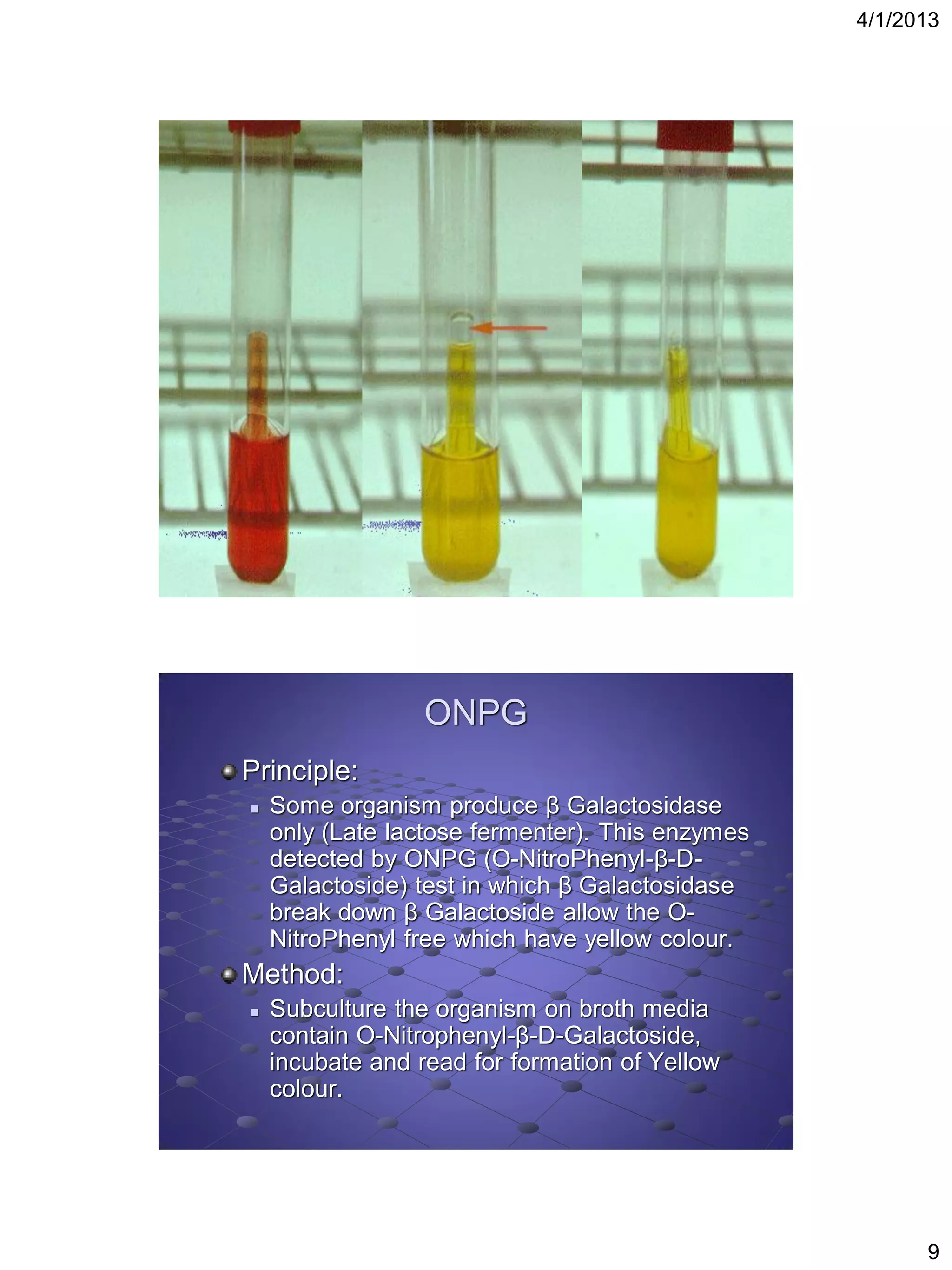
   Acid---- Yellow colour.
   Alkaline---- Red colour.


                                                                 8
4/1/2013


                  ONPG
Principle:
   Some organism produce β Galactosidase
    only (Late lactose fermenter). This enzymes
    detected by ONPG (O-NitroPhenyl-β-D-
    Galactoside) test in which β Galactosidase
    break down β Galactoside allow the O-
    NitroPhenyl free which have yellow colour.
Method:
   Subculture the organism on broth media
    contain O-Nitrophenyl-β-D-Galactoside,
    incubate and read for formation of Yellow
    colour.


                                                        9
4/1/2013


        Oxidation Fermentation
Principle:
   The test depends on fermentation of carbohydrate on
    anaerobic condition of oxidation of it in aerobic
    condition.
Media content:
   2 media each contain nutrition, sugar and bromothymol
    blue. One of them closed from air by paraffin oil.
Results:
   Oxidative ferment sugar on open tube (Yellow colour).
   Fermentative but anaerobically give yellow on closed
    tube.
   Facultative anaerobic ferment CHO on both tube
    (Yellow).
   Non oxidative- Non fermentative– give Blue colour on
    both tube.


        Phenyl Pyruvic Acid (PPA)

    Principle:
       Some organism deaminate Phenyl alanine to
        Phenyl Pyruvic acid which react with Ferric
        chloride to give green colour.
    Method:
       Subculture the organism on media contain
        Phenyl alanine and incubate at 37C for 24
        hrs, add 10% ferric chloride on the surface
        and examined for green colour.


                                                                 10

Biochemical reaction mahadi ppt

  • 1.
    4/1/2013 Sharq Elneil College School of Medical Laboratory Sciences Department of Microbiology Medical Bacteriology course Biochemical reaction of Gram negative bacteria U.Mahadi Hassan Mahmoud Bsc, Msc, MIBMS Microbiology INDOLE TEST Principle:  Certain bacteria break down Amino acid called Tryptophan to Give Indole. Indole react with Covac’s reagent to give Red ring. Method:  Sub-culture on media contain Tryptophan (e.g.: Peptone water, Incubate at 37ºC for 24 hrs.  Add few drops of Covac’s Reagent (4- paradimethyle amino benzaldehyde in amyl alcohol and HCL).  Examine for development of Red Ring.  +ve E. coli, -ve Klebsiella 1
  • 2.
    4/1/2013 Methyl Red (MR) Principle:  Certain bacteria ferment Glucose to give high amount of Lactic acid which react with Methyl Red to give Red colour. Method:  Sub-culture on Glucose Phosphate peptone water, incubate at 37ºC for 24 hrs.  Add few drops from MR and see development of Red colour.  +ve E. coli, -ve Klebsiella. 2
  • 3.
    4/1/2013 Vogous Proskaur (V.P) Principle:  Some organism Breakdown Glucose to give Acetyl Methyl carbinol which oxidized by air to give Diacetyl methyl carbinol react with - naphthol in Alkaline pH (KOH) to give red colour. Method:  Subculture in Glucose Phosphate peptone water incubate at 37ºC for 24 hrs.  Add 1 ml of 40% KOH and 3 ml - naphthol and examined for red colour with 2-5 min.  Listeria Monocytogenes V.P +ve and MR +ve. Citrate Utilization test Media content:  Koser’s citrate: (Broth media contain ammonium citrate and bromothymol blue)  Simon Citrate (Koser’s citrate + agar) Principle:  Some organism Utilize citrate as a source of carbon allow the ammonium ion free (Alkaline pH) this give blue colour. Method:  Subculture on media contain ammonium citrate and incubate then read after 24-48 hrs. may take 96 hrs.  Proteus Citrate +ve, E. coli Citrate –ve. 3
  • 4.
    4/1/2013 Urease test Principle:  Some organism secrete Urease which breakdown urea into ammonia (Alkaline) which change the colour of phenol red into red colour. Method:  Subculture on christensen’s urea broth or urea agar slop, incubate for 4 hrs and see the development of red colour.  Proteus is rapidly urease +ve, E. coli is Urease -ve 4
  • 5.
    4/1/2013 Oxidase test Principle:  Certain organism produce oxidase enzyme that oxidize oxidase reagents to give purple colour. Methods: Filter paper method:  Test requirements: Freshly prepared 1% Oxidase reagent (tetramethyl-p- phenylene diamine). Filter paper. Wood stick or glass rods.  Take a colonies and put it in filter paper, add drop of oxidase reagents and examined for purple colour.  Oxidase +ve like Neisseria and Pseudomonas. 5
  • 6.
    4/1/2013 H2S production Principle:  H2S react with Ferric ammonium citrate to give black colour. Method:  Subculture the organism in any media (solid or broth) and put on the cover filter paper impregnated on Ferric ammonium citrate, Examined for black colour after 24 hrs incubation.  Proteus and Salmonella H2S +ve. 6
  • 7.
    4/1/2013 Motility test Kligler Iron agar Principle:  This test used to detect the ability of the organism to ferment Glucose, or Glucose and Lactose with the production of Acid only or with Acid Which react with ferric chloride to give blacking.  Glucose fermentation give lactic acid which oxidized by air and return back to glucose on the top of the medium. Media content:  Nutrition, Ferric chloride, Phenol red, Glucose and Lactose. Method:  Subculture using straight loop till reach the bottom (Butt) and get out making Zigzag on the surface, incubate and read. 7
  • 8.
    4/1/2013 Sugar fermentation Principle:  The ability of the organism to ferment sugar depends on production of two enzymes:  Permiase----Allow the penetration of sugar.  β Galactosidase----Ferment the sugar. Media content:  Nutrient broth, Sugar (Glucose, Maltose, sucrose,….), Durham tube, Andrad’s indicator (Acid Fuchsin neutralized by NaOH). Method:  Subculture, incubate, read.  Acid---- Yellow colour.  Alkaline---- Red colour. 8
  • 9.
    4/1/2013 ONPG Principle:  Some organism produce β Galactosidase only (Late lactose fermenter). This enzymes detected by ONPG (O-NitroPhenyl-β-D- Galactoside) test in which β Galactosidase break down β Galactoside allow the O- NitroPhenyl free which have yellow colour. Method:  Subculture the organism on broth media contain O-Nitrophenyl-β-D-Galactoside, incubate and read for formation of Yellow colour. 9
  • 10.
    4/1/2013 Oxidation Fermentation Principle:  The test depends on fermentation of carbohydrate on anaerobic condition of oxidation of it in aerobic condition. Media content:  2 media each contain nutrition, sugar and bromothymol blue. One of them closed from air by paraffin oil. Results:  Oxidative ferment sugar on open tube (Yellow colour).  Fermentative but anaerobically give yellow on closed tube.  Facultative anaerobic ferment CHO on both tube (Yellow).  Non oxidative- Non fermentative– give Blue colour on both tube. Phenyl Pyruvic Acid (PPA) Principle:  Some organism deaminate Phenyl alanine to Phenyl Pyruvic acid which react with Ferric chloride to give green colour. Method:  Subculture the organism on media contain Phenyl alanine and incubate at 37C for 24 hrs, add 10% ferric chloride on the surface and examined for green colour. 10