BIOCHEMISTRY
CHEMISTRY OF LIFE 
• Elements: simplest form of a 
substance - cannot be broken down 
any further without changing what it is 
• Atom: the actual basic unit - 
composed of protons, neutrons, and 
electrons
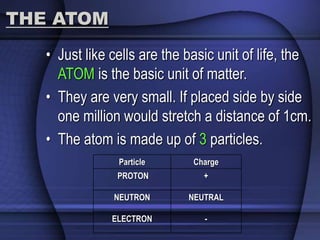
THE ATOM 
• Just like cells are the basic unit of life, the 
ATOM is the basic unit of matter. 
• They are very small. If placed side by side 
one million would stretch a distance of 1cm. 
• The atom is made up of 3 particles. 
Particle Charge 
PROTON + 
NEUTRON NEUTRAL 
ELECTRON -
• Electrons are not present within the atom, 
instead THEY REVOLVE AROUND THE 
NUCELUS OF THE ATOM & FORM THE 
ELECTRON CLOUD 
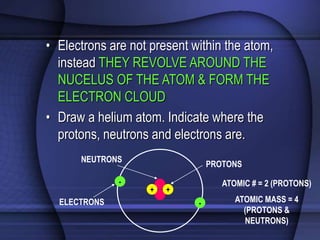
• Draw a helium atom. Indicate where the 
protons, neutrons and electrons are. 
+ + 
- 
- 
PROTONS 
NEUTRONS 
ELECTRONS 
ATOMIC # = 2 (PROTONS) 
ATOMIC MASS = 4 
(PROTONS & 
NEUTRONS)
ISOTOPES 
• atoms of the same element that HAVE A 
DIFFERENT NUMBER OF NEUTRONS 
• Some isotopes are radioactive. This means 
that their nuclei is unstable and will break 
down at a CONSTANT RATE over time. 
• There are several practical uses for 
radioactive isotopes: 
1. CARBON DATING 
2. TRACERS 
3. KILL BACTERIA / CANCER CELLS
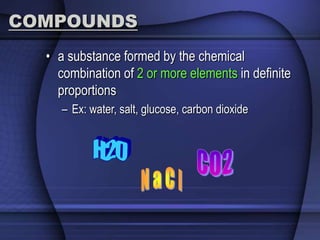
COMPOUNDS 
• a substance formed by the chemical 
combination of 2 or more elements in definite 
proportions 
– Ex: water, salt, glucose, carbon dioxide
• The cell is a COMPLEX CHEMICAL 
FACTORY containing some of the same 
elements found in the nonliving 
environment. 
• carbon (C), hydrogen (H), oxygen (O), and 
nitrogen (N) are present in the greatest 
percentages
TWO TYPES OF COMPOUNDS 
• Organic - Contain C, H, and O in some 
ratio (usually referred to as chemicals of 
life) 
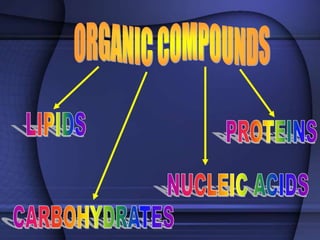
– Carbohydrates, Proteins, Lipids, Nucleic Acids 
• Inorganic - usually "support" life - no 
specific ratio of C, H, and O 
– Water (H2O), Carbon Dioxide (CO2)
CHEMICAL BONDS 
• Chemical bonds hold the atoms in a 
molecule together. 
• There are 2 types of chemical bonds 
IONIC and COVALENT
IONIC BONDS 
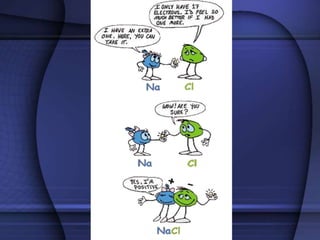
• Occur when 1 or more electrons are 
TRANSFERRED from one atom to another. 
• When an atom loses an electron it is a 
POSITIVE charge. 
• When an atom gains an electron it is a 
NEGATIVE charge 
• These newly charged atoms are now called 
IONS 
– Example: NaCl (SALT)
COVALENT BONDS 
• Occur when electrons are SHARED by atoms. 
• These new structures that result from covalent 
bonds are called MOLECULES 
• ** In general, the more chemical bonds a 
molecule has the more energy it contains 
SHARING IS CARING!
MIXTURES 
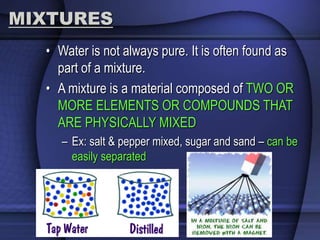
• Water is not always pure. It is often found as 
part of a mixture. 
• A mixture is a material composed of TWO OR 
MORE ELEMENTS OR COMPOUNDS THAT 
ARE PHYSICALLY MIXED 
– Ex: salt & pepper mixed, sugar and sand – can be 
easily separated
SOLUTION 
Two parts: 
• SOLUTE – SUBSTANCE THAT IS BEING 
DISSOLVED (SUGAR / SALT) 
• SOLVENT - the substance in which the solute 
dissolves 
• Materials that do not dissolve are known as 
SUSPENSIONS. 
– Blood is the most common example of a 
suspension. 
– Cells & other particles remain in suspension.
FORMULA 
• The chemical symbols and numbers that 
compose a compound ("recipe") 
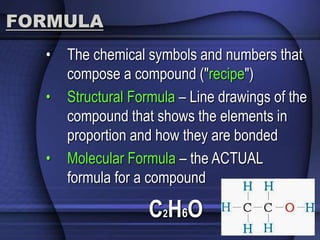
• Structural Formula – Line drawings of the 
compound that shows the elements in 
proportion and how they are bonded 
• Molecular Formula – the ACTUAL 
formula for a compound 
C2H6O
ACIDS & BASES 
• Acids: always (almost) begin with "H" because 
of the excess of H+ ions (hydrogen) 
– Ex: lemon juice (6), stomach acid (1.5), acid rain 
(4.5), normal rain (6) 
Facts about Acids 
• Acids turn litmus paper BLUE and usually 
taste SOUR. 
• You eat acids daily (coffee, vinegar, soda, 
spicy foods, etc…)
ACIDS & BASES 
• Bases: always (almost) end with -OH because 
of the excess of hydroxide ions (Oxygen & 
Hydrogen) 
– EX: oven cleaner, bleach, ammonia, sea water, 
blood, pure water 
Facts about Bases 
• Bases turn litmus BLUE. 
• Bases usually feel SLIPPERY to touch and taste 
BITTER.
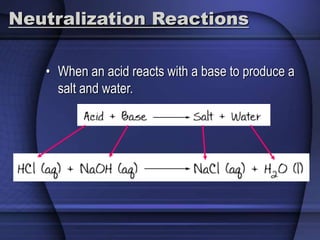
Neutralization Reactions 
• When an acid reacts with a base to produce a 
salt and water.
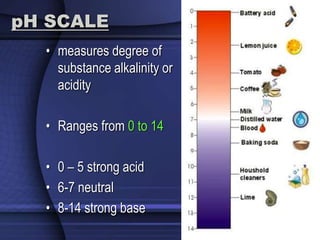
pH SCALE 
• measures degree of 
substance alkalinity or 
acidity 
• Ranges from 0 to 14 
• 0 – 5 strong acid 
• 6-7 neutral 
• 8-14 strong base
• The goal of the body is to maintain 
HOMEOSTASIS (neutrality) – to do this when 
pH is concerned, we add weak acids & bases to 
prevent sharp changes in pH. 
• These are called BUFFERS
And now for the 
Biochemistry portion of 
things….
CARBOHYDRATES 
• Living things use carbohydrates as a key source 
of ENERGY! 
• Plants use carbohydrates for structure 
(CELLULOSE) 
– include sugars and complex carbohydrates 
(starches) 
– contain the elements carbon, hydrogen, and oxygen 
(the hydrogen is in a 2:1 ratio to oxygen)
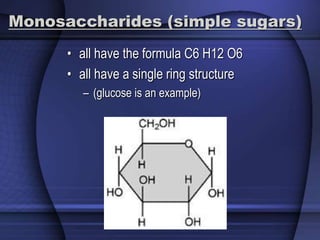
Monosaccharides (simple sugars) 
• all have the formula C6 H12 O6 
• all have a single ring structure 
– (glucose is an example)
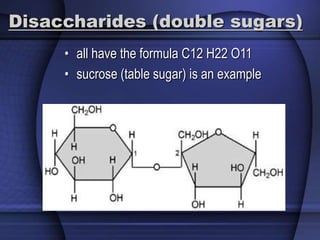
Disaccharides (double sugars) 
• all have the formula C12 H22 O11 
• sucrose (table sugar) is an example
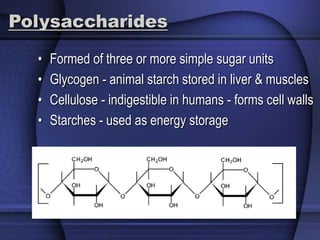
Polysaccharides 
• Formed of three or more simple sugar units 
• Glycogen - animal starch stored in liver & muscles 
• Cellulose - indigestible in humans - forms cell walls 
• Starches - used as energy storage
How are complex 
carbohydrates formed 
and broken down?
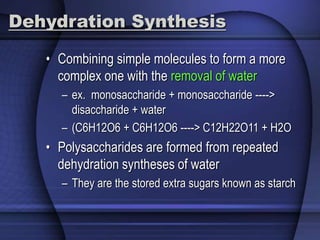
Dehydration Synthesis 
• Combining simple molecules to form a more 
complex one with the removal of water 
– ex. monosaccharide + monosaccharide ----> 
disaccharide + water 
– (C6H12O6 + C6H12O6 ----> C12H22O11 + H2O 
• Polysaccharides are formed from repeated 
dehydration syntheses of water 
– They are the stored extra sugars known as starch
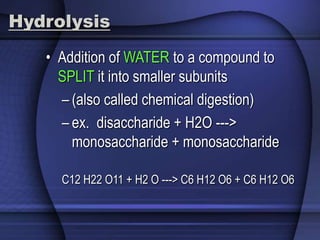
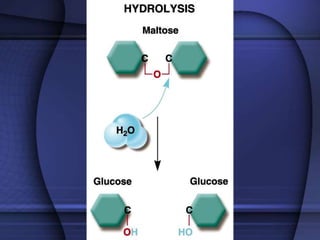
Hydrolysis 
• Addition of WATER to a compound to 
SPLIT it into smaller subunits 
– (also called chemical digestion) 
– ex. disaccharide + H2O ---> 
monosaccharide + monosaccharide 
C12 H22 O11 + H2 O ---> C6 H12 O6 + C6 H12 O6
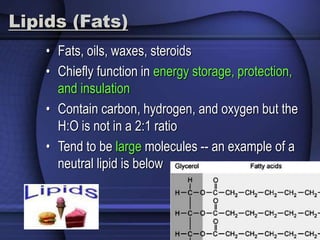
Lipids (Fats) 
• Fats, oils, waxes, steroids 
• Chiefly function in energy storage, protection, 
and insulation 
• Contain carbon, hydrogen, and oxygen but the 
H:O is not in a 2:1 ratio 
• Tend to be large molecules -- an example of a 
neutral lipid is below
• Neutral lipids are formed from the union of one 
glycerol molecule and 3 fatty acids 
• 3 fatty acids + glycerol ----> neutral fat (lipid) 
• Fats -- found chiefly in animals 
• Oils and waxes -- found chiefly in plants 
• Oils are liquid at room temperature, waxes are 
solids 
• Lipids along with proteins are key components of 
cell membranes 
• Steroids are special lipids used to build many 
reproductive hormones and cholesterol
PROTEINS 
• contain the elements carbon, hydrogen, oxygen, 
and nitrogen 
• composed of MANY amino acid subunits 
• It is the arrangement of the amino acid that 
forms the primary structure of proteins. 
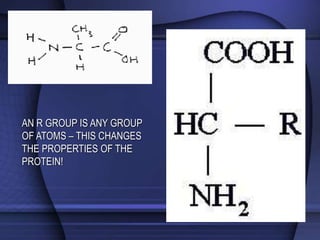
• The basic amino acid form has a carboxyl 
group on one end, a methyl group that only 
has one hydrogen in the middle, and a amino 
group on the other end. 
• Attached to the methyl group is a R group.
AN R GROUP IS ANY GROUP 
OF ATOMS – THIS CHANGES 
THE PROPERTIES OF THE 
PROTEIN!
FUNCTIONAL GROUPS 
• There are certain groups of atoms that are 
frequently attached to the organic molecules we 
will be studying, and these are called functional 
groups. 
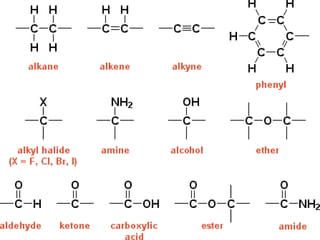
• These are things like hydroxyl groups which 
form alcohols, carbonyl groups which form 
aldehydes or ketones, carboxyl groups which 
form carboxylic acids, and amino groups 
which form amines.
Major Protein Functions 
• Growth and repair 
• Energy 
• Buffer -- helps keep body pH constant
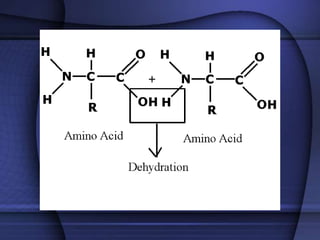
Dipeptide 
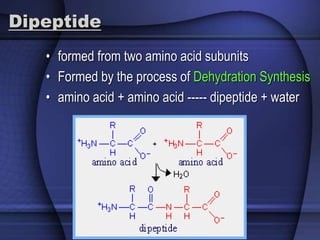
• formed from two amino acid subunits 
• Formed by the process of Dehydration Synthesis 
• amino acid + amino acid ----- dipeptide + water
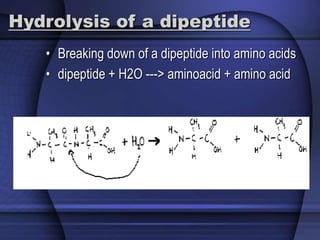
Hydrolysis of a dipeptide 
• Breaking down of a dipeptide into amino acids 
• dipeptide + H2O ---> aminoacid + amino acid
Polypeptide (protein) 
• composed of three or more amino acids linked 
by synthesis reactions 
• Examples of proteins include insulin, 
hemoglobin, and enzymes. 
• ** There are an extremely large number of 
different proteins. 
• The bases for variability include differences in 
the number, kinds and sequences of amino 
acids in the proteins
NUCLEIC ACIDS 
• in all cells 
• composed of NUCLEOTIDES 
• store & transmit heredity/genetic information 
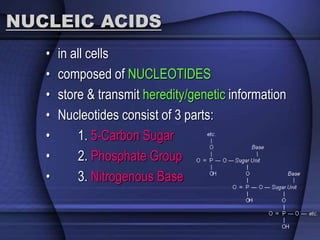
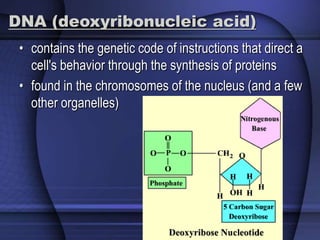
• Nucleotides consist of 3 parts: 
• 1. 5-Carbon Sugar 
• 2. Phosphate Group 
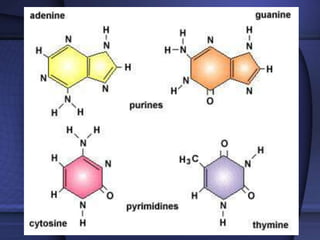
• 3. Nitrogenous Base
DNA (deoxyribonucleic acid) 
• contains the genetic code of instructions that direct a 
cell's behavior through the synthesis of proteins 
• found in the chromosomes of the nucleus (and a few 
other organelles)
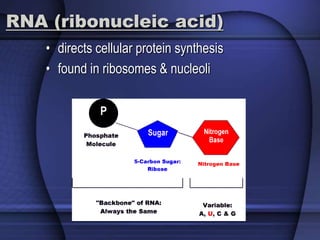
RNA (ribonucleic acid) 
• directs cellular protein synthesis 
• found in ribosomes & nucleoli
CHEMICAL REACTIONS 
• a process that changes one set of chemicals into 
another set of chemicals 
• REACTANTS – elements or compounds that 
enter into a chemical reaction 
• PRODUCTS – elements or compounds that are 
produced in a chemical reaction 
• Chemical reactions always involve the breaking of 
bonds in reactants and the formation of new 
bonds in products.
• In a reaction, energy is either TAKEN IN 
(ENDOTHERMIC) or GIVEN OFF 
(EXOTHERMIC) 
• Can you think of an everyday example of 
each type of reaction?
Enzymes and Enzyme Action 
• catalyst: inorganic or organic substance which 
speeds up the rate of a chemical reaction without 
entering the reaction itself 
• enzymes: organic catalysts made of protein 
• most enzyme names end in -ase 
• enzymes lower the energy needed to start a 
chemical reaction. (activation energy) 
• begin to be destroyed above 45øC. (above this 
temperature all proteins begin to be destroyed)
It is thought that, in order for an enzyme to affect the rate of a 
reaction, the following events must take place. 
1. The enzyme must form a temporary association with the 
substance or substances whose reaction rate it affects. 
These substances are known as substrates. 
2. The association between enzyme and substrate is thought to 
form a close physical association between the molecules and 
is called the enzyme-substrate complex. 
3. While the enzyme-substrate complex is formed, enzyme 
action takes place. 
4. Upon completion of the reaction, the enzyme and product(s) 
separate. The enzyme molecule is now available to form 
additional complexes.
How do enzymes work? 
• substrate: molecules upon which an enzyme acts 
• the enzyme is shaped so that it can only lock up 
with a specific substrate molecule 
enzyme 
substrate -------------> product
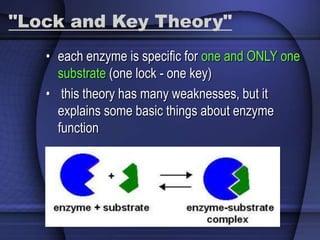
"Lock and Key Theory" 
• each enzyme is specific for one and ONLY one 
substrate (one lock - one key) 
• this theory has many weaknesses, but it 
explains some basic things about enzyme 
function
Factors Influencing Rate of 
Enzyme Action 
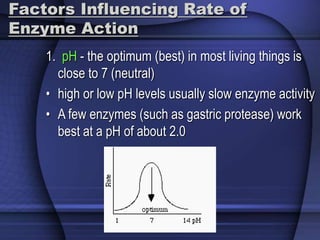
1. pH - the optimum (best) in most living things is 
close to 7 (neutral) 
• high or low pH levels usually slow enzyme activity 
• A few enzymes (such as gastric protease) work 
best at a pH of about 2.0
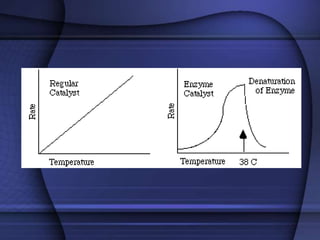
2. Temperature - strongly influences enzyme 
activity 
• optimum temperature for maximum enzyme 
function is usually about 35-40 C. 
• reactions proceed slowly below optimal 
temperatures 
• above 45 C most enzymes are denatured 
(change in their shape so the enzyme active site 
no longer fits with the substrate and the enzyme 
can't function)
3. Concentrations of Enzyme and Substrate 
• ** When there is a fixed amount of enzyme and 
an excess of substrate molecules -- the rate of 
reaction will increase to a point and then level 
off.

Biochemistry

  • 1.
  • 2.
    CHEMISTRY OF LIFE • Elements: simplest form of a substance - cannot be broken down any further without changing what it is • Atom: the actual basic unit - composed of protons, neutrons, and electrons
  • 3.
    THE ATOM •Just like cells are the basic unit of life, the ATOM is the basic unit of matter. • They are very small. If placed side by side one million would stretch a distance of 1cm. • The atom is made up of 3 particles. Particle Charge PROTON + NEUTRON NEUTRAL ELECTRON -
  • 4.
    • Electrons arenot present within the atom, instead THEY REVOLVE AROUND THE NUCELUS OF THE ATOM & FORM THE ELECTRON CLOUD • Draw a helium atom. Indicate where the protons, neutrons and electrons are. + + - - PROTONS NEUTRONS ELECTRONS ATOMIC # = 2 (PROTONS) ATOMIC MASS = 4 (PROTONS & NEUTRONS)
  • 5.
    ISOTOPES • atomsof the same element that HAVE A DIFFERENT NUMBER OF NEUTRONS • Some isotopes are radioactive. This means that their nuclei is unstable and will break down at a CONSTANT RATE over time. • There are several practical uses for radioactive isotopes: 1. CARBON DATING 2. TRACERS 3. KILL BACTERIA / CANCER CELLS
  • 6.
    COMPOUNDS • asubstance formed by the chemical combination of 2 or more elements in definite proportions – Ex: water, salt, glucose, carbon dioxide
  • 7.
    • The cellis a COMPLEX CHEMICAL FACTORY containing some of the same elements found in the nonliving environment. • carbon (C), hydrogen (H), oxygen (O), and nitrogen (N) are present in the greatest percentages
  • 8.
    TWO TYPES OFCOMPOUNDS • Organic - Contain C, H, and O in some ratio (usually referred to as chemicals of life) – Carbohydrates, Proteins, Lipids, Nucleic Acids • Inorganic - usually "support" life - no specific ratio of C, H, and O – Water (H2O), Carbon Dioxide (CO2)
  • 9.
    CHEMICAL BONDS •Chemical bonds hold the atoms in a molecule together. • There are 2 types of chemical bonds IONIC and COVALENT
  • 10.
    IONIC BONDS •Occur when 1 or more electrons are TRANSFERRED from one atom to another. • When an atom loses an electron it is a POSITIVE charge. • When an atom gains an electron it is a NEGATIVE charge • These newly charged atoms are now called IONS – Example: NaCl (SALT)
  • 12.
    COVALENT BONDS •Occur when electrons are SHARED by atoms. • These new structures that result from covalent bonds are called MOLECULES • ** In general, the more chemical bonds a molecule has the more energy it contains SHARING IS CARING!
  • 13.
    MIXTURES • Wateris not always pure. It is often found as part of a mixture. • A mixture is a material composed of TWO OR MORE ELEMENTS OR COMPOUNDS THAT ARE PHYSICALLY MIXED – Ex: salt & pepper mixed, sugar and sand – can be easily separated
  • 14.
    SOLUTION Two parts: • SOLUTE – SUBSTANCE THAT IS BEING DISSOLVED (SUGAR / SALT) • SOLVENT - the substance in which the solute dissolves • Materials that do not dissolve are known as SUSPENSIONS. – Blood is the most common example of a suspension. – Cells & other particles remain in suspension.
  • 15.
    FORMULA • Thechemical symbols and numbers that compose a compound ("recipe") • Structural Formula – Line drawings of the compound that shows the elements in proportion and how they are bonded • Molecular Formula – the ACTUAL formula for a compound C2H6O
  • 16.
    ACIDS & BASES • Acids: always (almost) begin with "H" because of the excess of H+ ions (hydrogen) – Ex: lemon juice (6), stomach acid (1.5), acid rain (4.5), normal rain (6) Facts about Acids • Acids turn litmus paper BLUE and usually taste SOUR. • You eat acids daily (coffee, vinegar, soda, spicy foods, etc…)
  • 17.
    ACIDS & BASES • Bases: always (almost) end with -OH because of the excess of hydroxide ions (Oxygen & Hydrogen) – EX: oven cleaner, bleach, ammonia, sea water, blood, pure water Facts about Bases • Bases turn litmus BLUE. • Bases usually feel SLIPPERY to touch and taste BITTER.
  • 18.
    Neutralization Reactions •When an acid reacts with a base to produce a salt and water.
  • 19.
    pH SCALE •measures degree of substance alkalinity or acidity • Ranges from 0 to 14 • 0 – 5 strong acid • 6-7 neutral • 8-14 strong base
  • 20.
    • The goalof the body is to maintain HOMEOSTASIS (neutrality) – to do this when pH is concerned, we add weak acids & bases to prevent sharp changes in pH. • These are called BUFFERS
  • 21.
    And now forthe Biochemistry portion of things….
  • 23.
    CARBOHYDRATES • Livingthings use carbohydrates as a key source of ENERGY! • Plants use carbohydrates for structure (CELLULOSE) – include sugars and complex carbohydrates (starches) – contain the elements carbon, hydrogen, and oxygen (the hydrogen is in a 2:1 ratio to oxygen)
  • 24.
    Monosaccharides (simple sugars) • all have the formula C6 H12 O6 • all have a single ring structure – (glucose is an example)
  • 25.
    Disaccharides (double sugars) • all have the formula C12 H22 O11 • sucrose (table sugar) is an example
  • 26.
    Polysaccharides • Formedof three or more simple sugar units • Glycogen - animal starch stored in liver & muscles • Cellulose - indigestible in humans - forms cell walls • Starches - used as energy storage
  • 27.
    How are complex carbohydrates formed and broken down?
  • 28.
    Dehydration Synthesis •Combining simple molecules to form a more complex one with the removal of water – ex. monosaccharide + monosaccharide ----> disaccharide + water – (C6H12O6 + C6H12O6 ----> C12H22O11 + H2O • Polysaccharides are formed from repeated dehydration syntheses of water – They are the stored extra sugars known as starch
  • 30.
    Hydrolysis • Additionof WATER to a compound to SPLIT it into smaller subunits – (also called chemical digestion) – ex. disaccharide + H2O ---> monosaccharide + monosaccharide C12 H22 O11 + H2 O ---> C6 H12 O6 + C6 H12 O6
  • 32.
    Lipids (Fats) •Fats, oils, waxes, steroids • Chiefly function in energy storage, protection, and insulation • Contain carbon, hydrogen, and oxygen but the H:O is not in a 2:1 ratio • Tend to be large molecules -- an example of a neutral lipid is below
  • 33.
    • Neutral lipidsare formed from the union of one glycerol molecule and 3 fatty acids • 3 fatty acids + glycerol ----> neutral fat (lipid) • Fats -- found chiefly in animals • Oils and waxes -- found chiefly in plants • Oils are liquid at room temperature, waxes are solids • Lipids along with proteins are key components of cell membranes • Steroids are special lipids used to build many reproductive hormones and cholesterol
  • 34.
    PROTEINS • containthe elements carbon, hydrogen, oxygen, and nitrogen • composed of MANY amino acid subunits • It is the arrangement of the amino acid that forms the primary structure of proteins. • The basic amino acid form has a carboxyl group on one end, a methyl group that only has one hydrogen in the middle, and a amino group on the other end. • Attached to the methyl group is a R group.
  • 35.
    AN R GROUPIS ANY GROUP OF ATOMS – THIS CHANGES THE PROPERTIES OF THE PROTEIN!
  • 36.
    FUNCTIONAL GROUPS •There are certain groups of atoms that are frequently attached to the organic molecules we will be studying, and these are called functional groups. • These are things like hydroxyl groups which form alcohols, carbonyl groups which form aldehydes or ketones, carboxyl groups which form carboxylic acids, and amino groups which form amines.
  • 38.
    Major Protein Functions • Growth and repair • Energy • Buffer -- helps keep body pH constant
  • 39.
    Dipeptide • formedfrom two amino acid subunits • Formed by the process of Dehydration Synthesis • amino acid + amino acid ----- dipeptide + water
  • 40.
    Hydrolysis of adipeptide • Breaking down of a dipeptide into amino acids • dipeptide + H2O ---> aminoacid + amino acid
  • 41.
    Polypeptide (protein) •composed of three or more amino acids linked by synthesis reactions • Examples of proteins include insulin, hemoglobin, and enzymes. • ** There are an extremely large number of different proteins. • The bases for variability include differences in the number, kinds and sequences of amino acids in the proteins
  • 42.
    NUCLEIC ACIDS •in all cells • composed of NUCLEOTIDES • store & transmit heredity/genetic information • Nucleotides consist of 3 parts: • 1. 5-Carbon Sugar • 2. Phosphate Group • 3. Nitrogenous Base
  • 44.
    DNA (deoxyribonucleic acid) • contains the genetic code of instructions that direct a cell's behavior through the synthesis of proteins • found in the chromosomes of the nucleus (and a few other organelles)
  • 45.
    RNA (ribonucleic acid) • directs cellular protein synthesis • found in ribosomes & nucleoli
  • 46.
    CHEMICAL REACTIONS •a process that changes one set of chemicals into another set of chemicals • REACTANTS – elements or compounds that enter into a chemical reaction • PRODUCTS – elements or compounds that are produced in a chemical reaction • Chemical reactions always involve the breaking of bonds in reactants and the formation of new bonds in products.
  • 47.
    • In areaction, energy is either TAKEN IN (ENDOTHERMIC) or GIVEN OFF (EXOTHERMIC) • Can you think of an everyday example of each type of reaction?
  • 48.
    Enzymes and EnzymeAction • catalyst: inorganic or organic substance which speeds up the rate of a chemical reaction without entering the reaction itself • enzymes: organic catalysts made of protein • most enzyme names end in -ase • enzymes lower the energy needed to start a chemical reaction. (activation energy) • begin to be destroyed above 45øC. (above this temperature all proteins begin to be destroyed)
  • 49.
    It is thoughtthat, in order for an enzyme to affect the rate of a reaction, the following events must take place. 1. The enzyme must form a temporary association with the substance or substances whose reaction rate it affects. These substances are known as substrates. 2. The association between enzyme and substrate is thought to form a close physical association between the molecules and is called the enzyme-substrate complex. 3. While the enzyme-substrate complex is formed, enzyme action takes place. 4. Upon completion of the reaction, the enzyme and product(s) separate. The enzyme molecule is now available to form additional complexes.
  • 50.
    How do enzymeswork? • substrate: molecules upon which an enzyme acts • the enzyme is shaped so that it can only lock up with a specific substrate molecule enzyme substrate -------------> product
  • 51.
    "Lock and KeyTheory" • each enzyme is specific for one and ONLY one substrate (one lock - one key) • this theory has many weaknesses, but it explains some basic things about enzyme function
  • 52.
    Factors Influencing Rateof Enzyme Action 1. pH - the optimum (best) in most living things is close to 7 (neutral) • high or low pH levels usually slow enzyme activity • A few enzymes (such as gastric protease) work best at a pH of about 2.0
  • 53.
    2. Temperature -strongly influences enzyme activity • optimum temperature for maximum enzyme function is usually about 35-40 C. • reactions proceed slowly below optimal temperatures • above 45 C most enzymes are denatured (change in their shape so the enzyme active site no longer fits with the substrate and the enzyme can't function)
  • 55.
    3. Concentrations ofEnzyme and Substrate • ** When there is a fixed amount of enzyme and an excess of substrate molecules -- the rate of reaction will increase to a point and then level off.