Media & Biochemical Tests
Laboratory Objectives
Tests To Know
 Case Study Tests
Indole
Methyl Red/Voges Proskauer
Citrate
H2S production in SIM
Urea hydrolysis
Motility
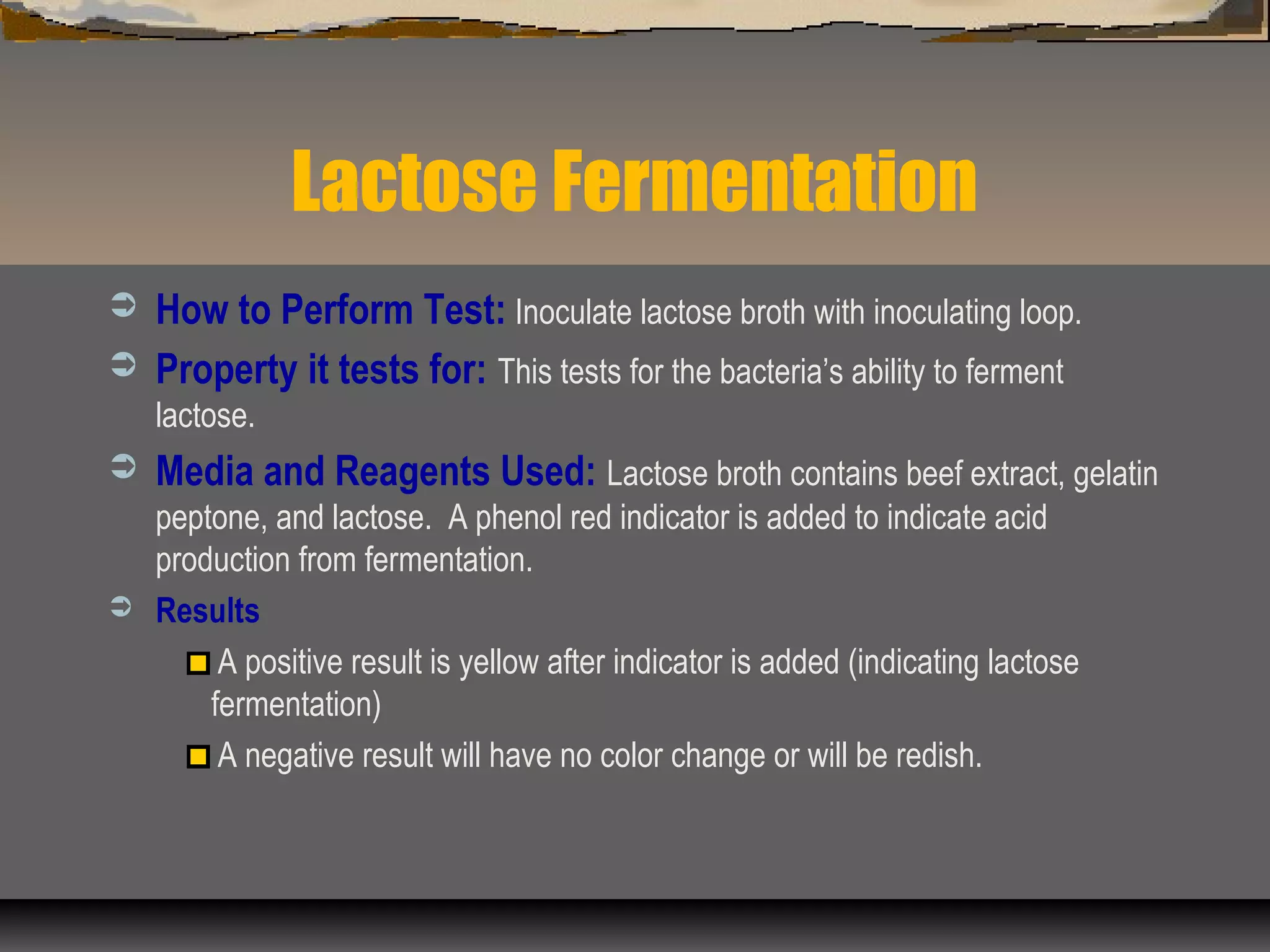
Lactose fermentation
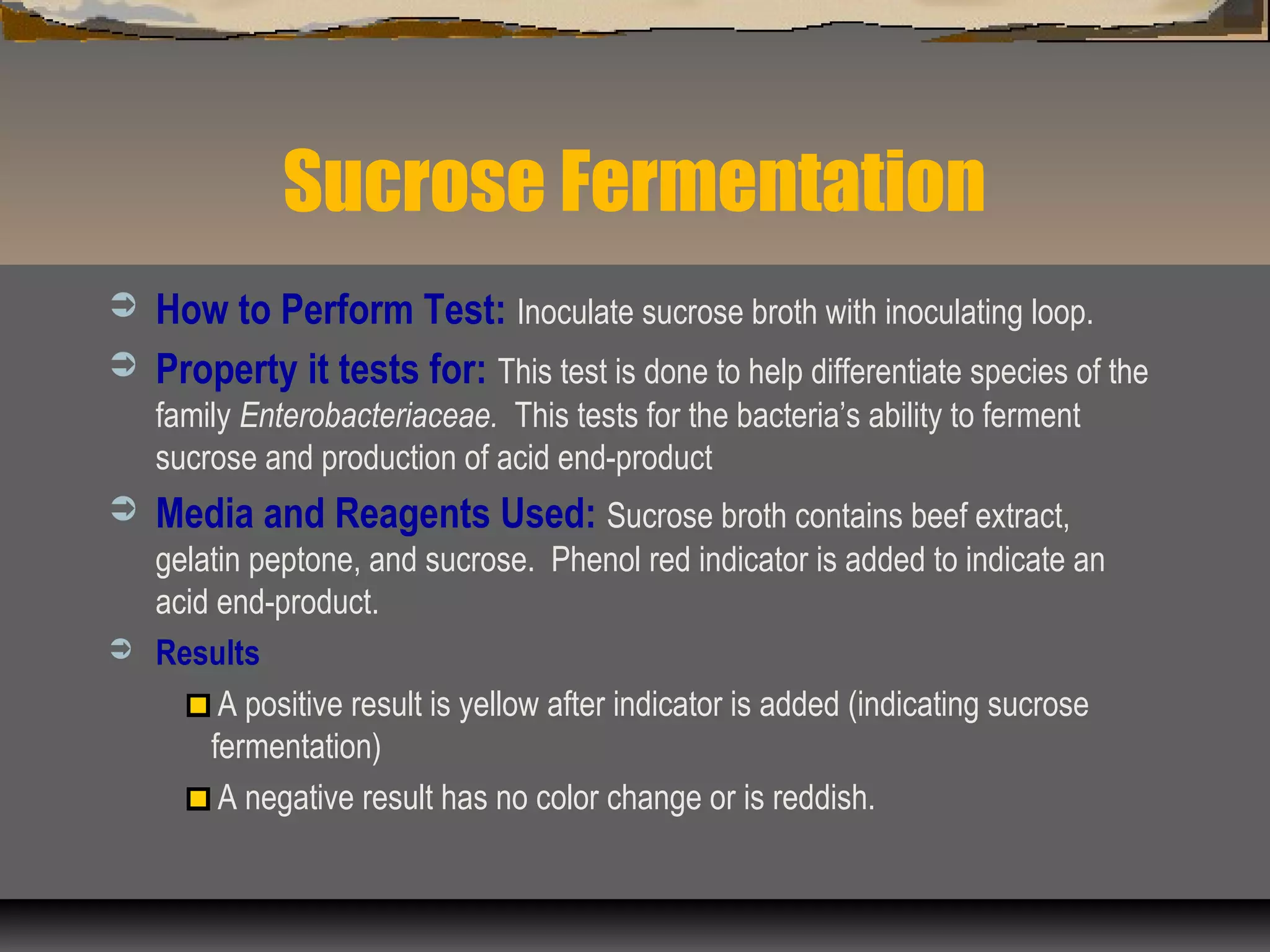
Sucrose fermentation
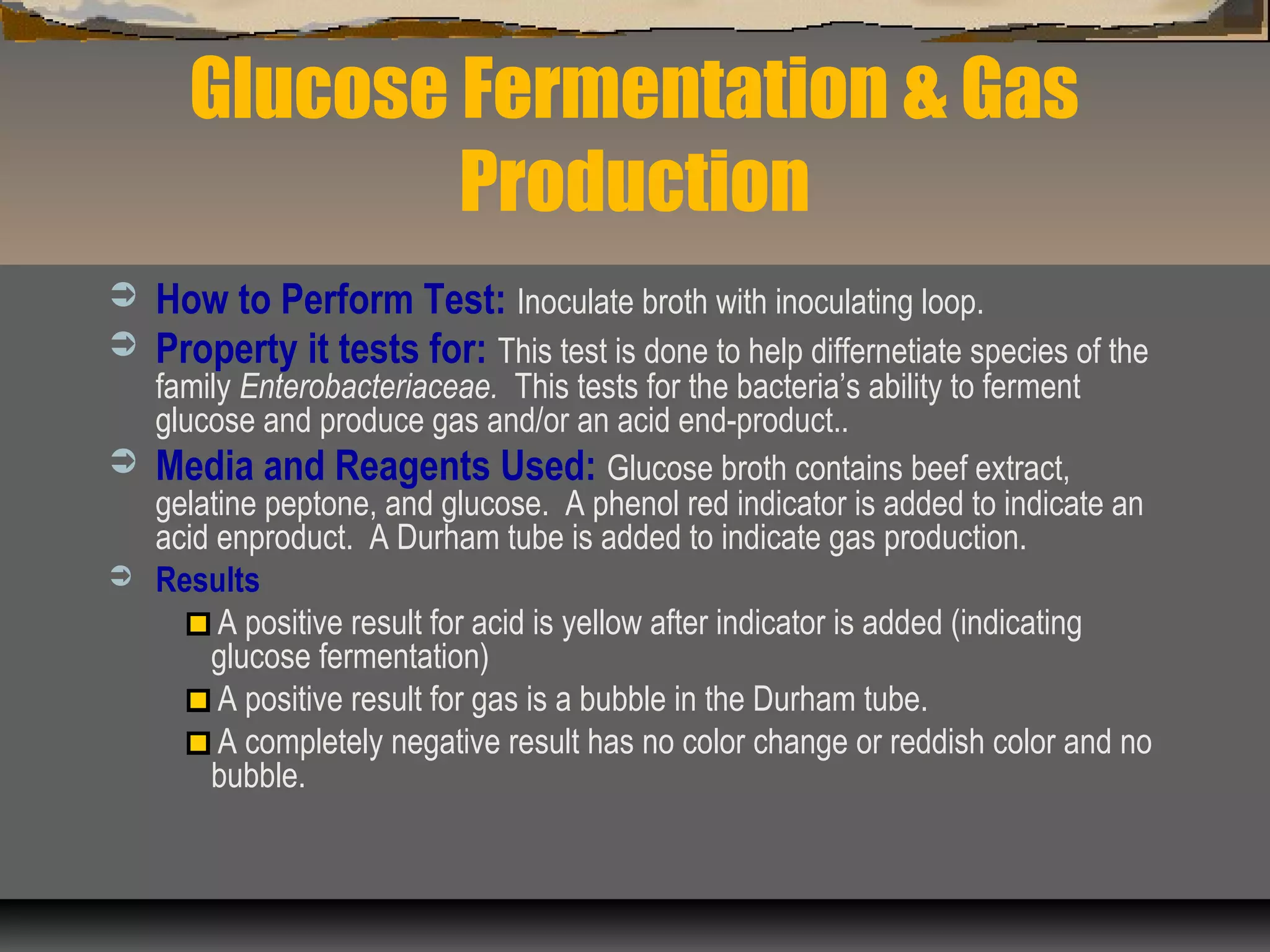
Glucose fermentation & gas production
 Staphylococcus identification tests
BAP
MSA
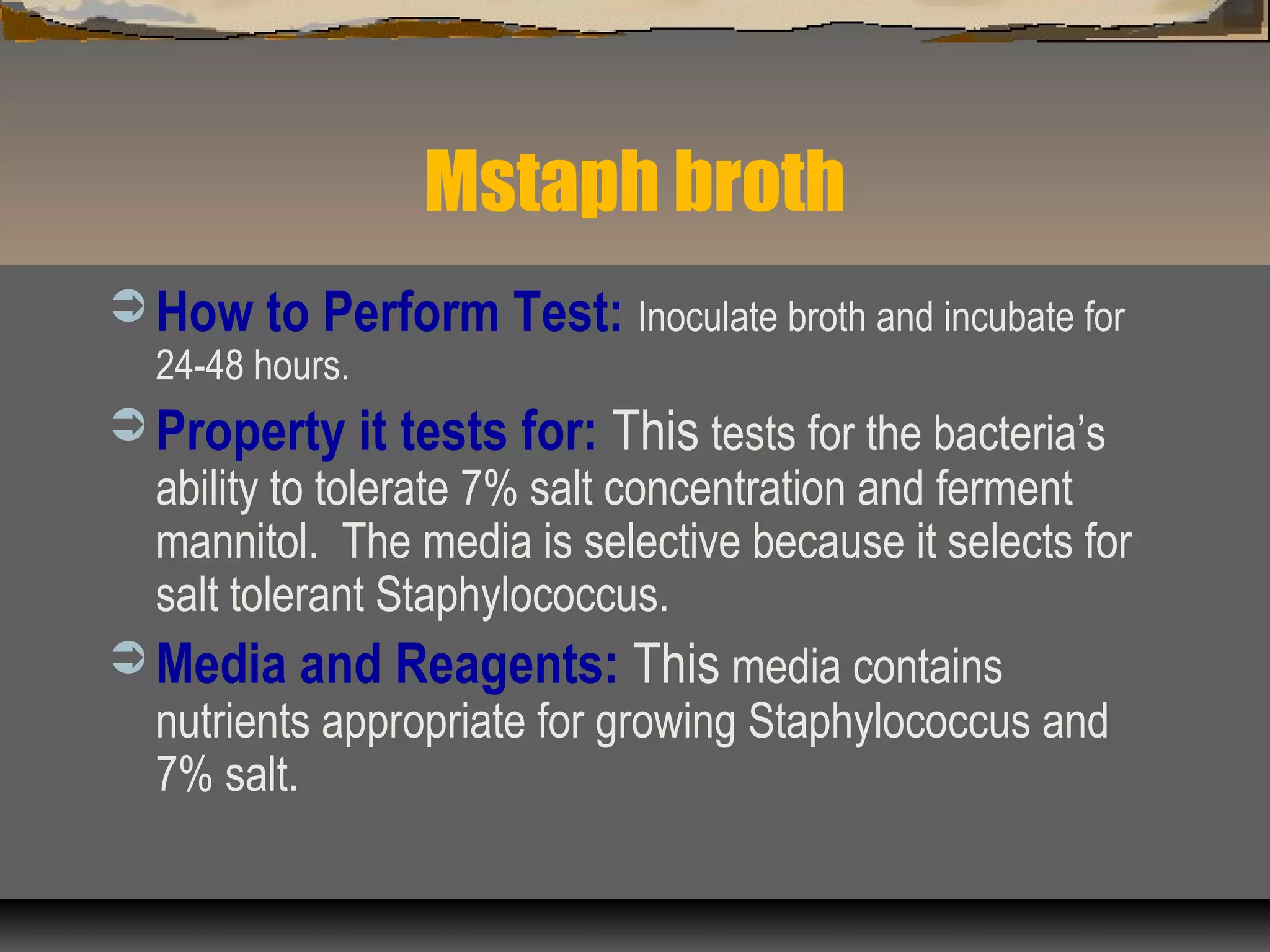
Mstaph broth
Coagulase
Indole Test
 How to Perform Test: Inoculate Tryptone broth with inoculating loop.
 Property it tests for: This test is performed to help differentiate species
of the family Enterobacteriaceae. It tests for the bacteria species’ ability to
produce indole. Bacteria use an enzyme, tryptophanase to break down the
amino acid, tryptophan, which makes by-products, of which, indole is one.
 Media and Reagents Used: Tryptone broth contains tryptophan.
Kovac’s reagent—contains hydrochloric acid, dimethylaminobenzaldehyde,
and amyl alcohol—yellow in color.
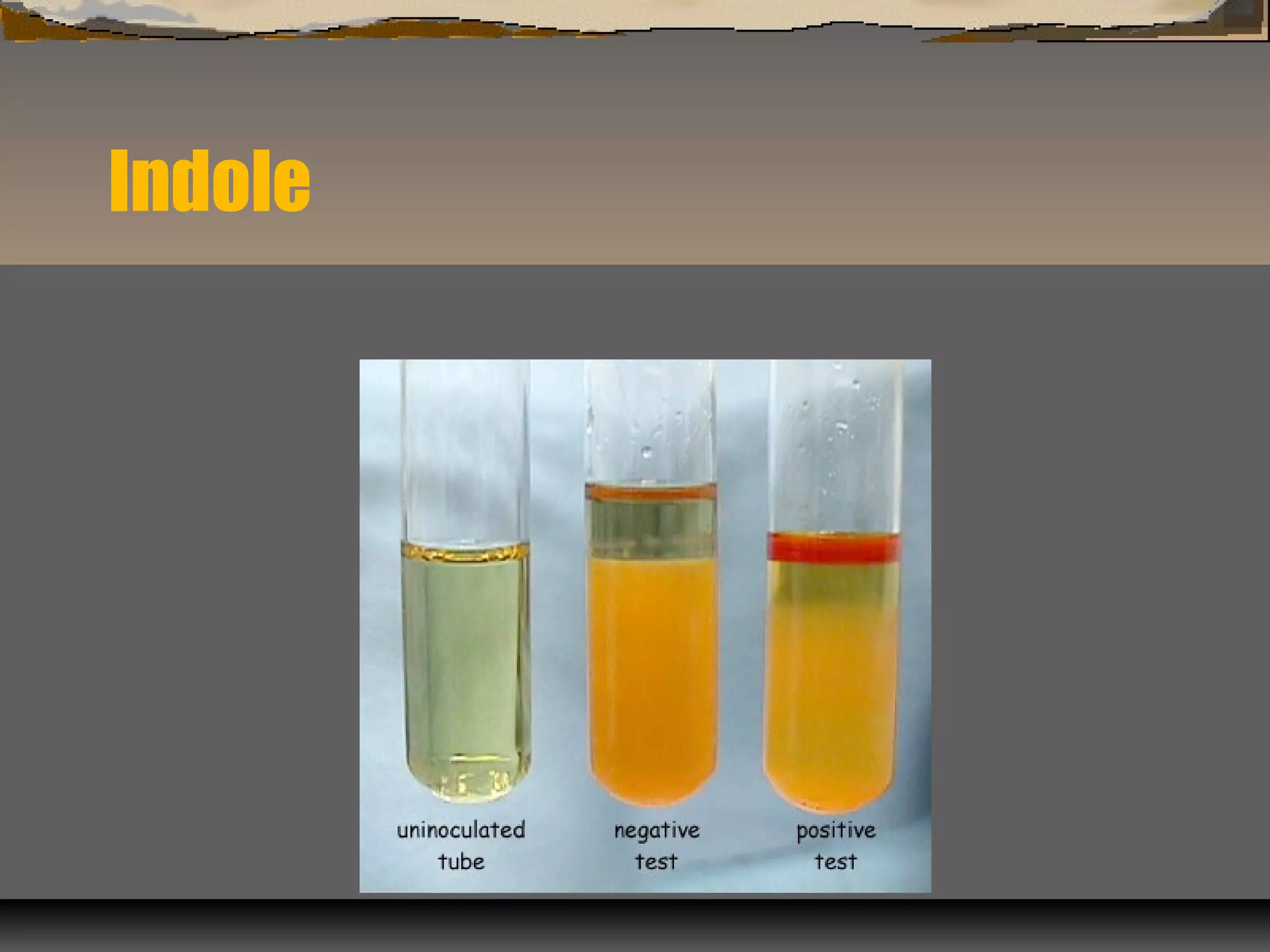
 Reading Results: Kovac’s reagent reacts with indole and creates a red
color at the top part of the test tube.
Indole
Methyl Red/Voges Proskauer
(MR/VP)
 How to Perform Tests: Inoculate 2 glucose broths with
inoculating loop. After 48 hours of incubation, add a few drops of
MR to one tube, and VP reagents to the other tube.
 Properties they test for: Both tests are used to help
differentiate species of the family Enterobacteriaceae.
MR—tests for acid end products from glucose fermentation.
VP—tests for acetoin production from glucose fermentation.
 Media and Reagents Used:
Glucose Broth
Methyl Red indicator for acid
Voges Proskauer reagents—A: 5% Alpha-Naphthol, & ethanol, B:
Potassium Hydroxide, & Deionized Water.
MR/VP continued
 Reading Results:
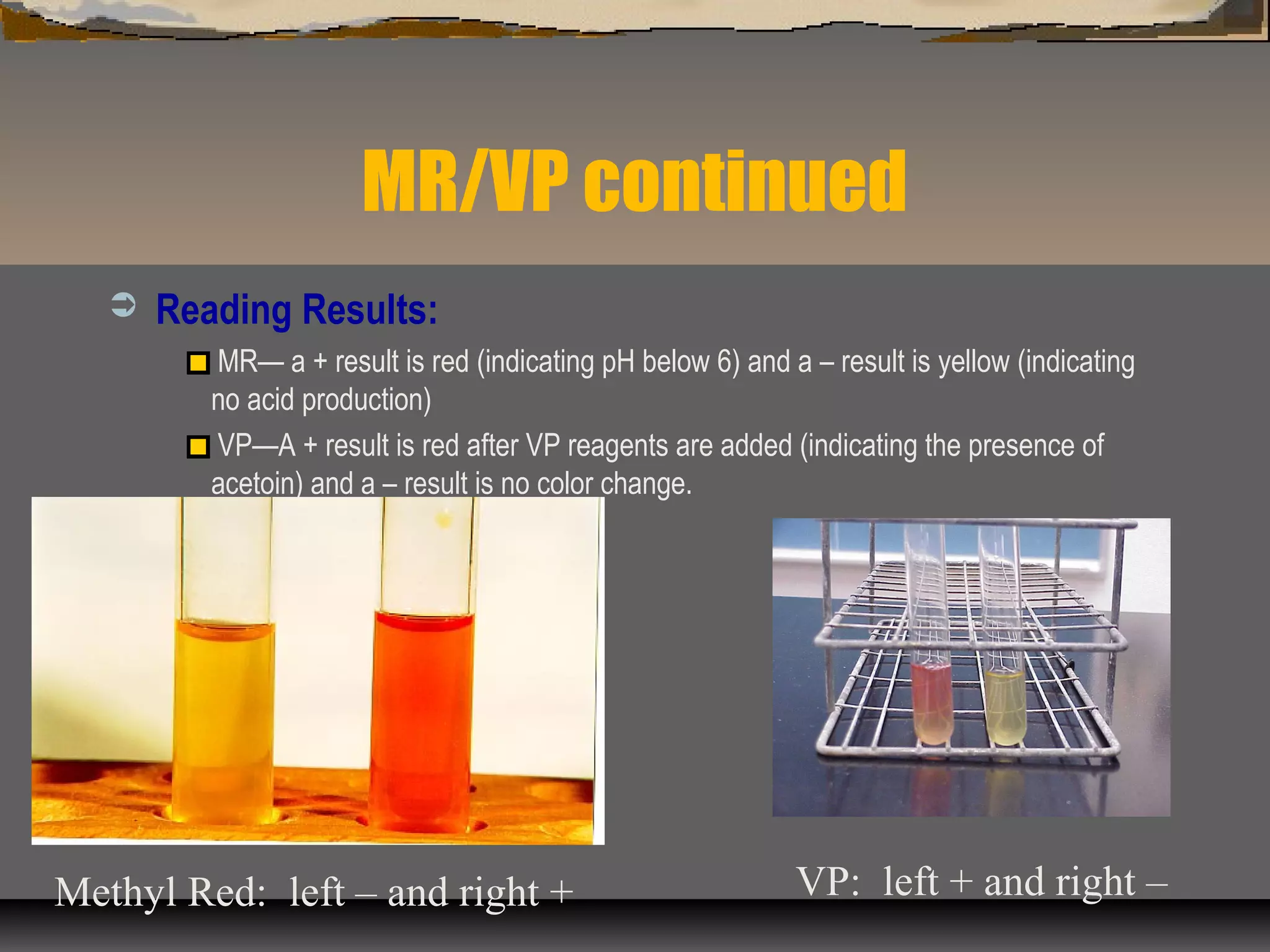
MR— a + result is red (indicating pH below 6) and a – result is yellow (indicating
no acid production)
VP—A + result is red after VP reagents are added (indicating the presence of
acetoin) and a – result is no color change.
Methyl Red: left – and right + VP: left + and right –
Citrate
 How to Perform Test: Inoculate slant with inoculating loop.
 Property it tests for: This test is used to help differentiate species of the
family Enterobacteriaceae. It is selective for bacteria that has the ability to
consume citrate as its sole source of carbon and ammonium as sole nitrogen
source.
 Media and Reagents Used: Simmon’s Citrate Agar contains sodium
citrate (carbon source), ammonium ion (nitrogen source), & pH indicator—
bromthymol blue.
 Reading Results:
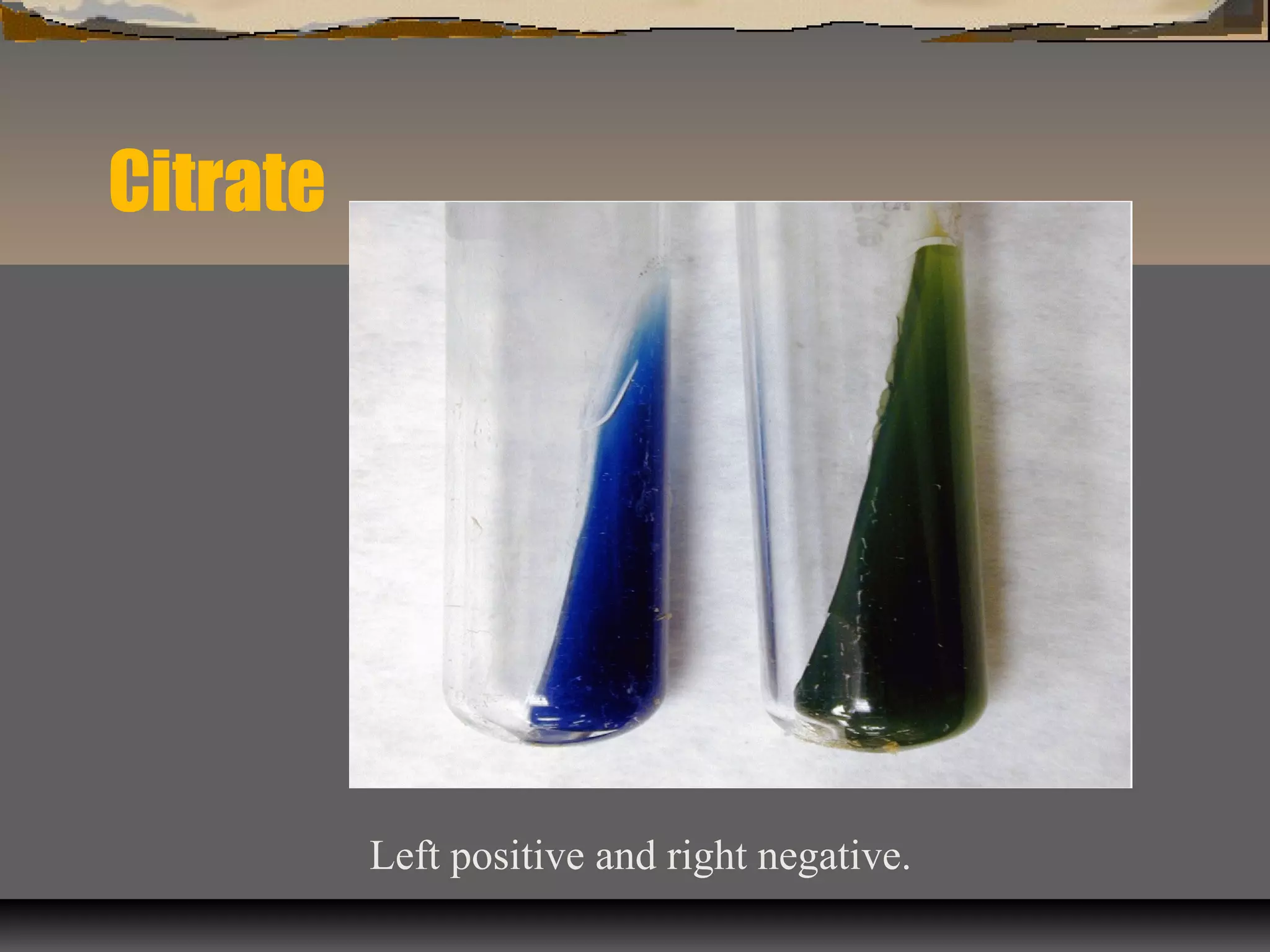
A + result is blue (meaning the bacteria metabolised citrate and produced an acid
end product) and a – result remains green
Citrate
Left positive and right negative.
H2S Production in SIM
 How to Perform Test: Stab SIM media with inoculating needle.
 Property it tests for: This test is used to help differentiate species of the
family Enterobacteriaceae. This test is used to determine the ability to reduce
sulfur into H2S.
 Media and Reagents Used: SIM media contains the sulfur containing
amino acid, cysteine, sodium thiosulfate, & peptonized iron or ferrous sulfate.
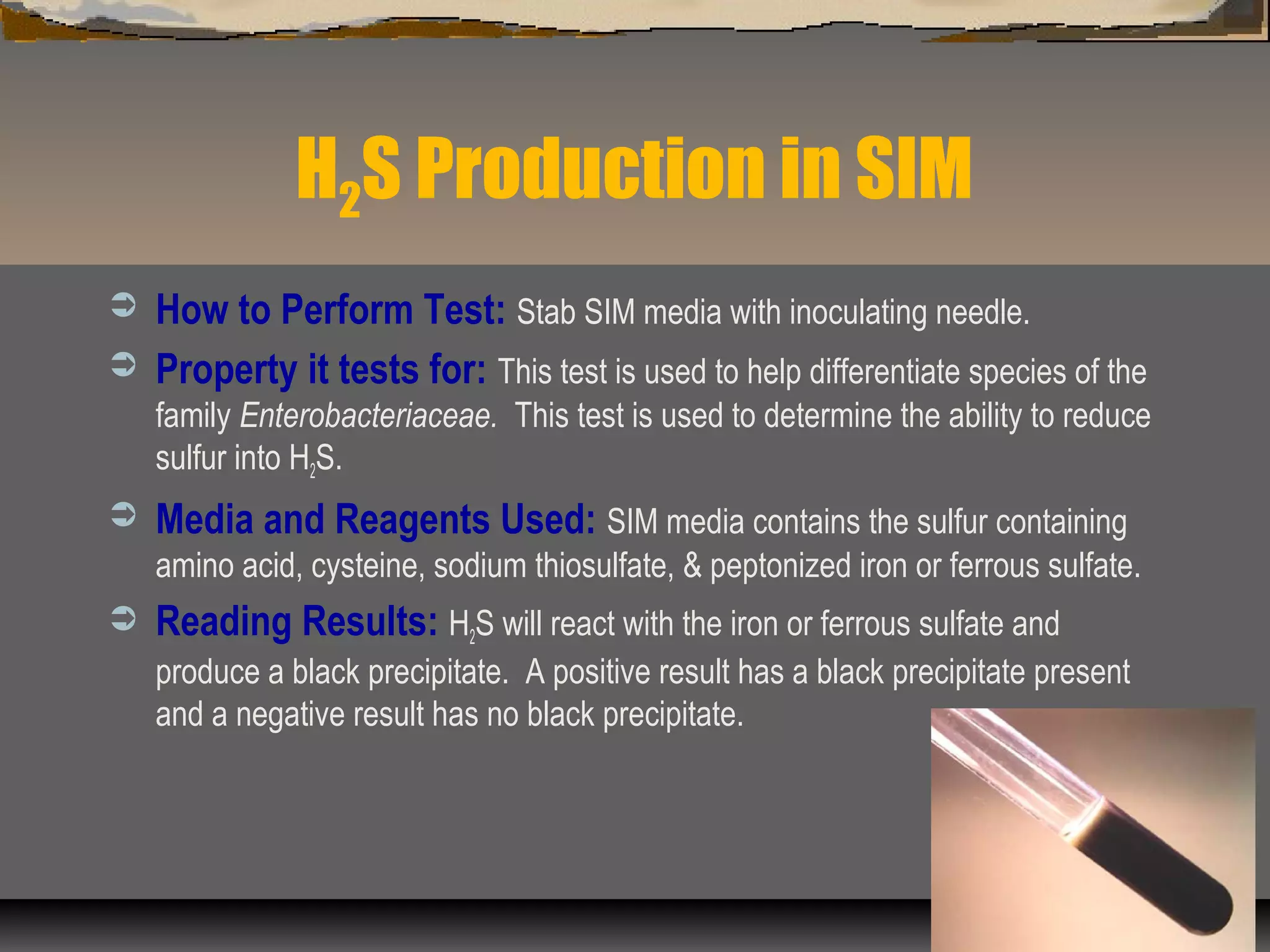
 Reading Results: H2S will react with the iron or ferrous sulfate and
produce a black precipitate. A positive result has a black precipitate present
and a negative result has no black precipitate.
Urea Hydrolysis
 How to Perform Test: Inoculate Urea broth with
inoculating loop.
 Property it tests for: This test is done to determine a
bacteria’s ability to hydrolyze urea to make ammonia using the
enzyme urease.
 Media and Reagents Used: Urea broth contains a
yeast extract, monopotassium phosphate, disodium
phosphate, urea, and phenol red indicator.
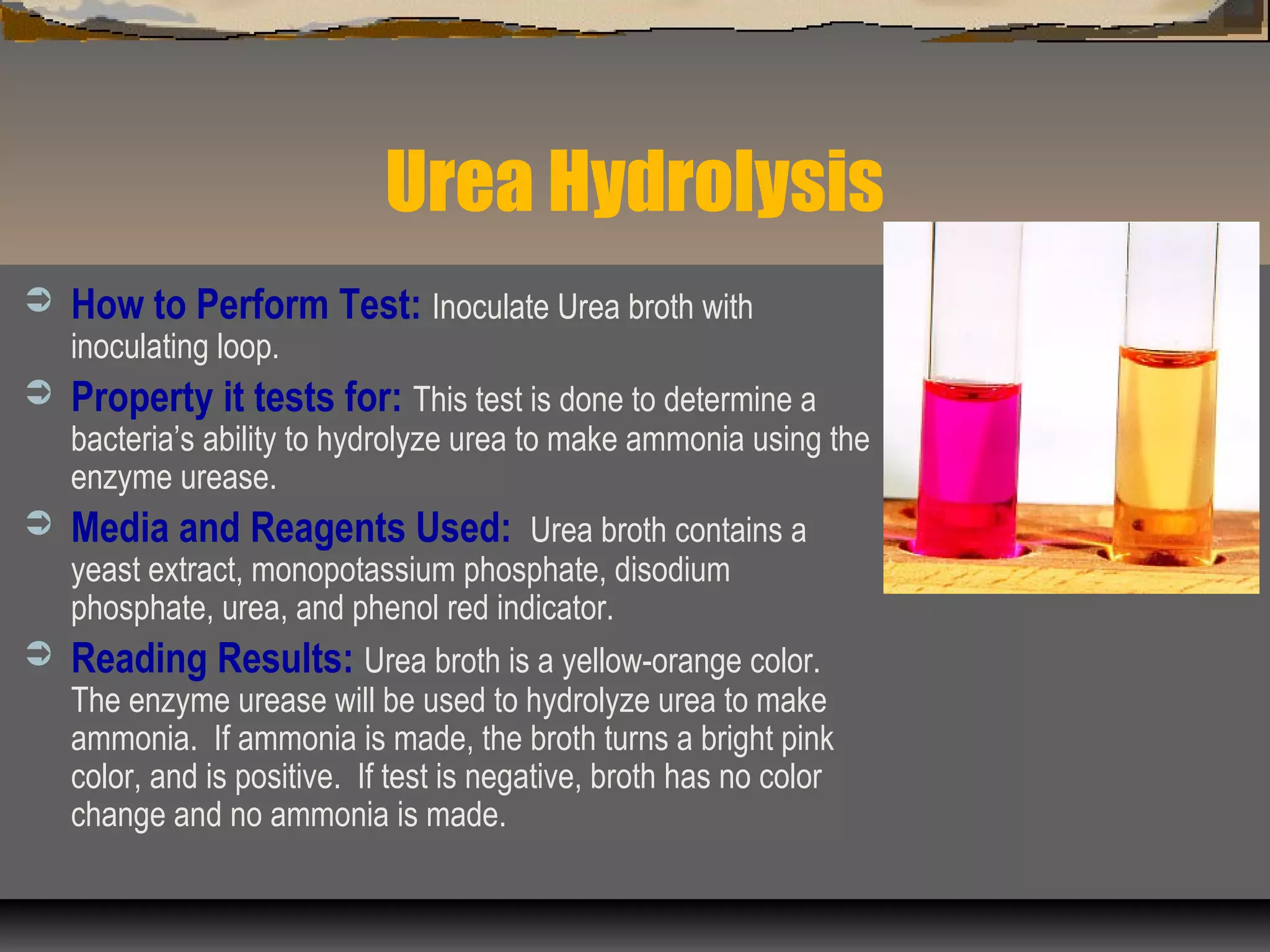
 Reading Results: Urea broth is a yellow-orange color.
The enzyme urease will be used to hydrolyze urea to make
ammonia. If ammonia is made, the broth turns a bright pink
color, and is positive. If test is negative, broth has no color
change and no ammonia is made.
Motility Test
 How to Perform Test: Stab motility media with inoculating
needle.
 Property it tests for: This test is done to help differentiate
species of bacteria that are motile.
 Media and Reagents Used: Motility media contains
tryptose, sodium chloride, agar, and a color indicator.
 Reading Results: If bacteria is motile, there will be growth
going out away from the stab line, and test is positive. If bacteria
is not motile, there will only be growth along the stab line. A
colored indicator can be used to make the results easier to see.
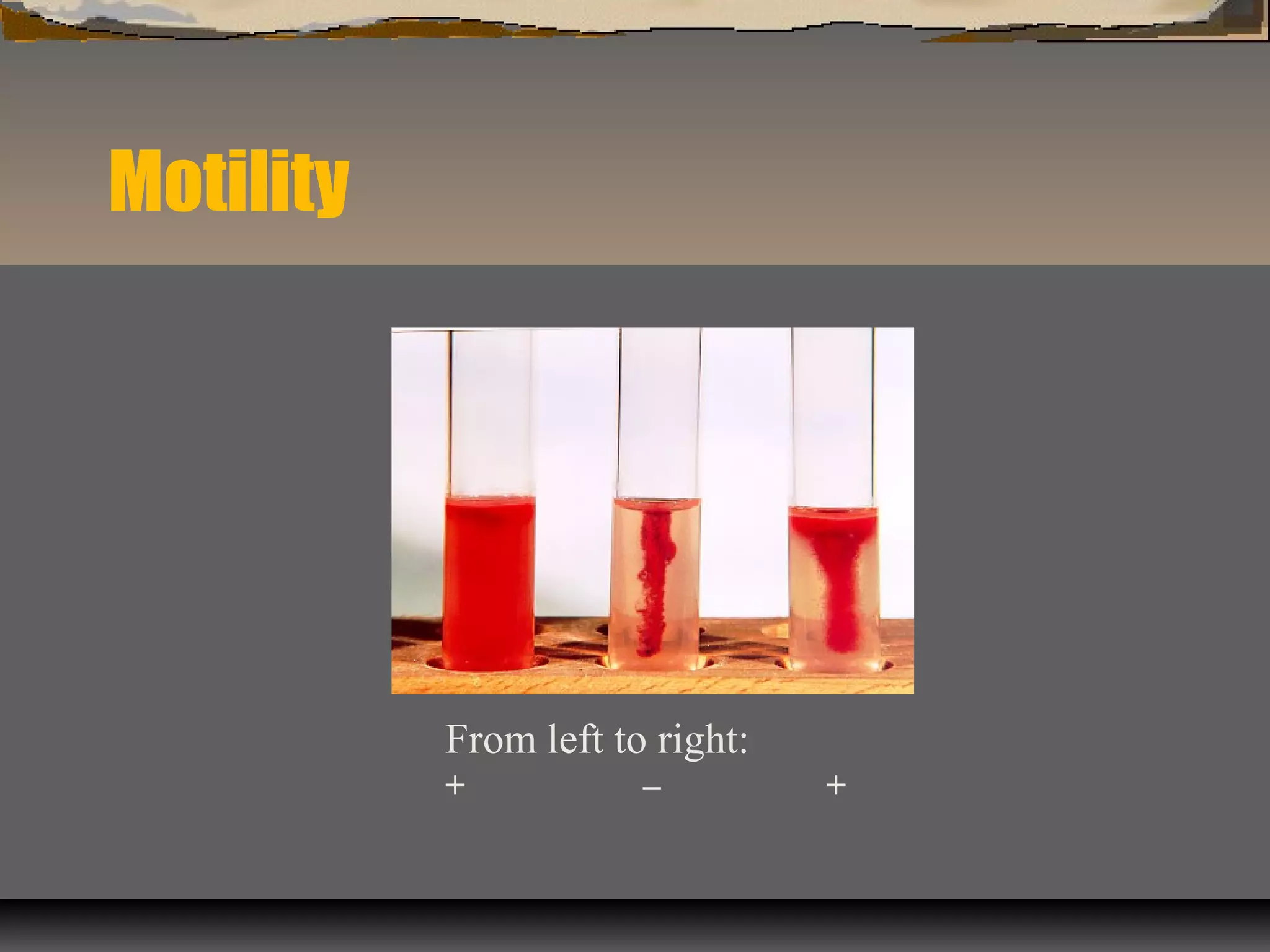
Motility
From left to right:
+ – +
Lactose Fermentation
 How to Perform Test: Inoculate lactose broth with inoculating loop.
 Property it tests for: This tests for the bacteria’s ability to ferment
lactose.
 Media and Reagents Used: Lactose broth contains beef extract, gelatin
peptone, and lactose. A phenol red indicator is added to indicate acid
production from fermentation.
 Results
A positive result is yellow after indicator is added (indicating lactose
fermentation)
A negative result will have no color change or will be redish.
Sucrose Fermentation
 How to Perform Test: Inoculate sucrose broth with inoculating loop.
 Property it tests for: This test is done to help differentiate species of the
family Enterobacteriaceae. This tests for the bacteria’s ability to ferment
sucrose and production of acid end-product
 Media and Reagents Used: Sucrose broth contains beef extract,
gelatin peptone, and sucrose. Phenol red indicator is added to indicate an
acid end-product.
 Results
A positive result is yellow after indicator is added (indicating sucrose
fermentation)
A negative result has no color change or is reddish.
Glucose Fermentation & Gas
Production
 How to Perform Test: Inoculate broth with inoculating loop.
 Property it tests for: This test is done to help differnetiate species of the
family Enterobacteriaceae. This tests for the bacteria’s ability to ferment
glucose and produce gas and/or an acid end-product..
 Media and Reagents Used: Glucose broth contains beef extract,
gelatine peptone, and glucose. A phenol red indicator is added to indicate an
acid enproduct. A Durham tube is added to indicate gas production.
 Results
A positive result for acid is yellow after indicator is added (indicating
glucose fermentation)
A positive result for gas is a bubble in the Durham tube.
A completely negative result has no color change or reddish color and no
bubble.
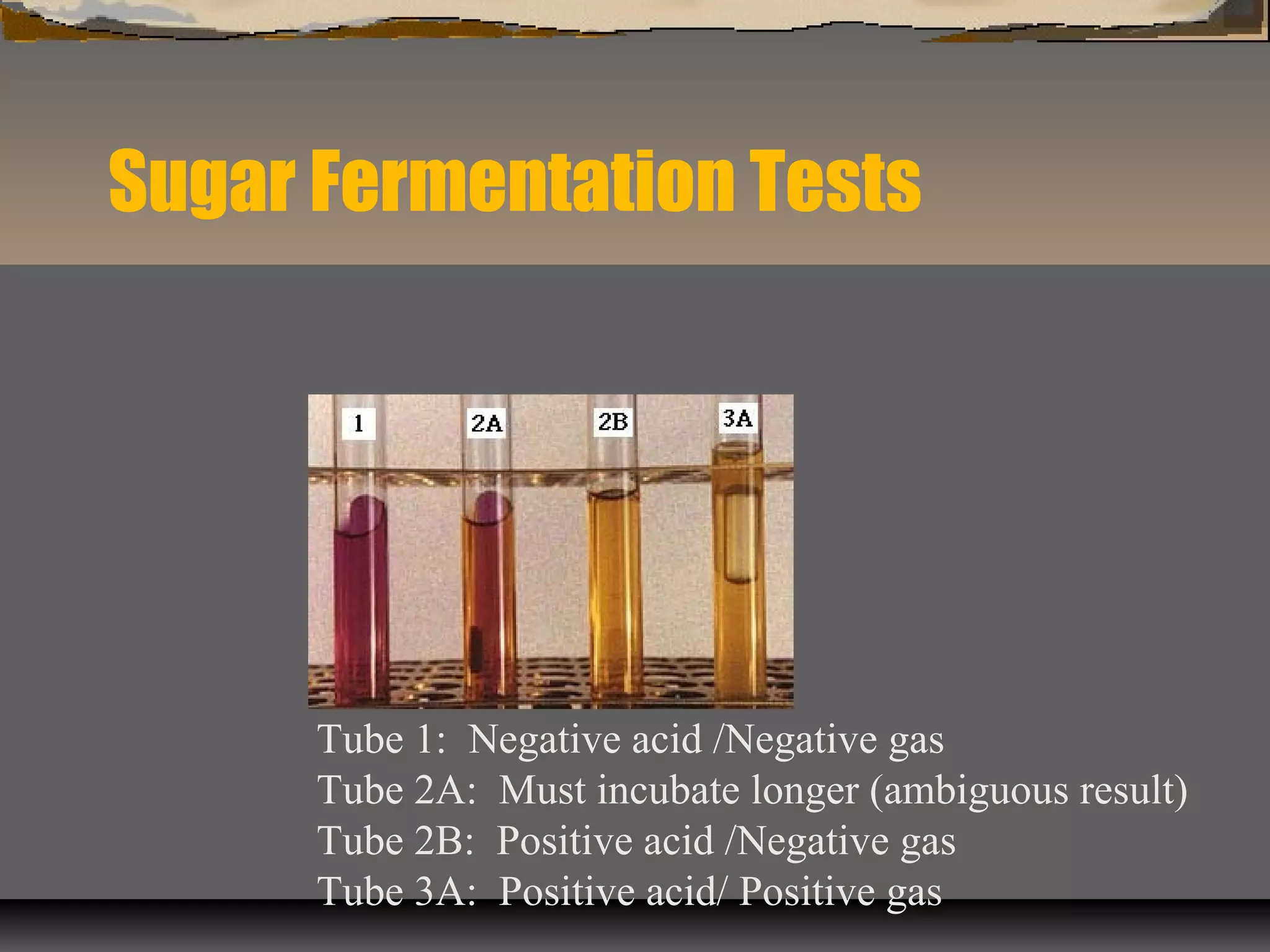
Sugar Fermentation Tests
Tube 1: Negative acid /Negative gas
Tube 2A: Must incubate longer (ambiguous result)
Tube 2B: Positive acid /Negative gas
Tube 3A: Positive acid/ Positive gas
BAP with Novobiocin Test
 How to Perform Test: Inoculate a BAP plate using streak plate
method and incubate 24-48 hours. Place a novovbiocin disk in the first
quadrant of the streak.
 Property it tests for: This test is used to determine two things:
It determines if the organism is resistant or sensitive to Novobiocin
It also determines if the organism can lyse red blood cells (hemolysis)
 Media and Reagents: Media contains nutrient agar with 5%
sheep's blood added. A Novobiocin antibiotic disk is added
after inoculation.
BAP with Novobiocin
 Possible test results:
Hemolysis
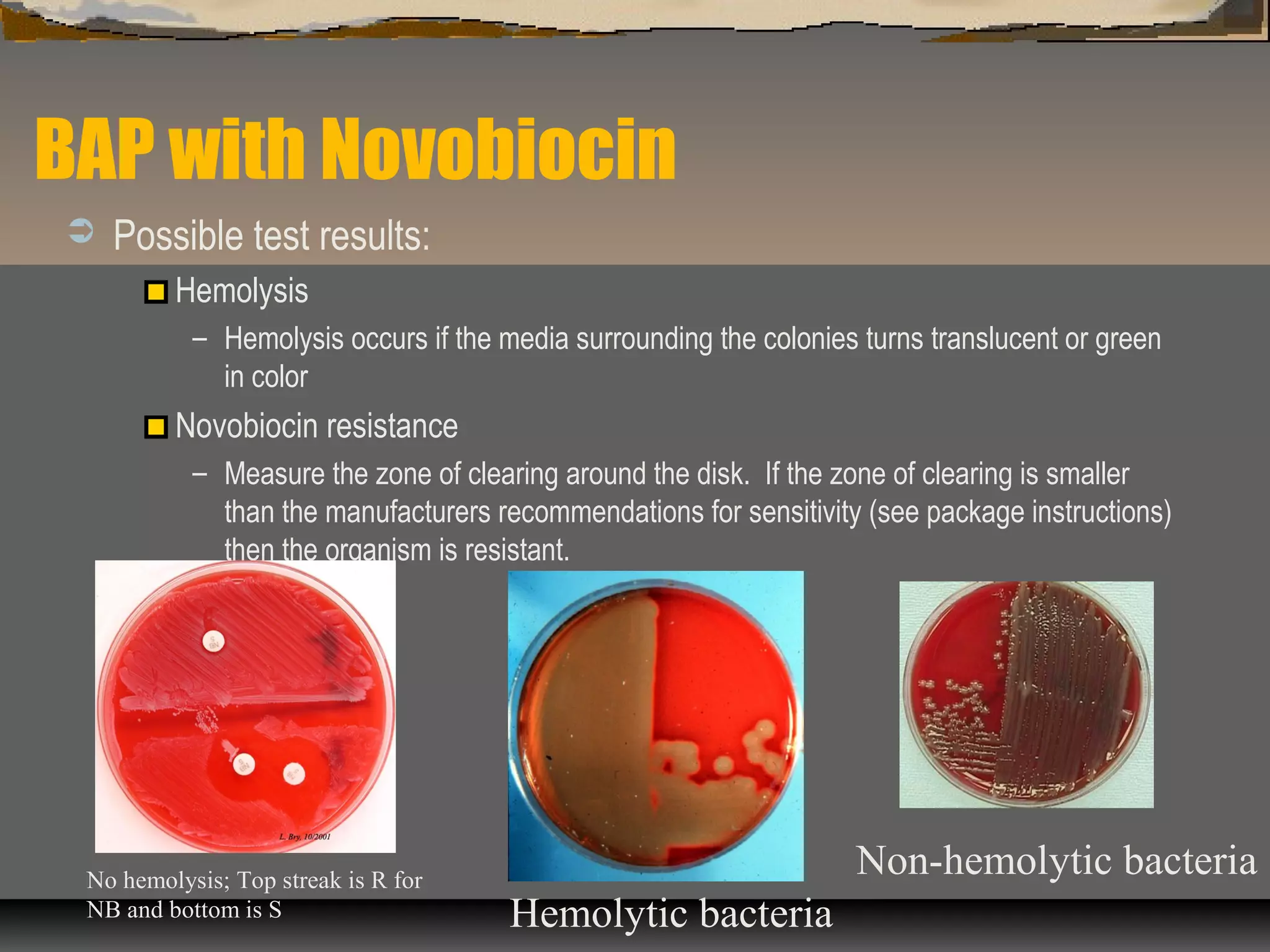
– Hemolysis occurs if the media surrounding the colonies turns translucent or green
in color
Novobiocin resistance
– Measure the zone of clearing around the disk. If the zone of clearing is smaller
than the manufacturers recommendations for sensitivity (see package instructions)
then the organism is resistant.
No hemolysis; Top streak is R for
NB and bottom is S Hemolytic bacteria
Non-hemolytic bacteria
Mannitol Salt Agar (MSA)
 How to Perform Test: Inoculate an MSA plate using streak plate
method and incubate 24-48 hours.
 Property it tests for: This tests for the bacteria’s ability to
tolerate 7% salt concentration and ferment mannitol. The media
is selective because it selects for salt tolerant bacteria. The
media is also differential because it differentiates the salt tolerant
organisms on their ability to ferment mannitol.
 Media and Reagents: MSA media contains nutrient agar,
mannitol, 7% sodium chloride and phenol red indicator.
MSA Results
 Reading Results:
If the organism is tolerant to salt it will grow.
If the organism is not tolerant to salt it will not grow.
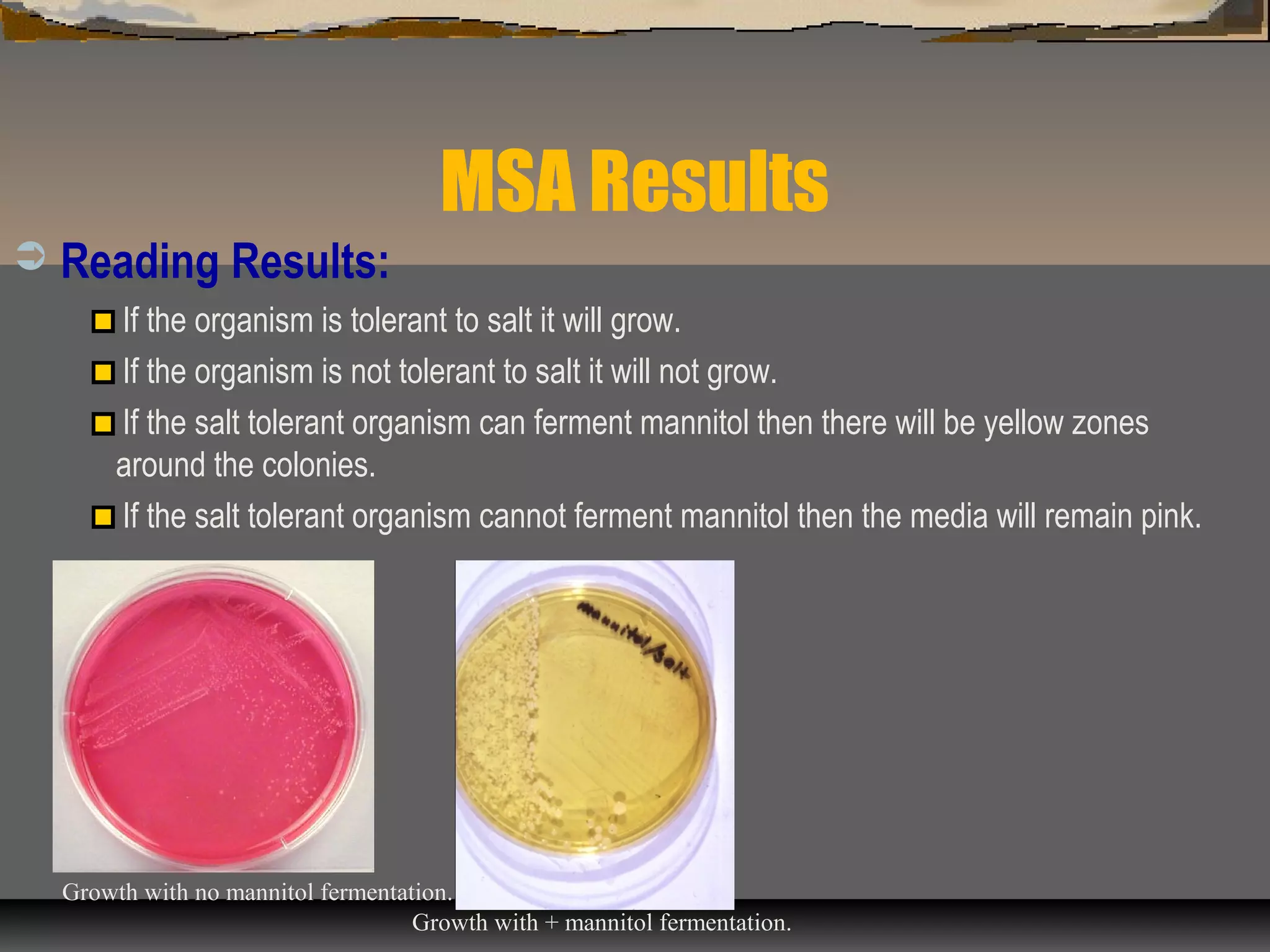
If the salt tolerant organism can ferment mannitol then there will be yellow zones
around the colonies.
If the salt tolerant organism cannot ferment mannitol then the media will remain pink.
Growth with no mannitol fermentation.
Growth with + mannitol fermentation.
Mstaph broth
 How to Perform Test: Inoculate broth and incubate for
24-48 hours.
 Property it tests for: This tests for the bacteria’s
ability to tolerate 7% salt concentration and ferment
mannitol. The media is selective because it selects for
salt tolerant Staphylococcus.
 Media and Reagents: This media contains
nutrients appropriate for growing Staphylococcus and
7% salt.
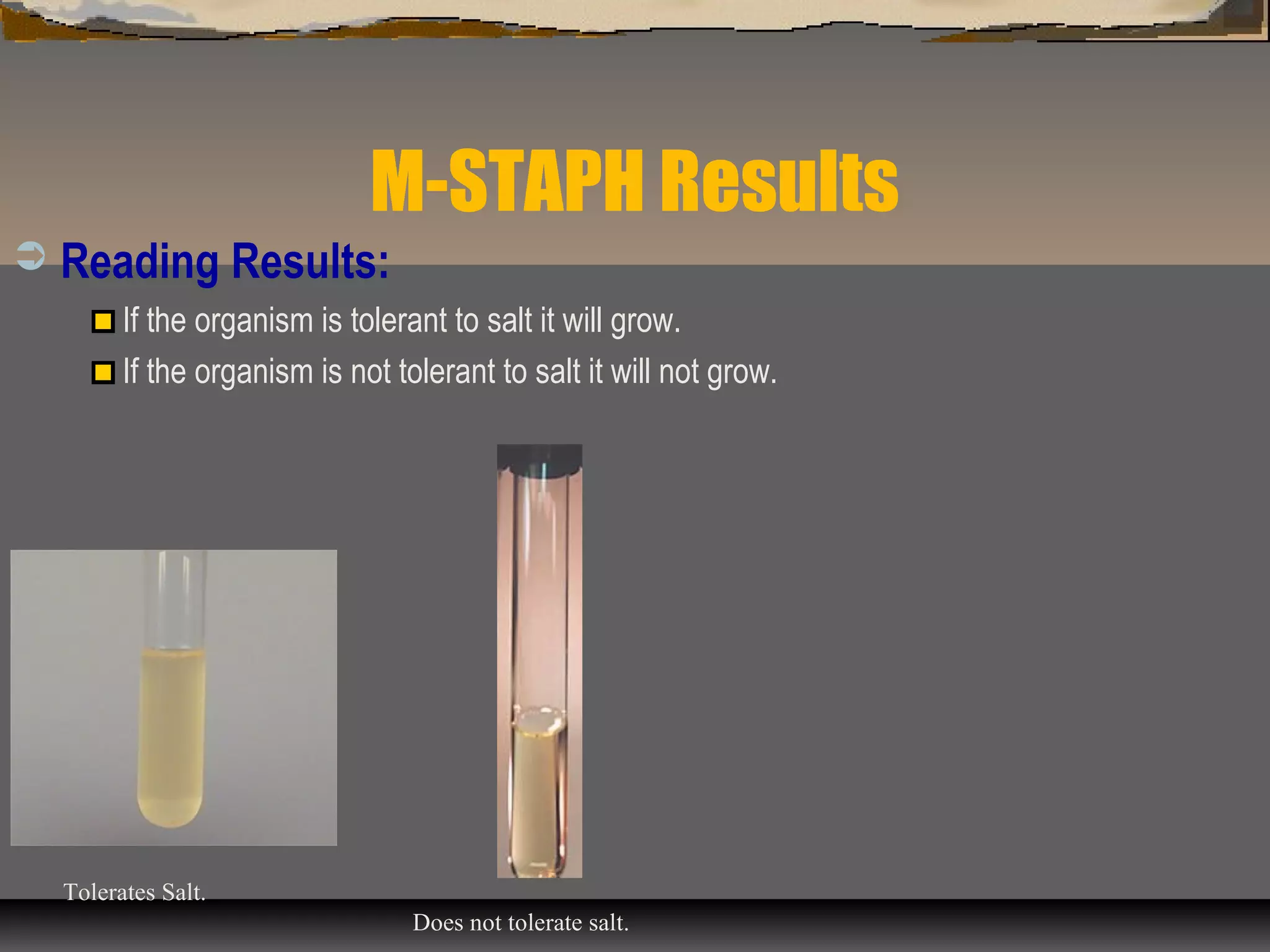
M-STAPH Results
 Reading Results:
If the organism is tolerant to salt it will grow.
If the organism is not tolerant to salt it will not grow.
Tolerates Salt.
Does not tolerate salt.
Coagulase
 How to Perform Test: Inoculate rabbit plasma with one
single colony. Break up colony and stir until blended in plasma.
Incubate at 37 degrees C for 24 hours.
 Property it tests for: This tests for the bacteria’s
ability to clot blood plasma using the enzyme
coagulase. If the organism has coagulase it will clump
rabbit plasma.
 Media and Reagents: This media contains rabbit
plasma dissolved in buffer.
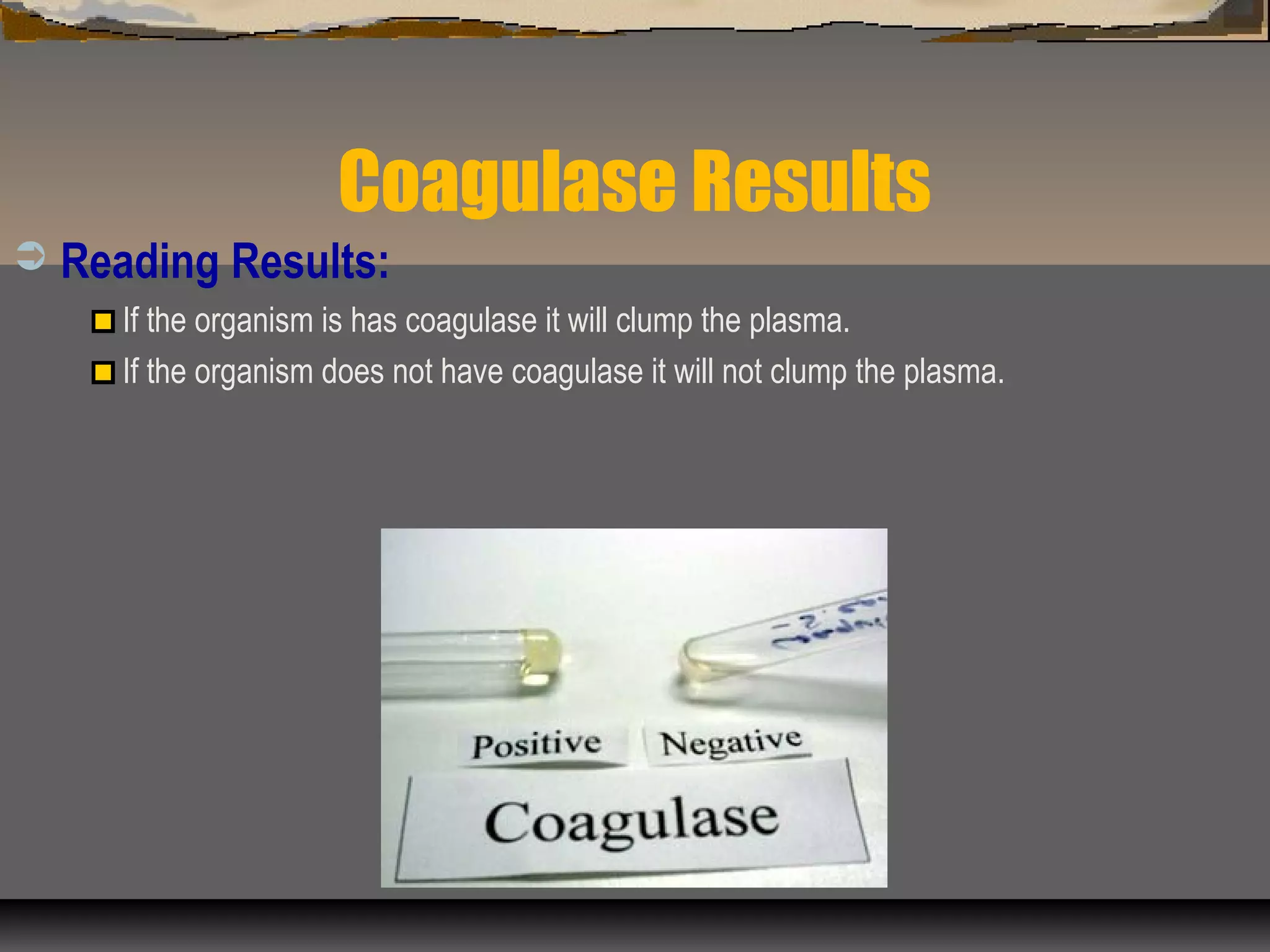
Coagulase Results
 Reading Results:
If the organism is has coagulase it will clump the plasma.
If the organism does not have coagulase it will not clump the plasma.

Media and biochemical tests

  • 1.
    Media & BiochemicalTests Laboratory Objectives
  • 2.
    Tests To Know Case Study Tests Indole Methyl Red/Voges Proskauer Citrate H2S production in SIM Urea hydrolysis Motility Lactose fermentation Sucrose fermentation Glucose fermentation & gas production  Staphylococcus identification tests BAP MSA Mstaph broth Coagulase
  • 3.
    Indole Test  Howto Perform Test: Inoculate Tryptone broth with inoculating loop.  Property it tests for: This test is performed to help differentiate species of the family Enterobacteriaceae. It tests for the bacteria species’ ability to produce indole. Bacteria use an enzyme, tryptophanase to break down the amino acid, tryptophan, which makes by-products, of which, indole is one.  Media and Reagents Used: Tryptone broth contains tryptophan. Kovac’s reagent—contains hydrochloric acid, dimethylaminobenzaldehyde, and amyl alcohol—yellow in color.  Reading Results: Kovac’s reagent reacts with indole and creates a red color at the top part of the test tube.
  • 4.
  • 5.
    Methyl Red/Voges Proskauer (MR/VP) How to Perform Tests: Inoculate 2 glucose broths with inoculating loop. After 48 hours of incubation, add a few drops of MR to one tube, and VP reagents to the other tube.  Properties they test for: Both tests are used to help differentiate species of the family Enterobacteriaceae. MR—tests for acid end products from glucose fermentation. VP—tests for acetoin production from glucose fermentation.  Media and Reagents Used: Glucose Broth Methyl Red indicator for acid Voges Proskauer reagents—A: 5% Alpha-Naphthol, & ethanol, B: Potassium Hydroxide, & Deionized Water.
  • 6.
    MR/VP continued  ReadingResults: MR— a + result is red (indicating pH below 6) and a – result is yellow (indicating no acid production) VP—A + result is red after VP reagents are added (indicating the presence of acetoin) and a – result is no color change. Methyl Red: left – and right + VP: left + and right –
  • 7.
    Citrate  How toPerform Test: Inoculate slant with inoculating loop.  Property it tests for: This test is used to help differentiate species of the family Enterobacteriaceae. It is selective for bacteria that has the ability to consume citrate as its sole source of carbon and ammonium as sole nitrogen source.  Media and Reagents Used: Simmon’s Citrate Agar contains sodium citrate (carbon source), ammonium ion (nitrogen source), & pH indicator— bromthymol blue.  Reading Results: A + result is blue (meaning the bacteria metabolised citrate and produced an acid end product) and a – result remains green
  • 8.
  • 9.
    H2S Production inSIM  How to Perform Test: Stab SIM media with inoculating needle.  Property it tests for: This test is used to help differentiate species of the family Enterobacteriaceae. This test is used to determine the ability to reduce sulfur into H2S.  Media and Reagents Used: SIM media contains the sulfur containing amino acid, cysteine, sodium thiosulfate, & peptonized iron or ferrous sulfate.  Reading Results: H2S will react with the iron or ferrous sulfate and produce a black precipitate. A positive result has a black precipitate present and a negative result has no black precipitate.
  • 10.
    Urea Hydrolysis  Howto Perform Test: Inoculate Urea broth with inoculating loop.  Property it tests for: This test is done to determine a bacteria’s ability to hydrolyze urea to make ammonia using the enzyme urease.  Media and Reagents Used: Urea broth contains a yeast extract, monopotassium phosphate, disodium phosphate, urea, and phenol red indicator.  Reading Results: Urea broth is a yellow-orange color. The enzyme urease will be used to hydrolyze urea to make ammonia. If ammonia is made, the broth turns a bright pink color, and is positive. If test is negative, broth has no color change and no ammonia is made.
  • 11.
    Motility Test  Howto Perform Test: Stab motility media with inoculating needle.  Property it tests for: This test is done to help differentiate species of bacteria that are motile.  Media and Reagents Used: Motility media contains tryptose, sodium chloride, agar, and a color indicator.  Reading Results: If bacteria is motile, there will be growth going out away from the stab line, and test is positive. If bacteria is not motile, there will only be growth along the stab line. A colored indicator can be used to make the results easier to see.
  • 12.
    Motility From left toright: + – +
  • 13.
    Lactose Fermentation  Howto Perform Test: Inoculate lactose broth with inoculating loop.  Property it tests for: This tests for the bacteria’s ability to ferment lactose.  Media and Reagents Used: Lactose broth contains beef extract, gelatin peptone, and lactose. A phenol red indicator is added to indicate acid production from fermentation.  Results A positive result is yellow after indicator is added (indicating lactose fermentation) A negative result will have no color change or will be redish.
  • 14.
    Sucrose Fermentation  Howto Perform Test: Inoculate sucrose broth with inoculating loop.  Property it tests for: This test is done to help differentiate species of the family Enterobacteriaceae. This tests for the bacteria’s ability to ferment sucrose and production of acid end-product  Media and Reagents Used: Sucrose broth contains beef extract, gelatin peptone, and sucrose. Phenol red indicator is added to indicate an acid end-product.  Results A positive result is yellow after indicator is added (indicating sucrose fermentation) A negative result has no color change or is reddish.
  • 15.
    Glucose Fermentation &Gas Production  How to Perform Test: Inoculate broth with inoculating loop.  Property it tests for: This test is done to help differnetiate species of the family Enterobacteriaceae. This tests for the bacteria’s ability to ferment glucose and produce gas and/or an acid end-product..  Media and Reagents Used: Glucose broth contains beef extract, gelatine peptone, and glucose. A phenol red indicator is added to indicate an acid enproduct. A Durham tube is added to indicate gas production.  Results A positive result for acid is yellow after indicator is added (indicating glucose fermentation) A positive result for gas is a bubble in the Durham tube. A completely negative result has no color change or reddish color and no bubble.
  • 16.
    Sugar Fermentation Tests Tube1: Negative acid /Negative gas Tube 2A: Must incubate longer (ambiguous result) Tube 2B: Positive acid /Negative gas Tube 3A: Positive acid/ Positive gas
  • 17.
    BAP with NovobiocinTest  How to Perform Test: Inoculate a BAP plate using streak plate method and incubate 24-48 hours. Place a novovbiocin disk in the first quadrant of the streak.  Property it tests for: This test is used to determine two things: It determines if the organism is resistant or sensitive to Novobiocin It also determines if the organism can lyse red blood cells (hemolysis)  Media and Reagents: Media contains nutrient agar with 5% sheep's blood added. A Novobiocin antibiotic disk is added after inoculation.
  • 18.
    BAP with Novobiocin Possible test results: Hemolysis – Hemolysis occurs if the media surrounding the colonies turns translucent or green in color Novobiocin resistance – Measure the zone of clearing around the disk. If the zone of clearing is smaller than the manufacturers recommendations for sensitivity (see package instructions) then the organism is resistant. No hemolysis; Top streak is R for NB and bottom is S Hemolytic bacteria Non-hemolytic bacteria
  • 19.
    Mannitol Salt Agar(MSA)  How to Perform Test: Inoculate an MSA plate using streak plate method and incubate 24-48 hours.  Property it tests for: This tests for the bacteria’s ability to tolerate 7% salt concentration and ferment mannitol. The media is selective because it selects for salt tolerant bacteria. The media is also differential because it differentiates the salt tolerant organisms on their ability to ferment mannitol.  Media and Reagents: MSA media contains nutrient agar, mannitol, 7% sodium chloride and phenol red indicator.
  • 20.
    MSA Results  ReadingResults: If the organism is tolerant to salt it will grow. If the organism is not tolerant to salt it will not grow. If the salt tolerant organism can ferment mannitol then there will be yellow zones around the colonies. If the salt tolerant organism cannot ferment mannitol then the media will remain pink. Growth with no mannitol fermentation. Growth with + mannitol fermentation.
  • 21.
    Mstaph broth  Howto Perform Test: Inoculate broth and incubate for 24-48 hours.  Property it tests for: This tests for the bacteria’s ability to tolerate 7% salt concentration and ferment mannitol. The media is selective because it selects for salt tolerant Staphylococcus.  Media and Reagents: This media contains nutrients appropriate for growing Staphylococcus and 7% salt.
  • 22.
    M-STAPH Results  ReadingResults: If the organism is tolerant to salt it will grow. If the organism is not tolerant to salt it will not grow. Tolerates Salt. Does not tolerate salt.
  • 23.
    Coagulase  How toPerform Test: Inoculate rabbit plasma with one single colony. Break up colony and stir until blended in plasma. Incubate at 37 degrees C for 24 hours.  Property it tests for: This tests for the bacteria’s ability to clot blood plasma using the enzyme coagulase. If the organism has coagulase it will clump rabbit plasma.  Media and Reagents: This media contains rabbit plasma dissolved in buffer.
  • 24.
    Coagulase Results  ReadingResults: If the organism is has coagulase it will clump the plasma. If the organism does not have coagulase it will not clump the plasma.