Presented by,
Mrs. ZAINABATH MAHNOORA,
B. Pharm
NU20PHPP13
Clinical kinetics and TDM
Department of Pharmacy Practice,
ESTIMATION OF BIOAVAILABILITY
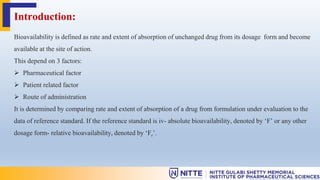
Introduction:
Bioavailability is defined as rate and extent of absorption of unchanged drug from its dosage form and become
available at the site of action.
This depend on 3 factors:
 Pharmaceutical factor
 Patient related factor
 Route of administration
It is determined by comparing rate and extent of absorption of a drug from formulation under evaluation to the
data of reference standard. If the reference standard is iv- absolute bioavailability, denoted by ‘F’ or any other
dosage form- relative bioavailability, denoted by ‘Fr’.
Measurement of bioavailability:
Quantitative evaluation of bioavailability done by two categories:-
 Pharmacokinetic method-
• widely used
• Based on pharmacokinetic profile-therapeutic effect
• Indirect method
• 2 types:- Plasma - level time studies and Urinary excretion studies
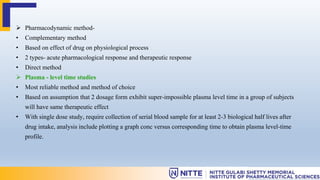
 Pharmacodynamic method-
• Complementary method
• Based on effect of drug on physiological process
• 2 types- acute pharmacological response and therapeutic response
• Direct method
 Plasma - level time studies
• Most reliable method and method of choice
• Based on assumption that 2 dosage form exhibit super-impossible plasma level time in a group of subjects
will have same therapeutic effect
• With single dose study, require collection of serial blood sample for at least 2-3 biological half lives after
drug intake, analysis include plotting a graph conc versus corresponding time to obtain plasma level-time
profile.
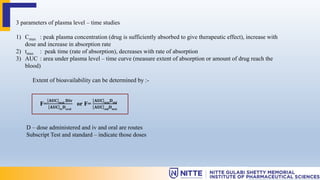
3 parameters of plasma level – time studies
1) Cmax : peak plasma concentration (drug is sufficiently absorbed to give therapeutic effect), increase with
dose and increase in absorption rate
2) tmax : peak time (rate of absorption), decreases with rate of absorption
3) AUC : area under plasma level – time curve (measure extent of absorption or amount of drug reach the
blood)
Extent of bioavailability can be determined by :-
F=
𝐀𝐔𝐂 𝐨𝐫𝐚𝐥
𝐃𝐢𝐯
𝐀𝐔𝐂 𝐢𝐯
𝐃𝐨𝐫𝐚𝐥
or F=
𝐀𝐔𝐂 𝐭𝐞𝐬𝐭
𝐃𝐬𝐭𝐝
𝐀𝐔𝐂 𝐬𝐭𝐝
𝐃𝐭𝐞𝐬𝐭
D – dose administered and iv and oral are routes
Subscript Test and standard – indicate those doses
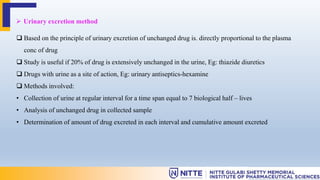
 Urinary excretion method
 Based on the principle of urinary excretion of unchanged drug is. directly proportional to the plasma
conc of drug
 Study is useful if 20% of drug is extensively unchanged in the urine, Eg: thiazide diuretics
 Drugs with urine as a site of action, Eg: urinary antiseptics-hexamine
 Methods involved:
• Collection of urine at regular interval for a time span equal to 7 biological half – lives
• Analysis of unchanged drug in collected sample
• Determination of amount of drug excreted in each interval and cumulative amount excreted
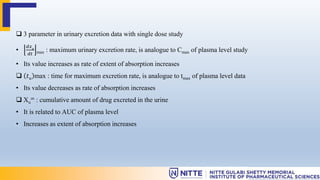
 3 parameter in urinary excretion data with single dose study
•
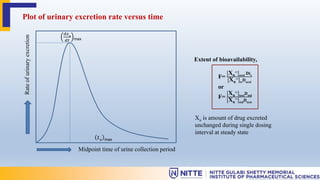
𝑑𝑥𝑢
𝑑𝑡 max : maximum urinary excretion rate, is analogue to Cmax of plasma level study
• Its value increases as rate of extent of absorption increases
 𝑡𝑢 max : time for maximum excretion rate, is analogue to tmax of plasma level data
• Its value decreases as rate of absorption increases
 Xu
∞ : cumulative amount of drug excreted in the urine
• It is related to AUC of plasma level
• Increases as extent of absorption increases
Midpoint time of urine collection period
Rate
of
urinary
excretion
𝑑𝑥𝑢
𝑑𝑡 max
𝑡𝑢 max
Plot of urinary excretion rate versus time
Extent of bioavailability,
F=
Xu
∞
𝐨𝐫𝐚𝐥
𝐃𝐢𝐯
Xu
∞
𝐢𝐯
𝐃𝐨𝐫𝐚𝐥
or
F=
Xu
∞
𝐭𝐞𝐬𝐭
𝐃𝐬𝐭𝐝
Xu
∞
𝐬𝐭𝐝
𝐃𝐭𝐞𝐬𝐭
Xu is amount of drug excreted
unchanged during single dosing
interval at steady state
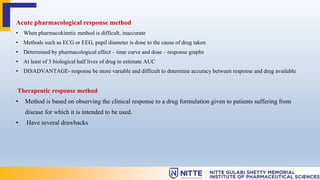
Acute pharmacological response method
• When pharmacokinetic method is difficult, inaccurate
• Methods such as ECG or EEG, pupil diameter is done to the cause of drug taken
• Determined by pharmacological effect – time curve and dose – response graphs
• At least of 3 biological half lives of drug to estimate AUC
• DISADVANTAGE- response be more variable and difficult to determine accuracy between response and drug available
Therapeutic response method
• Method is based on observing the clinical response to a drug formulation given to patients suffering from
disease for which it is intended to be used.
• Have several drawbacks
Bioavailability-Kinetics.pptx

Bioavailability-Kinetics.pptx

  • 1.
    Presented by, Mrs. ZAINABATHMAHNOORA, B. Pharm NU20PHPP13 Clinical kinetics and TDM Department of Pharmacy Practice, ESTIMATION OF BIOAVAILABILITY
  • 2.
    Introduction: Bioavailability is definedas rate and extent of absorption of unchanged drug from its dosage form and become available at the site of action. This depend on 3 factors:  Pharmaceutical factor  Patient related factor  Route of administration It is determined by comparing rate and extent of absorption of a drug from formulation under evaluation to the data of reference standard. If the reference standard is iv- absolute bioavailability, denoted by ‘F’ or any other dosage form- relative bioavailability, denoted by ‘Fr’.
  • 3.
    Measurement of bioavailability: Quantitativeevaluation of bioavailability done by two categories:-  Pharmacokinetic method- • widely used • Based on pharmacokinetic profile-therapeutic effect • Indirect method • 2 types:- Plasma - level time studies and Urinary excretion studies
  • 4.
     Pharmacodynamic method- •Complementary method • Based on effect of drug on physiological process • 2 types- acute pharmacological response and therapeutic response • Direct method  Plasma - level time studies • Most reliable method and method of choice • Based on assumption that 2 dosage form exhibit super-impossible plasma level time in a group of subjects will have same therapeutic effect • With single dose study, require collection of serial blood sample for at least 2-3 biological half lives after drug intake, analysis include plotting a graph conc versus corresponding time to obtain plasma level-time profile.
  • 5.
    3 parameters ofplasma level – time studies 1) Cmax : peak plasma concentration (drug is sufficiently absorbed to give therapeutic effect), increase with dose and increase in absorption rate 2) tmax : peak time (rate of absorption), decreases with rate of absorption 3) AUC : area under plasma level – time curve (measure extent of absorption or amount of drug reach the blood) Extent of bioavailability can be determined by :- F= 𝐀𝐔𝐂 𝐨𝐫𝐚𝐥 𝐃𝐢𝐯 𝐀𝐔𝐂 𝐢𝐯 𝐃𝐨𝐫𝐚𝐥 or F= 𝐀𝐔𝐂 𝐭𝐞𝐬𝐭 𝐃𝐬𝐭𝐝 𝐀𝐔𝐂 𝐬𝐭𝐝 𝐃𝐭𝐞𝐬𝐭 D – dose administered and iv and oral are routes Subscript Test and standard – indicate those doses
  • 6.
     Urinary excretionmethod  Based on the principle of urinary excretion of unchanged drug is. directly proportional to the plasma conc of drug  Study is useful if 20% of drug is extensively unchanged in the urine, Eg: thiazide diuretics  Drugs with urine as a site of action, Eg: urinary antiseptics-hexamine  Methods involved: • Collection of urine at regular interval for a time span equal to 7 biological half – lives • Analysis of unchanged drug in collected sample • Determination of amount of drug excreted in each interval and cumulative amount excreted
  • 7.
     3 parameterin urinary excretion data with single dose study • 𝑑𝑥𝑢 𝑑𝑡 max : maximum urinary excretion rate, is analogue to Cmax of plasma level study • Its value increases as rate of extent of absorption increases  𝑡𝑢 max : time for maximum excretion rate, is analogue to tmax of plasma level data • Its value decreases as rate of absorption increases  Xu ∞ : cumulative amount of drug excreted in the urine • It is related to AUC of plasma level • Increases as extent of absorption increases
  • 8.
    Midpoint time ofurine collection period Rate of urinary excretion 𝑑𝑥𝑢 𝑑𝑡 max 𝑡𝑢 max Plot of urinary excretion rate versus time Extent of bioavailability, F= Xu ∞ 𝐨𝐫𝐚𝐥 𝐃𝐢𝐯 Xu ∞ 𝐢𝐯 𝐃𝐨𝐫𝐚𝐥 or F= Xu ∞ 𝐭𝐞𝐬𝐭 𝐃𝐬𝐭𝐝 Xu ∞ 𝐬𝐭𝐝 𝐃𝐭𝐞𝐬𝐭 Xu is amount of drug excreted unchanged during single dosing interval at steady state
  • 9.
    Acute pharmacological responsemethod • When pharmacokinetic method is difficult, inaccurate • Methods such as ECG or EEG, pupil diameter is done to the cause of drug taken • Determined by pharmacological effect – time curve and dose – response graphs • At least of 3 biological half lives of drug to estimate AUC • DISADVANTAGE- response be more variable and difficult to determine accuracy between response and drug available Therapeutic response method • Method is based on observing the clinical response to a drug formulation given to patients suffering from disease for which it is intended to be used. • Have several drawbacks