Brief introduction to bioavailability 
Objectives of bioavailability 
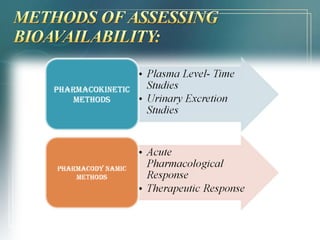
Methods of assessing bioavailability 
Concept of equivalence 
References
IInnttrroodduuccttiioonn 
• Bioavailability is defined as rate and extent of absorption of 
unchanged drug from it’s dosage form and become available at 
the site of action. 
• Bioavailability of a drug from it’s dosage form depends upon 3 
major factors: 
 Pharmaceutical factors 
 Patient related factors 
 Route of administration
OObbjjeeccttiivveess 
 Development of new formulations. 
 Determination of influence of excipients, patient related 
factors and possible interaction with other drugs on the 
efficiency of absorption. 
 Control of quality of a drug product during the early stages of 
marketing in order to determine the influence of processing 
factors, storage, stability on drug absorption. 
 Primary stages of the development of a suitable dosage form 
for a new drug entity.
• When systemic availability of drug administered orally is 
determined in comparison to its intravenous administration, is called 
absolute bioavailability. 
• Its determination is used to characterize a drug’s inherent 
absorption properties from the extra vascular site.. 
AAbbssoolluuttee bbiiooaavvaaiillaabbiilliittyy == [[AAUUCC]]oorraall ((DDoossee))iivv 
[[AAUUCC]]iivv ((DDoossee))oorraall
RReellaattiivvee BBiiooaavvaaiillaabbiilliittyy ((FFrr)) 
• When systemic availability of drug after oral administration is 
compared with that of an oral standard of same drug (such as an 
aqueous or non aqueous solution or suspension) it is referred as 
relative bioavailability. 
• It is used to characterize absorption of drug from its formulation. 
RReellaattiivvee BBiiooaavvaaiillaabbiilliittyy == [[AAUUCC]]tteesstt ((DDoossee))ssttdd 
[[AAUUCC]]ssttdd ((DDoossee))tteesstt
• Widely used and based on assumption that Pharmacokinetic 
profile reflects the therapeutic effectiveness of a drug. 
Plasma Level- Time Studies: 
• Most common type of human bioavailability studies. 
• Based on the assumption that there is a direct relationship 
between the concentration of drug in blood or plasma and the 
concentration of drug at the site of action. 
• Following the administration of a single dose of a medication, 
blood samples are drawn at specific time intervals and analyzed 
for drug content.
• A profile is constructed showing the concentration of drug in 
blood at the specific times the samples were taken. 
• Bioavailability (the rate and extent of drug absorption) is 
generally assessed by the determination of following three 
parameters. 
They are.. CCmmaaxx ((PPeeaakk ppllaassmmaa ccoonncceennttrraattiioonn)) 
ttmmaaxx((ttiimmee ooff ppeeaakk)) 
AArreeaa uunnddeerr ccuurrvvee
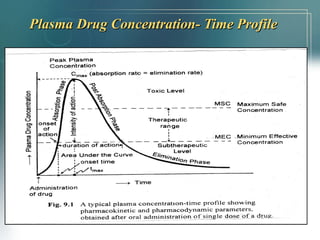
PPllaassmmaa DDrruugg CCoonncceennttrraattiioonn-- TTiimmee PPrrooffiillee
 CCmmaaxx:: (Peak plasma drug concentration) 
 Maximum concentration of the drug obtained after the 
administration of single dose of the drug. 
 Expressed in terms of μg/ml or mg/ml. 
 ttmmaaxx: (Time of peak plasma conc.) 
Time required to achieve peak concentration of the drug after 
administration. 
 Gives indication of the rate of absorption. 
 Expressed in terms of hours or minutes.
 AUC: Is the measurement of the extent of the drug bioavailability 
It is the area under the drug plasma level-time curve from t =0 & 
t = ∞, and is equal to the amount of unchanged drug reaching the 
general circulation divided by the clearance. 
[ AUC]0 
∞ = ∫0 
∞Cpdt 
[ AUC]0 
∞ = FD0 = FDO/ kVD 
Clearance
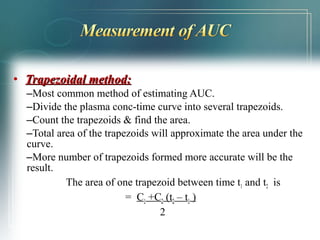
• TTrraappeezzooiiddaall mmeetthhoodd:: 
–Most common method of estimating AUC. 
–Divide the plasma conc-time curve into several trapezoids. 
–Count the trapezoids & find the area. 
–Total area of the trapezoids will approximate the area under the 
curve. 
–More number of trapezoids formed more accurate will be the 
result. 
The area of one trapezoid between time t1 and t2 is 
= C1 +C2 (t2 – t1 ) 
2
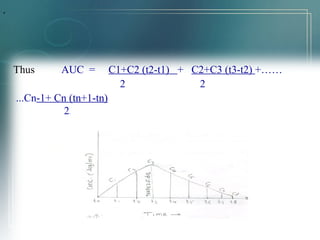
Thus AUC = C1+C2 (t2-t1) + C2+C3 (t3-t2) +…… 
2 2 
...Cn-1+ Cn (tn+1-tn) 
2. 
•
• CCUUTT && WWEEIIGGHH MMEETTHHOODD:: 
• Preparing calibrated plot by cutting squares of graph &weights 
are recorded & plotted against weight Vs area. 
• Sample curve is cut & weight is recorded. 
• By interpolation method area of sample graph is found.
• PPLLAANNIIMMEETTEERR:: 
• Instrument for mechanically measuring the 
area under the curve. 
• Measures area by tracing outline of curve. 
• Disadvantage: 
• Degree of error is high due to instrumental 
& human error. 
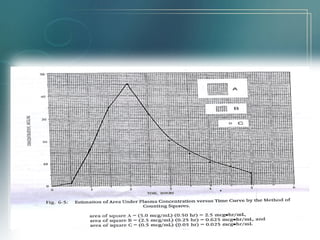
• CCOOUUNNTTIINNGG TTHHEE SSQQUUAARREE :: 
• Total no. of squares enclosed in the curve is counted. 
• Area of each square determined using relationship: 
AREA=(height) (width)
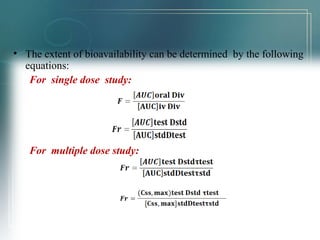
• The extent of bioavailability can be determined by the following 
equations: 
For single dose study: 
For multiple dose study:
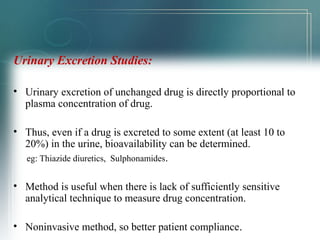
Urinary Excretion Studies: 
• Urinary excretion of unchanged drug is directly proportional to 
plasma concentration of drug. 
• Thus, even if a drug is excreted to some extent (at least 10 to 
20%) in the urine, bioavailability can be determined. 
eg: Thiazide diuretics, Sulphonamides. 
• Method is useful when there is lack of sufficiently sensitive 
analytical technique to measure drug concentration. 
• Noninvasive method, so better patient compliance..
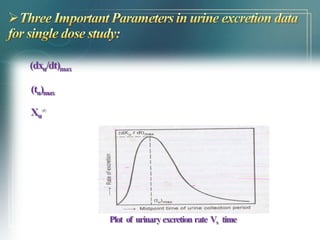
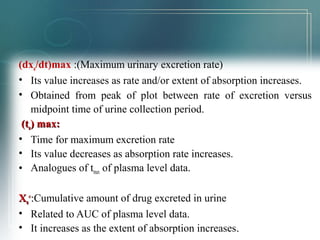
(dxu/dt)max :(Maximum urinary excretion rate) 
• Its value increases as rate and/or extent of absorption increases. 
• Obtained from peak of plot between rate of excretion versus 
midpoint time of urine collection period. 
((ttuu)) mmaaxx:: 
• Time for maximum excretion rate 
• Its value decreases as absorption rate increases. 
• Analogues of tmax of plasma level data. 
XXuu 
∞∞::Cumulative amount of drug excreted in urine 
• Related to AUC of plasma level data. 
• It increases as the extent of absorption increases..
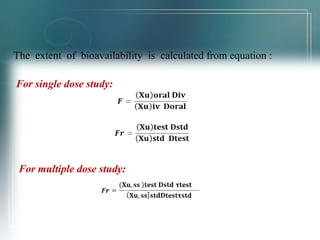
The extent of bioavailability is calculated from equation : 
For single dose study: 
For multiple dose study:
Acute Pharmacologic RReessppoonnssee MMeetthhoodd:: 
• When bioavailablity measurement by pharmacokinetic method is 
difficult, an acute pharmacologic effect such as effect on pupil 
diameter, EEG & ECG readings related to time course of drug. 
• Bioavailability can then be determined by construction of 
pharmacological effect- time curve as well as dose response 
graphs. 
DDiissaaddvvaannttaaggee:: 
• It tends to be more variable. 
• Observed response may be due to an active metabolite whose 
concentration is not proportional to concentration of parent drug.
TThheerraappeeuuttiicc RReessppoonnssee MMeetthhoodd:: 
• This method based on observing the clinical response to a drug 
formulation given to patient suffering from disease. 
DDrraawwbbaacckkss:: 
The major drawbacks of this method is that quantitation of 
observed response is too improper to allow for reasonable 
assessment of relative bioavailability between two dosage forms of 
the same drug. 
E.g.: Anti-inflammatory drugs. 
 Many patients receive more than one drug
• Clinical trails in humans establish the safety and effectiveness of 
the drug products and also used to determine bioavailability. 
• The FDA consider this approach only when analytical methods 
and pharmacodynamic methods are not available. 
• Comparative clinical studies have been used to establish 
bioequivalence for topical antifungal drug product. 
Ex: Ketoconazole
• Drug dissolution studies may under certain conditions give an 
indication of drug bioavailability. 
• Dissolution studies are often performed in several test 
formulations of the same drug. 
• The test formulation that demonstrates the most rapid rate of drug 
bioavailability in-vitro will generally have the most rapid rate of 
drug bioavailability in-vivo. 
• The FDA may also use the other in-vitro approaches for 
establishing bioequivalence. 
Ex: Cholestyramine resin.
CONCEPT OF EQUIVALENCE: 
EQUIVALENCE: Relationship in terms of bioavailability, 
therapeutic response or a set of established standards of one drug 
product to another. 
Objectives: 
• If a new product intended to be a substitute for an approved 
medical product. 
• To ensure clinical performance of drugs. 
• Equivalence studies are conducted if there is: 
a)A risk of bio-inequivalence. 
b)A risk of pharmacotherapeutic failure or diminished 
clinical safety.
Equivalence may be defined in several ways: 
Chemical equivalence: 
 If two or more dosage forms of same drug contain same labelled 
quantities specified in pharmacopoeia. 
Eg : Dilantin and Eptoin chemically equivalent as they contain 
same quantity of Phenytoin on chemical assay. 
Bioequivalence: 
 The drug substance in two or more identical dosage forms, 
reaches the systemic circulation at the same relative rate and 
extent i.e. their plasma concentration-time profiles will be 
identical without significant statistical differences.
Pharmaceutical equivalents: 
Drug products in identical dosage forms that contain same active 
ingredient(s),i.e , the same salt or ester, are of the same dosage 
form, use the same route of administration, and are identical in 
strength or concentration. 
Eg : Chlordiazepoxide hydrochloride,5mg capsules. 
Pharmaceutical equivalent drug products are: 
Same in : 
 Active ingredient and it’s quantity 
 Dosage form 
 standards like strength, quality , purity and identity.
 Disintegration time 
 Dissolution rates 
Differ in: 
 Shape 
 Release mechanisms 
 Packing 
 Excipients(including colours , flavours , preservatives) 
 labeling
Pharmaceutical alternatives: 
 Drug product that contain the same therapeutic moiety but as 
different salts, esters or complexes. 
Eg: Tetracyclin phosphate or Tetracyclin hydrochloride 
equivalent to 250mg Tetracyclin base are consider as 
pharmaceutical alternatives. 
pharmaceutical substitution: 
 The process of dispensing a pharmaceutical alternative for the 
prescribed drug product. 
Eg: Ampicillin suspension is dispensed in place of Ampicillin 
capsules. 
Tetracyclin hydrochloride is dispensed in place of Tetracyclin 
phosphate. 
NOTE: Pharmaceutical substitution generally requires the 
physician’s approval.
Therapeutic equivalents: 
 Drug products consider to be therapeutic equivalence only if they 
are pharmaceutical equivalence and if they can be expected to 
have a same clinical effect and safety profile when administered 
to patient specified in the labeling. 
 FDA classifies as therapeutically equivalent those products that 
meet the fallowing general criteria: 
1)They approved as safe and effective. 
2)They are pharmaceutically equivalents. 
3)They are bioequivalence. 
4)They are adequately labeled . 
5)They are manufactured in compliance with current GMP 
regulations.
Therapeutic alternatives: 
 Drug products containing different active ingredients that are 
indicated for the same therapeutic or clinical objectives. 
Eg: Ibuprofen is given instead of Aspirin. 
Cimetidine instead of Ranitidine. 
Therapeutic substitution: 
 The process of dispensing a therapeutic alternative in place of the 
prescribed drug product. 
Eg: Ampicillin is dispensed instead of Amoxicillin. 
Ibuprofen is dispensed instead of Naproxen.
• BBrraahhmmaannkkaarr ..DD..MM ,, SSuunniill BB..JJaaiisswwaall,, 
““BBiioopphhaarrmmaacceeuuttiiccss aanndd PPhhaarrmmaaccookkiinneettiiccss--AA TTrreeaattiissee””,, 
ppaaggee nnoo.. 223366--333377.. 
• LLeeoonnSShhaarrggeell && AAnnddrreeww BB..CC.. YYuu,, 
““AApppplliieedd BBiioopphhaarrmmaacceeuuttiiccss && pphhaarrmmaaccookkiinneettiiccss’’’’,, ppaaggee nnoo.. 445533-- 
446666.. 
• VV VVeennkkaatteesshhwwaarrlluu,, 
““ BBiioopphhaarrmmaacceeuuttiiccss && pphhaarrmmaaccookkiinneettiiccss’’’’ 
ppaaggee nnoo.. 440033--441166..
Bioavailability ppt

Bioavailability ppt

  • 2.
    Brief introduction tobioavailability Objectives of bioavailability Methods of assessing bioavailability Concept of equivalence References
  • 3.
    IInnttrroodduuccttiioonn • Bioavailabilityis defined as rate and extent of absorption of unchanged drug from it’s dosage form and become available at the site of action. • Bioavailability of a drug from it’s dosage form depends upon 3 major factors:  Pharmaceutical factors  Patient related factors  Route of administration
  • 4.
    OObbjjeeccttiivveess  Developmentof new formulations.  Determination of influence of excipients, patient related factors and possible interaction with other drugs on the efficiency of absorption.  Control of quality of a drug product during the early stages of marketing in order to determine the influence of processing factors, storage, stability on drug absorption.  Primary stages of the development of a suitable dosage form for a new drug entity.
  • 5.
    • When systemicavailability of drug administered orally is determined in comparison to its intravenous administration, is called absolute bioavailability. • Its determination is used to characterize a drug’s inherent absorption properties from the extra vascular site.. AAbbssoolluuttee bbiiooaavvaaiillaabbiilliittyy == [[AAUUCC]]oorraall ((DDoossee))iivv [[AAUUCC]]iivv ((DDoossee))oorraall
  • 6.
    RReellaattiivvee BBiiooaavvaaiillaabbiilliittyy ((FFrr)) • When systemic availability of drug after oral administration is compared with that of an oral standard of same drug (such as an aqueous or non aqueous solution or suspension) it is referred as relative bioavailability. • It is used to characterize absorption of drug from its formulation. RReellaattiivvee BBiiooaavvaaiillaabbiilliittyy == [[AAUUCC]]tteesstt ((DDoossee))ssttdd [[AAUUCC]]ssttdd ((DDoossee))tteesstt
  • 8.
    • Widely usedand based on assumption that Pharmacokinetic profile reflects the therapeutic effectiveness of a drug. Plasma Level- Time Studies: • Most common type of human bioavailability studies. • Based on the assumption that there is a direct relationship between the concentration of drug in blood or plasma and the concentration of drug at the site of action. • Following the administration of a single dose of a medication, blood samples are drawn at specific time intervals and analyzed for drug content.
  • 9.
    • A profileis constructed showing the concentration of drug in blood at the specific times the samples were taken. • Bioavailability (the rate and extent of drug absorption) is generally assessed by the determination of following three parameters. They are.. CCmmaaxx ((PPeeaakk ppllaassmmaa ccoonncceennttrraattiioonn)) ttmmaaxx((ttiimmee ooff ppeeaakk)) AArreeaa uunnddeerr ccuurrvvee
  • 10.
  • 11.
     CCmmaaxx:: (Peakplasma drug concentration)  Maximum concentration of the drug obtained after the administration of single dose of the drug.  Expressed in terms of μg/ml or mg/ml.  ttmmaaxx: (Time of peak plasma conc.) Time required to achieve peak concentration of the drug after administration.  Gives indication of the rate of absorption.  Expressed in terms of hours or minutes.
  • 12.
     AUC: Isthe measurement of the extent of the drug bioavailability It is the area under the drug plasma level-time curve from t =0 & t = ∞, and is equal to the amount of unchanged drug reaching the general circulation divided by the clearance. [ AUC]0 ∞ = ∫0 ∞Cpdt [ AUC]0 ∞ = FD0 = FDO/ kVD Clearance
  • 13.
    • TTrraappeezzooiiddaall mmeetthhoodd:: –Most common method of estimating AUC. –Divide the plasma conc-time curve into several trapezoids. –Count the trapezoids & find the area. –Total area of the trapezoids will approximate the area under the curve. –More number of trapezoids formed more accurate will be the result. The area of one trapezoid between time t1 and t2 is = C1 +C2 (t2 – t1 ) 2
  • 14.
    Thus AUC =C1+C2 (t2-t1) + C2+C3 (t3-t2) +…… 2 2 ...Cn-1+ Cn (tn+1-tn) 2. •
  • 15.
    • CCUUTT &&WWEEIIGGHH MMEETTHHOODD:: • Preparing calibrated plot by cutting squares of graph &weights are recorded & plotted against weight Vs area. • Sample curve is cut & weight is recorded. • By interpolation method area of sample graph is found.
  • 16.
    • PPLLAANNIIMMEETTEERR:: •Instrument for mechanically measuring the area under the curve. • Measures area by tracing outline of curve. • Disadvantage: • Degree of error is high due to instrumental & human error. • CCOOUUNNTTIINNGG TTHHEE SSQQUUAARREE :: • Total no. of squares enclosed in the curve is counted. • Area of each square determined using relationship: AREA=(height) (width)
  • 18.
    • The extentof bioavailability can be determined by the following equations: For single dose study: For multiple dose study:
  • 19.
    Urinary Excretion Studies: • Urinary excretion of unchanged drug is directly proportional to plasma concentration of drug. • Thus, even if a drug is excreted to some extent (at least 10 to 20%) in the urine, bioavailability can be determined. eg: Thiazide diuretics, Sulphonamides. • Method is useful when there is lack of sufficiently sensitive analytical technique to measure drug concentration. • Noninvasive method, so better patient compliance..
  • 21.
    (dxu/dt)max :(Maximum urinaryexcretion rate) • Its value increases as rate and/or extent of absorption increases. • Obtained from peak of plot between rate of excretion versus midpoint time of urine collection period. ((ttuu)) mmaaxx:: • Time for maximum excretion rate • Its value decreases as absorption rate increases. • Analogues of tmax of plasma level data. XXuu ∞∞::Cumulative amount of drug excreted in urine • Related to AUC of plasma level data. • It increases as the extent of absorption increases..
  • 22.
    The extent ofbioavailability is calculated from equation : For single dose study: For multiple dose study:
  • 23.
    Acute Pharmacologic RReessppoonnsseeMMeetthhoodd:: • When bioavailablity measurement by pharmacokinetic method is difficult, an acute pharmacologic effect such as effect on pupil diameter, EEG & ECG readings related to time course of drug. • Bioavailability can then be determined by construction of pharmacological effect- time curve as well as dose response graphs. DDiissaaddvvaannttaaggee:: • It tends to be more variable. • Observed response may be due to an active metabolite whose concentration is not proportional to concentration of parent drug.
  • 24.
    TThheerraappeeuuttiicc RReessppoonnssee MMeetthhoodd:: • This method based on observing the clinical response to a drug formulation given to patient suffering from disease. DDrraawwbbaacckkss:: The major drawbacks of this method is that quantitation of observed response is too improper to allow for reasonable assessment of relative bioavailability between two dosage forms of the same drug. E.g.: Anti-inflammatory drugs.  Many patients receive more than one drug
  • 25.
    • Clinical trailsin humans establish the safety and effectiveness of the drug products and also used to determine bioavailability. • The FDA consider this approach only when analytical methods and pharmacodynamic methods are not available. • Comparative clinical studies have been used to establish bioequivalence for topical antifungal drug product. Ex: Ketoconazole
  • 26.
    • Drug dissolutionstudies may under certain conditions give an indication of drug bioavailability. • Dissolution studies are often performed in several test formulations of the same drug. • The test formulation that demonstrates the most rapid rate of drug bioavailability in-vitro will generally have the most rapid rate of drug bioavailability in-vivo. • The FDA may also use the other in-vitro approaches for establishing bioequivalence. Ex: Cholestyramine resin.
  • 27.
    CONCEPT OF EQUIVALENCE: EQUIVALENCE: Relationship in terms of bioavailability, therapeutic response or a set of established standards of one drug product to another. Objectives: • If a new product intended to be a substitute for an approved medical product. • To ensure clinical performance of drugs. • Equivalence studies are conducted if there is: a)A risk of bio-inequivalence. b)A risk of pharmacotherapeutic failure or diminished clinical safety.
  • 28.
    Equivalence may bedefined in several ways: Chemical equivalence:  If two or more dosage forms of same drug contain same labelled quantities specified in pharmacopoeia. Eg : Dilantin and Eptoin chemically equivalent as they contain same quantity of Phenytoin on chemical assay. Bioequivalence:  The drug substance in two or more identical dosage forms, reaches the systemic circulation at the same relative rate and extent i.e. their plasma concentration-time profiles will be identical without significant statistical differences.
  • 29.
    Pharmaceutical equivalents: Drugproducts in identical dosage forms that contain same active ingredient(s),i.e , the same salt or ester, are of the same dosage form, use the same route of administration, and are identical in strength or concentration. Eg : Chlordiazepoxide hydrochloride,5mg capsules. Pharmaceutical equivalent drug products are: Same in :  Active ingredient and it’s quantity  Dosage form  standards like strength, quality , purity and identity.
  • 30.
     Disintegration time  Dissolution rates Differ in:  Shape  Release mechanisms  Packing  Excipients(including colours , flavours , preservatives)  labeling
  • 31.
    Pharmaceutical alternatives: Drug product that contain the same therapeutic moiety but as different salts, esters or complexes. Eg: Tetracyclin phosphate or Tetracyclin hydrochloride equivalent to 250mg Tetracyclin base are consider as pharmaceutical alternatives. pharmaceutical substitution:  The process of dispensing a pharmaceutical alternative for the prescribed drug product. Eg: Ampicillin suspension is dispensed in place of Ampicillin capsules. Tetracyclin hydrochloride is dispensed in place of Tetracyclin phosphate. NOTE: Pharmaceutical substitution generally requires the physician’s approval.
  • 32.
    Therapeutic equivalents: Drug products consider to be therapeutic equivalence only if they are pharmaceutical equivalence and if they can be expected to have a same clinical effect and safety profile when administered to patient specified in the labeling.  FDA classifies as therapeutically equivalent those products that meet the fallowing general criteria: 1)They approved as safe and effective. 2)They are pharmaceutically equivalents. 3)They are bioequivalence. 4)They are adequately labeled . 5)They are manufactured in compliance with current GMP regulations.
  • 33.
    Therapeutic alternatives: Drug products containing different active ingredients that are indicated for the same therapeutic or clinical objectives. Eg: Ibuprofen is given instead of Aspirin. Cimetidine instead of Ranitidine. Therapeutic substitution:  The process of dispensing a therapeutic alternative in place of the prescribed drug product. Eg: Ampicillin is dispensed instead of Amoxicillin. Ibuprofen is dispensed instead of Naproxen.
  • 34.
    • BBrraahhmmaannkkaarr ..DD..MM,, SSuunniill BB..JJaaiisswwaall,, ““BBiioopphhaarrmmaacceeuuttiiccss aanndd PPhhaarrmmaaccookkiinneettiiccss--AA TTrreeaattiissee””,, ppaaggee nnoo.. 223366--333377.. • LLeeoonnSShhaarrggeell && AAnnddrreeww BB..CC.. YYuu,, ““AApppplliieedd BBiioopphhaarrmmaacceeuuttiiccss && pphhaarrmmaaccookkiinneettiiccss’’’’,, ppaaggee nnoo.. 445533-- 446666.. • VV VVeennkkaatteesshhwwaarrlluu,, ““ BBiioopphhaarrmmaacceeuuttiiccss && pphhaarrmmaaccookkiinneettiiccss’’’’ ppaaggee nnoo.. 440033--441166..