PHARMACOKINETICS
TABLE OF CONTENTS
1. Bioavailability
2. C max
3. Distribution
4. Half life
5. T max
6. Area under the curve
PHARMACOKINETICS
Bioavailability
BIOAVAILABLITY
It describes the fraction of an
administered dose of a
medication that reaches the
systemic circulation.
PHARMACOKINETICS
Cmax
TIME
CONCENTRATION
C MAX
C MAX
C MAX
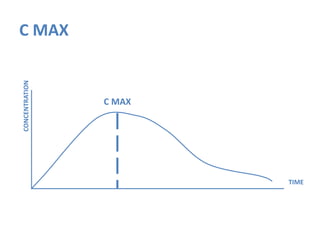
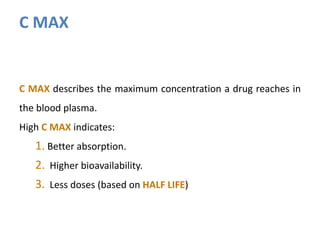
C MAX describes the maximum concentration a drug reaches in
the blood plasma.
High C MAX indicates:
1. Better absorption.
2. Higher bioavailability.
3. Less doses (based on HALF LIFE)
PHARMACOKINETICS
Distribution
DISTRIBUTION
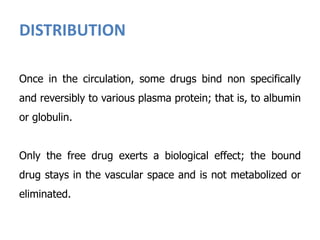
Once in the circulation, some drugs bind non specifically
and reversibly to various plasma protein; that is, to albumin
or globulin.
Only the free drug exerts a biological effect; the bound
drug stays in the vascular space and is not metabolized or
eliminated.
PHARMACOKINETICS
T max
T MAX
TIME
CONCENTRATION
C MAX
T MAX
T MAX
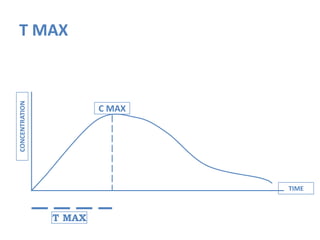
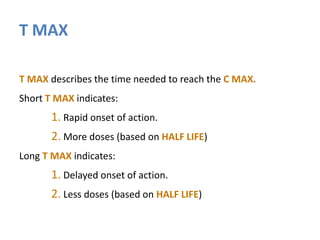
T MAX describes the time needed to reach the C MAX.
Short T MAX indicates:
1. Rapid onset of action.
2. More doses (based on HALF LIFE)
Long T MAX indicates:
1. Delayed onset of action.
2. Less doses (based on HALF LIFE)
PHARMACOKINETICS
T 1/2
HALF LIFE
TIME
CONCENTRATION
C MAX
T MAX
x HALF-LIFE
HALF LIFE
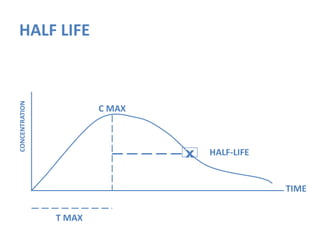
HALF-LIFE is the time required for the C MAX to decrease to half
of its initial value.
Long half life indicates:
1. Less doses (based on C MAX)
PHARMACOKINETICS
Area under the curve
AUC
AREA UNDER THE TIME CONCENTRATION CURVE
TIME
CONCENTRATION
C MAX
T MAX
x HALF-LIFE
AREA UNDER THE CURVE
AUC
AREA UNDER THE TIME CONCENTRATION CURVE
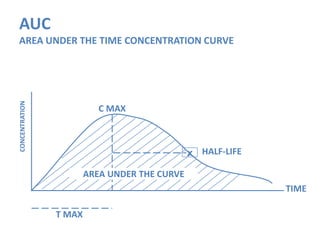
AUC represents the total amount of drug absorbed by the body,
irrespective of the rate of absorption.
AUC becomes useful for:
1. Knowing the average concentration over a time
interval.
2. Knowing the elimination rate.

Pharmacokinetics