Nonlinear Pharmacokinetics
Linear vs. Nonlinear Pharmacokinetics
 ADME all obey first-order
kinetics.
 PK parameters (CL, V, F, Ka,
and t1/2) are constant.
 AUC is directly proportional
to the dose.
 Concentration vs. time
profile is superimposable for
all doses.
Linear Nonlinear
 at least one of the ADME
processes is saturable.
 ≥1 PK parameters are dose-
dependent.
 AUC is disproportional to the
dose.
 Concentration vs. time profile is
not superimposable for different
doses.
(dose-dependent)(dose-independent)
Linear Pharmacokinetics
 Drug plasma concentrations are proportional to the dose.
 Drug plasma concentration-time profiles are superimposable when
normalized to the dose.
normalized
by dose
time
i.v. bolus
100 mg
1 mg
10 mg
LogC
100 mM
10 mM
1 mM
1 h
i.v. bolus
1 mg
time
LogC
1 h
Linear Pharmacokinetics
 Drug plasma concentrations are proportional to the dose.
 tmax remains unchanged.
 Drug plasma concentration-time profiles are superimposable when
normalized to the dose.
normalized
by dose
p. o.
25 mg
1 mg
5 mg
LogC
time
tmax
0.5 mM
0.1 mM
2.5 mM
p. o.
1 mg
LogC
timetmax
0.1 mM
5
Common Sources for Nonlinear Pharmacokinetics
6
Most Common Sources for Nonlinear Pharmacokinetics
 Capacity-limited oral absorption (F)
 Capacity-limited metabolism (CLH )
 Saturable protein binding (CLH, CLR, V )
 Capacity-limited excretion (CLR )
7
Capacity-Limited Oral Absorption (F)
 limited dissolution/solubility as the oral dose increases
 saturable transport across the intestinal mucosa as the oral
dose increases
 saturable first-pass metabolism in the intestinal epithelium
(gut wall) and/or liver as the oral dose increases
8
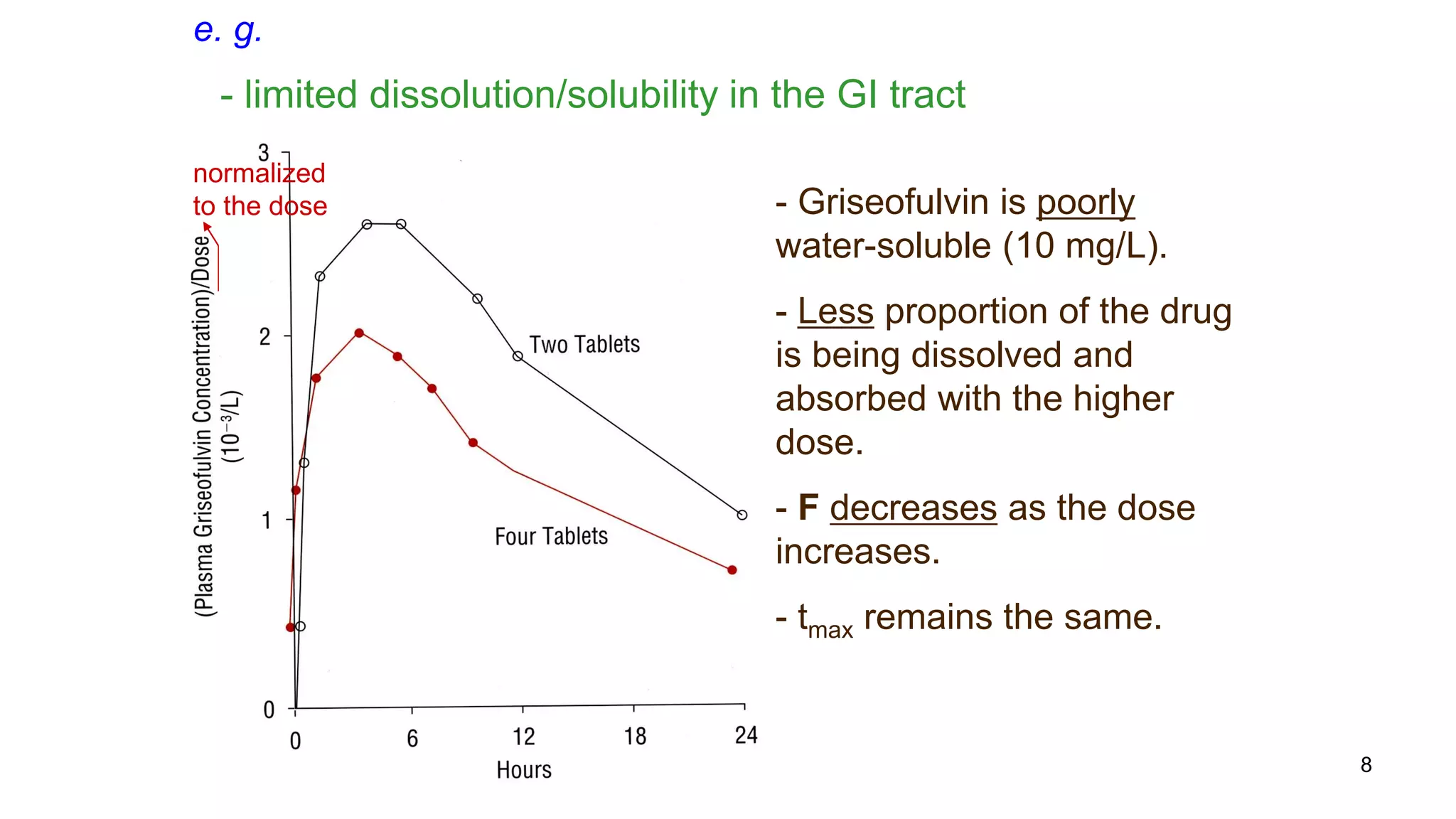
- limited dissolution/solubility in the GI tract
normalized
to the dose - Griseofulvin is poorly
water-soluble (10 mg/L).
- Less proportion of the drug
is being dissolved and
absorbed with the higher
dose.
- F decreases as the dose
increases.
- tmax remains the same.
e. g.
9
- Saturable transport across the intestinal epithelium
375 mg
750 mg
1500 mg
3000 mg
- Amoxicillin is actively transported
by peptide transporter in the small
intestine.
- The active transport becomes
saturated as the dose increases.
- F decreases as the dose
increases.
- tmax remains the same.
e. g.
10
- Saturable first-pass metabolism
- Nicardipine is metabolized by CYP3A4 in the intestinal
epithelium and hepatocytes.
- First-pass metabolism is saturated as the dose increases.
- F increases as the dose increases.
e. g.
11
Saturable Drug-Plasma Protein binding (CL,V)
 Drug-plasma protein binding is saturable
The saturation drug concentrations for binding with plasma
albumin and a1-acid glycoprotein are ~ 600 mM and 15 mM,
respectively.
 May increase CLH and/or CLR
 May increase V
 May be difficult to identify due to effect on both V and CL
 Example: Naproxen
12
Capacity-Limited Excretion (CLR)
 Active secretion and active reabsorption are saturable
processes.
 Saturated tubular secretion decreases CLR
Saturated tubular reabsorption increases CLR
13
 Enzymatic reactions are saturable.
 Saturated hepatic metabolism decreases CLH.
 Saturated first-pass metabolism increases F.
Capacity-Limited Metabolism (CLH ,F)
][
][max
SK
SV
v
m 

14
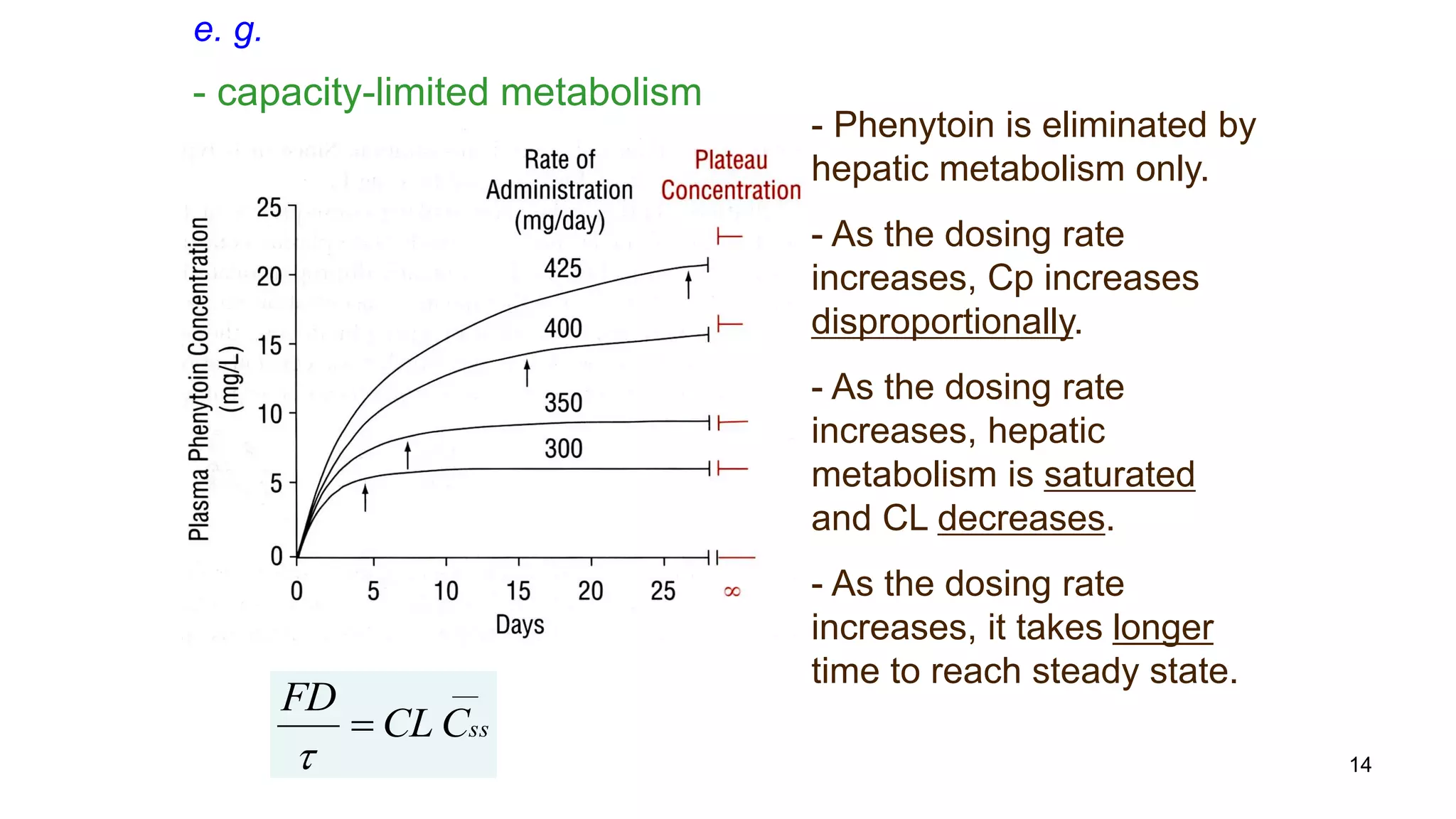
- capacity-limited metabolism
e. g.
- Phenytoin is eliminated by
hepatic metabolism only.
- As the dosing rate
increases, Cp increases
disproportionally.
- As the dosing rate
increases, hepatic
metabolism is saturated
and CL decreases.
- As the dosing rate
increases, it takes longer
time to reach steady state.
ssCCL
FD


15
Example 1:
Using the hypothetical drug
considered in (Vmax = 0.5 µg/mL per
hour, Km = 0.1 µg/mL), how long
would it take for the plasma drug
concentration to decrease from 20 to
12 µg/mL?
16
Because 12 mcg/mL is above the saturable level, as indicated in Table
10-2, elimination occurs at a zero-order rate of approximately 0.5 mcg/mL
per hour.
Time needed for the drug to decrease to 12 mcg/mL
17
18
Example 2:
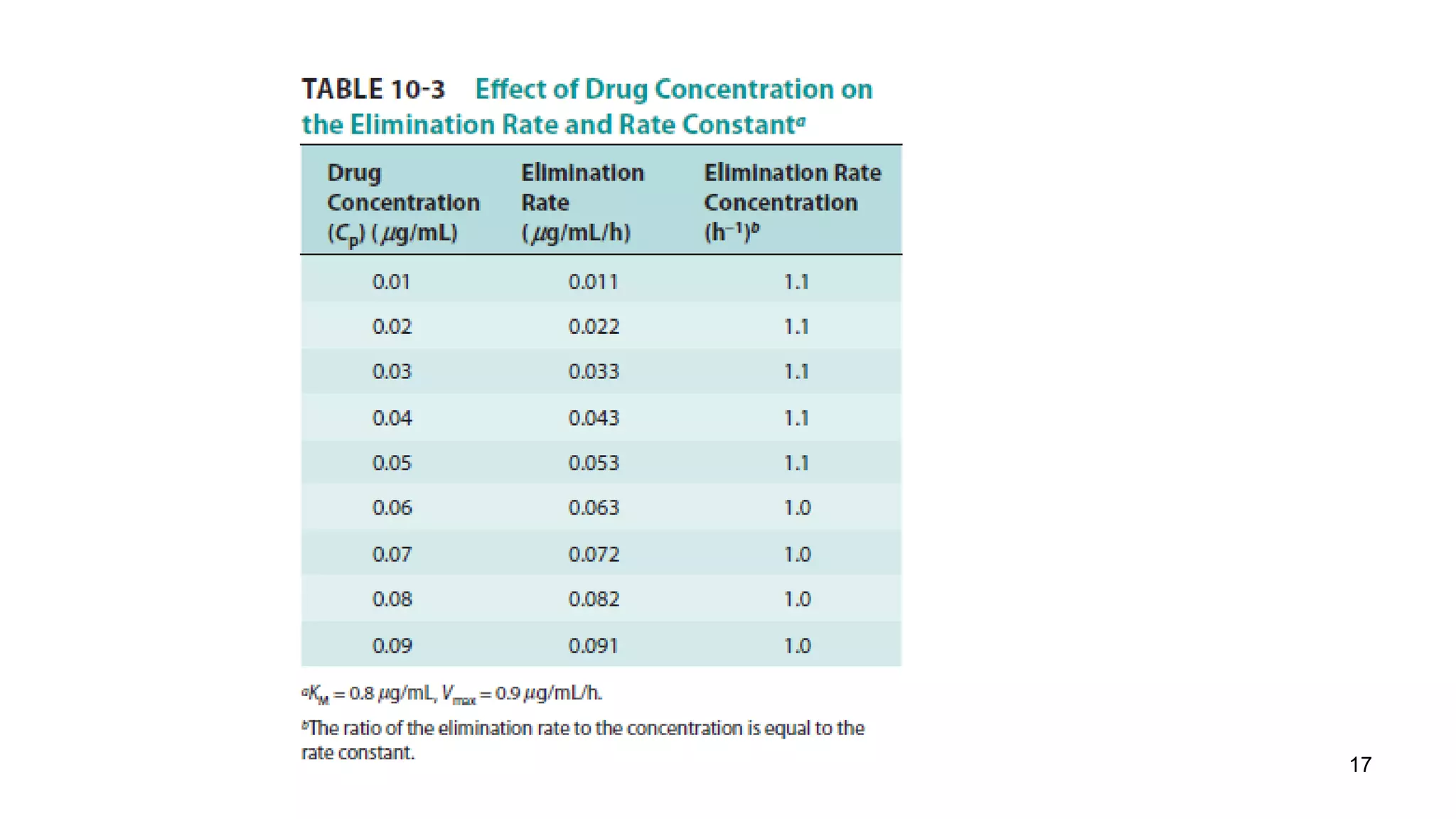
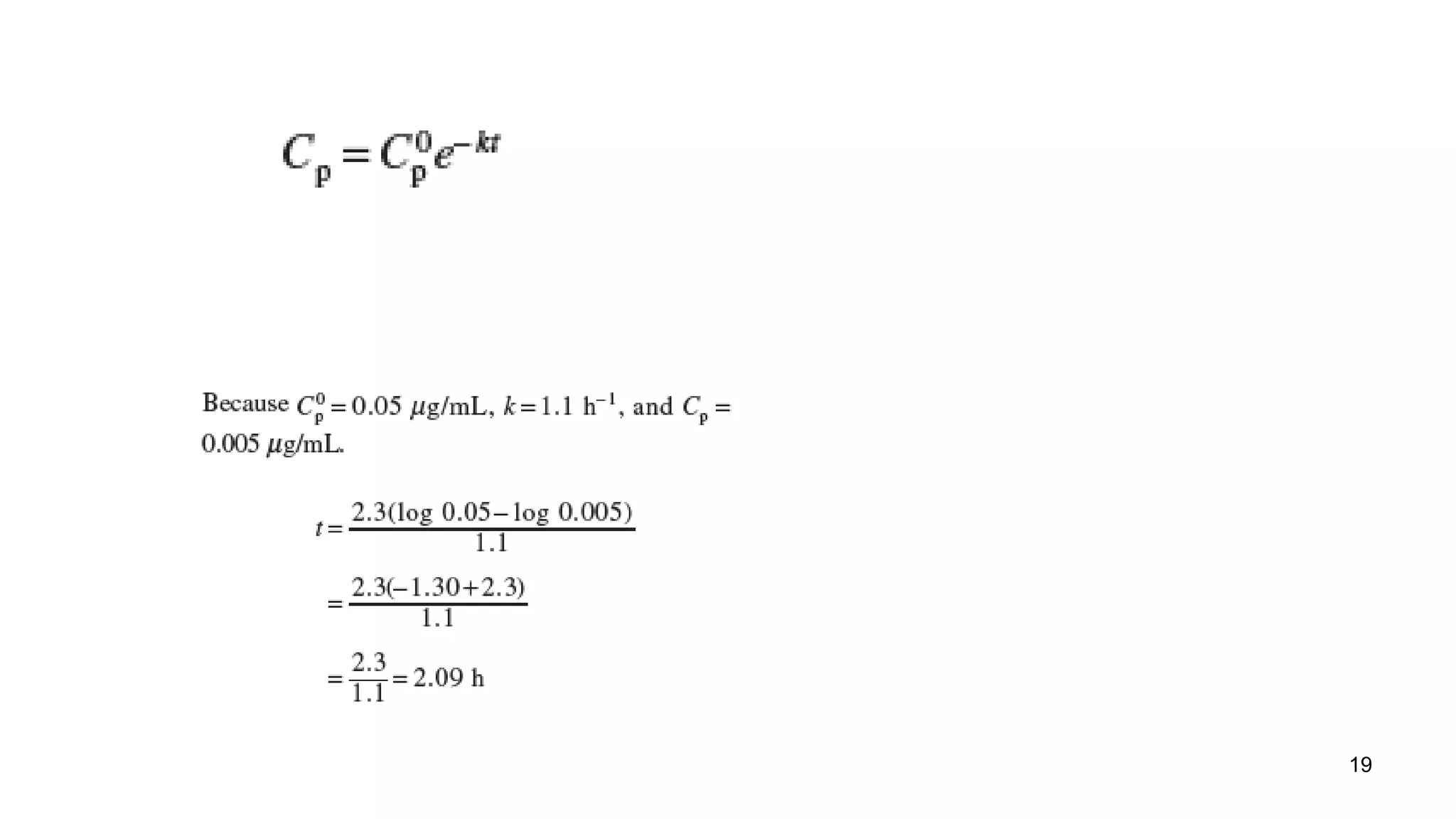
How long would it take for the plasma concentration of the drug in the table
shown bellow to decline from 0.05 to 0.005 µg/mL? (Knowing that Km = 0.8
µg/mL, Vmax = 0.9 µg/mL per hour.
19
20
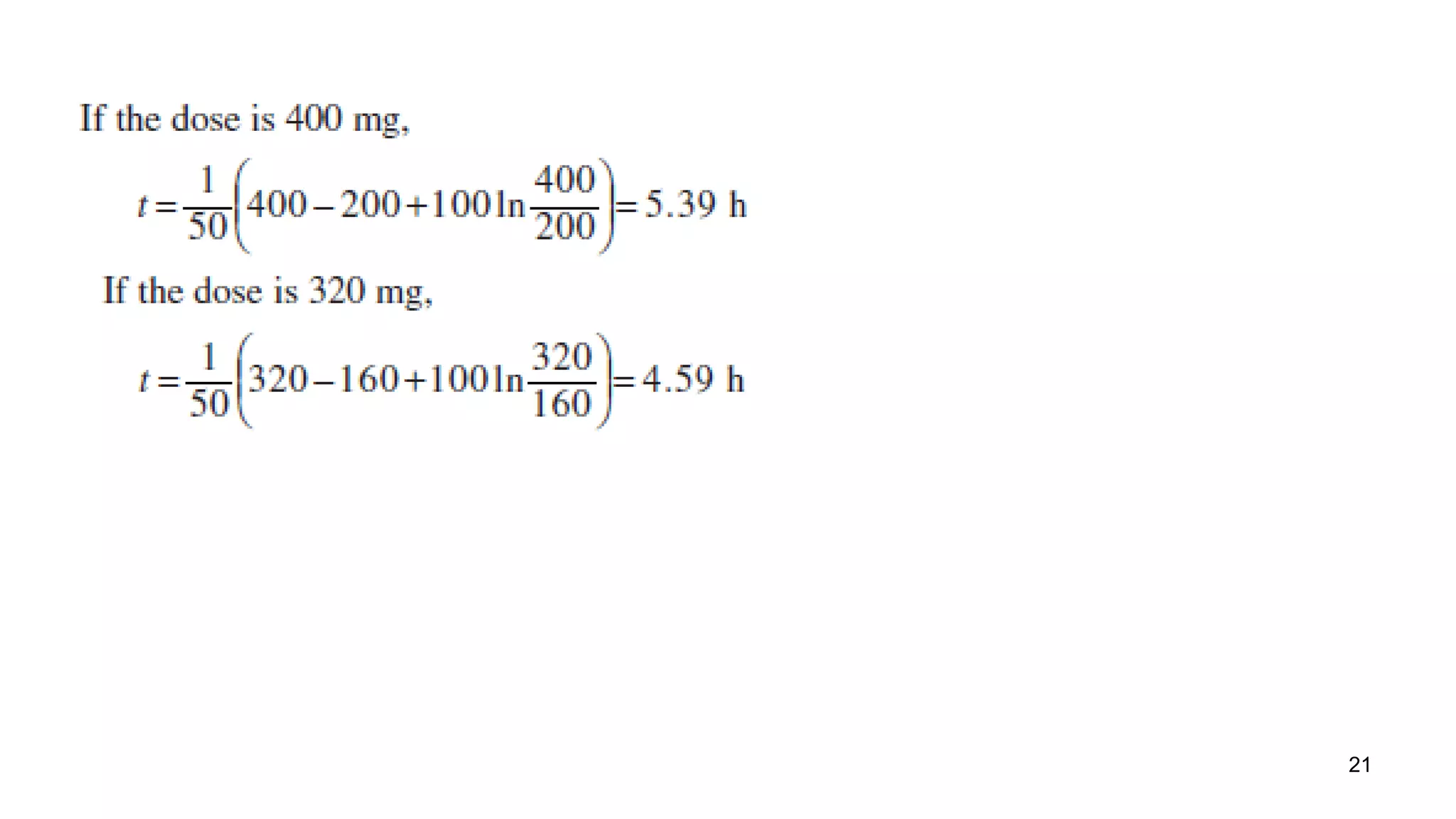
Example 3:
A drug eliminated from the body by capacity-limited pharmacokinetics has a
Km of 100 mg/L and a Vmax of 50 mg/hr. If 400 mg of the drug is given to a
patient by IV bolus injection, calculate the time for the drug to be 50%
eliminated.
If 320 mg of the drug is to be given by IV bolus injection, calculate the time for
50% of the dose to be eliminated.
Explain why there is a difference in the time for 50% elimination of a 400-mg
dose compared to a 320-mg dose
21
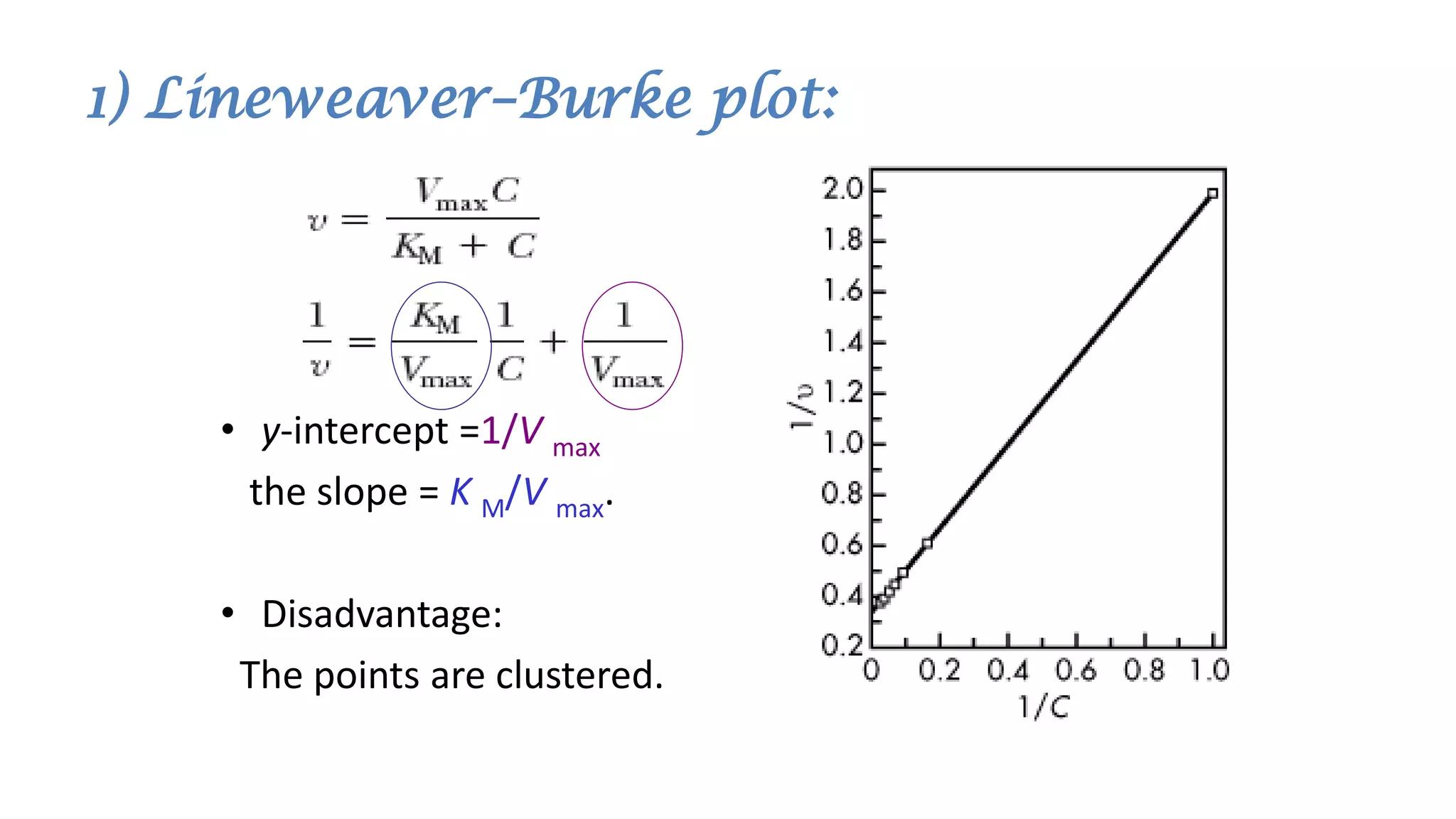
1) Lineweaver–Burke plot:
• y-intercept =1/V max
the slope = K M/V max.
• Disadvantage:
The points are clustered.
2) Plot of C/v versus C
• Yield a straight line
• slope = 1/V max
• Intercept = K M/V max
3) Plot of v Vs v/C
• slope = –K M
• intercept = V max
Determination of KM and Vmax in Patients
• The body may be regarded as
a single compartment in
which the drug is dissolved.
• The rate of drug metabolism
will vary depending on the
concentration of drug Cp as
well as on the metabolic rate
constants KM and Vmax of
the drug in each individual.
Phenytoin
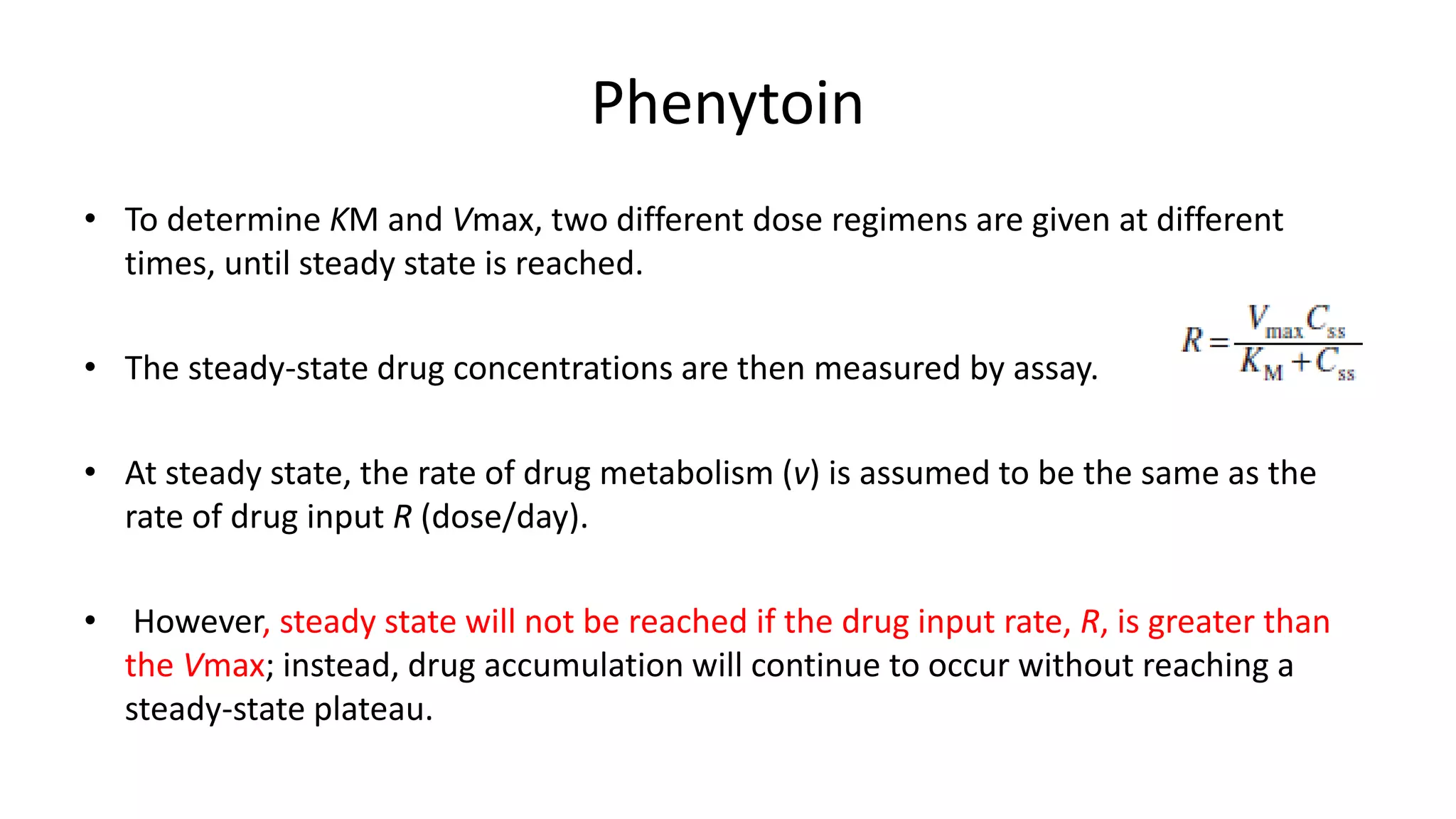
• To determine KM and Vmax, two different dose regimens are given at different
times, until steady state is reached.
• The steady-state drug concentrations are then measured by assay.
• At steady state, the rate of drug metabolism (v) is assumed to be the same as the
rate of drug input R (dose/day).
• However, steady state will not be reached if the drug input rate, R, is greater than
the Vmax; instead, drug accumulation will continue to occur without reaching a
steady-state plateau.
27
Example:
Phenytoin was administered to a patient at dosing rates of 150 and 300
mg/day, respectively. The steady-state plasma drug concentrations were
8.6 and 25.1 mg/L, respectively. Find the K M and V max of this patient.
What dose is needed to achieve a steady-state concentration of 11.3
mg/L?
4) A plot of R versus C SS is plotted
1. Mark points for R of 300
mg/day and C SS of 25.1 mg/L
as shown. Connect with a
straight line.
2. Mark points for R of 150
mg/day and C SS of 8.6 mg/L as
shown. Connect with a straight
line.
3. Where lines from the first two
steps cross is called point A.
4. From point A, read V max on
the y axis and K M on the x
axis.
Determination of KM and Vmax by Direct
Method
• When steady-state concentrations of phenytoin are known at
only two dose levels, there is no advantage in using the graphic
method.
• KM and Vmax may be calculated by solving two simultaneous
equations formed by substituting Css and R with C1, R1, C2,
and R2. The equations contain two unknowns, KM and Vmax,
and may be solved easily.
where C1 is steady-state plasma drug concentration after
dose 1, C2 is steady-state plasma drug concentration after
dose 2, R1 is the first dosing rate, and R2 is the second
dosing rate
31
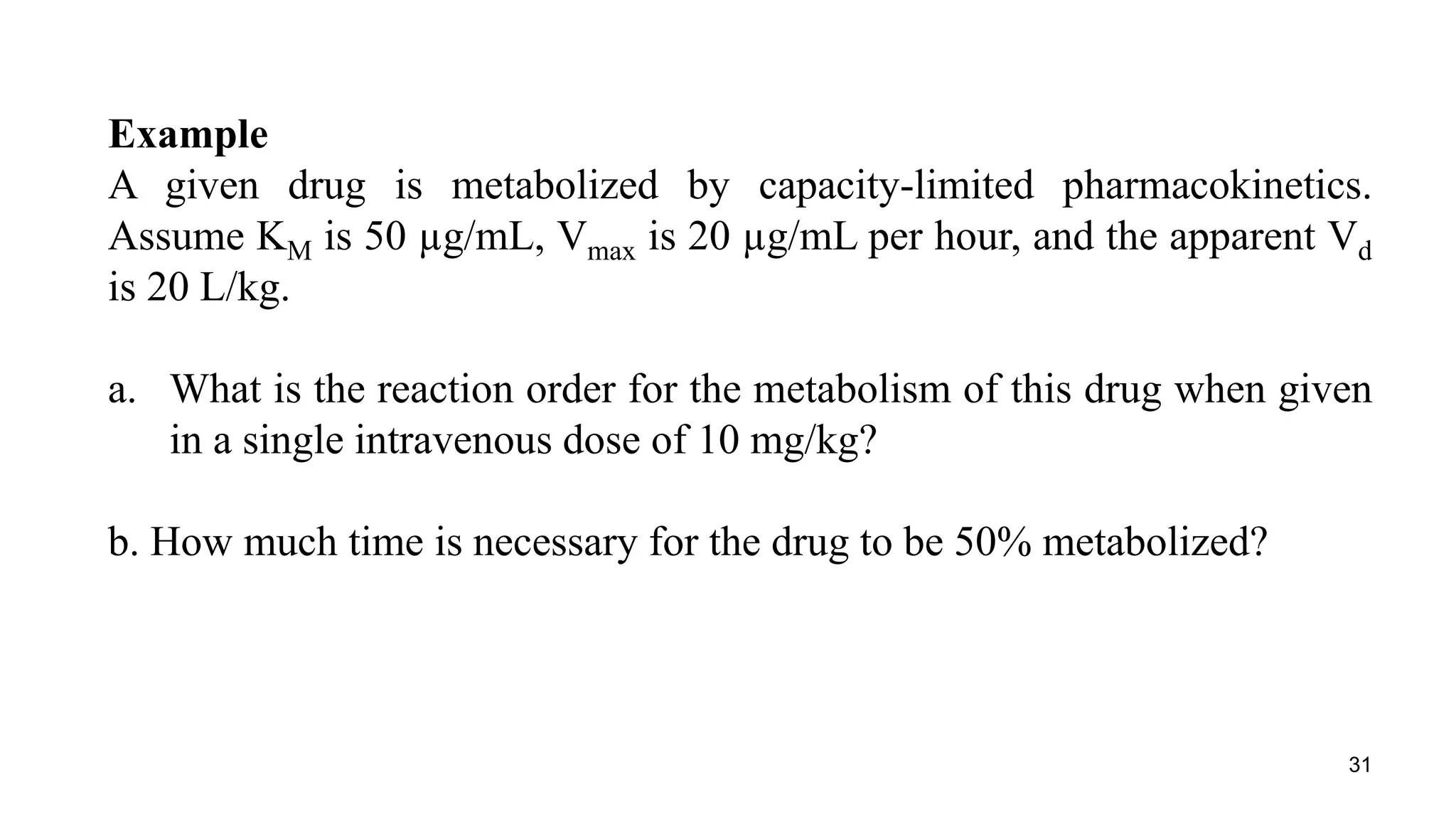
Example
A given drug is metabolized by capacity-limited pharmacokinetics.
Assume KM is 50 µg/mL, Vmax is 20 µg/mL per hour, and the apparent Vd
is 20 L/kg.
a. What is the reaction order for the metabolism of this drug when given
in a single intravenous dose of 10 mg/kg?
b. How much time is necessary for the drug to be 50% metabolized?

Non linear Pharmacokinetics 2

  • 1.
  • 2.
    Linear vs. NonlinearPharmacokinetics  ADME all obey first-order kinetics.  PK parameters (CL, V, F, Ka, and t1/2) are constant.  AUC is directly proportional to the dose.  Concentration vs. time profile is superimposable for all doses. Linear Nonlinear  at least one of the ADME processes is saturable.  ≥1 PK parameters are dose- dependent.  AUC is disproportional to the dose.  Concentration vs. time profile is not superimposable for different doses. (dose-dependent)(dose-independent)
  • 3.
    Linear Pharmacokinetics  Drugplasma concentrations are proportional to the dose.  Drug plasma concentration-time profiles are superimposable when normalized to the dose. normalized by dose time i.v. bolus 100 mg 1 mg 10 mg LogC 100 mM 10 mM 1 mM 1 h i.v. bolus 1 mg time LogC 1 h
  • 4.
    Linear Pharmacokinetics  Drugplasma concentrations are proportional to the dose.  tmax remains unchanged.  Drug plasma concentration-time profiles are superimposable when normalized to the dose. normalized by dose p. o. 25 mg 1 mg 5 mg LogC time tmax 0.5 mM 0.1 mM 2.5 mM p. o. 1 mg LogC timetmax 0.1 mM
  • 5.
    5 Common Sources forNonlinear Pharmacokinetics
  • 6.
    6 Most Common Sourcesfor Nonlinear Pharmacokinetics  Capacity-limited oral absorption (F)  Capacity-limited metabolism (CLH )  Saturable protein binding (CLH, CLR, V )  Capacity-limited excretion (CLR )
  • 7.
    7 Capacity-Limited Oral Absorption(F)  limited dissolution/solubility as the oral dose increases  saturable transport across the intestinal mucosa as the oral dose increases  saturable first-pass metabolism in the intestinal epithelium (gut wall) and/or liver as the oral dose increases
  • 8.
    8 - limited dissolution/solubilityin the GI tract normalized to the dose - Griseofulvin is poorly water-soluble (10 mg/L). - Less proportion of the drug is being dissolved and absorbed with the higher dose. - F decreases as the dose increases. - tmax remains the same. e. g.
  • 9.
    9 - Saturable transportacross the intestinal epithelium 375 mg 750 mg 1500 mg 3000 mg - Amoxicillin is actively transported by peptide transporter in the small intestine. - The active transport becomes saturated as the dose increases. - F decreases as the dose increases. - tmax remains the same. e. g.
  • 10.
    10 - Saturable first-passmetabolism - Nicardipine is metabolized by CYP3A4 in the intestinal epithelium and hepatocytes. - First-pass metabolism is saturated as the dose increases. - F increases as the dose increases. e. g.
  • 11.
    11 Saturable Drug-Plasma Proteinbinding (CL,V)  Drug-plasma protein binding is saturable The saturation drug concentrations for binding with plasma albumin and a1-acid glycoprotein are ~ 600 mM and 15 mM, respectively.  May increase CLH and/or CLR  May increase V  May be difficult to identify due to effect on both V and CL  Example: Naproxen
  • 12.
    12 Capacity-Limited Excretion (CLR) Active secretion and active reabsorption are saturable processes.  Saturated tubular secretion decreases CLR Saturated tubular reabsorption increases CLR
  • 13.
    13  Enzymatic reactionsare saturable.  Saturated hepatic metabolism decreases CLH.  Saturated first-pass metabolism increases F. Capacity-Limited Metabolism (CLH ,F) ][ ][max SK SV v m  
  • 14.
    14 - capacity-limited metabolism e.g. - Phenytoin is eliminated by hepatic metabolism only. - As the dosing rate increases, Cp increases disproportionally. - As the dosing rate increases, hepatic metabolism is saturated and CL decreases. - As the dosing rate increases, it takes longer time to reach steady state. ssCCL FD  
  • 15.
    15 Example 1: Using thehypothetical drug considered in (Vmax = 0.5 µg/mL per hour, Km = 0.1 µg/mL), how long would it take for the plasma drug concentration to decrease from 20 to 12 µg/mL?
  • 16.
    16 Because 12 mcg/mLis above the saturable level, as indicated in Table 10-2, elimination occurs at a zero-order rate of approximately 0.5 mcg/mL per hour. Time needed for the drug to decrease to 12 mcg/mL
  • 17.
  • 18.
    18 Example 2: How longwould it take for the plasma concentration of the drug in the table shown bellow to decline from 0.05 to 0.005 µg/mL? (Knowing that Km = 0.8 µg/mL, Vmax = 0.9 µg/mL per hour.
  • 19.
  • 20.
    20 Example 3: A drugeliminated from the body by capacity-limited pharmacokinetics has a Km of 100 mg/L and a Vmax of 50 mg/hr. If 400 mg of the drug is given to a patient by IV bolus injection, calculate the time for the drug to be 50% eliminated. If 320 mg of the drug is to be given by IV bolus injection, calculate the time for 50% of the dose to be eliminated. Explain why there is a difference in the time for 50% elimination of a 400-mg dose compared to a 320-mg dose
  • 21.
  • 22.
    1) Lineweaver–Burke plot: •y-intercept =1/V max the slope = K M/V max. • Disadvantage: The points are clustered.
  • 23.
    2) Plot ofC/v versus C • Yield a straight line • slope = 1/V max • Intercept = K M/V max
  • 24.
    3) Plot ofv Vs v/C • slope = –K M • intercept = V max
  • 25.
    Determination of KMand Vmax in Patients • The body may be regarded as a single compartment in which the drug is dissolved. • The rate of drug metabolism will vary depending on the concentration of drug Cp as well as on the metabolic rate constants KM and Vmax of the drug in each individual.
  • 26.
    Phenytoin • To determineKM and Vmax, two different dose regimens are given at different times, until steady state is reached. • The steady-state drug concentrations are then measured by assay. • At steady state, the rate of drug metabolism (v) is assumed to be the same as the rate of drug input R (dose/day). • However, steady state will not be reached if the drug input rate, R, is greater than the Vmax; instead, drug accumulation will continue to occur without reaching a steady-state plateau.
  • 27.
    27 Example: Phenytoin was administeredto a patient at dosing rates of 150 and 300 mg/day, respectively. The steady-state plasma drug concentrations were 8.6 and 25.1 mg/L, respectively. Find the K M and V max of this patient. What dose is needed to achieve a steady-state concentration of 11.3 mg/L?
  • 28.
    4) A plotof R versus C SS is plotted 1. Mark points for R of 300 mg/day and C SS of 25.1 mg/L as shown. Connect with a straight line. 2. Mark points for R of 150 mg/day and C SS of 8.6 mg/L as shown. Connect with a straight line. 3. Where lines from the first two steps cross is called point A. 4. From point A, read V max on the y axis and K M on the x axis.
  • 29.
    Determination of KMand Vmax by Direct Method • When steady-state concentrations of phenytoin are known at only two dose levels, there is no advantage in using the graphic method. • KM and Vmax may be calculated by solving two simultaneous equations formed by substituting Css and R with C1, R1, C2, and R2. The equations contain two unknowns, KM and Vmax, and may be solved easily.
  • 30.
    where C1 issteady-state plasma drug concentration after dose 1, C2 is steady-state plasma drug concentration after dose 2, R1 is the first dosing rate, and R2 is the second dosing rate
  • 31.
    31 Example A given drugis metabolized by capacity-limited pharmacokinetics. Assume KM is 50 µg/mL, Vmax is 20 µg/mL per hour, and the apparent Vd is 20 L/kg. a. What is the reaction order for the metabolism of this drug when given in a single intravenous dose of 10 mg/kg? b. How much time is necessary for the drug to be 50% metabolized?