


What is GLP? 
Good Laboratory Practice is defined in the OECD 
Principles as: “...a quality system concerned with 
the organizational process and the conditions 
under which non-clinical health and 
environmental safety studies are planned, 
performed, monitored, recorded, archived and 
reported.”
The Organisation for Economic 
Co-operation and Development 
• OECD is an intergovernmental organisation in which 
representatives of 30 industrialised countries in North America, 
Europe and the Pacific, as well as the European Commission, 
meet to coordinate and harmonize policies, discuss issues of 
mutual concern, and work together to respond to international 
problems. 
• Most of the OECD’s work is carried out by more than 200 
specialised Committees and subsidiary groups composed of 
Member country delegates. 
• Committees and subsidiary groups are served by the OECD 
Secretariat, located in Paris, France, which is organised into 
Directorates and Divisions.
• The work of the OECD related to chemical safety is carried 
out in the Environmental Health and Safety Division which 
publishes free-of charge documents in six different series : 
• Testing and Assessment; 
• Principles on Good Laboratory Practice and Compliance 
Monitoring; Pesticides; 
• Risk Management; 
• Chemical Accidents and 
• Harmonization of Regulatory Oversight in Biotechnology.
• The GLP principles were published and formally 
recommended for use in the 22 member countries of the OECD 
council in 1981. 
• The World Health Organisation special programme for 
Research and Training in Tropical Diseases (WHO/TDR, 2001) 
accepted and introduced the principles of GLP for international 
implementations, especially to the scientists of developing 
countries for the conduct of non clinical safety studies.
The GLP Principles in their strict, regulatory sense apply only to 
such studies on pharmaceuticals which: 
• Are non-clinical, i.e. are mostly conducted in animals or in 
vitro, and include analytical aspects. 
• Are conceived to obtain data on the properties and/or safety 
with respect to human health and/or the environment of the 
tested substances. 
• Are intended to be submitted to a national registration 
authority for the purposes of registering or licensing the tested 
substance or any product derived from it.
• In general, and depending on national legal requirements, the GLP requirements for 
non-clinical laboratory studies conducted for safety evaluation in the field of drug 
safety testing cover the following classes of studies : 
• Single dose toxicity. 
• Repeated dose toxicity (sub-acute and chronic). 
• Reproductive toxicity (fertility, embryo-foetal toxicity and teratogenicity, 
peri-/postnatal toxicity). 
• Mutagenic potential. 
• Carcinogenic potential. 
• Toxicokinetics (pharmacokinetic studies which provide systemic exposure data for 
the above studies). 
• Pharmacodynamic studies designed to test the potential for adverse effects (safety 
pharmacology). 
• Local tolerance studies, including photo toxicity, irritation and sensitization studies, 
and testing for suspected addictivity and/or withdrawal effects of drugs.
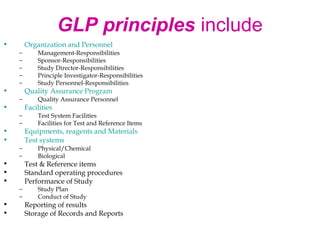
GLP principles include 
• Organization and Personnel 
– Management-Responsibilities 
– Sponsor-Responsibilities 
– Study Director-Responsibilities 
– Principle Investigator-Responsibilities 
– Study Personnel-Responsibilities 
• Quality Assurance Program 
– Quality Assurance Personnel 
• Facilities 
– Test System Facilities 
– Facilities for Test and Reference Items 
• Equipments, reagents and Materials 
• Test systems 
– Physical/Chemical 
– Biological 
• Test & Reference items 
• Standard operating procedures 
• Performance of Study 
– Study Plan 
– Conduct of Study 
• Reporting of results 
• Storage of Records and Reports
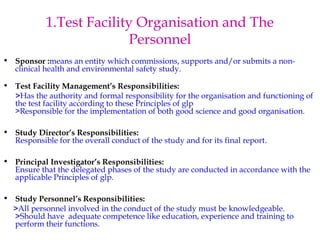
1.Test Facility Organisation and The 
Personnel 
• Sponsor :means an entity which commissions, supports and/or submits a non-clinical 
health and environmental safety study. 
• Test Facility Management’s Responsibilities: 
>Has the authority and formal responsibility for the organisation and functioning of 
the test facility according to these Principles of glp 
>Responsible for the implementation of both good science and good organisation. 
• Study Director’s Responsibilities: 
Responsible for the overall conduct of the study and for its final report. 
• Principal Investigator’s Responsibilities: 
Ensure that the delegated phases of the study are conducted in accordance with the 
applicable Principles of glp. 
• Study Personnel’s Responsibilities: 
>All personnel involved in the conduct of the study must be knowledgeable. 
>Should have adequate competence like education, experience and training to 
perform their functions.
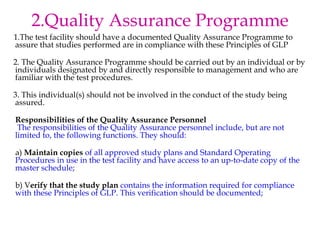
2.Quality Assurance Programme 
1.The test facility should have a documented Quality Assurance Programme to 
assure that studies performed are in compliance with these Principles of GLP 
2. The Quality Assurance Programme should be carried out by an individual or by 
individuals designated by and directly responsible to management and who are 
familiar with the test procedures. 
3. This individual(s) should not be involved in the conduct of the study being 
assured. 
Responsibilities of the Quality Assurance Personnel 
The responsibilities of the Quality Assurance personnel include, but are not 
limited to, the following functions. They should: 
a) Maintain copies of all approved study plans and Standard Operating 
Procedures in use in the test facility and have access to an up-to-date copy of the 
master schedule; 
b) Verify that the study plan contains the information required for compliance 
with these Principles of GLP. This verification should be documented;
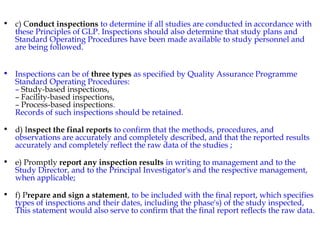
• c) Conduct inspections to determine if all studies are conducted in accordance with 
these Principles of GLP. Inspections should also determine that study plans and 
Standard Operating Procedures have been made available to study personnel and 
are being followed. 
• Inspections can be of three types as specified by Quality Assurance Programme 
Standard Operating Procedures: 
– Study-based inspections, 
– Facility-based inspections, 
– Process-based inspections. 
Records of such inspections should be retained. 
• d) Inspect the final reports to confirm that the methods, procedures, and 
observations are accurately and completely described, and that the reported results 
accurately and completely reflect the raw data of the studies ; 
• e) Promptly report any inspection results in writing to management and to the 
Study Director, and to the Principal Investigator's and the respective management, 
when applicable; 
• f) Prepare and sign a statement, to be included with the final report, which specifies 
types of inspections and their dates, including the phase's) of the study inspected, 
This statement would also serve to confirm that the final report reflects the raw data.
3.Facilities 
Test facility: 
1. The test facility should be of suitable size, construction and location to 
meet the requirements of the study and to minimise disturbance that 
would interfere with the validity of the study. 
2. The design of the test facility should provide an adequate degree of 
separation of the different activities to assure the proper conduct of each 
study. 
Facilities for Handling Test and Reference Items: 
1. To prevent contamination or mix-ups, there should be separate rooms or 
areas for receipt and storage of the test and reference items, and mixing of 
the test items with a vehicle. 
2. Storage rooms or areas for the test items should be separate from rooms 
or areas containing the test systems. They should be adequate to preserve 
identity, concentration, purity, and stability, and ensure safe storage for 
hazardous substances.
• Archive Facilities 
Archive facilities should be provided for the secure storage and 
retrieval of study plans, raw data, final reports, samples of test 
items and specimens. 
Archive design and archive conditions should protect contents 
from untimely deterioration. 
• Waste Disposal 
Handling and disposal of wastes should be carried out in such 
a way as not to jeopardise the integrity of studies. This includes 
provision for appropriate collection, storage and disposal 
facilities, and decontamination and transportation procedures
1.Apparatus, including validated computerised systems, used for the 
generation, storage and retrieval of data, and for controlling environmental 
factors relevant to the study should be suitably located and of appropriate 
design and adequate capacity. 
2. Apparatus used in a study should be periodically inspected, cleaned, 
maintained, and calibrated 
3. Chemicals, reagents, and solutions should be labelled to indicate identity 
expiry date and specific storage instructions. Information concerning source, 
preparation date and stability should be available.
5.Test Systems 
Physical/Chemical: 
• Apparatus used for the generation of physical/chemical data should be 
suitably located and of appropriate design and adequate capacity. 
• The integrity of the physical/chemical test systems should be ensured. 
Biological: 
• There should be Sops for the housing ,feeding ,handling and care of 
animals. 
• All newly received animals and their health status should be checked by a 
veterinarian. 
• At the initiation of a non-clinical study animals should be free of any 
diseases or condition that might interfere with the purpose and conduct of 
the study.
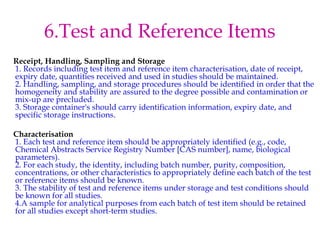
6.Test and Reference Items 
Receipt, Handling, Sampling and Storage 
1. Records including test item and reference item characterisation, date of receipt, 
expiry date, quantities received and used in studies should be maintained. 
2. Handling, sampling, and storage procedures should be identified in order that the 
homogeneity and stability are assured to the degree possible and contamination or 
mix-up are precluded. 
3. Storage container's should carry identification information, expiry date, and 
specific storage instructions. 
Characterisation 
1. Each test and reference item should be appropriately identified (e.g., code, 
Chemical Abstracts Service Registry Number [CAS number], name, biological 
parameters). 
2. For each study, the identity, including batch number, purity, composition, 
concentrations, or other characteristics to appropriately define each batch of the test 
or reference items should be known. 
3. The stability of test and reference items under storage and test conditions should 
be known for all studies. 
4.A sample for analytical purposes from each batch of test item should be retained 
for all studies except short-term studies.
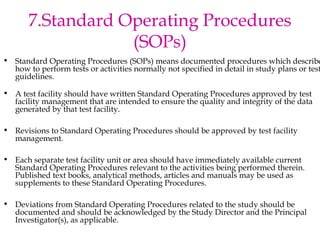
7.Standard Operating Procedures 
(SOPs) 
• Standard Operating Procedures (SOPs) means documented procedures which describe 
how to perform tests or activities normally not specified in detail in study plans or test 
guidelines. 
• A test facility should have written Standard Operating Procedures approved by test 
facility management that are intended to ensure the quality and integrity of the data 
generated by that test facility. 
• Revisions to Standard Operating Procedures should be approved by test facility 
management. 
• Each separate test facility unit or area should have immediately available current 
Standard Operating Procedures relevant to the activities being performed therein. 
Published text books, analytical methods, articles and manuals may be used as 
supplements to these Standard Operating Procedures. 
• Deviations from Standard Operating Procedures related to the study should be 
documented and should be acknowledged by the Study Director and the Principal 
Investigator(s), as applicable.
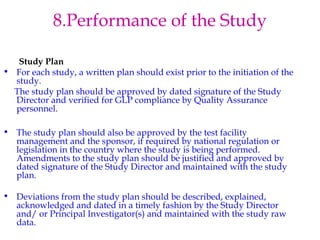
8.Performance of the Study 
Study Plan 
• For each study, a written plan should exist prior to the initiation of the 
study. 
The study plan should be approved by dated signature of the Study 
Director and verified for GLP compliance by Quality Assurance 
personnel. 
• The study plan should also be approved by the test facility 
management and the sponsor, if required by national regulation or 
legislation in the country where the study is being performed. 
Amendments to the study plan should be justified and approved by 
dated signature of the Study Director and maintained with the study 
plan. 
• Deviations from the study plan should be described, explained, 
acknowledged and dated in a timely fashion by the Study Director 
and/ or Principal Investigator(s) and maintained with the study raw 
data. 
.
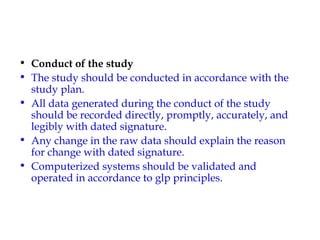
• Conduct of the study 
• The study should be conducted in accordance with the 
study plan. 
• All data generated during the conduct of the study 
should be recorded directly, promptly, accurately, and 
legibly with dated signature. 
• Any change in the raw data should explain the reason 
for change with dated signature. 
• Computerized systems should be validated and 
operated in accordance to glp principles.
9.Reporting of Study Results 
• A final report should be prepared for each study. 
• Reports of Principal Investigators or scientists involved in the study 
should be signed and dated by them. 
• The final report should be signed and dated by the Study Director 
to indicate acceptance of responsibility for the validity of the data. 
The extent of compliance with these Principles of Good Laboratory 
Practice should be indicated. 
• Corrections and additions to a final report should be in the form of 
amendments that should clearly specify the reason for the 
corrections or additions and should be signed and dated by the 
Study Director. 
• Reformatting of the final report to comply with the submission 
requirements of a national registration or regulatory authority does 
not constitute a correction, addition or amendment to the final 
report.
10.Storage and Retention of 
Records and Materials 
• The following should be retained in the archives for the period specified by the 
appropriate authorities : 
a) The study plan, raw data, samples of test and reference items, specimens, and the 
final report of each study; 
b) Records of all inspections performed by the Quality Assurance Programme, as well 
as master schedules; 
c) Records of qualifications, training, experience and job descriptions of personnel; 
d) Records and reports of the maintenance and calibration of apparatus 
e) Validation documentation for computerised systems; 
f) The historical file of all Standard Operating Procedures; 
g) Environmental monitoring records.
• Material retained in the archives should be indexed so as 
to facilitate orderly storage and retrieval. 
• Only personnel authorised by management should have 
access to the archives. Movement of material in and out 
of the archives should be properly recorded 
• Removal of any data file and specimens from the 
archives should be documented. 
• The conditions of the storage must prevent the 
detoriation of the data and the study related materials.
• OECD principles of GLP 
• National GLPlegislation 
• National GLPmonitoring authority 
• National GLPinspectors 
• National GLP certified test facilities
What is glp