Federal Food, Drug & Cosmetics Act
Kefauver's-Harris Amendments


                     ABDUL MUHEEM
                     M.PHARMA 2ND SEM.
                     (PHARMACEUTICS)
                     JAMIA HAMADARD
                     muheem.abdul985@gmail.com
OBJECTIVES OF FFDCA
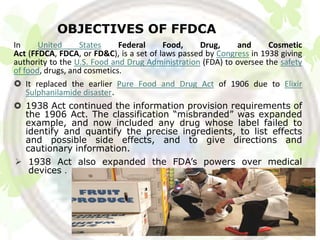
In     United     States     Federal     Food,    Drug,     and      Cosmetic
Act (FFDCA, FDCA, or FD&C), is a set of laws passed by Congress in 1938 giving
authority to the U.S. Food and Drug Administration (FDA) to oversee the safety
of food, drugs, and cosmetics.
 It replaced the earlier Pure Food and Drug Act of 1906 due to Elixir
    Sulphanilamide disaster.
 1938 Act continued the information provision requirements of
  the 1906 Act. The classification “misbranded” was expanded
  example, and now included any drug whose label failed to
  identify and quantify the precise ingredients, to list effects
  and possible side effects, and to give directions and
  cautionary information.
 1938 Act also expanded the FDA’s powers over medical
   devices .
Reason for implemented new act
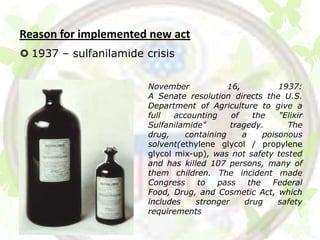
 1937 – sulfanilamide crisis


                        November            16,           1937:
                        A Senate resolution directs the U.S.
                        Department of Agriculture to give a
                        full   accounting    of    the    "Elixir
                        Sulfanilamide"       tragedy.       The
                        drug,    containing     a     poisonous
                        solvent(ethylene glycol / propylene
                        glycol mix-up), was not safety tested
                        and has killed 107 persons, many of
                        them children. The incident made
                        Congress    to   pass     the   Federal
                        Food, Drug, and Cosmetic Act, which
                        includes    stronger     drug     safety
                        requirements
OTHER TRAGEDIES
Koremlu Cream
Contained Thallium acetate
Serious hazardous side effects due to thallium
Radiothor
"Radium containing water“
Consumers died of radiation exposure
Label true and no therapeutic claims
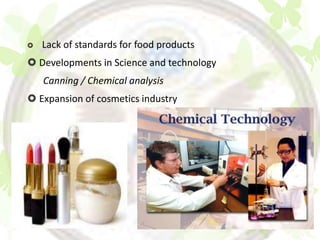
   Lack of standards for food products
 Developments in Science and technology
    Canning / Chemical analysis
 Expansion of cosmetics industry
GOALS OF FDCA(1938)
 The FDCA mandates the safety, purity, and in some cases the
  "effectiveness" of the products within its scope.
 FDA ensures safety through inspections of products already on
  the market, controls the manufacturing practices of
  companies, and possesses recall and seizure authority.
 The FDCA's Goal is to disclose information- requires
  truthfulness and completeness in product labeling and other
  marketing communications.
 The act forbids "misbranding," and provides a range of civil and
  criminal enforcement mechanisms against inaccurate product
  labeling.
 Section contains both civil law and criminal law clauses.
 The FDCA in 1958 with the Food Additives Amendment (also
  called the "Delaney Clause" after its House sponsor), precluding
  FDA approval of any food additive found to cause cancer in
  humans or animals.
Food & drug act
 Prohibited the sales of adulterated &misbranded drugs.
 Drug could be marketed as long as the label did not present
  false information regarding the strength & purity.
 no requirement to disclose ingredients.
 A largely unregulated industry was causing numerous public
  health problems.
CHAPTER WISE DESCRIPTION:
Chapter I. Short Titles
Chapter II – Definitions.
 201(f) is the definition for a food, which explicitly includes chewing
  gum
 201(g) is the definition for a drug
 201(h) is the definition for a medical device
 201(s) is the definition of a food additive
 201(ff) is the definition of a dietary supplement
CHAPTER III. Prohibited Acts and Penalties


  301. Prohibited Acts
   302. Injunction proceedings
   303. Penalties
   304. Seizures
   305. Hearing before report of criminal violation
   306. Report of minor violations
   307. Proceedings in name of United States; provision as to
   subpoenas .
CHAPTER IV. Food
  401. Definitions and standards for food
  402. Adulterated food
  403. Misbranded food
  404. Emergency permit control
  405. Regulations making exemptions
  406. Tolerances for poisonous ingredients in food
  407. Oleomargarine or margarine
  408. Tolerances for pesticide chemicals in or
  on raw agricultural commodities
  409. Food additives
  410. Bottled drinking water
  411. Vitamins and minerals
  412. Requirements for Infant Formulas .
CHAPTER V. Drugs and Devices


 505 is the description of the drug approval process
 510(k) is the section that allows for clearance of medical devices
 515 is the description of the device approval process.
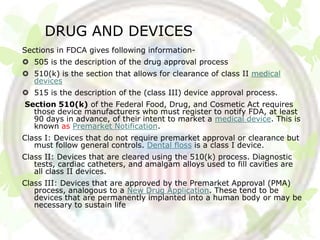
DRUG AND DEVICES
Sections in FDCA gives following information-
 505 is the description of the drug approval process
 510(k) is the section that allows for clearance of class II medical
  devices
 515 is the description of the (class III) device approval process.
Section 510(k) of the Federal Food, Drug, and Cosmetic Act requires
  those device manufacturers who must register to notify FDA, at least
  90 days in advance, of their intent to market a medical device. This is
  known as Premarket Notification.
Class I: Devices that do not require premarket approval or clearance but
   must follow general controls. Dental floss is a class I device.
Class II: Devices that are cleared using the 510(k) process. Diagnostic
   tests, cardiac catheters, and amalgam alloys used to fill cavities are
   all class II devices.
Class III: Devices that are approved by the Premarket Approval (PMA)
   process, analogous to a New Drug Application. These tend to be
   devices that are permanently implanted into a human body or may be
   necessary to sustain life
CHAPTER VII :


GENERAL ADMINISTRATIVE PROVISIONS


 701. Regulations and hearings
 702. Examinations and investigations
 702a. Seafood inspection
 703. Records of interstate shipment
 704. Factory inspection
 705. Publicity
 706. Listing and certification of color additives for foods, drugs, and
 cosmetics.
CHAPTER VIII :
        801.Imports And Exports 8


CHAPTER IX :
       901. Miscellaneous
LIMITATIONS OF 1938,FOOD DRUG
AND COSMETIC ACT INCLUDES
 It   did not included drugs which were previously
  marketed.
 Drugs had to be proven safe but        not   proven
  effective.
 The federal govt. had little authority to enact
  penalties, if the information on the labels was not
  written clearly.
 Drugs manufacturer were given the responsibility for
  determining whether a drug would be sold as a
  prescription or over the counter drug.
 Drug manufacturers conducted their own test to
  determine drugs effectiveness.
Introduction
 The Food and Drug Administration (FDA),
  established in 1938 as a part of the US Department
  of Health and Human Services (HHS), regulates
  products accounting for roughly 25% of the US gross
  national product.
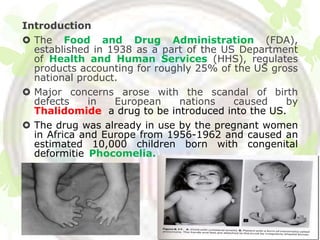
 Major concerns arose with the scandal of birth
  defects    in   European    nations    caused    by
  Thalidomide, a drug to be introduced into the US.
 The drug was already in use by the pregnant women
  in Africa and Europe from 1956-1962 and caused an
  estimated 10,000 children born with congenital
  deformitiesPhocomelia.).
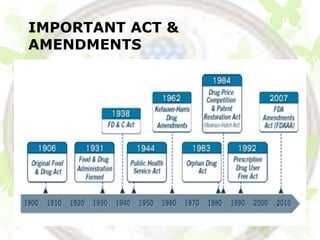
IMPORTANT ACT &
AMENDMENTS
News & Implementation Of
   Amendments
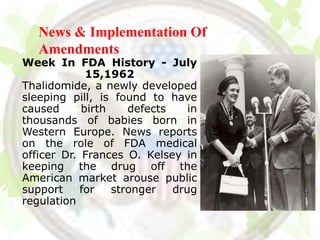
Week In FDA History - July
             15,1962
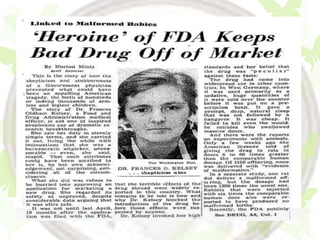
Thalidomide, a newly developed
sleeping pill, is found to have
caused      birth    defects    in
thousands of babies born in
Western Europe. News reports
on the role of FDA medical
officer Dr. Frances O. Kelsey in
keeping the drug off the
American market arouse public
support     for   stronger   drug
regulation
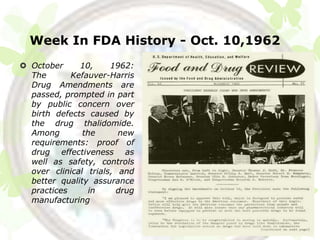
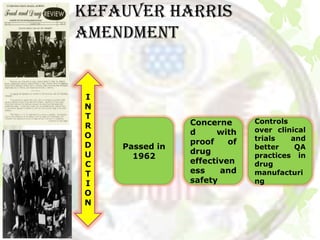
Week In FDA History - Oct. 10,1962
 October     10,     1962:
  The       Kefauver-Harris
  Drug Amendments are
  passed, prompted in part
  by public concern over
  birth defects caused by
  the drug thalidomide.
  Among        the      new
  requirements: proof of
  drug effectiveness as
  well as safety, controls
  over clinical trials, and
  better quality assurance
  practices     in     drug
  manufacturing
 Dr. Francis Kathleen Oldham Kelsey, working for the US FDA
  did not want to approve thalidomide into the American drug
  market because it was not properly tested as a result of what
  was going on in those years.
 The KEFAUVER HARRIS AMENDMENT was a response to the
  thalidomide tragedy. It was signed by President John F.
  Kennedy on October 10, 1962.
 US senator Estes Kefauver of the state of Tennessee and
  Arkansas state representative Oren Harris required the
  American drug manufacturers to present proof of the safety and
  effectiveness of their drugs before any endorsements.
 Hence, this amendment is also referred to as the DRUG
  EFFICACY AMENDMENT.
KEFAUVER HARRIS
AMENDMENT


I
N
T
                Concerne      Controls
R                             over clinical
O               d     with
                              trials   and
D               proof    of
    Passed in                 better    QA
U               drug
      1962                    practices in
C               effectiven    drug
T               ess    and    manufacturi
I               safety        ng
O
N
Objectives Of Amendments
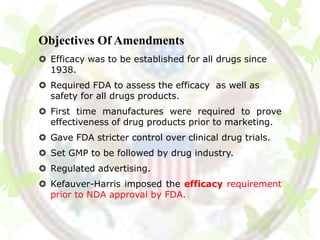
 Efficacy was to be established for all drugs since
  1938.
 Required FDA to assess the efficacy as well as
  safety for all drugs products.
 First time manufactures were required to prove
  effectiveness of drug products prior to marketing.
 Gave FDA stricter control over clinical drug trials.
 Set GMP to be followed by drug industry.
 Regulated advertising.
 Kefauver-Harris imposed the efficacy requirement
  prior to NDA approval by FDA.
APPROVAL OF NEW DRUGS AFTER
IMPLEMENTED OF AMENDMENTS


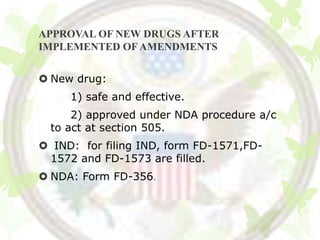
 New drug:
     1) safe and effective.
      2) approved under NDA procedure a/c
  to act at section 505.
 IND: for filing IND, form FD-1571,FD-
 1572 and FD-1573 are filled.
 NDA: Form FD-356.
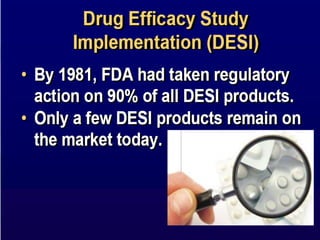
DRUG EFFICACY STUDy
IMPLEMENTATION (DESI)


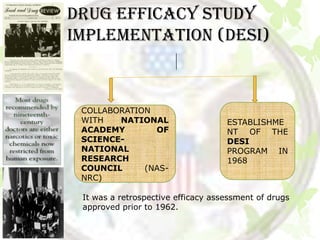
 COLLABORATION
 WITH   NATIONAL                    ESTABLISHME
 ACADEMY       OF                   NT OF THE
 SCIENCE-                           DESI
 NATIONAL                           PROGRAM IN
 RESEARCH                           1968
 COUNCIL     (NAS-
 NRC)

 It was a retrospective efficacy assessment of drugs
 approved prior to 1962.
DRUG EFFICACY STUDIES
  Early development
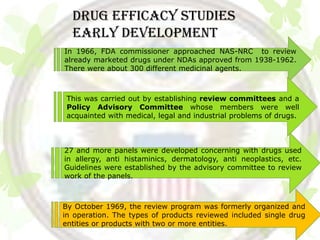
In 1966, FDA commissioner approached NAS-NRC to review
already marketed drugs under NDAs approved from 1938-1962.
There were about 300 different medicinal agents.


 This was carried out by establishing review committees and a
 Policy Advisory Committee whose members were well
 acquainted with medical, legal and industrial problems of drugs.


27 and more panels were developed concerning with drugs used
in allergy, anti histaminics, dermatology, anti neoplastics, etc.
Guidelines were established by the advisory committee to review
work of the panels.


By October 1969, the review program was formerly organized and
in operation. The types of products reviewed included single drug
entities or products with two or more entities.
DRUG EFFICACY STUDIES
         Early development

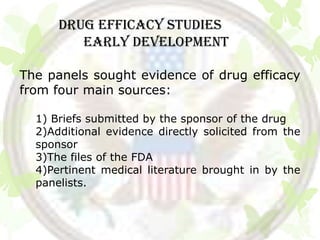
The panels sought evidence of drug efficacy
from four main sources:

  1) Briefs submitted by the sponsor of the drug
  2)Additional evidence directly solicited from the
  sponsor
  3)The files of the FDA
  4)Pertinent medical literature brought in by the
  panelists.
DRUG EFFICACY STUDIES
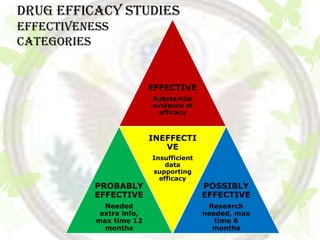
Effectiveness
categories


                          EFFECTIVE
                          Substantial
                          evidence of
                            efficacy


                          INEFFECTI
                             VE
                          Insufficient
                              data
                          supporting
                            efficacy
           PROBABLY                      POSSIBLY
           EFFECTIVE                     EFFECTIVE
             Needed                       Research
            extra info,                  needed, max
           max time 12                      time 6
             months                        months
DRUG EFFICACY STUDIES
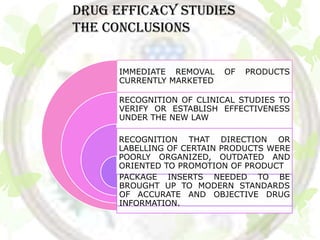
The conclusions

      IMMEDIATE REMOVAL    OF   PRODUCTS
      CURRENTLY MARKETED

      RECOGNITION OF CLINICAL STUDIES TO
      VERIFY OR ESTABLISH EFFECTIVENESS
      UNDER THE NEW LAW

     RECOGNITION THAT DIRECTION OR
     LABELLING OF CERTAIN PRODUCTS WERE
     POORLY ORGANIZED, OUTDATED AND
     ORIENTED TO PROMOTION OF PRODUCT
     PACKAGE INSERTS NEEDED TO BE
     BROUGHT UP TO MODERN STANDARDS
     OF ACCURATE AND OBJECTIVE DRUG
     INFORMATION.
DRUG EFFICACY STUDY
            RECORDS
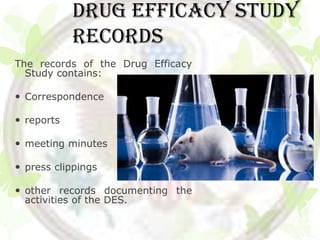
The records of the Drug Efficacy
  Study contains:

 Correspondence

 reports

 meeting minutes

 press clippings

 other records documenting the
  activities of the DES.
DRUG EFFICACY STUDIES
 abbreviated new drug applications
 One of the early effects        of   DESI   study   was   the
  development of ANDA.
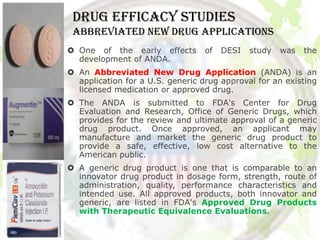
 An Abbreviated New Drug Application (ANDA) is an
  application for a U.S. generic drug approval for an existing
  licensed medication or approved drug.
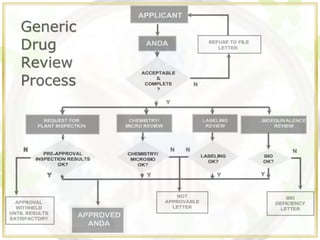
 The ANDA is submitted to FDA's Center for Drug
  Evaluation and Research, Office of Generic Drugs, which
  provides for the review and ultimate approval of a generic
  drug product. Once approved, an applicant may
  manufacture and market the generic drug product to
  provide a safe, effective, low cost alternative to the
  American public.
 A generic drug product is one that is comparable to an
  innovator drug product in dosage form, strength, route of
  administration, quality, performance characteristics and
  intended use. All approved products, both innovator and
  generic, are listed in FDA's Approved Drug Products
  with Therapeutic Equivalence Evaluations.
DRUG EFFICACY STUDIES
 abbreviated new drug applications
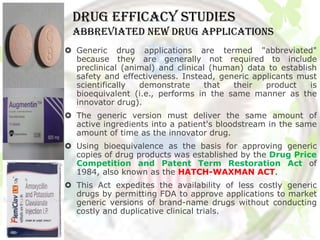
 Generic drug applications are termed "abbreviated"
  because they are generally not required to include
  preclinical (animal) and clinical (human) data to establish
  safety and effectiveness. Instead, generic applicants must
  scientifically  demonstrate      that  their  product     is
  bioequivalent (i.e., performs in the same manner as the
  innovator drug).
 The generic version must deliver the same amount of
  active ingredients into a patient's bloodstream in the same
  amount of time as the innovator drug.
 Using bioequivalence as the basis for approving generic
  copies of drug products was established by the Drug Price
  Competition and Patent Term Restoration Act of
  1984, also known as the HATCH-WAXMAN ACT.
 This Act expedites the availability of less costly generic
  drugs by permitting FDA to approve applications to market
  generic versions of brand-name drugs without conducting
  costly and duplicative clinical trials.
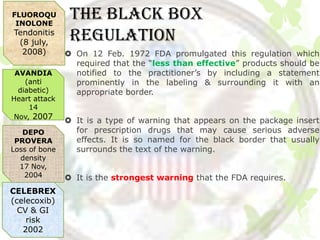
FLUOROQU
 INOLONE
                THE BLACK BOX
Tendonitis
 (8 july,
                REGULATION
  2008)         On 12 Feb. 1972 FDA promulgated this regulation which
                 required that the “less than effective” products should be
 AVANDIA         notified to the practitioner’s by including a statement
    (anti        prominently in the labeling & surrounding it with an
  diabetic)      appropriate border.
Heart attack
     14
Nov, 2007
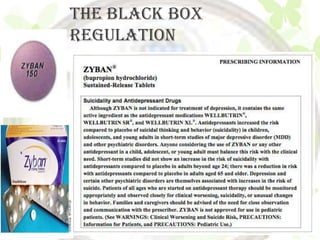
                It is a type of warning that appears on the package insert
   DEPO          for prescription drugs that may cause serious adverse
 PROVERA         effects. It is so named for the black border that usually
Loss of bone     surrounds the text of the warning.
  density
  17 Nov,
   2004         It is the strongest warning that the FDA requires.
CELEBREX
(celecoxib)
  CV & GI
    risk
   2002
THE BLACK BOX
REGULATION
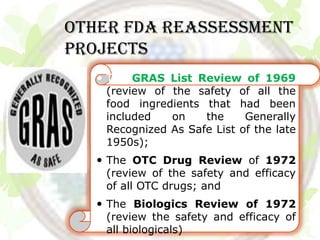
Other FDA REASSESSMENT
PROJECTS
    The GRAS List Review of 1969
     (review of the safety of all the
     food ingredients that had been
     included   on    the     Generally
     Recognized As Safe List of the late
     1950s);
    The OTC Drug Review of 1972
     (review of the safety and efficacy
     of all OTC drugs; and
    The Biologics Review of 1972
     (review the safety and efficacy of
     all biologicals)
Other related
legislations
       The     Medical   Device
       Amendments of 1976
       followed a U.S. Senate
       finding     that    faulty
       medical    devices    had
       caused 10,000 injuries,
       including 731 deaths. The
       law applied safety and
       effectiveness safeguards
       to new devices.
Other related
legislations

              2005
 Formation of the Drug Safety
 Board consisting of FDA staff
 and representatives from the
 National Institutes of Health and
 the Veterans Administration.
 The Board will advise the
 Director,   Center     for   Drug
 Evaluation and Research, FDA,
 on drug safety issues.
Contd…
 DRUG SAFETY AND DRUG EFFICACY:
   TWO SIDES OF THE SAME COIN

 In 2007, a committee of academic
 scientists,    research   advocates    and
 representatives of patient community
 was convened to recommend ways in
 which the Congress and the FDA could
 further strengthen product evaluation for
 it’s efficacy.
 A similar article was also published in the
 AACR, in the same year.
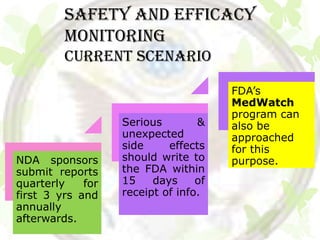
SAFETY AND EFFICACY
         MONITORING
         Current scenario

                                       FDA’s
                                       MedWatch
                                       program can
                   Serious        &    also be
                   unexpected          approached
                   side     effects    for this
NDA sponsors       should write to     purpose.
submit reports     the FDA within
quarterly    for   15    days     of
first 3 yrs and    receipt of info.
annually
afterwards.
Impacts of Kefauver Harris
Amendment(1962)
• The Kefauver Harris Amendment strengthened the U.S.
  Food and Drug Administration's control of
  experimentation on humans.
• It changed the way new drugs are approved and
  regulated.
• It introduced a "proof-of-efficacy" requirement, that
  was not present before.
• The Amendment required drug advertising to disclose
  accurate information about side effects and efficacy of
  treatments.
• Cheap generic drugs could no longer be marketed as
  expensive drugs under new trade names as new
  "breakthrough" medications, as they were prior to the
  amendment
DRUG EFFICACY STUDY IMPLEMENTATION

The amendment made onerous to evaluate each
product, also to evaluate the active ingredients in
the products. The active ingredients were placed
into one of the three categories.
Category I drugs: those determined to be safe ,
effective, and properly labeled.
Category II drugs:          those not generally
recognized as safe and effective, or recognized as
mislabeled; must be removed from medications
within 6 months after the FDA issues its final
regulations.
Category III drugs: those for which data is
insufficient to determine general recognition of
safety and effectiveness.
CONCLUSION
Today, the FDA regulates $1 trillion worth
of products a year. It ensures the safety of
all food except for meat, poultry and some
egg products; ensures the safety and
effectiveness of all drugs, biological
products (including blood, vaccines and
tissues    for  transplantation),   medical
devices, and animal drugs and feed; and
makes sure that cosmetics and medical
and consumer products that emit radiation
do no harm.
ConClusions …


By 1984, final action had been completed on 3,443
products; - 2,225 were found to be effective, 1,051
were found not effective, and 167 were pending.
References
 http://www.absoluteastronomy.com/discussion/Drug_Efficacy_Stu
  dy_Implementation
 http://en.wikipedia.org/wiki/Talk:Drug_Efficacy_Study_Implement
  ation
 http://www.ssa.gov/OP_Home/comp2/B-CFR-42.html
 http://www.nationalacademies.org/ The Drug Efficacy Study of the
  National Research Council’s Division of Medical Sciences, 1966-
  1969,
 W.M. WARDELL, The US Drug Efficacy Study and its Implication
  (DESI), Associate Professor, Pharmacology and Toxicology,
  University of Rochester, and Director, Center for the Study of Drug
  Development, USA
 http://edocket.access.gpo.gov/cfr_2008/aprqtr/pdf/21cfr207.20.p
  df
 W.E. GILBERTSON, The OCT Drug Review - FDA's Viewpoint,
  Director Division of OTC Drug Evaluation, Food and Drug
  Administration, Rockville, Maryland, USA
 Julie B. Esmay, B.S., and Albert I. Wertheimer, Ph.D., A REVIEW OF
  OVER-THE-COUNTER DRUG THERAPY, Journal of Community Health
  Vol. 5, No. 1, Fall 1979,
References
 Http://www.Personalcarecouncil.Org/
 Http://www.Fda.Gov/drugs/informationondrugs/default.Htm
 Http://www.Fda.Gov/drugs/guidancecomplianceregulatoryin
  formation/drugregistrationandlisting/default.Htm
 Center for veterinary medicine program policy and
  procedures manual, guide 1240.3560, General review and
  enforcement     policies,  responsible  office:   hfv-210,
  registration of producers of drugs and listing of drugs in
  commercial distribution.
 Guidance for industry , providing regulatory submissions in
 electronic format – drug establishment registration and drug
 listing
 Alan h. Kaplan, esq., Fifty years of drug amendments
  revisited: in easy-to-swallow capsule form
Federal food, drug & cosmetics act