WAJEEHA AKRAM
MPHIL MOLECULAR MEDICINE
DEPARTMENT OF BIOCHEMISTRY & MOLECULAR BIOLOGY
AMC, NUMS
 Tautomers are the alternate forms of bases
and are produced by rearrangements of
electrons and protons in the molecules.
 It is a structural isomer of some compound,
that is interconvertible and thus exists at
equilibrium with the standard, “normal”
molecule.
TAUTOMERIZATION
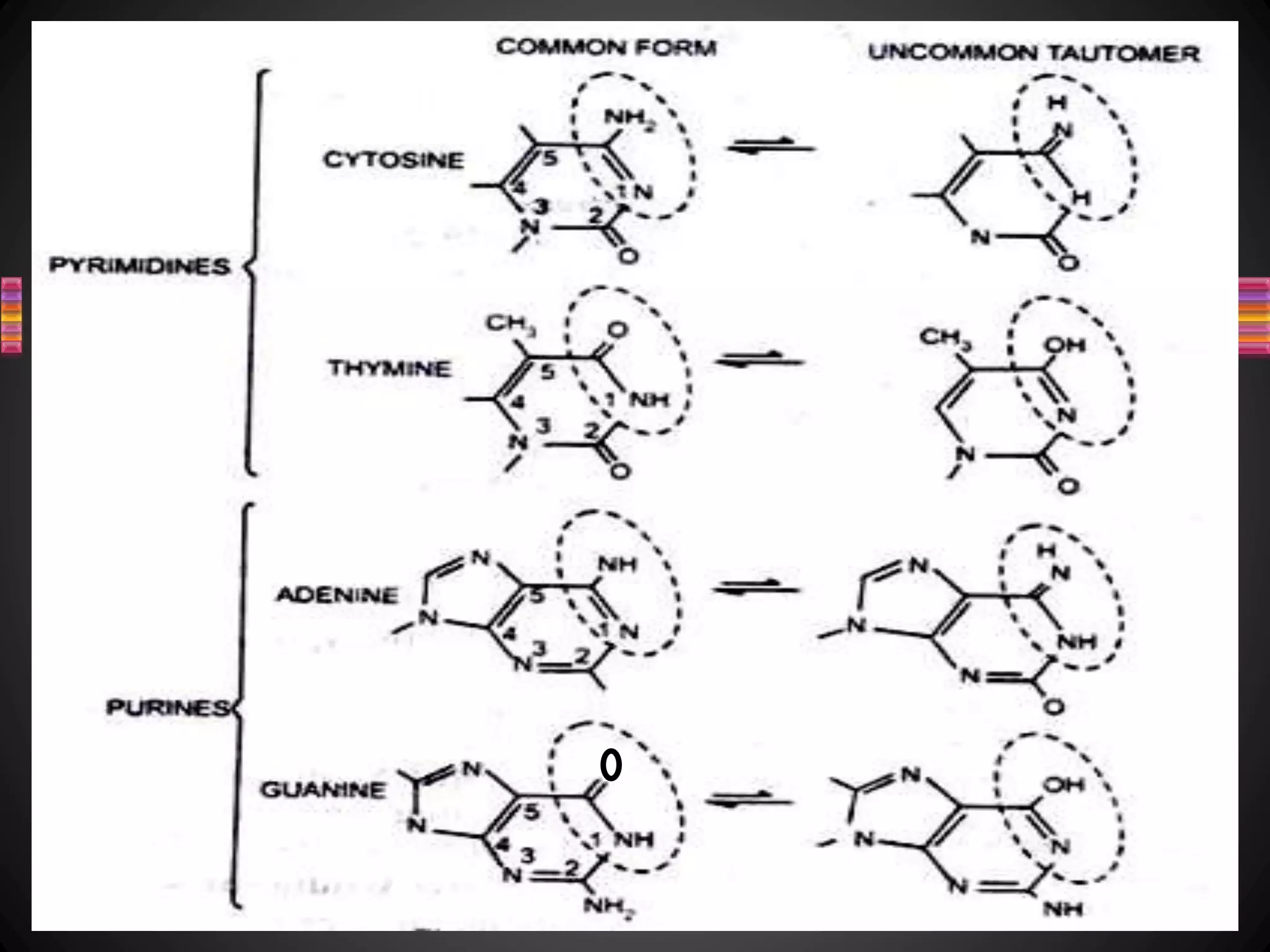
• Due to tautomerisation the amino (-NH2) group of
cytosine and adenine is converted into imino(-NH)
group and likewise keto (C=0) of thymine and
guanine is converted to enol group (-OH).
 Problems occur when the nitrogenous bases in
DNA tautomerize. Tautomeric thymine pairs with
normal guanine and cytosine with adenine. Such
pairing of nitrogenous bases are known as
unusual base pair.
 The tautomer form of the base hydrogen-bonds
to an incorrect base, and so the base laid down
during replication will be wrong, inducing a
mutation (if this mismatch is preserved through
another round of replication).
 This causes transitions (because the class of
nitrogenous base is preserved).
Mutations are also classified by their impact on protein function.
• Complete loss of the protein-: null, loss-of-
function, amorph
• Reduction of protein’s ability to work:
hypomorph, reduction-of-function
Loss of
Function
•Increase in the protein’s function:
hypermorph, gain-of-function
•A protein that interferes with the wild-type
protein’s function: antimorph, dominant
negative
•Acquisition of a new function (or ectopic
expression of the function): neomorph,
dominant gain-of-function
Gain of
Function
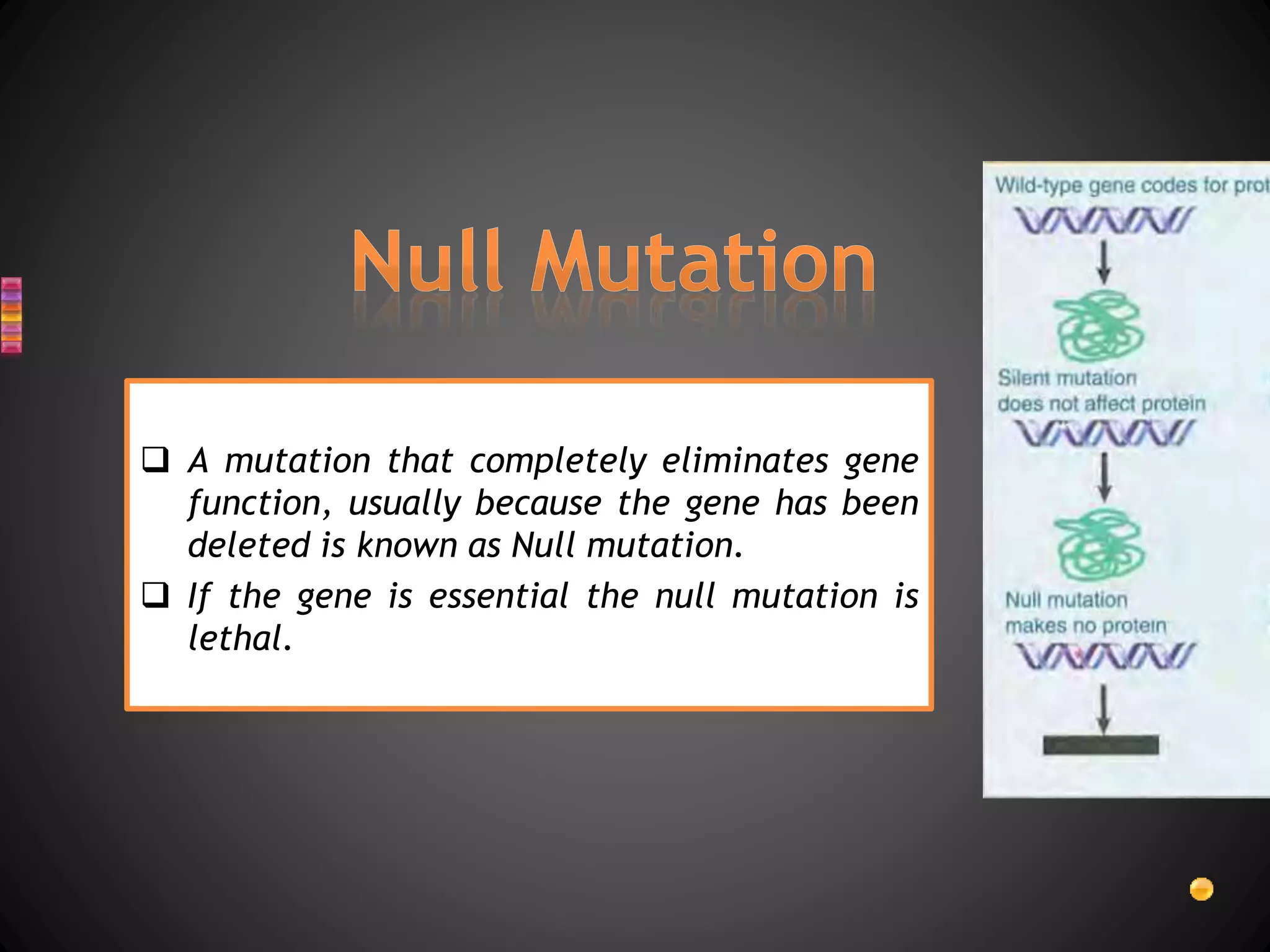
 A mutation that completely eliminates gene
function, usually because the gene has been
deleted is known as Null mutation.
 If the gene is essential the null mutation is
lethal.
 Hypo-morphic usually means that less of a protein is
made or that some function of the protein has been
compromised.
 Hypo-morphic mutations are usually recessive, since in
most cases, a single “good” copy of the gene will
suffice.
 Lactose intolerence (low expression of the lactase
enzyme in adult)
 Cystic Fibrosis (mutant CFTR gene)
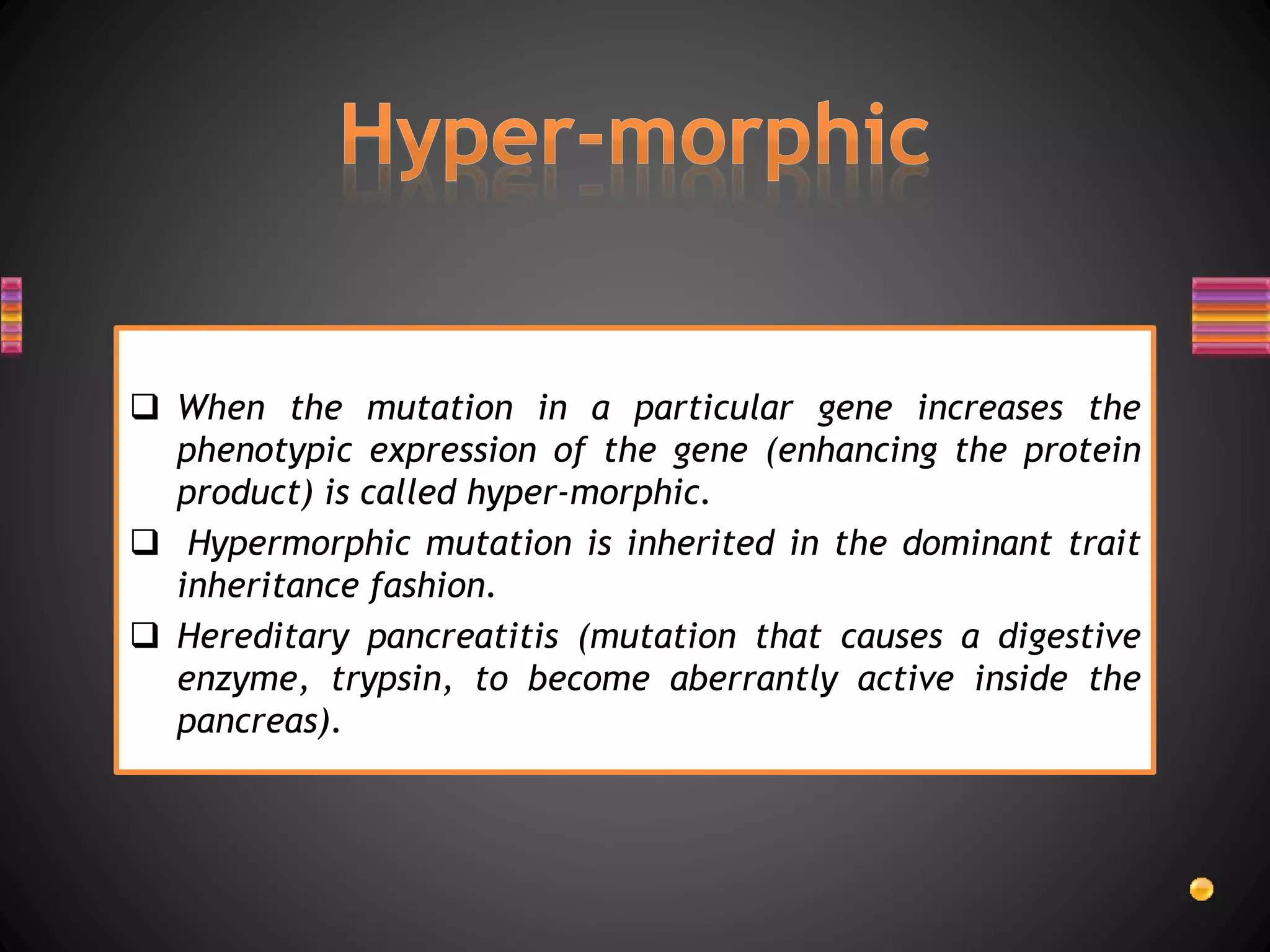
 When the mutation in a particular gene increases the
phenotypic expression of the gene (enhancing the protein
product) is called hyper-morphic.
 Hypermorphic mutation is inherited in the dominant trait
inheritance fashion.
 Hereditary pancreatitis (mutation that causes a digestive
enzyme, trypsin, to become aberrantly active inside the
pancreas).
 The defective gene interferes with the function of the wild-type
copy.
 Dominant negative (opposite to wild type).
 Increasing wildtype gene function reduces the phenotypic severity
of an antimorph
 Marfan syndrome (Defective Fibrillin-1 proteins disrupt the
integrity of microfibrils in the extracellular matrix).
 A neomorphic mutation causes a dominant gain of gene
function that is different from the normal function.
 A neomorphic mutation can cause ectopic mRNA or protein
expression, or new protein functions from altered protein
structure.
 Changing wildtype gene dose has no effect on the phenotype
of a neomorph.
 Malaria resistance in Sickle-cell anemia.
 Haploinsufficiency-a single copy of the standard (so-called wild-
type) allele at a locus in heterozygous combination with a
variant allele is insufficient to produce the standard phenotype.
 Haploinsufficiency may arise from a de novo or inherited loss-
of-function mutation in the variant allele, such that it produces
little or no gene product (often a protein).
 Although the other, standard allele still produces the standard
amount of product, the total product is insufficient to produce
the standard phenotype.
 Ehlers Danlos
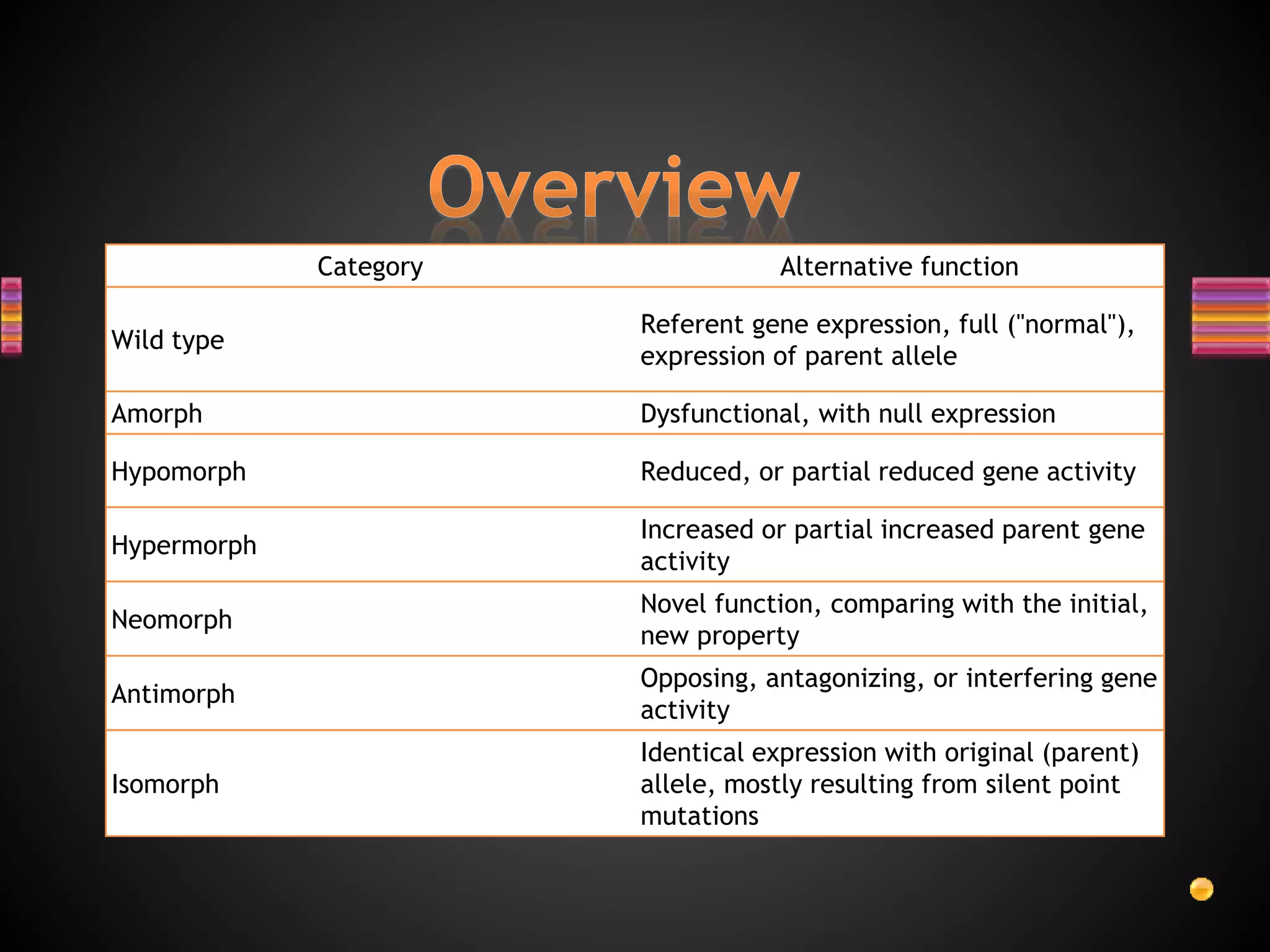
Category Alternative function
Wild type
Referent gene expression, full ("normal"),
expression of parent allele
Amorph Dysfunctional, with null expression
Hypomorph Reduced, or partial reduced gene activity
Hypermorph
Increased or partial increased parent gene
activity
Neomorph
Novel function, comparing with the initial,
new property
Antimorph
Opposing, antagonizing, or interfering gene
activity
Isomorph
Identical expression with original (parent)
allele, mostly resulting from silent point
mutations

Tautomers

  • 1.
    WAJEEHA AKRAM MPHIL MOLECULARMEDICINE DEPARTMENT OF BIOCHEMISTRY & MOLECULAR BIOLOGY AMC, NUMS
  • 2.
     Tautomers arethe alternate forms of bases and are produced by rearrangements of electrons and protons in the molecules.  It is a structural isomer of some compound, that is interconvertible and thus exists at equilibrium with the standard, “normal” molecule.
  • 4.
    TAUTOMERIZATION • Due totautomerisation the amino (-NH2) group of cytosine and adenine is converted into imino(-NH) group and likewise keto (C=0) of thymine and guanine is converted to enol group (-OH).
  • 5.
     Problems occurwhen the nitrogenous bases in DNA tautomerize. Tautomeric thymine pairs with normal guanine and cytosine with adenine. Such pairing of nitrogenous bases are known as unusual base pair.  The tautomer form of the base hydrogen-bonds to an incorrect base, and so the base laid down during replication will be wrong, inducing a mutation (if this mismatch is preserved through another round of replication).  This causes transitions (because the class of nitrogenous base is preserved).
  • 7.
    Mutations are alsoclassified by their impact on protein function. • Complete loss of the protein-: null, loss-of- function, amorph • Reduction of protein’s ability to work: hypomorph, reduction-of-function Loss of Function •Increase in the protein’s function: hypermorph, gain-of-function •A protein that interferes with the wild-type protein’s function: antimorph, dominant negative •Acquisition of a new function (or ectopic expression of the function): neomorph, dominant gain-of-function Gain of Function
  • 8.
     A mutationthat completely eliminates gene function, usually because the gene has been deleted is known as Null mutation.  If the gene is essential the null mutation is lethal.
  • 9.
     Hypo-morphic usuallymeans that less of a protein is made or that some function of the protein has been compromised.  Hypo-morphic mutations are usually recessive, since in most cases, a single “good” copy of the gene will suffice.  Lactose intolerence (low expression of the lactase enzyme in adult)  Cystic Fibrosis (mutant CFTR gene)
  • 10.
     When themutation in a particular gene increases the phenotypic expression of the gene (enhancing the protein product) is called hyper-morphic.  Hypermorphic mutation is inherited in the dominant trait inheritance fashion.  Hereditary pancreatitis (mutation that causes a digestive enzyme, trypsin, to become aberrantly active inside the pancreas).
  • 11.
     The defectivegene interferes with the function of the wild-type copy.  Dominant negative (opposite to wild type).  Increasing wildtype gene function reduces the phenotypic severity of an antimorph  Marfan syndrome (Defective Fibrillin-1 proteins disrupt the integrity of microfibrils in the extracellular matrix).
  • 12.
     A neomorphicmutation causes a dominant gain of gene function that is different from the normal function.  A neomorphic mutation can cause ectopic mRNA or protein expression, or new protein functions from altered protein structure.  Changing wildtype gene dose has no effect on the phenotype of a neomorph.  Malaria resistance in Sickle-cell anemia.
  • 13.
     Haploinsufficiency-a singlecopy of the standard (so-called wild- type) allele at a locus in heterozygous combination with a variant allele is insufficient to produce the standard phenotype.  Haploinsufficiency may arise from a de novo or inherited loss- of-function mutation in the variant allele, such that it produces little or no gene product (often a protein).  Although the other, standard allele still produces the standard amount of product, the total product is insufficient to produce the standard phenotype.  Ehlers Danlos
  • 14.
    Category Alternative function Wildtype Referent gene expression, full ("normal"), expression of parent allele Amorph Dysfunctional, with null expression Hypomorph Reduced, or partial reduced gene activity Hypermorph Increased or partial increased parent gene activity Neomorph Novel function, comparing with the initial, new property Antimorph Opposing, antagonizing, or interfering gene activity Isomorph Identical expression with original (parent) allele, mostly resulting from silent point mutations