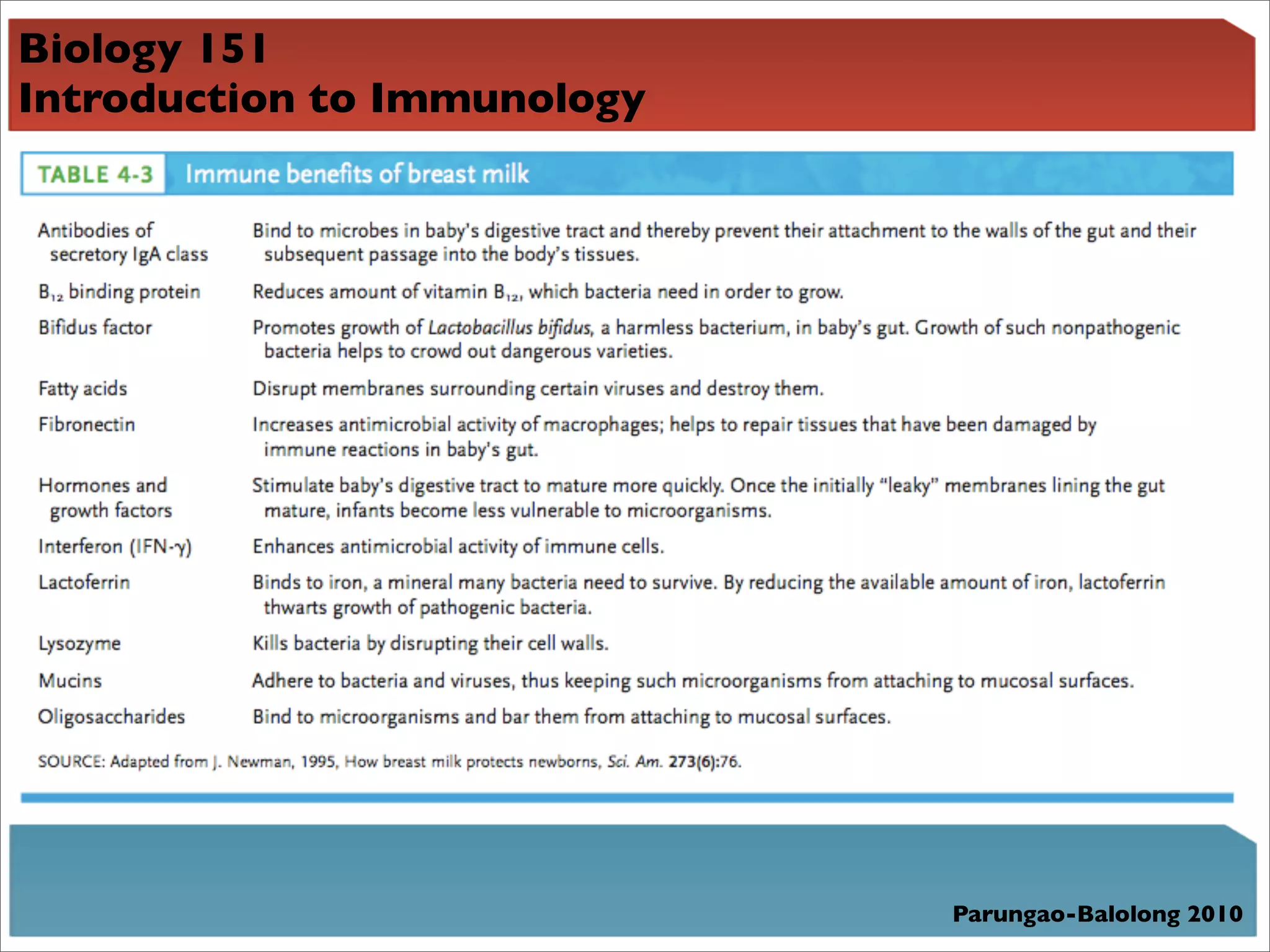
Biology 151
Introduction to Immunology


          ANTIGENS &
          ANTIBODIES
                     Lecture 4


                                 Parungao-Balolong 2010
Biology 151
Introduction to Immunology


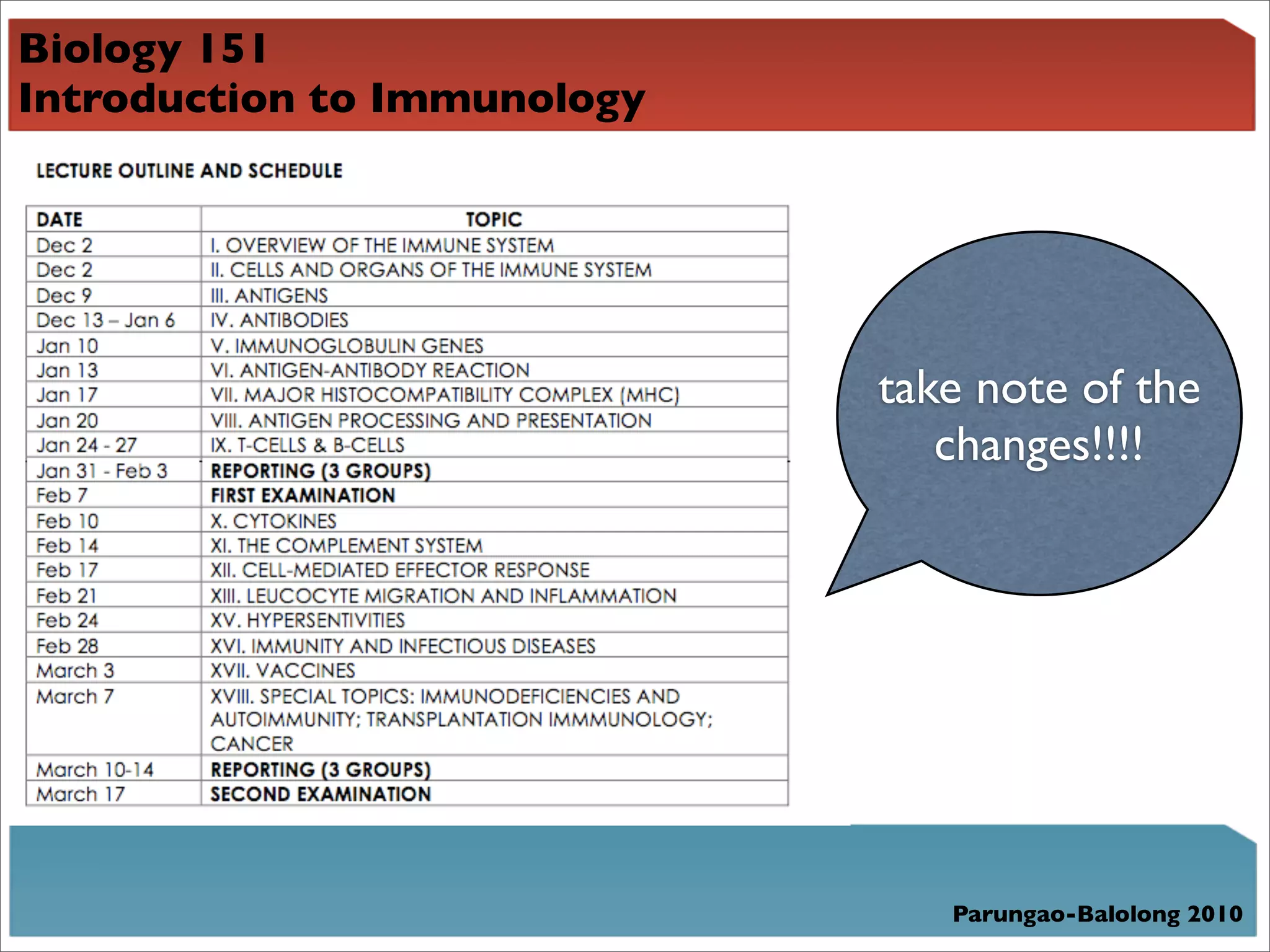
                             take note of the
                                changes!!!!


                                Parungao-Balolong 2010
Biology 151
Introduction to Immunology


             JOURNAL
            REPORTING
     Assignment for Jan 2011: each student to look
         for one journal article on immunology

       submit hard copies during the 1st meeting


                                          Parungao-Balolong 2010
Biology 151
Introduction to Immunology

    What you need to know

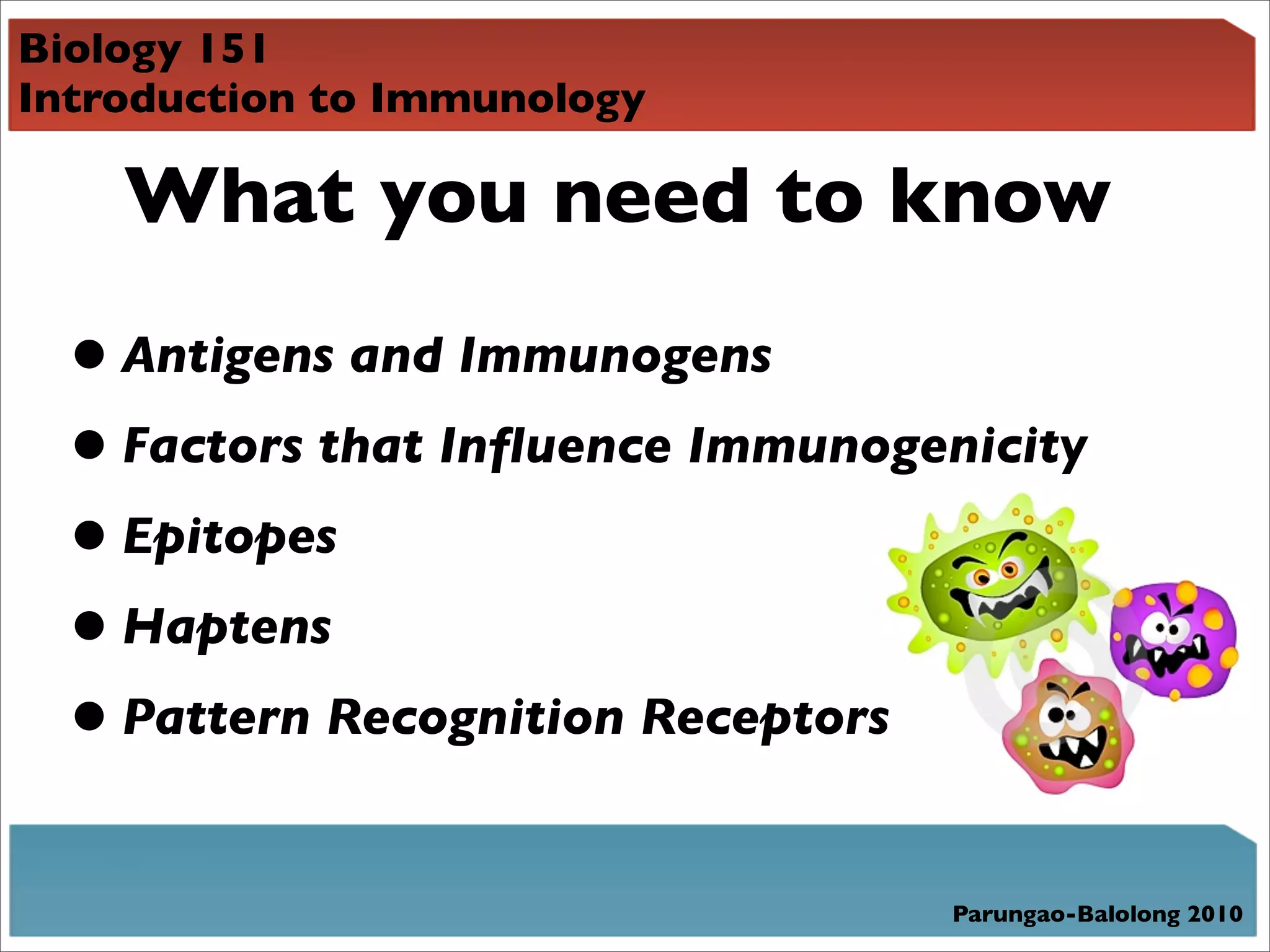
  • Antigens and Immunogens
  • Factors that Influence Immunogenicity
  • Epitopes
  • Haptens
  • Pattern Recognition Receptors
                                  Parungao-Balolong 2010
Biology 151
Introduction to Immunology

    What you need to know

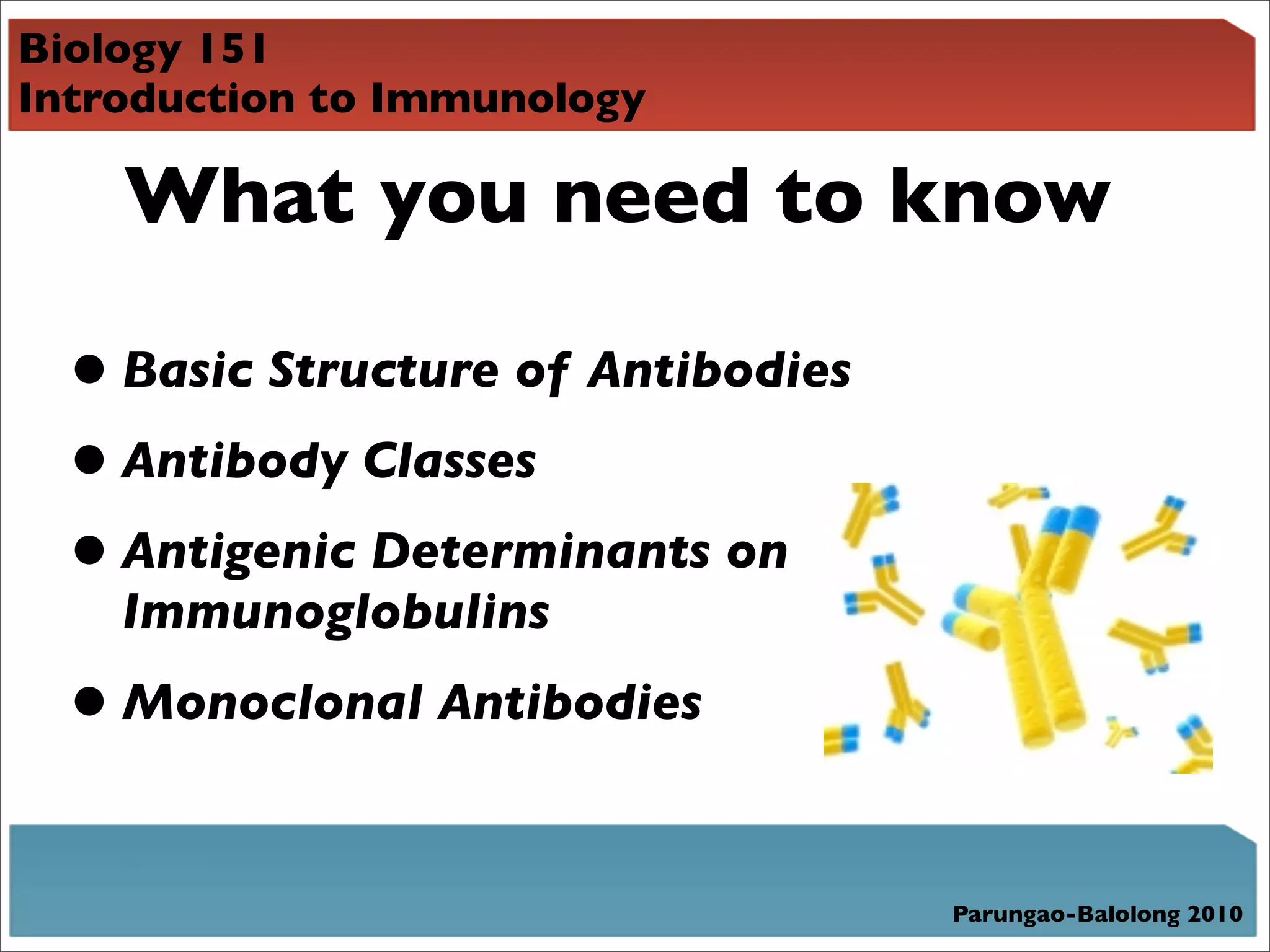
  • Basic Structure of Antibodies
  • Antibody Classes
  • Antigenic Determinants on
    Immunoglobulins
  • Monoclonal Antibodies

                                    Parungao-Balolong 2010
Biology 151
Introduction to Immunology

   ANTIGENS & IMMUNOGENS
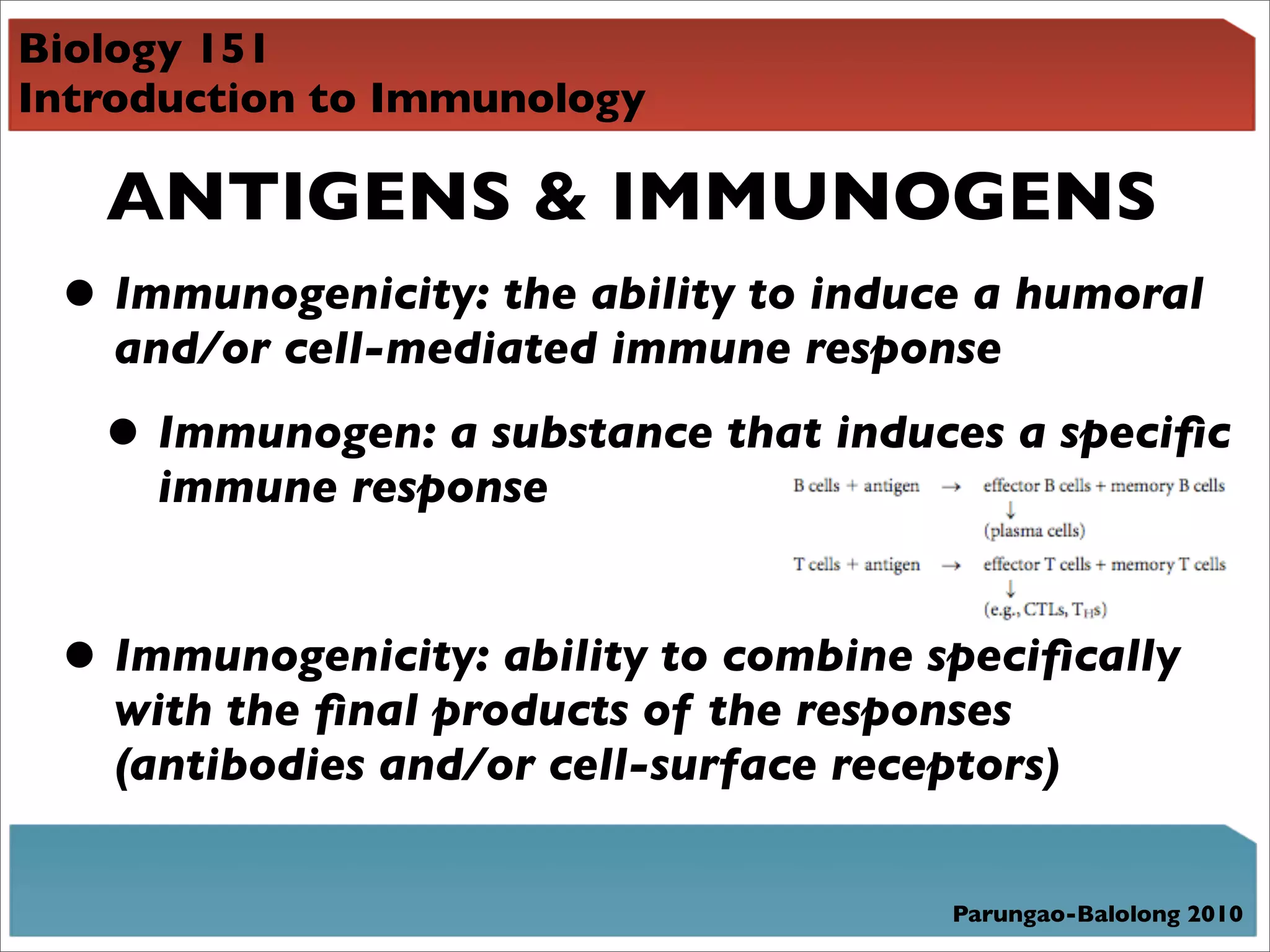
 • Immunogenicity: the ability to induce a humoral
    and/or cell-mediated immune response

   • Immunogen: a substance that induces a specific
     immune response


 • Immunogenicity: ability to combine specifically
    with the final products of the responses
    (antibodies and/or cell-surface receptors)


                                         Parungao-Balolong 2010
Biology 151
Introduction to Immunology

   ANTIGENS & IMMUNOGENS
 • ALL molecules that are immunogenic are also
   antigenic..BUT...

 • not all antigenic molecules are immunogenic!

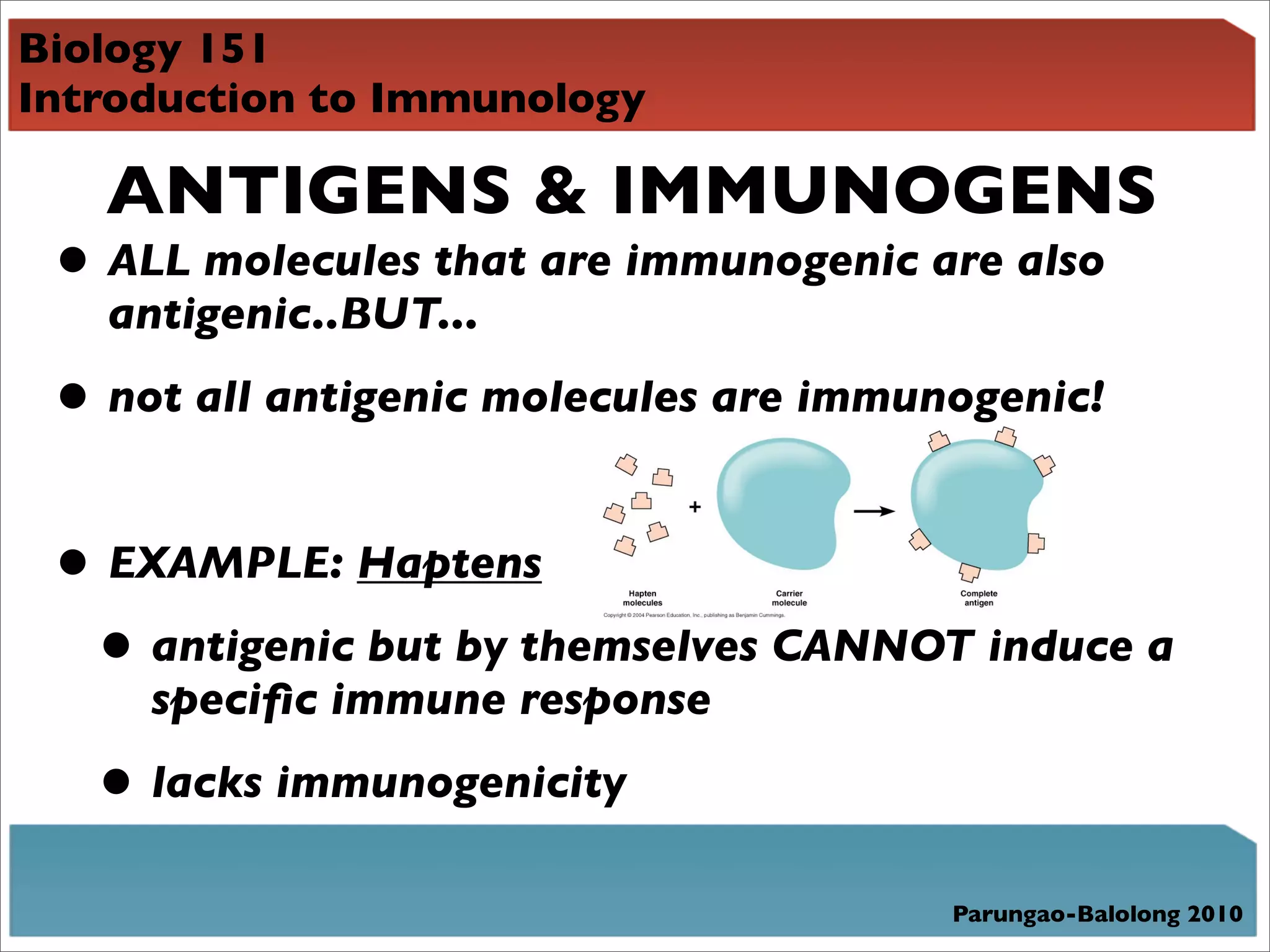
 • EXAMPLE: Haptens
  • antigenic but by themselves CANNOT induce a
     specific immune response

   • lacks immunogenicity
                                        Parungao-Balolong 2010
Biology 151
Introduction to Immunology

FACTORS INFLUENCING IMMUNOGENICITY
  • Nature of the Immunogen • Biological System
     •   foreignness                 •   genotype of the recipient
                                         animal
     •   molecular size
                                     •   immunogen dosage and and
     •   chemical composition and        route of administration
         heterogeneity
                                     •   adjuvants
     •   lipids as antigens

     •   susceptibility to antigen
         processing and
         presentation


                                                Parungao-Balolong 2010
Biology 151
Introduction to Immunology


          NATURE OF
         IMMUNOGEN


                             Parungao-Balolong 2010
Biology 151
Introduction to Immunology

FACTORS INFLUENCING IMMUNOGENICITY
                              “Foreignness”
 • Recall: “in order to elicit an immune response, a molecule must be recognized as
   NONSELF by the biological system”

     •   tolerance for self-antigens

 •   The greater the phylogenetic distance between two species, the greater the
     structural disparity between them

 •   EXAMPLE: bovine serum albumin not immunogenic to cow bt is on chicken (cow >
     goat > chicken)

 •   EXEMPTION: collagen, cytochrome c

     •   have been highly conserved throughout evolution

     •   little immunogenicity across diverse species line


                                                                 Parungao-Balolong 2010
Biology 151
Introduction to Immunology

FACTORS INFLUENCING IMMUNOGENICITY
            “Molecular Size”

   •   The most ACTIVE immunogens:
       100,000 Da

   •   Substances with a molecular mass
       of 5,000-10,000 Da are poor
       immunogens

   •   EXEMPTIONS: few substances with
       a molecular mass less than 1,000
       Da have proven to be immunogenic


                                          Parungao-Balolong 2010
Biology 151
Introduction to Immunology

FACTORS INFLUENCING IMMUNOGENICITY
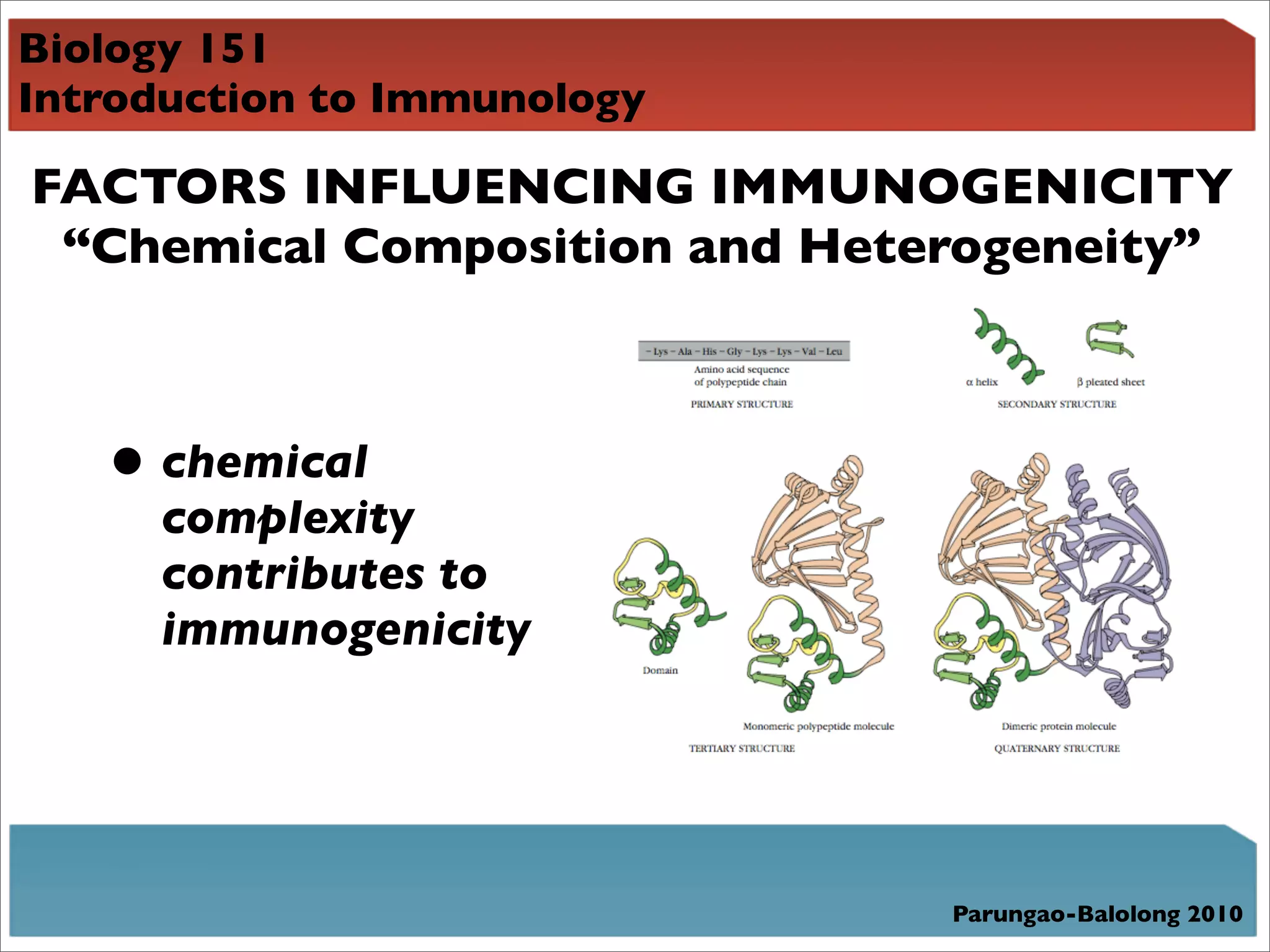
 “Chemical Composition and Heterogeneity”


   • chemical
     complexity
     contributes to
     immunogenicity


                               Parungao-Balolong 2010
Biology 151
Introduction to Immunology

FACTORS INFLUENCING IMMUNOGENICITY
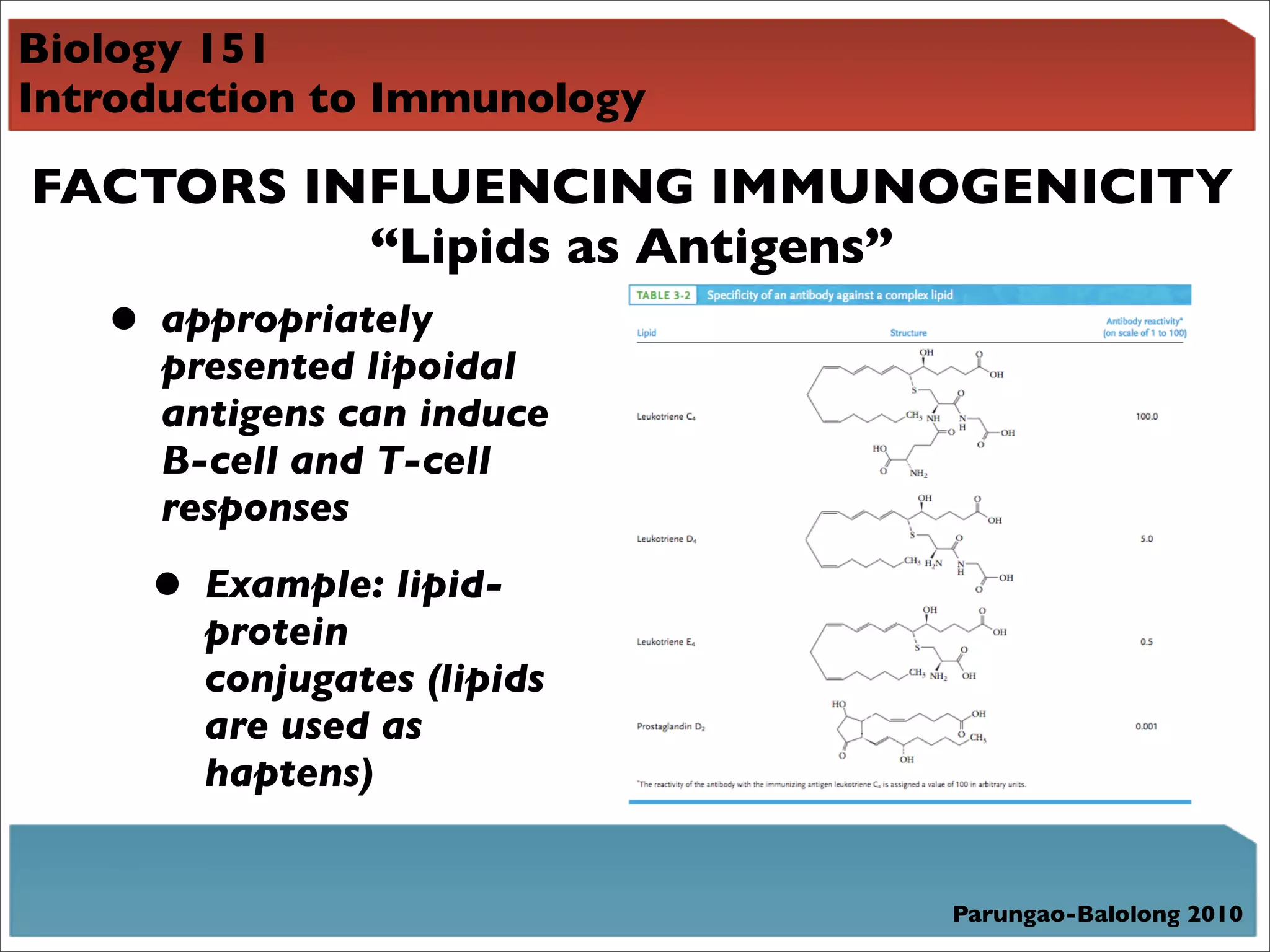
          “Lipids as Antigens”
   • appropriately
     presented lipoidal
     antigens can induce
     B-cell and T-cell
     responses

     • Example: lipid-
       protein
       conjugates (lipids
       are used as
       haptens)


                             Parungao-Balolong 2010
Biology 151
Introduction to Immunology

    FACTORS INFLUENCING IMMUNOGENICITY
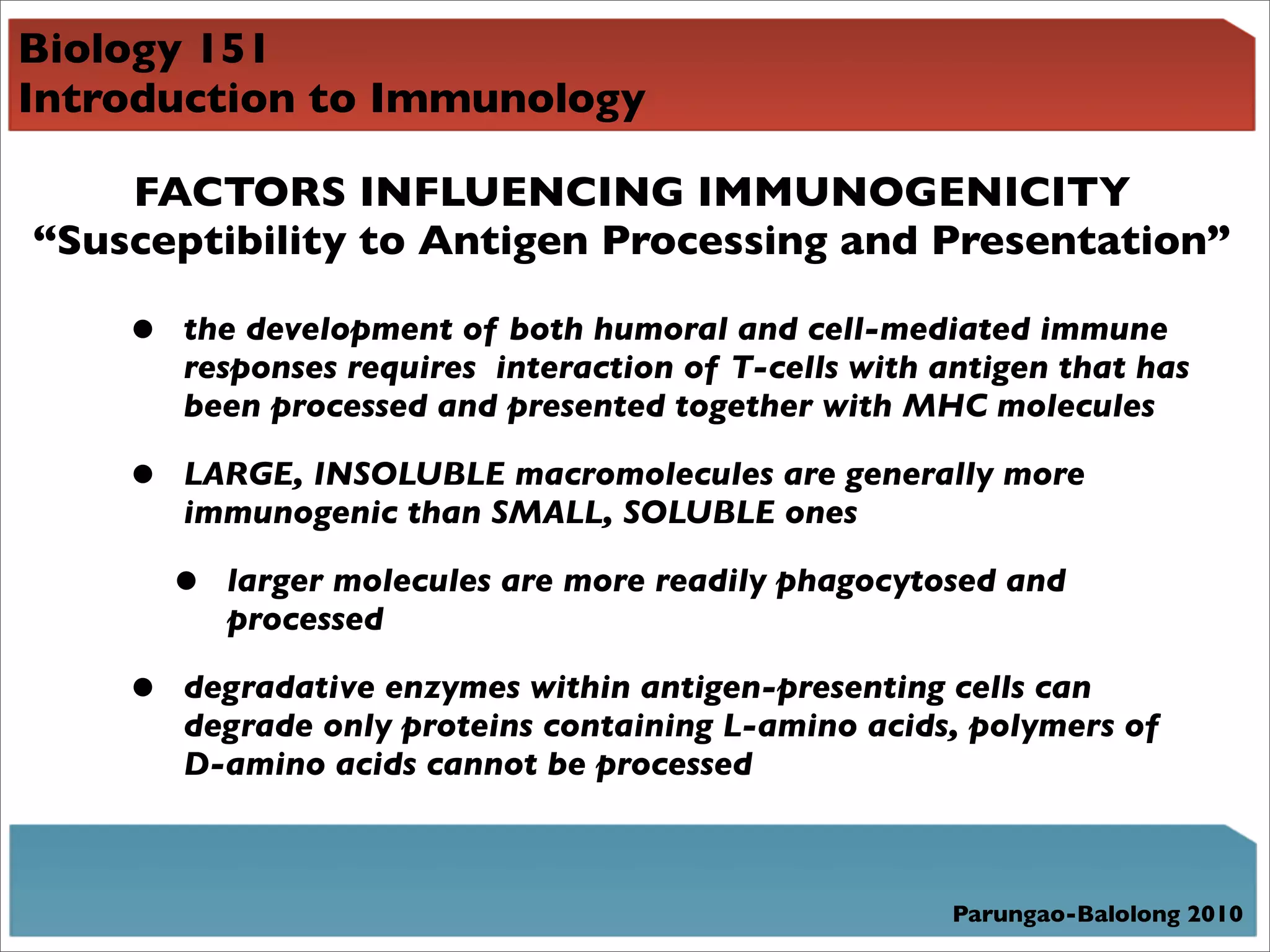
“Susceptibility to Antigen Processing and Presentation”

    •   the development of both humoral and cell-mediated immune
        responses requires interaction of T-cells with antigen that has
        been processed and presented together with MHC molecules

    •   LARGE, INSOLUBLE macromolecules are generally more
        immunogenic than SMALL, SOLUBLE ones

        •   larger molecules are more readily phagocytosed and
            processed

    •   degradative enzymes within antigen-presenting cells can
        degrade only proteins containing L-amino acids, polymers of
        D-amino acids cannot be processed


                                                        Parungao-Balolong 2010
Biology 151
Introduction to Immunology


          BIOLOGICAL
            SYSTEM


                             Parungao-Balolong 2010
Biology 151
Introduction to Immunology

      FACTORS INFLUENCING IMMUNOGENICITY
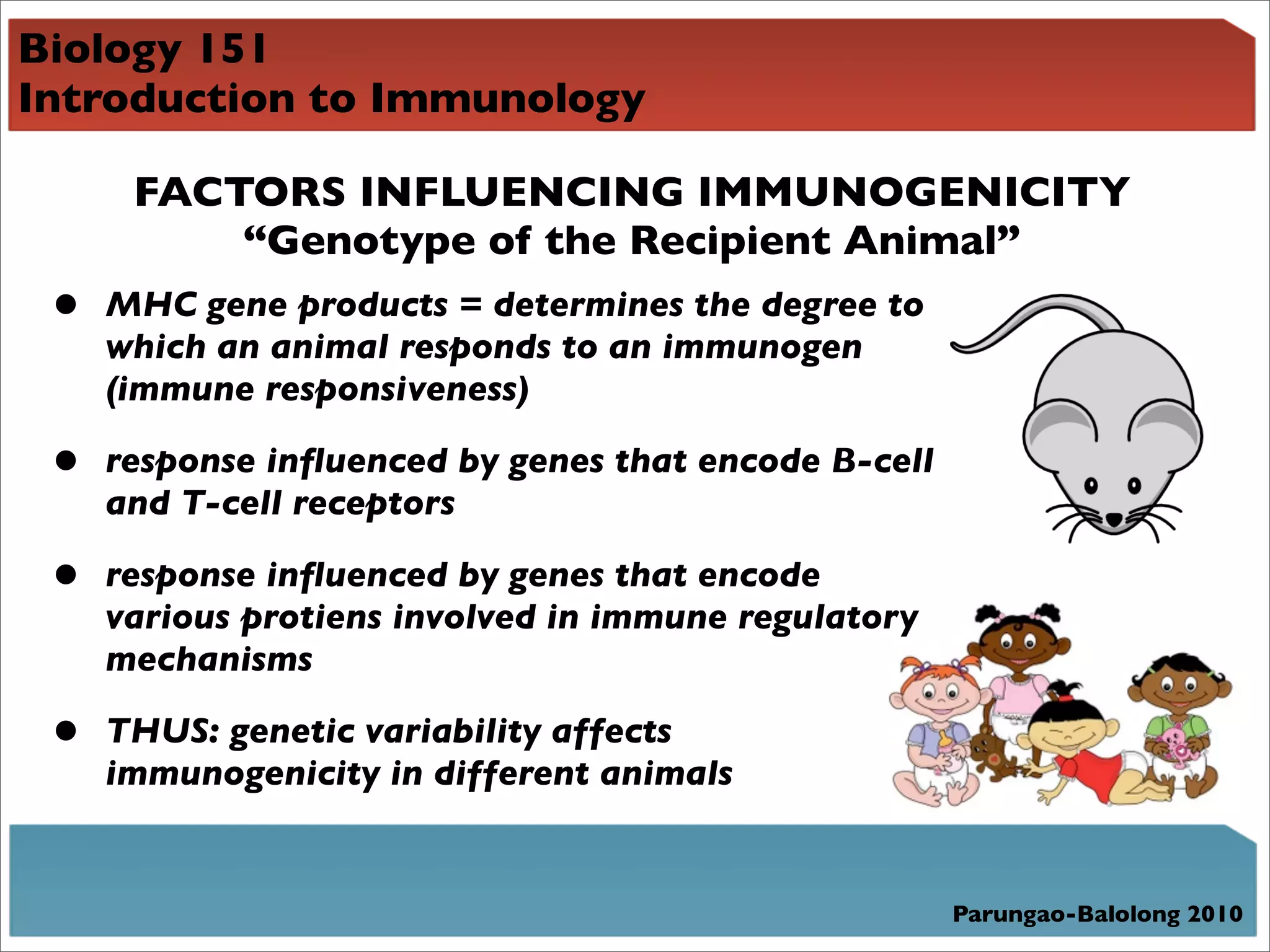
          “Genotype of the Recipient Animal”
 •   MHC gene products = determines the degree to
     which an animal responds to an immunogen
     (immune responsiveness)

 •   response influenced by genes that encode B-cell
     and T-cell receptors

 •   response influenced by genes that encode
     various protiens involved in immune regulatory
     mechanisms

 •   THUS: genetic variability affects
     immunogenicity in different animals


                                                      Parungao-Balolong 2010
Biology 151
Introduction to Immunology

       FACTORS INFLUENCING IMMUNOGENICITY
     “Immunogen Dosage and Route of Administration”
 •    experimental immunogen exhibits unique dose-response
      curve

 •    DOSE

     •   insufficient dose will not stimulate an immune response
         (fails to activate lymphocytes or tolerance)

     •   excessively high dose = tolerance

     •   THUS....repeated adminsitrations or BOOSTERS are done
         if a single dose will not induce a strong response =
         increase clonal proliferation of antigen-specific T cells or
         B-cells = increase the lymphocyte populations SPECIFIC
         for the immunogen


                                                                Parungao-Balolong 2010
Biology 151
Introduction to Immunology

       FACTORS INFLUENCING IMMUNOGENICITY
     “Immunogen Dosage and Route of Administration”
 •    ROUTE

     •   generally administered parenterally = other than the GIT

     •   common: intravenous, intradermal, subcutaneous,
         intramuscular, intraperitoneal

         •   Can you recall the route of your vaccine shots?

 •    strongly influence which immune organs and cell populations
      will be involved in the response

     •   intravenous = carried first to the spleen

     •   subcutaneous = moves first to local lymph nodes


                                                                Parungao-Balolong 2010
Biology 151
Introduction to Immunology
         FACTORS INFLUENCING IMMUNOGENICITY
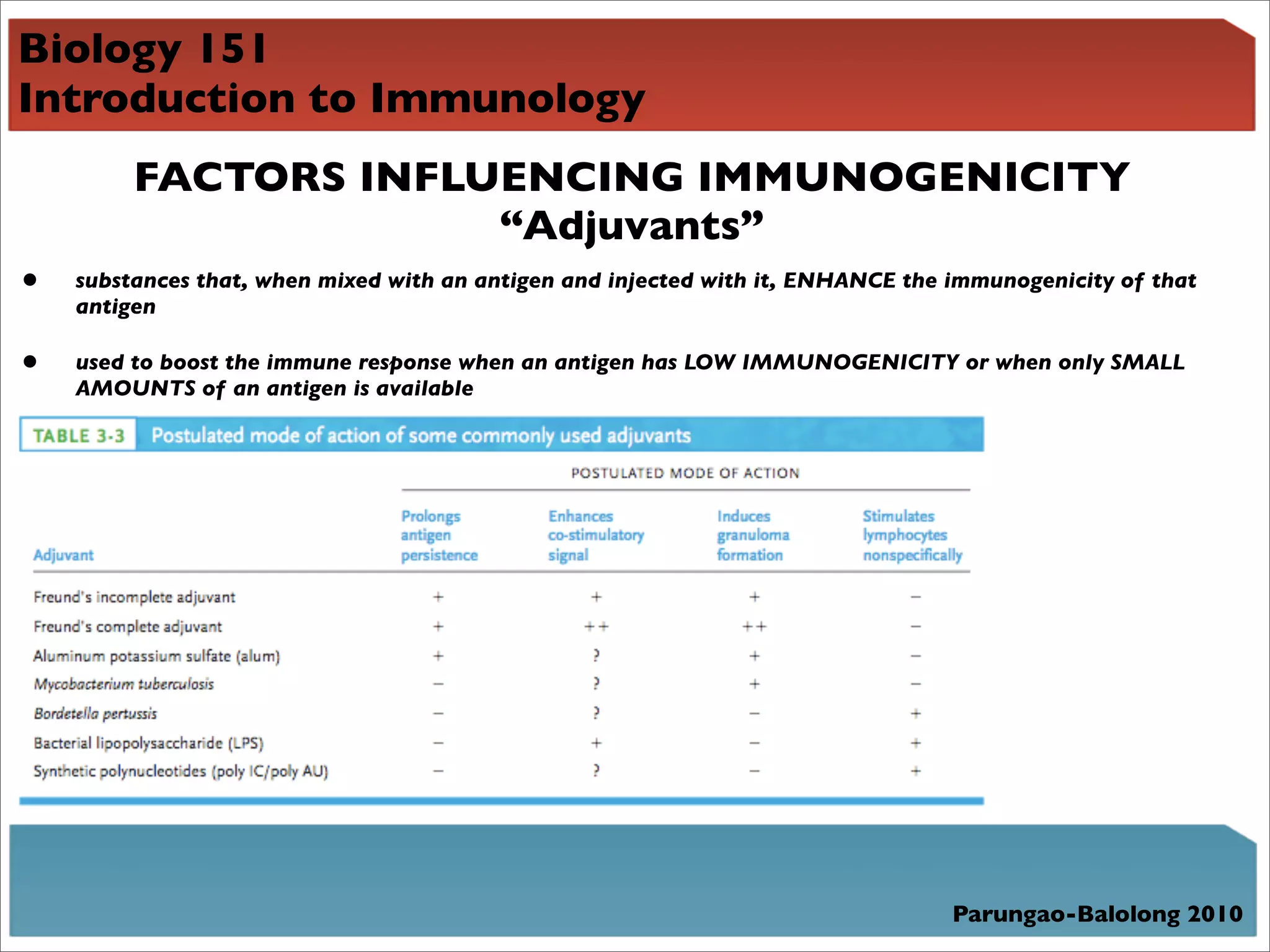
                      “Adjuvants”
•   substances that, when mixed with an antigen and injected with it, ENHANCE the immunogenicity of that
    antigen

•   used to boost the immune response when an antigen has LOW IMMUNOGENICITY or when only SMALL
    AMOUNTS of an antigen is available


                                                                                  Parungao-Balolong 2010
Biology 151
Introduction to Immunology
              HOW DO THEY DO THAT?
                    “Adjuvants”

• Stimulate a local, chronic inflammatory response that attracts both
    phagocytes and lymphocytes

• Infiltration of cells at the site of the adjuvant injection often results in
    formation of a dense, macrophage-rich mass of cells called a granuloma

   • activated granuloma enhances the activation of TH cells
• Other adjuvants
 • synthetic polyribonucleotides and 5-bacterial lipopolysaccharides
 • stimulate the nonspecific proliferation of lymphocytes and thus INCREASE
       THE LIKELIHOOD of antigen-induced clonal selection of lymphocytes


                                                                   Parungao-Balolong 2010
Biology 151
Introduction to Immunology
              HOW DO THEY DO THAT?
                    “Adjuvants”
• Aluminum potassium sulfate (alum) prolongs the persistence of antigen
 • When an antigen is mixed with alum, the salt precipitates the antigen
 • Injection of this alum precipitate results in a SLOWER RELEASE of
      antigen from the injection site, so that the effective time of exposure to
      the antigen increases

    • from a few days without adjuvant to several weeks with the adjuvant
• The alum precipitate also INCREASES THE SIZE of the antigen,thus
   increasing the likelihood of phagocytosis


                                                              Parungao-Balolong 2010
Biology 151
Introduction to Immunology
              HOW DO THEY DO THAT?
                    “Adjuvants”
• Water-in-oil adjuvants also prolong the persistence of antigen
• Example: Freund’s incomplete adjuvant
 • contains antigen in aqueous solution, mineral oil, and an
     emulsifying agent such as mannide monooleate

  • disperses the oil into small droplets surrounding the antigen
  • antigen is then RELEASED VERY SLOWLY from the site of injection
  • Based on Freund’s complete adjuvant


                                                       Parungao-Balolong 2010
Biology 151
Introduction to Immunology
              HOW DO THEY DO THAT?
                    “Adjuvants”

• Water-in-oil adjuvants also prolong the persistence of antigen
• Example: Freund’s complete adjuvant
 • first deliberately formulated highly effective adjuvant
 • contain heat-killed Mycobacteria as an additional ingredient
 • Muramyl dipeptide,a component of the mycobacterial cell
     wall,ACTIVATES macrophages

• THUS: Far more POTENT than the incomplete form

                                                      Parungao-Balolong 2010
Biology 151
Introduction to Immunology
              HOW DO THEY DO THAT?
                    “Adjuvants”

• Far more POTENT than the incomplete form......
 • WHY? : Activated macrophages are MORE PHAGOCYTIC than
    inactivated macrophages

  • WHY? : express HIGHER LEVELS of class II MHC molecules and the
    membrane molecules of the B7 family

  • WHY? : increased expression of class II MHC INCREASES ABILITY of the
    antigen-presenting cell to present antigen to TH cells

  • WHY? : antigen presentation are INCREASED in the presence of
    adjuvant


                                                             Parungao-Balolong 2010
Biology 151
Introduction to Immunology


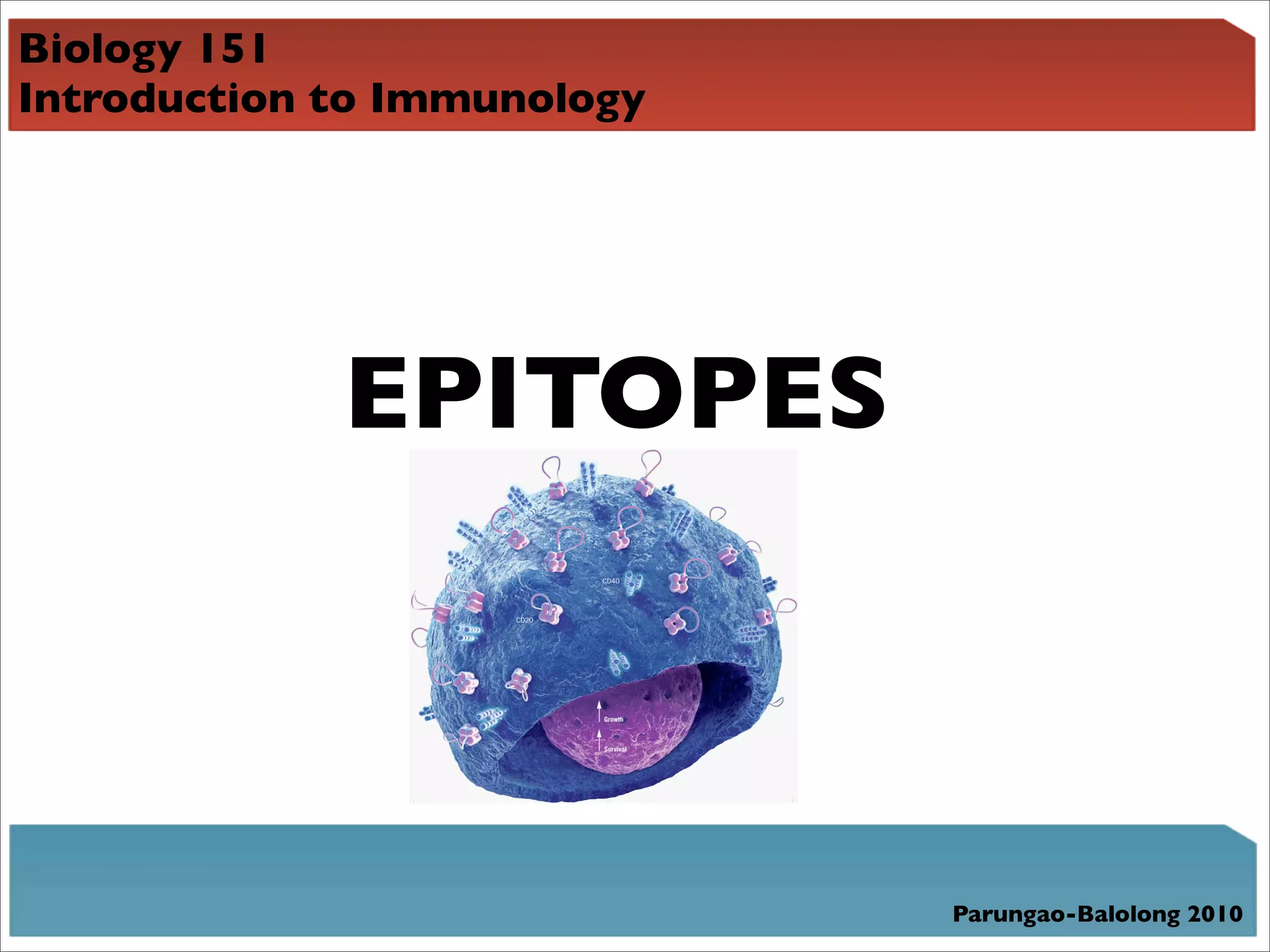
             EPITOPES


                             Parungao-Balolong 2010
Biology 151
Introduction to Immunology
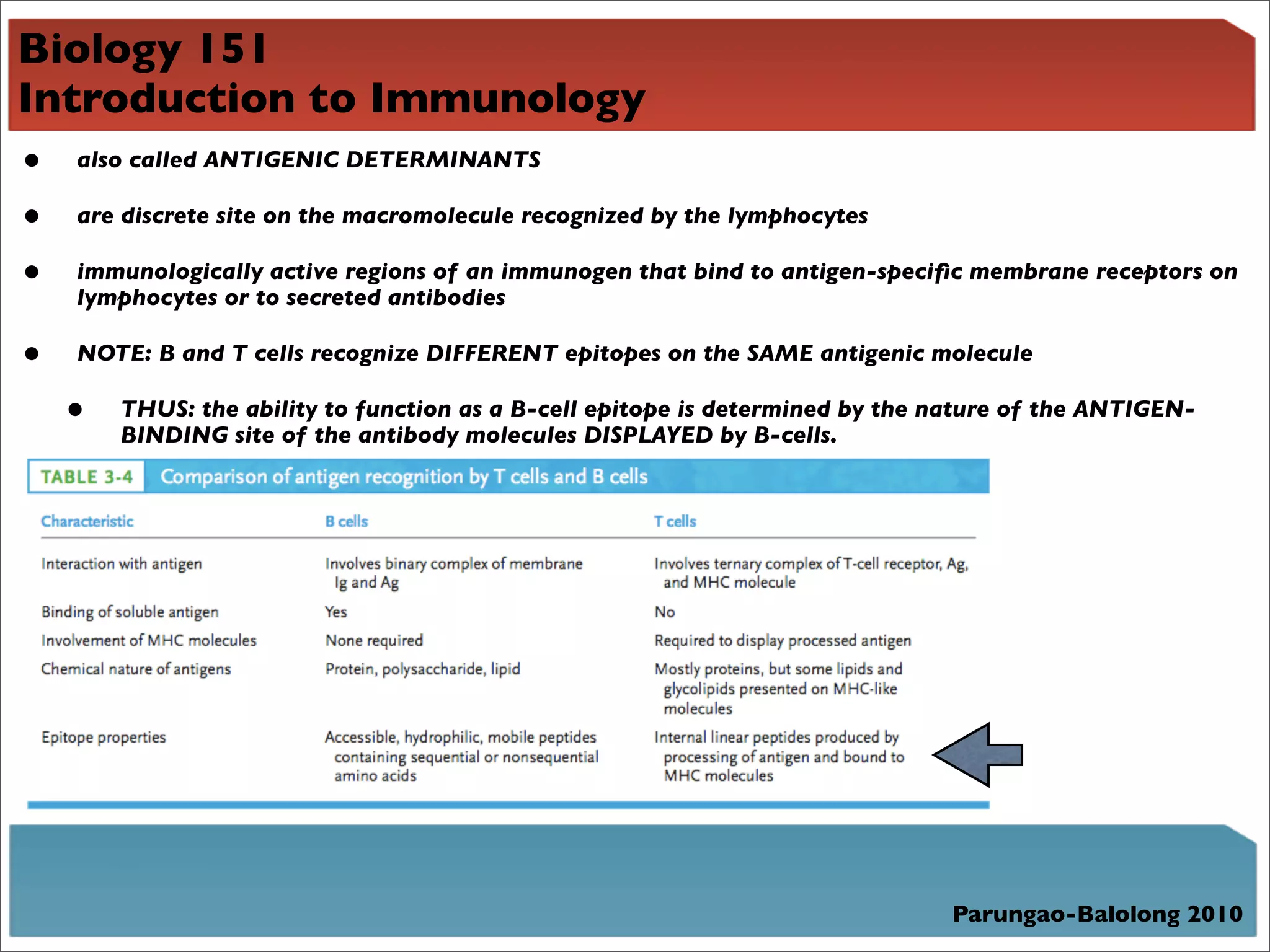
•   also called ANTIGENIC DETERMINANTS

•   are discrete site on the macromolecule recognized by the lymphocytes

•   immunologically active regions of an immunogen that bind to antigen-specific membrane receptors on
    lymphocytes or to secreted antibodies

•   NOTE: B and T cells recognize DIFFERENT epitopes on the SAME antigenic molecule

    •   THUS: the ability to function as a B-cell epitope is determined by the nature of the ANTIGEN-
        BINDING site of the antibody molecules DISPLAYED by B-cells.


                                                                               Parungao-Balolong 2010
Biology 151
Introduction to Immunology


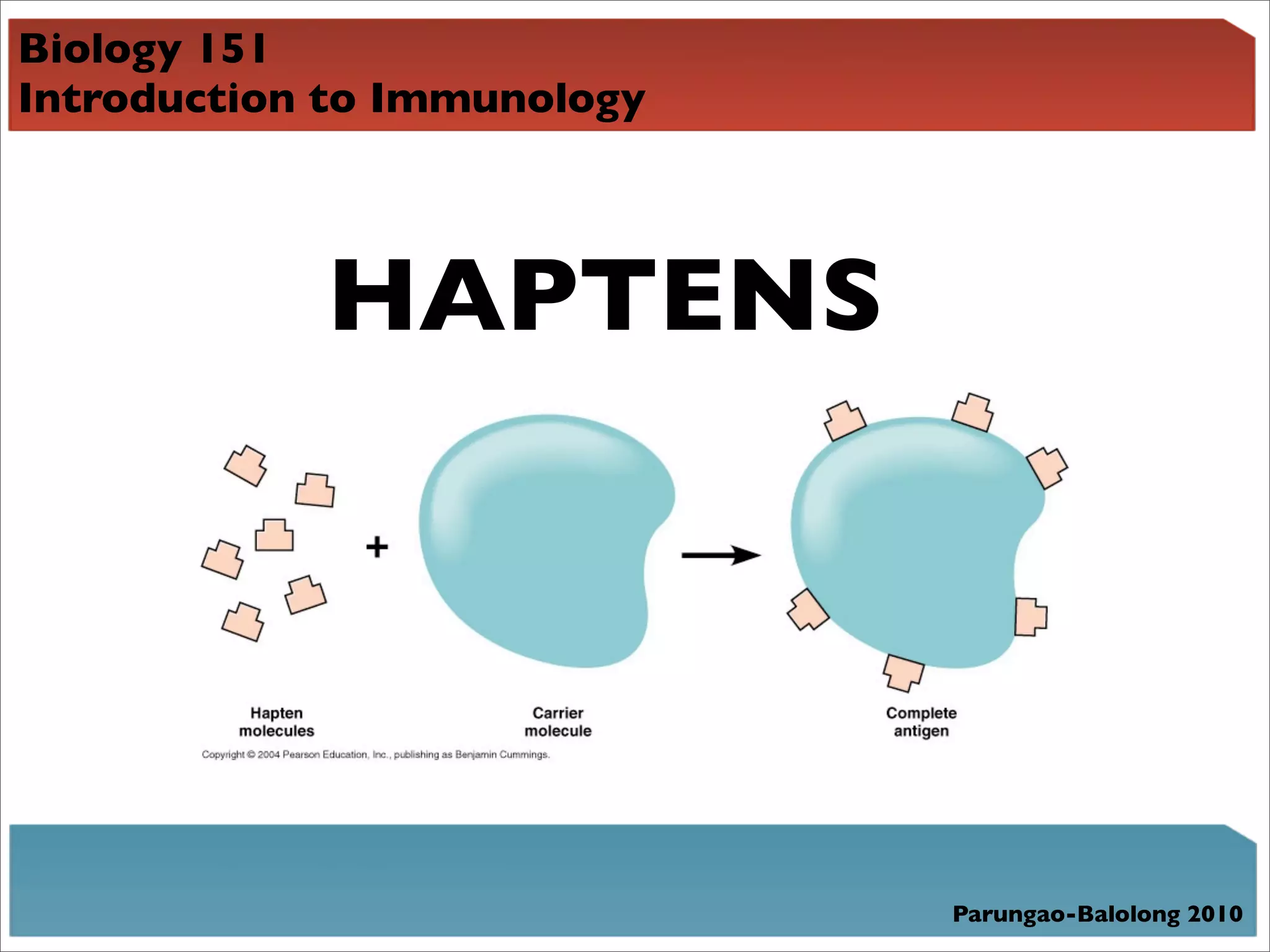
            HAPTENS


                             Parungao-Balolong 2010
Biology 151
Introduction to Immunology
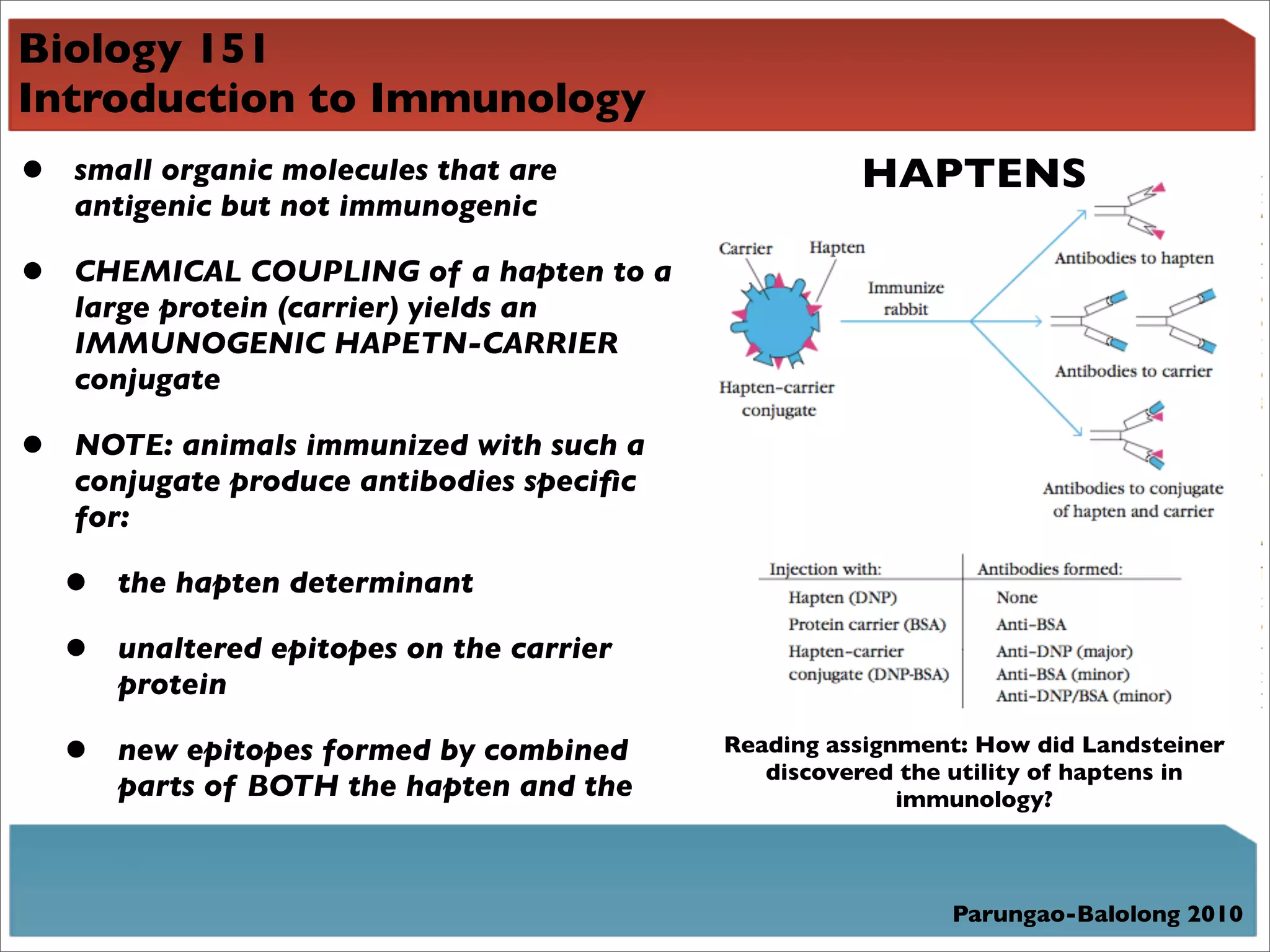
•   small organic molecules that are                  HAPTENS
    antigenic but not immunogenic

•   CHEMICAL COUPLING of a hapten to a
    large protein (carrier) yields an
    IMMUNOGENIC HAPETN-CARRIER
    conjugate

•   NOTE: animals immunized with such a
    conjugate produce antibodies specific
    for:

    •   the hapten determinant

    •   unaltered epitopes on the carrier
        protein

    •   new epitopes formed by combined     Reading assignment: How did Landsteiner
                                               discovered the utility of haptens in
        parts of BOTH the hapten and the                  immunology?


                                                             Parungao-Balolong 2010
Biology 151
Introduction to Immunology


         PATTERN
       RECOGNITION
        RECEPTORS


                             Parungao-Balolong 2010
Biology 151
Introduction to Immunology

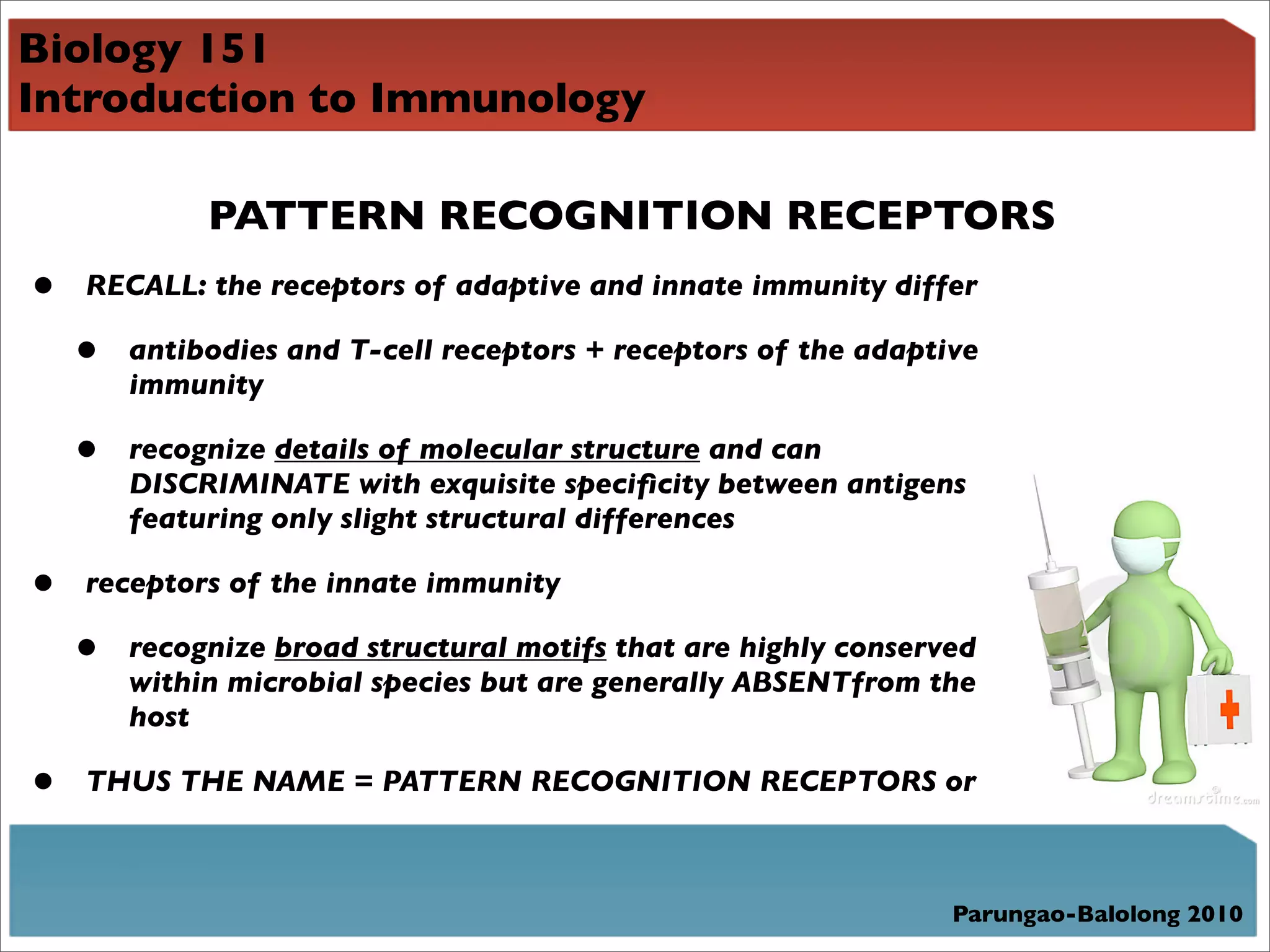
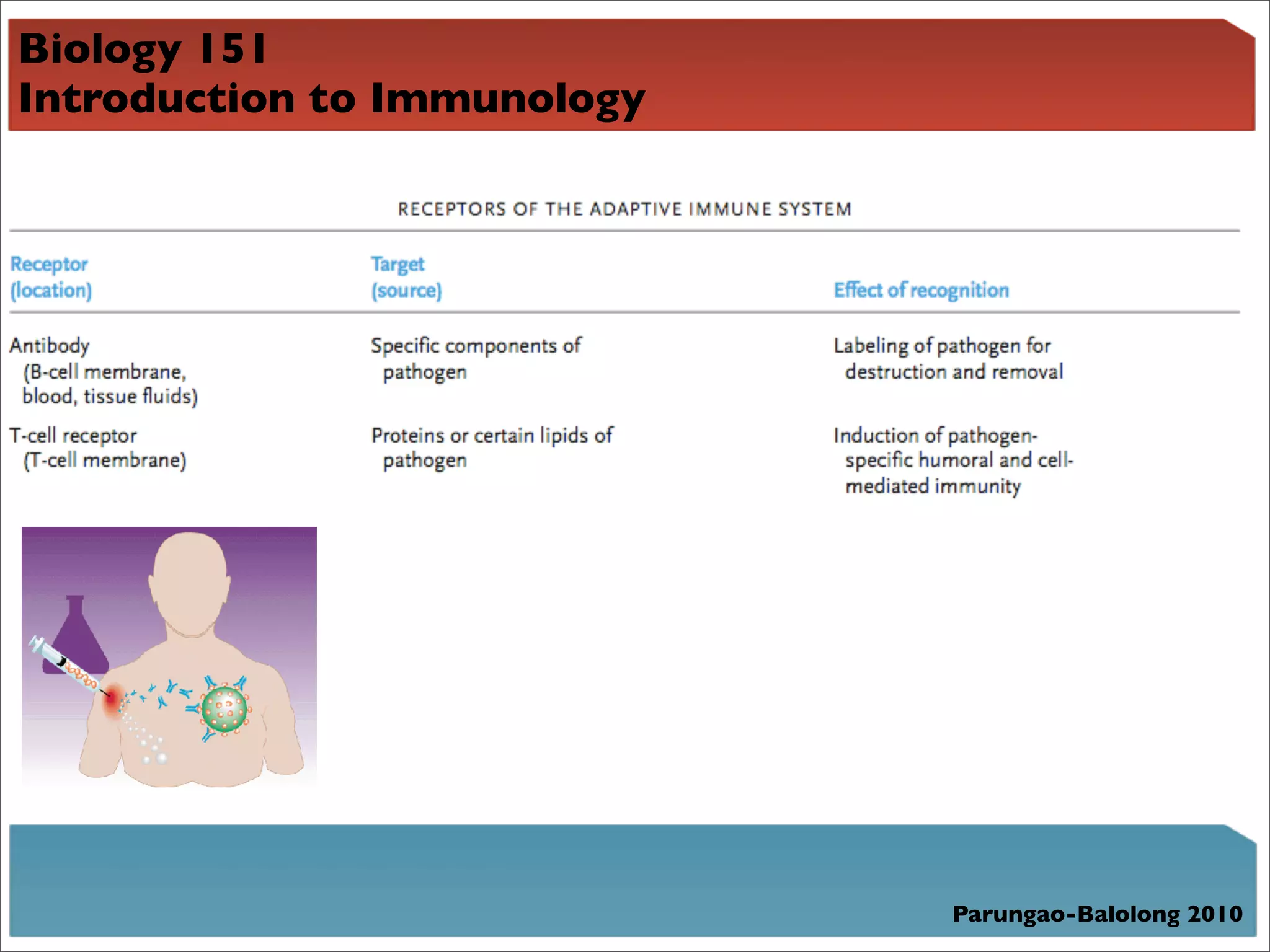
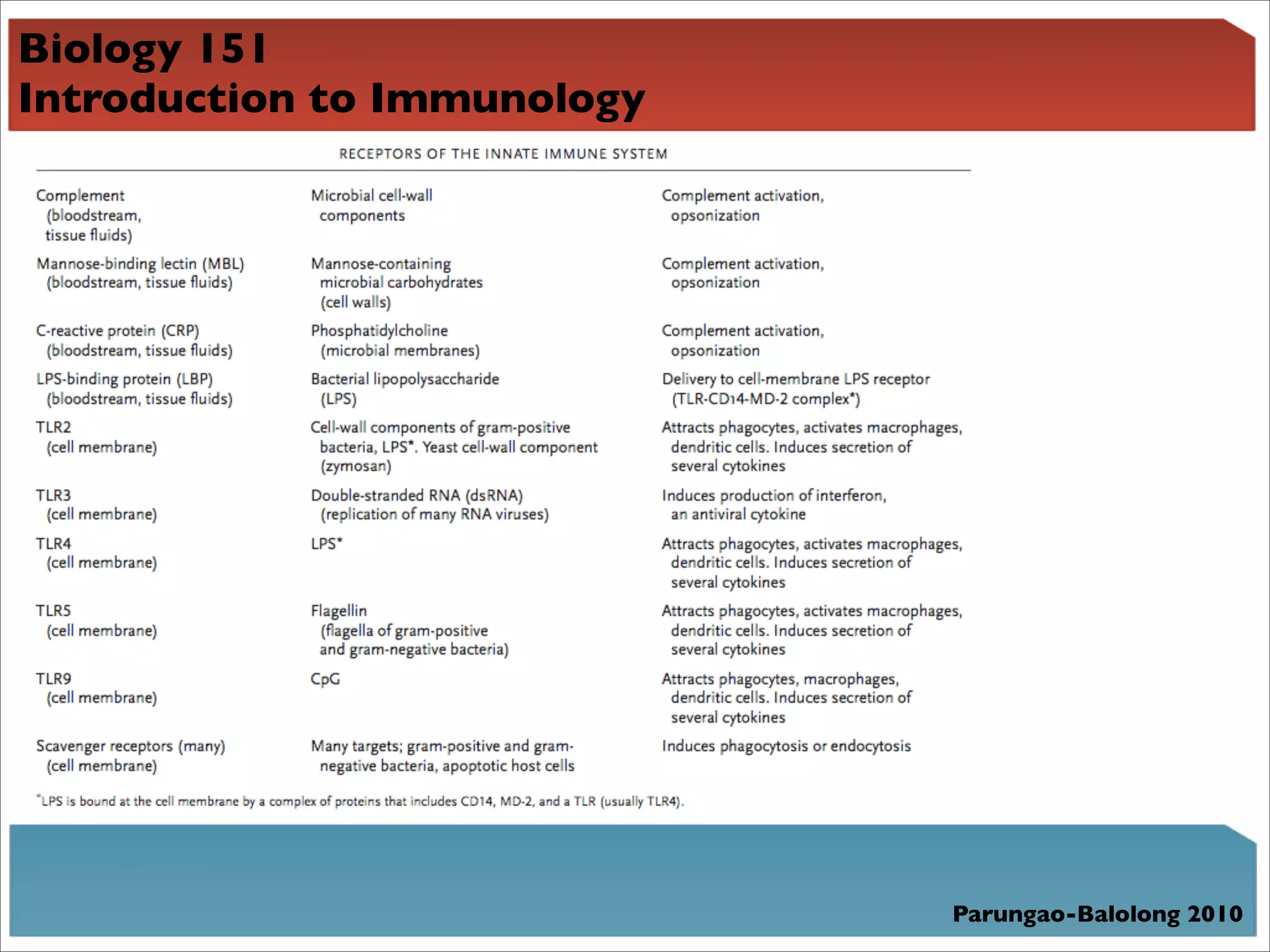
             PATTERN RECOGNITION RECEPTORS
•   RECALL: the receptors of adaptive and innate immunity differ

    •   antibodies and T-cell receptors + receptors of the adaptive
        immunity

    •   recognize details of molecular structure and can
        DISCRIMINATE with exquisite specificity between antigens
        featuring only slight structural differences

•   receptors of the innate immunity

    •   recognize broad structural motifs that are highly conserved
        within microbial species but are generally ABSENTfrom the
        host

•   THUS THE NAME = PATTERN RECOGNITION RECEPTORS or


                                                                 Parungao-Balolong 2010
Biology 151
Introduction to Immunology

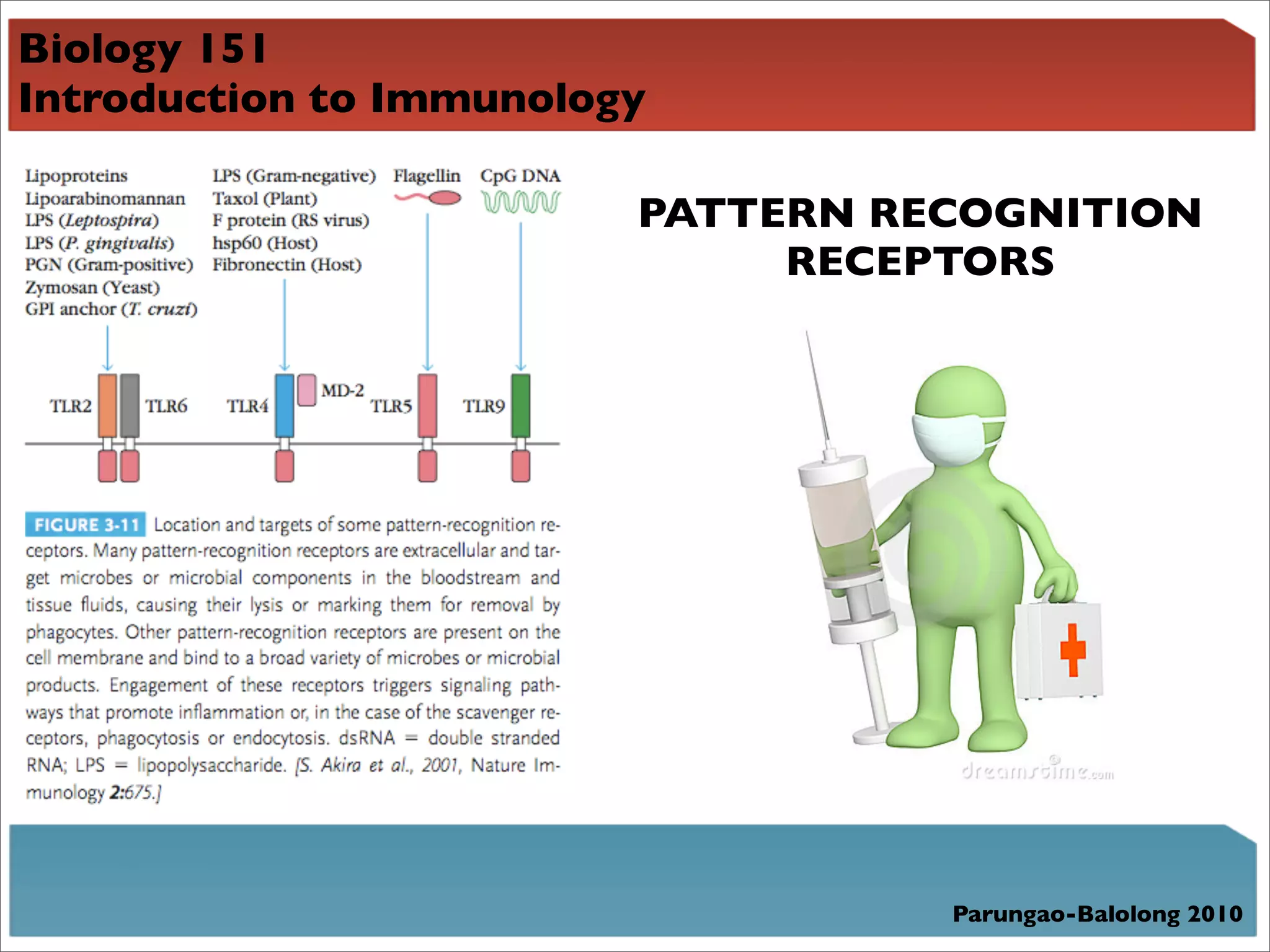
                         PATTERN RECOGNITION
                              RECEPTORS


                                   Parungao-Balolong 2010
Biology 151
Introduction to Immunology


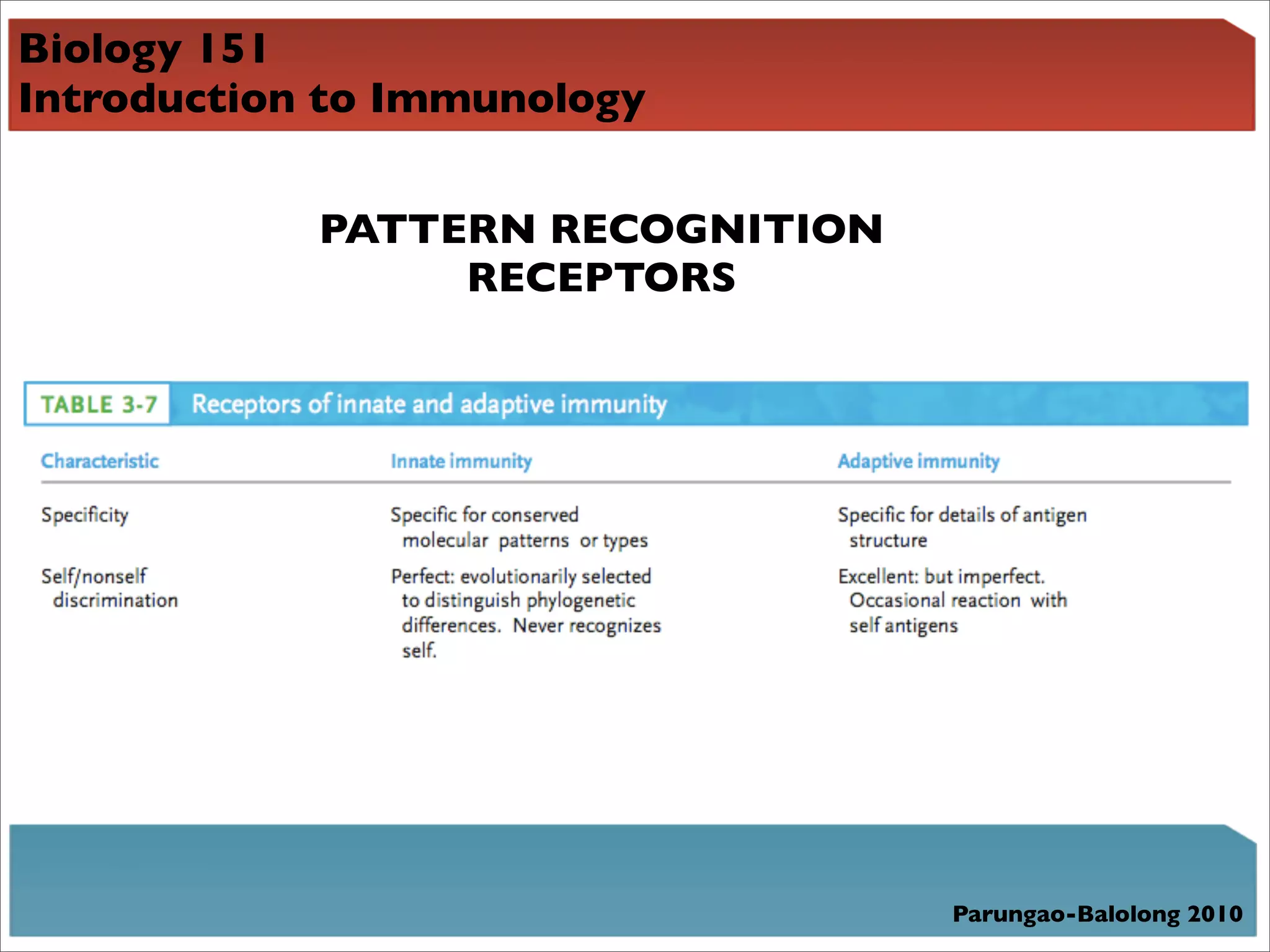
            PATTERN RECOGNITION
                 RECEPTORS


                                  Parungao-Balolong 2010
Biology 151
Introduction to Immunology


                             Parungao-Balolong 2010
Biology 151
Introduction to Immunology


                             Parungao-Balolong 2010
Biology 151
Introduction to Immunology


           ARE YOU
         ALLERGIC TO
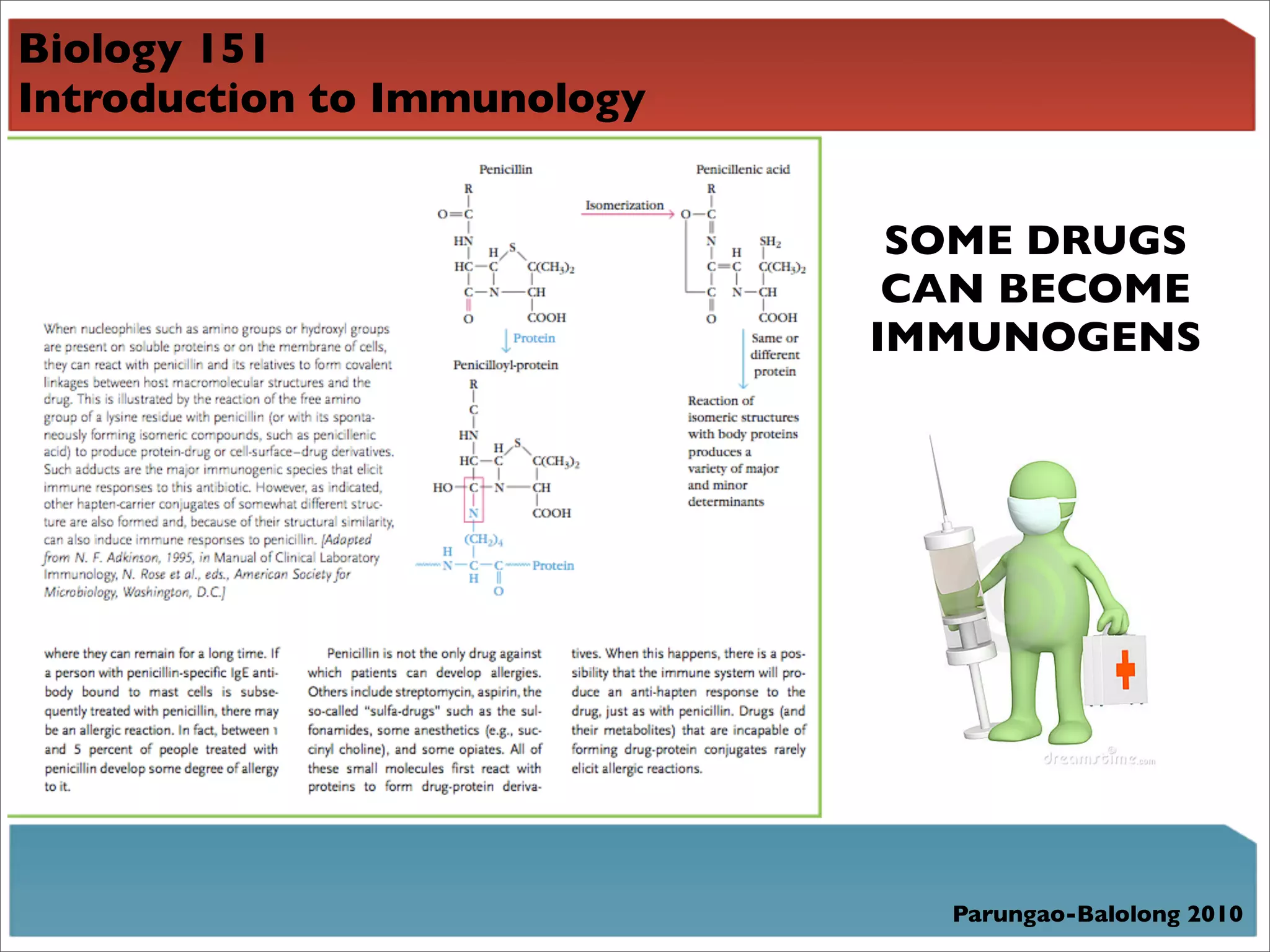
         SOME DRUGS?


                             Parungao-Balolong 2010
Biology 151
Introduction to Immunology


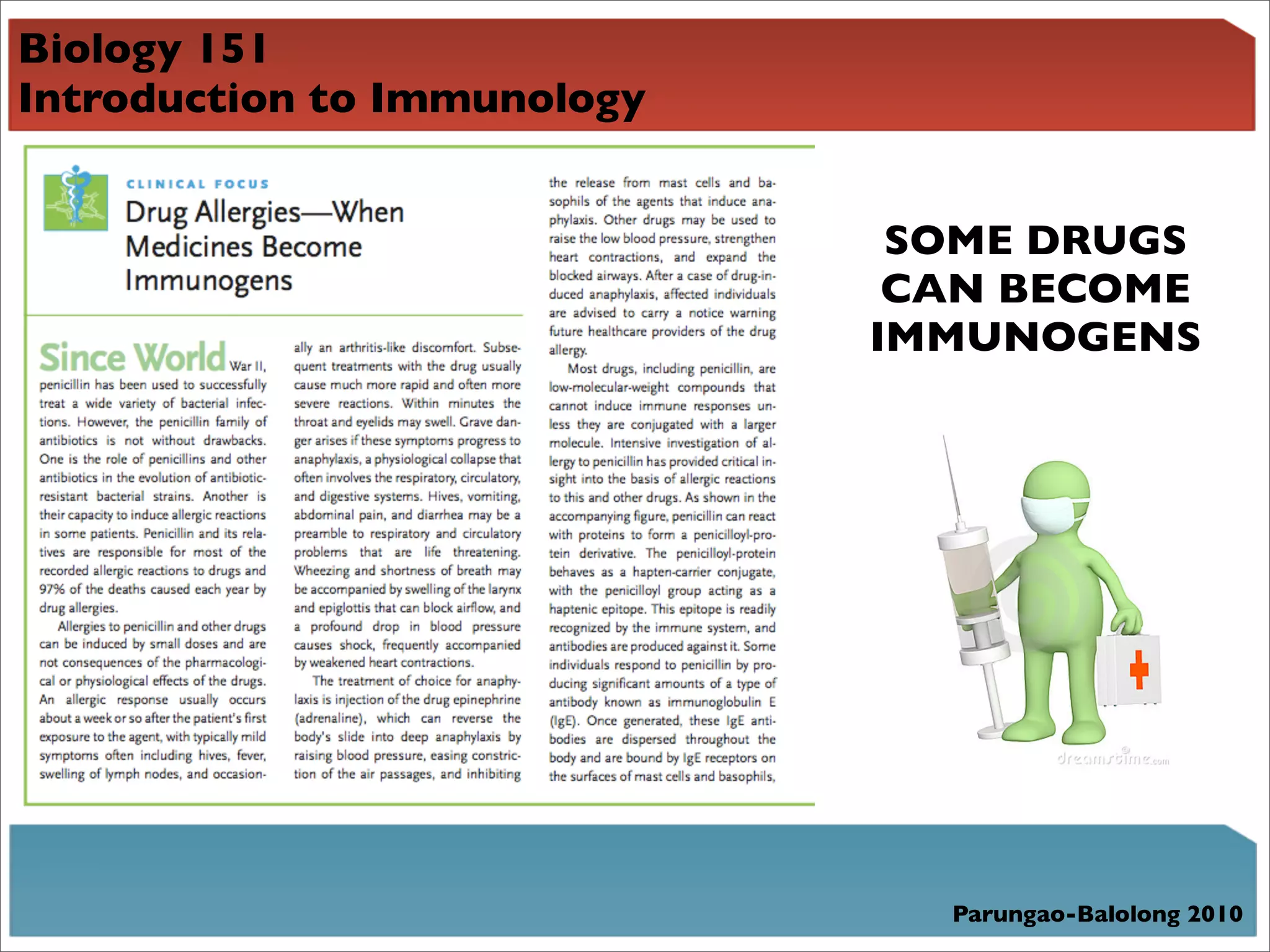
                              SOME DRUGS
                              CAN BECOME
                             IMMUNOGENS


                               Parungao-Balolong 2010
Biology 151
Introduction to Immunology


                              SOME DRUGS
                              CAN BECOME
                             IMMUNOGENS


                               Parungao-Balolong 2010
Biology 151
Introduction to Immunology


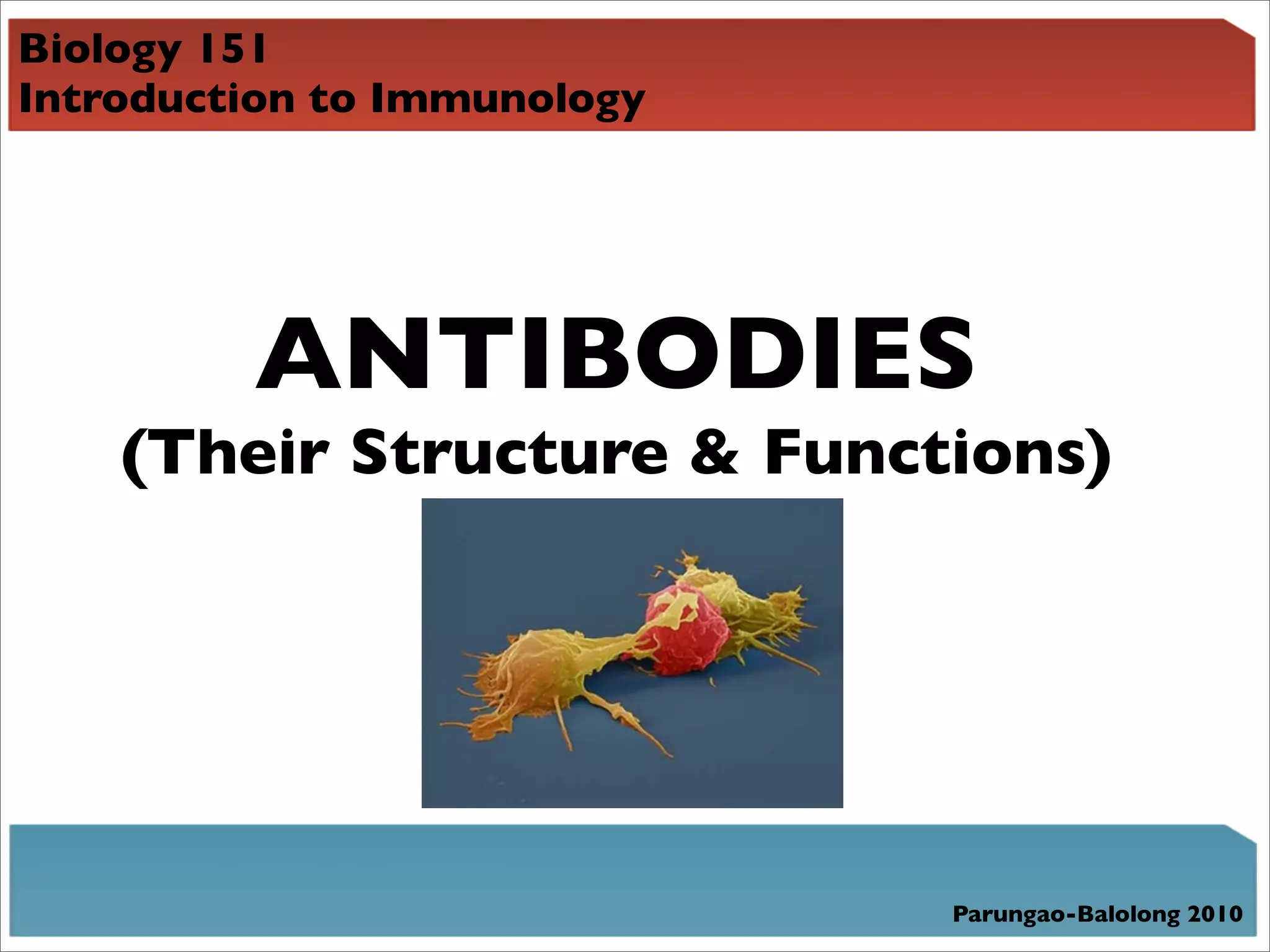
         ANTIBODIES
    (Their Structure & Functions)


                             Parungao-Balolong 2010
Biology 151
Introduction to Immunology

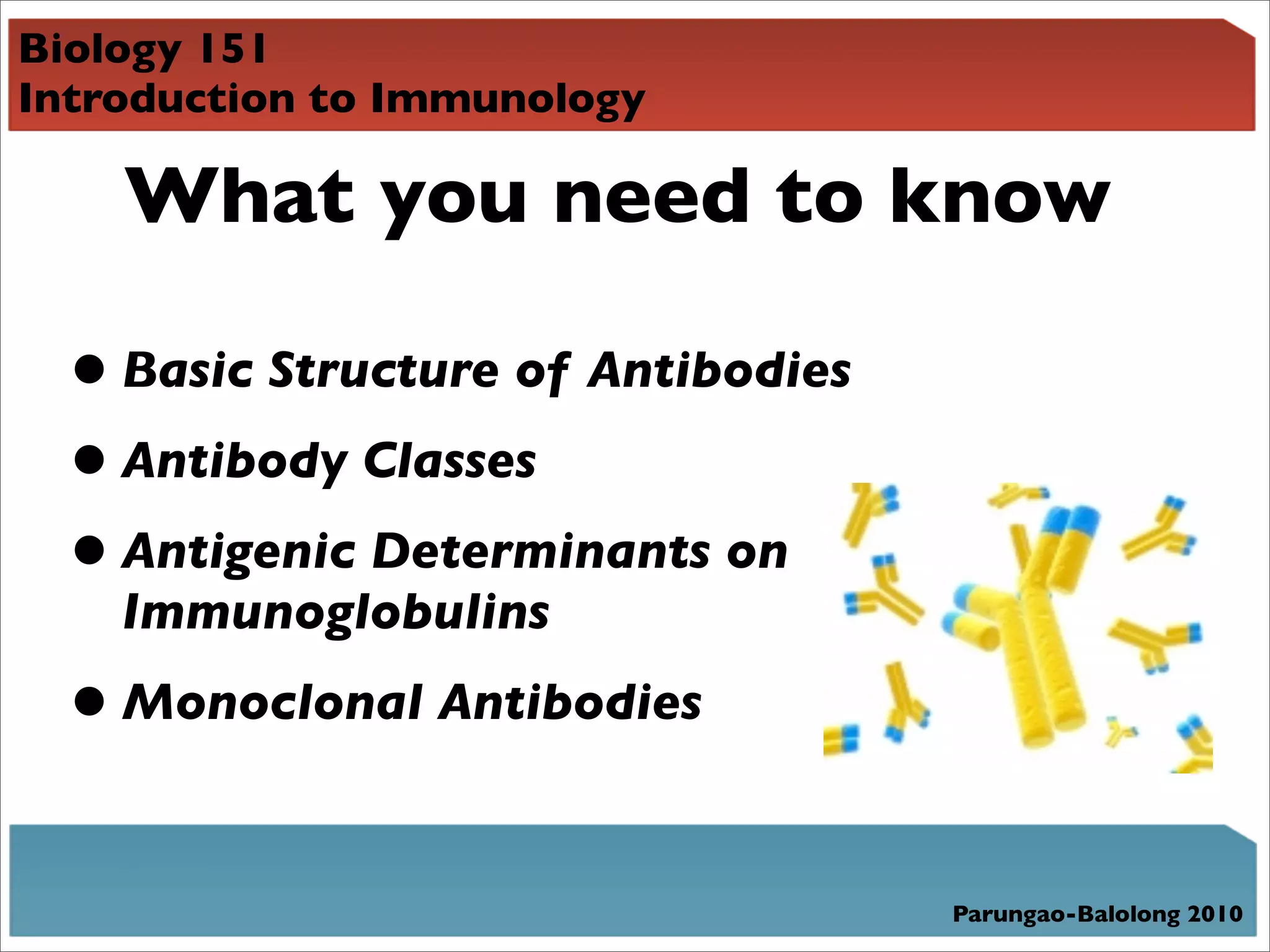
    What you need to know

  • Basic Structure of Antibodies
  • Antibody Classes
  • Antigenic Determinants on
    Immunoglobulins
  • Monoclonal Antibodies

                                    Parungao-Balolong 2010
Biology 151
Introduction to Immunology

BASIC STRUCTURE OF ANTIBODIES
  • Antibodies : antigen-binding proteins present on
    the B-cell membrane and secreted by plasma cells

  • when bound confers antigenic specificity on B-cells
  • Common to all antibodies:
   • structural features
   • binds to antigen
   • participate in effector function
                                          Parungao-Balolong 2010
Biology 151
Introduction to Immunology

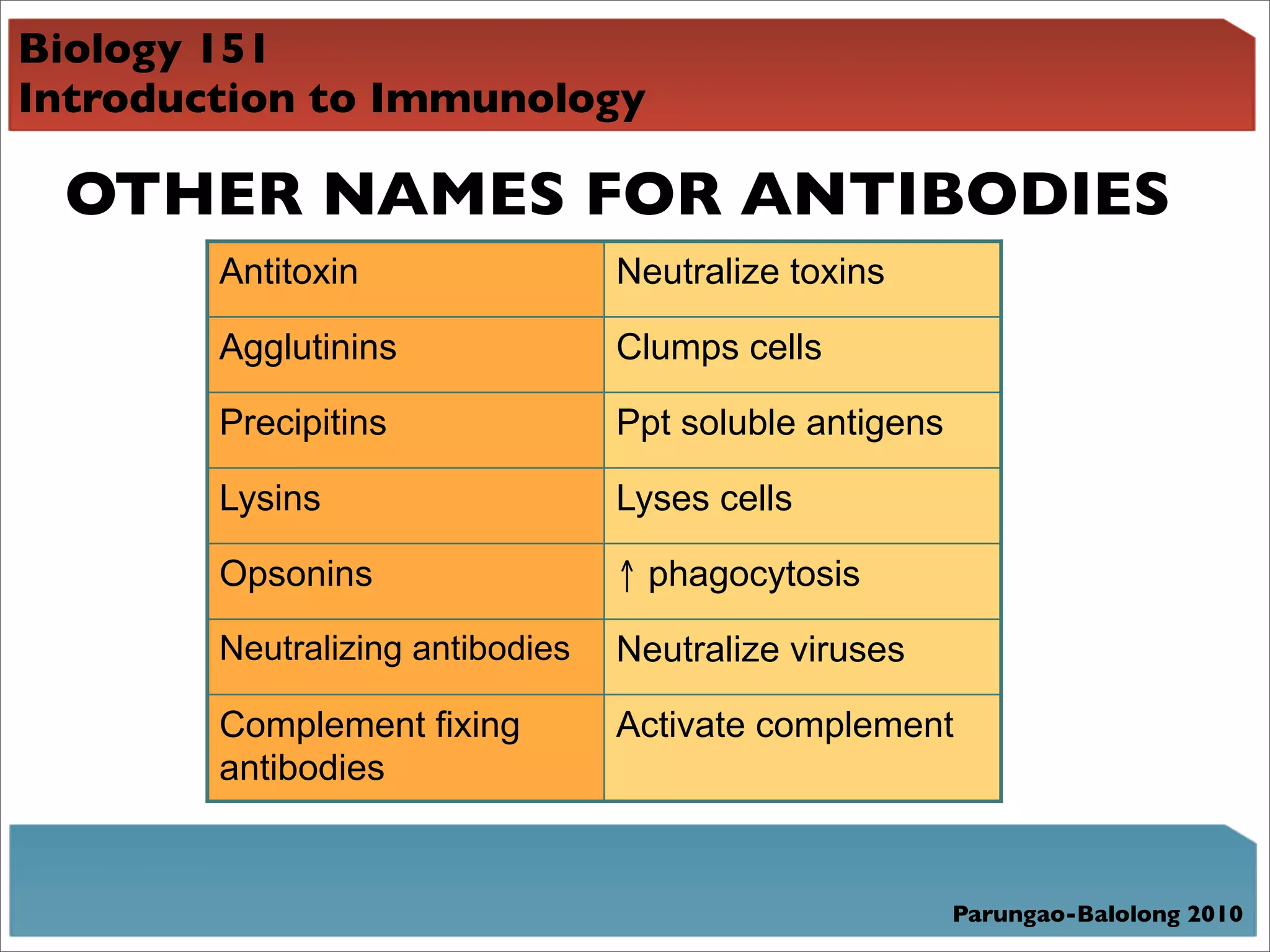
 OTHER NAMES FOR ANTIBODIES
        Antitoxin                 Neutralize toxins

        Agglutinins               Clumps cells

        Precipitins               Ppt soluble antigens

        Lysins                    Lyses cells

        Opsonins                  ! phagocytosis

        Neutralizing antibodies   Neutralize viruses

        Complement fixing         Activate complement
        antibodies


                                                         Parungao-Balolong 2010
Biology 151
Introduction to Immunology
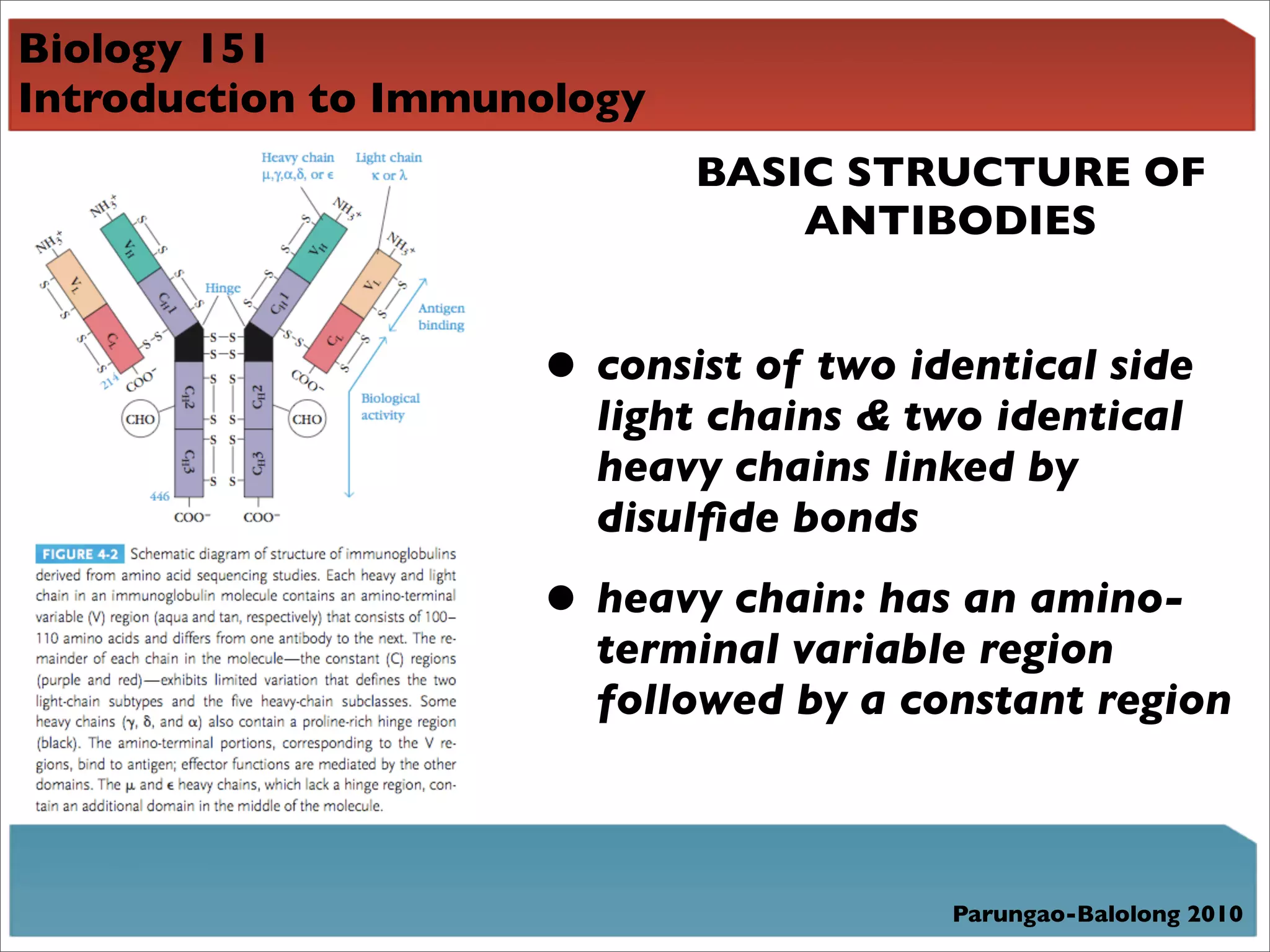
                             BASIC STRUCTURE OF
                                 ANTIBODIES


                     • consist of two identical side
                       light chains & two identical
                       heavy chains linked by
                       disulfide bonds

                     • heavy chain: has an amino-
                       terminal variable region
                       followed by a constant region


                                        Parungao-Balolong 2010
Biology 151
Introduction to Immunology

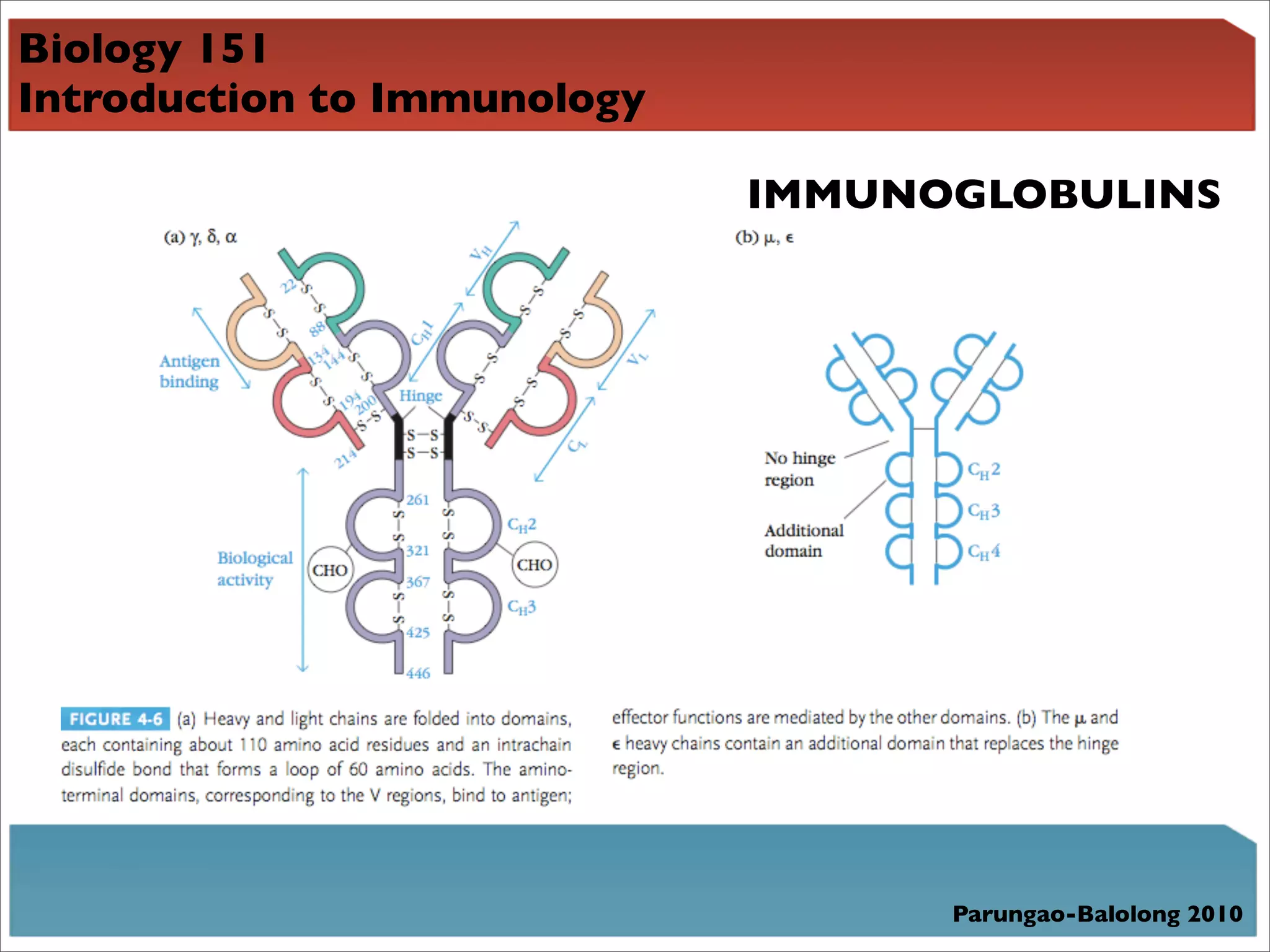
                             IMMUNOGLOBULINS


                                   Parungao-Balolong 2010
Biology 151
Introduction to Immunology

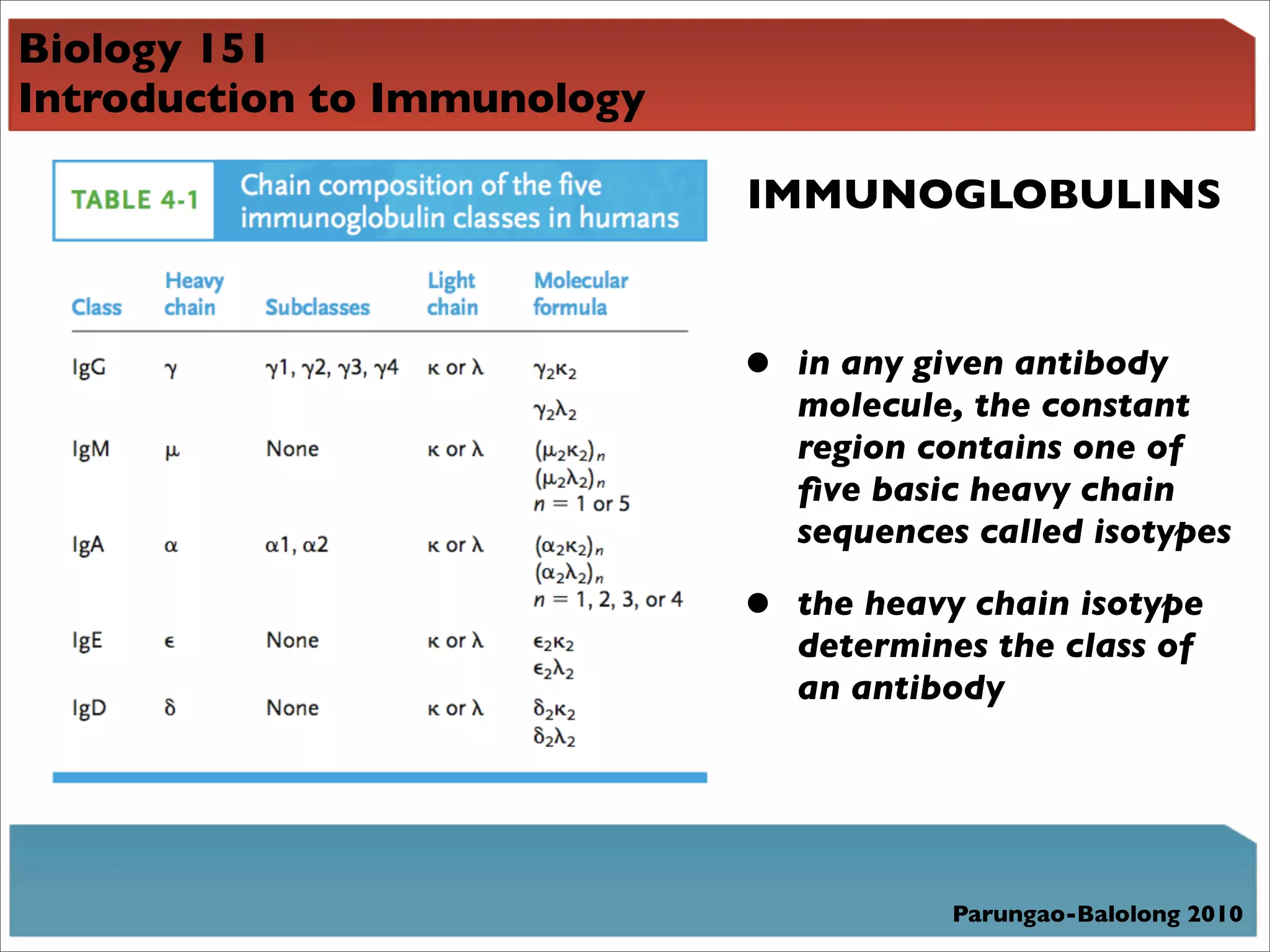
                             IMMUNOGLOBULINS


                             •   in any given antibody
                                 molecule, the constant
                                 region contains one of
                                 five basic heavy chain
                                 sequences called isotypes

                             •   the heavy chain isotype
                                 determines the class of
                                 an antibody


                                         Parungao-Balolong 2010
Biology 151
Introduction to Immunology
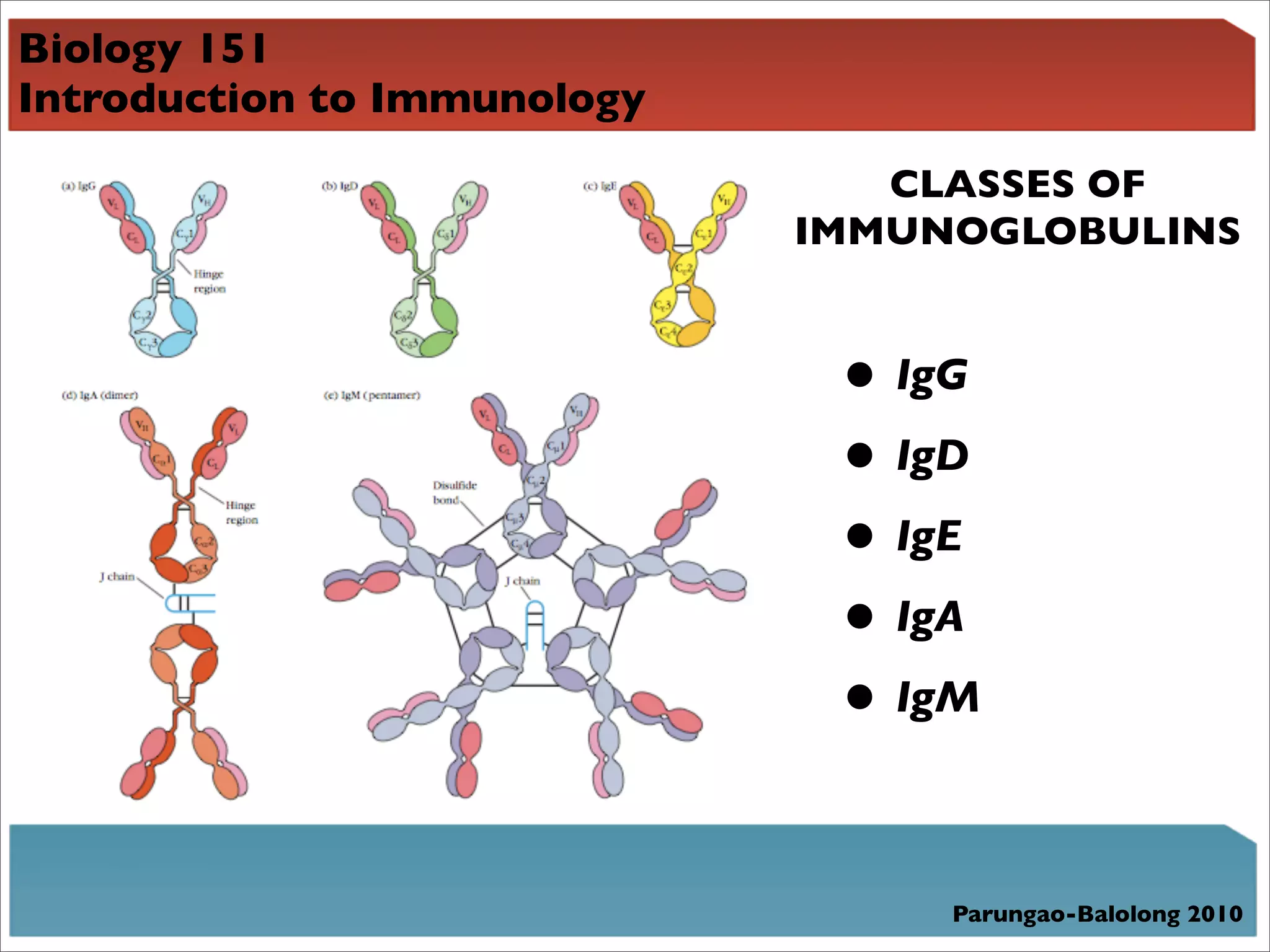
                                CLASSES OF
                             IMMUNOGLOBULINS


                              • IgG
                              • IgD
                              • IgE
                              • IgA
                              • IgM

                                  Parungao-Balolong 2010
Biology 151
Introduction to Immunology


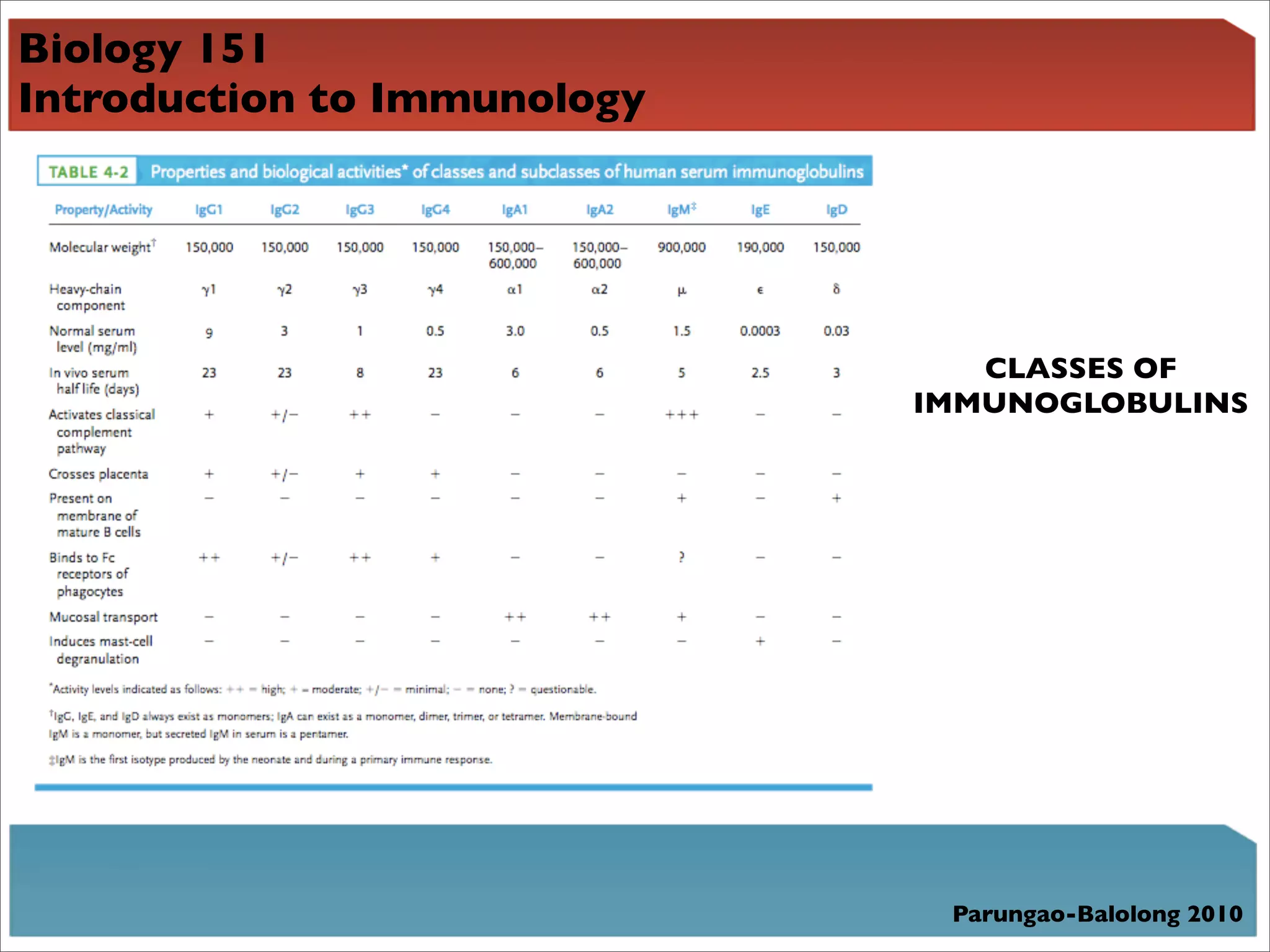
                                CLASSES OF
                             IMMUNOGLOBULINS


                              Parungao-Balolong 2010
Biology 151
Introduction to Immunology


                             Parungao-Balolong 2010
Biology 151
Introduction to Immunology

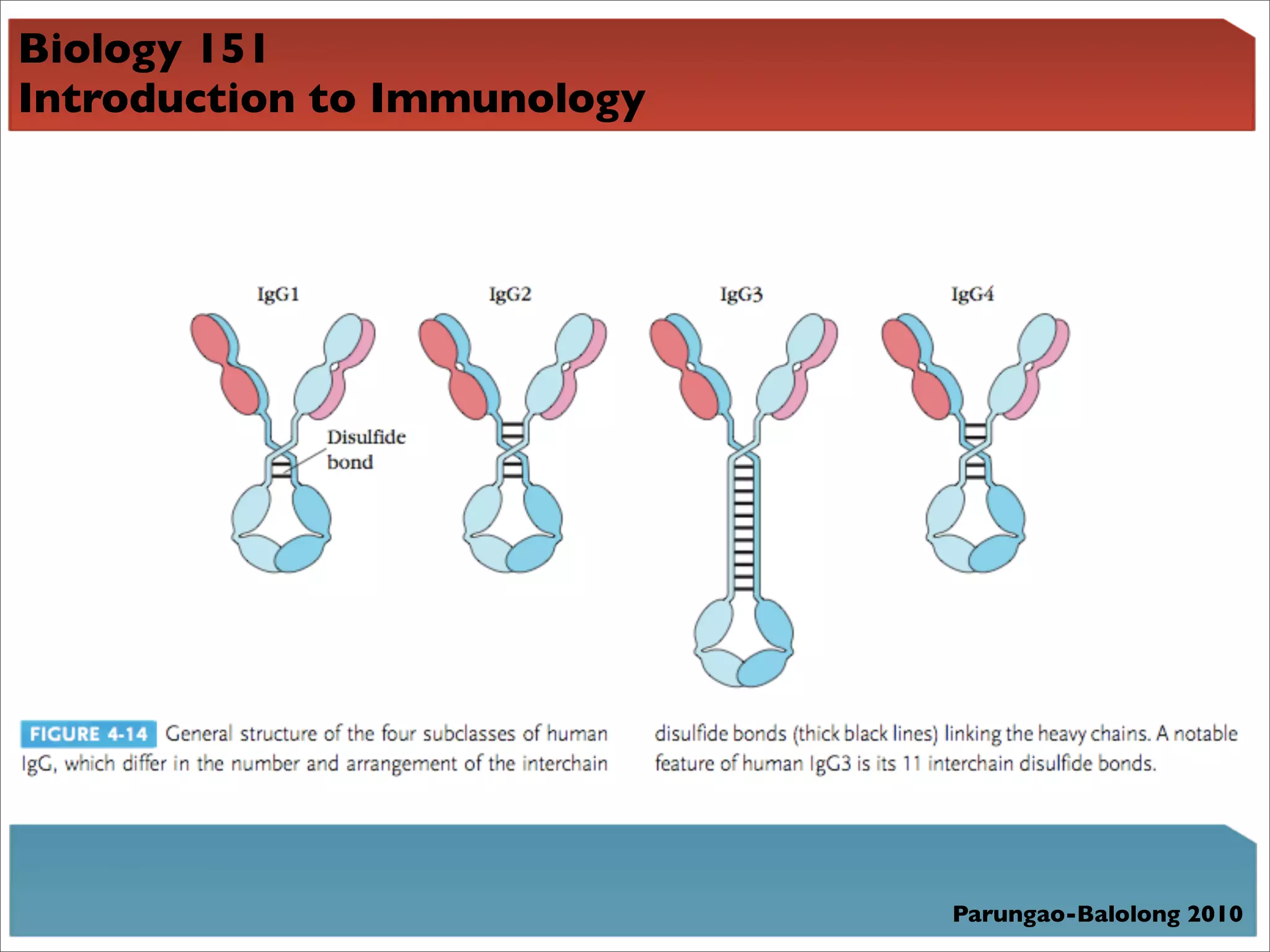
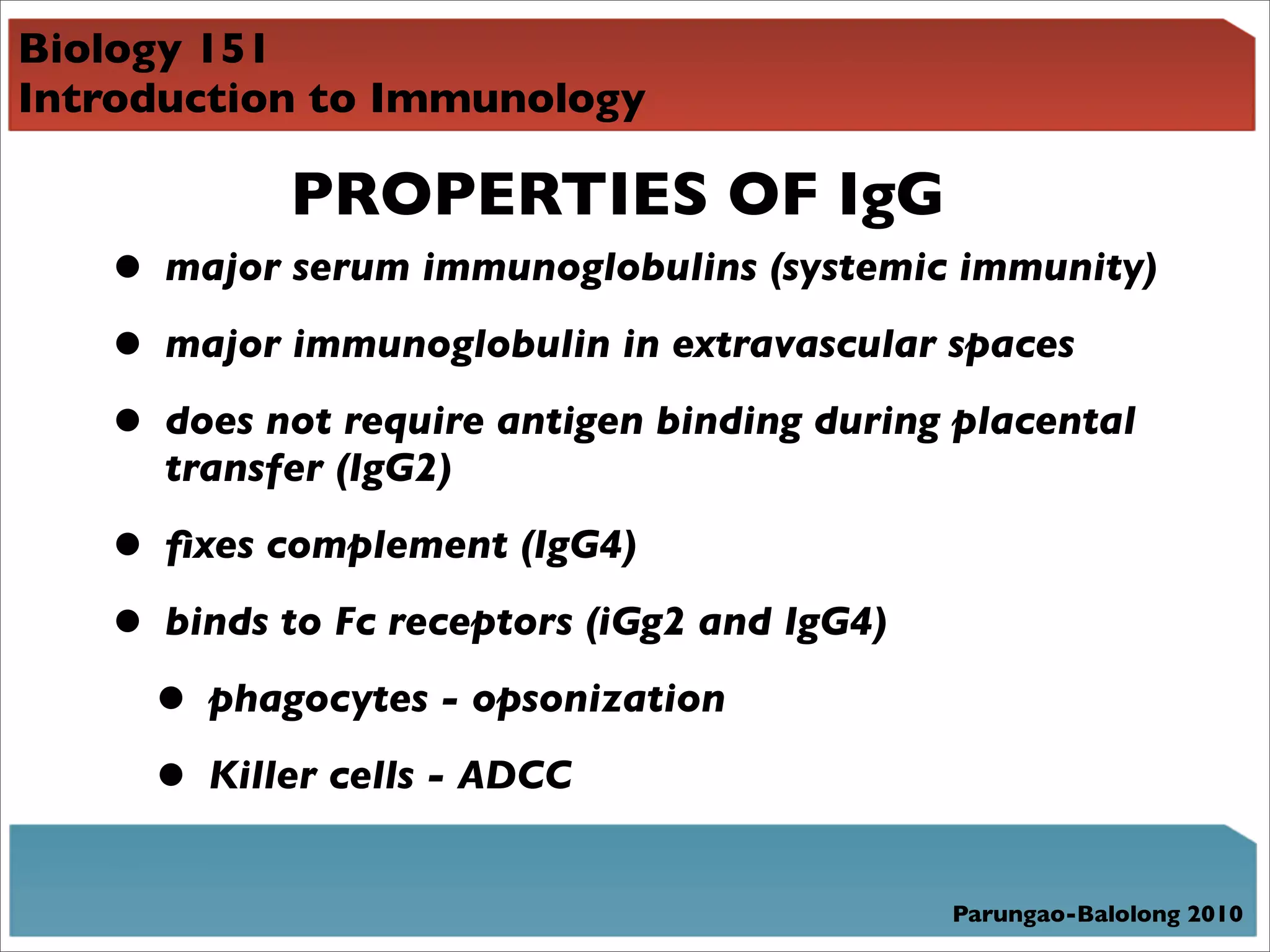
            PROPERTIES OF IgG
   • major serum immunoglobulins (systemic immunity)
   • major immunoglobulin in extravascular spaces
   • does not require antigen binding during placental
      transfer (IgG2)

   • fixes complement (IgG4)
   • binds to Fc receptors (iGg2 and IgG4)
    • phagocytes - opsonization
    • Killer cells - ADCC
                                             Parungao-Balolong 2010
Biology 151
Introduction to Immunology

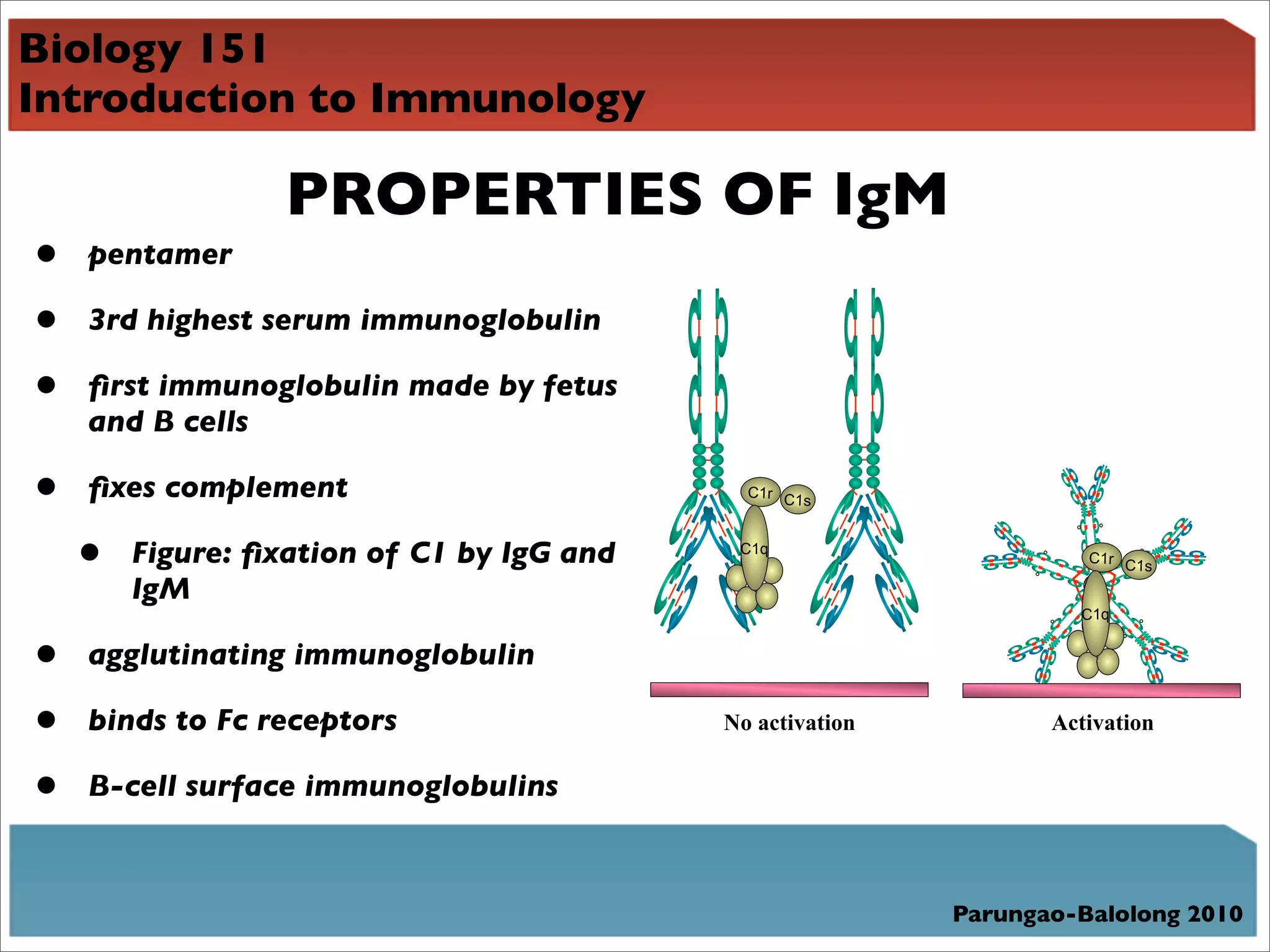
                  PROPERTIES OF IgM
•   pentamer

•   3rd highest serum immunoglobulin

•   first immunoglobulin made by fetus
    and B cells

•   fixes complement                          C1r C1
                                                    s


    •   Figure: fixation of C1 by IgG and    C1q
                                                                     C1r C1
                                                                            s
        IgM
                                                                    C1q


•   agglutinating immunoglobulin

•   binds to Fc receptors                  No activation          Activation


•   B-cell surface immunoglobulins


                                                           Parungao-Balolong 2010
Biology 151
Introduction to Immunology


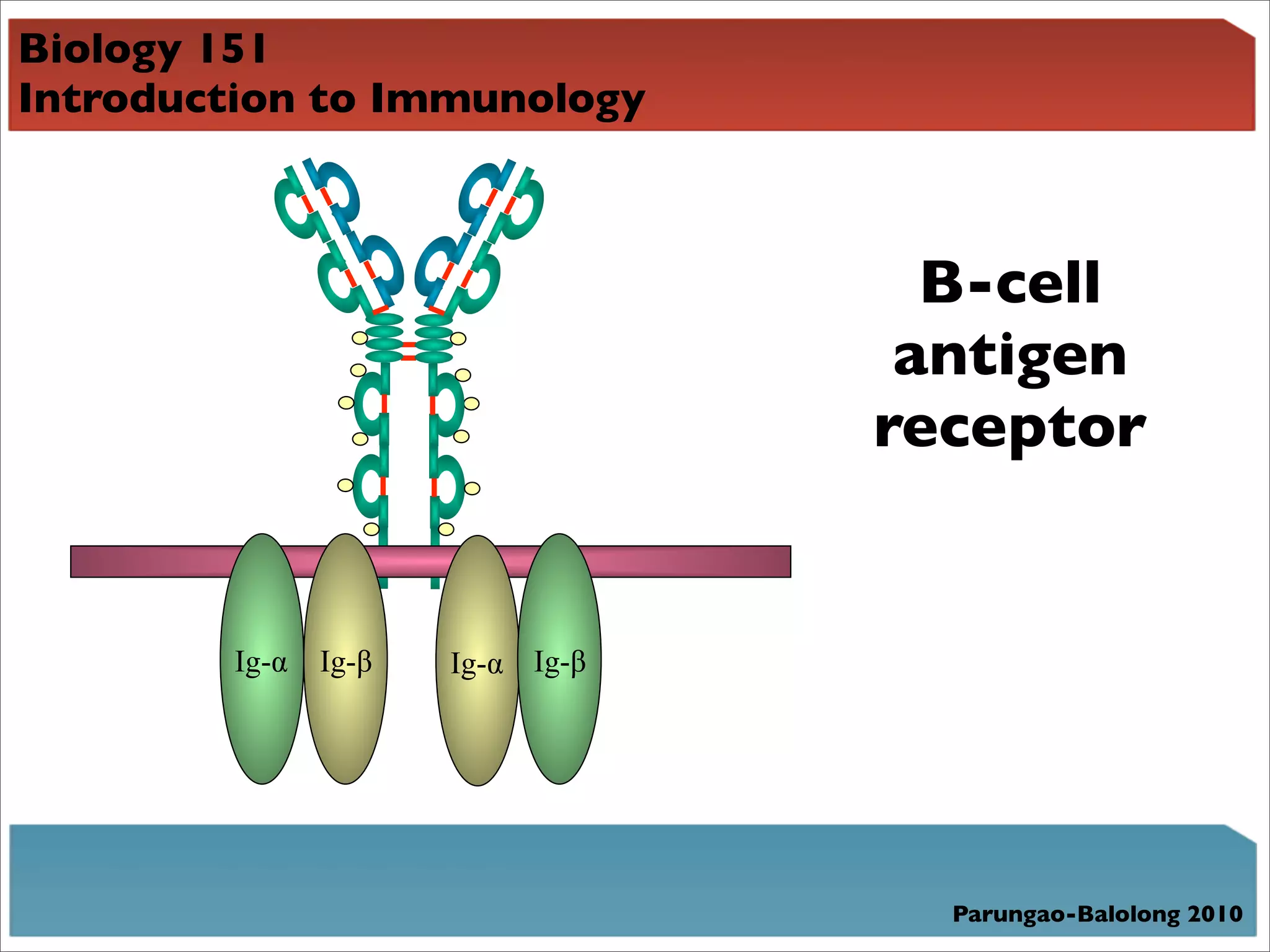
                                    B-cell
                                   antigen
                                  receptor


        Ig-!   Ig-"   Ig-! Ig-"


                                    Parungao-Balolong 2010
Biology 151
Introduction to Immunology

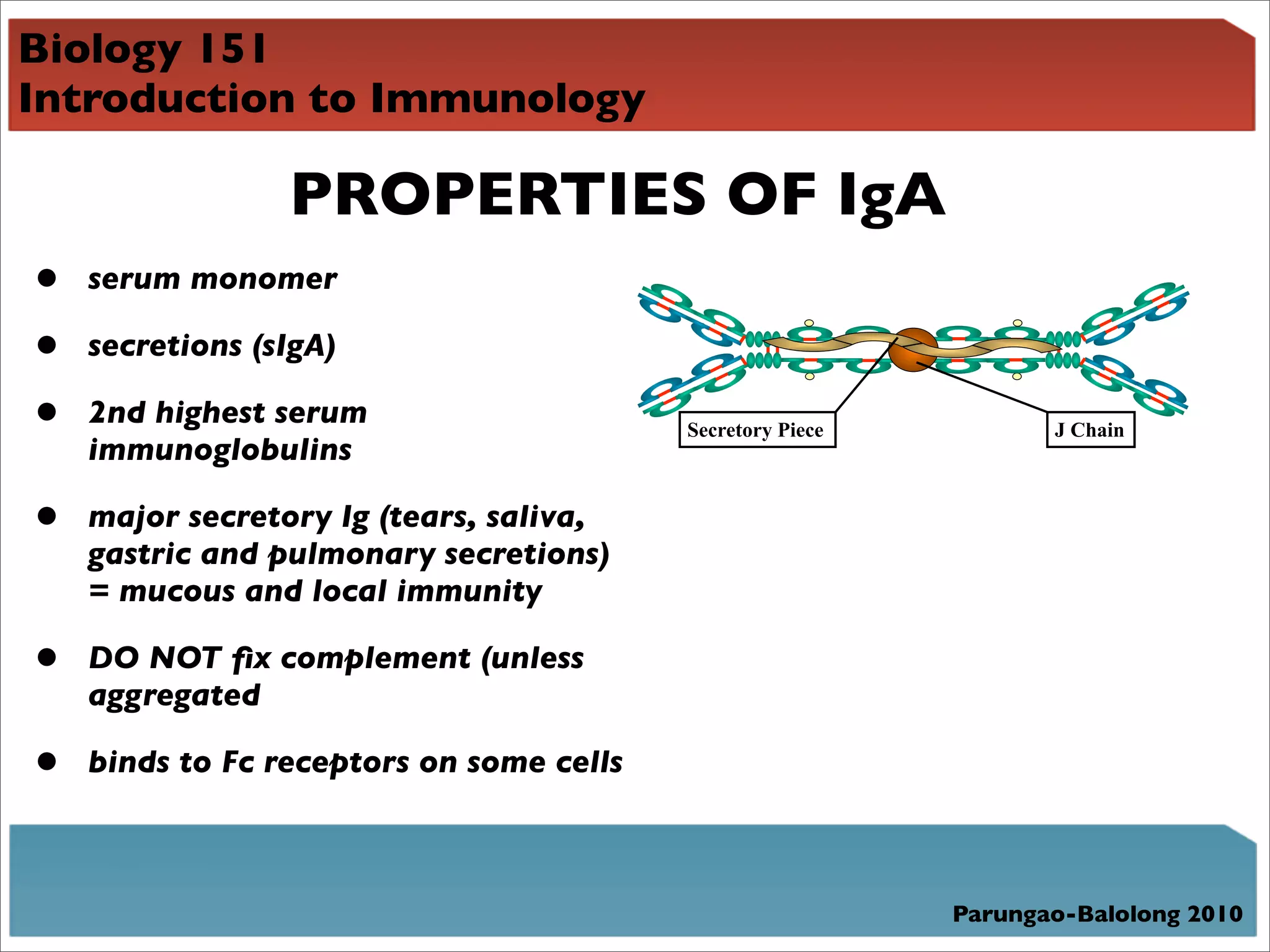
                 PROPERTIES OF IgA
•   serum monomer

•   secretions (sIgA)

•   2nd highest serum                     Secretory Piece          J Chain
    immunoglobulins

•   major secretory Ig (tears, saliva,
    gastric and pulmonary secretions)
    = mucous and local immunity

•   DO NOT fix complement (unless
    aggregated

•   binds to Fc receptors on some cells


                                                            Parungao-Balolong 2010
Biology 151
Introduction to Immunology


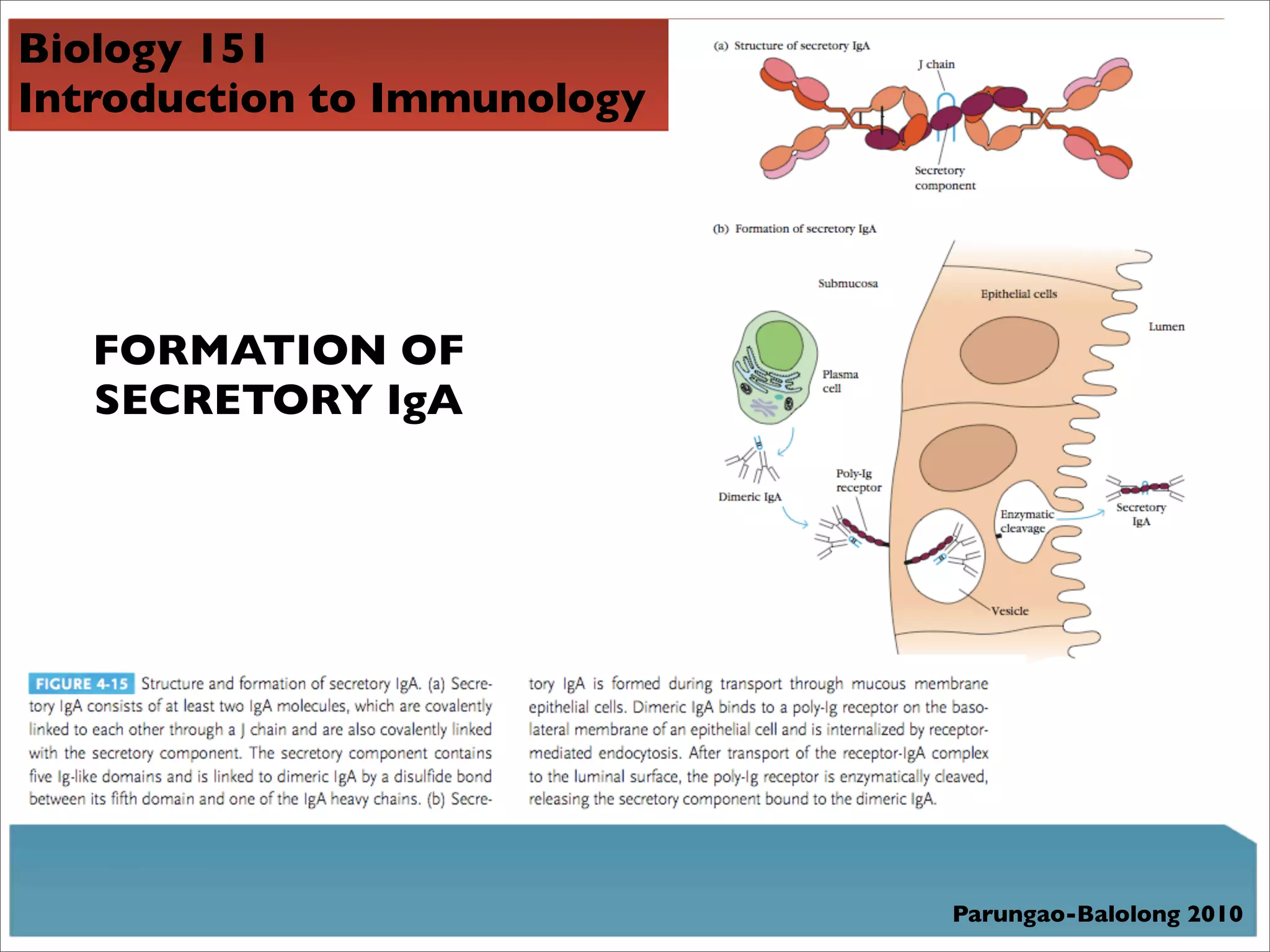
   FORMATION OF
   SECRETORY IgA


                             Parungao-Balolong 2010
Biology 151
Introduction to Immunology


                             Parungao-Balolong 2010
Biology 151
Introduction to Immunology

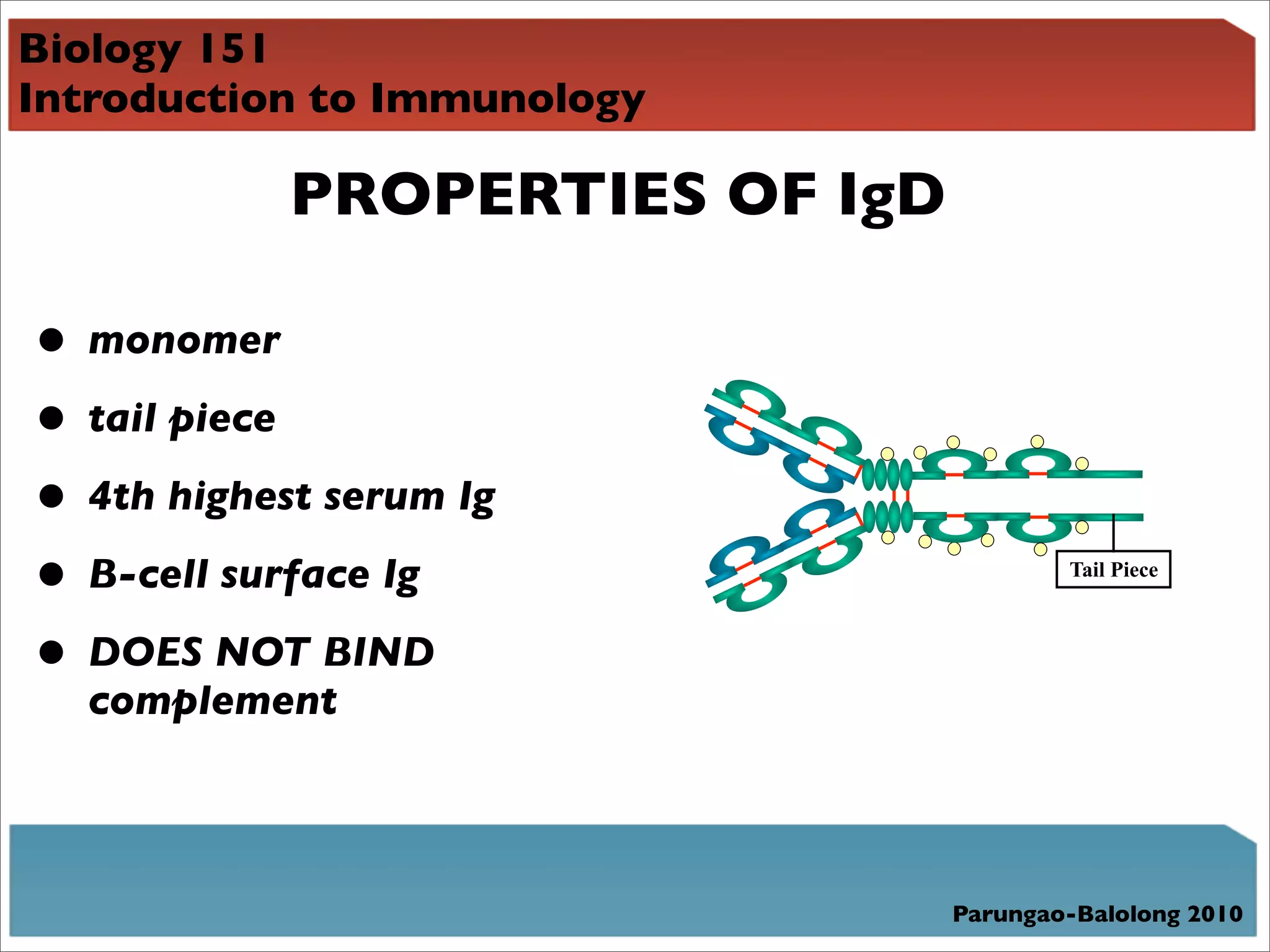
            PROPERTIES OF IgD

• monomer
• tail piece
• 4th highest serum Ig
• B-cell surface Ig                     Tail Piece


• DOES NOT BIND
  complement


                                Parungao-Balolong 2010
Biology 151
Introduction to Immunology

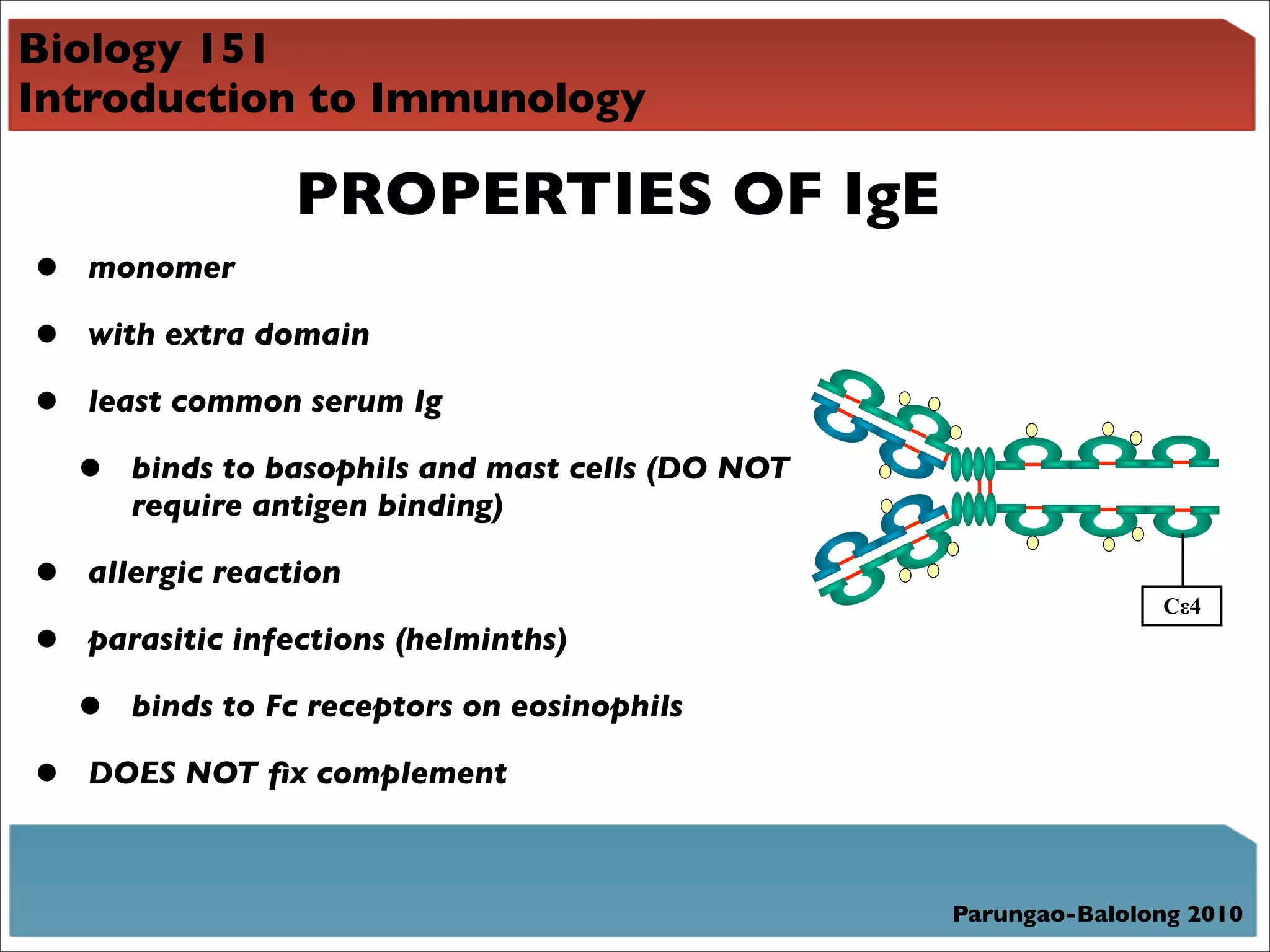
                  PROPERTIES OF IgE
•   monomer

•   with extra domain

•   least common serum Ig

    •   binds to basophils and mast cells (DO NOT
        require antigen binding)

•   allergic reaction
                                                                   C!4
•   parasitic infections (helminths)

    •   binds to Fc receptors on eosinophils

•   DOES NOT fix complement


                                                    Parungao-Balolong 2010
Biology 151
Introduction to Immunology


                         IMMUNOGLOBULINS &
                             ALLERGIES


                                  Parungao-Balolong 2010
Biology 151
Introduction to Immunology


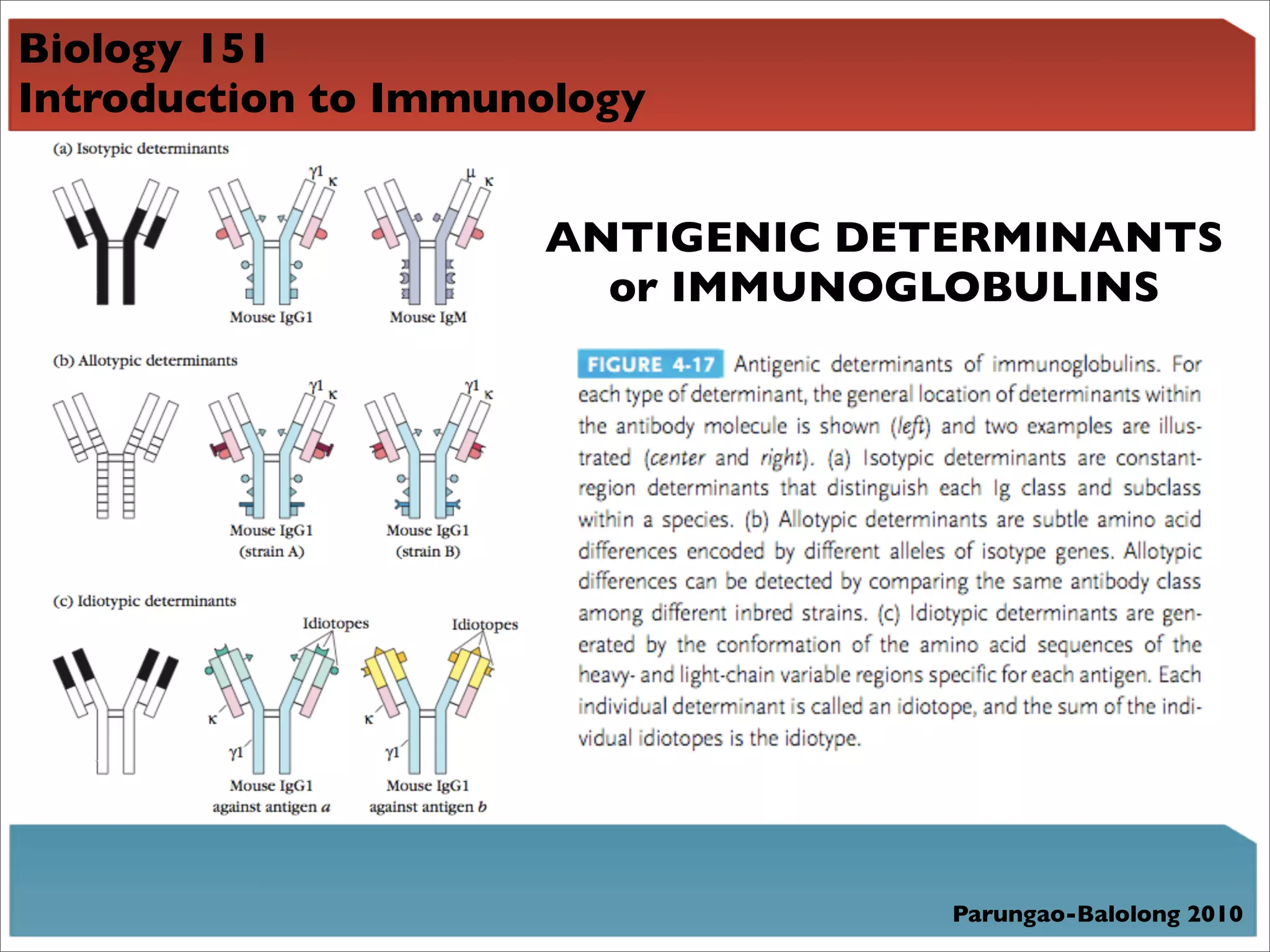
                     ANTIGENIC DETERMINANTS
                       or IMMUNOGLOBULINS


                                  Parungao-Balolong 2010
Biology 151
Introduction to Immunology

  ANTIGENIC DETERMINANTS OF
      IMMUNOGLOBULINS

• ISOTYPE
 • constant region determinants that collectively
    define each heavy-chain class and subclass

  • Example: distinguishing each IgG class and
    subclass within a species


                                        Parungao-Balolong 2010
Biology 151
Introduction to Immunology

    ANTIGENIC DETERMINANTS OF
        IMMUNOGLOBULINS
•   ALLOTYPE

    •   alleles encode subtle amino acid differences (allotypic determinants) that
        occur in some members of the species

    •   the SUM of the individual allotypic determinants displayed by an antibidy
        determines its allotype

•   IMPORTANCE

    •   monitoring bone marrow grafts

    •   forensic medicine

    •   paternity testing


                                                               Parungao-Balolong 2010
Biology 151
Introduction to Immunology

    ANTIGENIC DETERMINANTS OF
        IMMUNOGLOBULINS
•   ALLOTYPE

    •   NOTE: antibody to allotypic determinants sometimes produced by
        mother during pregnancy in response to paternal allotypic
        determinants on the fetal immunoglobulins; antibodies to allotypic
        determinants can also arise from blood transfusion

•   IDIOTYPE

    •   idiotypic determinants arise from the sequence of heavy and light-
        chain variable regions (idiotope)

    •   the sum of individual idiotopes = idiotype


                                                            Parungao-Balolong 2010
Biology 151
Introduction to Immunology
•   IDIOTYPE

    •   idiotypic determinants arise from the sequence of heavy and light-chain
        variable regions (idiotope)

    •   the sum of individual idiotopes = idiotype
                                                     +                  +
•   IMPORTANCE

    •   V-region marker          Ag            Id          anti-Id           anti-anti-Id
    •   regulation of immune responses
                                                     -                   -
    •   vaccines

    •   in some cases anti-idiotypic antibodies stimulate B cells to make antibodies

    •   this can be used as vaccines

    •   treatment of B-cell tumors (T-cells)


                                                                 Parungao-Balolong 2010
Biology 151
Introduction to Immunology

    ANTIGENIC DETERMINANTS OF
        IMMUNOGLOBULINS
•   THE 3 MAJOR EFFECTOR FUNCTIONS THAT ENABLE ANTIBODIES TO
    REMOVE ANTIGENS AND KILL PATHOGENS

    •   Opsonization

        •   promotes antigen phagocytosis by macrophages and neutrophils

    •   Complement Activation

        •   activates a pathway that leads the generation of a collection of
            proteins that can perforate cell membranes

    •   Antibody-Dependent Cell-Mediated Cytotoxicity

        •   kill antibody-bound target cells


                                                               Parungao-Balolong 2010
Biology 151
Introduction to Immunology
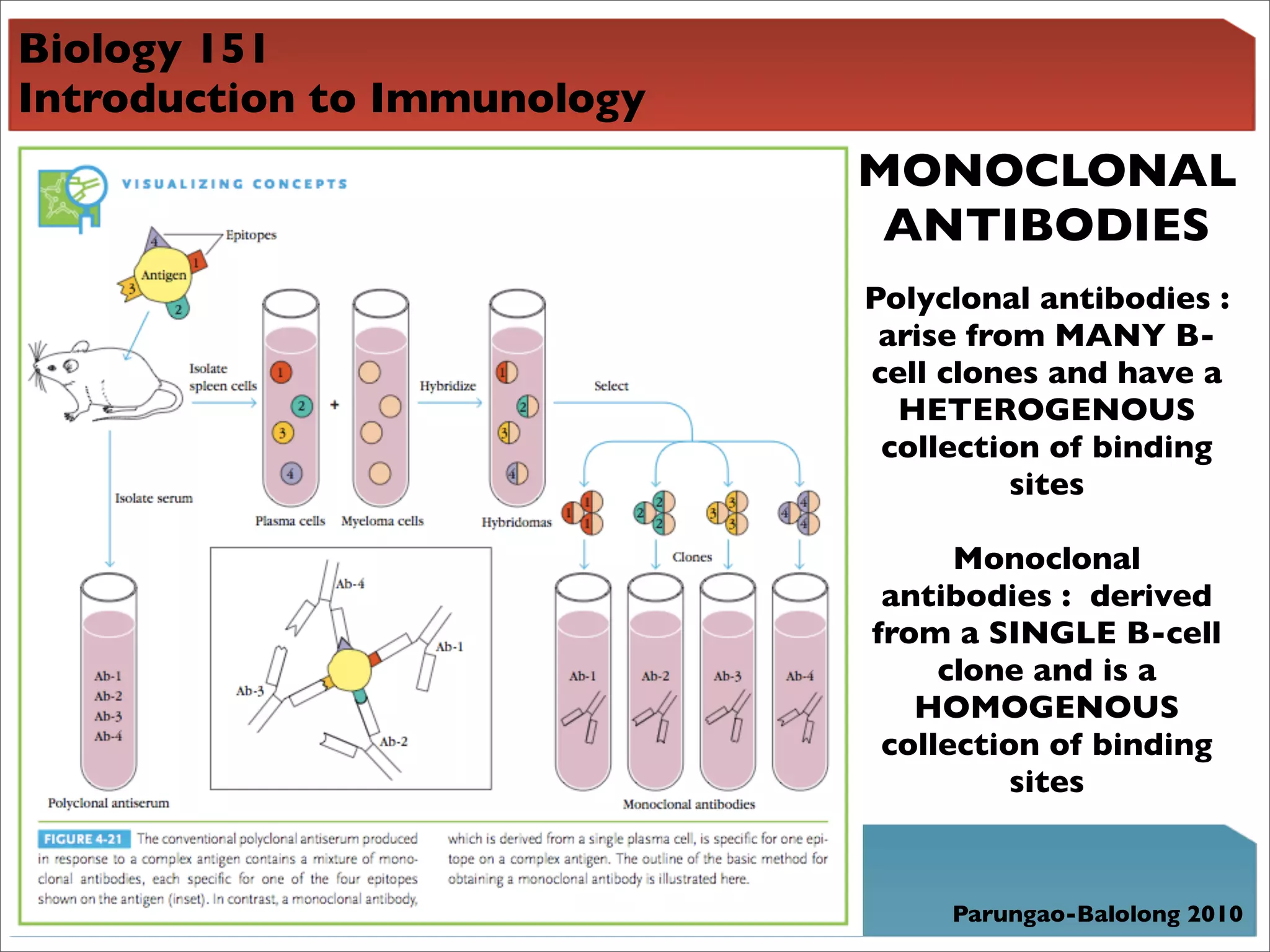
                             MONOCLONAL
                              ANTIBODIES
                             Polyclonal antibodies :
                              arise from MANY B-
                             cell clones and have a
                               HETEROGENOUS
                              collection of binding
                                       sites

                                   Monoclonal
                              antibodies : derived
                             from a SINGLE B-cell
                                  clone and is a
                                HOMOGENOUS
                              collection of binding
                                       sites


                                  Parungao-Balolong 2010
Biology 151
Introduction to Immunology


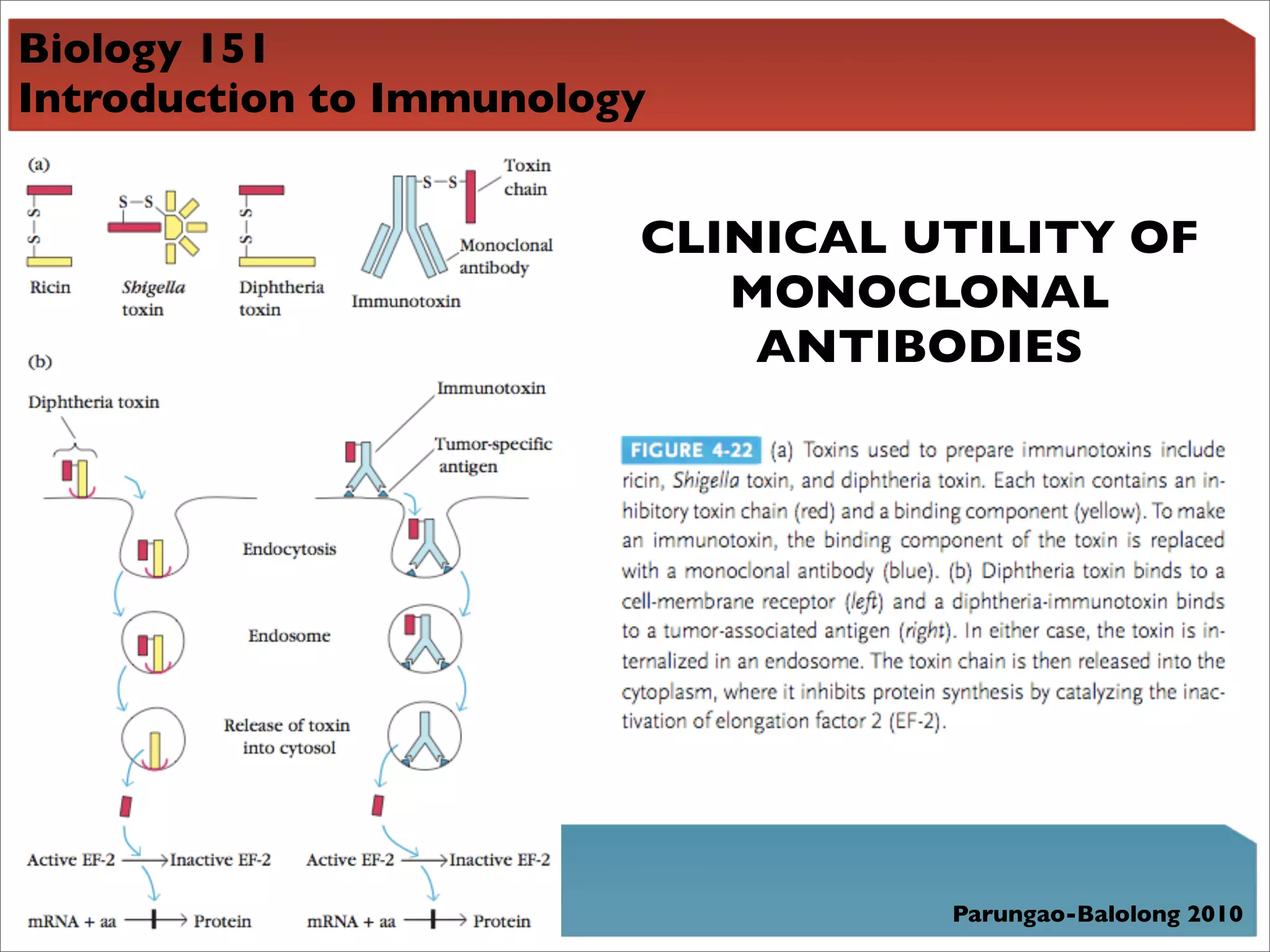
                         CLINICAL UTILITY OF
                            MONOCLONAL
                             ANTIBODIES


                                   Parungao-Balolong 2010
Biology 151
Introduction to Immunology


      NEXT MEETING
      Immunoglobulin Genes &
     Antigen-Antibody Reactions


                             Parungao-Balolong 2010

Bio 151 lecture 4

  • 1.
    Biology 151 Introduction toImmunology ANTIGENS & ANTIBODIES Lecture 4 Parungao-Balolong 2010
  • 2.
    Biology 151 Introduction toImmunology take note of the changes!!!! Parungao-Balolong 2010
  • 3.
    Biology 151 Introduction toImmunology JOURNAL REPORTING Assignment for Jan 2011: each student to look for one journal article on immunology submit hard copies during the 1st meeting Parungao-Balolong 2010
  • 4.
    Biology 151 Introduction toImmunology What you need to know • Antigens and Immunogens • Factors that Influence Immunogenicity • Epitopes • Haptens • Pattern Recognition Receptors Parungao-Balolong 2010
  • 5.
    Biology 151 Introduction toImmunology What you need to know • Basic Structure of Antibodies • Antibody Classes • Antigenic Determinants on Immunoglobulins • Monoclonal Antibodies Parungao-Balolong 2010
  • 6.
    Biology 151 Introduction toImmunology ANTIGENS & IMMUNOGENS • Immunogenicity: the ability to induce a humoral and/or cell-mediated immune response • Immunogen: a substance that induces a specific immune response • Immunogenicity: ability to combine specifically with the final products of the responses (antibodies and/or cell-surface receptors) Parungao-Balolong 2010
  • 7.
    Biology 151 Introduction toImmunology ANTIGENS & IMMUNOGENS • ALL molecules that are immunogenic are also antigenic..BUT... • not all antigenic molecules are immunogenic! • EXAMPLE: Haptens • antigenic but by themselves CANNOT induce a specific immune response • lacks immunogenicity Parungao-Balolong 2010
  • 8.
    Biology 151 Introduction toImmunology FACTORS INFLUENCING IMMUNOGENICITY • Nature of the Immunogen • Biological System • foreignness • genotype of the recipient animal • molecular size • immunogen dosage and and • chemical composition and route of administration heterogeneity • adjuvants • lipids as antigens • susceptibility to antigen processing and presentation Parungao-Balolong 2010
  • 9.
    Biology 151 Introduction toImmunology NATURE OF IMMUNOGEN Parungao-Balolong 2010
  • 10.
    Biology 151 Introduction toImmunology FACTORS INFLUENCING IMMUNOGENICITY “Foreignness” • Recall: “in order to elicit an immune response, a molecule must be recognized as NONSELF by the biological system” • tolerance for self-antigens • The greater the phylogenetic distance between two species, the greater the structural disparity between them • EXAMPLE: bovine serum albumin not immunogenic to cow bt is on chicken (cow > goat > chicken) • EXEMPTION: collagen, cytochrome c • have been highly conserved throughout evolution • little immunogenicity across diverse species line Parungao-Balolong 2010
  • 11.
    Biology 151 Introduction toImmunology FACTORS INFLUENCING IMMUNOGENICITY “Molecular Size” • The most ACTIVE immunogens: 100,000 Da • Substances with a molecular mass of 5,000-10,000 Da are poor immunogens • EXEMPTIONS: few substances with a molecular mass less than 1,000 Da have proven to be immunogenic Parungao-Balolong 2010
  • 12.
    Biology 151 Introduction toImmunology FACTORS INFLUENCING IMMUNOGENICITY “Chemical Composition and Heterogeneity” • chemical complexity contributes to immunogenicity Parungao-Balolong 2010
  • 13.
    Biology 151 Introduction toImmunology FACTORS INFLUENCING IMMUNOGENICITY “Lipids as Antigens” • appropriately presented lipoidal antigens can induce B-cell and T-cell responses • Example: lipid- protein conjugates (lipids are used as haptens) Parungao-Balolong 2010
  • 14.
    Biology 151 Introduction toImmunology FACTORS INFLUENCING IMMUNOGENICITY “Susceptibility to Antigen Processing and Presentation” • the development of both humoral and cell-mediated immune responses requires interaction of T-cells with antigen that has been processed and presented together with MHC molecules • LARGE, INSOLUBLE macromolecules are generally more immunogenic than SMALL, SOLUBLE ones • larger molecules are more readily phagocytosed and processed • degradative enzymes within antigen-presenting cells can degrade only proteins containing L-amino acids, polymers of D-amino acids cannot be processed Parungao-Balolong 2010
  • 15.
    Biology 151 Introduction toImmunology BIOLOGICAL SYSTEM Parungao-Balolong 2010
  • 16.
    Biology 151 Introduction toImmunology FACTORS INFLUENCING IMMUNOGENICITY “Genotype of the Recipient Animal” • MHC gene products = determines the degree to which an animal responds to an immunogen (immune responsiveness) • response influenced by genes that encode B-cell and T-cell receptors • response influenced by genes that encode various protiens involved in immune regulatory mechanisms • THUS: genetic variability affects immunogenicity in different animals Parungao-Balolong 2010
  • 17.
    Biology 151 Introduction toImmunology FACTORS INFLUENCING IMMUNOGENICITY “Immunogen Dosage and Route of Administration” • experimental immunogen exhibits unique dose-response curve • DOSE • insufficient dose will not stimulate an immune response (fails to activate lymphocytes or tolerance) • excessively high dose = tolerance • THUS....repeated adminsitrations or BOOSTERS are done if a single dose will not induce a strong response = increase clonal proliferation of antigen-specific T cells or B-cells = increase the lymphocyte populations SPECIFIC for the immunogen Parungao-Balolong 2010
  • 18.
    Biology 151 Introduction toImmunology FACTORS INFLUENCING IMMUNOGENICITY “Immunogen Dosage and Route of Administration” • ROUTE • generally administered parenterally = other than the GIT • common: intravenous, intradermal, subcutaneous, intramuscular, intraperitoneal • Can you recall the route of your vaccine shots? • strongly influence which immune organs and cell populations will be involved in the response • intravenous = carried first to the spleen • subcutaneous = moves first to local lymph nodes Parungao-Balolong 2010
  • 19.
    Biology 151 Introduction toImmunology FACTORS INFLUENCING IMMUNOGENICITY “Adjuvants” • substances that, when mixed with an antigen and injected with it, ENHANCE the immunogenicity of that antigen • used to boost the immune response when an antigen has LOW IMMUNOGENICITY or when only SMALL AMOUNTS of an antigen is available Parungao-Balolong 2010
  • 20.
    Biology 151 Introduction toImmunology HOW DO THEY DO THAT? “Adjuvants” • Stimulate a local, chronic inflammatory response that attracts both phagocytes and lymphocytes • Infiltration of cells at the site of the adjuvant injection often results in formation of a dense, macrophage-rich mass of cells called a granuloma • activated granuloma enhances the activation of TH cells • Other adjuvants • synthetic polyribonucleotides and 5-bacterial lipopolysaccharides • stimulate the nonspecific proliferation of lymphocytes and thus INCREASE THE LIKELIHOOD of antigen-induced clonal selection of lymphocytes Parungao-Balolong 2010
  • 21.
    Biology 151 Introduction toImmunology HOW DO THEY DO THAT? “Adjuvants” • Aluminum potassium sulfate (alum) prolongs the persistence of antigen • When an antigen is mixed with alum, the salt precipitates the antigen • Injection of this alum precipitate results in a SLOWER RELEASE of antigen from the injection site, so that the effective time of exposure to the antigen increases • from a few days without adjuvant to several weeks with the adjuvant • The alum precipitate also INCREASES THE SIZE of the antigen,thus increasing the likelihood of phagocytosis Parungao-Balolong 2010
  • 22.
    Biology 151 Introduction toImmunology HOW DO THEY DO THAT? “Adjuvants” • Water-in-oil adjuvants also prolong the persistence of antigen • Example: Freund’s incomplete adjuvant • contains antigen in aqueous solution, mineral oil, and an emulsifying agent such as mannide monooleate • disperses the oil into small droplets surrounding the antigen • antigen is then RELEASED VERY SLOWLY from the site of injection • Based on Freund’s complete adjuvant Parungao-Balolong 2010
  • 23.
    Biology 151 Introduction toImmunology HOW DO THEY DO THAT? “Adjuvants” • Water-in-oil adjuvants also prolong the persistence of antigen • Example: Freund’s complete adjuvant • first deliberately formulated highly effective adjuvant • contain heat-killed Mycobacteria as an additional ingredient • Muramyl dipeptide,a component of the mycobacterial cell wall,ACTIVATES macrophages • THUS: Far more POTENT than the incomplete form Parungao-Balolong 2010
  • 24.
    Biology 151 Introduction toImmunology HOW DO THEY DO THAT? “Adjuvants” • Far more POTENT than the incomplete form...... • WHY? : Activated macrophages are MORE PHAGOCYTIC than inactivated macrophages • WHY? : express HIGHER LEVELS of class II MHC molecules and the membrane molecules of the B7 family • WHY? : increased expression of class II MHC INCREASES ABILITY of the antigen-presenting cell to present antigen to TH cells • WHY? : antigen presentation are INCREASED in the presence of adjuvant Parungao-Balolong 2010
  • 25.
    Biology 151 Introduction toImmunology EPITOPES Parungao-Balolong 2010
  • 26.
    Biology 151 Introduction toImmunology • also called ANTIGENIC DETERMINANTS • are discrete site on the macromolecule recognized by the lymphocytes • immunologically active regions of an immunogen that bind to antigen-specific membrane receptors on lymphocytes or to secreted antibodies • NOTE: B and T cells recognize DIFFERENT epitopes on the SAME antigenic molecule • THUS: the ability to function as a B-cell epitope is determined by the nature of the ANTIGEN- BINDING site of the antibody molecules DISPLAYED by B-cells. Parungao-Balolong 2010
  • 27.
    Biology 151 Introduction toImmunology HAPTENS Parungao-Balolong 2010
  • 28.
    Biology 151 Introduction toImmunology • small organic molecules that are HAPTENS antigenic but not immunogenic • CHEMICAL COUPLING of a hapten to a large protein (carrier) yields an IMMUNOGENIC HAPETN-CARRIER conjugate • NOTE: animals immunized with such a conjugate produce antibodies specific for: • the hapten determinant • unaltered epitopes on the carrier protein • new epitopes formed by combined Reading assignment: How did Landsteiner discovered the utility of haptens in parts of BOTH the hapten and the immunology? Parungao-Balolong 2010
  • 29.
    Biology 151 Introduction toImmunology PATTERN RECOGNITION RECEPTORS Parungao-Balolong 2010
  • 30.
    Biology 151 Introduction toImmunology PATTERN RECOGNITION RECEPTORS • RECALL: the receptors of adaptive and innate immunity differ • antibodies and T-cell receptors + receptors of the adaptive immunity • recognize details of molecular structure and can DISCRIMINATE with exquisite specificity between antigens featuring only slight structural differences • receptors of the innate immunity • recognize broad structural motifs that are highly conserved within microbial species but are generally ABSENTfrom the host • THUS THE NAME = PATTERN RECOGNITION RECEPTORS or Parungao-Balolong 2010
  • 31.
    Biology 151 Introduction toImmunology PATTERN RECOGNITION RECEPTORS Parungao-Balolong 2010
  • 32.
    Biology 151 Introduction toImmunology PATTERN RECOGNITION RECEPTORS Parungao-Balolong 2010
  • 33.
    Biology 151 Introduction toImmunology Parungao-Balolong 2010
  • 34.
    Biology 151 Introduction toImmunology Parungao-Balolong 2010
  • 35.
    Biology 151 Introduction toImmunology ARE YOU ALLERGIC TO SOME DRUGS? Parungao-Balolong 2010
  • 36.
    Biology 151 Introduction toImmunology SOME DRUGS CAN BECOME IMMUNOGENS Parungao-Balolong 2010
  • 37.
    Biology 151 Introduction toImmunology SOME DRUGS CAN BECOME IMMUNOGENS Parungao-Balolong 2010
  • 38.
    Biology 151 Introduction toImmunology ANTIBODIES (Their Structure & Functions) Parungao-Balolong 2010
  • 39.
    Biology 151 Introduction toImmunology What you need to know • Basic Structure of Antibodies • Antibody Classes • Antigenic Determinants on Immunoglobulins • Monoclonal Antibodies Parungao-Balolong 2010
  • 40.
    Biology 151 Introduction toImmunology BASIC STRUCTURE OF ANTIBODIES • Antibodies : antigen-binding proteins present on the B-cell membrane and secreted by plasma cells • when bound confers antigenic specificity on B-cells • Common to all antibodies: • structural features • binds to antigen • participate in effector function Parungao-Balolong 2010
  • 41.
    Biology 151 Introduction toImmunology OTHER NAMES FOR ANTIBODIES Antitoxin Neutralize toxins Agglutinins Clumps cells Precipitins Ppt soluble antigens Lysins Lyses cells Opsonins ! phagocytosis Neutralizing antibodies Neutralize viruses Complement fixing Activate complement antibodies Parungao-Balolong 2010
  • 42.
    Biology 151 Introduction toImmunology BASIC STRUCTURE OF ANTIBODIES • consist of two identical side light chains & two identical heavy chains linked by disulfide bonds • heavy chain: has an amino- terminal variable region followed by a constant region Parungao-Balolong 2010
  • 43.
    Biology 151 Introduction toImmunology IMMUNOGLOBULINS Parungao-Balolong 2010
  • 44.
    Biology 151 Introduction toImmunology IMMUNOGLOBULINS • in any given antibody molecule, the constant region contains one of five basic heavy chain sequences called isotypes • the heavy chain isotype determines the class of an antibody Parungao-Balolong 2010
  • 45.
    Biology 151 Introduction toImmunology CLASSES OF IMMUNOGLOBULINS • IgG • IgD • IgE • IgA • IgM Parungao-Balolong 2010
  • 46.
    Biology 151 Introduction toImmunology CLASSES OF IMMUNOGLOBULINS Parungao-Balolong 2010
  • 47.
    Biology 151 Introduction toImmunology Parungao-Balolong 2010
  • 48.
    Biology 151 Introduction toImmunology PROPERTIES OF IgG • major serum immunoglobulins (systemic immunity) • major immunoglobulin in extravascular spaces • does not require antigen binding during placental transfer (IgG2) • fixes complement (IgG4) • binds to Fc receptors (iGg2 and IgG4) • phagocytes - opsonization • Killer cells - ADCC Parungao-Balolong 2010
  • 49.
    Biology 151 Introduction toImmunology PROPERTIES OF IgM • pentamer • 3rd highest serum immunoglobulin • first immunoglobulin made by fetus and B cells • fixes complement C1r C1 s • Figure: fixation of C1 by IgG and C1q C1r C1 s IgM C1q • agglutinating immunoglobulin • binds to Fc receptors No activation Activation • B-cell surface immunoglobulins Parungao-Balolong 2010
  • 50.
    Biology 151 Introduction toImmunology B-cell antigen receptor Ig-! Ig-" Ig-! Ig-" Parungao-Balolong 2010
  • 51.
    Biology 151 Introduction toImmunology PROPERTIES OF IgA • serum monomer • secretions (sIgA) • 2nd highest serum Secretory Piece J Chain immunoglobulins • major secretory Ig (tears, saliva, gastric and pulmonary secretions) = mucous and local immunity • DO NOT fix complement (unless aggregated • binds to Fc receptors on some cells Parungao-Balolong 2010
  • 52.
    Biology 151 Introduction toImmunology FORMATION OF SECRETORY IgA Parungao-Balolong 2010
  • 53.
    Biology 151 Introduction toImmunology Parungao-Balolong 2010
  • 54.
    Biology 151 Introduction toImmunology PROPERTIES OF IgD • monomer • tail piece • 4th highest serum Ig • B-cell surface Ig Tail Piece • DOES NOT BIND complement Parungao-Balolong 2010
  • 55.
    Biology 151 Introduction toImmunology PROPERTIES OF IgE • monomer • with extra domain • least common serum Ig • binds to basophils and mast cells (DO NOT require antigen binding) • allergic reaction C!4 • parasitic infections (helminths) • binds to Fc receptors on eosinophils • DOES NOT fix complement Parungao-Balolong 2010
  • 56.
    Biology 151 Introduction toImmunology IMMUNOGLOBULINS & ALLERGIES Parungao-Balolong 2010
  • 57.
    Biology 151 Introduction toImmunology ANTIGENIC DETERMINANTS or IMMUNOGLOBULINS Parungao-Balolong 2010
  • 58.
    Biology 151 Introduction toImmunology ANTIGENIC DETERMINANTS OF IMMUNOGLOBULINS • ISOTYPE • constant region determinants that collectively define each heavy-chain class and subclass • Example: distinguishing each IgG class and subclass within a species Parungao-Balolong 2010
  • 59.
    Biology 151 Introduction toImmunology ANTIGENIC DETERMINANTS OF IMMUNOGLOBULINS • ALLOTYPE • alleles encode subtle amino acid differences (allotypic determinants) that occur in some members of the species • the SUM of the individual allotypic determinants displayed by an antibidy determines its allotype • IMPORTANCE • monitoring bone marrow grafts • forensic medicine • paternity testing Parungao-Balolong 2010
  • 60.
    Biology 151 Introduction toImmunology ANTIGENIC DETERMINANTS OF IMMUNOGLOBULINS • ALLOTYPE • NOTE: antibody to allotypic determinants sometimes produced by mother during pregnancy in response to paternal allotypic determinants on the fetal immunoglobulins; antibodies to allotypic determinants can also arise from blood transfusion • IDIOTYPE • idiotypic determinants arise from the sequence of heavy and light- chain variable regions (idiotope) • the sum of individual idiotopes = idiotype Parungao-Balolong 2010
  • 61.
    Biology 151 Introduction toImmunology • IDIOTYPE • idiotypic determinants arise from the sequence of heavy and light-chain variable regions (idiotope) • the sum of individual idiotopes = idiotype + + • IMPORTANCE • V-region marker Ag Id anti-Id anti-anti-Id • regulation of immune responses - - • vaccines • in some cases anti-idiotypic antibodies stimulate B cells to make antibodies • this can be used as vaccines • treatment of B-cell tumors (T-cells) Parungao-Balolong 2010
  • 62.
    Biology 151 Introduction toImmunology ANTIGENIC DETERMINANTS OF IMMUNOGLOBULINS • THE 3 MAJOR EFFECTOR FUNCTIONS THAT ENABLE ANTIBODIES TO REMOVE ANTIGENS AND KILL PATHOGENS • Opsonization • promotes antigen phagocytosis by macrophages and neutrophils • Complement Activation • activates a pathway that leads the generation of a collection of proteins that can perforate cell membranes • Antibody-Dependent Cell-Mediated Cytotoxicity • kill antibody-bound target cells Parungao-Balolong 2010
  • 63.
    Biology 151 Introduction toImmunology MONOCLONAL ANTIBODIES Polyclonal antibodies : arise from MANY B- cell clones and have a HETEROGENOUS collection of binding sites Monoclonal antibodies : derived from a SINGLE B-cell clone and is a HOMOGENOUS collection of binding sites Parungao-Balolong 2010
  • 64.
    Biology 151 Introduction toImmunology CLINICAL UTILITY OF MONOCLONAL ANTIBODIES Parungao-Balolong 2010
  • 65.
    Biology 151 Introduction toImmunology NEXT MEETING Immunoglobulin Genes & Antigen-Antibody Reactions Parungao-Balolong 2010