Mucosal delivery of vaccines
• Presented by:
Alisha Bansal
M.Pharm(pharmaceutics)
INTRODUCTION
• Vaccination against infectious diseases has proven
to be an asset in preventing diseases and has
contributed significantly to an increase in life
expectancy.
• It is believed that the first productive interaction
among the most infectious agents and that host is
with mucosal surfaces, especially the agents and
the host is with mucosal surfaces, especially the
nasal, oropharyngeal, respiratory, genitourinary and
gastrointestinal mucosa.
Mucosal delivery of vaccines
• Mucosal surfaces area is major portal of entry for
many human pathogens that are the cause of
infectious diseases worldwide.
• Immunization by mucosal routes may be more
effective at inducing protective immunity against
mucosal pathogens at their sites of entry.
• Efforts have focused on efficient delivery of
vaccines antigens to mucosal sites that facilitate
uptake by local antigen-presenting cells to
generate protective mucosal immune responses.
TERMS
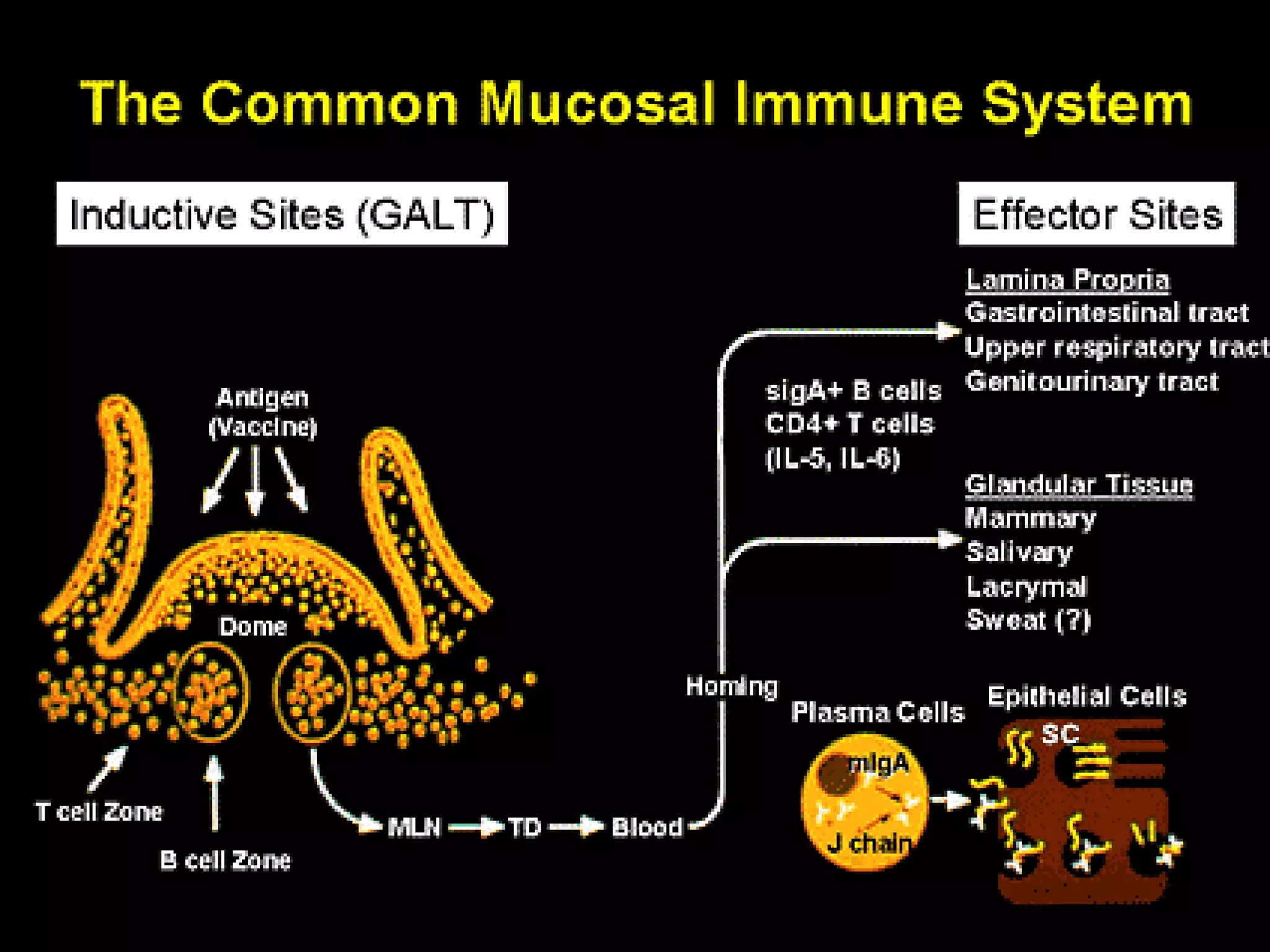
 Gut-associated lymphoid tissue (GALT)
 mucosa-associated lymphoid tissue (MALT)
 Nasopharynx-associated lymphoid tissue (NALT)
 Bronchi-associated lymphoid tissue (BALT)
• The adult human mucosa lines the surfaces of the
digestive, respiratory and genitourinary tracts,
covering an immune surface area that is nearly 200
times greater than that of the skin. It is estimated that
70% of the infectious agents enter the host by
mucosal routes.
• Mucosal surfaces are typically categorized as type-I
and type-II mucosa.
• Type-I mucosa includes surface area of lungs and gut.
• Type-II mucosa include surface area of mouth,
esophagus and cornea.
• The female genital tract has both type-I and type-II
mucosa.
• Most mucosal sites have organized lymphoid
follicles, such as NALT, and GALT, which have
assembly of scattered antigen-reactive cells of
immune system, such as B cells, T cells, and
professional antigen presenting cells such as
dendritic cells(APCs).
• These cells are responsible for the induction and
maintenance of immune responses against
mucosally delivered antigen.
• It is widely accepted that mucosal vaccination can
induce immune responses at both systemic and
mucosal sites and, prevent the invasion and
colonization of pathogens at mucosal surfaces.
WHY? Mucosal delivery of vaccines.
 Because injectable vaccines pose several
problems such as,
• High production cost
• Low/poor compliance
• Fear of needle borne infection
• Lack of mucosal immune response
• Injection site pain
• Local side effects
ADVANTAGES
• Low cost as compared to injectable vaccines.
• Easily adaptable for the purpose of mass
vaccination (especially desirable in pandemic
situation)
LIMITATIONS
• Hostile nature of gastrointestinal tract in case
of oral vaccine, impermeability of
biomacromolecule through the mucosal
epithelial barrier, presence of degrading
enzyme and fear of the inductiion of
tolerance.
POLYMERS USED FOR MUCOSAL
VACCINES
• The concept of polymeric carrier system(s)
offers advantage of delivering drugs/antigens
to a specific target site, where it has to be
released from the carrier.
• Polymeric nanoparticles/microparticles can
enhance the immune response to mucosally
administered antigens by several means.
Polymers used
• Polymeric materials used for the formulation of
microparticles / nanoparticles , include
POLYMERS
SYNTHETIC
PLA PLGA PCL
METHY
ETHACRYLATE
S
NATURAL
ALBUMIN CHITOSAN GALATIN ALGINATE
1. CHITOSAN
• Chitosan is a cationic polysachharide
consisting of repeating units of N-acetyl-D-
glucosamine and D-glucosamine.
• Chitosan seems to augment immune
responses by enhancing the uptake of antigen
across the nasal mucosa.
2. ALGINATE
• Alginate are safe, non-immunogenic and
inexpensive natural polymers with high
mucoadhesive properties.
• They are particularly used as thickeners or
emulsion stabilizers in manufacturing of
pharmaceutical formulations.
• Alginate microspheres have been used as
delivery system for antigens to mucosal
surfaces.
3. GELATIN
• It is a natural, biodegradable protein obtained
by acid or base catalyzed hydrolysis of
collagen.
• Antibody-modified gelatin nanoparticles have
been used for targeted uptake by
lymphocytes.
4. CARBOPOL
• Carbopol is a cross-linked poly of high
molecular weight, which is used
experimentally as an agent to enhance
adhesion to mucosal surfaces in combination
with other delivery systems and may facilitate
enhanced protection of peptides and proteins
against enzymatic degradation in the
gastrointestinal tract.
DESIGN AND STRATEGIES FOR
MUCOSAL DELIVERY
EMULSION TYPE DELIVERY
• Emulsions are heterogeneous liquid systems may be
w/o or o/w.
• Antigens are dissolved in a water phase and
emulsified in the oil in the presence of an
appropriate emulsifier.
• The controlled release characteristics of an
emulsion are determined by factors such as
– Viscosity of oil phase
– Oil to water phase ratio
– Emulsion droplet size
ADVANTAGES AND DISADVANTAGES
• ADVANATGES
• Slow release of antigen
• DISADVANTAGES
• Fever
• Sore arm at injection site
• Access immunogenic response
LIPOSOME BASED DELIVERY
• Liposomes are spherical shape vesicles containing
an aqueous core which is enclosed by a lipid bilayer.
• They are most often composed of phospholipids,
especially phosphatidylcholine, but may also
include other lipids, like Ethanolamine.
Preparation of Liposome Vaccine
Delivery System
Depending on the chemical properties, water-soluble antigens
(proteins, peptide, nucleic acids, carbohydrates, haptens) are
entrapped within the aqueous inner space of liposomes
Lipophilic compounds (lipopeptides, antigens, adjuvants, linker
molecules) are intercalated into the lipid bilayer
Antigens or adjuvants can be attached to the liposome surface
either by adsorption or stable chemical linking
ADVANTAGES AND DISADVANTAGES
• ADVANATGES
• Easy surface modification
• Synthesized from non toxic material
• Wide range of antigen encapsulation
• plasticity
• DISADVANTAGES
• Stability problem
• Low antigen loading
POLYMERIC NANO PARICLES
• Polymeric nan particles are submicron-sized
colloidal particles.
• Polymeric nanoparticles because of their size are
preferentially taken up by the mucosa associated
lymphoid Tissue.
• Limited doses of antigen are sufficient to induce
effective immunization.
• Hence, the use of nanoparticles for oral delivery
of antigens is suitable because of their ability to
release proteins and to protect them from
enzymatic degradation in the GIT.
VIROSOMES
• A Virosome is a a drug or vacine delivery mechanism
consisting of unilamellar phospholipid membrane vesicle
incorporating virus derived proteins to allow the virosomes
to fuse with target cells.
• These proteins enable the virosome membranes to fuse
with cells of the immune system and thus deliver the
specific antigens directly to their target cells.
• They elicit a specific immune response even with weak-
immunogenic antigens.
• Once they have delivered the antigens, the virosomes are
completely degraded within the cells.
MELT IN MOUTH STRIPS
• Quick dissolving films containing immunogens.
• Melts into liquid that children and infants will swallow
easily.
• These strips stick and dissolves on the tongue in less than
a minute. (useful for newborns who sometimes spit out
the liquid)
• EXAMPLE: ROTAVIRUS is a common cause of severe
diarrhea and vomiting in children. ROTAVIRUS VACCINE at
present is available in a liquid or freeze-dried form that
must be chilled for transport and storage, making it very
expensive for use in impoverished areas.
SINGLE SHOT
VACCINES
SINGLE SHOT VACCINES
• To provide effective patient protection, many
traditional vaccines require multiple
injections, which results in a costly and
inconvenient regimen. These disadvantages
have spurred the development of single-shot
vaccines that can provide protection against
infection with only one injection.
INTRODUCTION
• The single-shot vaccine is a combination product
of a prime component—antigen with an
appropriate adjuvant—and a microsphere
component that encapsulates antigen and
provides the booster immunizations by delayed
release of the antigen.
• They are given at a single contact point for
preventing 4 to 6 disease.
• In order to increase the therapeutic efficiency of
such vaccines, adjuvants are used.
DEFINITION • The single shot vaccine is
a combination product of
a prime component
antigen with an
microsphere component
and appropriate adjuvant
and an encapsulated
antigen which will
provide the booster
immunizations by
delayed release of the
antigen.
Polio vaccine
OBJECTIVES
• To elicit a protective immune response for a
long duration from a single-contact
immunization.
• Potentiate the immune response to the
vaccine without manifesting any adverse
effects.
• Incorporate many vaccines in a single
formulation.
VACCINE ADJUVANTS
• Adjuvants are the substance added to vaccines
to help them work better.
• Adding an adjuvant trigger the immune
system to become more sensitive to the
vaccine.
Why do we need adjuvants?
• To increase the therapeutic efficiency.
• They form depot of antigen at the site of
inoculation with slow release of antigens.
• It can improve the performance of vaccines by
targeting the antigen.
EXAMPLES OF ADJUVANTS
 ALUM
 VIROSOMES
 CYTOKINES
ALUM
• It is the most commonly used adjuvant
• Consists of Aluminium salts that are insoluble in
water
• Recently it is used in vaccines for HEPATITIS B
VIROSOMES
• They resemble to viruses but non-infectious
• They are included in FLU VACCINE and HEPATITIS A
VACCINE in europe
• Virosomes that are incorporated in these vaccines
have antigens and other proteins on their surface
• They are small proteins that serves as chemical
messenger of the immune system.
CYTOKINES
RECENT TRENDS
• Approaches for designing a prevent HIV
vaccine.
• Vaccine against Dengue.
• Malaria is mosquito born disease caused by a
parasite. Recent studies showed that upon
encapsulating a submit malarial antigen SPF66
in PLGA-mixture microspheres resulted in high
antibody levels in mice.
REFERENCES
1. Garg Neeraj, Mangal Sharad, Khambete
Hemant.”Recent patents on drug delivery &
formulation”;Mucosal Delivery of Vaccines:Role of
Mucoadhesive/Biodegradable Polymers
2010;4,114-128.
2. Saroja CH, Lakshmi PK”Recent trends in vaccine
delivery systems”:A Review International J pharm
investig.2011 apr-jun;1(2):64-74
3. Slideshare on vaccine delivery system by Ms Janu
Vashi, department of pharmaceutics, AR and GHP
college of pharmacy.
4. Slideshare on vaccine delivery system by Sishant
Rav Divya BBAU Lucknow.
5.https;//www.slideshare.net/ANUSHANADIKATLA/
vaccine-delivery-79561747.
Vaccine delivery system

Vaccine delivery system

  • 1.
    Mucosal delivery ofvaccines • Presented by: Alisha Bansal M.Pharm(pharmaceutics)
  • 2.
    INTRODUCTION • Vaccination againstinfectious diseases has proven to be an asset in preventing diseases and has contributed significantly to an increase in life expectancy. • It is believed that the first productive interaction among the most infectious agents and that host is with mucosal surfaces, especially the agents and the host is with mucosal surfaces, especially the nasal, oropharyngeal, respiratory, genitourinary and gastrointestinal mucosa.
  • 4.
    Mucosal delivery ofvaccines • Mucosal surfaces area is major portal of entry for many human pathogens that are the cause of infectious diseases worldwide. • Immunization by mucosal routes may be more effective at inducing protective immunity against mucosal pathogens at their sites of entry. • Efforts have focused on efficient delivery of vaccines antigens to mucosal sites that facilitate uptake by local antigen-presenting cells to generate protective mucosal immune responses.
  • 9.
    TERMS  Gut-associated lymphoidtissue (GALT)  mucosa-associated lymphoid tissue (MALT)  Nasopharynx-associated lymphoid tissue (NALT)  Bronchi-associated lymphoid tissue (BALT)
  • 10.
    • The adulthuman mucosa lines the surfaces of the digestive, respiratory and genitourinary tracts, covering an immune surface area that is nearly 200 times greater than that of the skin. It is estimated that 70% of the infectious agents enter the host by mucosal routes. • Mucosal surfaces are typically categorized as type-I and type-II mucosa. • Type-I mucosa includes surface area of lungs and gut. • Type-II mucosa include surface area of mouth, esophagus and cornea. • The female genital tract has both type-I and type-II mucosa.
  • 11.
    • Most mucosalsites have organized lymphoid follicles, such as NALT, and GALT, which have assembly of scattered antigen-reactive cells of immune system, such as B cells, T cells, and professional antigen presenting cells such as dendritic cells(APCs). • These cells are responsible for the induction and maintenance of immune responses against mucosally delivered antigen. • It is widely accepted that mucosal vaccination can induce immune responses at both systemic and mucosal sites and, prevent the invasion and colonization of pathogens at mucosal surfaces.
  • 12.
    WHY? Mucosal deliveryof vaccines.  Because injectable vaccines pose several problems such as, • High production cost • Low/poor compliance • Fear of needle borne infection • Lack of mucosal immune response • Injection site pain • Local side effects
  • 13.
    ADVANTAGES • Low costas compared to injectable vaccines. • Easily adaptable for the purpose of mass vaccination (especially desirable in pandemic situation)
  • 14.
    LIMITATIONS • Hostile natureof gastrointestinal tract in case of oral vaccine, impermeability of biomacromolecule through the mucosal epithelial barrier, presence of degrading enzyme and fear of the inductiion of tolerance.
  • 15.
    POLYMERS USED FORMUCOSAL VACCINES • The concept of polymeric carrier system(s) offers advantage of delivering drugs/antigens to a specific target site, where it has to be released from the carrier. • Polymeric nanoparticles/microparticles can enhance the immune response to mucosally administered antigens by several means.
  • 16.
    Polymers used • Polymericmaterials used for the formulation of microparticles / nanoparticles , include POLYMERS SYNTHETIC PLA PLGA PCL METHY ETHACRYLATE S NATURAL ALBUMIN CHITOSAN GALATIN ALGINATE
  • 17.
    1. CHITOSAN • Chitosanis a cationic polysachharide consisting of repeating units of N-acetyl-D- glucosamine and D-glucosamine. • Chitosan seems to augment immune responses by enhancing the uptake of antigen across the nasal mucosa.
  • 18.
    2. ALGINATE • Alginateare safe, non-immunogenic and inexpensive natural polymers with high mucoadhesive properties. • They are particularly used as thickeners or emulsion stabilizers in manufacturing of pharmaceutical formulations. • Alginate microspheres have been used as delivery system for antigens to mucosal surfaces.
  • 19.
    3. GELATIN • Itis a natural, biodegradable protein obtained by acid or base catalyzed hydrolysis of collagen. • Antibody-modified gelatin nanoparticles have been used for targeted uptake by lymphocytes.
  • 20.
    4. CARBOPOL • Carbopolis a cross-linked poly of high molecular weight, which is used experimentally as an agent to enhance adhesion to mucosal surfaces in combination with other delivery systems and may facilitate enhanced protection of peptides and proteins against enzymatic degradation in the gastrointestinal tract.
  • 21.
    DESIGN AND STRATEGIESFOR MUCOSAL DELIVERY
  • 22.
    EMULSION TYPE DELIVERY •Emulsions are heterogeneous liquid systems may be w/o or o/w. • Antigens are dissolved in a water phase and emulsified in the oil in the presence of an appropriate emulsifier. • The controlled release characteristics of an emulsion are determined by factors such as – Viscosity of oil phase – Oil to water phase ratio – Emulsion droplet size
  • 23.
    ADVANTAGES AND DISADVANTAGES •ADVANATGES • Slow release of antigen • DISADVANTAGES • Fever • Sore arm at injection site • Access immunogenic response
  • 24.
    LIPOSOME BASED DELIVERY •Liposomes are spherical shape vesicles containing an aqueous core which is enclosed by a lipid bilayer. • They are most often composed of phospholipids, especially phosphatidylcholine, but may also include other lipids, like Ethanolamine.
  • 25.
    Preparation of LiposomeVaccine Delivery System Depending on the chemical properties, water-soluble antigens (proteins, peptide, nucleic acids, carbohydrates, haptens) are entrapped within the aqueous inner space of liposomes Lipophilic compounds (lipopeptides, antigens, adjuvants, linker molecules) are intercalated into the lipid bilayer Antigens or adjuvants can be attached to the liposome surface either by adsorption or stable chemical linking
  • 26.
    ADVANTAGES AND DISADVANTAGES •ADVANATGES • Easy surface modification • Synthesized from non toxic material • Wide range of antigen encapsulation • plasticity • DISADVANTAGES • Stability problem • Low antigen loading
  • 27.
    POLYMERIC NANO PARICLES •Polymeric nan particles are submicron-sized colloidal particles. • Polymeric nanoparticles because of their size are preferentially taken up by the mucosa associated lymphoid Tissue. • Limited doses of antigen are sufficient to induce effective immunization. • Hence, the use of nanoparticles for oral delivery of antigens is suitable because of their ability to release proteins and to protect them from enzymatic degradation in the GIT.
  • 28.
    VIROSOMES • A Virosomeis a a drug or vacine delivery mechanism consisting of unilamellar phospholipid membrane vesicle incorporating virus derived proteins to allow the virosomes to fuse with target cells. • These proteins enable the virosome membranes to fuse with cells of the immune system and thus deliver the specific antigens directly to their target cells. • They elicit a specific immune response even with weak- immunogenic antigens. • Once they have delivered the antigens, the virosomes are completely degraded within the cells.
  • 30.
    MELT IN MOUTHSTRIPS • Quick dissolving films containing immunogens. • Melts into liquid that children and infants will swallow easily. • These strips stick and dissolves on the tongue in less than a minute. (useful for newborns who sometimes spit out the liquid) • EXAMPLE: ROTAVIRUS is a common cause of severe diarrhea and vomiting in children. ROTAVIRUS VACCINE at present is available in a liquid or freeze-dried form that must be chilled for transport and storage, making it very expensive for use in impoverished areas.
  • 34.
  • 35.
    SINGLE SHOT VACCINES •To provide effective patient protection, many traditional vaccines require multiple injections, which results in a costly and inconvenient regimen. These disadvantages have spurred the development of single-shot vaccines that can provide protection against infection with only one injection.
  • 36.
    INTRODUCTION • The single-shotvaccine is a combination product of a prime component—antigen with an appropriate adjuvant—and a microsphere component that encapsulates antigen and provides the booster immunizations by delayed release of the antigen. • They are given at a single contact point for preventing 4 to 6 disease. • In order to increase the therapeutic efficiency of such vaccines, adjuvants are used.
  • 37.
    DEFINITION • Thesingle shot vaccine is a combination product of a prime component antigen with an microsphere component and appropriate adjuvant and an encapsulated antigen which will provide the booster immunizations by delayed release of the antigen. Polio vaccine
  • 38.
    OBJECTIVES • To elicita protective immune response for a long duration from a single-contact immunization. • Potentiate the immune response to the vaccine without manifesting any adverse effects. • Incorporate many vaccines in a single formulation.
  • 39.
    VACCINE ADJUVANTS • Adjuvantsare the substance added to vaccines to help them work better. • Adding an adjuvant trigger the immune system to become more sensitive to the vaccine.
  • 40.
    Why do weneed adjuvants? • To increase the therapeutic efficiency. • They form depot of antigen at the site of inoculation with slow release of antigens. • It can improve the performance of vaccines by targeting the antigen.
  • 41.
    EXAMPLES OF ADJUVANTS ALUM  VIROSOMES  CYTOKINES ALUM • It is the most commonly used adjuvant • Consists of Aluminium salts that are insoluble in water • Recently it is used in vaccines for HEPATITIS B
  • 42.
    VIROSOMES • They resembleto viruses but non-infectious • They are included in FLU VACCINE and HEPATITIS A VACCINE in europe • Virosomes that are incorporated in these vaccines have antigens and other proteins on their surface • They are small proteins that serves as chemical messenger of the immune system. CYTOKINES
  • 43.
    RECENT TRENDS • Approachesfor designing a prevent HIV vaccine. • Vaccine against Dengue. • Malaria is mosquito born disease caused by a parasite. Recent studies showed that upon encapsulating a submit malarial antigen SPF66 in PLGA-mixture microspheres resulted in high antibody levels in mice.
  • 44.
    REFERENCES 1. Garg Neeraj,Mangal Sharad, Khambete Hemant.”Recent patents on drug delivery & formulation”;Mucosal Delivery of Vaccines:Role of Mucoadhesive/Biodegradable Polymers 2010;4,114-128. 2. Saroja CH, Lakshmi PK”Recent trends in vaccine delivery systems”:A Review International J pharm investig.2011 apr-jun;1(2):64-74 3. Slideshare on vaccine delivery system by Ms Janu Vashi, department of pharmaceutics, AR and GHP college of pharmacy.
  • 45.
    4. Slideshare onvaccine delivery system by Sishant Rav Divya BBAU Lucknow. 5.https;//www.slideshare.net/ANUSHANADIKATLA/ vaccine-delivery-79561747.