EXTINCTION
                             OF MICROBES...
                             SHOULD WE CARE?


                     Marilen M. Parungao-Balolong, MSc, SMic
                                Associate Professor
                             Bioweek 2012 BIOSeminar

Wednesday, August 15, 2012
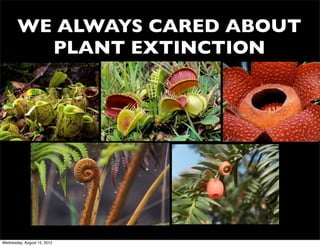
WE ALWAYS CARED ABOUT
         PLANT EXTINCTION


Wednesday, August 15, 2012
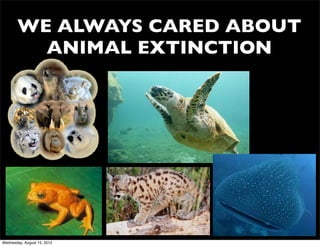
WE ALWAYS CARED ABOUT
         ANIMAL EXTINCTION


Wednesday, August 15, 2012
WE ALWAYS CARED ABOUT
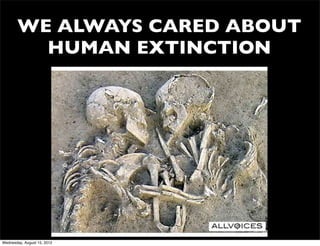
         HUMAN EXTINCTION


Wednesday, August 15, 2012
BUT...MICROBES?
      ALWAYS TAGGED AS
       THE REASON FOR
         EXTINCTION...


Wednesday, August 15, 2012
MICROBES: THREAT TO
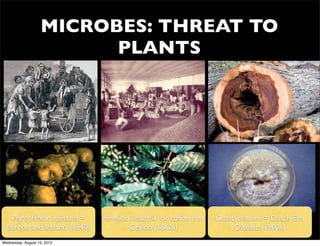
                         PLANTS


   Phytophthora infestans =    Hemileia vastatrix or coffee rust   Cratocyctis ulmi = Dutch Elm
  Europe and Ireland, (1840)           Ceylon (1860s)                    Disease (1900s)
Wednesday, August 15, 2012
MICROBES: THREAT TO
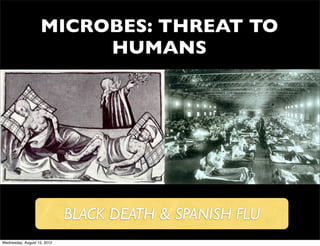
                        HUMANS


                             BLACK DEATH & SPANISH FLU
Wednesday, August 15, 2012
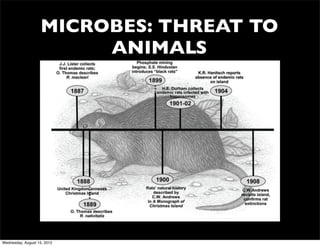
MICROBES: THREAT TO
                        ANIMALS


Wednesday, August 15, 2012
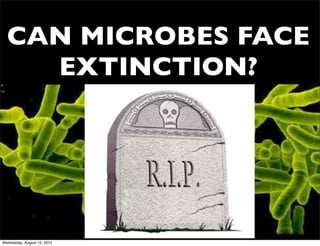
CAN MICROBES FACE
    EXTINCTION?


Wednesday, August 15, 2012
“Extinction is a
                              Principle of
                               Evolution”

Wednesday, August 15, 2012
EXTINCTION
       • Over 99% of the species that have
              ever lived have become extinct
       • Guesstimate: we lose about 1
              species per day
       •      CURRENTLY: they say that we are
              living in a period of mass extinction
              (6th) = brought about by human
              activity as driving force
Wednesday, August 15, 2012
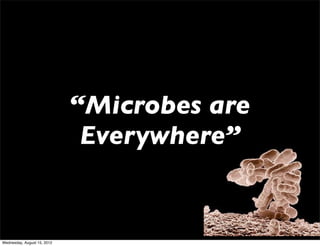
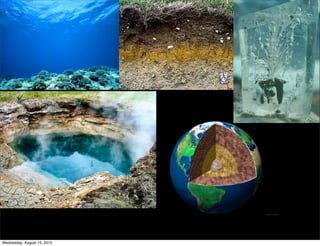
“Microbes are
                              Everywhere”


Wednesday, August 15, 2012
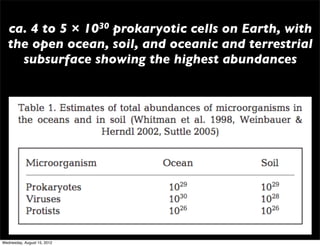
ca. 4 to 5 × 1030 prokaryotic cells on Earth, with
   the open ocean, soil, and oceanic and terrestrial
     subsurface showing the highest abundances


Wednesday, August 15, 2012
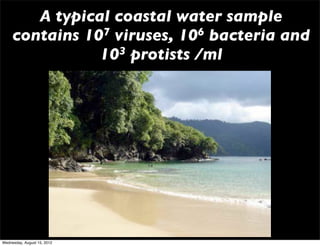
A typical coastal water sample
     contains 10 7 viruses, 106 bacteria and

                10  3 protists /ml


Wednesday, August 15, 2012
Microbes come in diverse forms; however, it
  is not known how many different species of
  microbes inhabit the planet....WHY?


Wednesday, August 15, 2012
Microbes come in diverse forms; however, it
  is not known how many different species of
  microbes inhabit the planet....WHY?

      • problems involved in defining a microbial
              species


Wednesday, August 15, 2012
Microbes come in diverse forms; however, it
  is not known how many different species of
  microbes inhabit the planet....WHY?

      • problems involved in defining a microbial
              species
      •        majority of prokaryotic cells cannot be
              easily grown in culture, which is a
              prerequisite for species identification of
              microbes


Wednesday, August 15, 2012
Microbes come in diverse forms; however, it
  is not known how many different species of
  microbes inhabit the planet....WHY?

      • problems involved in defining a microbial
              species
      •        majority of prokaryotic cells cannot be
              easily grown in culture, which is a
              prerequisite for species identification of
              microbes
      • NOTE: Only about 5000 to 6000 prokaryotic
              species have been formally described
Wednesday, August 15, 2012
With the birth of NON-CULTURE
  METHODOLOGIES....


Wednesday, August 15, 2012
With the birth of NON-CULTURE
  METHODOLOGIES....

      •       At least 1800 species and 1.2 million new genes were
              found using a shotgun sequencing approach of
              microorganisms from a single sample in the Sargasso Sea
              (Venter et al. 2004)


Wednesday, August 15, 2012
With the birth of NON-CULTURE
  METHODOLOGIES....

      •       At least 1800 species and 1.2 million new genes were
              found using a shotgun sequencing approach of
              microorganisms from a single sample in the Sargasso Sea
              (Venter et al. 2004)

      •       About 643 new species were identified using a 99%
              similarity as delineation between prokaryotic phylotypes
              or species based on 16S rRNA gene sequences (Venter
              et al. 2004)


Wednesday, August 15, 2012
With the birth of NON-CULTURE
  METHODOLOGIES....

      •       At least 1800 species and 1.2 million new genes were
              found using a shotgun sequencing approach of
              microorganisms from a single sample in the Sargasso Sea
              (Venter et al. 2004)

      •       About 643 new species were identified using a 99%
              similarity as delineation between prokaryotic phylotypes
              or species based on 16S rRNA gene sequences (Venter
              et al. 2004)

      •       Up to 7000 viral types have been detected using a
              metagenomics (community genomics) approach and it is
              believed that viruses represent the largest unknown
              sequence space (Breitbart et al. 2002)
Wednesday, August 15, 2012
PROKARYOTIC MICROBES AS
          SHAKERS & MOVERS OF THE
                BIOSPHERE


Wednesday, August 15, 2012
PROKARYOTIC MICROBES AS
          SHAKERS & MOVERS OF THE
                BIOSPHERE
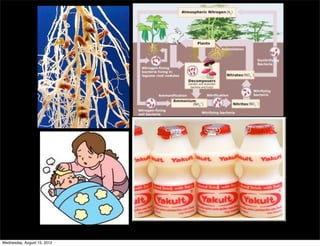
       •      They invented photosynthesis long before eukaryotes
              evolved


Wednesday, August 15, 2012
PROKARYOTIC MICROBES AS
          SHAKERS & MOVERS OF THE
                BIOSPHERE
       •      They invented photosynthesis long before eukaryotes
              evolved

       •      Their oxygen production changed the atmosphere to the
              oxygenic status we are currently experiencing


Wednesday, August 15, 2012
PROKARYOTIC MICROBES AS
          SHAKERS & MOVERS OF THE
                BIOSPHERE
       •      They invented photosynthesis long before eukaryotes
              evolved

       •      Their oxygen production changed the atmosphere to the
              oxygenic status we are currently experiencing

       •      Microorganisms degrade and remineralize organic material,
              others produce methane, reduce sulfate to sulfide, integrate
              molecular nitrogen or change the forms of inorganic
              nitrogen


Wednesday, August 15, 2012
PROKARYOTIC MICROBES AS
          SHAKERS & MOVERS OF THE
                BIOSPHERE
       •      They invented photosynthesis long before eukaryotes
              evolved

       •      Their oxygen production changed the atmosphere to the
              oxygenic status we are currently experiencing

       •      Microorganisms degrade and remineralize organic material,
              others produce methane, reduce sulfate to sulfide, integrate
              molecular nitrogen or change the forms of inorganic
              nitrogen

       •      Microorganisms drive the global cycles of carbon, nitrogen,
              phosphorus and sulfur
Wednesday, August 15, 2012
“WITHOUT
              MICROORGANISMS
               ALL OTHER LIFE
              FORMS WILL NOT
                  SURVIVE”

Wednesday, August 15, 2012
SO HOW DO
                             THEY ADAPT...

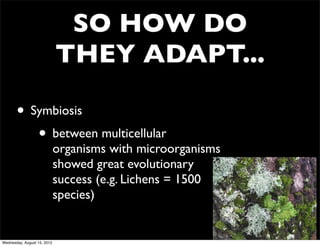
       • Symbiosis
          • between multicellular
                             organisms with microorganisms
                             showed great evolutionary
                             success (e.g. Lichens = 1500
                             species)


Wednesday, August 15, 2012
SO HOW DO
                             THEY ADAPT...

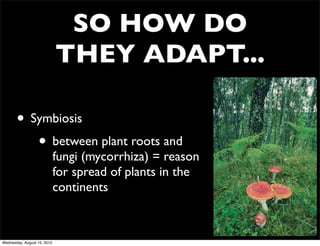
       • Symbiosis
          • between plant roots and
                             fungi (mycorrhiza) = reason
                             for spread of plants in the
                             continents


Wednesday, August 15, 2012
SO HOW DO
                             THEY ADAPT...
       • Symbiosis
          • between coral host and photosynthetic
                             dinoflagellate
                  • coral host obtains sugars from the algae and
                             the     interference of algae with carbon
                             cycling enhances calcification
                  • reason why coral reefs one of most diverse
                             ecosystem
Wednesday, August 15, 2012
SO HOW DO
                             THEY ADAPT...
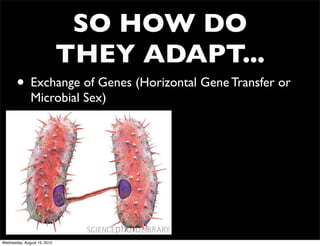
       • Exchange of Genes (Horizontal Gene Transfer or
              Microbial Sex)


Wednesday, August 15, 2012
SO HOW DO
                             THEY ADAPT...
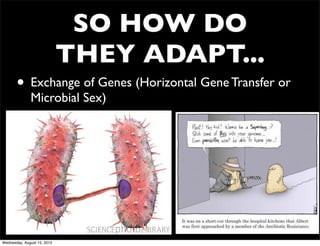
       • Exchange of Genes (Horizontal Gene Transfer or
              Microbial Sex)


Wednesday, August 15, 2012
CONSEQUENCES OF
                    GENE TRANSFERS
       • Cohan (2001)
          • gene transfer among species increases
                             diversity
                   • gene exchange can help to sustain co-
                             existence of genetically different ecotypes
                   • gene exchange would help protect ecotypes
                             from extinction if the adaptive mutation can
                             be transferred
Wednesday, August 15, 2012
BIOGEOGRAPHY
                          OF MICROBES


Wednesday, August 15, 2012
ON DISTRIBUTION
       •      Finlay & Fenchel 1999

       •      “there are no distributional barriers for small free-living
              organisms such as microbes”

       •        Finlay et al. 1996

       •      “global species diversity is inversely related to body
              size”
                   •         suggests that the shear number of protists makes
                             global dispersal very likely by mechanisms such as
                             hurricanes, ocean circulations, groundwater
                             connections, damp fur, etc


Wednesday, August 15, 2012
ON EXTINCTION

       • Cohan, 2001
       • “the large number of microbial cells per
              species makes extinction unlikely,
              extinction is not a threat”
       • works only for “free-living microbes”

Wednesday, August 15, 2012
ON ENDEMICITY

       • More evidence of endemicity and
              biogeography is available for
              microorganisms associated with plants or
              animals
       • Hosts can be considered as islands, which
              permit the development of endemism in
              prokaryotes

Wednesday, August 15, 2012
EVIDENCE OF
                             EXTINCTION


Wednesday, August 15, 2012
EVIDENCES
      • Local extinctions (or strong reductions in the
              abundance of microbial species) probably occur
              quite frequently, e.g. due to clearing of forests,
              agricultural activity or erupting volcanoes
      • a multicellular organism is best regarded as an
              association of species — a	

mini-ecosystem — and
              many of	

 these species exist only in this
              association (e.g. coral reefs destruction, microbes
              in Dodo or mammoth etc)

Wednesday, August 15, 2012
MICROBIAL
                              FOSSILS?


Wednesday, August 15, 2012
ARE THERE FOSSILS TO
                      GUIDE US?
      •      Listgarten & Loomer 2003

      •      Detection of microbial fossils is difficult compared to
             detection of plant and animal fossils

                  •      one of the reasons for our lack of knowledge on
                         extinction rates of microbes.

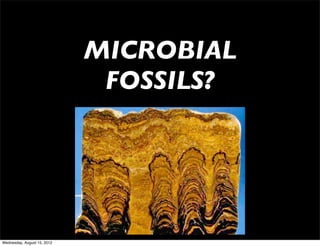
      •      Stromatolites (microbial reefs) were globally distributed in
             the Proterozoic but the abundance decreased markedly and
             at present there are only a few sites left

                  •      suggests at least local extinctions in the geological past
Wednesday, August 15, 2012
ENDANGERED

       • Most free-living microbes are likely not
              endangered, although their local distribution
              might vary considerably and local extinctions
       • However, associated species may be ‘threatened’
              in the same way as the multicellular hosts
              organisms

Wednesday, August 15, 2012
THE INFECTIOUS
                    PARTICLE...
        • Emiliani 1982, 1993
        • Microbes may also become extinct when
               one partner in a predator – prey	

or
               	

 parasite – host	

 system loses the
               	

 adaptation race
        • Example: As long as the virus cannot find
               an alternative host, this means self-
               extinction
Wednesday, August 15, 2012
SO...SHOULD WE
                    CARE ABOUT THE
                    POTENTIAL LOSES
                     OF MICROBIAL
                       SPECIES???
Wednesday, August 15, 2012
RECALL...the prokaryotic
                      DNA world constitutes a
                    ‘global superorganism’ that
                      shares the gene pool by
                   horizontal gene transfer, the
                       microbial ‘kamasutra’

                             (Doolittle 1999)

Wednesday, August 15, 2012
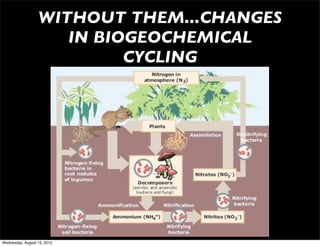
WITHOUT THEM...CHANGES
                     IN BIOGEOCHEMICAL
                           CYCLING


Wednesday, August 15, 2012
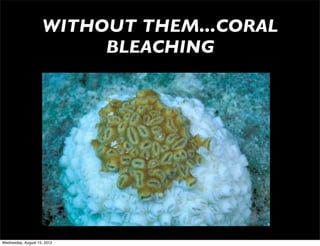
WITHOUT THEM...CORAL
                         BLEACHING


Wednesday, August 15, 2012
YOUR
CONTRIBUTION
  TO THEIR
 EXTINCTION


Wednesday, August 15, 2012
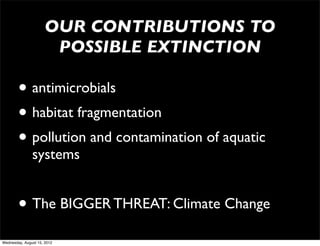
OUR CONTRIBUTIONS TO
                       POSSIBLE EXTINCTION

        • antimicrobials
        • habitat fragmentation
        • pollution and contamination of aquatic
               systems


        • The BIGGER THREAT: Climate Change
Wednesday, August 15, 2012
EXTINCTION
                             OF MICROBES...

                             WE SHOULD CARE!!!
Wednesday, August 15, 2012
THANK YOU
                             VERY MUCH!!!
Wednesday, August 15, 2012

Bioweek talk 2012

  • 1.
    EXTINCTION OF MICROBES... SHOULD WE CARE? Marilen M. Parungao-Balolong, MSc, SMic Associate Professor Bioweek 2012 BIOSeminar Wednesday, August 15, 2012
  • 2.
    WE ALWAYS CAREDABOUT PLANT EXTINCTION Wednesday, August 15, 2012
  • 3.
    WE ALWAYS CAREDABOUT ANIMAL EXTINCTION Wednesday, August 15, 2012
  • 4.
    WE ALWAYS CAREDABOUT HUMAN EXTINCTION Wednesday, August 15, 2012
  • 5.
    BUT...MICROBES? ALWAYS TAGGED AS THE REASON FOR EXTINCTION... Wednesday, August 15, 2012
  • 6.
    MICROBES: THREAT TO PLANTS Phytophthora infestans = Hemileia vastatrix or coffee rust Cratocyctis ulmi = Dutch Elm Europe and Ireland, (1840) Ceylon (1860s) Disease (1900s) Wednesday, August 15, 2012
  • 7.
    MICROBES: THREAT TO HUMANS BLACK DEATH & SPANISH FLU Wednesday, August 15, 2012
  • 8.
    MICROBES: THREAT TO ANIMALS Wednesday, August 15, 2012
  • 9.
    CAN MICROBES FACE EXTINCTION? Wednesday, August 15, 2012
  • 10.
    “Extinction is a Principle of Evolution” Wednesday, August 15, 2012
  • 11.
    EXTINCTION • Over 99% of the species that have ever lived have become extinct • Guesstimate: we lose about 1 species per day • CURRENTLY: they say that we are living in a period of mass extinction (6th) = brought about by human activity as driving force Wednesday, August 15, 2012
  • 12.
    “Microbes are Everywhere” Wednesday, August 15, 2012
  • 13.
  • 14.
  • 15.
    ca. 4 to5 × 1030 prokaryotic cells on Earth, with the open ocean, soil, and oceanic and terrestrial subsurface showing the highest abundances Wednesday, August 15, 2012
  • 16.
    A typical coastalwater sample contains 10 7 viruses, 106 bacteria and 10 3 protists /ml Wednesday, August 15, 2012
  • 17.
    Microbes come indiverse forms; however, it is not known how many different species of microbes inhabit the planet....WHY? Wednesday, August 15, 2012
  • 18.
    Microbes come indiverse forms; however, it is not known how many different species of microbes inhabit the planet....WHY? • problems involved in defining a microbial species Wednesday, August 15, 2012
  • 19.
    Microbes come indiverse forms; however, it is not known how many different species of microbes inhabit the planet....WHY? • problems involved in defining a microbial species • majority of prokaryotic cells cannot be easily grown in culture, which is a prerequisite for species identification of microbes Wednesday, August 15, 2012
  • 20.
    Microbes come indiverse forms; however, it is not known how many different species of microbes inhabit the planet....WHY? • problems involved in defining a microbial species • majority of prokaryotic cells cannot be easily grown in culture, which is a prerequisite for species identification of microbes • NOTE: Only about 5000 to 6000 prokaryotic species have been formally described Wednesday, August 15, 2012
  • 21.
    With the birthof NON-CULTURE METHODOLOGIES.... Wednesday, August 15, 2012
  • 22.
    With the birthof NON-CULTURE METHODOLOGIES.... • At least 1800 species and 1.2 million new genes were found using a shotgun sequencing approach of microorganisms from a single sample in the Sargasso Sea (Venter et al. 2004) Wednesday, August 15, 2012
  • 23.
    With the birthof NON-CULTURE METHODOLOGIES.... • At least 1800 species and 1.2 million new genes were found using a shotgun sequencing approach of microorganisms from a single sample in the Sargasso Sea (Venter et al. 2004) • About 643 new species were identified using a 99% similarity as delineation between prokaryotic phylotypes or species based on 16S rRNA gene sequences (Venter et al. 2004) Wednesday, August 15, 2012
  • 24.
    With the birthof NON-CULTURE METHODOLOGIES.... • At least 1800 species and 1.2 million new genes were found using a shotgun sequencing approach of microorganisms from a single sample in the Sargasso Sea (Venter et al. 2004) • About 643 new species were identified using a 99% similarity as delineation between prokaryotic phylotypes or species based on 16S rRNA gene sequences (Venter et al. 2004) • Up to 7000 viral types have been detected using a metagenomics (community genomics) approach and it is believed that viruses represent the largest unknown sequence space (Breitbart et al. 2002) Wednesday, August 15, 2012
  • 25.
    PROKARYOTIC MICROBES AS SHAKERS & MOVERS OF THE BIOSPHERE Wednesday, August 15, 2012
  • 26.
    PROKARYOTIC MICROBES AS SHAKERS & MOVERS OF THE BIOSPHERE • They invented photosynthesis long before eukaryotes evolved Wednesday, August 15, 2012
  • 27.
    PROKARYOTIC MICROBES AS SHAKERS & MOVERS OF THE BIOSPHERE • They invented photosynthesis long before eukaryotes evolved • Their oxygen production changed the atmosphere to the oxygenic status we are currently experiencing Wednesday, August 15, 2012
  • 28.
    PROKARYOTIC MICROBES AS SHAKERS & MOVERS OF THE BIOSPHERE • They invented photosynthesis long before eukaryotes evolved • Their oxygen production changed the atmosphere to the oxygenic status we are currently experiencing • Microorganisms degrade and remineralize organic material, others produce methane, reduce sulfate to sulfide, integrate molecular nitrogen or change the forms of inorganic nitrogen Wednesday, August 15, 2012
  • 29.
    PROKARYOTIC MICROBES AS SHAKERS & MOVERS OF THE BIOSPHERE • They invented photosynthesis long before eukaryotes evolved • Their oxygen production changed the atmosphere to the oxygenic status we are currently experiencing • Microorganisms degrade and remineralize organic material, others produce methane, reduce sulfate to sulfide, integrate molecular nitrogen or change the forms of inorganic nitrogen • Microorganisms drive the global cycles of carbon, nitrogen, phosphorus and sulfur Wednesday, August 15, 2012
  • 30.
    “WITHOUT MICROORGANISMS ALL OTHER LIFE FORMS WILL NOT SURVIVE” Wednesday, August 15, 2012
  • 31.
    SO HOW DO THEY ADAPT... • Symbiosis • between multicellular organisms with microorganisms showed great evolutionary success (e.g. Lichens = 1500 species) Wednesday, August 15, 2012
  • 32.
    SO HOW DO THEY ADAPT... • Symbiosis • between plant roots and fungi (mycorrhiza) = reason for spread of plants in the continents Wednesday, August 15, 2012
  • 33.
    SO HOW DO THEY ADAPT... • Symbiosis • between coral host and photosynthetic dinoflagellate • coral host obtains sugars from the algae and the interference of algae with carbon cycling enhances calcification • reason why coral reefs one of most diverse ecosystem Wednesday, August 15, 2012
  • 34.
    SO HOW DO THEY ADAPT... • Exchange of Genes (Horizontal Gene Transfer or Microbial Sex) Wednesday, August 15, 2012
  • 35.
    SO HOW DO THEY ADAPT... • Exchange of Genes (Horizontal Gene Transfer or Microbial Sex) Wednesday, August 15, 2012
  • 36.
    CONSEQUENCES OF GENE TRANSFERS • Cohan (2001) • gene transfer among species increases diversity • gene exchange can help to sustain co- existence of genetically different ecotypes • gene exchange would help protect ecotypes from extinction if the adaptive mutation can be transferred Wednesday, August 15, 2012
  • 37.
    BIOGEOGRAPHY OF MICROBES Wednesday, August 15, 2012
  • 38.
    ON DISTRIBUTION • Finlay & Fenchel 1999 • “there are no distributional barriers for small free-living organisms such as microbes” • Finlay et al. 1996 • “global species diversity is inversely related to body size” • suggests that the shear number of protists makes global dispersal very likely by mechanisms such as hurricanes, ocean circulations, groundwater connections, damp fur, etc Wednesday, August 15, 2012
  • 39.
    ON EXTINCTION • Cohan, 2001 • “the large number of microbial cells per species makes extinction unlikely, extinction is not a threat” • works only for “free-living microbes” Wednesday, August 15, 2012
  • 40.
    ON ENDEMICITY • More evidence of endemicity and biogeography is available for microorganisms associated with plants or animals • Hosts can be considered as islands, which permit the development of endemism in prokaryotes Wednesday, August 15, 2012
  • 41.
    EVIDENCE OF EXTINCTION Wednesday, August 15, 2012
  • 42.
    EVIDENCES • Local extinctions (or strong reductions in the abundance of microbial species) probably occur quite frequently, e.g. due to clearing of forests, agricultural activity or erupting volcanoes • a multicellular organism is best regarded as an association of species — a mini-ecosystem — and many of these species exist only in this association (e.g. coral reefs destruction, microbes in Dodo or mammoth etc) Wednesday, August 15, 2012
  • 43.
    MICROBIAL FOSSILS? Wednesday, August 15, 2012
  • 44.
    ARE THERE FOSSILSTO GUIDE US? • Listgarten & Loomer 2003 • Detection of microbial fossils is difficult compared to detection of plant and animal fossils • one of the reasons for our lack of knowledge on extinction rates of microbes. • Stromatolites (microbial reefs) were globally distributed in the Proterozoic but the abundance decreased markedly and at present there are only a few sites left • suggests at least local extinctions in the geological past Wednesday, August 15, 2012
  • 45.
    ENDANGERED • Most free-living microbes are likely not endangered, although their local distribution might vary considerably and local extinctions • However, associated species may be ‘threatened’ in the same way as the multicellular hosts organisms Wednesday, August 15, 2012
  • 46.
    THE INFECTIOUS PARTICLE... • Emiliani 1982, 1993 • Microbes may also become extinct when one partner in a predator – prey or parasite – host system loses the adaptation race • Example: As long as the virus cannot find an alternative host, this means self- extinction Wednesday, August 15, 2012
  • 47.
    SO...SHOULD WE CARE ABOUT THE POTENTIAL LOSES OF MICROBIAL SPECIES??? Wednesday, August 15, 2012
  • 48.
    RECALL...the prokaryotic DNA world constitutes a ‘global superorganism’ that shares the gene pool by horizontal gene transfer, the microbial ‘kamasutra’ (Doolittle 1999) Wednesday, August 15, 2012
  • 49.
  • 50.
    WITHOUT THEM...CHANGES IN BIOGEOCHEMICAL CYCLING Wednesday, August 15, 2012
  • 51.
    WITHOUT THEM...CORAL BLEACHING Wednesday, August 15, 2012
  • 52.
    YOUR CONTRIBUTION TOTHEIR EXTINCTION Wednesday, August 15, 2012
  • 53.
    OUR CONTRIBUTIONS TO POSSIBLE EXTINCTION • antimicrobials • habitat fragmentation • pollution and contamination of aquatic systems • The BIGGER THREAT: Climate Change Wednesday, August 15, 2012
  • 54.
    EXTINCTION OF MICROBES... WE SHOULD CARE!!! Wednesday, August 15, 2012
  • 55.
    THANK YOU VERY MUCH!!! Wednesday, August 15, 2012