MODULE 1
PERCEPTION OF NATURE, WORLD VIEWS &
ENVIRONMENTAL ETHICS
Marilen M. Parungao-Balolong
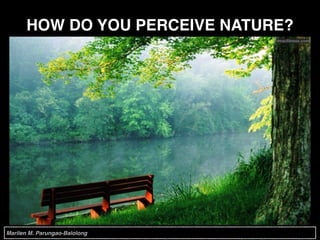
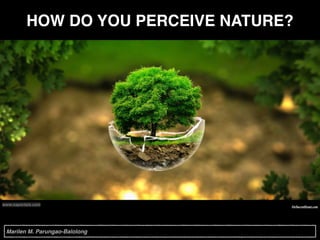
HOW DO YOU PERCEIVE NATURE?
tmacfitness.com
Marilen M. Parungao-Balolong
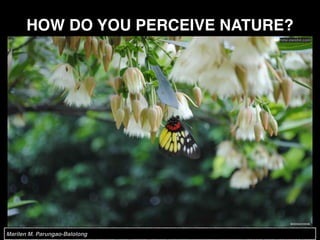
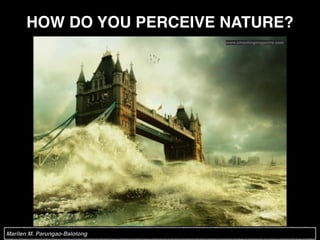
HOW DO YOU PERCEIVE NATURE?
hdw.eweb4.com
Marilen M. Parungao-Balolong
HOW DO YOU PERCEIVE NATURE?
www.smashingmagazine.com
www.naportals.com
Marilen M. Parungao-Balolong
HOW DO YOU PERCEIVE NATURE?
www.smashingmagazine.com
Marilen M. Parungao-Balolong
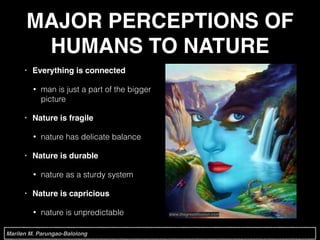
MAJOR PERCEPTIONS OF
HUMANS TO NATURE
• Everything is connected!
• man is just a part of the bigger
picture
• Nature is fragile!
• nature has delicate balance
• Nature is durable!
• nature as a sturdy system
• Nature is capricious!
• nature is unpredictable www.thegreatillusion.com
Marilen M. Parungao-Balolong
ENVIRONMENTAL ETHICS
AND WORLD VIEWS
fye2011.blogspot.comMarilen M. Parungao-Balolong
WHAT IS ETHICS?
“A discipline dealing with
what is good and bad,
with moral duty and
obligation”
Marilen M. Parungao-Balolong
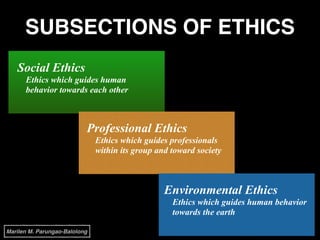
SUBSECTIONS OF ETHICS
Social Ethics
Ethics which guides human
behavior towards each other
Professional Ethics
Ethics which guides professionals
within its group and toward society
Environmental Ethics
Ethics which guides human behavior
towards the earth
Marilen M. Parungao-Balolong
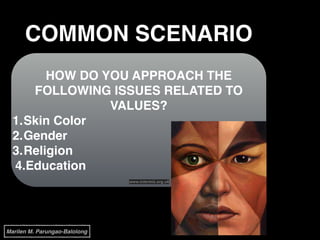
COMMON SCENARIO
HOW DO YOU APPROACH THE
FOLLOWING ISSUES RELATED TO
VALUES?!
1.Skin Color!
2.Gender!
3.Religion!
4.Education
www.intermix.org.uk
Marilen M. Parungao-Balolong
LETS’S TRY THE FOLLOWING?
WHAT IS YOUR REACTION?
• Some animals have more feelings than others, and
we should care for those with the most feelings first!
• I have mourned the loss of a plant!
• It is okay to pick just one flower in class!
• It is okay to pick just 50 flowers in class
Marilen M. Parungao-Balolong
LETS’S TRY THE FOLLOWING?
WHAT IS YOUR REACTION?
• I have secretly set insects free from the house so
they will not be killed!
• Would pick a bouquet of wild flowers, even if they
would die because of it!
• I would harm myself in defense of a forest
ecosystem (i.e. chaining myself to a tree)!
• The death of a household pet has been more
traumatizing than the death of humans
Marilen M. Parungao-Balolong
LETS’S TRY THE FOLLOWING?
WHAT IS YOUR REACTION?
• I have no problem with eating meat!
• Will eat meat, even if I don’t know how the animal
was treated during its life!
• I would kill a deer for a source of meat!
• I would kill a deer just to help control population
Marilen M. Parungao-Balolong
LETS’S TRY THE FOLLOWING?
WHAT IS YOUR REACTION?
• I would kill a deer for a trophy!
• It is better to test cosmetics and medicine on non-
humans before humans than the other way around!
• The world would be better without mosquitoes!
• The world would be better without dogs and cats!
• The world would be better without humans
Marilen M. Parungao-Balolong
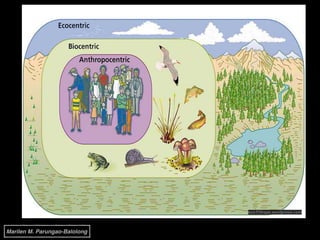
THE ENVIRONMENTAL
ETHICAL VALUE SYSTEM
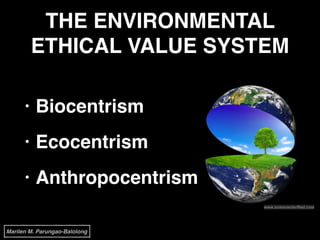
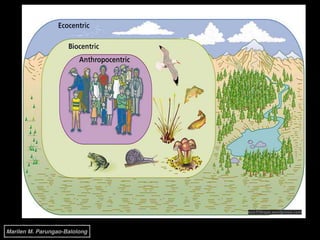
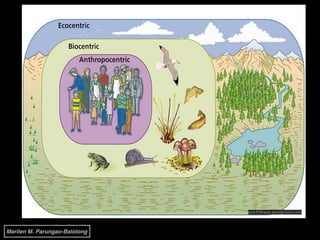
• Biocentrism!
• Ecocentrism!
• Anthropocentrism
www.scienceclarified.com
Marilen M. Parungao-Balolong
BIOCENTRISM
• Humans are members of the Earth’s
community!
• All species are integral elements in a system of
interdependence!
• All organisms are centers of life, each pursuing
its own good!
• Humans are not inherently superior to other
living things
Marilen M. Parungao-Balolong
eco110rope.wordpress.com
Marilen M. Parungao-Balolong
ECOCENTRISM
• Expansion of biocentrism by including
abiotic components of the environment!
• It cares less about individual life forms but
emphasizes interaction between them and
fosters a system approach
Marilen M. Parungao-Balolong
eco110rope.wordpress.com
Marilen M. Parungao-Balolong
ANTHROPOCENTRISM
• Emphasizes human domination over nature
and views non-human environment as a
bundle of natural resources to be managed
and exploited for maximal human gain!
• The ecosystems have only instrumental
value, not intrinsic worth
Marilen M. Parungao-Balolong
eco110rope.wordpress.com
Marilen M. Parungao-Balolong
ONE THING IN COMMON…
All three value systems have
the human stewardship for
the natural world in
common, however they
differ sharply as to whom
they do it
Marilen M. Parungao-Balolong
PROBLEMS OFTEN ARISE WITH
ANTHROPOCENTRIC VIEW…
Overpopulation
Preoccupation with
possession, power and
ambition
Marilen M. Parungao-Balolong
HOW COULD IT WORK?
Adopt Ecocentric Values
Re-connect emotionally to the natural world
!
Live simply so others may simply live
!
Welcome opportunity to conserve the earth’s
resources
Marilen M. Parungao-Balolong
ENVIRONMENTAL
JUSTICE in ETHICS
What Is Environmental Justice?
The EPA s Office of Environmental Justice defines Environmental
Justice as:
The fair treatment and meaningful involvement of all people regardless
of race, color, national origin, or income with respect to the
development, implementation, and enforcement of environmental laws,
regulations, and policies. Fair treatment means that no group of people,
including racial, ethnic, or socioeconomic group should bear a
disproportionate share of the negative environmental consequences
resulting from industrial, municipal, and commercial operations or the
execution of federal, state, local, and tribal programs and policies.
Marilen M. Parungao-Balolong

NS5 Lecture 1: Environmental Ethics

  • 1.
    MODULE 1 PERCEPTION OFNATURE, WORLD VIEWS & ENVIRONMENTAL ETHICS Marilen M. Parungao-Balolong
  • 2.
    HOW DO YOUPERCEIVE NATURE? tmacfitness.com Marilen M. Parungao-Balolong
  • 3.
    HOW DO YOUPERCEIVE NATURE? hdw.eweb4.com Marilen M. Parungao-Balolong
  • 4.
    HOW DO YOUPERCEIVE NATURE? www.smashingmagazine.com www.naportals.com Marilen M. Parungao-Balolong
  • 5.
    HOW DO YOUPERCEIVE NATURE? www.smashingmagazine.com Marilen M. Parungao-Balolong
  • 6.
    MAJOR PERCEPTIONS OF HUMANSTO NATURE • Everything is connected! • man is just a part of the bigger picture • Nature is fragile! • nature has delicate balance • Nature is durable! • nature as a sturdy system • Nature is capricious! • nature is unpredictable www.thegreatillusion.com Marilen M. Parungao-Balolong
  • 7.
    ENVIRONMENTAL ETHICS AND WORLDVIEWS fye2011.blogspot.comMarilen M. Parungao-Balolong
  • 8.
    WHAT IS ETHICS? “Adiscipline dealing with what is good and bad, with moral duty and obligation” Marilen M. Parungao-Balolong
  • 9.
    SUBSECTIONS OF ETHICS SocialEthics Ethics which guides human behavior towards each other Professional Ethics Ethics which guides professionals within its group and toward society Environmental Ethics Ethics which guides human behavior towards the earth Marilen M. Parungao-Balolong
  • 10.
    COMMON SCENARIO HOW DOYOU APPROACH THE FOLLOWING ISSUES RELATED TO VALUES?! 1.Skin Color! 2.Gender! 3.Religion! 4.Education www.intermix.org.uk Marilen M. Parungao-Balolong
  • 11.
    LETS’S TRY THEFOLLOWING? WHAT IS YOUR REACTION? • Some animals have more feelings than others, and we should care for those with the most feelings first! • I have mourned the loss of a plant! • It is okay to pick just one flower in class! • It is okay to pick just 50 flowers in class Marilen M. Parungao-Balolong
  • 12.
    LETS’S TRY THEFOLLOWING? WHAT IS YOUR REACTION? • I have secretly set insects free from the house so they will not be killed! • Would pick a bouquet of wild flowers, even if they would die because of it! • I would harm myself in defense of a forest ecosystem (i.e. chaining myself to a tree)! • The death of a household pet has been more traumatizing than the death of humans Marilen M. Parungao-Balolong
  • 13.
    LETS’S TRY THEFOLLOWING? WHAT IS YOUR REACTION? • I have no problem with eating meat! • Will eat meat, even if I don’t know how the animal was treated during its life! • I would kill a deer for a source of meat! • I would kill a deer just to help control population Marilen M. Parungao-Balolong
  • 14.
    LETS’S TRY THEFOLLOWING? WHAT IS YOUR REACTION? • I would kill a deer for a trophy! • It is better to test cosmetics and medicine on non- humans before humans than the other way around! • The world would be better without mosquitoes! • The world would be better without dogs and cats! • The world would be better without humans Marilen M. Parungao-Balolong
  • 15.
    THE ENVIRONMENTAL ETHICAL VALUESYSTEM • Biocentrism! • Ecocentrism! • Anthropocentrism www.scienceclarified.com Marilen M. Parungao-Balolong
  • 16.
    BIOCENTRISM • Humans aremembers of the Earth’s community! • All species are integral elements in a system of interdependence! • All organisms are centers of life, each pursuing its own good! • Humans are not inherently superior to other living things Marilen M. Parungao-Balolong
  • 17.
  • 18.
    ECOCENTRISM • Expansion ofbiocentrism by including abiotic components of the environment! • It cares less about individual life forms but emphasizes interaction between them and fosters a system approach Marilen M. Parungao-Balolong
  • 19.
  • 20.
    ANTHROPOCENTRISM • Emphasizes humandomination over nature and views non-human environment as a bundle of natural resources to be managed and exploited for maximal human gain! • The ecosystems have only instrumental value, not intrinsic worth Marilen M. Parungao-Balolong
  • 21.
  • 22.
    ONE THING INCOMMON… All three value systems have the human stewardship for the natural world in common, however they differ sharply as to whom they do it Marilen M. Parungao-Balolong
  • 23.
    PROBLEMS OFTEN ARISEWITH ANTHROPOCENTRIC VIEW… Overpopulation Preoccupation with possession, power and ambition Marilen M. Parungao-Balolong
  • 24.
    HOW COULD ITWORK? Adopt Ecocentric Values Re-connect emotionally to the natural world ! Live simply so others may simply live ! Welcome opportunity to conserve the earth’s resources Marilen M. Parungao-Balolong
  • 25.
    ENVIRONMENTAL JUSTICE in ETHICS WhatIs Environmental Justice? The EPA s Office of Environmental Justice defines Environmental Justice as: The fair treatment and meaningful involvement of all people regardless of race, color, national origin, or income with respect to the development, implementation, and enforcement of environmental laws, regulations, and policies. Fair treatment means that no group of people, including racial, ethnic, or socioeconomic group should bear a disproportionate share of the negative environmental consequences resulting from industrial, municipal, and commercial operations or the execution of federal, state, local, and tribal programs and policies. Marilen M. Parungao-Balolong