PRESENTED BY,
Habiba Khatun
Msc-Zoology
4TH semester
Roll no- 76
ANTIGEN
Antigen is a substances usually protein in nature and
sometimes polysaccharide, that generates a specific immune
response and induces the formation of a specific antibody or
specially sensitized T cells or both.
Although all antigens are recognized by
specific lymphocytes or by antibodies,
only some antigens are capable of
activating lymphocytes. Molecules that
stimulate immune responses are called
Immunogens.
Epitope is immunologically active regions of an immunogen (or
antigen) that binds to antigen-specific membrane receptors on
lymphocytes or to secreted antibodies. It is also called antigenic
determinants.
Autoantigens, for example, are a person’s own self antigens.
Examples: Thyroglobulin, DNA, Corneal tissue, etc.
Alloantigens are antigens found in different members of the
same species (the red blood cell antigens A and B are examples).
Heterophile antigens are identical antigens found in the cells of
different species. Examples: Forrssman antigen, Cross-reacting
microbial antigens, etc.
Chemical Nature of Antigens (Immunogens)
A. Proteins
The vast majority of immunogens are proteins. These may be pure
proteins or they may be glycoproteins or lipoproteins. In general,
proteins are usually very good immunogens.
B. Polysaccharides
Pure polysaccharides and lipopolysaccharides are good
immunogens.
C. Nucleic Acids
Nucleic acids are usually poorly immunogenic. However, they
may become immunogenic when single stranded or when
complexed with proteins.
D. Lipids
In general lipids are non-immunogenic, although they may be
haptens.
BASED ON IMMUNOGENICITY
Complete antigen : Substances which can induce antibody formation
by themselves and can react specifically with these antibodies
Incomplete antigen (haptens): substances unable to induce antibody
formation on its own but can become immunogenic when covalently
linked to proteins, called carrier proteins .they are of two types:
1. Complex
2. Simple
TYPES OF ANTIGENS
BASED ON ORIGIN:
 Exogenous antigens
Exogenous antigens are antigens that have entered the body from the outside,
for example by inhalation, ingestion, or injection. The immune system's response
to exogenous antigens is often subclinical.
 Endogenous antigens
Endogenous antigens are antigens that have been generated within previously
normal cells as a result of normal cell metabolism, or because of viral or
intracellular bacterial infection.
 Autoantigens
An autoantigen is usually a normal protein or complex of proteins (and sometimes
DNA or RNA) that is recognized by the immune system of patients suffering from
a specific autoimmune disease. These antigens should, under normal conditions,
not be the target of the immune system, but, due to mainly genetic and
environmental factors, the normal immunological tolerance for such an antigen
has been lost in these patients.
 Isoantigens
 Heterophile antigen
1.FOREIGNNESS
Antigen must be foreignness to immune system:
According to Burnnet’s clone selection theory , foreignness ( non-self) means substances
that never contact with lymphocytes during embryo period
2.SIZE
 Larger molecules are highly antigenic
 Lower molecular weight are either non antigenic or weakly antigenic
3.Chemical Nature
 Most naturally occurring antigens are either proteins or polysaccharides.
 Lipids and nucleic acids are less antigenic on their own but do so when combined
with proteins
4. SUSCEPTIBILITY TO TISSUE ENZYMES
 Substances which can be metabolised and are able to the action of tissue enzyme
behave as antigen.
5.Antigenic specificity
 It depends upon epitope
 Position of epitope in the antigen molecule is important for specificity.
6.Species specificity
 Tissue of all individual in species possess species specific antigens.
7.Isospecificity
 It depends on isoantigens which may be found in some but not all members of
species.
9.Organspecificity
10.Heterogenic specificity
 The same or closely related antigen may some time occur in different biological
species, classes and kingdom are know as heterophile antigens.
 Antibodies to these antigen produced by one species cross react with antigen of
other species. Eg. Forssman Ag, Weil-felix rxn., Paul-Bunnell test
 Some organs such as the brain, kidney and lens protein of different species share
the same antigens. such antigens are the characteristics of an organ or tissue
found in different species and they are known as organ specific antigen.
8.Autospecificity
 Self antigens are generally non-antigenic but in some case such as lens protein
and sperm these are not recognised as self antigen because they are absent
during the embryonic life and develop later.
11. Degradability
•Antigens that are easily phagocytosed are generally more immunogenic.
•This is because for most antigens (T-dependant antigens) the development of an immune
response requires that the antigen be phagocytosed, processed and presented to helper T
cells by an antigen presenting cell (APC).
12. Dose of the antigen
•The dose of administration of an immunogen can influence its immunogenicity.
•There is a dose of antigen above or below which the immune response will not be optimal.
13. Route of Administration
•Generally the subcutaneous route is better than the intravenous or intragastric routes.
•The route of antigen administration can also alter the nature of the response.
•Antigen administered intravenously is carried first to the spleen, whereas antigen
administered subcutaneously moves first to local lymph nodes.
14. Adjuvants
•Substances that can enhance the immune response to an immunogen are called adjuvants.
•The use of adjuvants, however, is often hampered by undesirable side effects such as fever
and inflammation.
•Example: aluminum hydroxide.
SUPERANTIGENS
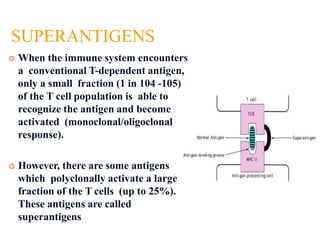
 When the immune system encounters
a conventional T-dependent antigen,
only a small fraction (1 in 104 -105)
of the T cell population is able to
recognize the antigen and become
activated (monoclonal/oligoclonal
response).
 However, there are some antigens
which polyclonally activate a large
fraction of the T cells (up to 25%).
These antigens are called
superantigens
TESTS FOR ANTIGEN DETECTION
Direct ELISA
Direct Immunofluoresence
Radio Immuno Assay(RIA)
Neutralization test
Complement fixation test(CFT)
Immunohistochemistry
Antigen

Antigen

  • 1.
  • 2.
    ANTIGEN Antigen is asubstances usually protein in nature and sometimes polysaccharide, that generates a specific immune response and induces the formation of a specific antibody or specially sensitized T cells or both. Although all antigens are recognized by specific lymphocytes or by antibodies, only some antigens are capable of activating lymphocytes. Molecules that stimulate immune responses are called Immunogens.
  • 3.
    Epitope is immunologicallyactive regions of an immunogen (or antigen) that binds to antigen-specific membrane receptors on lymphocytes or to secreted antibodies. It is also called antigenic determinants. Autoantigens, for example, are a person’s own self antigens. Examples: Thyroglobulin, DNA, Corneal tissue, etc. Alloantigens are antigens found in different members of the same species (the red blood cell antigens A and B are examples). Heterophile antigens are identical antigens found in the cells of different species. Examples: Forrssman antigen, Cross-reacting microbial antigens, etc.
  • 4.
    Chemical Nature ofAntigens (Immunogens) A. Proteins The vast majority of immunogens are proteins. These may be pure proteins or they may be glycoproteins or lipoproteins. In general, proteins are usually very good immunogens. B. Polysaccharides Pure polysaccharides and lipopolysaccharides are good immunogens. C. Nucleic Acids Nucleic acids are usually poorly immunogenic. However, they may become immunogenic when single stranded or when complexed with proteins. D. Lipids In general lipids are non-immunogenic, although they may be haptens.
  • 5.
    BASED ON IMMUNOGENICITY Completeantigen : Substances which can induce antibody formation by themselves and can react specifically with these antibodies Incomplete antigen (haptens): substances unable to induce antibody formation on its own but can become immunogenic when covalently linked to proteins, called carrier proteins .they are of two types: 1. Complex 2. Simple TYPES OF ANTIGENS
  • 6.
    BASED ON ORIGIN: Exogenous antigens Exogenous antigens are antigens that have entered the body from the outside, for example by inhalation, ingestion, or injection. The immune system's response to exogenous antigens is often subclinical.  Endogenous antigens Endogenous antigens are antigens that have been generated within previously normal cells as a result of normal cell metabolism, or because of viral or intracellular bacterial infection.  Autoantigens An autoantigen is usually a normal protein or complex of proteins (and sometimes DNA or RNA) that is recognized by the immune system of patients suffering from a specific autoimmune disease. These antigens should, under normal conditions, not be the target of the immune system, but, due to mainly genetic and environmental factors, the normal immunological tolerance for such an antigen has been lost in these patients.  Isoantigens  Heterophile antigen
  • 7.
    1.FOREIGNNESS Antigen must beforeignness to immune system: According to Burnnet’s clone selection theory , foreignness ( non-self) means substances that never contact with lymphocytes during embryo period 2.SIZE  Larger molecules are highly antigenic  Lower molecular weight are either non antigenic or weakly antigenic 3.Chemical Nature  Most naturally occurring antigens are either proteins or polysaccharides.  Lipids and nucleic acids are less antigenic on their own but do so when combined with proteins
  • 8.
    4. SUSCEPTIBILITY TOTISSUE ENZYMES  Substances which can be metabolised and are able to the action of tissue enzyme behave as antigen. 5.Antigenic specificity  It depends upon epitope  Position of epitope in the antigen molecule is important for specificity. 6.Species specificity  Tissue of all individual in species possess species specific antigens. 7.Isospecificity  It depends on isoantigens which may be found in some but not all members of species.
  • 9.
    9.Organspecificity 10.Heterogenic specificity  Thesame or closely related antigen may some time occur in different biological species, classes and kingdom are know as heterophile antigens.  Antibodies to these antigen produced by one species cross react with antigen of other species. Eg. Forssman Ag, Weil-felix rxn., Paul-Bunnell test  Some organs such as the brain, kidney and lens protein of different species share the same antigens. such antigens are the characteristics of an organ or tissue found in different species and they are known as organ specific antigen. 8.Autospecificity  Self antigens are generally non-antigenic but in some case such as lens protein and sperm these are not recognised as self antigen because they are absent during the embryonic life and develop later.
  • 10.
    11. Degradability •Antigens thatare easily phagocytosed are generally more immunogenic. •This is because for most antigens (T-dependant antigens) the development of an immune response requires that the antigen be phagocytosed, processed and presented to helper T cells by an antigen presenting cell (APC). 12. Dose of the antigen •The dose of administration of an immunogen can influence its immunogenicity. •There is a dose of antigen above or below which the immune response will not be optimal. 13. Route of Administration •Generally the subcutaneous route is better than the intravenous or intragastric routes. •The route of antigen administration can also alter the nature of the response. •Antigen administered intravenously is carried first to the spleen, whereas antigen administered subcutaneously moves first to local lymph nodes. 14. Adjuvants •Substances that can enhance the immune response to an immunogen are called adjuvants. •The use of adjuvants, however, is often hampered by undesirable side effects such as fever and inflammation. •Example: aluminum hydroxide.
  • 11.
    SUPERANTIGENS  When theimmune system encounters a conventional T-dependent antigen, only a small fraction (1 in 104 -105) of the T cell population is able to recognize the antigen and become activated (monoclonal/oligoclonal response).  However, there are some antigens which polyclonally activate a large fraction of the T cells (up to 25%). These antigens are called superantigens
  • 12.
    TESTS FOR ANTIGENDETECTION Direct ELISA Direct Immunofluoresence Radio Immuno Assay(RIA) Neutralization test Complement fixation test(CFT) Immunohistochemistry