NUCLEIC ACID RECOGNITION BY
THE INNATE IMMUNE SYSTEM
Presented by:
Ankur Sharma
PhD Scholar
CREDIT SEMINAR
ON
Pattern Recognition
Receptors (PRRs)
Endolysosomal
Toll-like receptors
Cytosolic
RLRs
(RIG-I, MDA5)
DNA sensors
NUCLEIC ACID RECOGNIZING PRRs
Severe fungal infection in a fruit fly (color) with a disabling mutation
in the signal-transduction pathway required for the synthesis of the
antifungal peptide drosomycin.
[Electron micrograph adapted from B. Lemaitre et al., 1996, Cell 86: 973;
courtesy of J.A. Hoffman, University of Strasbourg.]
Toll-LIKE RECEPTORS (TLRs)
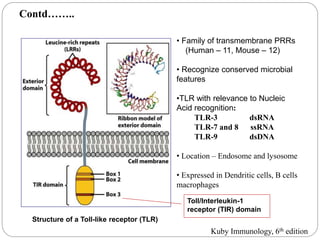
Toll/Interleukin-1
receptor (TIR) domain
Structure of a Toll-like receptor (TLR)
• Family of transmembrane PRRs
(Human – 11, Mouse – 12)
• Recognize conserved microbial
features
•TLR with relevance to Nucleic
Acid recognition:
TLR-3 dsRNA
TLR-7 and 8 ssRNA
TLR-9 dsDNA
• Location – Endosome and lysosome
• Expressed in Dendritic cells, B cells
macrophages
Contd……..
Kuby Immunology, 6th edition
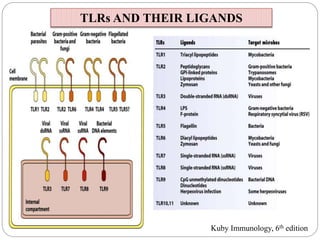
TLRs AND THEIR LIGANDS
Kuby Immunology, 6th edition
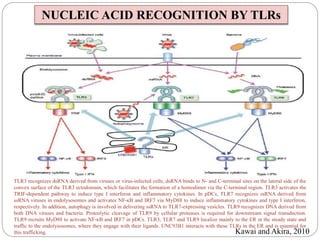
TLR3 recognizes dsRNA derived from viruses or virus-infected cells; dsRNA binds to N- and C-terminal sites on the lateral side of the
convex surface of the TLR3 ectodomain, which facilitates the formation of a homodimer via the C-terminal region. TLR3 activates the
TRIF-dependent pathway to induce type I interferon and inflammatory cytokines. In pDCs, TLR7 recognizes ssRNA derived from
ssRNA viruses in endolysosomes and activates NF-κB and IRF7 via MyD88 to induce inflammatory cytokines and type I interferon,
respectively. In addition, autophagy is involved in delivering ssRNA to TLR7-expressing vesicles. TLR9 recognizes DNA derived from
both DNA viruses and bacteria. Proteolytic cleavage of TLR9 by cellular proteases is required for downstream signal transduction.
TLR9 recruits MyD88 to activate NF-κB and IRF7 in pDCs. TLR3, TLR7 and TLR9 localize mainly to the ER in the steady state and
traffic to the endolysosomes, where they engage with their ligands. UNC93B1 interacts with these TLRs in the ER and is essential for
this trafficking. Kawai and Akira, 2010
NUCLEIC ACID RECOGNITION BY TLRs
 TLR 3
 First TLR implicated in viral nucleic acid sensing
 Binds with dsRNA with very less sequence specificty
 Minimum 40bp length required for responsiveness and
affinity increased in proportion to dsRNA length
(Botos et al., 2009)
 Also recognize synthetic RNA analogs:
Poly inosine – poly cytidylic acid [poly(I:C)]
(Alexopoulou et al., 2001)
 Recognizes the genomic DNA of Reo virus, dsRNA
intermediates of West Nile virus, encephalomyocarditis virus
and certain siRNAs
LIGAND SPECIFICITY AND MICROBIAL
RECOGNITION
C terminus
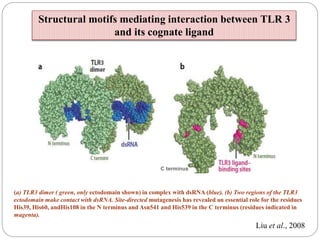
(a) TLR3 dimer ( green, only ectodomain shown) in complex with dsRNA (blue). (b) Two regions of the TLR3
ectodomain make contact with dsRNA. Site-directed mutagenesis has revealed an essential role for the residues
His39, His60, andHis108 in the N terminus and Asn541 and His539 in the C terminus (residues indicated in
magenta).
Liu et al., 2008
Structural motifs mediating interaction between TLR 3
and its cognate ligand
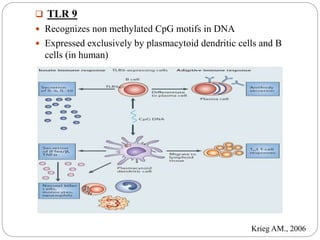
 TLR 9
 Recognizes non methylated CpG motifs in DNA
 Expressed exclusively by plasmacytoid dendritic cells and B
cells (in human)
Krieg AM., 2006
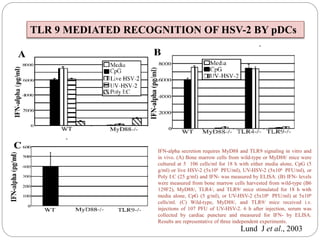
IFN-alpha secretion requires MyD88 and TLR9 signaling in vitro and
in vivo. (A) Bone marrow cells from wild-type or MyD88/ mice were
cultured at 5 106 cells/ml for 18 h with either media alone, CpG (5
g/ml) or live HSV-2 (5x10⁶ PFU/ml), UV-HSV-2 (5x10⁶ PFU/ml), or
Poly I:C (25 g/ml) and IFN- was measured by ELISA. (B) IFN- levels
were measured from bone marrow cells harvested from wild-type (B6
129F2), MyD88/, TLR4/, and TLR9/ mice stimulated for 18 h with
media alone, CpG (5 g/ml), or UV-HSV-2 (5x10⁶ PFU/ml) at 5x10⁶
cells/ml. (C) Wild-type, MyD88/, and TLR9/ mice received i.v.
injections of 107 PFU of UV-HSV-2. 6 h after injection, serum was
collected by cardiac puncture and measured for IFN- by ELISA.
Results are representative of three independent experiments.
Lund J et al., 2003
TLR 9 MEDIATED RECOGNITION OF HSV-2 BY pDCs
 Synthetic oligodeoxynucleotide used for targeted immune
activation.
 The two bases to the 5′ and 3′ sides of the CpG dinucleotide
comprise a CpG moif (hexamer)
Mice GACGTT
Human GTCGTT
 Factors determining the immune stimulatory activity of ODNs :
 No. of CpG motifs (2-4)
 Spacing of the CpG motifs (usually 2 intervening bases)
 Presence of poly G sequence
 ODN backbone
 CpG DNA triggers DNA-PK activation which in turn,
phosphorylates IkB kinase b and leads to NF-kB activation
CpG OLIGODEOXYNUCLEOTIDES
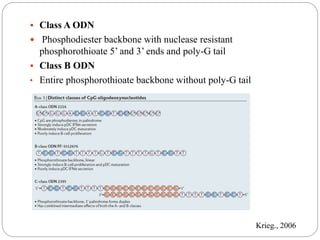
 Class A ODN
 Phosphodiester backbone with nuclease resistant
phosphorothioate 5’ and 3’ ends and poly-G tail
 Class B ODN
• Entire phosphorothioate backbone without poly-G tail
Krieg., 2006
 TLR 7
• Specificity to Uridine rich ssRNA and imidazoquinolines
• Type I IFN production by pDC induced by GU-rich sequences
(UUGU, GUUC)
• Has been implicated in recognition of RNA viruses
 pDCs from TLR 7 deficient mice are unable to respond to
Influenza ( Heil et al., 2004)
HIV-1 ( Diebold et al., 2004)
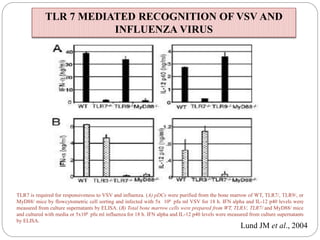
TLR7 is required for responsiveness to VSV and influenza. (A) pDCs were purified from the bone marrow of WT, TLR7/, TLR9/, or
MyD88/ mice by flowcytometric cell sorting and infected with 5x 10⁶ pfu ml VSV for 18 h. IFN alpha and IL-12 p40 levels were
measured from culture supernatants by ELISA. (B) Total bone marrow cells were prepared from WT, TLR3/, TLR7/ and MyD88/ mice
and cultured with media or 5x10⁶ pfu ml influenza for 18 h. IFN alpha and IL-12 p40 levels were measured from culture supernatants
by ELISA.
Lund JM et al., 2004
TLR 7 MEDIATED RECOGNITION OF VSV AND
INFLUENZA VIRUS
 TLR 8
 Recognize viral ssRNA
 AU rich sequences (AUUU, UAUC) induce TNF response
 Expressed in macrophages and conventional dendritic cells
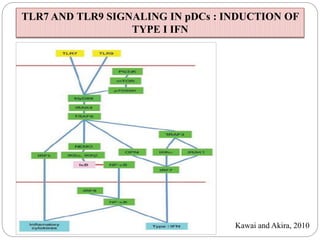
Kawai and Akira, 2010
TLR7 AND TLR9 SIGNALING IN pDCs : INDUCTION OF
TYPE I IFN
RLRs
 RIG-I (Retinoic acid inducible gene-I)
 Recognizes dsRNA
 Consist of :
2 CARD (caspase-recruiting domain)- like domain and
Helicase domain (IRF3 activation)
Regulatory domain (prevents constitutive expression of protein )
 Recognize Poly(I:C) (~70 bp) and and uncapped 5’ triphosphate
RNA
CYTOSOLIC SENSORS OF NUCLEIC ACIDS
Upper: RLR structure diagram showing positions
of functional domains. Lower: 3-step model of
RIG-I activation from a monomeric resting form
(left) to RNA-ligand bound, dimeric form (center)
and the final active form (right). The positions of
the CARDs, helicase domain, and repressor domain
(RD) are indicated. Ligand binding by RIG-I
facilitates a conformation change that releases it
from auto repression by the RD, thus driving
downstream signaling of innate antiviral immunity.
 Melanoma Differentiation Antigen 5 (MDA 5)
Similar domain structure to RIG-I :
N- terminal CARD domain, Central DEAD box
helicase/ATPase domain and C- terminal regulatory domain
Recognize long poly(I:C) >2Kb
Saito T et al., 2007
RLR Accessory Proteins
 Mitochondrial Anti Viral Signaling (MAVS )
 Essential adapter that connects RIG-I/MDA 5 activation with
IRF 3 phosphorylation
 N- terminal CARD domain associates with RLRs
 C- terminal Trans membrane domain targets to outer
mitochondrial membrane to activate IRF 3
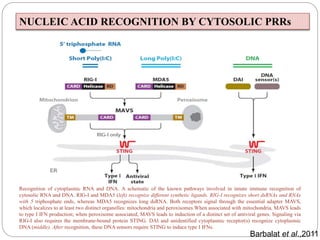
Recognition of cytoplasmic RNA and DNA. A schematic of the known pathways involved in innate immune recognition of
cytosolic RNA and DNA. RIG-I and MDA5 (left) recognize different synthetic ligands. RIG-I recognizes short dsRNAs and RNAs
with 5 triphosphate ends, whereas MDA5 recognizes long dsRNA. Both receptors signal through the essential adapter MAVS,
which localizes to at least two distinct organelles: mitochondria and peroxisomes.When associated with mitochondria, MAVS leads
to type I IFN production; when peroxisome associated, MAVS leads to induction of a distinct set of antiviral genes. Signaling via
RIG-I also requires the membrane-bound protein STING. DAI and unidentified cytoplasmic receptor(s) recognize cytoplasmic
DNA (middle). After recognition, these DNA sensors require STING to induce type I IFNs.
Barbalat et al.,2011
NUCLEIC ACID RECOGNITION BY CYTOSOLIC PRRs
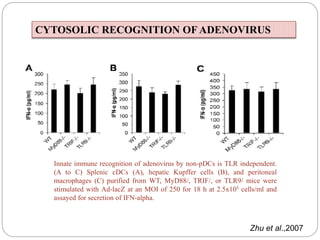
Innate immune recognition of adenovirus by non-pDCs is TLR independent.
(A to C) Splenic cDCs (A), hepatic Kupffer cells (B), and peritoneal
macrophages (C) purified from WT, MyD88/, TRIF/, or TLR9/ mice were
stimulated with Ad-lacZ at an MOI of 250 for 18 h at 2.5x10⁵ cells/ml and
assayed for secretion of IFN-alpha.
Zhu et al.,2007
CYTOSOLIC RECOGNITION OF ADENOVIRUS
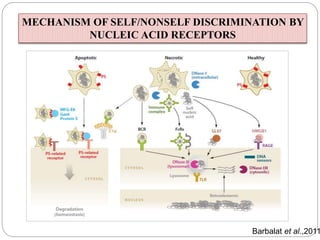
Barbalat et al.,2011
MECHANISM OF SELF/NONSELF DISCRIMINATION BY
NUCLEIC ACID RECEPTORS
 PRRs recognize conserved microbial features and induce both
innate and adaptive immune responses.
 Non specific recognition of nucleic acids results in autoimmune
diseases.
 CpG ODNs have therapeutic applications for cancer, infectious
diseases and autoimmune diseases.
 Mechanism of ligand binding to TLRs and DNA sensors as well
as differential gene induction are yet to be elucidated.
CONCLUSIONS AND FUTURE PROSPECTIVES
 Akira S, Takeda K, Kaisho T. 2001. Toll-like receptors: critical proteins
linking innate and acquired immunity. Nat. Immunol. 2:675–80
 Barbalat R, Ewald SE, Mouchess ML, Barton GM .2011. Nucleic Acid
Recognition by the Innate Immune System. Annu. Rev. Immunol.
2011.29:185-214.
 Kawai T, Akira S. 2010. The role of pattern-recognition receptors in innate
immunity: update on Toll like receptors. Nat. Immunol. 11:373–84
 Krieg AM. 2006. Therapeutic potential of Toll-like receptor 9 activation. Nat.
Rev. Drug Discov. 5:471–84
 Liu L, Botos I, Wang Y, Leonard JN, Shiloach J, et al. 2008. Structural basis of
Toll-like receptor 3 signaling with double-stranded RNA. Science 320:379–81
 Lund J, Sato A, Akira S, Medzhitov R, Iwasaki A. 2003. Toll-like receptor 9-
mediated recognition of Herpes simplex virus-2 by plasmacytoid dendritic
cells. J. Exp. Med. 198:513–20
REFRENCES
 Lund JM, Alexopoulou L, Sato A, Karow M, Adams NC. 2004. Recognition of
single-stranded RNA viruses by Toll-like receptor 7. Proc. Natl. Acad. Sci. USA
101:5598–603
 Stetson DB, Medzhitov R. 2006. Type I interferons in host defense. Immunity
25:373–81
 Zhu J, Huang X, Yang Y. 2007. Innate immune response to adenoviral vectors
is mediated by both Toll-like receptor-dependent and -independent pathways. J.
Virol. 81:3170–80
Nucleic acid recognition by the innate immune system

Nucleic acid recognition by the innate immune system

  • 1.
    NUCLEIC ACID RECOGNITIONBY THE INNATE IMMUNE SYSTEM Presented by: Ankur Sharma PhD Scholar CREDIT SEMINAR ON
  • 2.
    Pattern Recognition Receptors (PRRs) Endolysosomal Toll-likereceptors Cytosolic RLRs (RIG-I, MDA5) DNA sensors NUCLEIC ACID RECOGNIZING PRRs
  • 3.
    Severe fungal infectionin a fruit fly (color) with a disabling mutation in the signal-transduction pathway required for the synthesis of the antifungal peptide drosomycin. [Electron micrograph adapted from B. Lemaitre et al., 1996, Cell 86: 973; courtesy of J.A. Hoffman, University of Strasbourg.] Toll-LIKE RECEPTORS (TLRs)
  • 4.
    Toll/Interleukin-1 receptor (TIR) domain Structureof a Toll-like receptor (TLR) • Family of transmembrane PRRs (Human – 11, Mouse – 12) • Recognize conserved microbial features •TLR with relevance to Nucleic Acid recognition: TLR-3 dsRNA TLR-7 and 8 ssRNA TLR-9 dsDNA • Location – Endosome and lysosome • Expressed in Dendritic cells, B cells macrophages Contd…….. Kuby Immunology, 6th edition
  • 5.
    TLRs AND THEIRLIGANDS Kuby Immunology, 6th edition
  • 6.
    TLR3 recognizes dsRNAderived from viruses or virus-infected cells; dsRNA binds to N- and C-terminal sites on the lateral side of the convex surface of the TLR3 ectodomain, which facilitates the formation of a homodimer via the C-terminal region. TLR3 activates the TRIF-dependent pathway to induce type I interferon and inflammatory cytokines. In pDCs, TLR7 recognizes ssRNA derived from ssRNA viruses in endolysosomes and activates NF-κB and IRF7 via MyD88 to induce inflammatory cytokines and type I interferon, respectively. In addition, autophagy is involved in delivering ssRNA to TLR7-expressing vesicles. TLR9 recognizes DNA derived from both DNA viruses and bacteria. Proteolytic cleavage of TLR9 by cellular proteases is required for downstream signal transduction. TLR9 recruits MyD88 to activate NF-κB and IRF7 in pDCs. TLR3, TLR7 and TLR9 localize mainly to the ER in the steady state and traffic to the endolysosomes, where they engage with their ligands. UNC93B1 interacts with these TLRs in the ER and is essential for this trafficking. Kawai and Akira, 2010 NUCLEIC ACID RECOGNITION BY TLRs
  • 7.
     TLR 3 First TLR implicated in viral nucleic acid sensing  Binds with dsRNA with very less sequence specificty  Minimum 40bp length required for responsiveness and affinity increased in proportion to dsRNA length (Botos et al., 2009)  Also recognize synthetic RNA analogs: Poly inosine – poly cytidylic acid [poly(I:C)] (Alexopoulou et al., 2001)  Recognizes the genomic DNA of Reo virus, dsRNA intermediates of West Nile virus, encephalomyocarditis virus and certain siRNAs LIGAND SPECIFICITY AND MICROBIAL RECOGNITION
  • 8.
    C terminus (a) TLR3dimer ( green, only ectodomain shown) in complex with dsRNA (blue). (b) Two regions of the TLR3 ectodomain make contact with dsRNA. Site-directed mutagenesis has revealed an essential role for the residues His39, His60, andHis108 in the N terminus and Asn541 and His539 in the C terminus (residues indicated in magenta). Liu et al., 2008 Structural motifs mediating interaction between TLR 3 and its cognate ligand
  • 9.
     TLR 9 Recognizes non methylated CpG motifs in DNA  Expressed exclusively by plasmacytoid dendritic cells and B cells (in human) Krieg AM., 2006
  • 10.
    IFN-alpha secretion requiresMyD88 and TLR9 signaling in vitro and in vivo. (A) Bone marrow cells from wild-type or MyD88/ mice were cultured at 5 106 cells/ml for 18 h with either media alone, CpG (5 g/ml) or live HSV-2 (5x10⁶ PFU/ml), UV-HSV-2 (5x10⁶ PFU/ml), or Poly I:C (25 g/ml) and IFN- was measured by ELISA. (B) IFN- levels were measured from bone marrow cells harvested from wild-type (B6 129F2), MyD88/, TLR4/, and TLR9/ mice stimulated for 18 h with media alone, CpG (5 g/ml), or UV-HSV-2 (5x10⁶ PFU/ml) at 5x10⁶ cells/ml. (C) Wild-type, MyD88/, and TLR9/ mice received i.v. injections of 107 PFU of UV-HSV-2. 6 h after injection, serum was collected by cardiac puncture and measured for IFN- by ELISA. Results are representative of three independent experiments. Lund J et al., 2003 TLR 9 MEDIATED RECOGNITION OF HSV-2 BY pDCs
  • 11.
     Synthetic oligodeoxynucleotideused for targeted immune activation.  The two bases to the 5′ and 3′ sides of the CpG dinucleotide comprise a CpG moif (hexamer) Mice GACGTT Human GTCGTT  Factors determining the immune stimulatory activity of ODNs :  No. of CpG motifs (2-4)  Spacing of the CpG motifs (usually 2 intervening bases)  Presence of poly G sequence  ODN backbone  CpG DNA triggers DNA-PK activation which in turn, phosphorylates IkB kinase b and leads to NF-kB activation CpG OLIGODEOXYNUCLEOTIDES
  • 12.
     Class AODN  Phosphodiester backbone with nuclease resistant phosphorothioate 5’ and 3’ ends and poly-G tail  Class B ODN • Entire phosphorothioate backbone without poly-G tail Krieg., 2006
  • 13.
     TLR 7 •Specificity to Uridine rich ssRNA and imidazoquinolines • Type I IFN production by pDC induced by GU-rich sequences (UUGU, GUUC) • Has been implicated in recognition of RNA viruses  pDCs from TLR 7 deficient mice are unable to respond to Influenza ( Heil et al., 2004) HIV-1 ( Diebold et al., 2004)
  • 14.
    TLR7 is requiredfor responsiveness to VSV and influenza. (A) pDCs were purified from the bone marrow of WT, TLR7/, TLR9/, or MyD88/ mice by flowcytometric cell sorting and infected with 5x 10⁶ pfu ml VSV for 18 h. IFN alpha and IL-12 p40 levels were measured from culture supernatants by ELISA. (B) Total bone marrow cells were prepared from WT, TLR3/, TLR7/ and MyD88/ mice and cultured with media or 5x10⁶ pfu ml influenza for 18 h. IFN alpha and IL-12 p40 levels were measured from culture supernatants by ELISA. Lund JM et al., 2004 TLR 7 MEDIATED RECOGNITION OF VSV AND INFLUENZA VIRUS
  • 15.
     TLR 8 Recognize viral ssRNA  AU rich sequences (AUUU, UAUC) induce TNF response  Expressed in macrophages and conventional dendritic cells
  • 16.
    Kawai and Akira,2010 TLR7 AND TLR9 SIGNALING IN pDCs : INDUCTION OF TYPE I IFN
  • 17.
    RLRs  RIG-I (Retinoicacid inducible gene-I)  Recognizes dsRNA  Consist of : 2 CARD (caspase-recruiting domain)- like domain and Helicase domain (IRF3 activation) Regulatory domain (prevents constitutive expression of protein )  Recognize Poly(I:C) (~70 bp) and and uncapped 5’ triphosphate RNA CYTOSOLIC SENSORS OF NUCLEIC ACIDS
  • 18.
    Upper: RLR structurediagram showing positions of functional domains. Lower: 3-step model of RIG-I activation from a monomeric resting form (left) to RNA-ligand bound, dimeric form (center) and the final active form (right). The positions of the CARDs, helicase domain, and repressor domain (RD) are indicated. Ligand binding by RIG-I facilitates a conformation change that releases it from auto repression by the RD, thus driving downstream signaling of innate antiviral immunity.  Melanoma Differentiation Antigen 5 (MDA 5) Similar domain structure to RIG-I : N- terminal CARD domain, Central DEAD box helicase/ATPase domain and C- terminal regulatory domain Recognize long poly(I:C) >2Kb Saito T et al., 2007
  • 19.
    RLR Accessory Proteins Mitochondrial Anti Viral Signaling (MAVS )  Essential adapter that connects RIG-I/MDA 5 activation with IRF 3 phosphorylation  N- terminal CARD domain associates with RLRs  C- terminal Trans membrane domain targets to outer mitochondrial membrane to activate IRF 3
  • 20.
    Recognition of cytoplasmicRNA and DNA. A schematic of the known pathways involved in innate immune recognition of cytosolic RNA and DNA. RIG-I and MDA5 (left) recognize different synthetic ligands. RIG-I recognizes short dsRNAs and RNAs with 5 triphosphate ends, whereas MDA5 recognizes long dsRNA. Both receptors signal through the essential adapter MAVS, which localizes to at least two distinct organelles: mitochondria and peroxisomes.When associated with mitochondria, MAVS leads to type I IFN production; when peroxisome associated, MAVS leads to induction of a distinct set of antiviral genes. Signaling via RIG-I also requires the membrane-bound protein STING. DAI and unidentified cytoplasmic receptor(s) recognize cytoplasmic DNA (middle). After recognition, these DNA sensors require STING to induce type I IFNs. Barbalat et al.,2011 NUCLEIC ACID RECOGNITION BY CYTOSOLIC PRRs
  • 21.
    Innate immune recognitionof adenovirus by non-pDCs is TLR independent. (A to C) Splenic cDCs (A), hepatic Kupffer cells (B), and peritoneal macrophages (C) purified from WT, MyD88/, TRIF/, or TLR9/ mice were stimulated with Ad-lacZ at an MOI of 250 for 18 h at 2.5x10⁵ cells/ml and assayed for secretion of IFN-alpha. Zhu et al.,2007 CYTOSOLIC RECOGNITION OF ADENOVIRUS
  • 22.
    Barbalat et al.,2011 MECHANISMOF SELF/NONSELF DISCRIMINATION BY NUCLEIC ACID RECEPTORS
  • 23.
     PRRs recognizeconserved microbial features and induce both innate and adaptive immune responses.  Non specific recognition of nucleic acids results in autoimmune diseases.  CpG ODNs have therapeutic applications for cancer, infectious diseases and autoimmune diseases.  Mechanism of ligand binding to TLRs and DNA sensors as well as differential gene induction are yet to be elucidated. CONCLUSIONS AND FUTURE PROSPECTIVES
  • 24.
     Akira S,Takeda K, Kaisho T. 2001. Toll-like receptors: critical proteins linking innate and acquired immunity. Nat. Immunol. 2:675–80  Barbalat R, Ewald SE, Mouchess ML, Barton GM .2011. Nucleic Acid Recognition by the Innate Immune System. Annu. Rev. Immunol. 2011.29:185-214.  Kawai T, Akira S. 2010. The role of pattern-recognition receptors in innate immunity: update on Toll like receptors. Nat. Immunol. 11:373–84  Krieg AM. 2006. Therapeutic potential of Toll-like receptor 9 activation. Nat. Rev. Drug Discov. 5:471–84  Liu L, Botos I, Wang Y, Leonard JN, Shiloach J, et al. 2008. Structural basis of Toll-like receptor 3 signaling with double-stranded RNA. Science 320:379–81  Lund J, Sato A, Akira S, Medzhitov R, Iwasaki A. 2003. Toll-like receptor 9- mediated recognition of Herpes simplex virus-2 by plasmacytoid dendritic cells. J. Exp. Med. 198:513–20 REFRENCES
  • 25.
     Lund JM,Alexopoulou L, Sato A, Karow M, Adams NC. 2004. Recognition of single-stranded RNA viruses by Toll-like receptor 7. Proc. Natl. Acad. Sci. USA 101:5598–603  Stetson DB, Medzhitov R. 2006. Type I interferons in host defense. Immunity 25:373–81  Zhu J, Huang X, Yang Y. 2007. Innate immune response to adenoviral vectors is mediated by both Toll-like receptor-dependent and -independent pathways. J. Virol. 81:3170–80