Hypersensitivity
Reaction
or Allergy
“Microbiology”
By Rania Hadi
Aden University-Faculty Of Dentistry
Content
-Simple Introduction.

-Hyper sensitivity or allergy type-I
Exaggerated immune response may lead to different
forms of tissue damage:

1) An overactive immune response:
produce more damage than it prevents
e.g. hypersensitivity reactions and graft
rejection

2) Failure of appropriate recognition:
as in autoimmune diseases
Introduction
We Have To Know That allergy is Abnormal And
May Be Harmful To Human Body.
Definition .
So the hypersensitivity reaction is an abnormal and may be
dangerous (damaging or sometimes fatal) from a normal
immunity’s Response to the body’s tissues.
Allergy Types
Based on the mechanisms involved and time taken for the
reaction ,There are 4 types of allergy
*Type I and Type II are body-mediated, Reaction
mediated by IgE
*Type III is body-mediated as well ,but reaction mediated
by IgG.
*Type IV is cell-mediated.
Type [I]
About:
-This type is the most common one.
-Called Immediate hypersensitivity and anaphylactic hypersensitivity as
well.
-This type doesn’t occur in all population.
-symptoms of this type are called : anaphylaxis
KEYS
1-Mast Cell
A Large cell which contains granules or vesicles containing Mediators like
Histamine Inside it ,and it’s role related to allergy .
2-Allergen : is a type of antigen that produces an
abnormally immune response.
3-IgE : Is a specific one of the 5 antibodies which plays an
essential role in allergy type-I,And it’s induced by this allergen, produced by
B-cells.
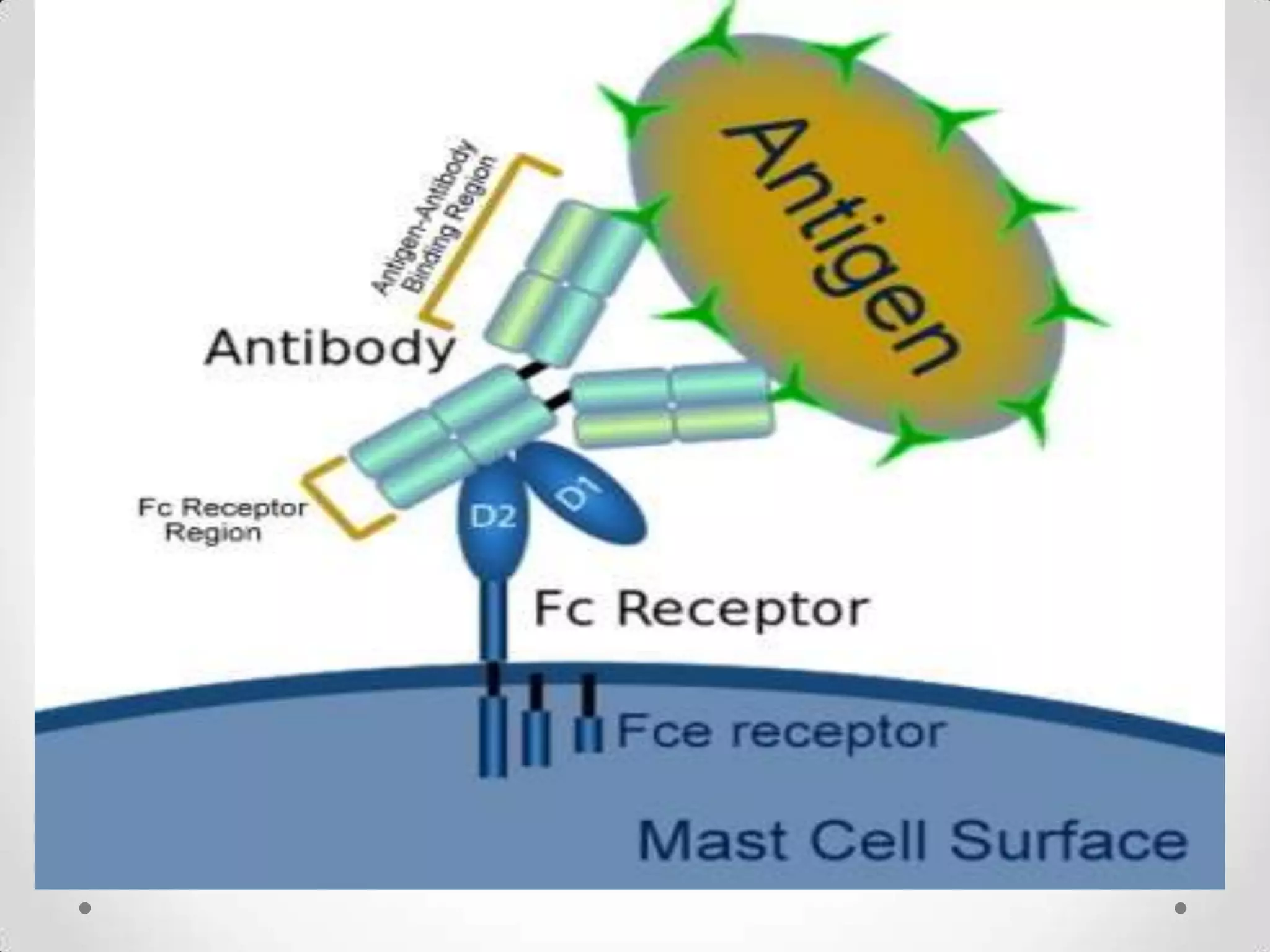
On the surface of mast cell, there's a receptor called
IgE receptor or (Fcε) receptor
ε = epsilon
This receptor receives the IgE for Binding on the
surface of mast cell
*Note
The IgE Antibody Has 2 regions, one of them is called
Fc region for binding to Fcε receptor on mast cell
surface
And the second region is for binding with the Allergen
or antigen.
(See the next slide below)
IgE Structure
Pathogenic Mechanism
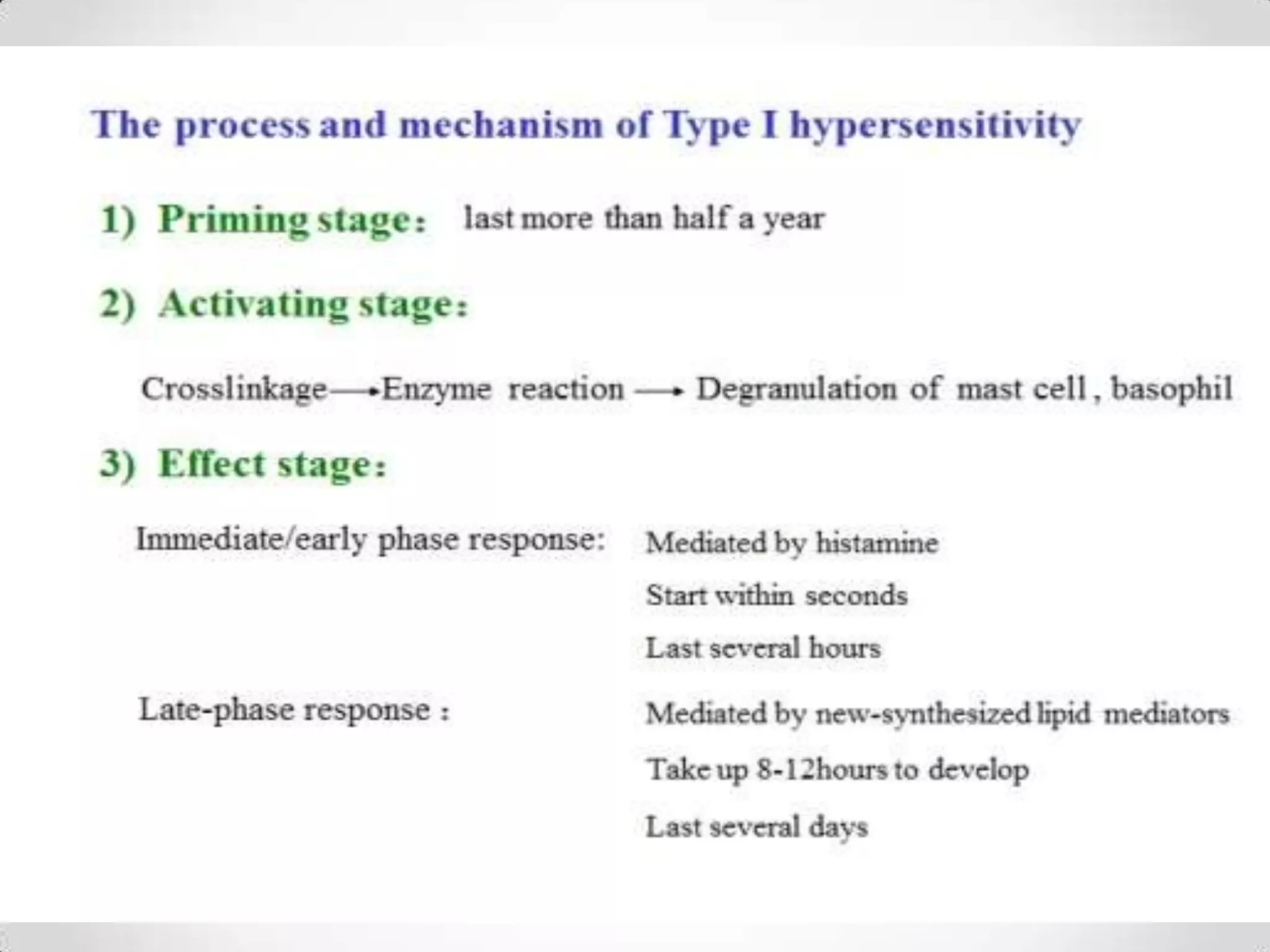
1-Exporsure for 1st time :
An allergen invades the human body, and this can be occurred by
digestion(Food),inhalation and injection.
Induction of formation of IgE By B-cell ,which binds to the mast cell by its Fc ,called
sensitization, and innate immunity play its role to eject the pathogen.
2-Reexporsure for 2nd time: of same allergen again, Allergen cross links IgE on
mast cell surface and trigger degranulation of mast cell occurs(release of
mediators)in human tissues
Cross-linking meaning :
Side by side (lateral) linking in which two or more adjacent molecules of a polymer join to form a bigger
molecule.
It’s important in this type
Reexporsure
Mechanism [Con’t]
*What are the mediator that released from mast cell?
Mediator are soluble substances which cause manifestation of
disease.
Calcium and cyclic nucleotide play role in release of these mediators

Note : NO Single mediator accounts or causes for all the allergy
Type-I Manifestation or symptoms.

*There are 3 classes of mediators derived from mast
cell :
1-Preformed or primary Mediators
2-Newly sensitized ,synthesized or Secondary
Mediators
3-cytokines and chemokines.
Type-I Effects
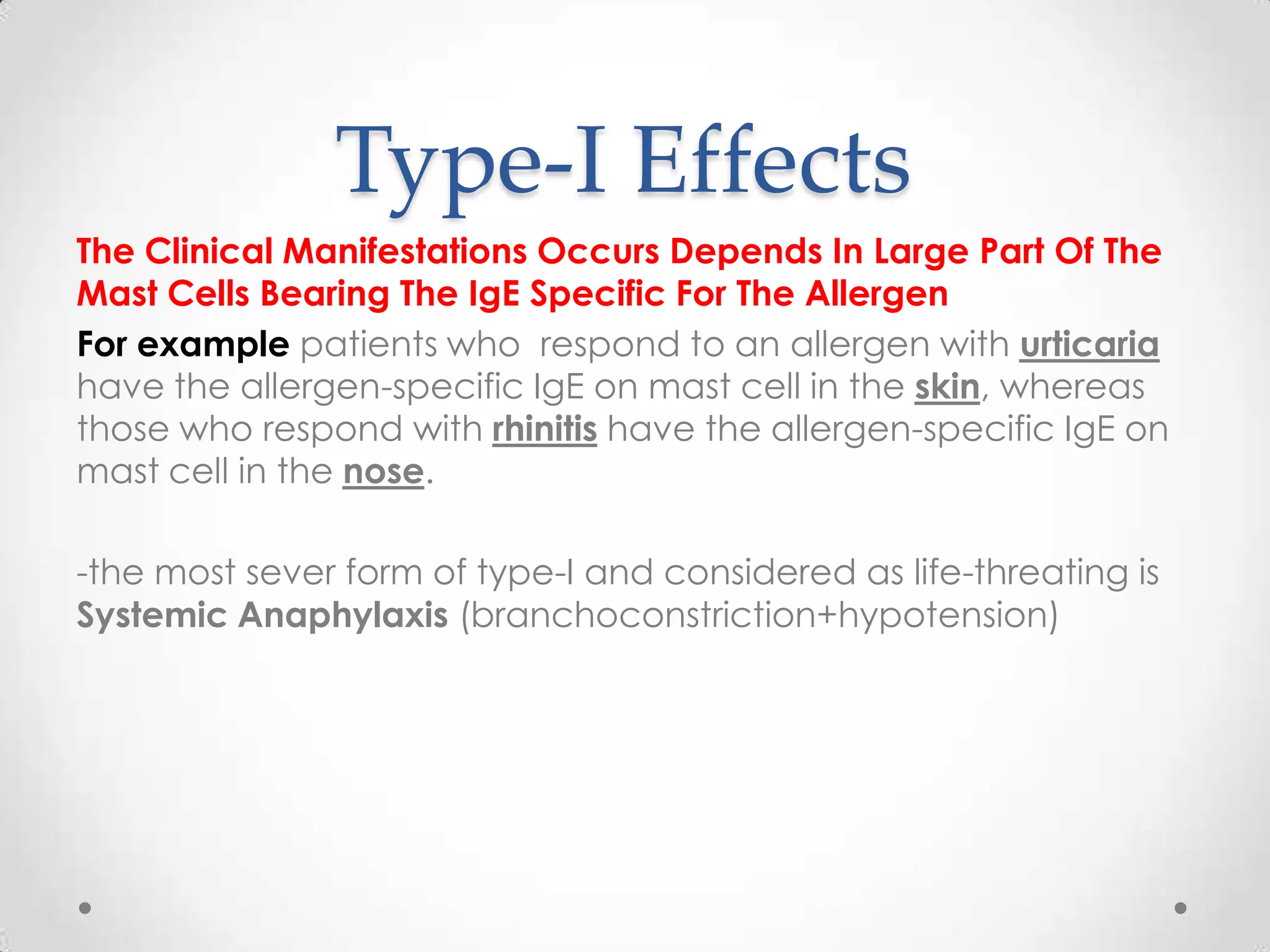
The Clinical Manifestations Occurs Depends In Large Part Of The
Mast Cells Bearing The IgE Specific For The Allergen
For example patients who respond to an allergen with urticaria
have the allergen-specific IgE on mast cell in the skin, whereas
those who respond with rhinitis have the allergen-specific IgE on
mast cell in the nose.
-the most sever form of type-I and considered as life-threating is
Systemic Anaphylaxis (branchoconstriction+hypotension)
[Con’t]
Effects of these substances when released
1-Histamine: vasodilation, increased capillary
permeability & smooth-muscle contraction.
Clinically : rhinitis (hay fever) urticaria and
angioedema can occur and bronchospasm.
[Con’t]
2-Release of Leukotrienes: the principal mediator in
the bronchoconstriction of asthma ,increased
vascular permeability and smooth muscle constriction
occur
[Con’t]
3-Eosinophil Chemotactic Factor Anaphylaxis (ECF-A)
-is a tetra peptide
-when released attracts Eosinophil's
-may reduce the severity of allergy type-I
-The role in Type-I is Uncertain
-they release histaminase and arylsulfatase which
degrade 2 important mediators, Histamine and SRS-A
(slow-reacting substances of anaphylaxis)respectively
[Con’t]
4-Serotonin(hydroxytryptamine)
When released causes increased vascular
permeabiltty,capillary dilation and smooth muscles
contraction.

5-prostaglandin and thromboxanes
-Prostaglandin causes dilation and increased
permeability and bronchoconstriction
-Thromboxanes aggregate platelets
Manifestation of anaphylaxis Vary among the species Because mediators are
released in different amounts and different rates, and tissues vary in their
sensitivity to them.
For Example :the respiratory tract (bronchospasm and laryngeal edema) is
principle shock organ in Human
But the Liver play that role in Dogs

Don’t be confused B/W Anaphylactic Reactions and Anaphylactiod Reactions.
-Anaphylactiod Reactions appear Clinically similar to the anaphylactic reactions
-not IgE-Mediated
-in this reaction usually the initiating agents induce the degranulation of mast
cell without IgE involvement.
Atopy(Atopic Disorders)
Atopy is the genetic predisposition of an individual to produce high quantities of
IgE in response to allergens in the environment (pollens, house dust mites,
moulds, cat dander, foods etc). Heredity is very important in atopy.

The terms atopy and allergy are often used interchangeably but are different:
*Atopy is an exaggerated IgE-mediated immune response; all atopic disorders
are type I hypersensitivity disorders.
*Allergy is any exaggerated immune response to a foreign antigen regardless of
mechanism.
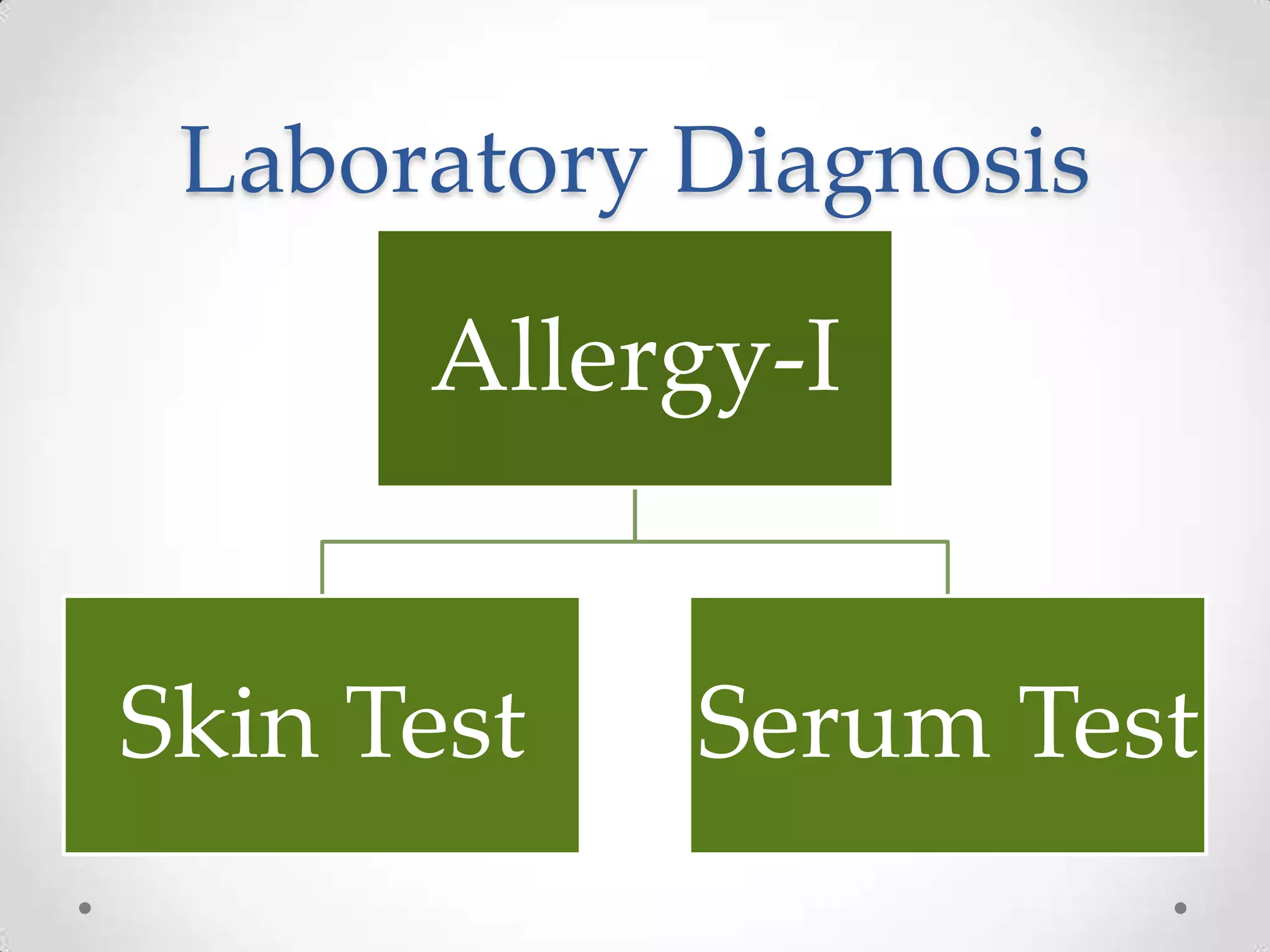
Laboratory Diagnosis

Allergy-I

Skin Test

Serum Test
1-Skin (Cutaneous)Test :
Called Skin Prick Test (SPT)
Routine diagnosis in diseases (atopic or anaphylactic).
A single drop of concentrated aqueous allergen extract placed on the skin which is
then pricked lightly with a needle point at the center of the drop. After 20 minutes
the reaction is graded and recorded

2-Serum Test : for detecting the levels of IgE
Treatment & Prevention
-Epinephrine
-Antihistamines
-corticosteriods
-cromolyn sodium

Hypersensitivity Or Allergy

  • 1.
  • 2.
  • 3.
    Exaggerated immune responsemay lead to different forms of tissue damage: 1) An overactive immune response: produce more damage than it prevents e.g. hypersensitivity reactions and graft rejection 2) Failure of appropriate recognition: as in autoimmune diseases
  • 4.
    Introduction We Have ToKnow That allergy is Abnormal And May Be Harmful To Human Body. Definition . So the hypersensitivity reaction is an abnormal and may be dangerous (damaging or sometimes fatal) from a normal immunity’s Response to the body’s tissues. Allergy Types Based on the mechanisms involved and time taken for the reaction ,There are 4 types of allergy *Type I and Type II are body-mediated, Reaction mediated by IgE *Type III is body-mediated as well ,but reaction mediated by IgG. *Type IV is cell-mediated.
  • 6.
    Type [I] About: -This typeis the most common one. -Called Immediate hypersensitivity and anaphylactic hypersensitivity as well. -This type doesn’t occur in all population. -symptoms of this type are called : anaphylaxis KEYS 1-Mast Cell A Large cell which contains granules or vesicles containing Mediators like Histamine Inside it ,and it’s role related to allergy . 2-Allergen : is a type of antigen that produces an abnormally immune response. 3-IgE : Is a specific one of the 5 antibodies which plays an essential role in allergy type-I,And it’s induced by this allergen, produced by B-cells.
  • 7.
    On the surfaceof mast cell, there's a receptor called IgE receptor or (Fcε) receptor ε = epsilon This receptor receives the IgE for Binding on the surface of mast cell *Note The IgE Antibody Has 2 regions, one of them is called Fc region for binding to Fcε receptor on mast cell surface And the second region is for binding with the Allergen or antigen. (See the next slide below)
  • 8.
  • 10.
    Pathogenic Mechanism 1-Exporsure for1st time : An allergen invades the human body, and this can be occurred by digestion(Food),inhalation and injection. Induction of formation of IgE By B-cell ,which binds to the mast cell by its Fc ,called sensitization, and innate immunity play its role to eject the pathogen. 2-Reexporsure for 2nd time: of same allergen again, Allergen cross links IgE on mast cell surface and trigger degranulation of mast cell occurs(release of mediators)in human tissues Cross-linking meaning : Side by side (lateral) linking in which two or more adjacent molecules of a polymer join to form a bigger molecule. It’s important in this type
  • 11.
  • 12.
    Mechanism [Con’t] *What arethe mediator that released from mast cell? Mediator are soluble substances which cause manifestation of disease. Calcium and cyclic nucleotide play role in release of these mediators Note : NO Single mediator accounts or causes for all the allergy Type-I Manifestation or symptoms. *There are 3 classes of mediators derived from mast cell : 1-Preformed or primary Mediators 2-Newly sensitized ,synthesized or Secondary Mediators 3-cytokines and chemokines.
  • 17.
    Type-I Effects The ClinicalManifestations Occurs Depends In Large Part Of The Mast Cells Bearing The IgE Specific For The Allergen For example patients who respond to an allergen with urticaria have the allergen-specific IgE on mast cell in the skin, whereas those who respond with rhinitis have the allergen-specific IgE on mast cell in the nose. -the most sever form of type-I and considered as life-threating is Systemic Anaphylaxis (branchoconstriction+hypotension)
  • 18.
    [Con’t] Effects of thesesubstances when released 1-Histamine: vasodilation, increased capillary permeability & smooth-muscle contraction. Clinically : rhinitis (hay fever) urticaria and angioedema can occur and bronchospasm.
  • 19.
    [Con’t] 2-Release of Leukotrienes:the principal mediator in the bronchoconstriction of asthma ,increased vascular permeability and smooth muscle constriction occur
  • 20.
    [Con’t] 3-Eosinophil Chemotactic FactorAnaphylaxis (ECF-A) -is a tetra peptide -when released attracts Eosinophil's -may reduce the severity of allergy type-I -The role in Type-I is Uncertain -they release histaminase and arylsulfatase which degrade 2 important mediators, Histamine and SRS-A (slow-reacting substances of anaphylaxis)respectively
  • 21.
    [Con’t] 4-Serotonin(hydroxytryptamine) When released causesincreased vascular permeabiltty,capillary dilation and smooth muscles contraction. 5-prostaglandin and thromboxanes -Prostaglandin causes dilation and increased permeability and bronchoconstriction -Thromboxanes aggregate platelets
  • 22.
    Manifestation of anaphylaxisVary among the species Because mediators are released in different amounts and different rates, and tissues vary in their sensitivity to them. For Example :the respiratory tract (bronchospasm and laryngeal edema) is principle shock organ in Human But the Liver play that role in Dogs Don’t be confused B/W Anaphylactic Reactions and Anaphylactiod Reactions. -Anaphylactiod Reactions appear Clinically similar to the anaphylactic reactions -not IgE-Mediated -in this reaction usually the initiating agents induce the degranulation of mast cell without IgE involvement.
  • 23.
    Atopy(Atopic Disorders) Atopy isthe genetic predisposition of an individual to produce high quantities of IgE in response to allergens in the environment (pollens, house dust mites, moulds, cat dander, foods etc). Heredity is very important in atopy. The terms atopy and allergy are often used interchangeably but are different: *Atopy is an exaggerated IgE-mediated immune response; all atopic disorders are type I hypersensitivity disorders. *Allergy is any exaggerated immune response to a foreign antigen regardless of mechanism.
  • 24.
  • 25.
    1-Skin (Cutaneous)Test : CalledSkin Prick Test (SPT) Routine diagnosis in diseases (atopic or anaphylactic). A single drop of concentrated aqueous allergen extract placed on the skin which is then pricked lightly with a needle point at the center of the drop. After 20 minutes the reaction is graded and recorded 2-Serum Test : for detecting the levels of IgE
  • 26.