Example-1
In a survey of100 participants, 15 of the participants said that they had never bought
lottery tickets or a premium bonds, 73 had bought lottery tickets, 49 had bought
premium bonds and 37 had bought both.
Find the probability that a participant chosen at random
(i) had bought lottery tickets or premium bonds,
(ii) had bought lottery tickets and premium bonds,
(iii) had bought lottery tickets only.
Solution
𝐿𝑒𝑡 𝐿 = 𝑙𝑜𝑡𝑡𝑒𝑟𝑦 𝑡𝑖𝑐𝑘𝑒𝑡
𝐿𝑒𝑡 𝐵 = 𝑝𝑟𝑒𝑚𝑖𝑢𝑚 𝑏𝑜𝑛𝑑
𝑆𝑡𝑒𝑝 − 1 mark (L∩ B = 37),(37 had bought both)
𝑆𝑡𝑒𝑝 − 2 mark (L = 36),(73 had bought lottery tickets = 73− 37 = 36)
𝑆𝑡𝑒𝑝 − 3 mark (B = 12),(49 had bought premium bonds = 49 − 37 = 12)
𝑆𝑡𝑒𝑝 − 4 mark (U = 15),(100 − 36− 37− 12 = 15)
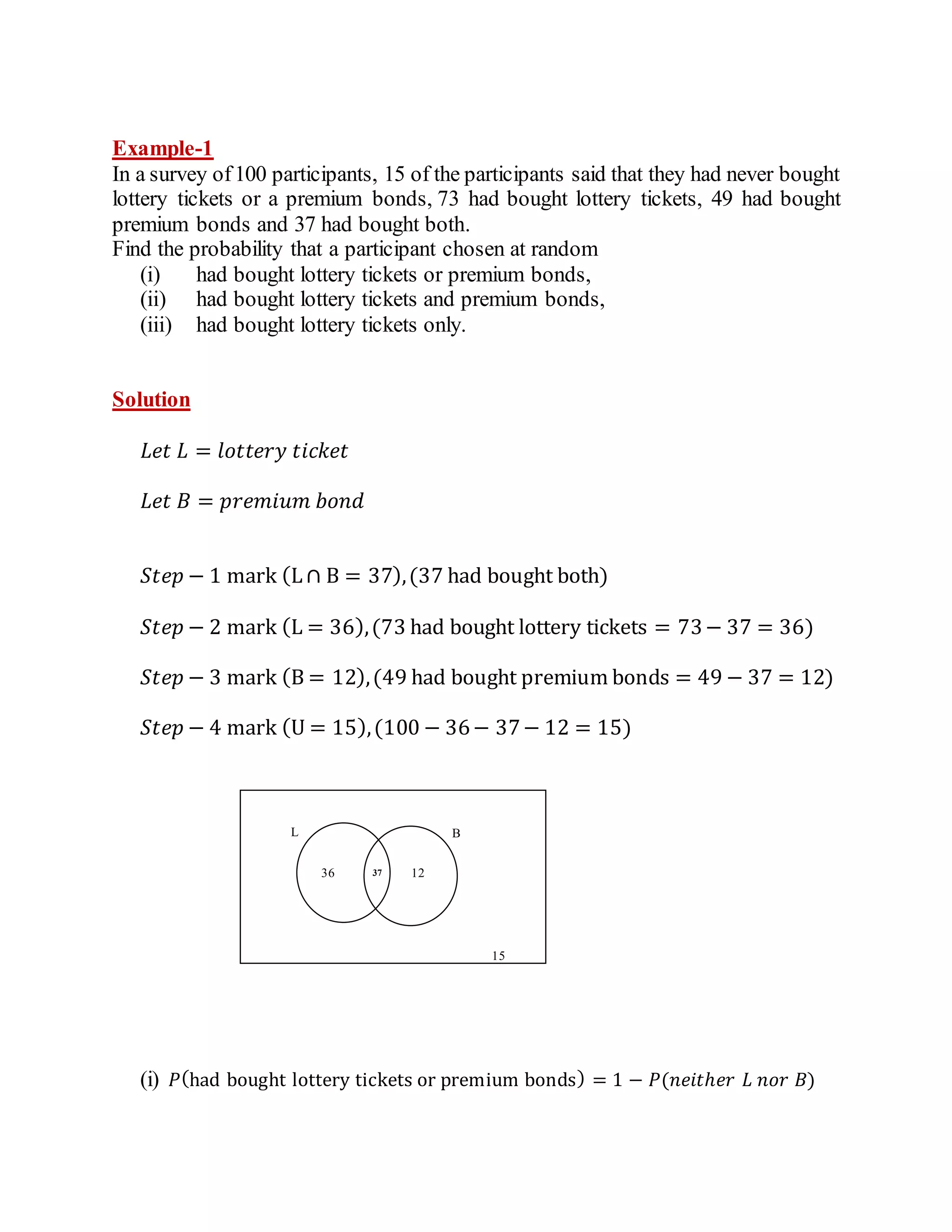
(i) 𝑃(had bought lottery tickets or premium bonds) = 1 − 𝑃(𝑛𝑒𝑖𝑡ℎ𝑒𝑟 𝐿 𝑛𝑜𝑟 𝐵)
L B
36 12
37
15
𝑃(had bought lottery tickets or premium bonds) = 1 −
15
100
= 0.85
(ii) 𝑃(had bought lottery tickets and premium bonds) =
37
100
= 0.37
(iii) 𝑃(had bought lottery tickets only) =
36
100
= 0.36
Example-2
A group of 50 people was asked of three newspapers, A , B or C. They read, the
results showed that 25 read A, 16 read B, 14 read C, 5 read both A and B, 4 read
both B and C, 6 read both C and A and 2 read all 3.
Represent these data on a Venn diagram.
Find probability that a person selected at random from this group reads.
(i) At least 1 of the newspapers. (ii) Only 1 of the newspapers.
(iii) Only A.
Solution
𝑆𝑡𝑒𝑝 − 1 mark (A ∩ B ∩ C = 2),(2 read all 3)
𝑆𝑡𝑒𝑝 − 2 mark (A ∩ C = 4),(6 read both C and A = 6 – 2 = 4)
𝑆𝑡𝑒𝑝 − 3 mark (B∩ C = 2),(4 read both B and C = 4 – 2 = 2)
𝑆𝑡𝑒𝑝 − 4 mark (A ∩ B = 3),(5 read both A and B = 5 – 2 = 3)
𝑆𝑡𝑒𝑝 − 5 mark (A = 16),(25 read A = 25 – 4 – 2 – 3 = 16)
𝑆𝑡𝑒𝑝 − 6 mark (B = 9),(16 read B = 16 – 3 – 2 – 2 = 9)
𝑆𝑡𝑒𝑝 − 7 mark (C = 6),(14 read C = 14 – 4 – 2 – 2 = 6)
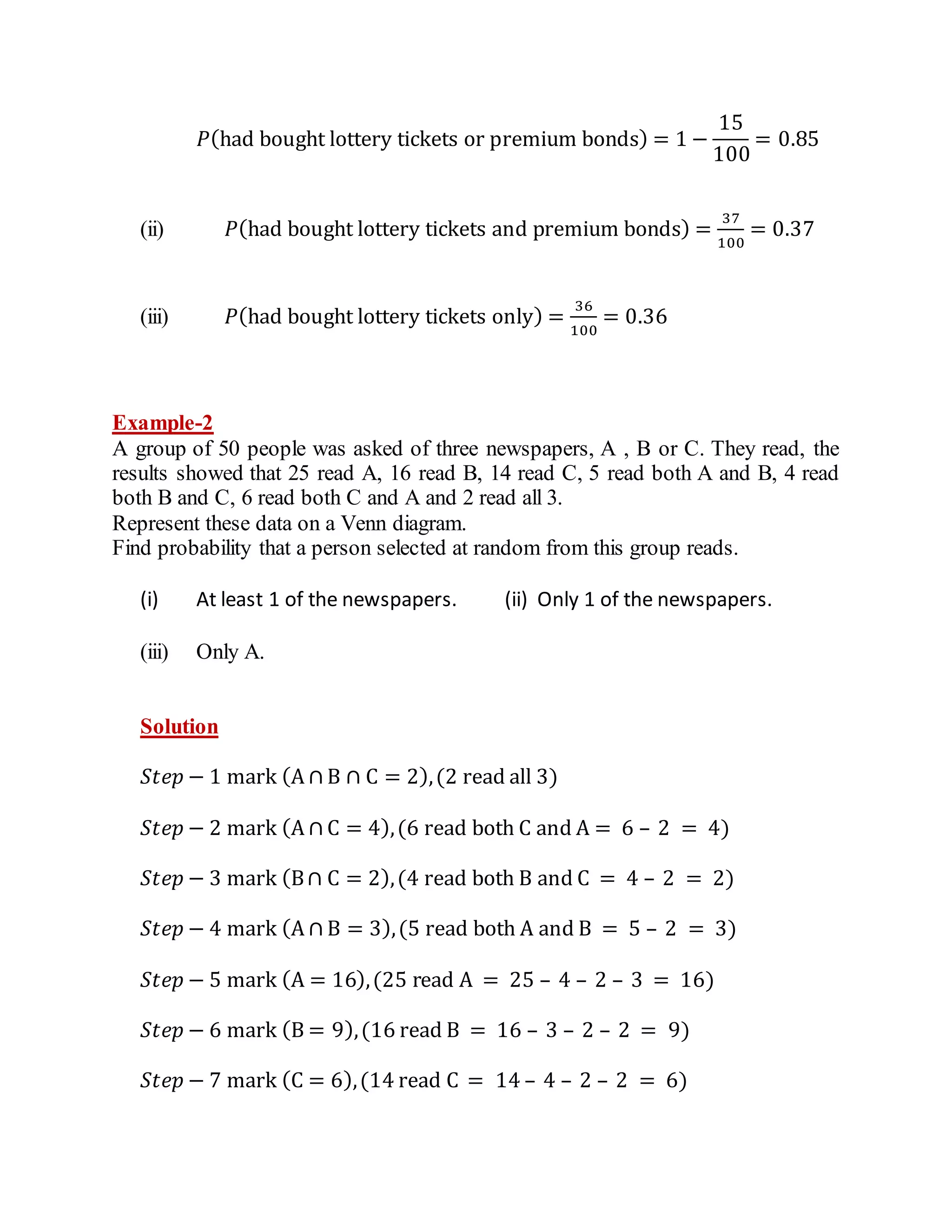
𝑆𝑡𝑒𝑝 − 8 mark (U = 8),(50 − 16 − 9 − 6 − 3 − 2 − 2 − 4 = 8)
(i) 𝑃(At least 1 of the newspapers) = 1 − 𝑃(𝑁𝑜𝑡 𝑟𝑒𝑎𝑑)
𝑃(At least 1 of the newspapers) = 1 −
8
50
=
42
50
= 0.84
(ii) 𝑃(Only 1 of the newspapers) =
16
50
+
9
50
+
6
50
= 0.62
(iii) 𝑃(Only A) =
16
50
= 0.32
Example-3
In a survey of 1,000 persons it was found that 600 drink, 720 smoke, 560 chew, 380
drink and smoke, 270 drink and chew, 350 smoke and chew, 80 drink, smoke and
chew.
Represent these data on a Venn diagram.
Find the probability that a person is chosen at random from the group.
(i) Drink, smoke, but do not chew. (ii) Do not drink or smoke.
A B
C
16
6
9
3
2
2
4
8
Solution
𝑆𝑡𝑒𝑝 − 1 mark (D∩ S ∩ C = 80),(80 drink,smoke and chew)
𝑆𝑡𝑒𝑝 − 2 mark (S∩ C = 270),(350 smoke and chew = 350 − 80 = 270)
𝑆𝑡𝑒𝑝 − 3 mark (D∩ C = 190),(270 drink and chew = 270 − 80 = 190)
𝑆𝑡𝑒𝑝 − 4 mark (D∩ S = 300),(380 drink and smoke = 380 − 80 = 300)
𝑆𝑡𝑒𝑝 − 5 mark (D = 30),(600 drink = 600 − 300 − 190− 80 = 30)
𝑆𝑡𝑒𝑝 − 6 mark (S = 70),(720 smoke = 720− 270 − 300 − 80 = 70)
𝑆𝑡𝑒𝑝 − 7 mark (C = 20),(560 chew = 560− 80− 190 − 270 = 20)
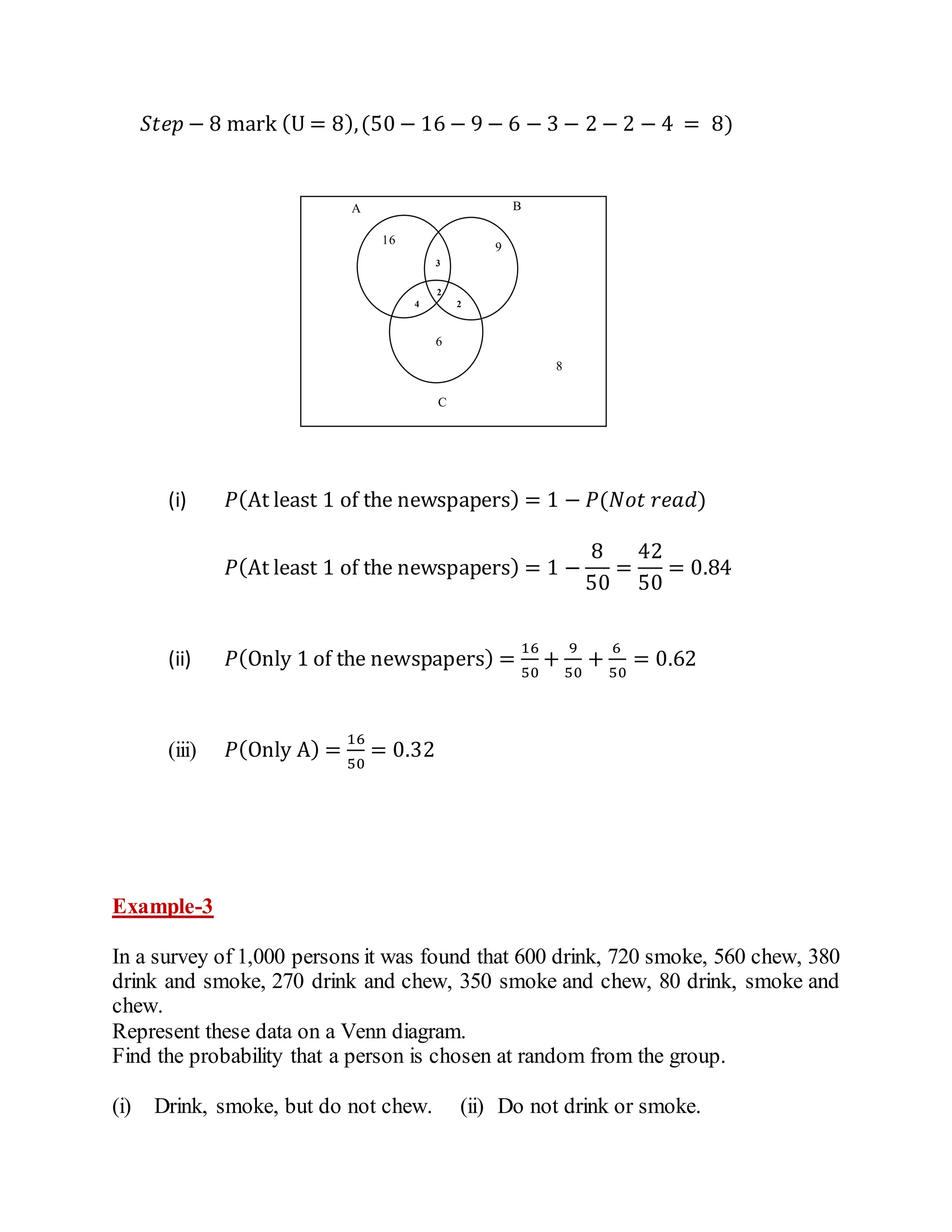
𝑆𝑡𝑒𝑝 − 8 mark (U = 40), (1000 − 80 − 300 − 190 − 270 − 30 − 70 − 20 = 40)
𝑃(Drink,smoke,but do not chew) =
300
1000
=
3
10
𝑃(Do not drink or smoke) =
20+ 40
1000
=
3
50
D S
C
30
20
70
300
80
270
190
40
Example-4
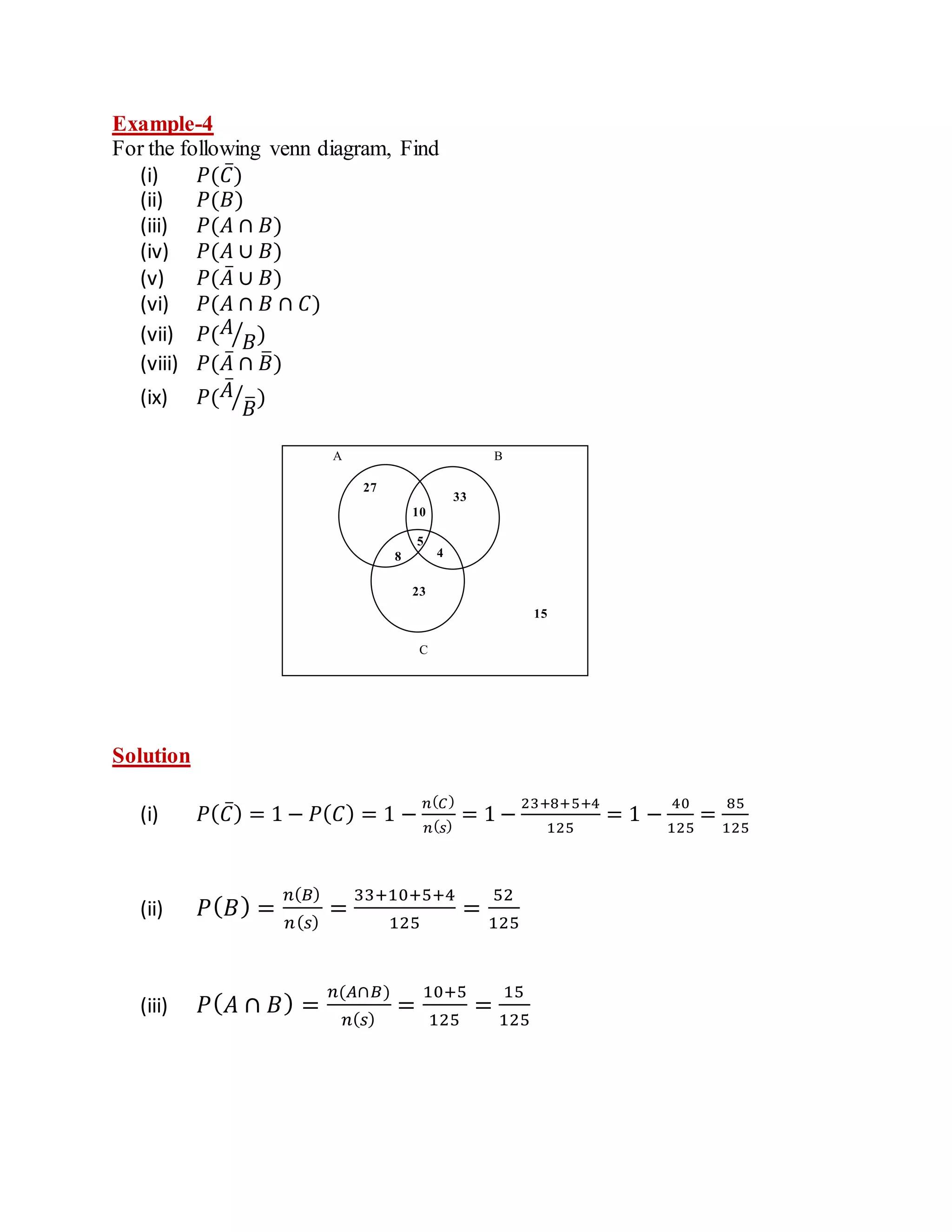
For the following venn diagram, Find
(i) 𝑃(𝐶̅)
(ii) 𝑃(𝐵)
(iii) 𝑃(𝐴 ∩ 𝐵)
(iv) 𝑃(𝐴 ∪ 𝐵)
(v) 𝑃(𝐴̅ ∪ 𝐵)
(vi) 𝑃(𝐴 ∩ 𝐵 ∩ 𝐶)
(vii) 𝑃(𝐴
𝐵
⁄ )
(viii) 𝑃(𝐴̅ ∩ 𝐵
̅)
(ix) 𝑃(𝐴̅
𝐵
̅
⁄ )
Solution
(i) 𝑃(𝐶̅) = 1 − 𝑃(𝐶) = 1 −
𝑛(𝐶)
𝑛(𝑠)
= 1 −
23+8+5+4
125
= 1 −
40
125
=
85
125
(ii) 𝑃(𝐵) =
𝑛(𝐵)
𝑛(𝑠)
=
33+10+5+4
125
=
52
125
(iii) 𝑃(𝐴 ∩ 𝐵) =
𝑛(𝐴∩𝐵)
𝑛(𝑠)
=
10+5
125
=
15
125
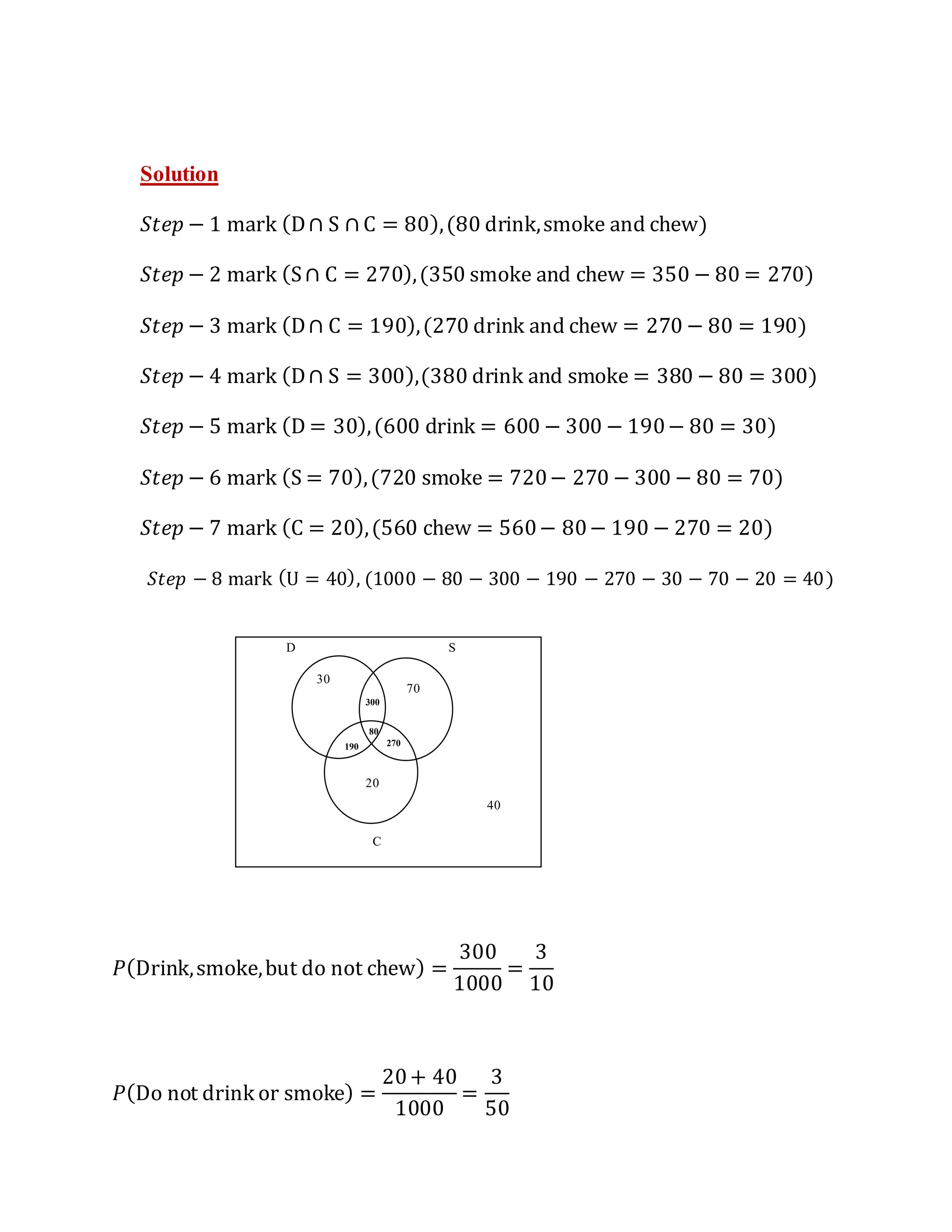
A B
C
27
23
33
10
5
4
8
15
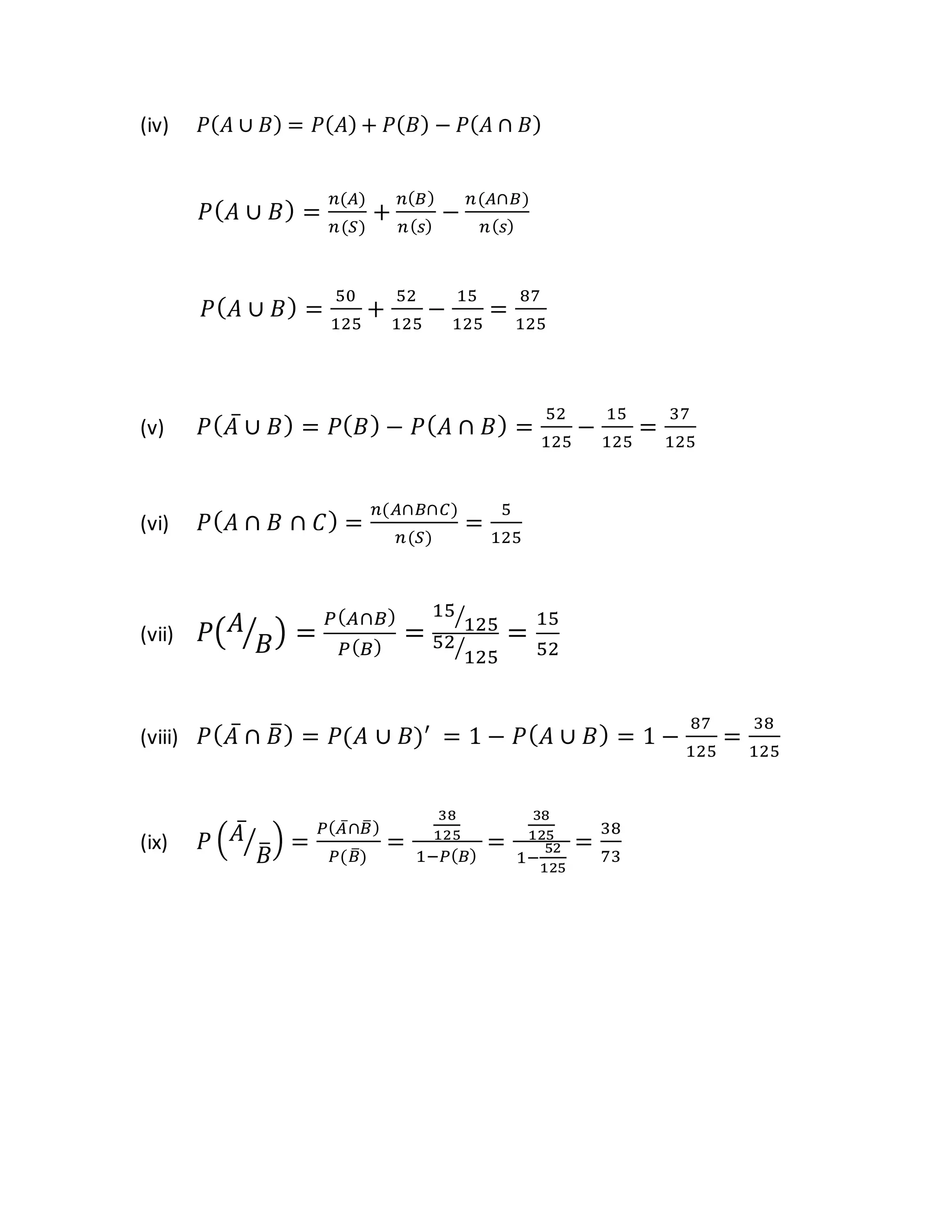
(iv) 𝑃(𝐴 ∪ 𝐵) = 𝑃(𝐴) + 𝑃(𝐵) − 𝑃(𝐴 ∩ 𝐵)
𝑃(𝐴 ∪ 𝐵) =
𝑛(𝐴)
𝑛(𝑆)
+
𝑛(𝐵)
𝑛(𝑠)
−
𝑛(𝐴∩𝐵)
𝑛(𝑠)
𝑃(𝐴 ∪ 𝐵) =
50
125
+
52
125
−
15
125
=
87
125
(v) 𝑃(𝐴̅ ∪ 𝐵) = 𝑃(𝐵) − 𝑃(𝐴 ∩ 𝐵) =
52
125
−
15
125
=
37
125
(vi) 𝑃(𝐴 ∩ 𝐵 ∩ 𝐶) =
𝑛(𝐴∩𝐵∩𝐶)
𝑛(𝑆)
=
5
125
(vii) 𝑃(𝐴
𝐵
⁄ ) =
𝑃(𝐴∩𝐵)
𝑃(𝐵)
=
15
125
⁄
52
125
⁄
=
15
52
(viii) 𝑃(𝐴̅ ∩ 𝐵
̅) = 𝑃(𝐴 ∪ 𝐵)′
= 1 − 𝑃(𝐴 ∪ 𝐵) = 1 −
87
125
=
38
125
(ix) 𝑃 (𝐴̅
𝐵
̅
⁄ ) =
𝑃(𝐴̅∩𝐵
̅)
𝑃(𝐵
̅)
=
38
125
1−𝑃(𝐵)
=
38
125
1−
52
125
=
38
73

Probability by venn diagram.docx

  • 1.
    Example-1 In a surveyof100 participants, 15 of the participants said that they had never bought lottery tickets or a premium bonds, 73 had bought lottery tickets, 49 had bought premium bonds and 37 had bought both. Find the probability that a participant chosen at random (i) had bought lottery tickets or premium bonds, (ii) had bought lottery tickets and premium bonds, (iii) had bought lottery tickets only. Solution 𝐿𝑒𝑡 𝐿 = 𝑙𝑜𝑡𝑡𝑒𝑟𝑦 𝑡𝑖𝑐𝑘𝑒𝑡 𝐿𝑒𝑡 𝐵 = 𝑝𝑟𝑒𝑚𝑖𝑢𝑚 𝑏𝑜𝑛𝑑 𝑆𝑡𝑒𝑝 − 1 mark (L∩ B = 37),(37 had bought both) 𝑆𝑡𝑒𝑝 − 2 mark (L = 36),(73 had bought lottery tickets = 73− 37 = 36) 𝑆𝑡𝑒𝑝 − 3 mark (B = 12),(49 had bought premium bonds = 49 − 37 = 12) 𝑆𝑡𝑒𝑝 − 4 mark (U = 15),(100 − 36− 37− 12 = 15) (i) 𝑃(had bought lottery tickets or premium bonds) = 1 − 𝑃(𝑛𝑒𝑖𝑡ℎ𝑒𝑟 𝐿 𝑛𝑜𝑟 𝐵) L B 36 12 37 15
  • 2.
    𝑃(had bought lotterytickets or premium bonds) = 1 − 15 100 = 0.85 (ii) 𝑃(had bought lottery tickets and premium bonds) = 37 100 = 0.37 (iii) 𝑃(had bought lottery tickets only) = 36 100 = 0.36 Example-2 A group of 50 people was asked of three newspapers, A , B or C. They read, the results showed that 25 read A, 16 read B, 14 read C, 5 read both A and B, 4 read both B and C, 6 read both C and A and 2 read all 3. Represent these data on a Venn diagram. Find probability that a person selected at random from this group reads. (i) At least 1 of the newspapers. (ii) Only 1 of the newspapers. (iii) Only A. Solution 𝑆𝑡𝑒𝑝 − 1 mark (A ∩ B ∩ C = 2),(2 read all 3) 𝑆𝑡𝑒𝑝 − 2 mark (A ∩ C = 4),(6 read both C and A = 6 – 2 = 4) 𝑆𝑡𝑒𝑝 − 3 mark (B∩ C = 2),(4 read both B and C = 4 – 2 = 2) 𝑆𝑡𝑒𝑝 − 4 mark (A ∩ B = 3),(5 read both A and B = 5 – 2 = 3) 𝑆𝑡𝑒𝑝 − 5 mark (A = 16),(25 read A = 25 – 4 – 2 – 3 = 16) 𝑆𝑡𝑒𝑝 − 6 mark (B = 9),(16 read B = 16 – 3 – 2 – 2 = 9) 𝑆𝑡𝑒𝑝 − 7 mark (C = 6),(14 read C = 14 – 4 – 2 – 2 = 6)
  • 3.
    𝑆𝑡𝑒𝑝 − 8mark (U = 8),(50 − 16 − 9 − 6 − 3 − 2 − 2 − 4 = 8) (i) 𝑃(At least 1 of the newspapers) = 1 − 𝑃(𝑁𝑜𝑡 𝑟𝑒𝑎𝑑) 𝑃(At least 1 of the newspapers) = 1 − 8 50 = 42 50 = 0.84 (ii) 𝑃(Only 1 of the newspapers) = 16 50 + 9 50 + 6 50 = 0.62 (iii) 𝑃(Only A) = 16 50 = 0.32 Example-3 In a survey of 1,000 persons it was found that 600 drink, 720 smoke, 560 chew, 380 drink and smoke, 270 drink and chew, 350 smoke and chew, 80 drink, smoke and chew. Represent these data on a Venn diagram. Find the probability that a person is chosen at random from the group. (i) Drink, smoke, but do not chew. (ii) Do not drink or smoke. A B C 16 6 9 3 2 2 4 8
  • 4.
    Solution 𝑆𝑡𝑒𝑝 − 1mark (D∩ S ∩ C = 80),(80 drink,smoke and chew) 𝑆𝑡𝑒𝑝 − 2 mark (S∩ C = 270),(350 smoke and chew = 350 − 80 = 270) 𝑆𝑡𝑒𝑝 − 3 mark (D∩ C = 190),(270 drink and chew = 270 − 80 = 190) 𝑆𝑡𝑒𝑝 − 4 mark (D∩ S = 300),(380 drink and smoke = 380 − 80 = 300) 𝑆𝑡𝑒𝑝 − 5 mark (D = 30),(600 drink = 600 − 300 − 190− 80 = 30) 𝑆𝑡𝑒𝑝 − 6 mark (S = 70),(720 smoke = 720− 270 − 300 − 80 = 70) 𝑆𝑡𝑒𝑝 − 7 mark (C = 20),(560 chew = 560− 80− 190 − 270 = 20) 𝑆𝑡𝑒𝑝 − 8 mark (U = 40), (1000 − 80 − 300 − 190 − 270 − 30 − 70 − 20 = 40) 𝑃(Drink,smoke,but do not chew) = 300 1000 = 3 10 𝑃(Do not drink or smoke) = 20+ 40 1000 = 3 50 D S C 30 20 70 300 80 270 190 40
  • 5.
    Example-4 For the followingvenn diagram, Find (i) 𝑃(𝐶̅) (ii) 𝑃(𝐵) (iii) 𝑃(𝐴 ∩ 𝐵) (iv) 𝑃(𝐴 ∪ 𝐵) (v) 𝑃(𝐴̅ ∪ 𝐵) (vi) 𝑃(𝐴 ∩ 𝐵 ∩ 𝐶) (vii) 𝑃(𝐴 𝐵 ⁄ ) (viii) 𝑃(𝐴̅ ∩ 𝐵 ̅) (ix) 𝑃(𝐴̅ 𝐵 ̅ ⁄ ) Solution (i) 𝑃(𝐶̅) = 1 − 𝑃(𝐶) = 1 − 𝑛(𝐶) 𝑛(𝑠) = 1 − 23+8+5+4 125 = 1 − 40 125 = 85 125 (ii) 𝑃(𝐵) = 𝑛(𝐵) 𝑛(𝑠) = 33+10+5+4 125 = 52 125 (iii) 𝑃(𝐴 ∩ 𝐵) = 𝑛(𝐴∩𝐵) 𝑛(𝑠) = 10+5 125 = 15 125 A B C 27 23 33 10 5 4 8 15
  • 6.
    (iv) 𝑃(𝐴 ∪𝐵) = 𝑃(𝐴) + 𝑃(𝐵) − 𝑃(𝐴 ∩ 𝐵) 𝑃(𝐴 ∪ 𝐵) = 𝑛(𝐴) 𝑛(𝑆) + 𝑛(𝐵) 𝑛(𝑠) − 𝑛(𝐴∩𝐵) 𝑛(𝑠) 𝑃(𝐴 ∪ 𝐵) = 50 125 + 52 125 − 15 125 = 87 125 (v) 𝑃(𝐴̅ ∪ 𝐵) = 𝑃(𝐵) − 𝑃(𝐴 ∩ 𝐵) = 52 125 − 15 125 = 37 125 (vi) 𝑃(𝐴 ∩ 𝐵 ∩ 𝐶) = 𝑛(𝐴∩𝐵∩𝐶) 𝑛(𝑆) = 5 125 (vii) 𝑃(𝐴 𝐵 ⁄ ) = 𝑃(𝐴∩𝐵) 𝑃(𝐵) = 15 125 ⁄ 52 125 ⁄ = 15 52 (viii) 𝑃(𝐴̅ ∩ 𝐵 ̅) = 𝑃(𝐴 ∪ 𝐵)′ = 1 − 𝑃(𝐴 ∪ 𝐵) = 1 − 87 125 = 38 125 (ix) 𝑃 (𝐴̅ 𝐵 ̅ ⁄ ) = 𝑃(𝐴̅∩𝐵 ̅) 𝑃(𝐵 ̅) = 38 125 1−𝑃(𝐵) = 38 125 1− 52 125 = 38 73