Binomial Distribution
With Real-LifeExamples
Presented by
Dr J Sinthiya
Department of Mathematics
Sri Ramakrishna College of Arts & Science
Coimbatore
2.
Introduction to BinomialDistribution
• The binomial distribution is a probability
distribution that summarizes the likelihood that
a value will take one of two independent states
across a number of observations.
• It is used when there are exactly two mutually
exclusive outcomes of a trial, often referred to
as 'success' and 'failure'.
3.
Key Properties
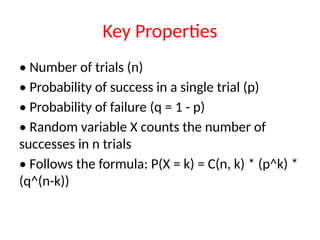
• Numberof trials (n)
• Probability of success in a single trial (p)
• Probability of failure (q = 1 - p)
• Random variable X counts the number of
successes in n trials
• Follows the formula: P(X = k) = C(n, k) * (p^k) *
(q^(n-k))
4.
Real-Life Example 1:Coin Toss
• Suppose a fair coin is tossed 10 times.
• Probability of getting heads (success) in each
toss: p = 0.5
• Let X be the number of heads obtained.
• X follows a binomial distribution with
parameters n = 10, p = 0.5.
5.
Real-Life Example 2:Quality Control
• A factory produces light bulbs with a 2% defect
rate.
• A random sample of 20 bulbs is tested.
• Probability of finding exactly 1 defective bulb
can be calculated using the binomial formula
with n = 20, p = 0.02.
6.
Real-Life Example 3:Exam Questions
• A multiple-choice quiz has 5 questions, each
with 4 possible answers.
• Probability of guessing a question correctly: p
= 0.25
• X = number of correct answers follows a
binomial distribution with n = 5, p = 0.25.
7.
Applications of BinomialDistribution
• Quality control in manufacturing
• Decision making in business
• Genetics and biology studies
• Risk analysis in finance
• Sports performance analysis
8.
Characteristics of BinomialDistribution
• Fixed Number of Trials (n)
The experiment consists of a fixed number of trials.
Each trial is performed under the same conditions.
• Two Possible Outcomes in Each Trial
Each trial results in only two mutually exclusive
outcomes:
– Success (with probability p)
– Failure (with probability q=1−p)
9.
Characteristics of BinomialDistribution
•Constant Probability of Success
The probability p of success is the same for all trials.
𝑝
• Independent Trials
The outcome of any trial does not affect the outcome
of the other trials.
• Discrete Random Variable
The random variable counts the
𝑋 number of
successes in trials. can take integer values from
𝑛 𝑋 0
to 𝑛.
10.
Characteristics of BinomialDistribution
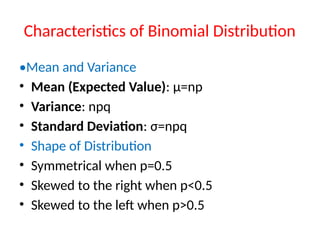
•Mean and Variance
• Mean (Expected Value): μ=np
• Variance: npq
• Standard Deviation: σ=npq
• Shape of Distribution
• Symmetrical when p=0.5
• Skewed to the right when p<0.5
• Skewed to the left when p>0.5