DISCRETE
PROBABILITY
DISTRIBUTIONS
ENGR. JORDAN RONQUILLO
RANDOM VARIABLE
 A random variable is a variable whose values are determined by chance.
 A random variable is a function that associates a real number with each
element in the sample space.
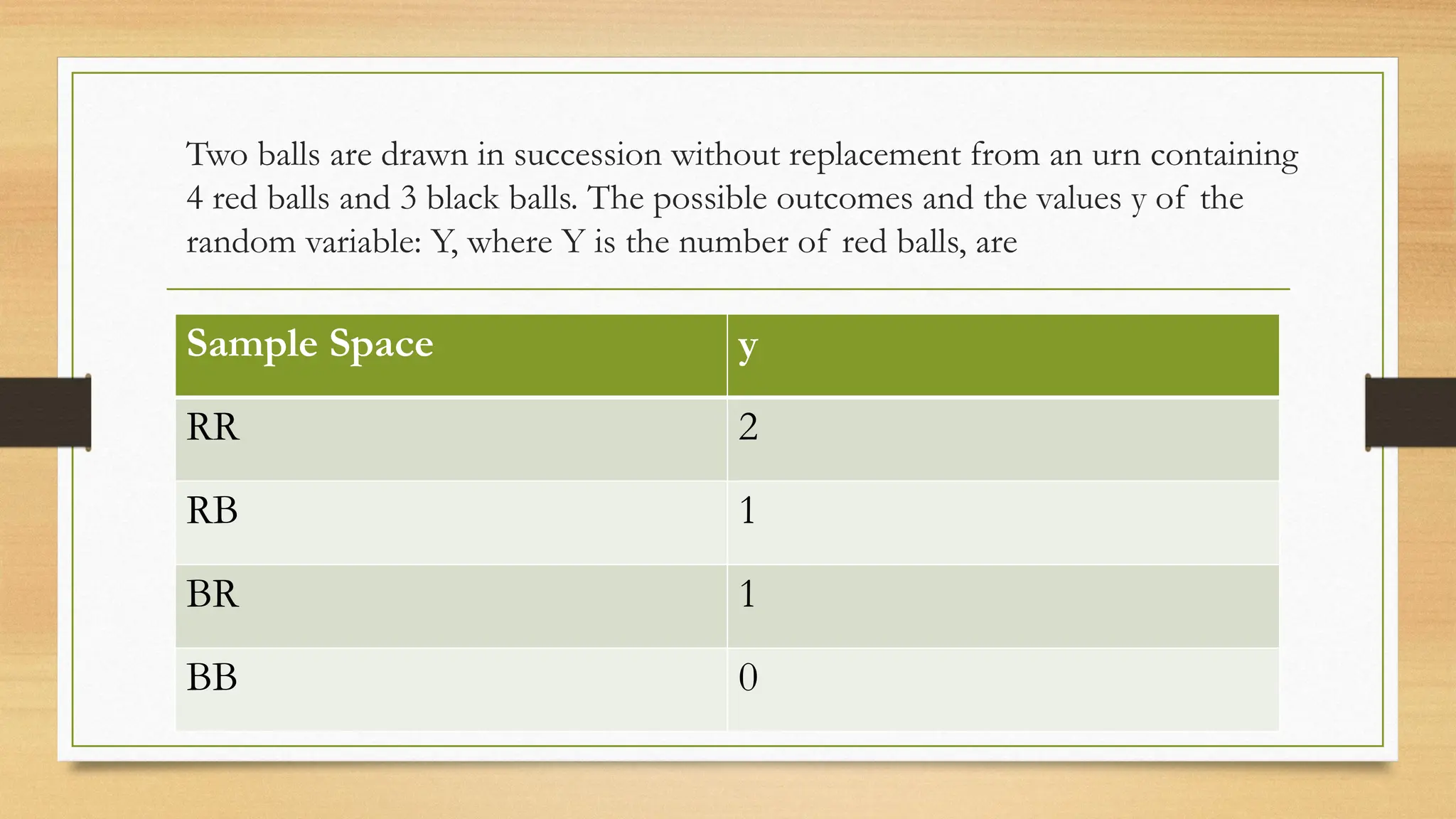
Two balls are drawn in succession without replacement from an urn containing
4 red balls and 3 black balls. The possible outcomes and the values y of the
random variable: Y, where Y is the number of red balls, are
Sample Space y
RR 2
RB 1
BR 1
BB 0
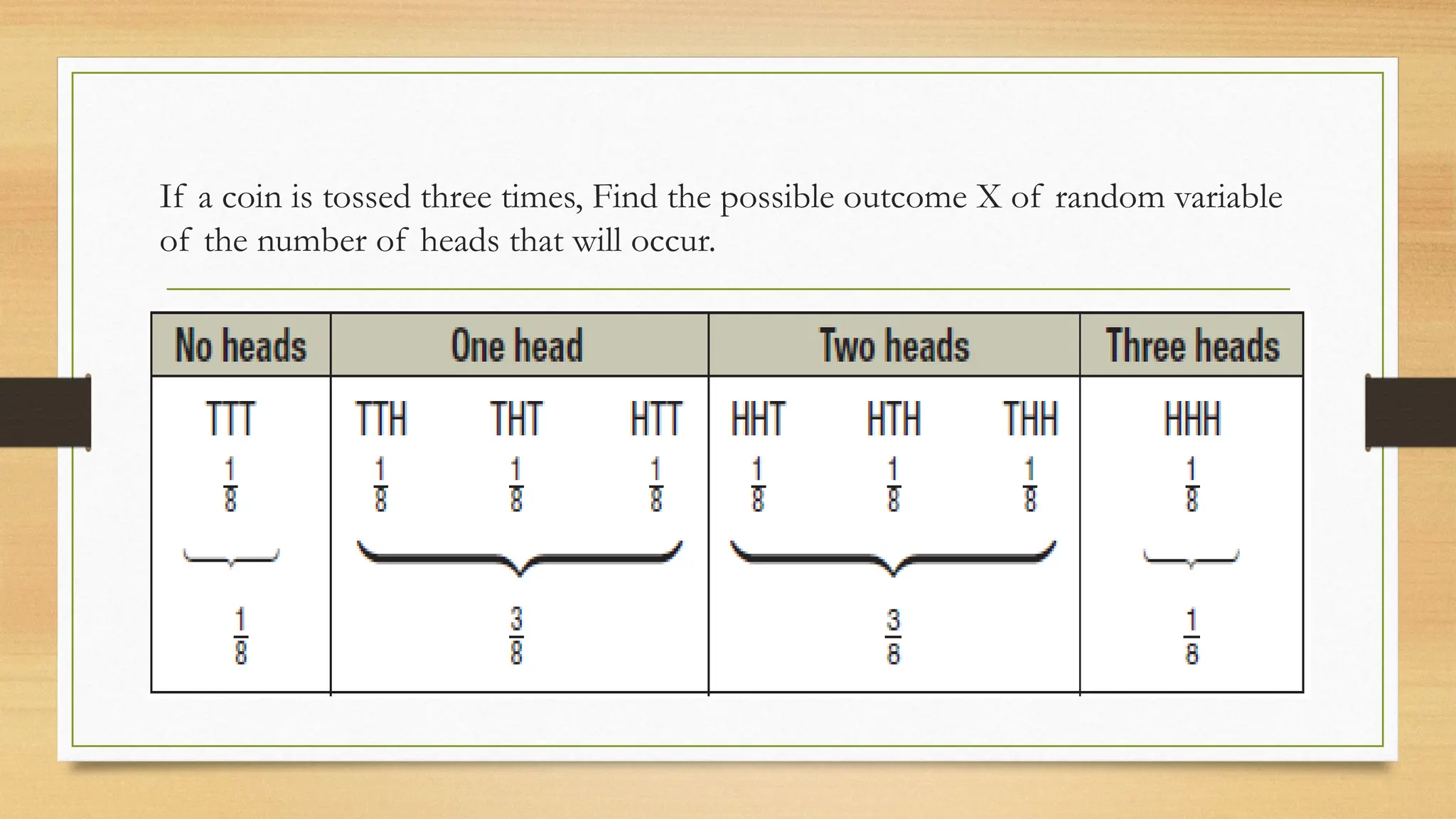
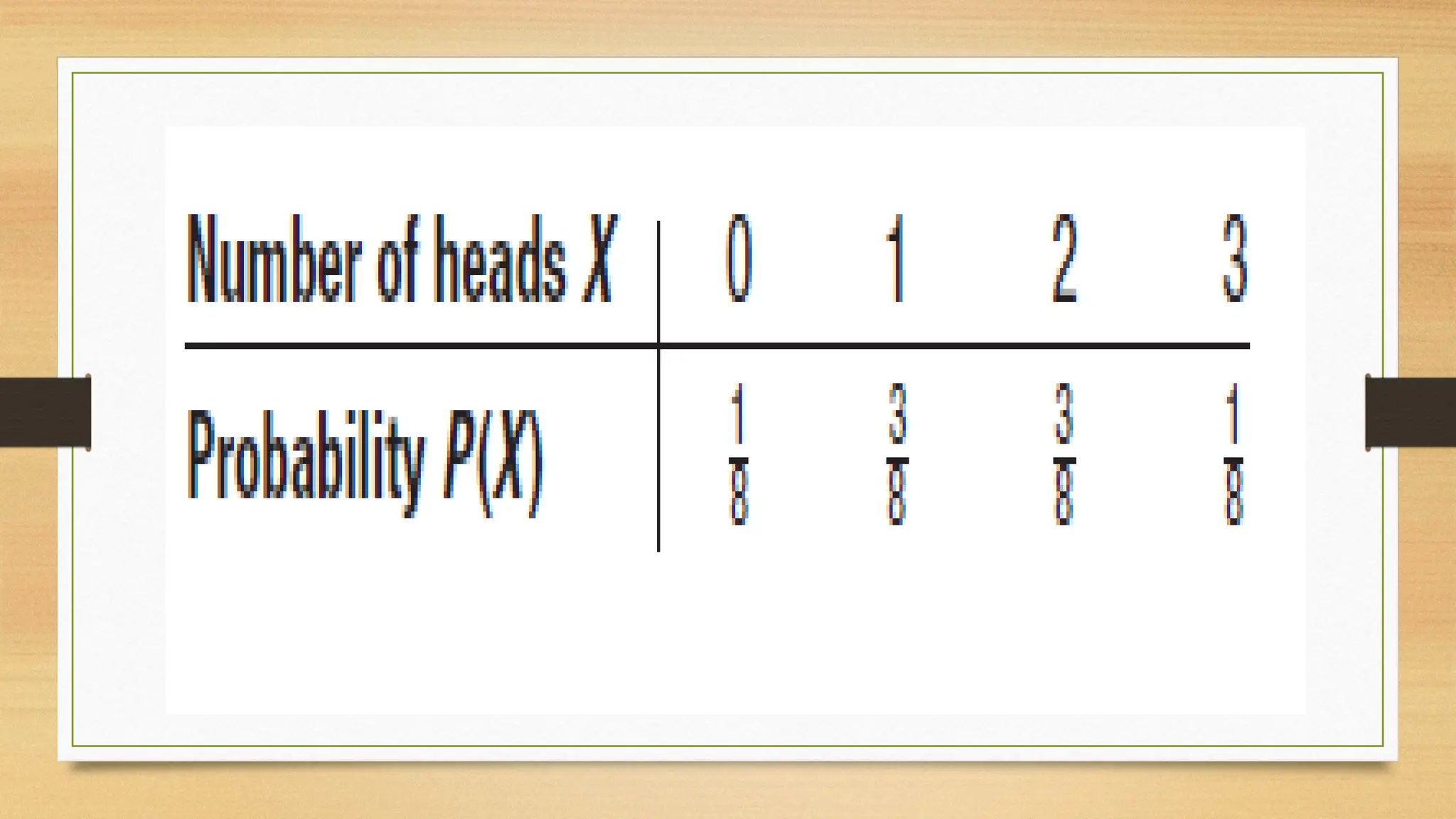
If a coin is tossed three times, Find the possible outcome X of random variable
of the number of heads that will occur.
DISCRETE PROBABILITY DISTRIBUTION
 A discrete probability distribution consists of the values a random variable
can assume and the corresponding probabilities of the values. The
probabilities are determined theoretically or by observation.
 Discrete probability distributions can be shown by using a graph or a table.
Probability distributions can also be represented by a formula.
DISCRETE PROBABILITY DISTRIBUTION
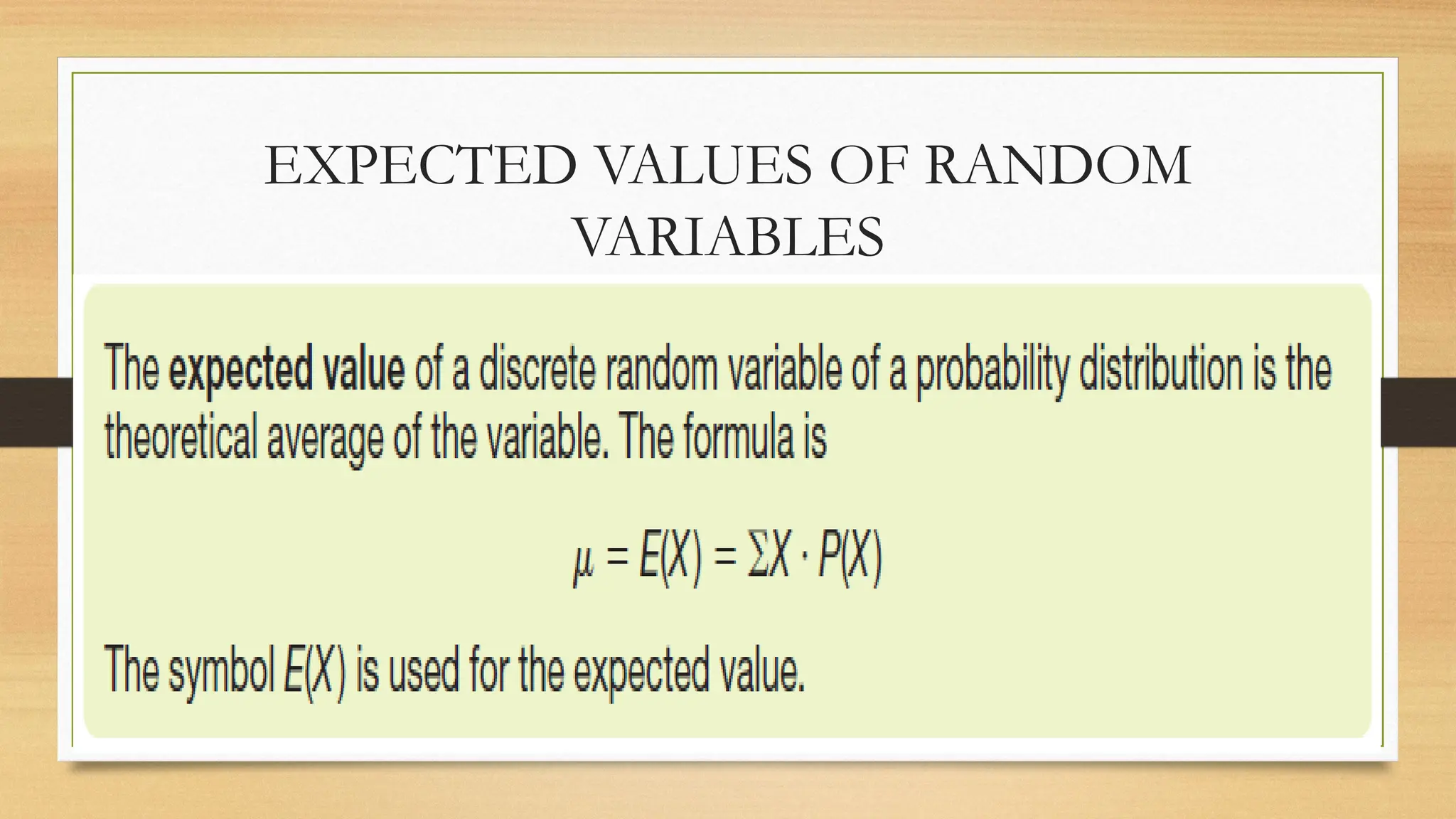
 The baseball World Series is played by the winner of the National
League and that of the American League. The first team to win
four games wins the World Series. In other words, the series will
consist of four to seven games, depending on the individual
victories. The data shown consist of 40 World Series events. The
number of games played in each series is represented by the
variable X. Find the probability P(X) for each X, construct a
probability distribution, and draw a graph for the data.
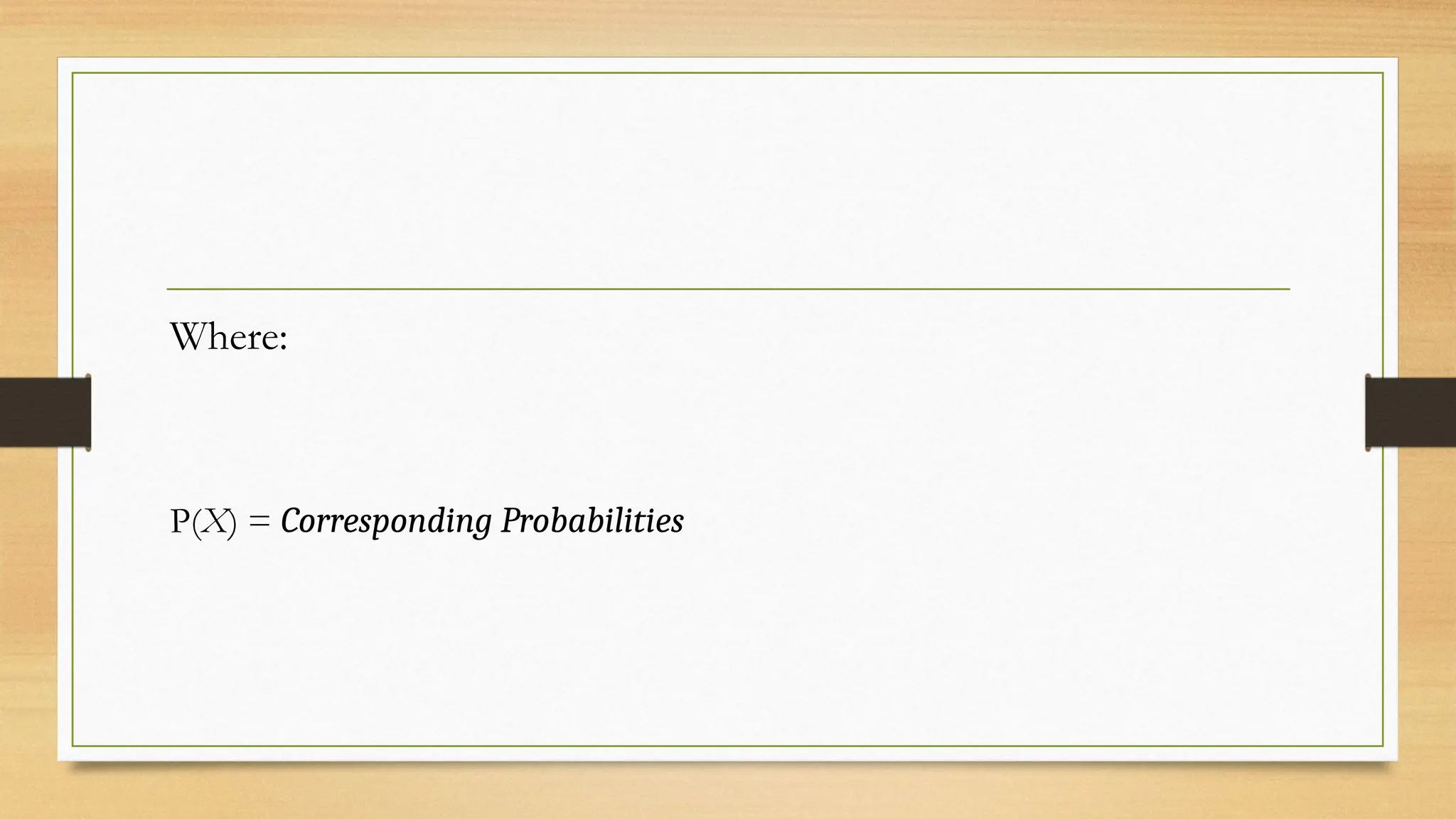
EXPECTED VALUES OF RANDOM
VARIABLES
Where:
P(X) = Corresponding Probabilities
 In gambling games, if the expected value of the game is zero, the
game is said to be fair.
If the expected value of a game is positive, then the game is in
favor of the player. That is, the player has a better than even
chance of winning.
If the expected value of the game is negative, then the game is
said to be in favor of the house. That is, in the long run, the
players will lose money.
EXPECTED VALUES OF RANDOM
VARIABLES
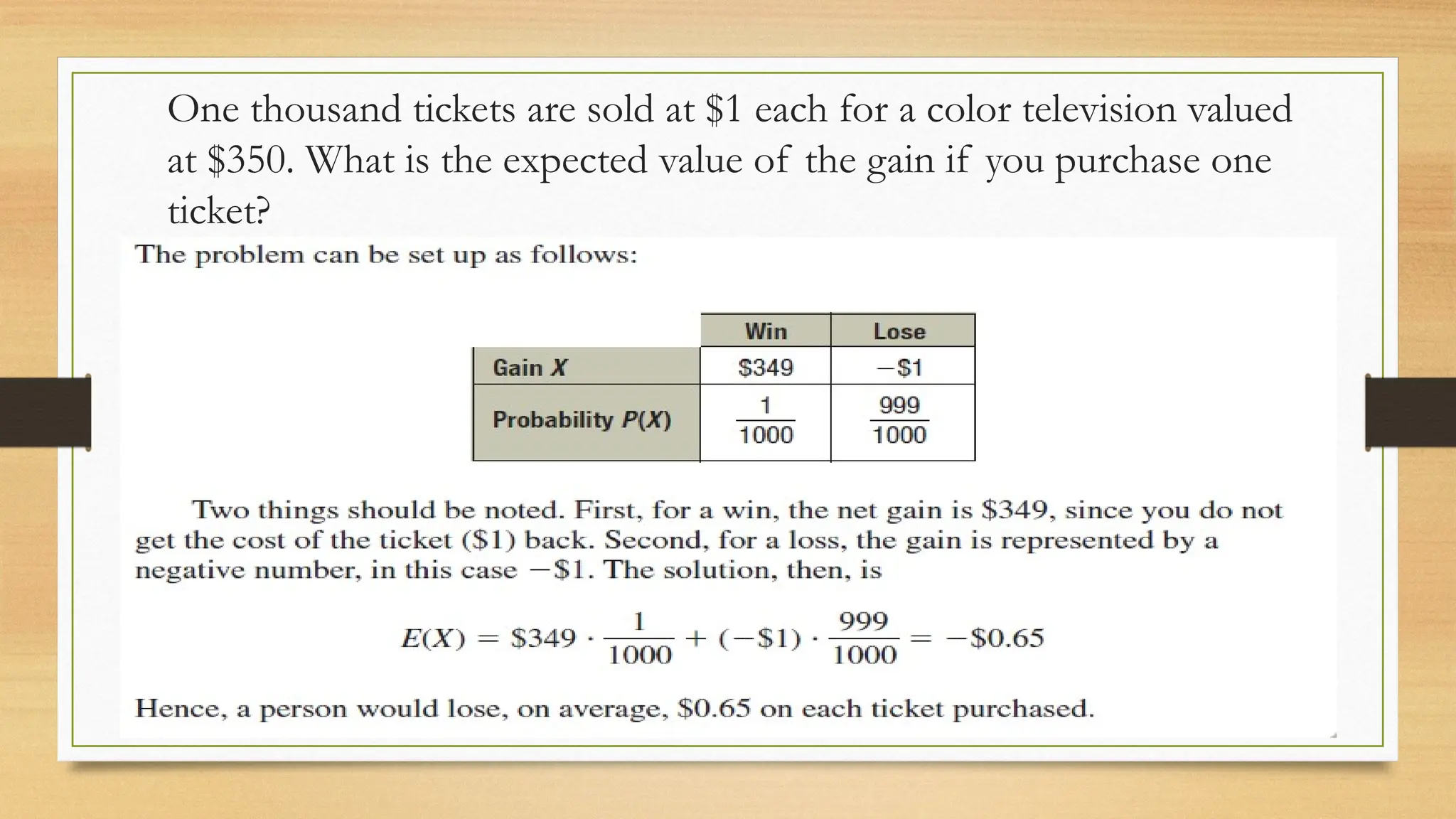
One thousand tickets are sold at $1 each for a color television valued
at $350. What is the expected value of the gain if you purchase one
ticket?
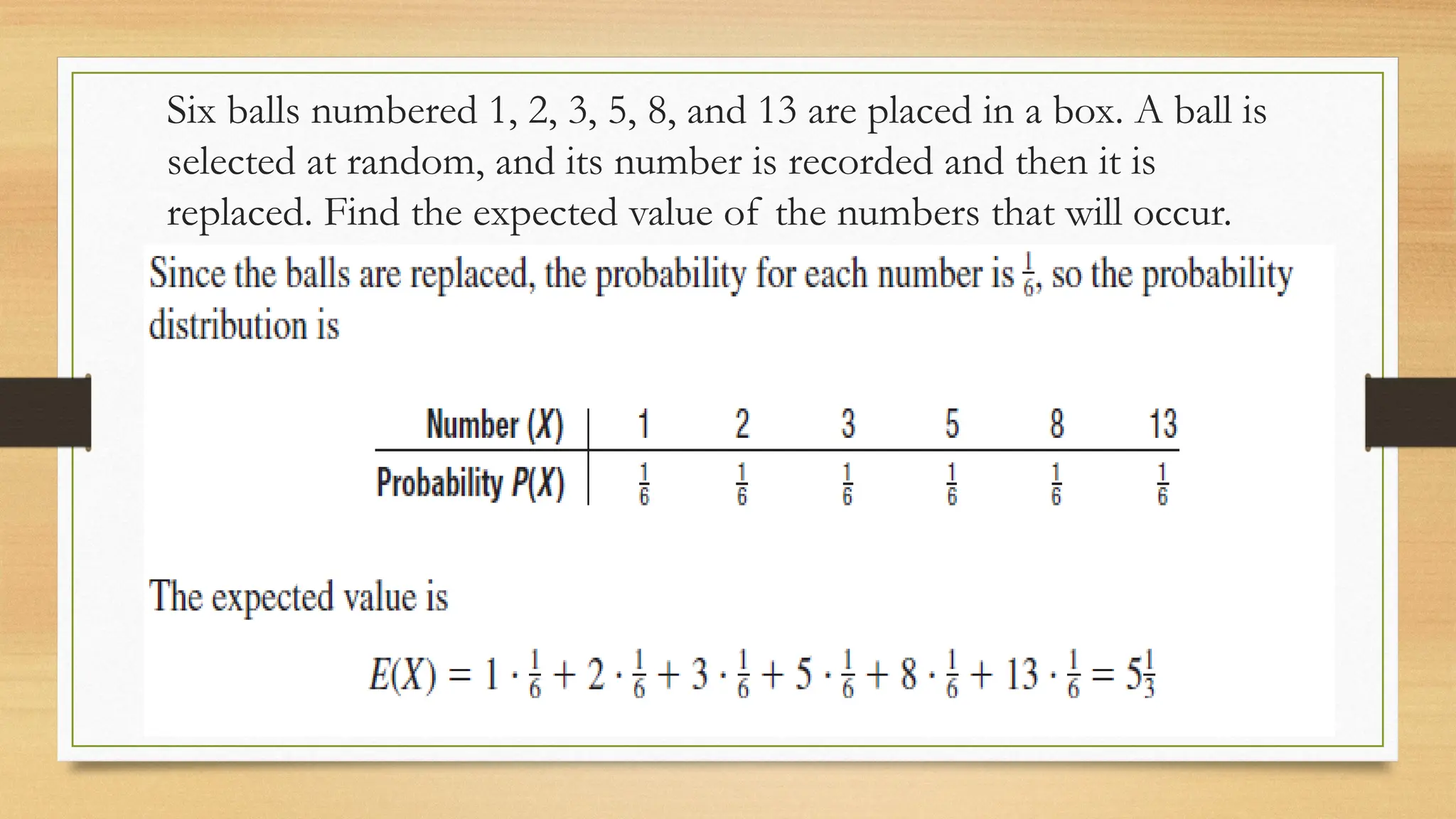
Six balls numbered 1, 2, 3, 5, 8, and 13 are placed in a box. A ball is
selected at random, and its number is recorded and then it is
replaced. Find the expected value of the numbers that will occur.
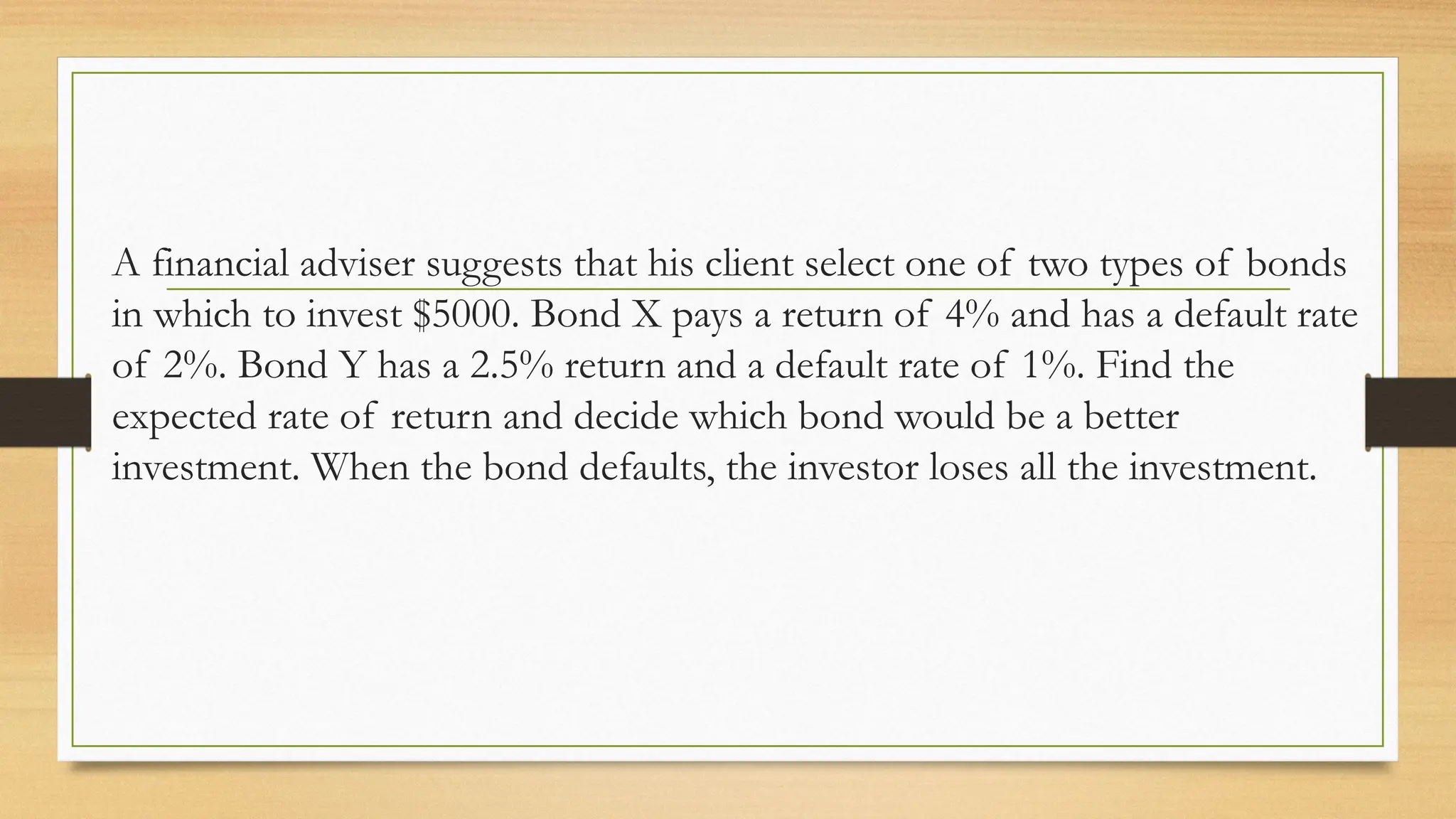
A financial adviser suggests that his client select one of two types of bonds
in which to invest $5000. Bond X pays a return of 4% and has a default rate
of 2%. Bond Y has a 2.5% return and a default rate of 1%. Find the
expected rate of return and decide which bond would be a better
investment. When the bond defaults, the investor loses all the investment.
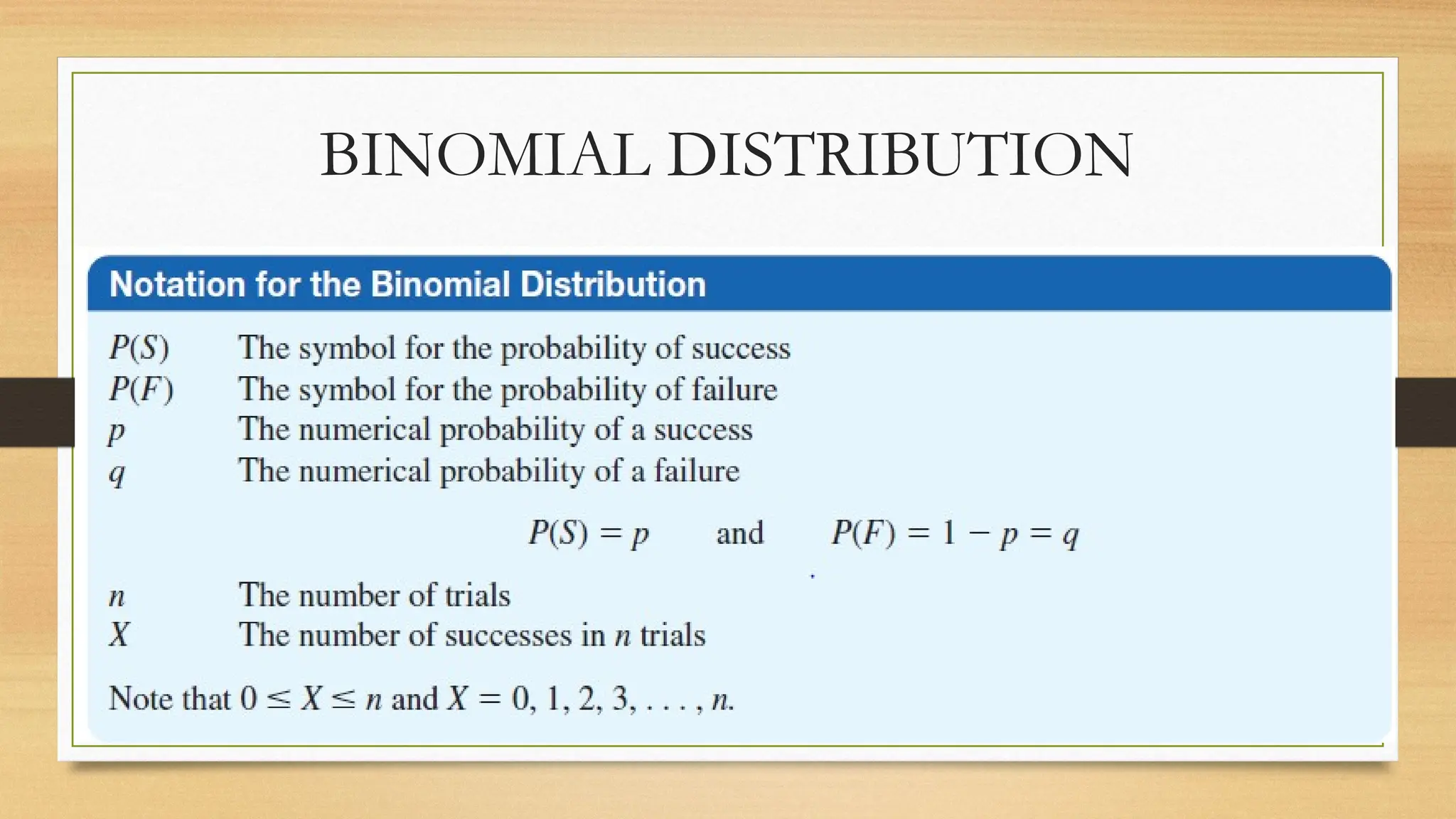
THE BINOMIAL DISTRIBUTION
• A binomial experiment is a probability experiment that satisfies the following
four requirements:
1. There must be a fixed number of trials.
2. Each trial can have only two outcomes or outcomes that can be reduced to
two outcomes. These outcomes can be considered as either success or failure.
3. The outcomes of each trial must be independent of one another.
4. The probability of a success must remain the same for each trial.
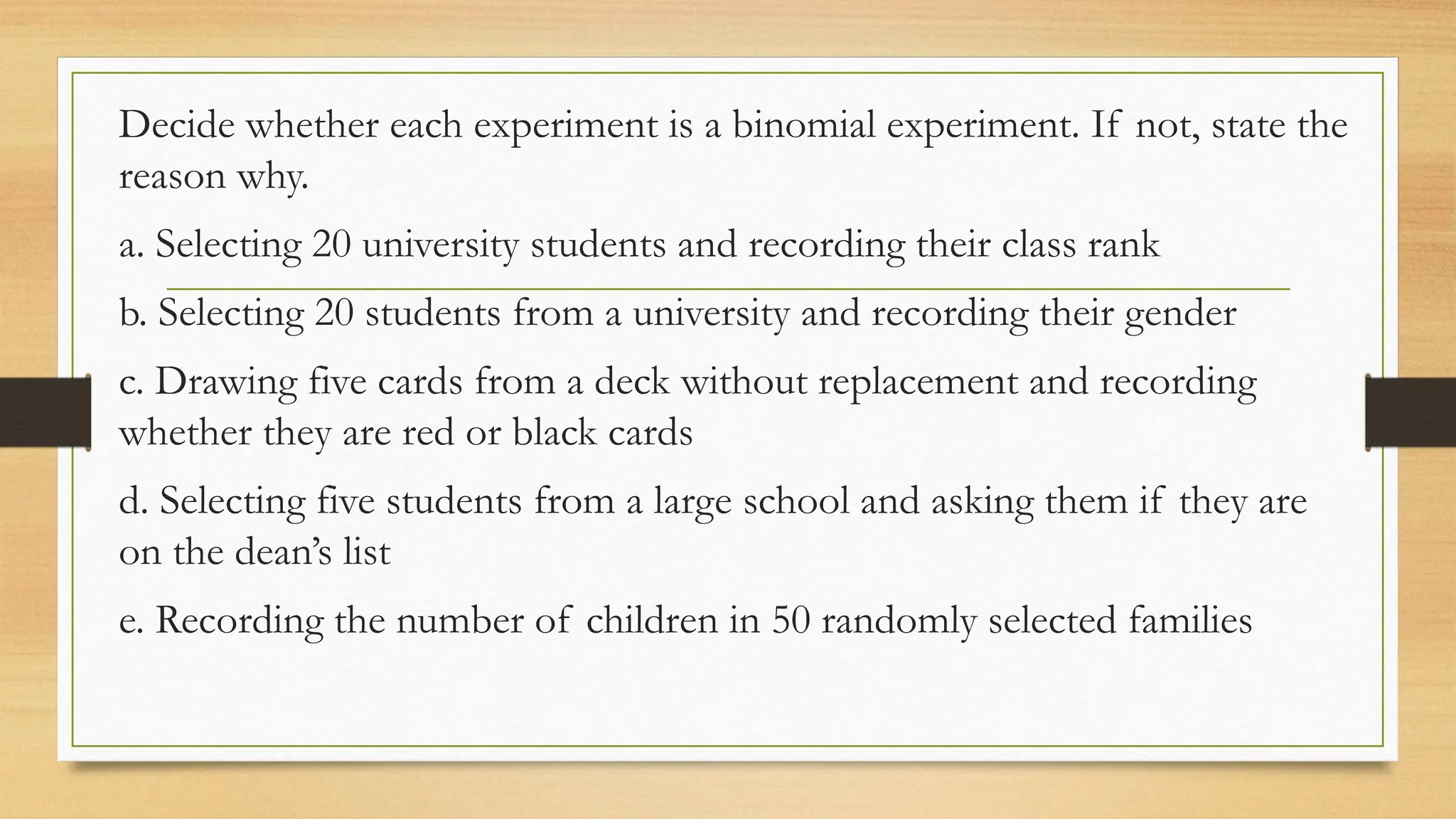
Decide whether each experiment is a binomial experiment. If not, state the
reason why.
a. Selecting 20 university students and recording their class rank
b. Selecting 20 students from a university and recording their gender
c. Drawing five cards from a deck without replacement and recording
whether they are red or black cards
d. Selecting five students from a large school and asking them if they are
on the dean’s list
e. Recording the number of children in 50 randomly selected families
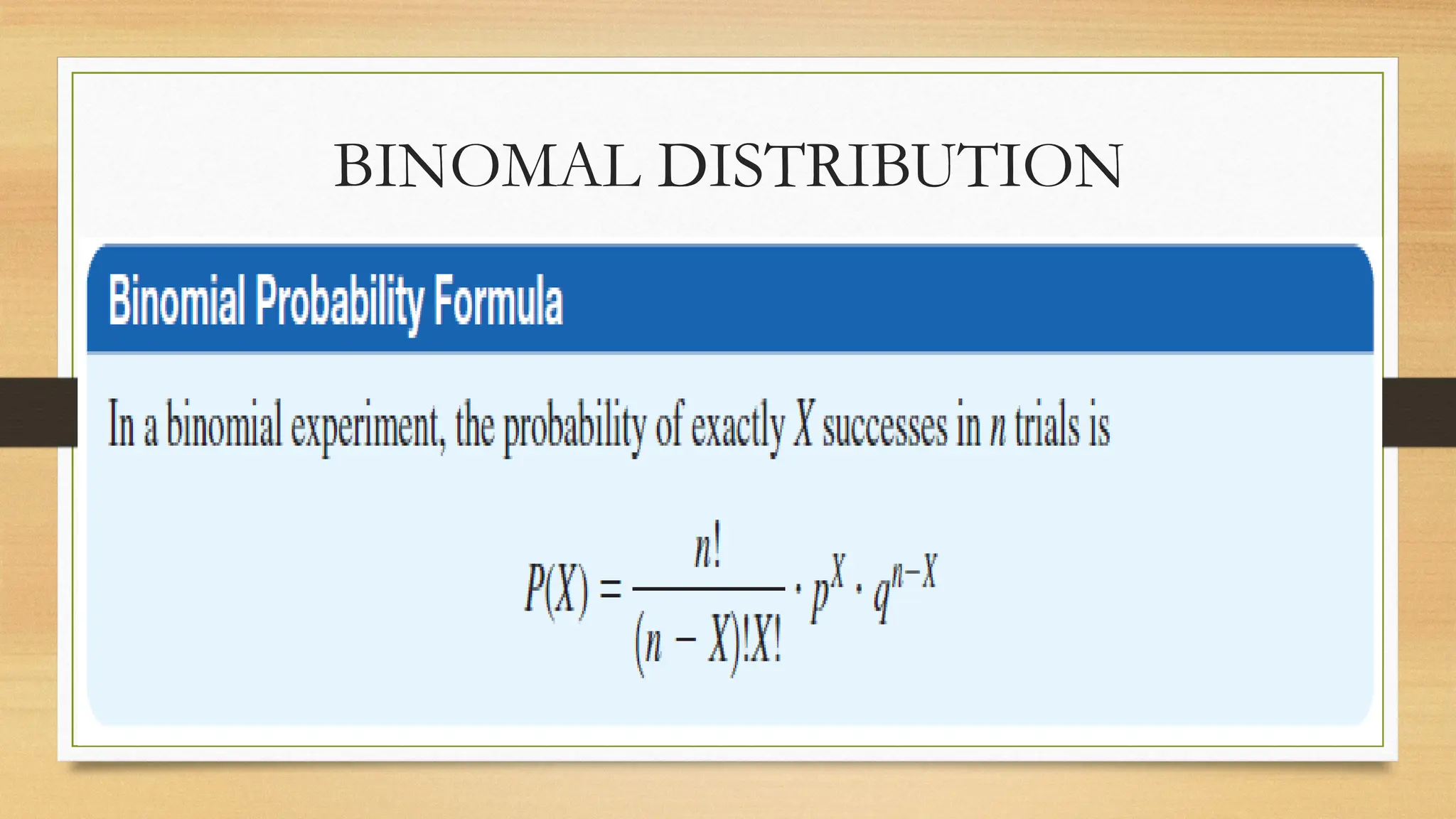
BINOMIAL DISTRIBUTION
• The outcomes of a binomial experiment and the
corresponding probabilities of these outcomes are called a
binomial distribution.
BINOMAL DISTRIBUTION
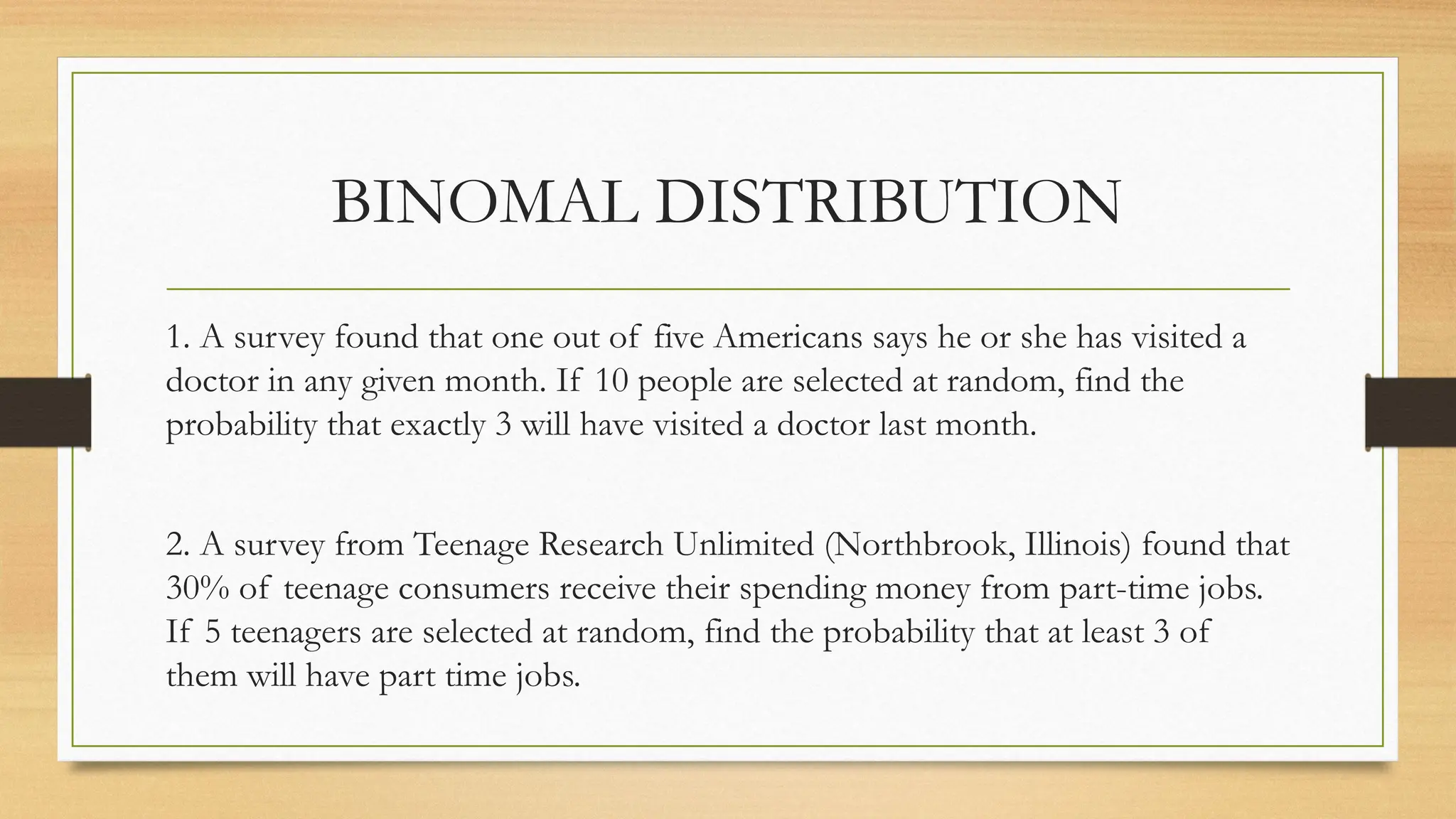
1. A survey found that one out of five Americans says he or she has visited a
doctor in any given month. If 10 people are selected at random, find the
probability that exactly 3 will have visited a doctor last month.
2. A survey from Teenage Research Unlimited (Northbrook, Illinois) found that
30% of teenage consumers receive their spending money from part-time jobs.
If 5 teenagers are selected at random, find the probability that at least 3 of
them will have part time jobs.
BINOMAL DISTRIBUTION
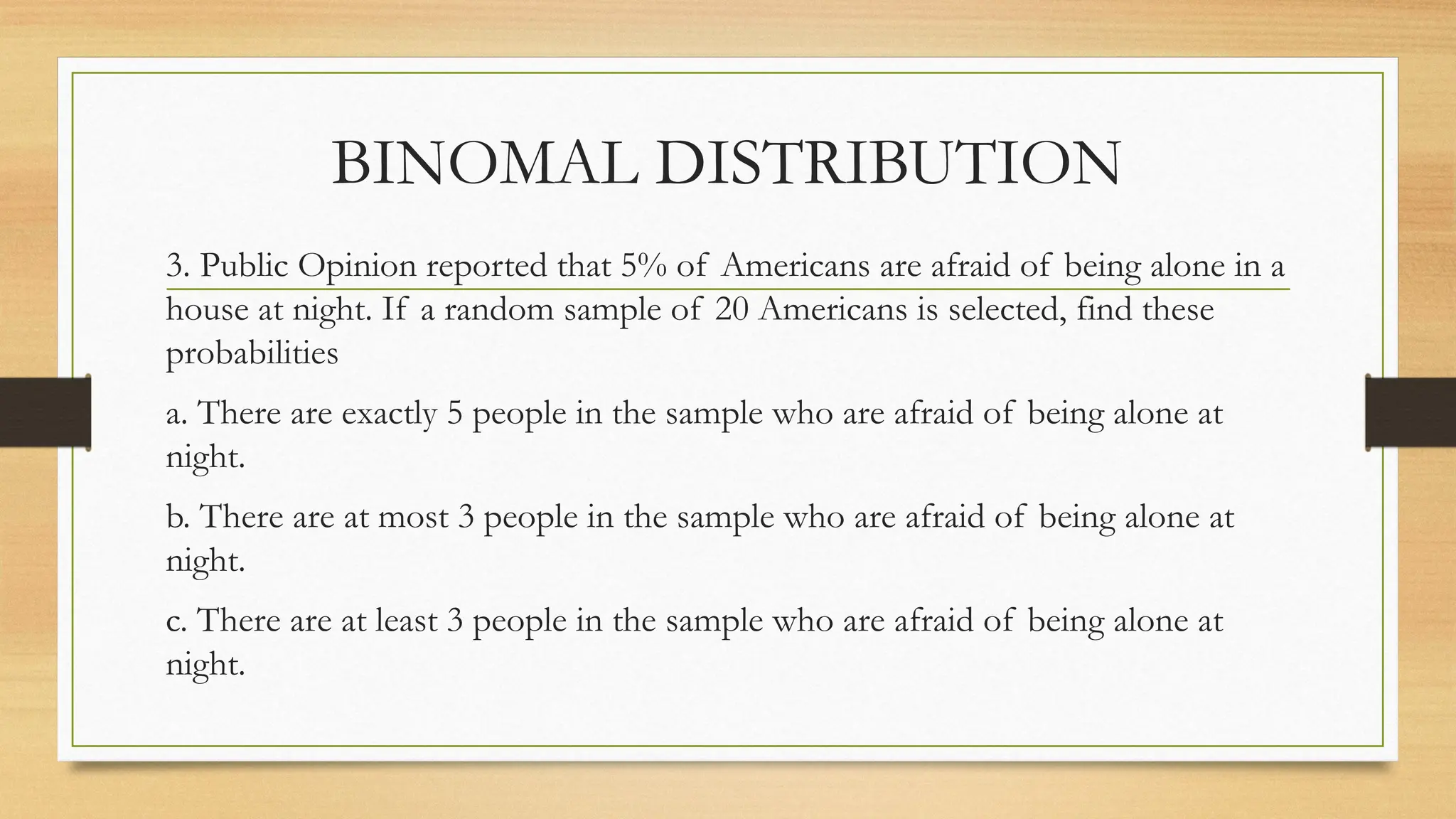
3. Public Opinion reported that 5% of Americans are afraid of being alone in a
house at night. If a random sample of 20 Americans is selected, find these
probabilities
a. There are exactly 5 people in the sample who are afraid of being alone at
night.
b. There are at most 3 people in the sample who are afraid of being alone at
night.
c. There are at least 3 people in the sample who are afraid of being alone at
night.
BINOMAL DISTRIBUTION
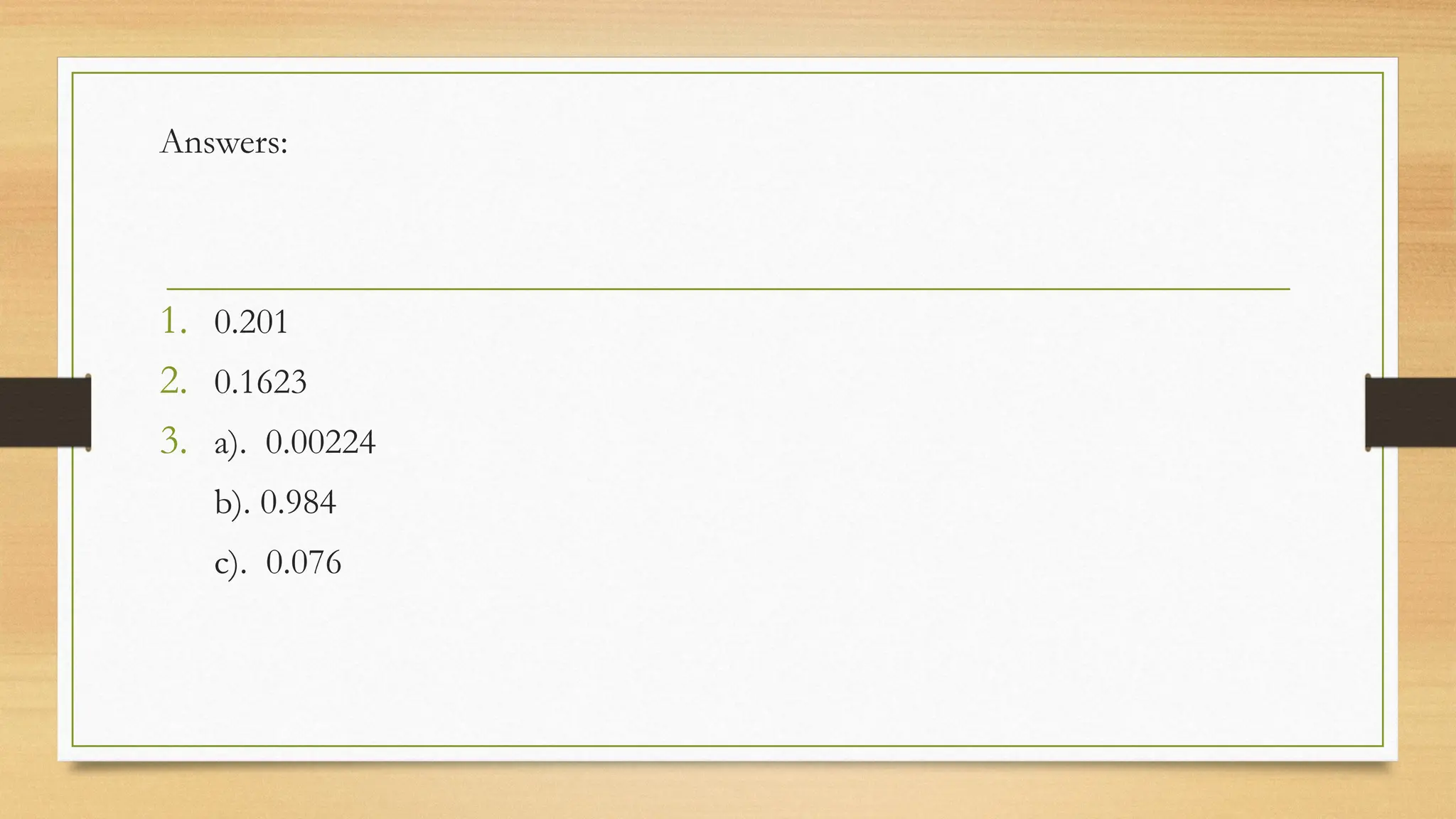
Answers:
1. 0.201
2. 0.1623
3. a). 0.00224
b). 0.984
c). 0.076
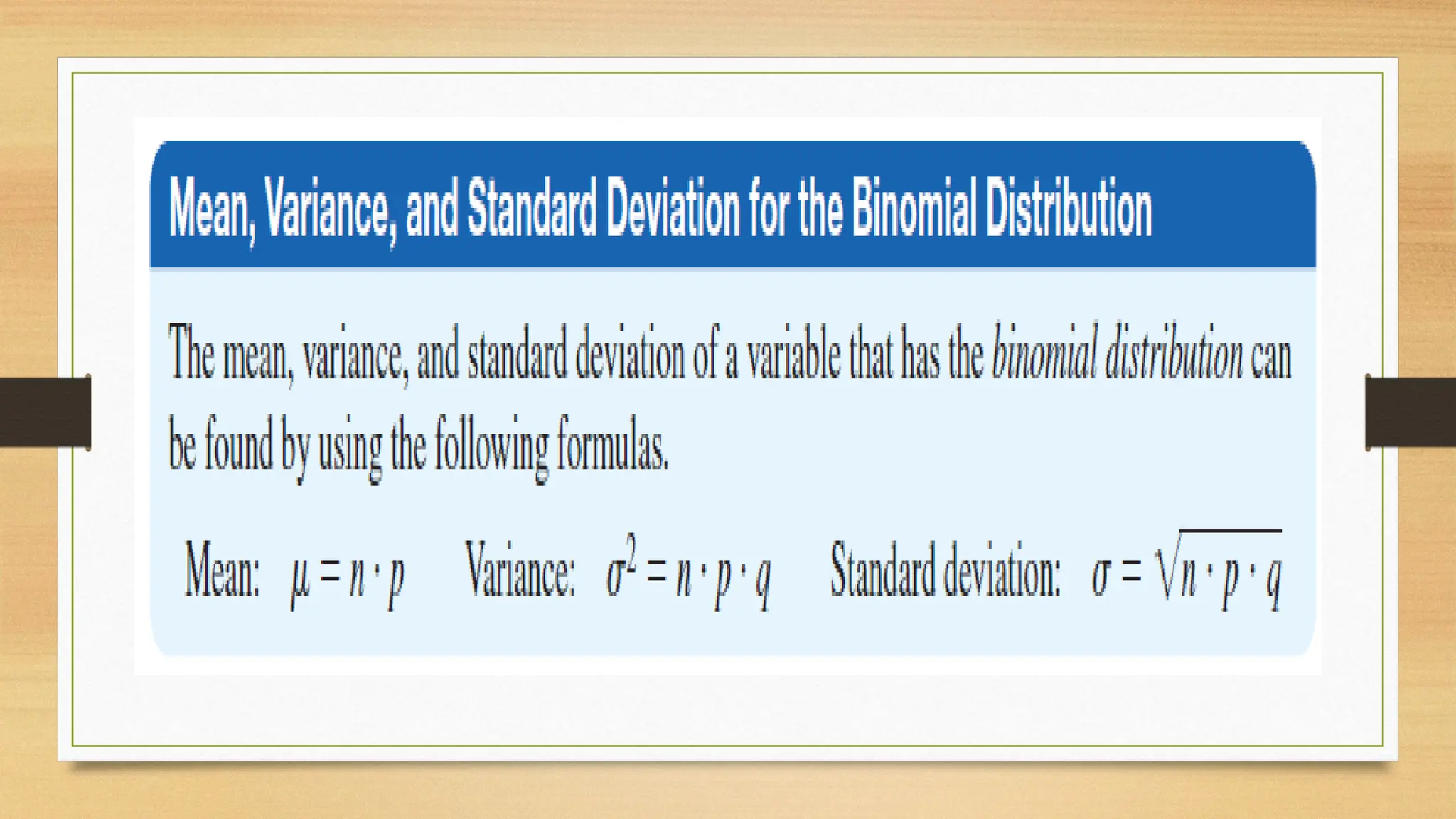
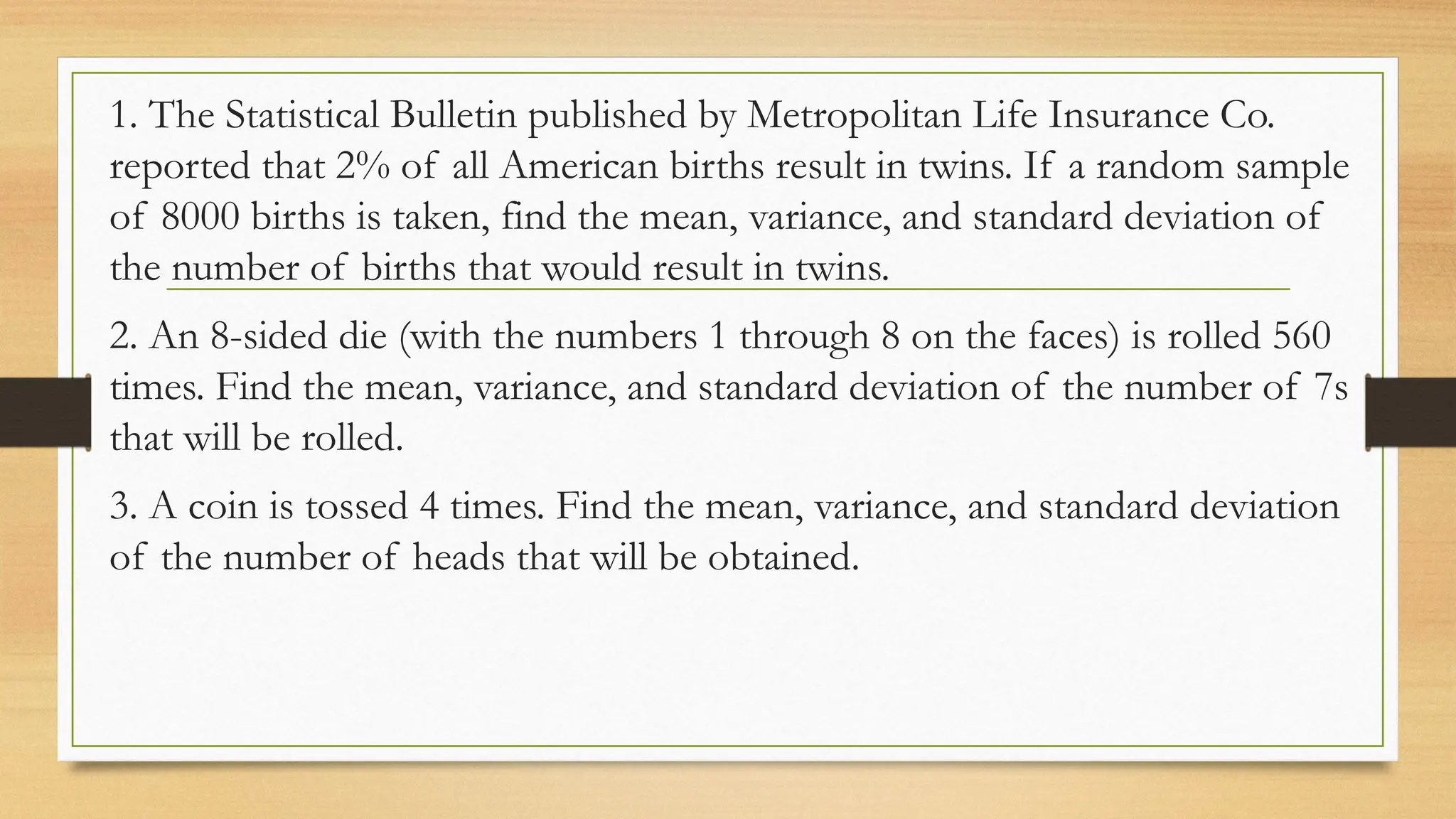
1. The Statistical Bulletin published by Metropolitan Life Insurance Co.
reported that 2% of all American births result in twins. If a random sample
of 8000 births is taken, find the mean, variance, and standard deviation of
the number of births that would result in twins.
2. An 8-sided die (with the numbers 1 through 8 on the faces) is rolled 560
times. Find the mean, variance, and standard deviation of the number of 7s
that will be rolled.
3. A coin is tossed 4 times. Find the mean, variance, and standard deviation
of the number of heads that will be obtained.
THE POISSON DISTRIBUTION
• A Poisson experiment is a probability experiment that satisfies the
following requirements:
1. The random variable X is the number of occurrences of an event over
some interval (i.e., length, area, volume, period of time, etc.).
2. The occurrences occur randomly.
3. The occurrences are independent of one another.
4. The average number of occurrences over an interval is known.
THEPOISSON DISTRIBUTION
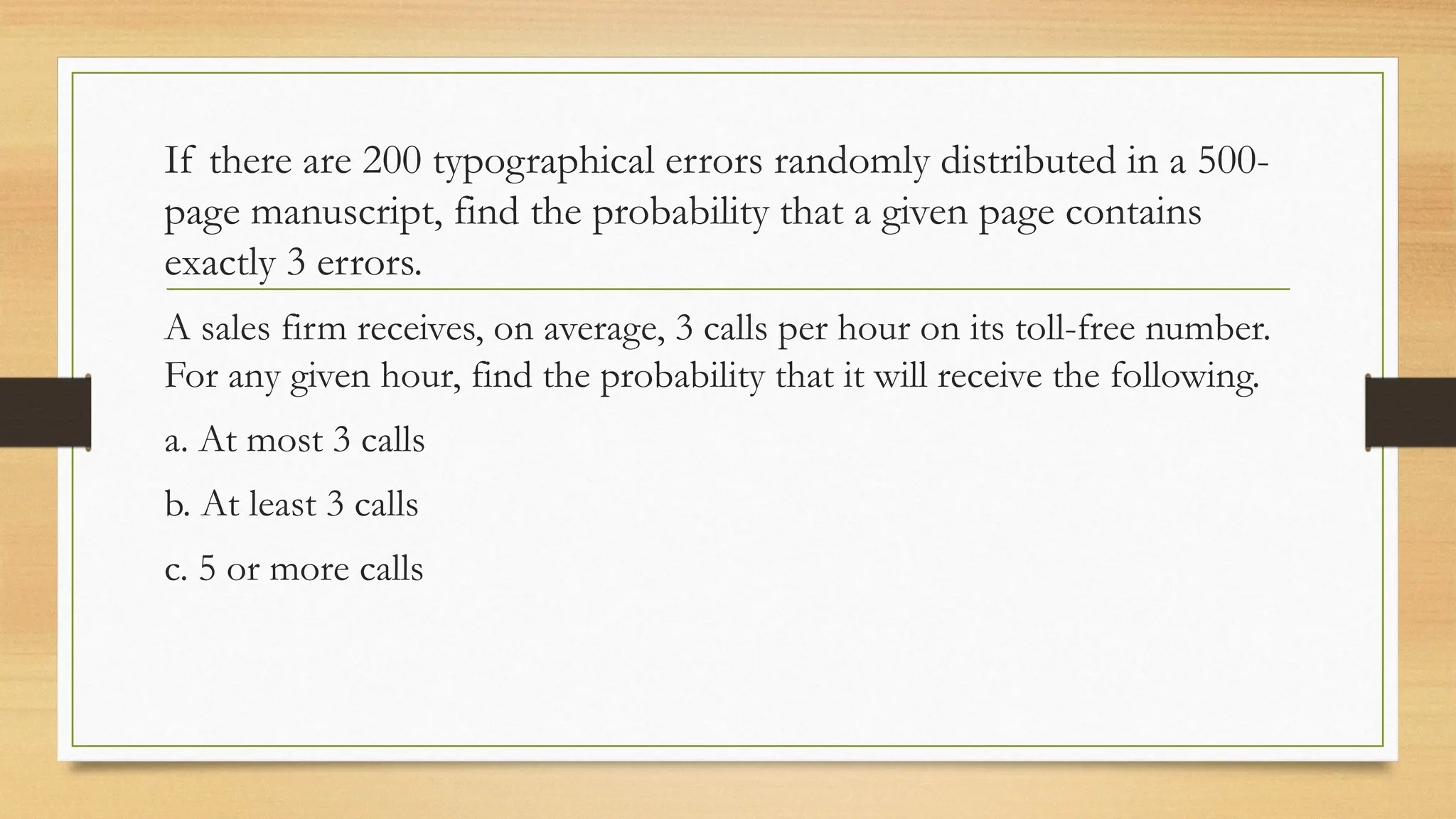
If there are 200 typographical errors randomly distributed in a 500-
page manuscript, find the probability that a given page contains
exactly 3 errors.
A sales firm receives, on average, 3 calls per hour on its toll-free number.
For any given hour, find the probability that it will receive the following.
a. At most 3 calls
b. At least 3 calls
c. 5 or more calls
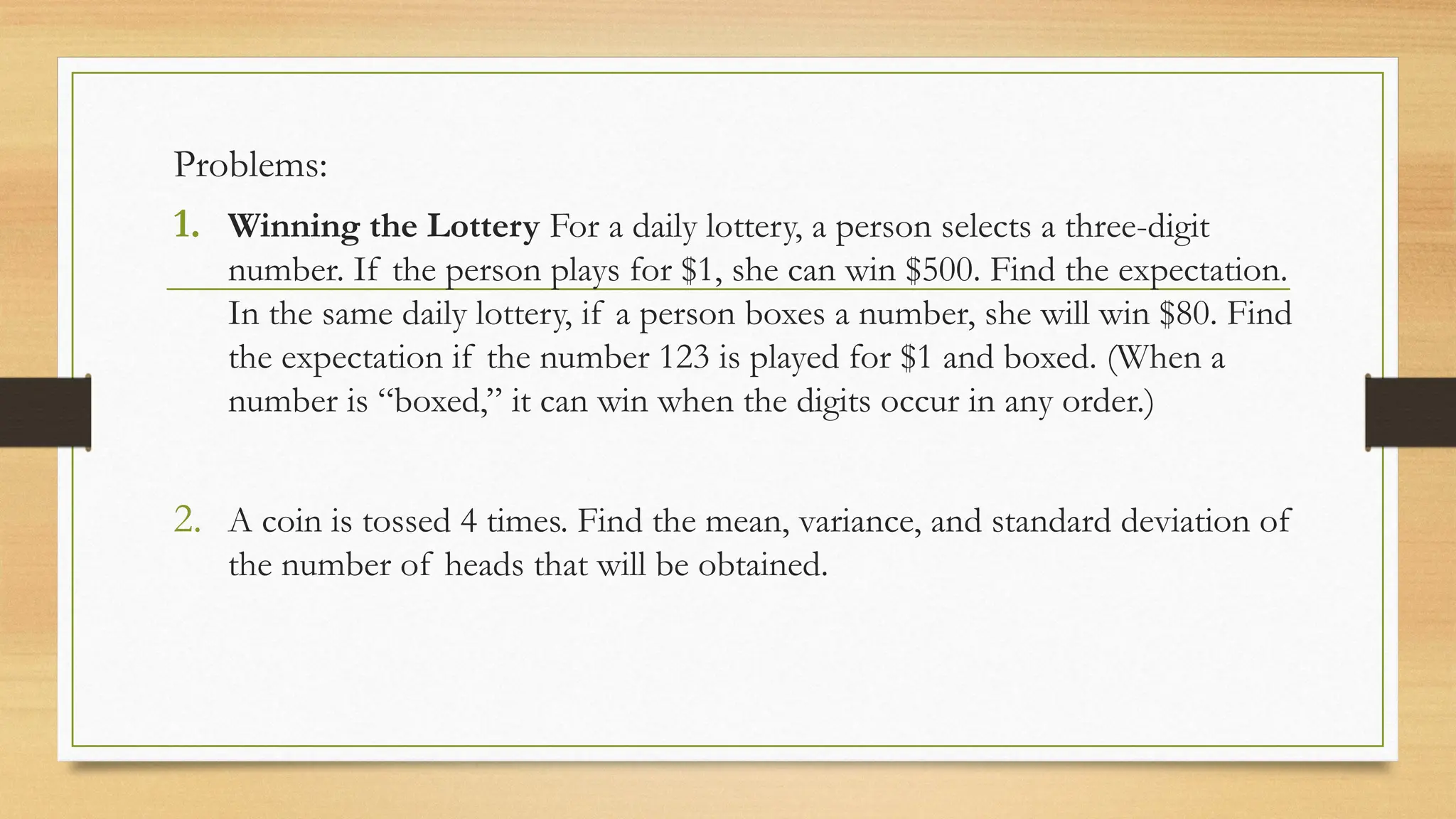
Problems:
1. Winning the Lottery For a daily lottery, a person selects a three-digit
number. If the person plays for $1, she can win $500. Find the expectation.
In the same daily lottery, if a person boxes a number, she will win $80. Find
the expectation if the number 123 is played for $1 and boxed. (When a
number is “boxed,” it can win when the digits occur in any order.)
2. A coin is tossed 4 times. Find the mean, variance, and standard deviation of
the number of heads that will be obtained.
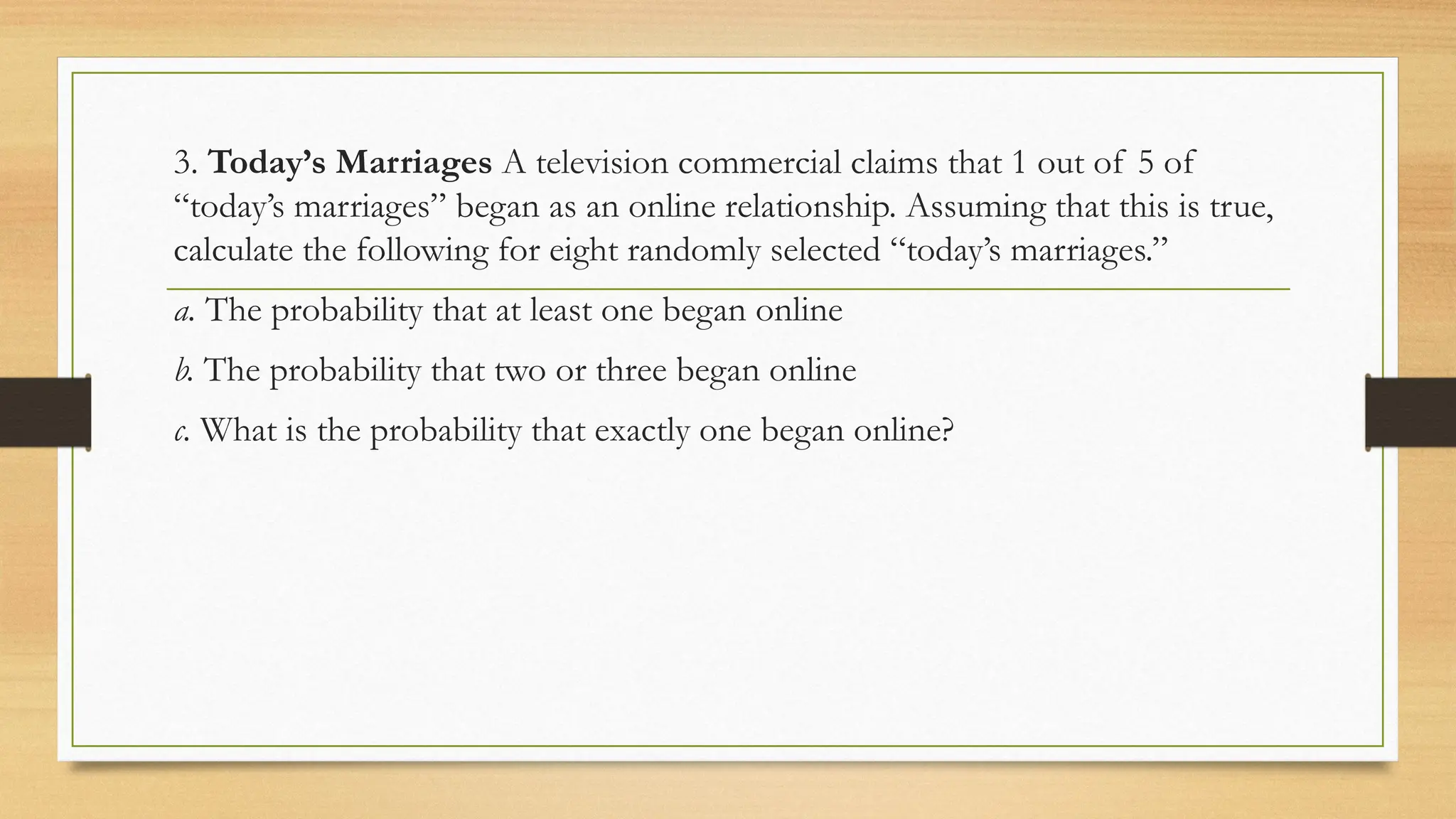
3. Today’s Marriages A television commercial claims that 1 out of 5 of
“today’s marriages” began as an online relationship. Assuming that this is true,
calculate the following for eight randomly selected “today’s marriages.”
a. The probability that at least one began online
b. The probability that two or three began online
c. What is the probability that exactly one began online?
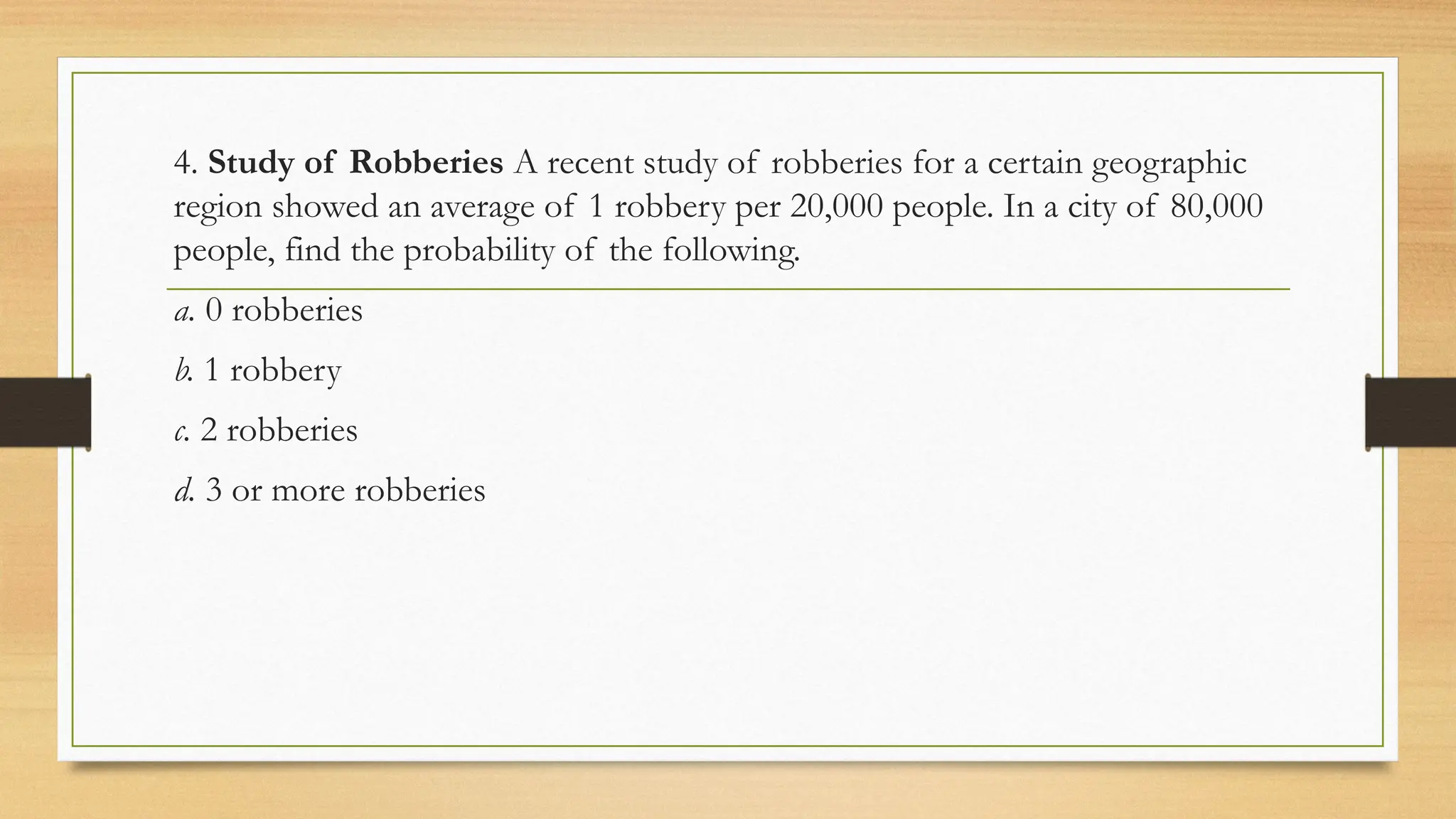
4. Study of Robberies A recent study of robberies for a certain geographic
region showed an average of 1 robbery per 20,000 people. In a city of 80,000
people, find the probability of the following.
a. 0 robberies
b. 1 robbery
c. 2 robberies
d. 3 or more robberies

DISCRETE PROBABILITY DISTRIBUTIONS (2).pptx

  • 1.
  • 2.
    RANDOM VARIABLE  Arandom variable is a variable whose values are determined by chance.  A random variable is a function that associates a real number with each element in the sample space.
  • 3.
    Two balls aredrawn in succession without replacement from an urn containing 4 red balls and 3 black balls. The possible outcomes and the values y of the random variable: Y, where Y is the number of red balls, are Sample Space y RR 2 RB 1 BR 1 BB 0
  • 4.
    If a coinis tossed three times, Find the possible outcome X of random variable of the number of heads that will occur.
  • 6.
    DISCRETE PROBABILITY DISTRIBUTION A discrete probability distribution consists of the values a random variable can assume and the corresponding probabilities of the values. The probabilities are determined theoretically or by observation.  Discrete probability distributions can be shown by using a graph or a table. Probability distributions can also be represented by a formula.
  • 7.
  • 9.
     The baseballWorld Series is played by the winner of the National League and that of the American League. The first team to win four games wins the World Series. In other words, the series will consist of four to seven games, depending on the individual victories. The data shown consist of 40 World Series events. The number of games played in each series is represented by the variable X. Find the probability P(X) for each X, construct a probability distribution, and draw a graph for the data.
  • 10.
    EXPECTED VALUES OFRANDOM VARIABLES
  • 11.
  • 12.
     In gamblinggames, if the expected value of the game is zero, the game is said to be fair. If the expected value of a game is positive, then the game is in favor of the player. That is, the player has a better than even chance of winning. If the expected value of the game is negative, then the game is said to be in favor of the house. That is, in the long run, the players will lose money. EXPECTED VALUES OF RANDOM VARIABLES
  • 13.
    One thousand ticketsare sold at $1 each for a color television valued at $350. What is the expected value of the gain if you purchase one ticket?
  • 14.
    Six balls numbered1, 2, 3, 5, 8, and 13 are placed in a box. A ball is selected at random, and its number is recorded and then it is replaced. Find the expected value of the numbers that will occur.
  • 15.
    A financial advisersuggests that his client select one of two types of bonds in which to invest $5000. Bond X pays a return of 4% and has a default rate of 2%. Bond Y has a 2.5% return and a default rate of 1%. Find the expected rate of return and decide which bond would be a better investment. When the bond defaults, the investor loses all the investment.
  • 16.
    THE BINOMIAL DISTRIBUTION •A binomial experiment is a probability experiment that satisfies the following four requirements: 1. There must be a fixed number of trials. 2. Each trial can have only two outcomes or outcomes that can be reduced to two outcomes. These outcomes can be considered as either success or failure. 3. The outcomes of each trial must be independent of one another. 4. The probability of a success must remain the same for each trial.
  • 17.
    Decide whether eachexperiment is a binomial experiment. If not, state the reason why. a. Selecting 20 university students and recording their class rank b. Selecting 20 students from a university and recording their gender c. Drawing five cards from a deck without replacement and recording whether they are red or black cards d. Selecting five students from a large school and asking them if they are on the dean’s list e. Recording the number of children in 50 randomly selected families
  • 18.
    BINOMIAL DISTRIBUTION • Theoutcomes of a binomial experiment and the corresponding probabilities of these outcomes are called a binomial distribution.
  • 19.
  • 20.
    1. A surveyfound that one out of five Americans says he or she has visited a doctor in any given month. If 10 people are selected at random, find the probability that exactly 3 will have visited a doctor last month. 2. A survey from Teenage Research Unlimited (Northbrook, Illinois) found that 30% of teenage consumers receive their spending money from part-time jobs. If 5 teenagers are selected at random, find the probability that at least 3 of them will have part time jobs. BINOMAL DISTRIBUTION
  • 21.
    3. Public Opinionreported that 5% of Americans are afraid of being alone in a house at night. If a random sample of 20 Americans is selected, find these probabilities a. There are exactly 5 people in the sample who are afraid of being alone at night. b. There are at most 3 people in the sample who are afraid of being alone at night. c. There are at least 3 people in the sample who are afraid of being alone at night. BINOMAL DISTRIBUTION
  • 22.
    Answers: 1. 0.201 2. 0.1623 3.a). 0.00224 b). 0.984 c). 0.076
  • 24.
    1. The StatisticalBulletin published by Metropolitan Life Insurance Co. reported that 2% of all American births result in twins. If a random sample of 8000 births is taken, find the mean, variance, and standard deviation of the number of births that would result in twins. 2. An 8-sided die (with the numbers 1 through 8 on the faces) is rolled 560 times. Find the mean, variance, and standard deviation of the number of 7s that will be rolled. 3. A coin is tossed 4 times. Find the mean, variance, and standard deviation of the number of heads that will be obtained.
  • 25.
    THE POISSON DISTRIBUTION •A Poisson experiment is a probability experiment that satisfies the following requirements: 1. The random variable X is the number of occurrences of an event over some interval (i.e., length, area, volume, period of time, etc.). 2. The occurrences occur randomly. 3. The occurrences are independent of one another. 4. The average number of occurrences over an interval is known.
  • 26.
  • 27.
    If there are200 typographical errors randomly distributed in a 500- page manuscript, find the probability that a given page contains exactly 3 errors. A sales firm receives, on average, 3 calls per hour on its toll-free number. For any given hour, find the probability that it will receive the following. a. At most 3 calls b. At least 3 calls c. 5 or more calls
  • 28.
    Problems: 1. Winning theLottery For a daily lottery, a person selects a three-digit number. If the person plays for $1, she can win $500. Find the expectation. In the same daily lottery, if a person boxes a number, she will win $80. Find the expectation if the number 123 is played for $1 and boxed. (When a number is “boxed,” it can win when the digits occur in any order.) 2. A coin is tossed 4 times. Find the mean, variance, and standard deviation of the number of heads that will be obtained.
  • 29.
    3. Today’s MarriagesA television commercial claims that 1 out of 5 of “today’s marriages” began as an online relationship. Assuming that this is true, calculate the following for eight randomly selected “today’s marriages.” a. The probability that at least one began online b. The probability that two or three began online c. What is the probability that exactly one began online?
  • 30.
    4. Study ofRobberies A recent study of robberies for a certain geographic region showed an average of 1 robbery per 20,000 people. In a city of 80,000 people, find the probability of the following. a. 0 robberies b. 1 robbery c. 2 robberies d. 3 or more robberies

Editor's Notes

  • #1 Many decisions in business, insurance, and other real-life situations are made by assigning probabilities to all possible outcomes pertaining to the situation and then evaluating the results. For example, a saleswoman can compute the probability that she will make 0, 1, 2, or 3 or more sales in a single day. An insurance company might be able to assign probabilities to the number of vehicles a family owns. A self-employed speaker might be able to compute the probabilities for giving 0, 1, 2, 3, or 4 or more speeches each week. Once these probabilities are assigned, statistics such as the mean, variance, and standard deviation can be computed for these events. With these statistics, various decisions can be made. The saleswoman will be able to compute the average number of sales she makes per week, and if she is working on commission, she will be able to approximate her weekly income over a period of time, say, monthly. The public speaker will be able to plan ahead and approximate his average income and expenses. The insurance company can use its information to design special computer forms and programs to accommodate its customers’ future needs. This chapter explains the concepts and applications of what is called a probability distribution. In addition, special probability distributions, such as the binomial, multinomial, Poisson, hypergeometric, and geometric distributions, are explained.
  • #2 Before probability distribution is defined formally, the definition of a variable is reviewed. In Chapter 1, a variable was defined as a characteristic or attribute that can assume different values. Various letters of the alphabet, such as X, Y, or Z, are used to represent variables. Since the variables in this chapter are associated with probability, they are called random variables. For example, if a die is rolled, a letter such as X can be used to represent the outcomes. Then the value that X can assume is 1, 2, 3, 4, 5, or 6, corresponding to the outcomes of rolling a single die. If two coins are tossed, a letter, say Y, can be used to represent the number of heads, in this case 0, 1, or 2. As another example, if the temperature at 8:00 A.M. is 43_x0002_ and at noon it is 53_x0002_, then the values T that the temperature assumes are said to be random, since they are due to various atmospheric conditions at the time the temperature was taken.
  • #6 Discrete variables have a finite number of possible values or an infinite number of values that can be counted. The word counted means that they can be enumerated using the numbers 1, 2, 3, etc. For example, the number of joggers in Riverview Park each day and the number of phone calls received after a TV commercial airs are examples of discrete variables, since they can be counted.
  • #8 No. The sum of the probabilities is greater than 1. b. Yes. The sum of the probabilities of all the events is equal to 1. Each probability is greater than or equal to 0 and less than or equal to 1. c. Yes. The sum of the probabilities of all the events is equal to 1. Each probability is greater than or equal to 0 and less than or equal to 1. d. No. One of the probabilities is less than 0.
  • #10 Another concept related to the mean for a probability distribution is that of expected value or expectation. Expected value is used in various types of games of chance, in insurance, and in other areas, such as decision theory.
  • #11 Another concept related to the mean for a probability distribution is that of expected value or expectation. Expected value is used in various types of games of chance, in insurance, and in other areas, such as decision theory.
  • #12 In his book Probabilities in Everyday Life (Ivy Books, 1986), author John D. McGervy gives the expectations for various casino games. For keno, the house wins $0.27 on every $1.00 bet. For Chuck-a-Luck, the house wins about $0.52 on every $1.00 bet. For roulette, the house wins about $0.90 on every $1.00 bet. For craps, the house wins about $0.88 on every $1.00 bet. The bottom line here is that if you gamble long enough, sooner or later you will end up losing money.
  • #16 Many types of probability problems have only two outcomes or can be reduced to two outcomes. For example, when a coin is tossed, it can land heads or tails. When a baby is born, it will be either male or female. In a basketball game, a team either wins or loses. A true/false item can be answered in only two ways, true or false. Other situations can be reduced to two outcomes. For example, a medical treatment can be classified as effective or ineffective, depending on the results. A person can be classified as having normal or abnormal blood pressure, depending on the measure of the blood pressure gauge. A multiple-choice question, even though there are four or five answer choices, can be classified as correct or incorrect. Situations like these are called binomial experiments.
  • #17 a. No. There are five possible outcomes: freshman, sophomore, junior, senior, and graduate student. b. Yes. All four requirements are met. c. No. Since the cards are not replaced, the events are not independent. d. Yes. All four requirements are met. e. No. There can be more than two categories for the answers.
  • #18 In binomial experiments, the outcomes are usually classified as successes or failures. For example, the correct answer to a multiple-choice item can be classified as a success, but any of the other choices would be incorrect and hence classified as a failure. The notation that is commonly used for binomial experiments and the binomial distribution is defined now.
  • #25 A discrete probability distribution that is useful when n is large and p is small and when the independent variables occur over a period of time is called the Poisson distribution. In addition to being used for the stated conditions (that is, n is large, p is small, and the variables occur over a period of time), the Poisson distribution can be used when a density of items is distributed over a given area or volume, such as the number of plants growing per acre or the number of defects in a given length of videotape.